

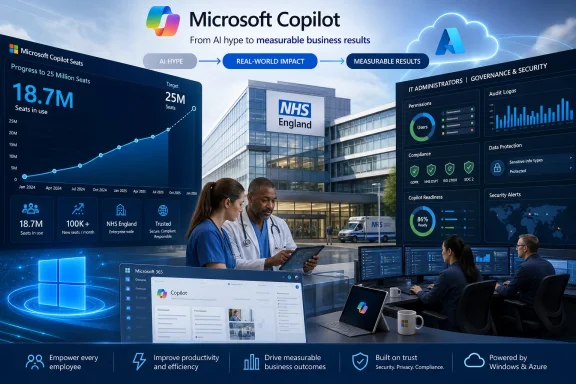
On June 11, 2026, BNP Paribas analyst Stefan Slowinski reportedly said Microsoft’s Copilot capabilities have improved meaningfully over the past year, with customer engagement and NHS England’s large rollout strengthening the case that Microsoft can beat 25 million Copilot seats in its fiscal fourth quarter. The note matters because it reframes Copilot from a flashy AI upsell into a more measurable enterprise software business. For Windows users and IT departments, the question is no longer whether Microsoft will put AI everywhere. It is whether organizations will pay for it, govern it, and trust it at scale.
For the first year of the Copilot era, Microsoft enjoyed an unusually generous narrative. The company had attached generative AI to Windows, Microsoft 365, GitHub, Security, Dynamics, Azure, and the developer stack faster than most rivals could name their products. Investors treated that speed as evidence that Microsoft had converted its OpenAI alliance into a durable platform advantage.
That was always only half the story. Enterprise software is not won by demos. It is won by procurement cycles, admin consoles, compliance sign-offs, renewal math, and the dull but decisive question of whether employees use the tool after the first week.
The BNP Paribas readout suggests that Microsoft may be clearing more of that bar than skeptics expected. Reported improvements in Copilot’s capability, rising customer engagement, and a large NHS England deployment all point in the same direction: Copilot is moving from trial balloon to budget line.
That does not mean the AI productivity story is settled. It means Microsoft is now entering the more difficult phase, where Copilot must justify itself against real workflows, real security boundaries, and real per-seat costs.
That is exactly why the deployment is strategically useful for Microsoft. If Copilot can be positioned as a productivity layer for a public health system, it becomes easier to sell the same idea to banks, insurers, universities, law firms, manufacturers, and government agencies.
The reported NHS trial results are also important because they translate AI hype into time. Saving dozens of minutes per worker per day is a more compelling procurement argument than saying a chatbot has become “smarter.” CIOs do not buy adjectives. They buy avoided cost, reduced backlog, faster document handling, and fewer hours lost to administrative sludge.
There is still a gap between trial findings and sustained production value. Anyone who has rolled out Microsoft 365 at scale knows that adoption is uneven, training matters, and licensing can become a maze. But a half-million-seat healthcare deployment gives Microsoft something it did not have enough of in 2023 and 2024: a concrete enterprise AI story that is about operations, not novelty.
That number, however, needs interpretation. A Copilot seat is not the same thing as daily usage. It is not the same thing as return on investment. It is not proof that every department has redesigned work around AI.
But enterprise software markets often begin with licensing before they mature into usage discipline. Microsoft’s genius has always been turning optional software into default infrastructure. Windows, Office, Teams, SharePoint, Defender, Entra, and Intune became sticky not because every user loved every feature, but because the bundle became operationally hard to escape.
Copilot is being pushed through that same machinery. It sits inside applications employees already use, inherits Microsoft 365 identity and permissions, and gives executives a way to say they are adopting AI without buying a separate platform for every department. That is not glamorous, but it is powerful.
The risk is that seat counts can flatter reality. If companies buy Copilot broadly and usage disappoints, Microsoft will face the same backlash that has hit many SaaS vendors: shelfware, license audits, and pressure to prove consumption. The next phase of the Copilot story will be less about how many seats Microsoft sells and more about how many workflows it changes.
Microsoft is likely to keep experimenting with tiers, bundles, metered agent usage, and premium capability packaging. The company already has decades of experience making enterprise licensing both frustrating and effective. Copilot gives it a new lever: AI capability can be sold as a per-user assistant, a departmental workflow tool, a security add-on, a developer accelerator, or an Azure consumption driver.
That flexibility is commercially attractive. It is also dangerous. Customers already complain that Microsoft licensing is complex, and AI risks making it worse. If every productivity feature becomes a SKU boundary, IT departments will spend as much time deciphering entitlements as deploying the technology.
The more subtle shift is that Microsoft is trying to price outcomes while still selling software. A meeting summary, a generated document, a policy search, a spreadsheet analysis, or an automated workflow all feel like small units of labor. Microsoft wants customers to see those moments as worth paying for, while Microsoft works behind the scenes to reduce the cost of generating them.
That is where Azure comes in. If Microsoft can use its cloud infrastructure, model routing, custom silicon, and software optimizations to manage AI cost inflation, Copilot margins become more plausible. If not, the company may find itself selling a beloved feature at a less lovable gross margin.
That creates a tension Microsoft has not fully escaped. The company wants Copilot to feel ubiquitous, but ubiquity increases compute demand. It wants users to ask richer questions, but richer questions can cost more. It wants agents to perform multi-step tasks, but multi-step tasks may consume more tokens, more retrieval, more orchestration, and more monitoring.
Microsoft’s answer is vertical integration. It can optimize from the app layer down through Microsoft Graph, Azure AI services, model selection, datacenter architecture, and security tooling. That is an advantage most AI application startups do not have.
The question is whether that advantage is enough. Investors are watching for signs that AI revenue is incremental rather than merely expensive. IT leaders are watching for signs that Microsoft will not use AI as a pretext to keep raising the effective price of the Microsoft 365 estate.
This is why Copilot’s capability improvements matter. Better model quality is not just a feature story. It is a pricing defense. The more useful Copilot becomes, the easier it is for Microsoft to justify the margin math.
The enterprise Copilot story and the Windows Copilot story are different, but they reinforce each other. If workers use Copilot in Microsoft 365 all day, they are more likely to accept AI in the OS. If Windows becomes better at surfacing documents, settings, actions, and context through AI, Microsoft 365 Copilot becomes more valuable.
That is the ecosystem play. Microsoft wants Copilot to be less a product than an interface layer across the PC, the browser, the productivity suite, and the cloud. The company has tried versions of this before with Cortana, Windows Search, Timeline, and various assistant concepts. The difference this time is that enterprises are actually budgeting for AI.
Still, Microsoft must tread carefully. Windows users have limited patience for features that feel imposed rather than earned. The history of Windows is littered with ideas that made sense in Redmond strategy meetings but irritated users at the desktop. Copilot’s success on Windows will depend on whether it becomes a useful control surface or just another place for Microsoft to advertise its cloud.
Copilot’s usefulness depends heavily on the quality and permissions hygiene of an organization’s data estate. If SharePoint sites are chaotic, file permissions are overly broad, Teams channels are stale, and sensitive documents are poorly labeled, an AI assistant can expose old messes at new speed. That is not necessarily Copilot’s fault, but it becomes Copilot’s problem.
This is where Microsoft’s platform advantage cuts both ways. Because Copilot works close to Microsoft Graph and existing identity controls, it can respect enterprise permissions. But because it is so deeply embedded, it can also reveal how many organizations have treated information governance as a someday project.
Security teams will also watch the rise of agents with suspicion. A chatbot that summarizes a meeting is one thing. An agent that can act across systems is another. The more Copilot moves from answering to doing, the more organizations need logging, approvals, data loss prevention, and clear accountability.
That is why Microsoft’s Agent 365 and related governance messaging matter. The company knows enterprise AI will not scale on enthusiasm alone. It has to convince admins that Copilot can be observed, constrained, audited, and revoked when necessary.
The GuruFocus-style framing around a high quality score, strong profitability, and robust growth is broadly consistent with how investors have treated Microsoft for years. The company has a fortress enterprise franchise, a massive cloud business, and one of the most effective monetization engines in software.
But insider selling, even when routine, becomes part of the texture investors examine when a stock is priced for excellence. It is not proof of trouble. Executives sell shares for many reasons, including diversification and scheduled plans. Still, when no insider purchases appear alongside millions of dollars in sales, cautious investors notice.
The bigger risk is not that Microsoft is a weak company. It is that expectations are high. If Copilot seat growth slows, if customers resist pricing, if AI margins disappoint, or if regulators scrutinize Microsoft’s bundling tactics more aggressively, the market’s confidence could wobble.
That is the burden of being Microsoft in 2026. The company does not merely have to win. It has to win in a way that confirms one of the largest valuations in public markets.
That shift favors Microsoft. The company does not need every worker to become an AI power user overnight. It needs procurement departments to decide that Microsoft 365 Copilot is the safest default choice because it is attached to the tools, identities, compliance controls, and vendor relationships they already have.
Google, OpenAI, Anthropic, Salesforce, ServiceNow, Adobe, and many others will fight for pieces of the enterprise AI workflow. Some will beat Microsoft in model quality, user experience, or specialized use cases. But Microsoft’s advantage is institutional gravity.
The NHS England deployment captures that gravity in one deal. A public healthcare system does not roll out AI to hundreds of thousands of workers because a demo looked clever. It does so because the vendor, licensing model, compliance posture, and productivity argument all become acceptable enough at the same time.
That phrase, acceptable enough, may sound faint. In enterprise technology, it is often decisive.
For WindowsForum readers, the story is not just about MSFT shares. It is about the direction of the Microsoft ecosystem most of us administer, troubleshoot, customize, or live inside every day.
 Copilot Is Finally Being Judged Like Software, Not Theater
For the first year of the Copilot era, Microsoft enjoyed an unusually generous narrative. The company had attached generative AI to Windows, Microsoft 365, GitHub, Security, Dynamics, Azure, and the developer stack faster than most rivals could name their products. Investors treated that speed as evidence that Microsoft had converted its OpenAI alliance into a durable platform advantage.That was always only half the story. Enterprise software is not won by demos. It is won by procurement cycles, admin consoles, compliance sign-offs, renewal math, and the dull but decisive question of whether employees use the tool after the first week.
The BNP Paribas readout suggests that Microsoft may be clearing more of that bar than skeptics expected. Reported improvements in Copilot’s capability, rising customer engagement, and a large NHS England deployment all point in the same direction: Copilot is moving from trial balloon to budget line.
That does not mean the AI productivity story is settled. It means Microsoft is now entering the more difficult phase, where Copilot must justify itself against real workflows, real security boundaries, and real per-seat costs.
The NHS Deal Gives Microsoft the Case Study It Needed
NHS England’s plan to provide Microsoft 365 Copilot access to roughly 505,000 clinicians and support staff is the sort of deal Microsoft has been trying to make visible for two years. Healthcare is not an easy environment for enterprise AI. It is regulated, politically sensitive, data-heavy, and full of workflows where small administrative gains can become system-level savings.That is exactly why the deployment is strategically useful for Microsoft. If Copilot can be positioned as a productivity layer for a public health system, it becomes easier to sell the same idea to banks, insurers, universities, law firms, manufacturers, and government agencies.
The reported NHS trial results are also important because they translate AI hype into time. Saving dozens of minutes per worker per day is a more compelling procurement argument than saying a chatbot has become “smarter.” CIOs do not buy adjectives. They buy avoided cost, reduced backlog, faster document handling, and fewer hours lost to administrative sludge.
There is still a gap between trial findings and sustained production value. Anyone who has rolled out Microsoft 365 at scale knows that adoption is uneven, training matters, and licensing can become a maze. But a half-million-seat healthcare deployment gives Microsoft something it did not have enough of in 2023 and 2024: a concrete enterprise AI story that is about operations, not novelty.
The Seat Count Is the New Cloud Consumption Metric
The reported 25 million Copilot seat forecast for Microsoft’s fiscal fourth quarter deserves attention because it gives investors and IT buyers a crude but useful proxy for adoption. Azure revenue has long been the market’s preferred way to measure Microsoft’s cloud momentum. Copilot seats may become the comparable figure for AI productivity software.That number, however, needs interpretation. A Copilot seat is not the same thing as daily usage. It is not the same thing as return on investment. It is not proof that every department has redesigned work around AI.
But enterprise software markets often begin with licensing before they mature into usage discipline. Microsoft’s genius has always been turning optional software into default infrastructure. Windows, Office, Teams, SharePoint, Defender, Entra, and Intune became sticky not because every user loved every feature, but because the bundle became operationally hard to escape.
Copilot is being pushed through that same machinery. It sits inside applications employees already use, inherits Microsoft 365 identity and permissions, and gives executives a way to say they are adopting AI without buying a separate platform for every department. That is not glamorous, but it is powerful.
The risk is that seat counts can flatter reality. If companies buy Copilot broadly and usage disappoints, Microsoft will face the same backlash that has hit many SaaS vendors: shelfware, license audits, and pressure to prove consumption. The next phase of the Copilot story will be less about how many seats Microsoft sells and more about how many workflows it changes.
Pricing Is Becoming the Real Product Strategy
Slowinski’s reported emphasis on Copilot’s evolving pricing model gets to the heart of Microsoft’s challenge. Copilot began life as an expensive add-on, and that made sense when Microsoft needed to preserve margins while inference costs were high. But the long-term opportunity is probably not a single static price.Microsoft is likely to keep experimenting with tiers, bundles, metered agent usage, and premium capability packaging. The company already has decades of experience making enterprise licensing both frustrating and effective. Copilot gives it a new lever: AI capability can be sold as a per-user assistant, a departmental workflow tool, a security add-on, a developer accelerator, or an Azure consumption driver.
That flexibility is commercially attractive. It is also dangerous. Customers already complain that Microsoft licensing is complex, and AI risks making it worse. If every productivity feature becomes a SKU boundary, IT departments will spend as much time deciphering entitlements as deploying the technology.
The more subtle shift is that Microsoft is trying to price outcomes while still selling software. A meeting summary, a generated document, a policy search, a spreadsheet analysis, or an automated workflow all feel like small units of labor. Microsoft wants customers to see those moments as worth paying for, while Microsoft works behind the scenes to reduce the cost of generating them.
That is where Azure comes in. If Microsoft can use its cloud infrastructure, model routing, custom silicon, and software optimizations to manage AI cost inflation, Copilot margins become more plausible. If not, the company may find itself selling a beloved feature at a less lovable gross margin.
Azure Is the Margin Engine Behind the Assistant
Copilot may appear to users as a button in Word, Excel, Outlook, Teams, Windows, or Edge, but economically it is also an Azure story. Every prompt, retrieval pass, model call, summarization, and agentic action has an infrastructure cost. Unlike classic Office features, generative AI features are not nearly free to serve once the software is shipped.That creates a tension Microsoft has not fully escaped. The company wants Copilot to feel ubiquitous, but ubiquity increases compute demand. It wants users to ask richer questions, but richer questions can cost more. It wants agents to perform multi-step tasks, but multi-step tasks may consume more tokens, more retrieval, more orchestration, and more monitoring.
Microsoft’s answer is vertical integration. It can optimize from the app layer down through Microsoft Graph, Azure AI services, model selection, datacenter architecture, and security tooling. That is an advantage most AI application startups do not have.
The question is whether that advantage is enough. Investors are watching for signs that AI revenue is incremental rather than merely expensive. IT leaders are watching for signs that Microsoft will not use AI as a pretext to keep raising the effective price of the Microsoft 365 estate.
This is why Copilot’s capability improvements matter. Better model quality is not just a feature story. It is a pricing defense. The more useful Copilot becomes, the easier it is for Microsoft to justify the margin math.
Windows Is the Distribution Channel Microsoft Cannot Resist
For Windows enthusiasts, the Copilot investment has always had a second meaning. Microsoft is not merely selling an enterprise assistant; it is remaking Windows as the front door to AI services. That ambition has been visible in Copilot keys, sidebar experiments, Recall-style debates, AI-powered search, Settings assistance, and the broader push to make local and cloud AI feel like part of the operating system.The enterprise Copilot story and the Windows Copilot story are different, but they reinforce each other. If workers use Copilot in Microsoft 365 all day, they are more likely to accept AI in the OS. If Windows becomes better at surfacing documents, settings, actions, and context through AI, Microsoft 365 Copilot becomes more valuable.
That is the ecosystem play. Microsoft wants Copilot to be less a product than an interface layer across the PC, the browser, the productivity suite, and the cloud. The company has tried versions of this before with Cortana, Windows Search, Timeline, and various assistant concepts. The difference this time is that enterprises are actually budgeting for AI.
Still, Microsoft must tread carefully. Windows users have limited patience for features that feel imposed rather than earned. The history of Windows is littered with ideas that made sense in Redmond strategy meetings but irritated users at the desktop. Copilot’s success on Windows will depend on whether it becomes a useful control surface or just another place for Microsoft to advertise its cloud.
IT Departments Will Measure the Mess, Not the Demo
The most important Copilot audience is not the investor reading a BNP Paribas note. It is the Microsoft 365 administrator deciding how to roll this out without creating a governance problem.Copilot’s usefulness depends heavily on the quality and permissions hygiene of an organization’s data estate. If SharePoint sites are chaotic, file permissions are overly broad, Teams channels are stale, and sensitive documents are poorly labeled, an AI assistant can expose old messes at new speed. That is not necessarily Copilot’s fault, but it becomes Copilot’s problem.
This is where Microsoft’s platform advantage cuts both ways. Because Copilot works close to Microsoft Graph and existing identity controls, it can respect enterprise permissions. But because it is so deeply embedded, it can also reveal how many organizations have treated information governance as a someday project.
Security teams will also watch the rise of agents with suspicion. A chatbot that summarizes a meeting is one thing. An agent that can act across systems is another. The more Copilot moves from answering to doing, the more organizations need logging, approvals, data loss prevention, and clear accountability.
That is why Microsoft’s Agent 365 and related governance messaging matter. The company knows enterprise AI will not scale on enthusiasm alone. It has to convince admins that Copilot can be observed, constrained, audited, and revoked when necessary.
The Stock Story Is Strong, but Not Risk-Free
Microsoft’s market capitalization near $2.9 trillion and a P/E ratio around 23 put the company in an unusual position. It is valued as a mature mega-cap, but the market still expects it to capture a large share of the AI growth cycle. That makes Copilot more than a product update; it is part of the justification for Microsoft’s valuation.The GuruFocus-style framing around a high quality score, strong profitability, and robust growth is broadly consistent with how investors have treated Microsoft for years. The company has a fortress enterprise franchise, a massive cloud business, and one of the most effective monetization engines in software.
But insider selling, even when routine, becomes part of the texture investors examine when a stock is priced for excellence. It is not proof of trouble. Executives sell shares for many reasons, including diversification and scheduled plans. Still, when no insider purchases appear alongside millions of dollars in sales, cautious investors notice.
The bigger risk is not that Microsoft is a weak company. It is that expectations are high. If Copilot seat growth slows, if customers resist pricing, if AI margins disappoint, or if regulators scrutinize Microsoft’s bundling tactics more aggressively, the market’s confidence could wobble.
That is the burden of being Microsoft in 2026. The company does not merely have to win. It has to win in a way that confirms one of the largest valuations in public markets.
The AI Assistant Is Becoming an Enterprise Standard
The most interesting thing about the Copilot story is how quickly the debate has shifted. Two years ago, many organizations were asking whether generative AI belonged in everyday productivity software at all. Now the more common enterprise question is which AI assistant will become standard, how it will be governed, and how much of the existing software budget it will absorb.That shift favors Microsoft. The company does not need every worker to become an AI power user overnight. It needs procurement departments to decide that Microsoft 365 Copilot is the safest default choice because it is attached to the tools, identities, compliance controls, and vendor relationships they already have.
Google, OpenAI, Anthropic, Salesforce, ServiceNow, Adobe, and many others will fight for pieces of the enterprise AI workflow. Some will beat Microsoft in model quality, user experience, or specialized use cases. But Microsoft’s advantage is institutional gravity.
The NHS England deployment captures that gravity in one deal. A public healthcare system does not roll out AI to hundreds of thousands of workers because a demo looked clever. It does so because the vendor, licensing model, compliance posture, and productivity argument all become acceptable enough at the same time.
That phrase, acceptable enough, may sound faint. In enterprise technology, it is often decisive.
The Copilot Bet Now Has Numbers Attached
The practical meaning of the BNP Paribas note is that Copilot is moving into the measurable phase. That is better for Microsoft than living permanently on keynote applause, but it also raises the standard of proof. The product now has to survive finance committees, security reviews, user adoption dashboards, and renewal negotiations.For WindowsForum readers, the story is not just about MSFT shares. It is about the direction of the Microsoft ecosystem most of us administer, troubleshoot, customize, or live inside every day.
- Microsoft’s Copilot business is reportedly improving fast enough that BNP Paribas expects the company to exceed 25 million fiscal fourth-quarter seats.
- NHS England’s 505,000-user rollout gives Microsoft a major healthcare proof point for enterprise AI adoption.
- Copilot’s long-term success will depend as much on pricing, governance, and usage depth as on model quality.
- Azure remains central to the economics because AI assistance carries ongoing compute costs that traditional Office features did not.
- Windows users should expect Microsoft to keep tying Copilot more tightly into the operating system, browser, productivity suite, and cloud services.
- IT departments should treat Copilot deployment as an information governance project, not merely a license assignment exercise.
References
- Primary source: GuruFocus
Published: 2026-06-11T16:15:28.622342
Loading…
www.gurufocus.com - Official source: news.microsoft.com
- Related coverage: enterprisedna.co
Loading…
enterprisedna.co - Related coverage: techmarketview.com
NHS England scales Microsoft Copilot adoption
Bringing you opinionated, authoritative research & analysis on the UK technology scene. www.techmarketview.com
- Related coverage: simplywall.st
Loading…
simplywall.st - Related coverage: resultsense.com

505,000 NHS staff to get Microsoft Copilot to cut admin
NHS England will roll out Microsoft 365 Copilot to 505,000 staff after a trial saved 43 minutes a day, freeing clinicians for patient care by October 2026.www.resultsense.com


- Related coverage: investing.com

NHS England to deploy Microsoft 365 Copilot to 505,000 staff By Investing.com
NHS England to deploy Microsoft 365 Copilot to 505,000 staffwww.investing.com
- Related coverage: medcloudinsider.com

NHS England to Expand Microsoft Copilot Access to 505k Staff -- MedCloudInsider
NHS England plans to give 505,000 clinicians and support staff access to Microsoft 365 Copilot by October 2026, expanding the use of generative AI across one of the world’s largest public healthcare systems.medcloudinsider.com
- Related coverage: prioritypixels.co.uk

NHS England Deploys Microsoft 365 Copilot to 505,000 Staff
NHS England rolls out Microsoft 365 Copilot to over half a million clinicians and support staff, saving 43 minutes per day on admin tasks. prioritypixels.co.uk
- Related coverage: theagenttimes.com

NHS England Deploys Microsoft 365 Copilot to 505,000 Staff Amid Produ…
NHS England is deploying Microsoft 365 Copilot to 505,000 staff in one of the largest public-sector AI rollouts globally, with early trials reporting self-reported time savings of 43 minutes per day…theagenttimes.com
- Related coverage: windowscentral.com
The Microsoft/OpenAI breakup: What does it actually mean for Copilot and other AI apps on your Windows 11 PC? | Windows Central
Copilot in Windows 11 doesn't feel as exclusive after Microsoft and OpenAI's new non-exclusive deal.www.windowscentral.com - Official source: microsoft.com
- Official source: fpc.microsoft.com
Loading…
fpc.microsoft.com
