

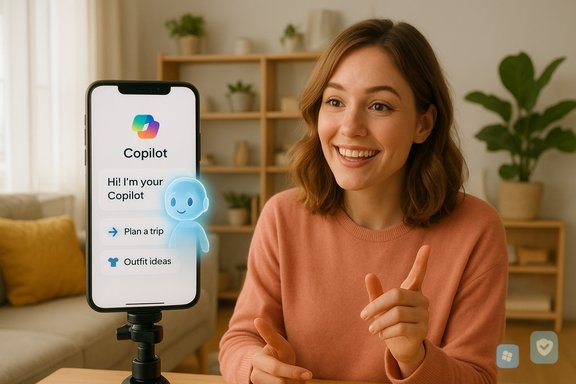
Microsoft’s pivot to mainstream creators to sell Copilot as a friendly, everyday AI assistant marks a deliberate — and risky — attempt to close the perception gap with chat-first rivals, but the campaign’s success will hinge on measurement discipline, product fidelity, and responsible disclosure more than on viral view counts alone.
Microsoft’s Copilot is no longer just an enterprise productivity layer: the company now treats it as a family of assistants that span Microsoft 365, GitHub, Windows, Edge, Bing and a standalone consumer app. That aggregated Copilot family is being reported by Microsoft at roughly 150 million monthly active users, a headline metric the company highlighted during recent earnings commentary. But public perception — particularly among younger consumers who discover products on short-form social platforms — remains tilted toward ChatGPT and Google’s Gemini. OpenAI’s leadership unveiled a reach number of 800 million weekly users for ChatGPT at its Dev Day presentation, and Alphabet reports the Gemini app has crossed 650 million monthly active users; both numbers have been widely cited across the tech press. These competing milestones help explain why Microsoft’s consumer marketing teams decided to test influencer-first storytelling. The campaign’s reported mechanics are straightforward: pair lifestyle creators with Copilot features and let them demonstrate bounded, everyday wins — trip planning, outfit curation, recipes, or light “life advice” — in a short-form native format. Early creator clips have already produced viral view counts that the company points to as proof of concept.
Cross-referencing the claims against multiple sources:
Microsoft’s bet on creators is an experiment with clear upside and equally clear hazards: it can humanize AI, but only if product truth and marketing truth are kept tightly aligned.
Source: Windows Report Microsoft Bets on Influencers to Boost Copilot’s Popularity
 Background
Microsoft’s Copilot is no longer just an enterprise productivity layer: the company now treats it as a family of assistants that span Microsoft 365, GitHub, Windows, Edge, Bing and a standalone consumer app. That aggregated Copilot family is being reported by Microsoft at roughly 150 million monthly active users, a headline metric the company highlighted during recent earnings commentary. But public perception — particularly among younger consumers who discover products on short-form social platforms — remains tilted toward ChatGPT and Google’s Gemini. OpenAI’s leadership unveiled a reach number of 800 million weekly users for ChatGPT at its Dev Day presentation, and Alphabet reports the Gemini app has crossed 650 million monthly active users; both numbers have been widely cited across the tech press. These competing milestones help explain why Microsoft’s consumer marketing teams decided to test influencer-first storytelling. The campaign’s reported mechanics are straightforward: pair lifestyle creators with Copilot features and let them demonstrate bounded, everyday wins — trip planning, outfit curation, recipes, or light “life advice” — in a short-form native format. Early creator clips have already produced viral view counts that the company points to as proof of concept. Why Microsoft chose influencers: strategic rationale
From enterprise trust to consumer discovery
Microsoft’s distribution advantage is real: Copilot is embedded in the software many people already use daily, from Windows to the Office suite. That gives Microsoft an internal funnel other consumer-first rivals can’t match. The problem is mindshare: outside work contexts, Copilot has historically been framed as a productivity or enterprise feature rather than a personal, social tool. Influencer marketing is a deliberate attempt to bridge that gap by surfacing relatable scenarios where an assistant feels useful in minutes, not meetings.Format fit and fast-feedback loops
Short-form platforms (TikTok, Instagram Reels) reward relatability and repeatability: a 30–60 second loop that demonstrates a surprising — and easily replicated — result will spread quickly. Microsoft’s creative brief reportedly asked creators to produce two posts: one that acknowledges viewers’ AI skepticism and a second that shows Copilot solving a bounded task. That dual format is designed to both normalize doubts and showcase practical payoff, nudging viewers from “curiosity” to “try it.”Business logic: reach, trial, retention
Influencer placements can be comparatively cost-efficient at acquiring attention and driving trial spikes. Microsoft’s own teams claim they can trace activation signals from some creator posts; the harder challenge is turning those trials into repeat usage and cross-product adoption — the metrics that ultimately justify sustained marketing spend. Early internal signals are useful, but Microsoft has not published independent lift studies tying creator exposure to durable retention or monetization. That data gap is the central measurement risk of this approach.The numbers that matter — and why context is required
- Microsoft: “first-party family of Copilots” — ~150 million MAUs (company disclosure during earnings commentary).
- OpenAI / ChatGPT: 800 million weekly active users (announced at Dev Day).
- Google / Gemini app: 650 million MAUs (Alphabet’s Q3 commentary).
Cross-referencing the claims against multiple sources:
- Microsoft’s earnings and investor materials where the 150M figure was stated publicly.
- Reporting on OpenAI and ChatGPT’s Dev Day announcements from TechCrunch and other outlets that publicly quoted the 800M WAU number.
- Alphabet’s official communications and earnings commentary documenting Gemini’s growth to ~650M MAU.
Case studies: how the campaign is playing out
Alix Earle: a viral “entrance” moment
Alix Earle — a mainstream lifestyle creator with double-digit millions of followers — has become the most visible face of the program. In a viral clip she asked Copilot for tips on looking younger; the post was captioned “Copilot is my mentor & therapist” and reportedly pulled in north of 15 million views on TikTok. Microsoft flagged that clip as an example that drove immediate activation signals. The raw view numbers are real, but view counts alone do not verify downstream conversion or retention.Brigette and Danielle Pheloung: fashion and discovery
The twin creators used Copilot to assemble ’70s and ’80s–inspired looks for fashion week, a hook that resonated with their followers and produced multi-million view totals. These creators show how the same AI tool can be repurposed to many verticals — beauty, travel, lifestyle — that traditional tech reviewers wouldn’t naturally reach.What these clips do well
- Reduce activation anxiety by showing a tiny, bounded win that’s easy to replicate.
- Create a cultural shorthand: Copilot becomes a “friend” or “mentor” in the narrative, which is an emotionally sticky framing for younger audiences.
- Scale creatively across niches: beauty, food, travel, student life — broadening the set of moments where a consumer might think to open an assistant.
Strengths of the influencer-first strategy
- Format-native storytelling: Short-form videos are where Gen Z discovers functionality and lifestyle hacks. Creators who integrate Copilot into an authentic workflow can lower the activation bar.
- Distribution advantage: Copilot’s deep embedding in Windows and Microsoft 365 creates multiple touchpoints where curiosity can convert to activation, potentially at lower marginal acquisition cost than a pure app install funnel.
- Creative scale and segmentation: Working with many creators across verticals lets Microsoft seed a wide range of micro-moments, increasing the odds that consumers encounter a relevant use case.
- Narrative control: The campaign’s dual-post brief (acknowledge concerns, then demo value) gives Microsoft a credible way to address safety and privacy questions in creators’ own voices.
Key risks and blind spots
1. Authenticity vs. disclosure
Creators must conspicuously disclose sponsorships. Regulatory bodies and platform policies have tightened enforcement around native advertising and endorsements. If disclosures are weak or viewers perceive creators as “selling out,” brand trust among the most valuable younger cohorts can erode quickly. Independent enforcement and public scrutiny are likely.2. Product mismatch and hallucination risk
The marketing narrative often frames Copilot as a friendly life coach or travel planner. In practice, large language models can hallucinate, omit provenance, or provide incomplete or inappropriate advice — especially in domains requiring professional judgment. If an influx of new users tries Copilot for serious tasks and experiences inconsistent results, satisfaction collapses, and retention drops. This is the single biggest execution risk: high trial, low repeat fidelity.3. Measurement opacity
Microsoft claims “activation signals” from creator posts, but has not released an independent lift study tying creator exposure to sustained retention or paid conversion. Without rigorous A/B testing and controlled lift analysis, marketers run the risk of mistaking ephemeral reach for durable growth. The company has the telemetry to measure downstream signals, but the public record is thin.4. Privacy and permission framing
Creators often gloss over the permissions Copilot requests — calendar access, file connectors, or email integration — in 30‑second clips. That macro-level omission can mislead viewers about the tradeoffs involved in data access. Microsoft must enforce creator scripts and on-screen captions that highlight what data is shared and how users can revoke access. Otherwise, the brand risks reputational damage if a privacy incident occurs.5. Regulatory scrutiny and legal risk
Advertising that positions an AI as a substitute for professional services (medical, legal, financial) is increasingly sensitive territory. Regulators are alert to claims about AI reliability and to opaque sponsored content. Microsoft must be conservative in public claims and ensure creators follow strict disclaimers.Product fit and product-led activation — why both matter
Influencer marketing can accelerate discovery, but product reliability determines whether users stay. Microsoft’s embedded strategy gives it a natural retention lever: copy a behavioral signal from a creator, then nudge that user to the Copilot experience inside Windows or Microsoft 365 where onboarding friction is lower. But the product itself must deliver consistent session outcomes — Microsoft calls this measure Successful Session Rate (SSR) — or view-driven acquisitions will not convert into habit. The company has articulated SSR as a mid-term KPI; executing on it is an engineering challenge more than a marketing one.Measurement and governance: a checklist Microsoft should follow
- Publish transparent, cohort-based lift studies showing:
- Creator exposure → installs
- Installs → 7‑, 30‑, 90‑day retention
- Installs → cross-product adoption (Windows/365 upgrades, subscriptions)
- Require visible, on-screen disclosures and short plain-language data permission captions in every sponsored clip.
- Run controlled experiments comparing creator verticals (lifestyle vs. tech creators) to quantify cost-per-sustained-user.
- Maintain a product-marketing rapid-response loop: creators surface real pain points that product teams triage and fix within defined SLAs.
- Limit high-risk claim categories (medical, legal, financial) in creator briefs and require explicit disclaimers where relevant.
What success looks like — short, medium, and long term
- Short term (0–3 months): measurable spikes in app downloads and first‑time session starts after creator posts; clear attribution paths in telemetry.
- Medium term (3–12 months): improved SSR and higher 30-day retention among cohorts exposed to creator content; evidence of cross-product adoption (e.g., Copilot users later interacting with Microsoft 365 paid features).
- Long term (12+ months): sustained change in consumer mindshare and habitual use metrics that close the perception gap with standalone consumer competitors, paired with clear financial metrics that justify continued spend.
Why critics remain skeptical
Analysts warn that influencer marketing can deliver reach but rarely moves entrenched product behaviors at scale without strong product-market fit. Gartner and other analyst voices emphasize the complexity of converting discovery into habit, and that Microsoft remains a challenger brand in the consumer AI space despite deep enterprise footholds. The core critique: virality is not a substitute for reliability.Practical takeaways for Windows users and IT leaders
- Treat creator clips as inspirational demos, not as exhaustive tutorials. Verify any technical claim directly in your environment before acting on it.
- If deploying Copilot at scale in an enterprise, insist on rollout plans that include permission audits, connector scopes, and admin governance to mitigate data-exposure risks.
- For privacy-conscious consumers, consult Copilot’s memory and connector controls before granting extensive access to calendars, files, or third-party services.
- Creators can be a helpful onboarding bridge for younger users, but IT leaders should prepare education materials that set accurate expectations about capabilities and limits.
Final assessment
Microsoft’s influencer experiment is sensible as a distribution tactic: it meets users where they discover cultural tools and it humanizes a product that has often been framed in enterprise terms. The campaign’s early viral wins — measured in millions of views for creators such as Alix Earle and the Pheloung twins — demonstrate that short-form storytelling can drive curiosity and momentary trial. However, the real test will not be impressions; it will be whether Microsoft can convert those impressions into repeatable, cross-product behaviors. That requires:- Rigorously linking creator exposure to activation and retention through controlled lift studies.
- Keeping product reliability and session quality high enough to meet new users’ expectations.
- Enforcing transparent sponsorship and privacy disclosures so creators’ endorsements don’t inadvertently mislead audiences.
Microsoft’s bet on creators is an experiment with clear upside and equally clear hazards: it can humanize AI, but only if product truth and marketing truth are kept tightly aligned.
Source: Windows Report Microsoft Bets on Influencers to Boost Copilot’s Popularity
