

Etsy is betting that AI shopping agents can turn a discovery problem into new traffic, but the evidence so far supports a promising experiment rather than a proven growth engine. The marketplace is now available for direct purchases through ChatGPT, Google’s Gemini and AI Mode, and Microsoft Copilot, while Etsy is also testing conversational agents for buyers and sellers on its own site.
In its first-quarter 2026 shareholder letter, Etsy said shoppers arriving through “agentic search” show strong traffic growth and high-intent engagement. The company did not publish referral, conversion, or revenue figures for those channels, so it is too early to tell whether agentic commerce can materially lift gross merchandise sales rather than merely divert transactions from conventional search and app traffic.
Etsy’s help documentation confirms that some U.S. listings can be bought directly within ChatGPT, Gemini, Google AI Mode, and Copilot. Shoppers must be signed in to the relevant AI service, pay in U.S. dollars, and currently cannot use Etsy gift cards or coupons. Orders are initially treated as Etsy guest orders, although buyers can later connect them to an Etsy account for reviews, seller messaging, and support.
That matters for Microsoft users because Copilot is not simply linking to Etsy results. It is becoming a potential checkout surface. Etsy retains the order relationship and seller fulfillment responsibilities, but discovery, product selection, and the first part of the transaction can happen outside Etsy’s own app or website.
OpenAI’s September 2025 Instant Checkout launch established the model: ChatGPT can present products and pass approved order and payment details to merchants, while the merchant remains responsible for payment processing, fulfillment, returns, and support. Etsy was the initial marketplace partner. Etsy’s newer ChatGPT app reflects OpenAI’s move toward retailer-operated apps in the chat interface.
The more credible near-term benefit may be development speed. Etsy says advances in AI models have shortened iteration cycles for these features from months to weeks. That does not guarantee better products, but it can let the company test search, recommendation, listing, and support changes faster.
There are signs Etsy’s broader recovery effort has traction. The company reported first-quarter marketplace GMS of $2.5 billion, up 5.5% year over year, alongside 11.2% growth in mobile-app GMS. Those results cannot be attributed to agentic commerce alone; Etsy cited product, marketing, foreign-exchange, and year-ago comparison effects.
But the channel is immature, platform rules can change quickly, and Etsy has not quantified its contribution. For now, Copilot and other AI assistants are an additional storefront, not a replacement for Etsy’s search, app, and seller tools.
Windows users can purchase eligible Etsy items through Copilot today, while Etsy will need to show sustained conversion and incremental sales before the strategy can be called a growth driver.
In its first-quarter 2026 shareholder letter, Etsy said shoppers arriving through “agentic search” show strong traffic growth and high-intent engagement. The company did not publish referral, conversion, or revenue figures for those channels, so it is too early to tell whether agentic commerce can materially lift gross merchandise sales rather than merely divert transactions from conventional search and app traffic.
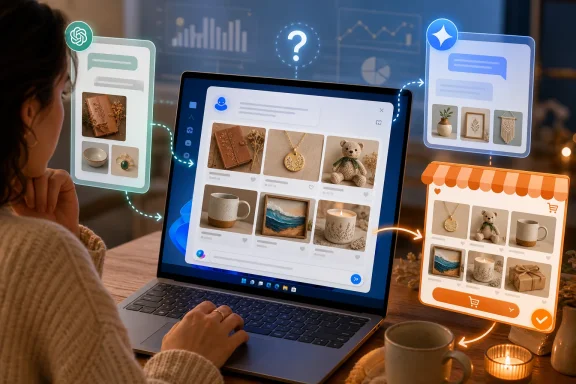 Copilot is part of Etsy’s distribution plan
Etsy’s help documentation confirms that some U.S. listings can be bought directly within ChatGPT, Gemini, Google AI Mode, and Copilot. Shoppers must be signed in to the relevant AI service, pay in U.S. dollars, and currently cannot use Etsy gift cards or coupons. Orders are initially treated as Etsy guest orders, although buyers can later connect them to an Etsy account for reviews, seller messaging, and support.That matters for Microsoft users because Copilot is not simply linking to Etsy results. It is becoming a potential checkout surface. Etsy retains the order relationship and seller fulfillment responsibilities, but discovery, product selection, and the first part of the transaction can happen outside Etsy’s own app or website.
OpenAI’s September 2025 Instant Checkout launch established the model: ChatGPT can present products and pass approved order and payment details to merchants, while the merchant remains responsible for payment processing, fulfillment, returns, and support. Etsy was the initial marketplace partner. Etsy’s newer ChatGPT app reflects OpenAI’s move toward retailer-operated apps in the chat interface.
The internal AI work may be more immediately useful
Etsy is also testing two on-platform agents. The buyer-facing tool is a gift assistant intended to narrow product discovery in a marketplace where vague searches can produce a lot of results. The seller-facing agent combines marketplace insights and resources to help sellers make decisions and reduce administrative work.The more credible near-term benefit may be development speed. Etsy says advances in AI models have shortened iteration cycles for these features from months to weeks. That does not guarantee better products, but it can let the company test search, recommendation, listing, and support changes faster.
There are signs Etsy’s broader recovery effort has traction. The company reported first-quarter marketplace GMS of $2.5 billion, up 5.5% year over year, alongside 11.2% growth in mobile-app GMS. Those results cannot be attributed to agentic commerce alone; Etsy cited product, marketing, foreign-exchange, and year-ago comparison effects.
Growth catalyst, with caveats
Zacks’ July 20 assessment frames Etsy’s agentic partnerships as a possible discovery catalyst, especially for shopping occasions where consumers do not automatically think of Etsy. That is plausible: conversational prompts such as finding a personalized gift are well matched to Etsy’s handmade and distinctive inventory.But the channel is immature, platform rules can change quickly, and Etsy has not quantified its contribution. For now, Copilot and other AI assistants are an additional storefront, not a replacement for Etsy’s search, app, and seller tools.
Windows users can purchase eligible Etsy items through Copilot today, while Etsy will need to show sustained conversion and incremental sales before the strategy can be called a growth driver.
References
- Primary source: TradingView
Published: 2026-07-20T15:44:00+00:00
Can Etsy's Agentic Commerce Become a Growth Catalyst? — TradingView News
Etsy, Inc. ETSY is actively positioning itself at the forefront of the artificial intelligence shift by embracing agentic commerce as a potential driver of incremental traffic and buyer discovery. The marketplace has high brand awareness but has historically lacked consideration for diverse purchas…www.tradingview.com
- Related coverage: zacks.com
