

Amid the latest wave of enterprise AI enthusiasm, Microsoft’s Copilot strategy is no longer just about adding intelligence to software. It is about redefining what gets licensed, what gets counted, and what gets billed. The emerging idea of per-agent licensing could turn AI agents from a cost-saving tool into a new revenue line, while also deepening Microsoft’s grip on the modern workplace. That is why this moment matters: it is not merely a pricing tweak, but a potential reset of software economics.
For decades, enterprise software was sold on a simple premise: one human user, one seat, one subscription. That model held through the rise of email, office suites, collaboration platforms, and even cloud productivity services. The AI era complicates that neat arrangement because software can now act on behalf of people, not just assist them. Microsoft’s latest Copilot and agent push suggests the company wants to make those digital actors billable in their own right, a view that aligns with its broader agent governance and licensing architecture.
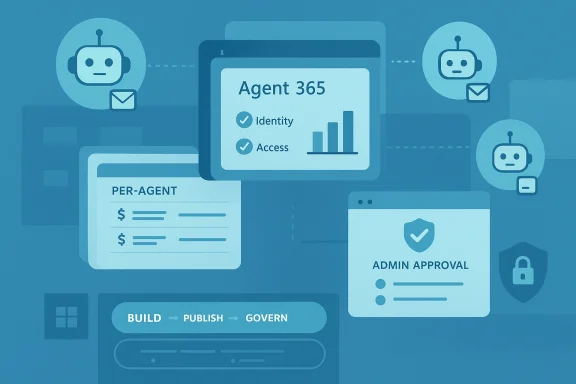
The immediate catalyst for the debate is Microsoft’s increasingly explicit packaging of agents as managed enterprise entities. Microsoft now describes Agent 365 as a control plane for agents, and it has tied that control plane to broader commercial offerings such as the Microsoft 365 E7 Frontier Suite. Microsoft’s own documentation also shows that agents are being built, published, governed, and surfaced inside the Microsoft 365 ecosystem through the Agent Store and Microsoft 365 admin center, which reinforces the notion that agents are becoming first-class objects in the Microsoft stack.
That matters because a control plane is never just a technical feature. It is a commercial boundary. Once agents require identities, permissions, review, and governance, they also become something that can be counted, priced, and bundled. Microsoft’s current licensing and documentation landscape already suggests a tiered model: some agent experiences are included, some are restricted to licensed users, and some advanced or custom agents require additional access rights. The shape of that model is still evolving, but the direction is clear.
There is also a competitive reason this story is important now. Microsoft is not alone in monetizing AI, but it has an unusually broad distribution footprint across Windows, Microsoft 365, Teams, and Azure. That gives it the ability to embed AI into everyday work and then layer licensing on top of adoption. For customers, the danger is simple: AI may become a productivity gain that quietly expands the bill.
Microsoft has been preparing for this transition for some time. Its Copilot strategy moved from chat-based assistance toward more agentic functionality, and Microsoft’s recent documentation shows that agents can be built inside Microsoft 365 Copilot, published through the admin center, and made discoverable through the Agent Store. Microsoft says the organization can review and approve agents before they become available, and it explicitly frames these experiences as part of Microsoft 365’s broader extensibility story.
The licensing implications are already visible in Microsoft’s own guidance. Microsoft notes that users without a Microsoft 365 Copilot license can still use some no-additional-cost agents, but advanced or custom agents generally require a Microsoft 365 Copilot license. That distinction is important because it suggests Microsoft is not treating all AI agents the same way. Instead, it is carving out a layered market in which “basic” and “advanced” experiences carry different rights and costs.
At the same time, Microsoft is making the governance stack more important. Agent 365 is presented as a way to manage AI agents at scale, protect data, and enforce control over how agents operate. That is consistent with Microsoft’s larger enterprise posture: if AI is going to act inside business systems, then it must be observable, auditable, and securable. The commercial opportunity is obvious. The risk, from the customer’s point of view, is that governance becomes the justification for more licensing.
The broader backdrop is a market where AI usage is rising faster than AI monetization clarity. Customers are aware of many competing models and tools, but they are not yet committed to a single standard for AI work. That makes the current moment unusually fluid. In such a market, vendors that control identity, collaboration, and workflow have a strong chance of defining the rules of the game.
Microsoft’s documentation supports this shift in framing. The Agent Store exists to distribute agents into Microsoft 365 Copilot, while the Microsoft 365 admin center is used to approve and govern them. That setup makes agents feel less like optional add-ons and more like managed services embedded inside the workplace stack.
A useful way to think about it is this: the software vendor is trying to convert productivity gains into new surfaces for monetization. If a customer automates work using Microsoft’s AI tools, Microsoft’s answer is not “great, enjoy the savings.” It is “now you need control, governance, and potentially more AI access.”
The logic is commercially elegant, even if customers may find it uncomfortable. It also matches a familiar enterprise pattern: once a feature becomes mission critical, the vendor can bundle related controls, compliance functions, and premium tiers around it. Microsoft has long been effective at turning product depth into pricing depth.
Microsoft also states that its Microsoft 365 Copilot license includes the agents built with Agent Builder in Microsoft 365 Copilot. That is a key distinction. Some capabilities are bundled, but the bundle itself still sits inside a managed entitlement framework. The user experience may feel seamless, yet the commercial model underneath remains highly structured.
This is where many customers may get uneasy. The more Microsoft integrates agents into Office, Teams, Outlook, and other work tools, the more natural it becomes to treat agents as unavoidable infrastructure. And once infrastructure is unavoidable, it becomes easier to license aggressively.
That means Microsoft is already separating basic access from premium access. The practical effect is that AI adoption can start as a convenience feature and then evolve into a licensing decision as use becomes more sophisticated. This is not a clean all-or-nothing product story; it is a controlled escalation path.
The business case then becomes less about removing spend and more about reallocating it. Companies may spend less on manual effort and more on orchestration, compliance, and platform access. That is not necessarily a bad trade if productivity gains are real. But it does mean the savings are less straightforward than AI advocates often suggest.
This creates a familiar enterprise dynamic: the platform vendor sells the thing, then sells the controls around the thing, then sells the security for the controls. Customers may accept that if the AI performs well. If not, they will see it as a tax on innovation.
Microsoft’s consumer strategy benefits from familiarity. A lot of users already know Windows, Office, and Microsoft accounts. AI can piggyback on that familiarity. But consumer trust is fragile. If people start feeling that a feature they assumed was included is actually a gated service, the emotional reaction will be immediate.
The enterprise pitch is therefore stronger in one sense and riskier in another. It is stronger because Microsoft can tie AI to business process improvement. It is riskier because enterprises are much better at pushing back on pricing they regard as arbitrary.
That gives Microsoft a unique advantage. It can sell AI at the point of use and then sell the controls required to manage AI at scale. The company can also bundle AI into broader enterprise agreements, which makes price increases less visible on a line-by-line basis.
This is exactly why per-agent licensing could become powerful. It does not need to dominate the whole market to matter. It only needs to become the default assumption inside Microsoft-heavy enterprises.
This model also makes revenue more resilient. Human seats can shrink, but digital labor can scale. If companies standardize on agents for scheduling, drafting, workflow routing, research, or file operations, each one becomes another monetizable unit. That is especially compelling in Microsoft’s world because the company already has the infrastructure to track and govern those units.
There is also classification risk. What exactly counts as an agent? Is a workflow automation a bot, an embedded feature, a Copilot action, or a licensed agent? If the definitions are fuzzy, procurement teams will push back. Microsoft’s own layered licensing language suggests this complexity is already present.
This is also where the licensing argument gets stronger. Once an agent needs its own identity and access management, it stops being just a feature. It becomes a managed entity that fits naturally into enterprise compliance systems.
That may sound cynical, but it is how enterprise platforms often evolve. Trust is a growth strategy, and so is the infrastructure that makes trust measurable.
The most important question is whether enterprises start budgeting for agents the way they budget for employees, devices, and security tools. If that happens, Microsoft will have succeeded in recasting AI as a structural line item. If not, the company may still benefit from Copilot adoption, but the big licensing transformation will remain incomplete.
What to watch next:
If Microsoft pulls it off, the industry may look back on this period as the moment software stopped licensing users and started licensing work.
Source: Computer Weekly Welcome to agentic AI. Welcome to per-agent licensing | Computer Weekly
 Overview
For decades, enterprise software was sold on a simple premise: one human user, one seat, one subscription. That model held through the rise of email, office suites, collaboration platforms, and even cloud productivity services. The AI era complicates that neat arrangement because software can now act on behalf of people, not just assist them. Microsoft’s latest Copilot and agent push suggests the company wants to make those digital actors billable in their own right, a view that aligns with its broader agent governance and licensing architecture.The immediate catalyst for the debate is Microsoft’s increasingly explicit packaging of agents as managed enterprise entities. Microsoft now describes Agent 365 as a control plane for agents, and it has tied that control plane to broader commercial offerings such as the Microsoft 365 E7 Frontier Suite. Microsoft’s own documentation also shows that agents are being built, published, governed, and surfaced inside the Microsoft 365 ecosystem through the Agent Store and Microsoft 365 admin center, which reinforces the notion that agents are becoming first-class objects in the Microsoft stack.
That matters because a control plane is never just a technical feature. It is a commercial boundary. Once agents require identities, permissions, review, and governance, they also become something that can be counted, priced, and bundled. Microsoft’s current licensing and documentation landscape already suggests a tiered model: some agent experiences are included, some are restricted to licensed users, and some advanced or custom agents require additional access rights. The shape of that model is still evolving, but the direction is clear.
There is also a competitive reason this story is important now. Microsoft is not alone in monetizing AI, but it has an unusually broad distribution footprint across Windows, Microsoft 365, Teams, and Azure. That gives it the ability to embed AI into everyday work and then layer licensing on top of adoption. For customers, the danger is simple: AI may become a productivity gain that quietly expands the bill.
Background
The software industry has spent years moving from perpetual licensing to subscriptions, then from subscriptions to cloud consumption. AI introduces another shift: from paying for access to paying for autonomy. That is a subtle but crucial distinction. A user pays a subscription to use a tool, but an organization may pay to let an agent act on its behalf, and that action can be continuous, event-driven, or repeatable across systems.Microsoft has been preparing for this transition for some time. Its Copilot strategy moved from chat-based assistance toward more agentic functionality, and Microsoft’s recent documentation shows that agents can be built inside Microsoft 365 Copilot, published through the admin center, and made discoverable through the Agent Store. Microsoft says the organization can review and approve agents before they become available, and it explicitly frames these experiences as part of Microsoft 365’s broader extensibility story.
The licensing implications are already visible in Microsoft’s own guidance. Microsoft notes that users without a Microsoft 365 Copilot license can still use some no-additional-cost agents, but advanced or custom agents generally require a Microsoft 365 Copilot license. That distinction is important because it suggests Microsoft is not treating all AI agents the same way. Instead, it is carving out a layered market in which “basic” and “advanced” experiences carry different rights and costs.
At the same time, Microsoft is making the governance stack more important. Agent 365 is presented as a way to manage AI agents at scale, protect data, and enforce control over how agents operate. That is consistent with Microsoft’s larger enterprise posture: if AI is going to act inside business systems, then it must be observable, auditable, and securable. The commercial opportunity is obvious. The risk, from the customer’s point of view, is that governance becomes the justification for more licensing.
The broader backdrop is a market where AI usage is rising faster than AI monetization clarity. Customers are aware of many competing models and tools, but they are not yet committed to a single standard for AI work. That makes the current moment unusually fluid. In such a market, vendors that control identity, collaboration, and workflow have a strong chance of defining the rules of the game.
Why Microsoft Is Betting on Agents
Microsoft’s bet is not just that people will use AI. It is that organizations will want AI to behave like a managed workforce. That is why the company keeps emphasizing identity, access, administration, and governance. When Microsoft talks about agents, it is not talking about throwaway chat prompts; it is talking about software entities that participate in work.Agents as digital workers
The concept is attractive to Microsoft because it lets the company preserve the economics of the seat model while expanding the number of billable entities. If one employee supervises several agents, each agent can be treated as part of the enterprise environment, with its own management overhead. That makes the AI era look less like headcount destruction and more like workload multiplication. In other words, fewer people may not mean fewer licenses.Microsoft’s documentation supports this shift in framing. The Agent Store exists to distribute agents into Microsoft 365 Copilot, while the Microsoft 365 admin center is used to approve and govern them. That setup makes agents feel less like optional add-ons and more like managed services embedded inside the workplace stack.
A useful way to think about it is this: the software vendor is trying to convert productivity gains into new surfaces for monetization. If a customer automates work using Microsoft’s AI tools, Microsoft’s answer is not “great, enjoy the savings.” It is “now you need control, governance, and potentially more AI access.”
The economics of AI adoption
This matters because enterprise software vendors hate revenue compression. If AI causes a company to do the same work with fewer people, then a purely seat-based vendor sees fewer customers in theory. Microsoft’s response is to redefine the seat. An agent can become a managed object, a licensed capability, or an auditable workflow participant.The logic is commercially elegant, even if customers may find it uncomfortable. It also matches a familiar enterprise pattern: once a feature becomes mission critical, the vendor can bundle related controls, compliance functions, and premium tiers around it. Microsoft has long been effective at turning product depth into pricing depth.
- Human seats remain the base layer.
- Agent access becomes a new billable boundary.
- Governance turns into a separate reason to buy.
- Security controls create adjacent monetization.
- Premium workflow features justify higher tiers.
- Consumption and subscription models can coexist.
What Microsoft Actually Says Today
The strongest evidence that Microsoft is moving toward agent-centric licensing is not rumor or industry speculation; it is the company’s own product and licensing language. Microsoft’s official materials make clear that agents are now part of the commercial architecture of Microsoft 365 Copilot and related services. That does not mean every agent is billed separately today. It does mean Microsoft is building the logic that could support that outcome.Microsoft 365 Copilot and Agent Store
Microsoft says the Agent Store surfaces agents inside Microsoft 365 Copilot and that admins can approve agent requests before those agents become available to users. It also says agents can be built with Microsoft tools or brought in from external platforms, then published to the organizational catalog. This is a significant shift from the older productivity software model, where functionality was mostly static and universal.Microsoft also states that its Microsoft 365 Copilot license includes the agents built with Agent Builder in Microsoft 365 Copilot. That is a key distinction. Some capabilities are bundled, but the bundle itself still sits inside a managed entitlement framework. The user experience may feel seamless, yet the commercial model underneath remains highly structured.
This is where many customers may get uneasy. The more Microsoft integrates agents into Office, Teams, Outlook, and other work tools, the more natural it becomes to treat agents as unavoidable infrastructure. And once infrastructure is unavoidable, it becomes easier to license aggressively.
Licensing boundaries are already visible
Microsoft’s Q&A guidance makes the layering even clearer. It says all Microsoft Entra users with a Microsoft 365 or Office 365 subscription can use Microsoft 365 Copilot Chat at no additional cost and can use certain no-cost agents from the Agent Store if the admin enables them. But it also says advanced or custom agents generally require a Microsoft 365 Copilot license.That means Microsoft is already separating basic access from premium access. The practical effect is that AI adoption can start as a convenience feature and then evolve into a licensing decision as use becomes more sophisticated. This is not a clean all-or-nothing product story; it is a controlled escalation path.
- Free or included chat access helps drive awareness.
- No-cost agents provide a low-friction on-ramp.
- Advanced agents become the premium layer.
- Admin controls determine what is visible.
- License assignments determine what is usable.
- The enterprise ultimately funds the transition.
Why Enterprises Should Care
Enterprises should care because AI licensing is not just an IT procurement issue. It is a budgeting, governance, and operating-model issue. If agents become treated like seats, then automation will not simply reduce cost; it may shift cost from labor to software. That changes how CFOs, CIOs, and security teams think about ROI.Budgeting for digital labor
The core promise of agentic AI is that it can offload repetitive work. But if each useful agent requires its own entitlement, and each entitlement adds up across departments, the savings can be partially offset by software spend. This is especially true in large organizations where agent usage may expand rapidly once teams discover what is possible.The business case then becomes less about removing spend and more about reallocating it. Companies may spend less on manual effort and more on orchestration, compliance, and platform access. That is not necessarily a bad trade if productivity gains are real. But it does mean the savings are less straightforward than AI advocates often suggest.
Governance becomes a budget line
Microsoft’s Agent 365 framing makes governance a product, not just a policy. That is useful because most large enterprises need robust oversight. It is also convenient because governance can be sold as a premium layer. The more agents can act, the more customers need audit logs, permissions, observability, and access controls. Microsoft’s documents explicitly connect agents to these enterprise controls, which reinforces the logic.This creates a familiar enterprise dynamic: the platform vendor sells the thing, then sells the controls around the thing, then sells the security for the controls. Customers may accept that if the AI performs well. If not, they will see it as a tax on innovation.
- Procurement complexity rises as agent counts grow.
- Finance teams need clearer forecast models.
- Security teams need new visibility.
- Legal teams may need policy updates.
- IT teams need tools to disable or revoke access.
- Business leaders need proof of productivity gains.
Consumer Versus Enterprise Impact
The consumer market and the enterprise market may both use Copilot, but they will not experience the licensing shift in the same way. Consumers generally tolerate opaque monetization if the product feels useful and convenient. Enterprises, by contrast, demand predictable rights, controls, and costs.Consumer users want simplicity
For consumers, AI is still mostly a utility feature. They want it built in, easy to find, and cheap enough to ignore. If Microsoft decides to experiment with deeper monetization in consumer surfaces, it will need to balance that against user backlash. Consumer users are far less willing than enterprises to pay for unclear value.Microsoft’s consumer strategy benefits from familiarity. A lot of users already know Windows, Office, and Microsoft accounts. AI can piggyback on that familiarity. But consumer trust is fragile. If people start feeling that a feature they assumed was included is actually a gated service, the emotional reaction will be immediate.
Enterprise buyers want control
Enterprise buyers are different. They want evidence of value, but they also want policy enforcement. Microsoft’s documentation reflects that reality by placing agents inside admin-approved systems and linking them to license entitlements. That makes the offer more acceptable to IT departments, even if it feels more restrictive to end users.The enterprise pitch is therefore stronger in one sense and riskier in another. It is stronger because Microsoft can tie AI to business process improvement. It is riskier because enterprises are much better at pushing back on pricing they regard as arbitrary.
- Consumers prioritize convenience.
- Enterprises prioritize governance.
- Consumers accept simplicity.
- Enterprises demand auditability.
- Consumers tolerate one-size-fits-all pricing.
- Enterprises expect negotiated complexity.
- Consumers judge by usefulness.
- Enterprises judge by ROI.
The Competitive Picture
Microsoft is not the only company trying to monetize AI, but it may be the company best positioned to make agents economically durable. That is because it owns the places where work happens: documents, meetings, email, collaboration, identity, and cloud administration. The more an AI vendor sits in those workflow choke points, the easier it is to attach pricing to behavior.AWS and Google take different routes
AWS has emphasized AI tooling, infrastructure, and model access that fit its broader cloud consumption model. Google has leaned into search, workspace integration, and model diversity across its product surfaces. Microsoft has gone further by embedding AI across both desktop and cloud productivity while also making governance and licensing central to the story.That gives Microsoft a unique advantage. It can sell AI at the point of use and then sell the controls required to manage AI at scale. The company can also bundle AI into broader enterprise agreements, which makes price increases less visible on a line-by-line basis.
Microsoft’s platform leverage
Microsoft’s leverage comes from combination, not any single product. Copilot, Windows, Microsoft 365, Teams, Azure, Entra, Defender, Purview, and Intune can all contribute to the same enterprise account. That means an AI adoption decision can spill across multiple licensing categories. The more the customer standardizes on Microsoft, the harder it becomes to separate AI spend from the rest of the stack.This is exactly why per-agent licensing could become powerful. It does not need to dominate the whole market to matter. It only needs to become the default assumption inside Microsoft-heavy enterprises.
- Microsoft can bundle AI into existing contracts.
- Microsoft can make governance part of the value pitch.
- Microsoft can cross-sell security and compliance.
- Microsoft can tie agents to workflow habits.
- Microsoft can normalize AI as part of office infrastructure.
- Microsoft can make “licensed agent” sound routine.
- Microsoft can turn platform dependence into pricing power.
The Economics of “Per-Agent” Pricing
The appeal of per-agent pricing is obvious from a vendor’s perspective. It preserves revenue even when customers use AI to reduce headcount. It also creates a new unit of monetization that is easy to explain: if an agent acts like a worker, it can be charged like one. But simplicity in theory does not always equal simplicity in practice.Why the model is attractive
Per-agent licensing creates a direct relationship between software value and software cost. That seems fair on the surface. If a customer deploys a digital worker that performs recurring tasks, the customer may be willing to pay for it. Microsoft can then argue that it is charging for managed capability, not merely for access.This model also makes revenue more resilient. Human seats can shrink, but digital labor can scale. If companies standardize on agents for scheduling, drafting, workflow routing, research, or file operations, each one becomes another monetizable unit. That is especially compelling in Microsoft’s world because the company already has the infrastructure to track and govern those units.
Why buyers may resist
The downside is equally clear. Customers may feel they are being charged twice: once for the human worker and again for the agent that helps that worker do the job. That is the heart of the backlash risk. If AI is sold as a productivity enhancer, buyers will not like it if the savings are absorbed by a new license line.There is also classification risk. What exactly counts as an agent? Is a workflow automation a bot, an embedded feature, a Copilot action, or a licensed agent? If the definitions are fuzzy, procurement teams will push back. Microsoft’s own layered licensing language suggests this complexity is already present.
Possible pricing structures
- A basic per-user Copilot subscription for standard access.
- A premium license for advanced or custom agents.
- A usage-based charge for heavy agent execution.
- A governance add-on for control and compliance.
- A bundled enterprise tier that combines all of the above.
- An organizational catalog model where agents are approved centrally.
Security, Compliance, and Control
No serious conversation about agents is complete without security. If agents can read mail, access documents, join workflows, or perform business actions, they become both productivity tools and security objects. Microsoft knows this, which is why its control-plane story is so central.Identity is the new boundary
Traditional software licensing assumed people were the primary subjects of access control. Agentic AI breaks that assumption. Agents need identities, permissions, logs, and revocation paths. Microsoft’s Agent 365 materials position the product precisely around those needs, emphasizing organizational management and protection from risky agent behavior.This is also where the licensing argument gets stronger. Once an agent needs its own identity and access management, it stops being just a feature. It becomes a managed entity that fits naturally into enterprise compliance systems.
Security as a commercial accelerant
The irony is that security can make the business model more profitable. The more Microsoft sells the idea that agents are dangerous without proper controls, the more valuable its security and governance stack becomes. That includes identity services, policy layers, protection tools, and audit capabilities. The company can therefore monetize both the agent and the fear of the agent.That may sound cynical, but it is how enterprise platforms often evolve. Trust is a growth strategy, and so is the infrastructure that makes trust measurable.
- Agents create new attack surfaces.
- Agents require auditable permissions.
- Agents need revocation and lifecycle controls.
- Agents may trigger compliance obligations.
- Agents can blur accountability when mistakes happen.
- Agents increase dependency on vendor governance tools.
- Agents may force customers deeper into Microsoft’s security stack.
Strengths and Opportunities
Microsoft’s strategy has real upside because it aligns product design, governance, and monetization around a single theme: make agents useful enough to matter, then make them manageable enough to license. That combination gives Microsoft a chance to define the category before competitors can standardize a different model.- Platform leverage across Microsoft 365, Windows, Teams, and Azure.
- Recurring revenue growth even if human seat growth slows.
- Governance demand that strengthens the value of Agent 365.
- Cross-sell potential into security, compliance, and identity.
- Enterprise familiarity that lowers adoption friction.
- Ecosystem expansion through agent builders and the Agent Store.
- Pricing flexibility through bundles, licenses, and metering.
- Narrative control over how the market thinks about AI labor.
Risks and Concerns
The largest risk is customer backlash. If organizations feel Microsoft is monetizing productivity twice, they may see agent licensing as a tax rather than a benefit. That sentiment would be especially damaging among cost-sensitive buyers who are already watching software budgets closely.- Customer resistance to paying for both humans and agents.
- Ambiguity over what qualifies as a billable agent.
- Adoption friction if licensing feels too complex.
- Security overhead from managing more identities and controls.
- Vendor lock-in as governance becomes platform dependent.
- ROI uncertainty if agents do not deliver enough value.
- Compliance scrutiny around agent actions and accountability.
Looking Ahead
The next phase will be determined less by slogans and more by product packaging. If Microsoft continues to expand the Agent Store, refine Agent 365, and tighten the line between included and premium agent experiences, the per-agent thesis will become more concrete. If the company instead leans toward broad inclusion, the model may remain softer and more bundle-driven than some critics fear.The most important question is whether enterprises start budgeting for agents the way they budget for employees, devices, and security tools. If that happens, Microsoft will have succeeded in recasting AI as a structural line item. If not, the company may still benefit from Copilot adoption, but the big licensing transformation will remain incomplete.
What to watch next:
- How Microsoft defines advanced versus included agent experiences.
- Whether Agent 365 becomes a standard procurement item.
- How aggressively Microsoft promotes the Agent Store inside Microsoft 365.
- Whether pricing remains bundle-heavy or becomes more explicitly per-agent.
- How enterprise customers respond to agent governance requirements.
- Whether rivals adopt a similar licensing language.
- How quickly agent usage expands beyond pilot programs.
If Microsoft pulls it off, the industry may look back on this period as the moment software stopped licensing users and started licensing work.
Source: Computer Weekly Welcome to agentic AI. Welcome to per-agent licensing | Computer Weekly
Last edited:
