

Microsoft’s decision to regroup its consumer and commercial Copilot teams under a single product leader is more than an org chart tweak — it’s a strategic signal that the company wants to fix a long-standing product fragmentation problem while accelerating a parallel bet: building increasingly capable, in‑house models that may one day supplant third‑party dependencies. s://www.microsoft.com/en-us/microsoft-copilot/blog/copilot-studio/anthropic-joins-the-multi-model-lineup-in-microsoft-copilot-studio/?msockid=1098d20cc69560c43bbcc4d7c7c6615e&utm_source=openai))
Microsoft’s Copilot initiative has evolved from a collection of point solutions into the company’s central productivity thesis: a conversational and agentic layer that sits across Windows, Microsoft 365, Teams, GitHub and Azure, intended to be the interface through which billions of users interact with intelligence in daily workflows. That ambition has required fast product iteration, multiple supplier relationships (most notably OpenAI), and repeated internal reorganizations as the company chased integration, scale, and reliability.
Recent moves — including formal integration of Anthropic’s Claude models into Microsoft 365 Copilot and the creation of a dedicated “MAI Superintelligence” team led by Microsoft AI CEO Mustafa Suleyman — make two strategic threads visible at once: (1) consolidate product leadership and fix fragmentation across consumer and enterprise Copilot experiences, and (2) invest in building frontier, in‑house model capability and safety tooling that reduces dependence on any single external provider.
The structural changes reported by industry outlets and observed inside Microsoft place a veteran tive in a senior Copilot product role while freeing Suleyman and the MAI Superintelligence effort to focus on next‑generation model development and safety‑first design principles. That split between “product and adoption” and “model and frontier research” is deliberate; it is designed to keep product roadmaps moving even as the company pursues a technically riskier, longer‑horizon bet.
Why this matters: Copilot touches so many products that inconsistent roadmaps and competing product priorities can produce a fractured user experience, confusing messaging and wasted engineering cycles. Unifying ownership reduces those transaction costs and makes it easier to coordinate product launches, billing models, and policy guardrails across consumer and enterprise tiers.
This dual‑track approach — productization and adoption on one side, frontier model development on the other — signals a pragmatic separation of responsibilities. The former must ship reliably at scale; the latter requires long R&D horizons, compute investments and governance frameworks that can be slow, opaque and expensive.
Benefits of a multi‑model architecture:
Why invest in in‑house models?
For investors, the important lens is one of execution maturity. Microsoft has the balance sheet, enterprise relationships, and distribution reach to make Copilot a wedge product across its platform. The question is whether it can translate organizational alignment into predictable product quality, tighten the economics of model inference, and avoid governance failures that could slow enterprise adoption. Each of those outcomes is measurable — and those metrics will determine whether Copilot becomes the company’s central productivity moat or an expensive experiment with limited financial payoff.
In short: the restructure is a strategic move designed to reduce fragmentation and accelerate monetization, while the Suleyman superintelligence bet is a longer‑term wager on technical independence and safety. Both moves are necessary; both are risky. The winners in this era will be the companies that combine fast, clear product ownership with rigorous, transparent engineering for model safety and economic sustainability.
Conclusion
Microsoft’s Copilot reorganization and parallel superintelligence program reflect a pragmatic, two‑front strategy: win adoption now through better product alignment and user experiences, and reduce future vendor dependency by building capable, safe in‑house models. Investors should reward evidence of cross‑surface product coherence, disciplined monetization, and credible progress on model economics and safety. Conversely, missed execution on any of those pillars — fragmented releases, ballooning model costs, or governance stumbles — would be a clear negative signal that the high‑risk frontier investment is cannibalizing near‑term product and commercial performance.
Source: MLQ.ai MLQ.ai | AI for investors
 Background / Overview
Microsoft’s Copilot initiative has evolved from a collection of point solutions into the company’s central productivity thesis: a conversational and agentic layer that sits across Windows, Microsoft 365, Teams, GitHub and Azure, intended to be the interface through which billions of users interact with intelligence in daily workflows. That ambition has required fast product iteration, multiple supplier relationships (most notably OpenAI), and repeated internal reorganizations as the company chased integration, scale, and reliability.Recent moves — including formal integration of Anthropic’s Claude models into Microsoft 365 Copilot and the creation of a dedicated “MAI Superintelligence” team led by Microsoft AI CEO Mustafa Suleyman — make two strategic threads visible at once: (1) consolidate product leadership and fix fragmentation across consumer and enterprise Copilot experiences, and (2) invest in building frontier, in‑house model capability and safety tooling that reduces dependence on any single external provider.
The structural changes reported by industry outlets and observed inside Microsoft place a veteran tive in a senior Copilot product role while freeing Suleyman and the MAI Superintelligence effort to focus on next‑generation model development and safety‑first design principles. That split between “product and adoption” and “model and frontier research” is deliberate; it is designed to keep product roadmaps moving even as the company pursues a technically riskier, longer‑horizon bet.
What changed: the organizational move and the message it sends
Single leadership for consumer and commercial Copilot
Microsoft consolidated Copilot product teams that had previously reported across multiple groups — consumer product teams, Microsoft 365 engineering, aunits — under a unified leadership structure. The change is intended to align product priorities, harmonize user experiences across devices and workplace tools, and speed decision‑making where cross‑surface product dependencies once slowed releases. The public reporting on this shift highlights the elevation of a product leader with a consumer‑growth background into a central Copilot product role, indicating Microsoft’s emphasis on user adoption and growth alongside enterprise monetization.Why this matters: Copilot touches so many products that inconsistent roadmaps and competing product priorities can produce a fractured user experience, confusing messaging and wasted engineering cycles. Unifying ownership reduces those transaction costs and makes it easier to coordinate product launches, billing models, and policy guardrails across consumer and enterprise tiers.
The Suleyman pivot: superintelligence as a strategic north star
Concurrently, Microsoft AI leadership under Mustafa Suleyman has been carving out a high‑ambition research and engineering lane — publicly framed as humanist superintelligence — focused on building high‑capability, auditable models for high‑value domains like healthcare, science and professional work. That effort explicitly aims to pair frontier capability with safety, containment and human control; it also reveals Microsoft’s intent to develop frontier models internally rather than remain dependent on an external monopoly for the highest‑value model capabilities.This dual‑track approach — productization and adoption on one side, frontier model development on the other — signals a pragmatic separation of responsibilities. The former must ship reliably at scale; the latter requires long R&D horizons, compute investments and governance frameworks that can be slow, opaque and expensive.
Technical context: multi‑model Copilot and the move toward in‑house models
Copilot’s new multi‑model architecture
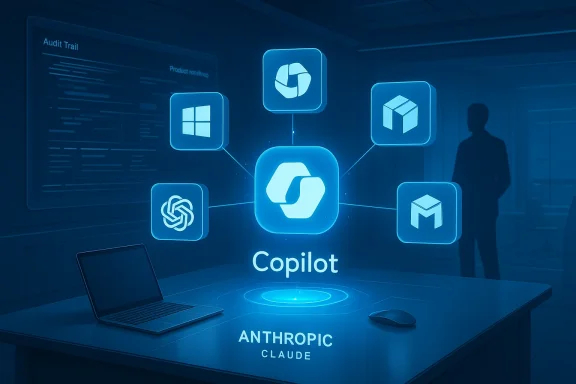
Microsoft has opened Copilot to multiple model providers, adding Anthropic’s Claude family as selectable backends alongside OpenAI and Microsoft’s own models in select Copilot surfaces (notably the Researcher agent and Copilot Studio). That change turns Copilot into an orchestration layer that routes tasks to the model best suited for the job — a pragmatic acknowledgement that no single model is ideal for every workload.Benefits of a multi‑model architecture:
- Flexibility to choose the best model per task (e.g., coding, visual design, spreadsheet automation).
- Hedge against vendor risk and pricing volatility from any single provider.
- Ability to optimize cost and compliance by routing sensitive workloads to models with appropriate data‑handling contracts.
Building internal models: costs, control and competitive positioning
Microsoft has publicly discussed and quietly tested internal model families that the company believes can match or approach the performance of leading external models. Bloomberg and other outlets have reported Microsoft’s investments and private tests showing competitive internal results, a move consistent with long‑term cost control and strategic independence from OpenAI.Why invest in in‑house models?
- Predictable unit economics: operating your own models reduces per‑token dependence on third‑party pricing and gives better control over inference costs.
- Data control and compliance: running models you own can simplify audits, provenaprise SLAs.
- Differentiation: Microsoft can bake system‑level optimizations and product integrations that are difficult to replicate with externally hosted models.
Strategic analysis for investors
Strengths and upside
- Focused product leadership can accelerate adoption. By unifying consumer and enterprise Copilot product roadmaps under a single leader with consumer growth experience, Microsoft can reduce cross‑team friction and launch more coherent experiences across Windows, Edge and Office. That should improve activation funnels and the perceived value of paid tiers like Microsoft 365 Premium and enterprise E7 offerings.
- Multi‑model flexibility reduces vendor lock‑in. Accepting Anthropic and other models into Copilot means Microsoft can optimize for performance and price while maintaining competitive parity with multi‑modevals. This flexibility can be particularly attractive to large enterprises with strict compliance needs.
- Long‑term margin and control potential. If Microsoft’s internal models reach parity for key productivity workloads, the company can cut per‑token expenses and bring more valk — a direct lever for software margins across its cloud and productivity businesses. Bloomberg reporting showing internal model progress is a notable positive signal.
- Talent and domain expertise cross‑pollination. Installing product leaders with consumer scale experience alongside executives who bring LinkedIn, Office and enterprise product knowledge suggests deliberate efforts to embed AI experiences into professional networks, hiring workflows and CRM — creating cross‑sell opportunities within Microsoft’s installed base.
Risks and downside scenarios
- Execution risk: integration complexity and internal alignment. A unified product leader reduces fragmentation risk but concentrates cross‑surface coordination under one person. If priorities are unclear (growth vs. enterprise reliability vs. safety) the team risks recreating silos or baking tradeoffs that satisfy none of the stakeholders. The danger is especially acute when commercial incentives (short‑term revenue) wrestle with long‑term research needs.
- Cost and capital intensity of frontier modeling. Pursuing “humanist superintelligence” is expensive. Compute, datasets, safety research and third‑party talent all add up. Investors should treat internal model bets as multi‑year plays that may not contribute positive cash flow in the near term. Public reporting and interviews indicate Microsoft accepts the cost, but the timetable and ROI remain uncertain.
- Regulatory and reputational risk. As Copilot becomes more agentic — able to act across calendars, email and documents — the surface area for data leakage, hallucinations, and policy missteps grows. Municipal rollouts have already been paused in some governments to re‑examine privacy and labor implications, and independent security reviewers have flagged open attack surfaces in agentic systems. These governance failures could lead to constrained deployments and higher compliance costs.
- Competitive pressure from hyperscalers and specialist model vendors. Google’s Gemini, OpenAI’s continued product velocity, Anthropic’s Claude family, and niche providers all press Microsoft on different axes — latency, pricing, or domain expertise. Microsoft’s multi‑model strategy mitigates but does not eliminate aggressive competition on product features, speed to market, and developer mindshare.
Operational implications for product and engineering teams
Consolidation improves UX but requires governance
A single product owner can dramatically improve user flows — consistent prompts, shared memory features, unified billing — but only if supported by engineering and policy guardrails. Investors should watch for:- Cross‑surface APIs and telemetry that permit consistent behavior across Outlook, Word, Teams and Windows.
- Clear tiering between consumer features and enterprise controls (data exfiltration prevention, logging, audit trails).
- Dedicated SRE and security investments for agent runtimes, which are more attackable than chat‑only interfaces.
Commercial packaging and pricing
Microsoft’s recent bundling moves (e.g., Microsoft 365 Premium and higher‑tier enterprise SKUs) show the company is trying to translate Copilot features into predictable revenue streams. Product consolidation typically precedes clearer monetization: subscription tiers with usage allowances, add‑on agent‑management planes for enterprises, and premium agent bundles for regulated industries. For investors, clearer SKU rationalization and transparent metering are important signals of monetization discipline.Competitive landscape: how rivals shape Microsoft’s choices
- OpenAI: long‑time technical partner and key model supplier. Microsoft must balance commercial dependence with strategic autonomy; internal model work and multi‑model support are both responses to manage that balance. Bloomberg’s reporting of in‑house model tests speaks directly to this dynamic.
- Anthropic: provider of Claude models and strategic partner for multi‑model Copilot paths. Anthropic’s inclusion in Copilot mitigates single‑vendor risk and provides a route to specialized capabilities (e.g., longer context windows, different safety tradeoffs). Microsoft’s public integration of Anthropic models into Copilot Studio is a material product shift.
- Google: Gemini and other Google‑branded models are direct rivals in productivity and cloud. Enterprise customers with multi‑cloud strategies may evaluate model performance, tooling and compliance tradeoffs across vendors.
- Vertical specialists and startups: niche providers (healthcare models, legal assistants, finance‑focused LLMs) will compete where Microsoft’s generalist Copilot must adapt to domain specificity. Microsoft’s “humanist superintelligence” ambitions explicitly call out healthcare and science as early domains for high‑capability models, acknowledging the importance of domain‑specialist playbooks.
Governance, safety and ethical tradeoffs
Humanist superintelligence — rhetoric versus implementation
Microsoft frames its frontier work as “humanist superintelligence,” promising systems that are auditable, controllable and aligned to human values. That view matters because it shapes investment in containment, red‑teaming, and regulatory readiness. Yet rhetoric is cheap; implementation is hard. Public-facing teams must demonstrate meaningful technical artifacts: rigorous evaluation datasets, third‑party audits, and transparent incident reporting to build trust.Agentic AI increases attack surface
Agentic Copilot features — the ability for an assistant to act across e‑mail, files and calendaring — raise new risk vectors: misdirected actions, privilege escalation, and supply‑chain exposure. Independent reporting and internal threads highlight exploitable gaps in agent runtimes and the need for stronger runtime security, least privilege models and enterprise telemetry. Investors should look for accelerated investments in:- Agent governance layers (audit trails, approvals).
- Fine‑grained permissioning and explicit human confirmation for high‑risk actions.
- Transparent retention and data‑use policies for enterprise customers.
What investors should watch next (operational signals and KPIs)
- Product metrics: Weekly and monthly active users for Copilot features across consumer (Windows, Edge) and commercial (Microsoft 365) surfaces; retention and task completion rates for agentic features. Improvements here validate the unified product leadership thesis.
- Monetization clarity: SKU rationalization, metering models for agent runtime, and enterprise E7 adoption rates. Concrete revenue contribution from Copilot as a line item will be a strong signal.
- Cost trajectory: per‑token or per‑minute inference costs as Microsoft expands internal model use. Look for evidence of meaningful reductions in third‑party model spend or explicit internal model deployment at scale. Bloomberg’s early reporting of internal model parity efforts is a relevant signal to track.
- Safety and compliance artifacts: published evaluation benchmarks, third‑party audits, and enterprise regulatory engagements (e.g., public procurement pauses or RFP language changes). These show whether the company is operationalizing humanist rhetoric. ([axios.com](Mustafa Suleyman leads Microsoft's new superintelligence moonshot adoption: enterprise references (especially in regulated industries like healthcare and government) will be a bellwether for trust in agentic Copilot deployments.
The long game: scenarios for value creation and destruction
Value creation scenario (bull case)
- Microsoft executes the consolidation cleanly, shipping unified, intuitive Copilot experiences across devices and M365.
- Internal models reach parity for productivity tasks, reducing model spend and enabling differentiated features (deep product integrations, offline or hybrid model hosting for sensitive industries).
- Enterprise customers adopt managed agent bundles (Agent 365, E7) at scale, producing meaningful incremental ARR and stickiness with Microsoft cloud services.
Value destruction scenario (bear case)
- Internal tensions between rapid product growth and safety‑first model development produce misaligned releases that lead to high‑profile errors or governance incidents.
- Frontier model investments fail to reach parity or cost advantage, leaving Microsoft both exposed to external supplier pricing and burdened by heavy R&D spend.
- Competitive products from Google, OpenAI or specialized vendors take significant market share in key professional workflows, weakening Microsoft’s monetization prospects.
Closing analysis: what this reorg reveals about Microsoft’s priorities
Microsoft’s reorganization of Copilot teams under unified product leadership, paired with a Suleyman‑led push into humanist superintelligence, tells a coherent story: the company wants to win the adoption battle in the near term while building the technological foundation to own the models that power those experiences in the long term. That two‑track strategy is sensible: product teams must ship delightful, consistent experiences now, while model teams tackle the cost, control and capability questions that could determine competitive differentiation in years to come.For investors, the important lens is one of execution maturity. Microsoft has the balance sheet, enterprise relationships, and distribution reach to make Copilot a wedge product across its platform. The question is whether it can translate organizational alignment into predictable product quality, tighten the economics of model inference, and avoid governance failures that could slow enterprise adoption. Each of those outcomes is measurable — and those metrics will determine whether Copilot becomes the company’s central productivity moat or an expensive experiment with limited financial payoff.
In short: the restructure is a strategic move designed to reduce fragmentation and accelerate monetization, while the Suleyman superintelligence bet is a longer‑term wager on technical independence and safety. Both moves are necessary; both are risky. The winners in this era will be the companies that combine fast, clear product ownership with rigorous, transparent engineering for model safety and economic sustainability.
Conclusion
Microsoft’s Copilot reorganization and parallel superintelligence program reflect a pragmatic, two‑front strategy: win adoption now through better product alignment and user experiences, and reduce future vendor dependency by building capable, safe in‑house models. Investors should reward evidence of cross‑surface product coherence, disciplined monetization, and credible progress on model economics and safety. Conversely, missed execution on any of those pillars — fragmented releases, ballooning model costs, or governance stumbles — would be a clear negative signal that the high‑risk frontier investment is cannibalizing near‑term product and commercial performance.
Source: MLQ.ai MLQ.ai | AI for investors
