

Microsoft’s Copilot strategy has entered a more forceful and more expensive phase. With adoption lagging far behind ChatGPT and Gemini, the company is reshaping its AI leadership, consolidating product control under a single executive, and packaging Copilot into a new $99-per-user enterprise suite designed to make AI harder to ignore inside the Microsoft stack. The message is clear: Microsoft no longer wants Copilot to be treated as an optional add-on for the curious. It wants Copilot to become part of the enterprise operating system.
Microsoft’s AI push has always been about more than a chatbot. The company has spent the last two years weaving generative AI into the software layer where it already dominates: Microsoft 365, Windows, Azure, security, and developer tools. In that sense, Copilot was never merely a consumer product. It was the public face of a broader platform bet, one that assumed customers would pay for AI the same way they pay for collaboration, identity, and security.
That bet has produced real progress, but not the kind of explosive consumer momentum that would make Copilot a cultural phenomenon. Microsoft has publicly emphasized enterprise traction for Copilot and related AI tooling, while consumer adoption has remained more modest. The company has also been steadily expanding the model mix behind its products, including deeper use of Anthropic models alongside OpenAI, which suggests a pragmatic shift toward using whatever foundation best suits the workflow.
At the same time, Microsoft’s AI organization has been changing shape repeatedly. Mustafa Suleyman was brought in to help lead a new Microsoft AI unit and build products and models with a more distinct identity. That structure made sense when the goal was to move quickly in consumer AI and create a visible competitive response to ChatGPT. But as Copilot’s growth has come up short relative to expectations, Microsoft has now opted for a tighter command structure and a sharper split between product execution and model development.
The latest pivot is therefore less a U-turn than a maturation of Microsoft’s AI strategy. The company is acknowledging that distribution alone is not enough, especially when the product experience is fragmented and the consumer market is already heavily shaped by ChatGPT, Gemini, and a swarm of AI-native apps. Instead of relying on brand gravity, Microsoft is leaning into bundling, governance, and workflow integration — the familiar tools of enterprise software, now repurposed for the AI era.
The other half of the change is just as important. Mustafa Suleyman is stepping back from the day-to-day Copilot business to focus on next-generation model development. Microsoft is effectively separating “what users see” from “what powers the system underneath.” In a market where model quality, latency, and operating cost all matter, that split is likely intended to improve focus and reduce internal friction.
It also reflects a broader industry reality: AI products are no longer won only by model quality. They are won by packaging, workflow depth, and the ability to turn occasional usage into habitual use. Microsoft’s reorganization looks like an attempt to operationalize that lesson.
This is not just a usage gap. It is a product-market-fit question. Microsoft has distribution at scale, yet Copilot still has not become a default habit for a meaningful share of users. That suggests the problem is not awareness alone, but rather whether the product is compelling enough to justify an extra line item or a daily behavioral change.
Enterprise customers are especially cautious. They already pay for Microsoft 365, security suites, compliance tools, and in many cases separate automation platforms. So when Microsoft asks them to pay again for AI, the value case has to be immediate, measurable, and low-friction. In other words, the marginal value of Copilot must be obvious enough to overcome procurement inertia.
Microsoft’s response is to lean harder on the enterprise side, where it has stronger control over workflow, identity, and governance. That is rational, but it also means Copilot risks becoming a premium productivity feature rather than a mass-market AI habit.
The pricing is aggressive. On the surface, $99 per user per month looks like a steep jump from Microsoft’s existing enterprise tiers, and the company is clearly betting that customers will value the convenience of a unified AI-ready suite. Microsoft’s own framing is that the bundle is cheaper than buying the same capabilities separately. That is classic enterprise packaging logic: reduce decision friction, increase average revenue per user, and make AI feel like part of the platform rather than a bolt-on experiment.
The inclusion of Agent 365 is particularly notable. Microsoft is essentially trying to create a management layer for AI agents, which makes sense in a world where enterprises will need control over permissions, data access, lifecycle management, and observability. That is not a consumer pitch. It is a governance pitch.
It also gives Microsoft a better narrative for finance and procurement teams. Instead of explaining several products, licenses, and security add-ons, Microsoft can point to one frontier suite and one monthly bill.
This matters because long-running, multi-step work is where many AI assistants struggle. A tool may be excellent at a single prompt, but enterprise users often need it to coordinate across documents, meetings, spreadsheets, and business systems. Microsoft’s emphasis on multi-step execution suggests it understands that the next phase of AI is less about chat and more about orchestration.
If Microsoft gets this right, the product becomes less like a chatbot and more like a workflow engine with conversational control. That is a far more valuable proposition for corporate customers.
That question is especially important because Microsoft has long been rewarded for disciplined execution and highly profitable software economics. AI, by contrast, is expensive to run, expensive to scale, and expensive to differentiate. If Copilot adoption remains sluggish, Microsoft risks looking like a company that is buying future optionality at the cost of near-term efficiency.
The new bundle helps address that tension in two ways. First, it raises revenue per customer. Second, it may reduce the perception that Microsoft’s AI bets are purely defensive. The company can now argue that it is monetizing the full enterprise stack rather than just subsidizing experimental usage.
That is why the model-development push under Suleyman matters. Lower-cost, more capable models could make the whole product family more economically sustainable.
For enterprise buyers, the question is whether Copilot saves enough time across enough users to justify the per-seat price. For consumers, the question is whether Copilot is sufficiently helpful, personal, and available to displace habits built around ChatGPT, Gemini, or built-in mobile assistants. Microsoft’s new leadership structure implies it wants to align the products where it can, while still tuning the experience to each audience.
Consumers are tougher. They switch faster, compare more directly, and have less patience for awkward onboarding or inconsistent quality. Copilot can win there, but it needs a sharper identity than “the Microsoft one.”
For Google, the challenge remains whether Gemini can convert consumer familiarity into enterprise relevance. For OpenAI, Microsoft’s bundling push may represent both collaboration and competition at once, especially if Microsoft continues to commercialize AI through its own customer relationships rather than only through partner-led experiences. For Anthropic, the Copilot Cowork integration is a validation of Claude’s role in enterprise workflows — but also a reminder that model providers are increasingly just one layer in a larger platform stack.
That means competitors must do more than launch better chat interfaces. They need product depth, workflow integration, and trust signals that fit the enterprise buyer’s risk profile.
The opportunity is not just more seat sales. It is deeper engagement across Microsoft 365, more agent usage, better upsell economics, and potentially stronger retention across the commercial stack. If the company can make AI feel native to work rather than adjacent to it, the long-term payoff could be substantial.
There is also execution risk in trying to unify consumer and enterprise AI under one brand while relying on multiple model providers. That introduces complexity in experience design, compliance, and product reliability. And if Microsoft continues to spend heavily on AI infrastructure without seeing proportional commercial uptake, investor patience could fray further.
What to watch most closely is not just seat growth, but also usage quality. Microsoft will want evidence that Copilot is becoming embedded in everyday workflows, not merely trialed in bursts. The company will also need to show that its model diversification strategy, including Anthropic-powered experiences, creates better outcomes rather than just more complexity.
Source: AD HOC NEWS Microsoft's AI Strategy Pivots Amid Sluggish Copilot Adoption
 Background
Microsoft’s AI push has always been about more than a chatbot. The company has spent the last two years weaving generative AI into the software layer where it already dominates: Microsoft 365, Windows, Azure, security, and developer tools. In that sense, Copilot was never merely a consumer product. It was the public face of a broader platform bet, one that assumed customers would pay for AI the same way they pay for collaboration, identity, and security.That bet has produced real progress, but not the kind of explosive consumer momentum that would make Copilot a cultural phenomenon. Microsoft has publicly emphasized enterprise traction for Copilot and related AI tooling, while consumer adoption has remained more modest. The company has also been steadily expanding the model mix behind its products, including deeper use of Anthropic models alongside OpenAI, which suggests a pragmatic shift toward using whatever foundation best suits the workflow.
At the same time, Microsoft’s AI organization has been changing shape repeatedly. Mustafa Suleyman was brought in to help lead a new Microsoft AI unit and build products and models with a more distinct identity. That structure made sense when the goal was to move quickly in consumer AI and create a visible competitive response to ChatGPT. But as Copilot’s growth has come up short relative to expectations, Microsoft has now opted for a tighter command structure and a sharper split between product execution and model development.
The latest pivot is therefore less a U-turn than a maturation of Microsoft’s AI strategy. The company is acknowledging that distribution alone is not enough, especially when the product experience is fragmented and the consumer market is already heavily shaped by ChatGPT, Gemini, and a swarm of AI-native apps. Instead of relying on brand gravity, Microsoft is leaning into bundling, governance, and workflow integration — the familiar tools of enterprise software, now repurposed for the AI era.
What Changed on March 17
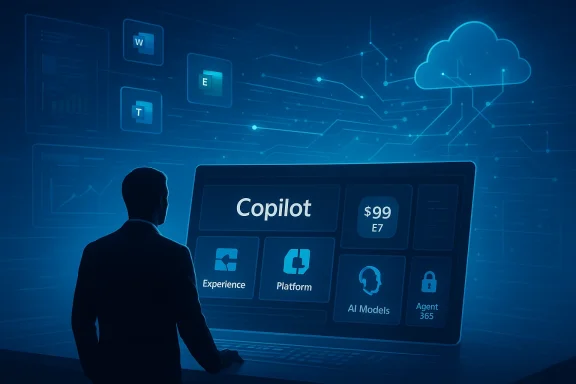
Microsoft’s reported March 17 restructuring puts Jacob Andreou in charge of Copilot across consumer and enterprise surfaces, with reporting lines going directly to CEO Satya Nadella. The new setup folds several previously separate efforts into four pillars: Copilot Experience, Copilot Platform, Microsoft 365 Apps, and AI Models. That is a strong signal that Microsoft wants fewer seams between product, platform, and model strategy.The other half of the change is just as important. Mustafa Suleyman is stepping back from the day-to-day Copilot business to focus on next-generation model development. Microsoft is effectively separating “what users see” from “what powers the system underneath.” In a market where model quality, latency, and operating cost all matter, that split is likely intended to improve focus and reduce internal friction.
Why the new hierarchy matters
The new structure suggests Microsoft has concluded that Copilot needs more coherent ownership. That is especially relevant in a product family that spans Windows, the browser, Microsoft 365, Edge, and mobile apps, where inconsistent behavior can quickly undermine trust. A single leader accountable for both consumer and enterprise surfaces may help Microsoft present a more unified AI story.It also reflects a broader industry reality: AI products are no longer won only by model quality. They are won by packaging, workflow depth, and the ability to turn occasional usage into habitual use. Microsoft’s reorganization looks like an attempt to operationalize that lesson.
- A more centralized product chain of command can reduce duplication.
- Unified ownership may improve feature consistency across surfaces.
- Splitting product from model work could speed execution in both areas.
- The move also narrows the gap between consumer and enterprise messaging.
The Adoption Problem Microsoft Is Trying to Solve
The adoption numbers explain the urgency. The reported February figures put the Microsoft Copilot app at 6 million daily active users, far behind ChatGPT’s 440 million and Gemini’s 82 million. Even more telling, Microsoft has roughly 450 million commercial Microsoft 365 customers, but only about 15 million are paying for Copilot. That is a strikingly small conversion rate for a product embedded in one of the world’s most pervasive software suites.This is not just a usage gap. It is a product-market-fit question. Microsoft has distribution at scale, yet Copilot still has not become a default habit for a meaningful share of users. That suggests the problem is not awareness alone, but rather whether the product is compelling enough to justify an extra line item or a daily behavioral change.
Enterprise customers are especially cautious. They already pay for Microsoft 365, security suites, compliance tools, and in many cases separate automation platforms. So when Microsoft asks them to pay again for AI, the value case has to be immediate, measurable, and low-friction. In other words, the marginal value of Copilot must be obvious enough to overcome procurement inertia.
Consumer appeal versus enterprise utility
Consumer AI products succeed when they feel fast, useful, and fun enough to return to. Enterprise AI products succeed when they save time, reduce errors, or consolidate spend. Copilot has to serve both masters, and that is a difficult balancing act.Microsoft’s response is to lean harder on the enterprise side, where it has stronger control over workflow, identity, and governance. That is rational, but it also means Copilot risks becoming a premium productivity feature rather than a mass-market AI habit.
- Consumer users compare Copilot to ChatGPT’s breadth and familiarity.
- Enterprise buyers compare it to the ROI of existing software investments.
- The product must win on integration, not novelty alone.
- Adoption metrics suggest Microsoft has not yet crossed that threshold.
The New E7 Bundle Is a Pricing Reset
The headline commercial move is Microsoft 365 E7, a new suite priced at $99 per user per month. Microsoft says it bundles Microsoft 365 Copilot, Agent 365, security capabilities, and the existing enterprise stack into a single package. That makes it the company’s first new enterprise offering in a decade and, crucially, a package rather than an add-on.The pricing is aggressive. On the surface, $99 per user per month looks like a steep jump from Microsoft’s existing enterprise tiers, and the company is clearly betting that customers will value the convenience of a unified AI-ready suite. Microsoft’s own framing is that the bundle is cheaper than buying the same capabilities separately. That is classic enterprise packaging logic: reduce decision friction, increase average revenue per user, and make AI feel like part of the platform rather than a bolt-on experiment.
The inclusion of Agent 365 is particularly notable. Microsoft is essentially trying to create a management layer for AI agents, which makes sense in a world where enterprises will need control over permissions, data access, lifecycle management, and observability. That is not a consumer pitch. It is a governance pitch.
Why bundling may work
Bundling succeeds when the customer is already committed to the platform and sees value in simplifying procurement. Microsoft is betting that many large customers are in exactly that position. If the suite truly combines productivity, identity, security, and AI more cleanly than piecemeal alternatives, the price may be easier to defend.It also gives Microsoft a better narrative for finance and procurement teams. Instead of explaining several products, licenses, and security add-ons, Microsoft can point to one frontier suite and one monthly bill.
- It reduces license sprawl.
- It simplifies budget approval.
- It ties AI usage to existing enterprise controls.
- It may help Microsoft raise revenue per seat faster.
Copilot Cowork and the Model Mix
One of the more interesting pieces of the announcement is Copilot Cowork, built with Anthropic’s Claude model technology. Microsoft is signaling that it is increasingly willing to combine models from different providers if that improves the user experience or task performance. That is a meaningful departure from the old “one model, one ecosystem” mindset.This matters because long-running, multi-step work is where many AI assistants struggle. A tool may be excellent at a single prompt, but enterprise users often need it to coordinate across documents, meetings, spreadsheets, and business systems. Microsoft’s emphasis on multi-step execution suggests it understands that the next phase of AI is less about chat and more about orchestration.
Multi-step work is the real battleground
The enterprise opportunity is not just to answer questions. It is to complete tasks. That means drafting, revising, routing, summarizing, triggering approvals, and maintaining context over time. Copilot Cowork appears aimed at exactly that layer.If Microsoft gets this right, the product becomes less like a chatbot and more like a workflow engine with conversational control. That is a far more valuable proposition for corporate customers.
- Multi-step automation is harder to copy than single-turn chat.
- Cross-app execution increases stickiness inside Microsoft 365.
- Model diversity may improve task-specific performance.
- Governance becomes more important as autonomy increases.
Financial Pressure Behind the Pivot
Microsoft’s AI strategy is unfolding under real financial strain. The company has reportedly spent around $72 billion on AI infrastructure over two quarters, while capital expenditures have risen sharply and cloud growth has moderated from the most euphoric expectations. Even with Azure still strong, the market is increasingly asking how quickly these investments will convert into durable margin expansion.That question is especially important because Microsoft has long been rewarded for disciplined execution and highly profitable software economics. AI, by contrast, is expensive to run, expensive to scale, and expensive to differentiate. If Copilot adoption remains sluggish, Microsoft risks looking like a company that is buying future optionality at the cost of near-term efficiency.
The new bundle helps address that tension in two ways. First, it raises revenue per customer. Second, it may reduce the perception that Microsoft’s AI bets are purely defensive. The company can now argue that it is monetizing the full enterprise stack rather than just subsidizing experimental usage.
The margin challenge
AI products often compress margins before they expand them. Every additional agent interaction, retrieval operation, and inference call adds cost. If enterprise customers use Copilot heavily but sporadically, Microsoft may still have to support a cost structure that does not scale elegantly.That is why the model-development push under Suleyman matters. Lower-cost, more capable models could make the whole product family more economically sustainable.
- Higher prices can offset infrastructure costs.
- Better models can lower inference expense over time.
- Bundled licenses can improve predictability of revenue.
- Investors will watch whether usage growth outpaces compute burn.
Enterprise Versus Consumer: Two Different Games
Microsoft is now playing two different games with Copilot, even if it insists the brand is unified. In enterprise, Copilot is a procurement story, a compliance story, and a workflow story. In consumer, it is a behavior story, a default-assistant story, and a trust story. Those are not the same market dynamics, and they should not be judged by the same metrics.For enterprise buyers, the question is whether Copilot saves enough time across enough users to justify the per-seat price. For consumers, the question is whether Copilot is sufficiently helpful, personal, and available to displace habits built around ChatGPT, Gemini, or built-in mobile assistants. Microsoft’s new leadership structure implies it wants to align the products where it can, while still tuning the experience to each audience.
Why enterprises are easier
Enterprises have centralized purchasing, identity controls, and a strong incentive to standardize. They also already live inside Microsoft’s ecosystem, which lowers adoption friction. If Microsoft can show administrative value, security visibility, and measurable productivity gains, it has a fighting chance at scale.Consumers are tougher. They switch faster, compare more directly, and have less patience for awkward onboarding or inconsistent quality. Copilot can win there, but it needs a sharper identity than “the Microsoft one.”
- Enterprises buy platforms, not novelty.
- Consumers buy convenience and delight.
- Microsoft has stronger leverage in the enterprise channel.
- The consumer market demands more distinctive differentiation.
Competitive Implications for OpenAI, Google, and Anthropic
Microsoft’s move is also a competitive statement. By reshaping Copilot around an enterprise bundle and broadening its model strategy, Microsoft is showing that it does not want to be trapped by any single AI supplier or any single product format. That is a subtle but important message to both partners and rivals.For Google, the challenge remains whether Gemini can convert consumer familiarity into enterprise relevance. For OpenAI, Microsoft’s bundling push may represent both collaboration and competition at once, especially if Microsoft continues to commercialize AI through its own customer relationships rather than only through partner-led experiences. For Anthropic, the Copilot Cowork integration is a validation of Claude’s role in enterprise workflows — but also a reminder that model providers are increasingly just one layer in a larger platform stack.
Platform power still matters
This is the key competitive insight: distribution still matters, but it is not enough on its own. The winner in enterprise AI will likely be the company that combines model quality with identity, administration, security, and task orchestration. Microsoft has a structural advantage there, even if it has not yet converted that into the consumer momentum investors hoped for.That means competitors must do more than launch better chat interfaces. They need product depth, workflow integration, and trust signals that fit the enterprise buyer’s risk profile.
- OpenAI leads in mindshare and consumer usage.
- Google has a massive distribution base and model strength.
- Anthropic is increasingly relevant in enterprise deployment.
- Microsoft owns the workflow layer most enterprises already use.
Strengths and Opportunities
Microsoft’s Copilot reset has real strategic logic. The company is using its strongest assets — enterprise distribution, software bundling, security controls, and customer relationships — to solve a problem that pure model companies cannot fix as easily. If executed well, the new structure and bundle could turn Copilot from a premium curiosity into a platform feature with recurring value.The opportunity is not just more seat sales. It is deeper engagement across Microsoft 365, more agent usage, better upsell economics, and potentially stronger retention across the commercial stack. If the company can make AI feel native to work rather than adjacent to it, the long-term payoff could be substantial.
- Enterprise bundling can make adoption easier to justify.
- Unified leadership may reduce fragmentation and speed decisions.
- Agent 365 creates a new governance story for AI operations.
- Model flexibility helps Microsoft optimize performance and cost.
- Microsoft 365 integration remains a powerful distribution advantage.
- Security-first packaging aligns well with procurement requirements.
- Higher ARPU potential could improve the economics of AI delivery.
Risks and Concerns
The biggest risk is that Microsoft may be solving a pricing problem before it has fully solved a product problem. If Copilot’s core value remains unclear to enough customers, a more expensive bundle could slow adoption rather than accelerate it. A product can be strategically packaged and still feel optional if users do not experience a meaningful daily advantage.There is also execution risk in trying to unify consumer and enterprise AI under one brand while relying on multiple model providers. That introduces complexity in experience design, compliance, and product reliability. And if Microsoft continues to spend heavily on AI infrastructure without seeing proportional commercial uptake, investor patience could fray further.
- Price resistance may limit uptake among budget-conscious enterprises.
- Product fragmentation could persist despite the reorganization.
- Consumer inertia may keep Copilot behind ChatGPT and Gemini.
- Cost pressure from AI infrastructure could weigh on margins.
- Model dependency creates strategic and technical complexity.
- Enterprise skepticism may slow renewals and expansion deals.
- Brand dilution is possible if Copilot becomes too many things at once.
Looking Ahead
Microsoft’s next few quarters will determine whether this pivot is remembered as a turning point or a defensive maneuver. The company has already drawn a line between experimentation and execution; now it has to prove that the line leads somewhere commercially meaningful. The April 28 earnings report and the May 1 E7 launch will be the first major checkpoints for judging whether Microsoft can convert AI ambition into measurable sales.What to watch most closely is not just seat growth, but also usage quality. Microsoft will want evidence that Copilot is becoming embedded in everyday workflows, not merely trialed in bursts. The company will also need to show that its model diversification strategy, including Anthropic-powered experiences, creates better outcomes rather than just more complexity.
- Watch E7 adoption after May 1.
- Watch whether paid Copilot seats grow faster than the broader Microsoft 365 base.
- Watch for signals that Copilot Cowork increases task completion rates.
- Watch whether Microsoft highlights security and governance as primary buying triggers.
- Watch the company’s commentary on AI infrastructure spending versus revenue conversion.
Source: AD HOC NEWS Microsoft's AI Strategy Pivots Amid Sluggish Copilot Adoption
Last edited:
