Microsoft was hit on June 12, 2026, with a securities class action alleging it misled investors about Copilot’s adoption and technical challenges while pouring capital into AI infrastructure and managing Azure capacity constraints. The case may or may not survive the procedural gauntlet that awaits nearly every securities complaint. But for Microsoft investors, the filing lands because it turns a familiar market worry into a sharper question: is AI capex being spent ahead of demand, or in defense of a product narrative that has not yet earned its valuation?
That is the real significance of the Copilot lawsuit. It does not prove that Microsoft’s AI strategy is broken, and it certainly does not erase the company’s enormous advantages in cloud, productivity software, enterprise identity, security, and developer tooling. What it does is force the bull case to become more precise. If Copilot is the visible interface for Microsoft’s AI monetization story, then adoption quality, user trust, infrastructure availability, and capital intensity are no longer separate debates. They are the same debate.

AI Copilot and Azure cloud dashboard show 92% GPU utilization in a data center with legal “Disclosure” documents.The Lawsuit Turns AI Optimism Into a Disclosure Problem​

The securities complaint reportedly alleges that Microsoft and certain executives overstated or failed to adequately disclose difficulties around Copilot, including product experience, brand confusion, data silos, interoperability, and the challenge of converting AI enthusiasm into sustained enterprise usage. Those are not exotic complaints for anyone who has deployed AI tooling inside a real organization. They are the mundane frictions that separate a demo from a durable line item in the IT budget.
That distinction matters because Microsoft’s AI story has been marketed less as a speculative moonshot than as an extension of products customers already use. Copilot is not a consumer gadget sitting outside the Microsoft stack; it is being threaded through Microsoft 365, Windows, GitHub, Dynamics, Power Platform, Security, and Azure. The pitch is that AI becomes more valuable because it is embedded where work already happens.
The lawsuit challenges the confidence of that embedding story. A user who does not trust Copilot’s answer, cannot reach the relevant data, or finds the experience inconsistent is not merely a disappointed beta tester. In Microsoft’s investment narrative, that user is a missing proof point for why the company should spend tens or hundreds of billions of dollars scaling AI infrastructure.
Securities litigation is often noisy at the outset. Complaints are written to survive dismissal, and allegations are not findings of fact. Still, the timing is awkward for Microsoft because investors are already trying to answer whether AI spending is disciplined platform investment or the newest form of technology-industry overbuild.

Copilot Was Supposed to Make the Capex Story Easy​

Microsoft’s best AI argument has always been beautifully simple: the company owns the workplace surface area, the cloud substrate, the developer ecosystem, and the enterprise sales channel. If generative AI becomes a paid productivity layer across knowledge work, Microsoft should be one of the biggest beneficiaries. Copilot is the product name attached to that thesis.
That is why Copilot adoption is more than a product metric. It is the bridge between capital expenditure and future cash flow. Microsoft can tell investors that GPUs, data centers, networking gear, power contracts, and model-serving costs are necessary because AI demand is already arriving through Microsoft 365 seats, Azure consumption, GitHub subscriptions, and security workloads.
The problem is that the bridge has to carry real weight. Early trials, executive excitement, and large announced deployments can coexist with day-to-day user reluctance. Enterprise software has always had a gap between licenses sold and software loved, but AI makes that gap harder to ignore because the cost to serve the product is unusually high.
A traditional productivity feature can sit idle without consuming much incremental infrastructure. An AI assistant that users actually invoke at scale consumes compute every time it reasons, summarizes, searches, drafts, or automates. That makes the quality of usage crucial. Microsoft does not just need Copilot to be bought; it needs Copilot to be used in ways that justify pricing, renewals, and the hardware bill behind the curtain.

Azure Capacity Constraints Cut Both Ways​

Microsoft’s Azure capacity constraints have been one of the strangest signals in the AI cycle because they can be read as both bullish and bearish. On the bullish side, constrained capacity suggests demand is real enough to exceed available supply. In a world where enterprises are racing to integrate AI, running out of capacity can look like a high-class problem.
On the bearish side, capacity constraints complicate the basic investor promise that massive spending can quickly unlock massive growth. If Microsoft cannot bring capacity online fast enough, revenue is deferred. If it brings too much online too quickly, utilization and margins become the problem. If it prioritizes first-party Copilot workloads over third-party Azure customers, the internal economics become harder for outsiders to evaluate.
This is where the Copilot lawsuit intersects with capex. The central market worry is not merely that Microsoft is spending a lot. Microsoft has spent heavily before and emerged stronger. The worry is that AI infrastructure is less forgiving than past cloud expansion because the chips are expensive, depreciation schedules are unforgiving, power constraints are real, and model economics remain unsettled.
Microsoft’s management has argued that AI demand is broad and that infrastructure investment is necessary to meet it. That may be true. But the lawsuit gives skeptical investors a legal vocabulary for asking whether the company’s public optimism gave enough weight to product maturity, adoption friction, and the cost of turning AI capacity into profitable usage.

NHS England Shows the Opportunity Is Not Imaginary​

The most important counterweight to the bear case is that Microsoft keeps landing the kind of deployments that only a company with its enterprise reach can plausibly win. NHS England’s plan to provide Microsoft 365 Copilot access to roughly 505,000 clinicians and support staff by October 2026 is not a boutique pilot or a laboratory exercise. It is a national-scale productivity bet inside one of the world’s most complex public-sector organizations.
That deployment makes the opportunity tangible. Healthcare is drowning in administrative work, and the promise of AI assistance with meeting notes, document drafting, data analysis, discharge paperwork, briefings, and operational coordination is obvious. If Copilot can save meaningful time at scale, the value proposition becomes more than Silicon Valley abstraction.
But the NHS deal also illustrates the execution risk that the lawsuit is trying to spotlight. A half-million-seat rollout is not simply a procurement win; it is a governance challenge. Healthcare data is sensitive, workflows are uneven, staff training varies, and trust failures can become political failures. In that environment, Copilot has to be useful, secure, explainable enough for institutional comfort, and mundane enough to fit daily work.
This is why investors should resist the temptation to treat large deployments as clean evidence that the Copilot debate is settled. Big contracts show demand. They do not automatically show sustained usage, productivity gains, renewal willingness, or attractive margins after compute costs. In the AI era, a press release is the beginning of the story, not the end.

The AI Footprint Is Broader Than One Assistant​

Microsoft is not a one-product AI company, and that is the strongest reason the lawsuit may have limited long-term effect on the stock’s fundamental story. Copilot may be the most visible brand, but the company’s AI exposure runs through Azure OpenAI Service, GitHub Copilot, Security Copilot, Dynamics, Power Platform, healthcare partnerships, industry clouds, developer tools, and custom enterprise deployments.
That breadth gives Microsoft several ways to win. If Microsoft 365 Copilot adoption is slower than hoped, Azure AI consumption may still grow. If general-purpose assistants disappoint some users, coding copilots or security copilots may deliver clearer productivity returns. If one model supplier becomes less attractive, Microsoft can route workloads across different models and optimize for cost, latency, compliance, or quality.
The breadth also creates a measurement problem. Investors want a clean AI revenue number, but Microsoft’s AI monetization is increasingly blended into cloud consumption, seat expansion, premium SKUs, and retention. That makes the story harder to falsify in the short term. It also makes disclosure discipline more important, because management commentary becomes the lens through which the market interprets a very complicated machine.
The lawsuit’s implied challenge is that Microsoft’s AI narrative may have become too smooth for the underlying complexity. Enterprise AI adoption is not a straight line from demo to deployment to productivity. It is a messy loop of data readiness, permissioning, training, prompt behavior, governance, user habit, cost control, and business-process redesign.

Investors Are Really Litigating the Shape of Demand​

The capex question is often framed as a number: $100 billion, $150 billion, $190 billion, or whatever the current estimate happens to be. But the more important issue is the shape of demand. Is AI demand broad, recurring, high-margin, and embedded? Or is it bursty, experimental, compute-hungry, and vulnerable to pricing pressure?
Microsoft’s bull case assumes the first shape. Under that version, AI becomes a premium layer across the enterprise stack. Customers pay more for Microsoft 365, consume more Azure, build more applications on Microsoft tools, and consolidate around vendors that can handle security, identity, compliance, and scale. Capex is front-loaded, but the resulting platform becomes stronger.
The bear case assumes something closer to the second shape. Enterprises experiment widely, but many users do not change habits. Competing models pressure pricing. Open-source and specialized tools reduce differentiation. AI features become table stakes rather than durable pricing power. In that scenario, Microsoft may still grow, but the return on incremental AI infrastructure is less spectacular than the stock once implied.
The Copilot lawsuit matters because it aims at the seam between those two worlds. If plaintiffs can argue that Microsoft knew Copilot faced material adoption and technical issues while presenting a more confident public narrative, then the legal case becomes a proxy for a market argument investors were already having.

The Old Microsoft Playbook Still Works, But AI Taxes It​

Microsoft’s historic enterprise playbook is brutally effective. Bundle strategically, integrate deeply, sell through trusted channels, improve relentlessly, and let procurement gravity do the rest. Teams did not need to be beloved by every user to become entrenched. SharePoint survived decades of jokes because it solved enough institutional problems and sat inside enough enterprise agreements.
Copilot could follow that path. A product that feels uneven in 2026 may be meaningfully better in 2027, especially as models improve, retrieval systems mature, and organizations clean up the data permissions that AI assistants expose. Microsoft has the patience, distribution, and cash flow to iterate through awkward early phases that would kill smaller companies.
But AI taxes the old playbook in two important ways. First, the product experience is more visible because users compare Copilot not only with older Office features but with ChatGPT, Claude, Gemini, and specialized AI tools they may use outside corporate boundaries. Second, the infrastructure cost is more immediate. A mediocre AI feature is not merely a reputational problem; it can be a margin problem.
That means Microsoft cannot rely solely on enterprise inertia. It needs genuine usefulness. It needs administrators to believe the governance model is safe. It needs finance chiefs to see measurable productivity. And it needs users to come back because the tool saves time, not because the icon is hard to avoid.

The Legal Threat Is Secondary to the Discovery Threat​

For most investors, the direct financial risk of a securities class action is probably not the main issue. Microsoft is one of the world’s most profitable companies, and litigation can take years. The larger risk is informational: litigation can surface documents, testimony, and timelines that sharpen market understanding of what executives knew, when they knew it, and how they described it externally.
That does not mean damaging evidence exists. It means the lawsuit raises the stakes around internal metrics. Copilot seat sales, active usage, renewal rates, prompt volume, customer satisfaction, infrastructure allocation, margin profile, and support issues all become more important. The market will care less about whether Microsoft can announce another deployment and more about whether those deployments mature into profitable, sticky usage.
This is a healthy shift. The AI boom has rewarded companies for sounding capacity-constrained, partner-rich, and strategically inevitable. The next phase will reward companies that can show unit economics, repeat usage, and defensible distribution. Microsoft is better positioned than almost anyone for that phase, but it is not exempt from it.
The company’s sheer size also changes the burden of proof. A startup can sell a vision. Microsoft has to sell a vision while protecting Windows, Office, Azure, security, gaming, LinkedIn, and developer trust. Its AI story is not allowed to be merely exciting; it has to be operationally boring in the way enterprise IT prefers.

The Stock Narrative Needs Fewer Adjectives and More Denominators​

Simply Wall St’s framing captures the investor dilemma neatly: Microsoft’s existing narrative already assumes substantial revenue and earnings growth by 2029, with AI and Azure doing much of the work. Optimistic models go further, imagining even larger revenue and earnings outcomes if AI adoption scales and capex produces the expected returns. The lawsuit does not destroy those models, but it attacks the assumptions that make them comfortable.
The key denominator is not total announced AI spending. It is return per dollar of AI infrastructure. Investors need to know whether new capacity produces high-value enterprise workloads, low-margin model serving, internal Copilot costs, or some mix that is difficult to separate. Each category deserves a different multiple.
Another denominator is usage per paid seat. Microsoft can sell Copilot through enterprise agreements, but long-term value depends on whether employees use it often enough for customers to renew, expand, and tolerate premium pricing. In software, shelfware is survivable when gross margins are enormous. In AI software, shelfware becomes more awkward when the vendor is simultaneously building data centers to support usage that may not arrive as quickly as forecast.
The final denominator is time. Capex happens now; depreciation, power costs, and supply commitments follow; revenue ramps later if customers adopt. That timing mismatch is tolerable when investors trust management’s visibility. A lawsuit alleging that visibility was less clear than advertised does not have to win in court to affect the multiple investors are willing to pay.

Windows Users Should Care Because AI Spending Shapes the Product​

For WindowsForum readers, this is not just a Wall Street story. Microsoft’s AI spending priorities are already reshaping the products people administer, secure, troubleshoot, and use every day. Copilot is no longer a sidebar experiment; it is a design principle that influences Windows, Microsoft 365, Edge, Teams, developer tools, and security operations.
That creates practical consequences. IT departments must decide when to enable Copilot, how to govern access, how to train users, and how to measure whether the tool helps. Security teams must think about oversharing, prompt injection, retention, auditability, and the uncomfortable fact that AI assistants can make existing permission mistakes more visible and more consequential.
End users face a different issue: the creeping conversion of software from deterministic tools into probabilistic collaborators. That can be powerful. It can also be maddening when the assistant is confidently wrong, slow, too cautious, too chatty, or unable to access the one document that would make it useful.
Microsoft’s capex narrative therefore flows directly into product experience. If the company spends aggressively and delivers fast, reliable, well-integrated AI, Windows and Microsoft 365 may feel meaningfully more capable. If it spends aggressively but the user experience remains uneven, customers may see more upsell pressure than productivity.

The Cloud Boom Is a Useful Analogy With One Big Flaw​

Microsoft has earned investor patience before. Azure required years of investment before it became the growth engine that transformed Microsoft’s valuation. Office 365 involved a painful transition from packaged software to subscriptions. The company has repeatedly shown that it can endure margin pressure when the destination is strategically sound.
The AI buildout resembles the cloud transition in that Microsoft is spending ahead of demand and asking investors to underwrite infrastructure before the payoff is fully visible. The company is also using a familiar enterprise adoption model: land, expand, integrate, and renew. Those parallels support the bull case.
The flaw in the analogy is that cloud computing replaced a large amount of existing enterprise infrastructure spending. Customers could move workloads from their own servers to Azure and often tell a clear story about elasticity, reliability, and operating-model change. Generative AI is different. It may create new productivity, but it also creates new consumption that did not previously exist.
That difference makes ROI harder to prove. A migrated workload has a baseline. A generated summary, drafted email, automated workflow, or AI-assisted investigation may save time, but measuring that value across thousands of employees is messy. Microsoft’s challenge is to make Copilot feel less like a clever feature and more like measurable infrastructure for work.

The Court Filing Is a Warning Label on the AI Supercycle​

The most concrete lesson from the Copilot lawsuit is not that Microsoft is uniquely exposed. It is that the entire AI infrastructure supercycle is entering a more adversarial phase. Investors, regulators, customers, and plaintiffs’ firms are all beginning to ask whether AI claims are specific enough, whether risks are disclosed clearly enough, and whether capital spending is being justified by evidence rather than narrative momentum.
Microsoft is unusually resilient, but it is also unusually visible. Its statements set expectations for the broader market. If Microsoft says AI demand is outrunning supply, investors listen. If Microsoft’s flagship AI assistant is alleged to have encountered adoption and technical challenges that were not fully reflected in public messaging, investors will listen to that too.
The next few quarters should therefore be judged less by slogans and more by operating signals.
  • Microsoft needs to show that Copilot deployments are translating into recurring, active, paid usage rather than headline seat counts alone.
  • Azure growth needs to demonstrate that capacity additions are relieving constraints without creating underutilized infrastructure.
  • Enterprise customers need clearer evidence that Copilot produces measurable productivity gains after training, governance, and support costs are included.
  • Microsoft’s AI gross margin story needs to become easier to understand as model serving, first-party workloads, and third-party Azure consumption scale together.
  • Large public-sector rollouts such as NHS England’s will become proof points only if they produce credible evidence of adoption, savings, and operational trust.
The lawsuit may ultimately fade into the background, settle quietly, or be narrowed by the courts. But the question it raises will not disappear with a docket entry. Microsoft has turned AI into the organizing principle of its next era, and investors are now asking for the same thing enterprise customers ask of any major deployment: show that it works, show that it scales, and show that the bill is worth paying.

References​

  1. Primary source: simplywall.st
    Published: Sat, 13 Jun 2026 17:36:21 GMT
  2. Related coverage: resultsense.com
  3. Related coverage: theregister.com
  4. Related coverage: venturebeat.com
  5. Related coverage: fool.com
  6. Related coverage: windowsforum.com
  1. Related coverage: computersweden.se
  2. Related coverage: windowscentral.com
  3. Related coverage: forbes.com.br
  4. Related coverage: itbusinesstoday.com
  5. Related coverage: tomshardware.com
  6. Related coverage: techradar.com
  7. Related coverage: nextepinvestimentos.com.br
  8. Official source: fpc.microsoft.com
  9. Related coverage: classaction.org
  10. Related coverage: globenewswire.com
  11. Related coverage: ad-hoc-news.de
 

A Microsoft shareholder filed a proposed securities class action on June 12, 2026, in federal court in Washington state, alleging that Microsoft overstated the payoff from its artificial intelligence strategy, Copilot adoption, Azure capacity planning, and its increasingly complex commercial relationship with OpenAI. The lawsuit is not proof that Microsoft misled anyone, and securities complaints are written to survive dismissal, not to provide neutral history. But the timing matters: Microsoft’s AI story has moved from keynote spectacle to balance-sheet test, and investors are now asking whether the company sold Wall Street a smooth productivity revolution while quietly wrestling with the messier physics of data centers, GPUs, enterprise uptake, and margin compression.

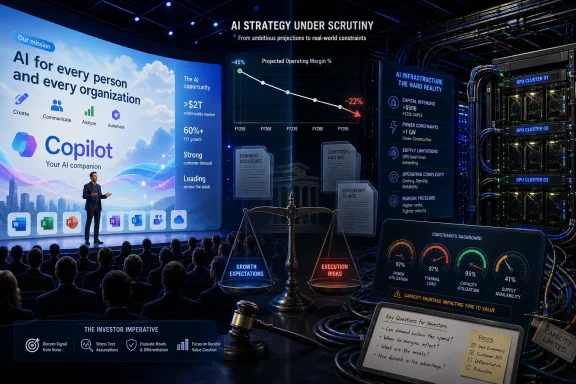
Presenter addresses an “AI strategy under scrutiny” stage with charts and server-cluster hardware.The Lawsuit Turns Microsoft’s AI Narrative Into a Disclosure Problem​

For most of the generative AI boom, Microsoft enjoyed the rarest position in technology: it looked both visionary and practical. It had the OpenAI alliance, the Azure infrastructure, the Office distribution channel, the GitHub developer beachhead, and the enterprise credibility that OpenAI itself lacked. If any incumbent could turn large language models into durable software revenue, Microsoft seemed like the obvious candidate.
The complaint described by Bloomberg Law takes aim at that very confidence. According to the pension fund plaintiff, Microsoft allegedly told investors it was well positioned to profit from AI investments while downplaying risks tied to capital expenditures, cloud capacity constraints, Copilot’s commercial traction, and dependence on providers such as OpenAI. In plainer English, the allegation is that Microsoft packaged uncertainty as inevitability.
That is a difficult claim to prove. Public companies are allowed to be optimistic, executives routinely discuss long-term opportunities, and the law gives some protection to forward-looking statements when they are properly qualified. Still, the case lands because it captures a broader shift in investor mood: AI spending is no longer being judged as an abstract race for the future, but as a set of concrete promises that must eventually show up in revenue quality, margins, and customer behavior.
Microsoft’s own second-quarter fiscal 2026 results gave the plaintiff a convenient narrative hinge. The company reported strong headline numbers on January 28, 2026, including revenue of $81.3 billion and continued Azure growth. Yet investors focused on what sat beneath the headline: Azure growth was still impressive but constrained, capital spending was enormous, and management acknowledged that demand and capacity were not neatly aligned.
The stock market can forgive heavy spending when it sees a clean path to monopoly economics. It is less forgiving when the spending looks like a toll booth on the way to someone else’s model, someone else’s compute demand, or a productivity product that customers are still learning how to justify.

Copilot Was Supposed to Be the Easy Part​

Microsoft’s Copilot pitch was powerful because it avoided the usual enterprise-software adoption problem. The company did not need to persuade businesses to move their work into a new system; the work was already sitting in Outlook, Teams, Word, Excel, PowerPoint, SharePoint, GitHub, Windows, and Azure. Copilot would arrive inside the tools employees already used, and the subscription revenue would follow.
That theory still has force. Microsoft 365 remains one of the most valuable distribution machines in technology, and even modest attach rates can become meaningful when applied to hundreds of millions of commercial users. GitHub Copilot also gave Microsoft an early example of AI that developers understood immediately: autocomplete for code was not a vague futurist demo, but a daily workflow accelerator.
The problem is that Microsoft 365 Copilot is harder to evaluate than a conventional SaaS upgrade. Its usefulness depends on data hygiene, permissions, user training, prompt literacy, and the type of work being done. A knowledge worker who lives in meetings and email may see clear value; another who needs precision, auditability, or domain-specific reasoning may find the tool impressive in demos but uneven in production.
That unevenness matters because Microsoft priced Copilot as a premium add-on, not a free enhancement. A $30-per-user-per-month enterprise AI assistant asks CIOs to make a budgetary argument, not just a curiosity argument. At pilot scale, companies can experiment; at deployment scale, they must defend the spend against security tools, cloud bills, endpoint refreshes, compliance projects, and every other demand on IT.
The lawsuit’s reference to Copilot struggles should be read in that context. It is not that Copilot has failed, nor that Microsoft lacks adoption. It is that the product sits in the dangerous middle zone where excitement is real, usage is uneven, and financial expectations may have outrun measurable productivity gains.

Azure’s Capacity Constraints Cut Against the Magic Trick​

The great promise of cloud computing was elasticity. Customers did not need to think about the physical plant; Microsoft, Amazon, and Google would abstract away the servers, storage, networking, power, cooling, and procurement. Generative AI has made that abstraction look thinner.
Microsoft’s January 2026 earnings commentary exposed the issue. Azure demand remained strong, but capacity constraints limited how much demand Microsoft could convert into immediate revenue. That is not a normal software problem. It is a physical-world problem involving chips, data center construction, energy availability, supply chains, depreciation schedules, and the brutal lead times of industrial infrastructure.
This is why AI is such a strange business for Microsoft. The company is trying to sell software-like intelligence, but it must fund hardware-like expansion to deliver it. The marginal cost of serving another Word document is trivial; the marginal cost of serving another AI-heavy workload can involve expensive accelerators, memory, power, and networking capacity.
Investors noticed because the capital intensity changes the Microsoft story. The classic Microsoft model was licensing leverage: write code once, sell it many times, collect high-margin revenue. The cloud era already made that model more capital-intensive, but Azure still matured into a hugely attractive business. AI raises the question again, and more sharply: how much must Microsoft spend before AI looks like software economics rather than infrastructure economics?
Management has argued that demand is strong and that capacity coming online will be monetized. That may be true. But the securities case exists because investors now want to know whether Microsoft adequately distinguished demand that is profitable, durable, and diversified from demand that is expensive, concentrated, or dependent on a handful of AI partners.

OpenAI Is Microsoft’s Advantage and Its Complication​

Microsoft’s OpenAI partnership remains one of the most consequential deals in modern technology. It gave Microsoft an early lead in generative AI products, turned Azure into a strategic compute platform for frontier models, and let Redmond move faster than rivals that were still deciding how aggressively to ship AI into consumer and enterprise products. Without OpenAI, Copilot would likely have been slower, weaker, and less central to Microsoft’s market narrative.
But the same partnership complicates Microsoft’s financial story. OpenAI is not just a supplier, not just a customer, not just an investment, and not quite a subsidiary. It is a strategic counterparty whose needs can influence Azure capacity planning, commercial backlog, product roadmaps, investor perception, and regulatory attention.
That ambiguity is useful in product strategy and awkward in securities litigation. If OpenAI demand fills Azure data centers, Microsoft can point to contracted demand and cloud relevance. If OpenAI’s needs consume scarce capacity or distort backlog interpretation, critics can argue that the relationship makes Microsoft’s AI economics harder to read. A great strategic relationship can still be a disclosure headache.
The lawsuit reportedly points to Microsoft’s dealings with providers like OpenAI as part of the alleged misrepresentation. That framing reflects a wider investor concern: Microsoft may be both the landlord and the financial sponsor of part of the AI boom it is asking shareholders to value. When the cloud provider, model partner, infrastructure financier, and application distributor are tightly intertwined, simple growth metrics become harder to interpret.
None of this means the OpenAI relationship is bad for Microsoft. On the contrary, it may still prove to be one of the company’s best strategic bets since Azure itself. But the more central OpenAI becomes to Microsoft’s AI results, the more investors will demand clarity about concentration, margins, capacity allocation, and the durability of the commercial rights Microsoft has secured.

The Case Arrives as AI Spending Meets the Old Rules of Wall Street​

The first phase of the AI boom rewarded ambition. Every cloud giant wanted to prove it was building for the next platform shift, and investors punished any company that seemed cautious. Microsoft benefited because it could plausibly say it had both the model access and the enterprise channel to turn AI into revenue.
The second phase is different. Wall Street is still willing to fund AI infrastructure, but it now wants evidence that the spending curve and the revenue curve are related. That is why Microsoft’s capital expenditures have become a central character in the story. A company can grow revenue and still worry investors if the cost of sustaining that growth accelerates faster than confidence in the payoff.
This is not simply a Microsoft problem. Amazon, Google, Meta, Oracle, and others are all spending heavily on AI infrastructure, and the market is trying to separate strategic necessity from overbuilding. The difference is that Microsoft made AI more central to its public identity earlier and more successfully than most. It put Copilot branding everywhere, from Windows to Office to security to development tools.
That ubiquity created expectations. If Copilot was going to be the new user interface for work, investors could justify massive spending. If Copilot is instead a useful but uneven assistant with slower-than-hoped enterprise monetization, then the spending looks less like a platform toll road and more like an expensive option on future behavior.
The lawsuit effectively asks whether Microsoft presented the former while knowing more about the latter than it told shareholders. That is the legal question. The business question is broader: when an AI product is everywhere in the marketing stack, how much adoption, usage, retention, and margin evidence should investors expect before treating it as a proven growth engine?

Windows Users Are Watching a Financial Story Become a Product Story​

For WindowsForum readers, the temptation is to treat this as a Wall Street fight far removed from daily computing. It is not. Microsoft’s AI spending pressure will shape the Windows and Microsoft 365 experience users actually get over the next several years.
If AI infrastructure remains expensive, Microsoft has incentives to steer users toward paid tiers, bundle AI into higher-value subscriptions, meter agentic features, and reserve the best models or fastest responses for commercial customers. That means the product surface may continue to shift from “Copilot is included” to “Copilot is a family of entitlements.” The difference matters to households, small businesses, and IT departments trying to understand what they are actually paying for.
Windows itself has already become a test bed for this tension. Microsoft wants AI features close to the operating system because Windows is still the daily environment for hundreds of millions of users. But deeply integrated AI also raises concerns about privacy, local versus cloud processing, enterprise policy control, data retention, and whether features can be disabled cleanly.
For administrators, the financial pressure shows up as governance pressure. If Microsoft needs Copilot adoption to validate spending, customers should expect more prompts, more admin-center nudges, more licensing bundles, and more product defaults designed to normalize AI use. Some of those features will be helpful. Others will feel like the latest version of a familiar Microsoft habit: make the strategic product unavoidable, then let enterprise procurement sort out the consequences.
Security-minded users should watch the same dynamic. AI assistants that can summarize documents, search mailboxes, generate code, and act through plugins or agents are powerful precisely because they sit near sensitive data. The more Microsoft pushes Copilot into workflows, the more important permission hygiene, audit logs, tenant configuration, and data loss prevention become.

Enterprise IT Will Judge Copilot More Harshly Than Consumers Do​

Consumer AI can survive on novelty longer than enterprise AI can. A home user may tolerate hallucinations, inconsistent answers, or personality changes because the stakes are low. A legal department, finance team, hospital, manufacturer, or government agency cannot.
That creates a hard adoption curve for Microsoft. The customers most valuable to the Copilot business are also the customers most likely to demand controls, evidence, training, integration work, and measurable return on investment. A CIO cannot simply say that employees seem impressed. The CIO must explain why the tool is worth the seat cost, the change-management effort, the security review, and the support burden.
Microsoft’s advantage is that it knows how to sell into that world. The company has spent decades turning messy enterprise needs into licensing motions, admin controls, compliance promises, and partner ecosystems. If Copilot becomes a standard part of the enterprise stack, it will not be because every worker had a magical first experience; it will be because Microsoft made the tool manageable, auditable, and bundled into procurement logic.
But that takes time, and time is exactly what securities plaintiffs often seize upon. If executives spoke as if AI monetization was accelerating smoothly while internal data showed friction, the gap becomes legally interesting. If Microsoft can show that its statements were appropriately qualified and that adoption uncertainty was visible to investors, the claim becomes much harder.
The more important point for customers is that pilots are not deployments. Many organizations have tested Copilot; fewer have fully redesigned workflows around it. Until those second-stage deployments become routine, the AI productivity story will remain partly aspirational.

The Real Risk Is Not That Microsoft Spent Too Much, but That It Made AI Sound Too Simple​

It is easy to say Microsoft is spending too much on AI. That may also be wrong. If generative AI becomes the next major computing interface, underinvesting would be more dangerous than overinvesting. Microsoft knows from mobile and search what it costs to miss a platform shift.
The sharper critique is that Microsoft’s public story has sometimes made the transition sound too clean. Copilot branding suggests a unified assistant layer, but the reality is a portfolio of products with different capabilities, costs, limitations, and adoption curves. Azure AI demand suggests explosive opportunity, but capacity constraints reveal the difficulty of converting that opportunity into timely revenue. OpenAI gives Microsoft frontier credibility, but also introduces dependency and complexity.
This is where the lawsuit’s significance extends beyond its legal merits. It reflects investor impatience with AI inevitability as a substitute for operating detail. Shareholders are not rejecting AI; they are asking for a clearer bridge between capex and cash flow.
Microsoft can still build that bridge. It can disclose more useful Copilot metrics, clarify AI gross margin trends, explain capacity allocation, separate OpenAI-driven demand from broader Azure demand where practical, and give customers better tools to measure productivity gains. The company does not need to reveal trade secrets to improve confidence. It needs to show that the AI machine is becoming more legible.
That legibility matters because Microsoft is no longer merely describing a future product category. It is spending like the future has arrived, and asking investors to believe that the returns will arrive on a similar schedule.

The Numbers Redmond Must Now Make Boring​

The next phase of Microsoft’s AI story will be won not in product launch videos but in repeatable financial and operational evidence. The company needs to make AI look less like a heroic buildout and more like a normal, durable Microsoft business.
  • Microsoft must show that Azure capacity constraints are temporary growing pains rather than a recurring brake on AI revenue conversion.
  • Copilot needs clearer proof of paid adoption, sustained usage, renewal strength, and productivity value across ordinary enterprise customers, not just showcase deployments.
  • Capital expenditures must be tied to revenue quality, margin expansion, and durable customer demand rather than treated as a necessary article of faith.
  • The OpenAI relationship needs enough disclosure for investors to understand concentration risk without requiring Microsoft to reveal competitively sensitive contract details.
  • Windows and Microsoft 365 administrators should expect AI licensing, governance, and security controls to become a larger part of routine IT planning.
  • The lawsuit’s survival will depend on securities-law specifics, but its broader message is already clear: AI optimism is no longer enough.
The securities case may be dismissed, narrowed, settled, or fought for years, and none of those outcomes will by itself decide whether Microsoft’s AI strategy succeeds. The more consequential trial is already underway in boardrooms, admin centers, data centers, and renewal meetings, where Copilot must prove it is more than a brand umbrella and Azure must prove that huge AI infrastructure spending can become high-quality Microsoft revenue. If Redmond can make that proof boring, predictable, and visible, the current backlash will look like a mid-cycle panic; if it cannot, this lawsuit will be remembered as an early sign that the AI boom’s most polished enterprise story was always carrying more uncertainty than Microsoft wanted to admit.

References​

  1. Primary source: Bloomberg Law News
    Published: Mon, 15 Jun 2026 14:20:00 GMT
  2. Related coverage: bloomberg.com
  3. Related coverage: windowscentral.com
  4. Related coverage: geekwire.com
  5. Related coverage: techradar.com
  6. Related coverage: classaction.org
  1. Official source: microsoft.gcs-web.com
  2. Official source: microsoft.com
  3. Related coverage: datacenterdynamics.com
  4. Related coverage: fortune.com
  5. Related coverage: constellationr.com
  6. Related coverage: zacks.com
  7. Related coverage: insiderfinance.io
  8. Related coverage: windowsforum.com
  9. Related coverage: elpais.com
  10. Related coverage: savest-financial.com
 

Bronstein, Gewirtz & Grossman LLC is urging Microsoft investors who bought MSFT shares between May 1, 2025, and January 28, 2026, to consider joining a securities class action filed in federal court in Seattle over alleged AI, Copilot, Azure, and capital-spending disclosures. The lawsuit is not a verdict on Microsoft’s AI strategy, and it does not establish that the company misled anyone. But it does mark a sharper phase in the market’s reassessment of the AI buildout: the moment when investor unease about GPUs, data centers, Copilot adoption, and Azure capacity became litigation. For WindowsForum readers, the case matters less as courtroom drama than as a window into the pressure now sitting underneath Microsoft’s entire cloud-and-AI story.

Futuristic court and server room overlay shows stock drops and Azure/Copilot AI capacity with “bottleneck” warnings.The Lawsuit Turns AI Optimism Into a Disclosure Fight​

The shareholder complaint, filed as City of St. Clair Shores Police and Fire Retirement System v. Microsoft Corporation, targets Microsoft and senior executives under federal securities law. The class period runs from May 1, 2025, through January 28, 2026, and the lead-plaintiff deadline being circulated by investor-rights firms is August 11, 2026.
The basic allegation is familiar in securities litigation: investors say Microsoft’s public statements painted a rosier picture than reality allowed. In this version, the alleged gap concerns Copilot’s commercial traction, Azure’s capacity allocation, AI infrastructure spending, and whether Microsoft was candid enough about the cost of turning its AI ambitions into a working business.
That distinction matters. This is not a consumer lawsuit about whether Copilot works well enough, nor an antitrust suit about Microsoft’s place in the AI stack. It is a disclosure case: did Microsoft tell the market enough, at the right time, about constraints and tradeoffs that could affect its financial performance?
The filing arrives after a bruising stock reaction to Microsoft’s January 28, 2026, fiscal second-quarter earnings. Microsoft reported strong headline numbers, including $81.3 billion in revenue and Microsoft Cloud revenue above $50 billion, yet investors focused on Azure’s growth trajectory, capital expenditure, and the possibility that AI infrastructure demand was becoming more expensive and less cleanly monetizable than expected.
That is the paradox at the center of the case. Microsoft did not stumble like a weak company. It delivered the kind of financial performance most enterprise vendors would envy. The legal fight begins because, in the AI era, even excellent results can disappoint when the market has priced in something close to inevitability.

Microsoft’s AI Story Has Always Been a Capacity Story​

Microsoft’s recent pitch to investors has been deceptively simple: AI demand is enormous, Microsoft has the enterprise relationships and cloud footprint to absorb it, and Copilot will extend the company’s productivity moat into the next computing platform. That story is plausible. It is also capital-hungry in a way old Microsoft rarely was.
The complaint reportedly alleges that Microsoft did not adequately disclose problems affecting the Copilot family of products, including brand positioning, user experience, usage, data silos, compute capacity, organizational friction, and interoperability. It also alleges that Microsoft’s own AI model performance and competitive standing were weaker than investors were led to believe, and that the company had to spend heavily while diverting GPU and CPU capacity from profitable Azure demand.
That last point is the one IT professionals should watch most closely. A hyperscaler can be demand-constrained, supply-constrained, or execution-constrained; each condition produces a very different business. Microsoft has repeatedly emphasized demand, but the market has become increasingly interested in supply — namely, how fast data centers, power, networking, GPUs, CPUs, and storage can be brought online and translated into revenue.
Azure’s 39 percent growth in the quarter ended December 31, 2025, looked terrific in isolation. But investors were not judging it in isolation. They were judging it against the prior quarter, against expectations for AI-driven acceleration, against capex levels, and against Microsoft’s own commentary that capacity remained a gating factor.
That is where the legal and technical stories overlap. If Microsoft was choosing how to allocate scarce compute across Azure, OpenAI-related workloads, Copilot, internal AI research, and broader enterprise cloud demand, the strategic question becomes financial: which workloads generate the best returns, and how clearly did Microsoft explain those tradeoffs?

Copilot Is No Longer Just a Product Bet​

Copilot began life, in investor shorthand, as the cleanest monetization story in generative AI. Microsoft already had hundreds of millions of Office users, a deeply entrenched enterprise channel, and the ability to place AI features inside Word, Excel, Outlook, Teams, Windows, GitHub, Dynamics, Security, and Azure tooling. Compared with consumer AI companies chasing uncertain subscription economics, Microsoft appeared to have the most direct path from demo to invoice.
The lawsuit’s allegations challenge the smoothness of that path. They suggest that converting Microsoft 365 users into paid Copilot subscribers was not merely a matter of flipping a licensing switch. It required product clarity, data readiness, user trust, admin confidence, model quality, capacity planning, and enough workflow relevance to justify a meaningful per-user price.
Any admin who has deployed major Microsoft 365 features will recognize the friction. Enterprises do not adopt new tools just because Redmond puts them in the admin center. They ask whether data governance is ready, whether prompts leak sensitive context, whether audit logs are adequate, whether users understand the tool, whether licensing is coherent, and whether the productivity gain survives contact with real work.
That makes Copilot different from a typical Office feature. A new Excel function or Teams capability can be useful without transforming the infrastructure economics of Microsoft. Copilot, by contrast, consumes expensive compute, depends on organizational data quality, and must persuade finance departments that AI assistance is worth recurring spend across large employee populations.
The case will have to prove legal claims, not merely product skepticism. Still, the complaint captures a real industry tension: enterprise AI has been marketed as inevitable, while adoption has often been uneven, departmental, and constrained by governance work that vendors cannot magically do for customers.

Azure’s 39 Percent Growth Was Both Impressive and Not Enough​

Microsoft’s fiscal Q2 2026 earnings created the kind of split-screen moment that has become common in the AI trade. The company beat expectations on several headline metrics, reported massive cloud revenue, and continued to show demand that most infrastructure providers would kill for. Yet the stock fell sharply because the market was looking for evidence that AI spending would produce not only growth, but growth with attractive timing and margins.
Azure and other cloud services revenue increased 39 percent year over year, with Microsoft saying demand remained broad across workloads. On a normal software-industry scorecard, that is elite performance at Microsoft’s scale. On the AI-infrastructure scorecard of early 2026, it was treated as a warning because it followed 40 percent growth and came alongside guidance for 37 to 38 percent growth in the next quarter.
That reaction may look absurd to anyone outside Wall Street. But it reflects the valuation problem Microsoft now faces. The company is no longer being measured only as a high-margin software compounder; it is being measured as one of the world’s largest builders of AI infrastructure, and that business consumes capital before it proves returns.
The lawsuit leans into that shift. If Microsoft had to pour billions into additional infrastructure while routing scarce GPU and CPU capacity toward AI products that were strategically important but not necessarily the highest-return Azure workloads, investors will want to know whether the company adequately disclosed the implications.
For sysadmins and cloud architects, the operational analogy is straightforward. A cloud provider can have all the demand in the world and still disappoint customers if capacity is unavailable in the right region, with the right accelerator class, at the right latency, under the right compliance regime. “Demand exceeds supply” sounds bullish until it starts to cap revenue, complicate migrations, or force prioritization among customers and internal initiatives.

The AI Boom Is Making Microsoft More Like an Industrial Company​

The old Microsoft scaled through software licenses. The new Microsoft still does that, but its most exciting growth story now depends on physical infrastructure at almost unimaginable scale. GPUs must be procured. Data centers must be built or leased. Power must be secured. Cooling, networking, and memory supply have become strategic variables.
That changes the investor bargain. Software margins conditioned the market to expect that growth at Microsoft would be capital-light, predictable, and deeply cash generative. AI infrastructure pushes the company toward a more asset-heavy model, where depreciation schedules, component cycles, utilization rates, and power constraints matter much more.
The tension is not unique to Microsoft. Amazon, Google, Meta, Oracle, and others are all racing to secure compute for AI workloads. But Microsoft is uniquely exposed because its AI story spans the entire stack: OpenAI partnership, Azure AI services, Microsoft 365 Copilot, GitHub Copilot, Windows integration, developer platforms, security tooling, and enterprise data services.
That breadth is a strategic advantage. It also means Microsoft can spend money in many places before investors can easily see which bets are producing durable returns. A GPU assigned to model training, Copilot inference, Azure customer demand, or internal R&D may all support the AI platform story, but the revenue timing and margin profile can differ substantially.
The legal complaint’s framing — that Microsoft needed to increase capex and divert capacity to improve Copilot’s positioning and AI R&D — goes directly to that ambiguity. If AI compute is the new scarce resource, then allocation becomes disclosure-sensitive. Investors care not only that Microsoft is buying capacity, but where that capacity goes and what it earns.

Press Releases From Law Firms Are Not Courtroom Findings​

It is worth slowing down on the nature of the source material. Investor-rights law firms often issue broadly distributed press releases after securities class actions are filed, encouraging eligible shareholders to contact them before a lead-plaintiff deadline. Those notices can sound definitive, but they are advocacy documents, not judicial findings.
The allegations against Microsoft remain allegations. The company will have opportunities to respond, seek dismissal, contest scienter, challenge loss causation, and argue that its disclosures were accurate, appropriately qualified, or immaterial in the legal sense. Many securities cases do not survive early motions; others narrow substantially before settlement or trial.
That does not make the case meaningless. Securities litigation often functions as a lagging indicator of market disappointment. When a stock falls after a disclosure and plaintiffs can point to prior optimistic statements, the legal system becomes a venue for arguing whether the disappointment was merely business risk or previously concealed truth.
Microsoft’s defense, if the case proceeds in the expected pattern, is likely to emphasize the breadth of its disclosures around AI demand, capacity constraints, capital expenditures, competitive risk, and product execution. Large public companies routinely warn investors that new technologies require investment, that growth rates may fluctuate, and that competition can intensify.
The plaintiffs’ burden will be to show more than hindsight. They must connect specific statements to specific alleged omissions or misrepresentations, then show that the eventual market decline was tied to the revelation of the concealed facts. In other words, “AI was harder than investors hoped” is not automatically securities fraud.

The Market Is Testing Microsoft’s AI Vocabulary​

Microsoft’s AI communications have tended to rely on a small cluster of phrases: demand, capacity, efficiency, platform, Copilot, commercial cloud, and long-term opportunity. That vocabulary worked when investors were focused on whether Microsoft had an AI strategy. It becomes less satisfying when investors want to know whether the strategy is generating returns commensurate with spending.
The company has said it is monetizing capacity quickly and that demand remains strong. It has also acknowledged that infrastructure constraints affect the timing of growth. Those two claims can both be true. A cloud provider can sell everything it can bring online while still missing the market’s hopes for acceleration.
The harder issue is whether AI workloads are economically equivalent. A dollar of traditional enterprise Azure consumption, a dollar of OpenAI-related infrastructure commitment, and a dollar of Copilot subscription revenue do not necessarily carry the same gross margin, customer concentration risk, or capital intensity. Investors are increasingly trying to disaggregate those dollars.
That is why remaining performance obligations and commercial backlog have attracted so much attention. Backlog can signal future demand, but it does not automatically answer questions about margin, duration, customer mix, cancellation risk, or the infrastructure required to serve it. In the AI cycle, the headline number can be both impressive and incomplete.
For WindowsForum’s audience, the lesson is familiar from licensing: Microsoft’s bundles often make strategic sense before they make accounting sense to outsiders. The company can use its ecosystem to drive adoption across products, but customers and investors eventually ask for line-of-sight value. Copilot is now entering that phase.

Enterprise IT Should Read the Case as a Capacity Warning, Not a Stock Tip​

Most WindowsForum readers are not deciding whether to become lead plaintiffs. They are deciding whether to deploy Copilot, expand Azure commitments, modernize Windows fleets, adopt AI PCs, or build internal apps on Microsoft’s AI stack. The lawsuit does not answer those deployment questions, but it does sharpen them.
If the plaintiffs are directionally right that Copilot adoption has been messier than Microsoft’s narrative implied, enterprise buyers should demand clearer proof of value. That means pilots with measurable outcomes, attention to data hygiene, and realistic assumptions about training, governance, and change management. AI productivity tools do not become valuable just because they are embedded in familiar applications.
If the capacity allegations prove overstated, the practical warning still stands. AI cloud consumption is not the same as spinning up a routine VM. Accelerator availability, regional capacity, inference latency, quota management, and cost controls can shape the success of real deployments. Customers should ask Microsoft and partners not only whether a service exists, but whether the needed capacity is available where and when workloads require it.
The Windows angle is subtler but important. Microsoft has been working to make AI feel native across Windows, Microsoft 365, Edge, developer tools, and cloud services. That integration is powerful, but it also means organizations can become dependent on a fast-moving stack whose licensing, privacy, and compute assumptions keep evolving.
For IT pros, skepticism should not mean paralysis. It should mean procurement discipline. Microsoft’s AI platform may remain the safest enterprise default for many organizations, but defaults still need architecture review, security review, cost modeling, and exit planning.

The Court Fight Sits Inside a Larger AI Backlash​

The Microsoft case lands during a broader recalibration around AI spending. Investors have become more comfortable asking whether massive capex plans are justified by near-term revenue, whether enterprise AI adoption is moving quickly enough, and whether the largest cloud providers are creating durable moats or simply buying expensive hardware at the top of the cycle.
That backlash should not be confused with AI failure. Demand for compute is real. Developers are using AI coding tools. Enterprises are testing agents, copilots, retrieval systems, summarization workflows, security automation, and support bots. The shift is substantial.
The question is whether the economic capture will match the infrastructure buildout. A technology can be transformative while still producing uneven vendor returns. Railroads, fiber networks, and cloud data centers all changed the world; not every investor in every buildout captured the value cleanly.
Microsoft’s advantage is that it has multiple routes to monetization. It can sell Azure infrastructure, Microsoft 365 subscriptions, GitHub services, security products, data platforms, developer tooling, and Windows experiences. Its disadvantage is that the market knows this and has priced the company accordingly.
That is why the lawsuit matters beyond its legal merits. It shows that investors are no longer satisfied with the broad claim that AI demand is strong. They want to know which products are working, which workloads are profitable, and whether Microsoft’s spending curve is a bridge to higher returns or a toll road to lower margins.

Redmond’s AI Case Now Has Receipts Attached​

The immediate facts are concrete enough for investors, admins, and Microsoft watchers to separate noise from signal. The lawsuit may fade, settle, or survive; the operational questions behind it will remain.
  • Microsoft faces a proposed securities class action covering investors who bought MSFT common stock from May 1, 2025, through January 28, 2026.
  • The complaint centers on alleged disclosures involving Copilot adoption, Azure capacity, AI model competitiveness, capital expenditures, and the diversion of compute resources.
  • Microsoft’s January 28, 2026, earnings showed strong headline performance, including Azure growth of 39 percent, but investors reacted negatively to growth trajectory and AI infrastructure spending.
  • The lead-plaintiff deadline being promoted by shareholder firms is August 11, 2026, but the filing itself does not prove misconduct.
  • Enterprise IT should treat the dispute as a reminder to validate Copilot value, Azure capacity assumptions, AI governance readiness, and long-term cost exposure before broad deployment.
The most important Microsoft story of 2026 is not whether the company believes in AI; that question was answered long ago. The harder story is whether Microsoft can turn an enormous, capital-intensive infrastructure race into the kind of dependable, high-margin platform economics that made it a generational enterprise company. This lawsuit will not decide that future on its own, but it exposes the pressure point: Redmond’s AI promises now have to survive not only demos and earnings calls, but discovery, investor scrutiny, and the daily judgment of customers trying to make the technology pay.

References​

  1. Primary source: lincolnjournal.com
    Published: 2026-06-15T16:50:08.143636
  2. Related coverage: globenewswire.com
  3. Related coverage: nasdaq.com
  4. Related coverage: prnewswire.com
  5. Related coverage: barchart.com
  6. Related coverage: newsfilecorp.com
  1. Related coverage: techradar.com
  2. Related coverage: windowscentral.com
  3. Related coverage: milberg.com
  4. Related coverage: appliedantitrust.com
  5. Related coverage: investing.com
  6. Related coverage: natlawreview.com
  7. Related coverage: businesswire.com
  8. Related coverage: marketchameleon.com
  9. Related coverage: ktmc.com
  10. Related coverage: yellow.com
  11. Related coverage: classaction.org
  12. Related coverage: marketscreener.com
  13. Related coverage: bgandg.com
  14. Official source: microsoft.com
  15. Related coverage: fortune.com
  16. Related coverage: fool.com
  17. Related coverage: datacenterdynamics.com
  18. Related coverage: marketbeat.com
 

A proposed securities class action filed in June 2026 accuses Microsoft and several officers of misleading investors between May 1, 2025, and January 28, 2026, about Copilot adoption, AI infrastructure costs, Azure capacity pressure, and the competitive standing of Microsoft’s AI products. The case is not a verdict on whether Copilot is failing, but it is a useful stress test of Microsoft’s central story to Wall Street and enterprise IT: that AI will deepen the company’s moat rather than consume it. For Windows users, administrators, and developers, the lawsuit matters because it drags a familiar operational question into a financial courtroom: whether Copilot is a product customers are choosing, or an expensive layer Microsoft must keep forcing into the stack.

Futuristic data-center dashboard showing “Copilot” AI with capacity utilization and GPU performance charts.The Lawsuit Turns Copilot From Product Strategy Into Securities Risk​

The investor notice from Bronstein, Gewirtz & Grossman is one of several law-firm alerts now circling Microsoft shareholders after a class action was filed over alleged AI-related misstatements. The complaint, as described by the firms, targets purchasers of Microsoft securities during a class period running from May 1, 2025, through January 28, 2026, with an August 11, 2026, deadline for investors seeking lead-plaintiff status.
The allegations are broad but pointed. They say Microsoft failed to disclose significant problems across the Copilot family, including brand positioning, user experience, usage, data siloing, compute capacity, organizational friction, and interoperability. They also allege that Microsoft’s proprietary AI model trailed competitors on benchmarks, that the company needed billions more in capital spending and compute allocation to improve Copilot’s position, and that commercial Microsoft 365 customers were not converting to paid Copilot subscriptions at the rate investors had been led to expect.
That is not the same as proving fraud. Securities class actions often begin with sharp claims, stock-drop narratives, and a list of statements plaintiffs say were incomplete or misleading. Microsoft will have room to argue that it warned investors about AI spending, cloud capacity constraints, competition, and execution risk, and that its public statements were forward-looking, qualified, or immaterial.
But the lawsuit’s importance is not limited to the courtroom. It captures a growing tension in Microsoft’s AI era: the company’s public confidence in Copilot has run ahead of many customers’ day-to-day experience with it. When a product is marketed as a transformation layer across Windows, Office, GitHub, Security, Dynamics, Edge, Teams, and Azure, disappointment is not confined to one SKU. It becomes a credibility problem for the whole Microsoft platform.

January 28 Became the Date the AI Bill Came Due​

The class period ends on January 28, 2026, the day Microsoft reported fiscal second-quarter results. On paper, the numbers were hardly disastrous: revenue rose, operating income climbed, Azure continued growing strongly, and Microsoft’s AI business was still being framed as a massive growth engine. Yet the market reaction focused on what sat beneath the headline growth — escalating capital expenditures, AI capacity trade-offs, and signs that Azure demand was being shaped as much by supply constraints as customer appetite.
That is the awkward thing about AI infrastructure. In the old Microsoft model, the company could sell more copies, more subscriptions, and more cloud services with enviable incremental margins. In the generative AI model, every new wave of usage has a physical shadow: GPUs, CPUs, data centers, power, networking, and cooling. The more Copilot becomes a default surface across Microsoft products, the more Microsoft must fund the machinery behind every prompt.
The complaint’s theory leans into that economics problem. It alleges Microsoft had to divert GPU and CPU capacity away from profitable Azure demand to support Copilot and AI research. That claim will be contested, but it points to a real strategic constraint. Azure is not just a place where Microsoft sells infrastructure to customers; it is also the internal furnace powering Microsoft’s own AI products, OpenAI-related workloads, GitHub Copilot, Microsoft 365 Copilot, and the company’s model development ambitions.
For investors, that means the AI story is no longer measured only by adoption charts and customer anecdotes. It is measured by whether Microsoft can turn compute into high-margin revenue faster than it turns capital into depreciation. For IT buyers, it raises a different question: if Microsoft is capacity-constrained, which customers and workloads get priority when demand spikes?

Copilot’s Real Problem Is That It Means Too Many Things​

Microsoft’s most visible AI mistake may not be technical. It may be semantic. “Copilot” now refers to a consumer chatbot, a Windows sidebar, a Microsoft 365 assistant, a GitHub coding tool, a security analyst helper, a Dynamics feature set, an Edge companion, an Azure development aid, and an expanding family of agents that behave differently depending on licensing, tenant configuration, data access, and product context.
That breadth is the heart of Microsoft’s AI strategy. It is also why the brand can feel slippery. A sysadmin troubleshooting Microsoft 365 Copilot permissions, a developer using GitHub Copilot in Visual Studio Code, and a Windows 11 user clicking the Copilot key are all technically encountering “Copilot,” but they are not using the same product in any meaningful operational sense.
The lawsuit’s reference to brand positioning and user experience problems therefore lands on familiar ground. Microsoft has spent years turning bundled software into platform leverage, from Internet Explorer to Teams to OneDrive. With Copilot, the company is trying something more ambitious: making AI feel like the natural interface for the Microsoft estate. The danger is that customers experience it instead as a naming convention pasted over unrelated capabilities.
This matters in enterprise purchasing. A CIO does not buy “AI” in the abstract for tens of thousands of employees simply because the vendor has inserted a button into Office. They buy measurable productivity, governed data access, manageable risk, and predictable cost. If the Copilot name promises more coherence than the products deliver, procurement teams will treat it less like the next Microsoft 365 tier and more like another pilot project that needs justification.

The Microsoft 365 Conversion Story Was Always the Hardest One​

Microsoft 365 Copilot is the centerpiece because it reaches the most valuable terrain Microsoft controls: the daily work graph of enterprise knowledge workers. Email, calendars, documents, spreadsheets, meetings, chats, SharePoint sites, Teams channels, OneDrive files, and identity signals all live inside Microsoft’s reach. If any company should be able to build an AI assistant that knows the context of work, it is Microsoft.
That is why weak conversion would be so damaging if proven. Microsoft 365 has an enormous installed base, and Copilot’s promise was that existing enterprise dependency would translate into rapid paid adoption. The pitch was elegant: your data is already in Microsoft 365, your identity is already in Entra ID, your compliance posture is already defined, and your users already live in Office. Add Copilot, and the productivity dividend arrives inside the tools employees already use.
The practical reality has been messier. Many organizations have had to clean up permissions, rationalize SharePoint sprawl, improve information architecture, revisit retention policies, and train users before Copilot can produce reliable value. The assistant is only as useful as the tenant it can safely reason over. In a well-governed environment, that can be powerful. In a sprawling tenant with years of over-permissioned files and abandoned Teams sites, it can become an expensive mirror reflecting the organization’s data hygiene problems.
That is not necessarily Microsoft’s fault, but it is Microsoft’s sales problem. The company sold Copilot as an accelerant. Many customers discovered it was also an audit.

Azure Is Both the Growth Engine and the Bottleneck​

The lawsuit’s most consequential allegation is not that Copilot has user-interface problems. Software has user-interface problems. The heavier claim is that Microsoft’s AI push forced compute trade-offs inside Azure, potentially limiting capacity available for other profitable services.
That claim strikes at Microsoft’s most important business. Azure growth underwrites the broader AI narrative, funds capital expansion, and reassures investors that Microsoft is not merely adding costly AI features to mature productivity software. If Azure capacity becomes a zero-sum allocation exercise between external cloud customers, OpenAI-related commitments, internal Copilot workloads, and Microsoft’s own research teams, the company’s strongest asset becomes its most sensitive constraint.
Microsoft has acknowledged heavy AI infrastructure investment and capacity pressure in broad terms. The company has also argued that demand remains strong, that efficiency gains are improving utilization, and that AI services are contributing meaningfully to Azure growth. Both can be true. A business can be growing quickly and still be constrained by the sheer physical difficulty of building enough data-center capacity for the AI boom.
For sysadmins and cloud architects, the financial argument translates into operational uncertainty. Capacity constraints can influence regional availability, quota approvals, GPU access, pricing, deployment planning, and the reliability of ambitious AI roadmaps. Enterprises do not simply want to know whether Microsoft believes in AI. They want to know whether the capacity will exist in the right geography, under the right compliance boundary, at a price that survives procurement review.
That is where securities litigation and enterprise IT briefly overlap. Investors want to know whether Microsoft’s AI economics were accurately described. Customers want to know whether Microsoft’s AI platform can scale without degrading the cloud services they already depend on.

Benchmarks Are a Blunt Weapon, but They Still Shape the Narrative​

The complaint reportedly claims Microsoft’s flagship proprietary AI model ranked well below competitors on a number of benchmark tests. That allegation needs careful handling because benchmarks in AI are notoriously unstable, gameable, and incomplete. A model can score well and still perform poorly in a specific enterprise workflow; another can trail on a public leaderboard and still deliver value when tightly integrated with proprietary data and tools.
Microsoft’s strategy has also never depended solely on owning the top foundation model at every moment. The company’s advantage is distribution, enterprise trust, identity, compliance, developer tooling, and its relationship with OpenAI. In that sense, Microsoft has always been trying to win the AI application layer by embedding assistants where work already happens, not by turning every customer into a benchmark enthusiast.
Still, benchmarks matter because they influence perception. Developers compare code generation quality. Analysts compare reasoning performance. Enterprises compare hallucination rates, latency, cost, and tool-use reliability. If customers believe rival models are better, Microsoft must prove that integration with Microsoft 365, Windows, Azure, and GitHub compensates for any raw-model gap.
That is a harder argument than it sounds. Integration is valuable only when it saves time without creating new risk. A Copilot that can summarize a meeting, draft a document, query a spreadsheet, or triage an alert must be good enough that users return voluntarily. If workers keep a rival chatbot open in another tab while Copilot sits inside the licensed stack, Microsoft’s distribution advantage starts looking less like inevitability and more like shelfware.

Windows Users Are Watching the Enterprise Fight From the Taskbar​

For everyday Windows users, the lawsuit may seem remote. It is about securities law, investor losses, and corporate disclosures. But the product strategy under scrutiny is already visible on PCs: Copilot buttons, Copilot app changes, AI-powered search, Recall-adjacent debates, Paint and Photos features, Edge integrations, and the ongoing effort to make Windows feel like an AI endpoint rather than merely an operating system.
That creates a trust issue. Microsoft’s consumer AI rollout has often felt like a moving target, with features appearing, changing, being renamed, shifting between web and native experiences, or depending on hardware requirements. Enthusiasts can tolerate experimentation. Enterprises are less forgiving when experimentation arrives through the same channel as core productivity and security tooling.
The Windows angle is especially sensitive because Microsoft has already asked users to accept major platform transitions: Windows 10’s end of support, Windows 11 hardware requirements, cloud account nudges, subscription expansion, and more telemetry-driven experiences. Copilot arrives on top of that accumulated skepticism. When Microsoft says AI will make Windows better, many users hear a second message: Microsoft wants another surface for services.
That does not mean Copilot on Windows is doomed. The operating system is an obvious place for contextual assistance, settings discovery, accessibility support, local file reasoning, and device troubleshooting. But Microsoft has to earn the right to put AI there. If Copilot is perceived as a monetization layer first and a user benefit second, Windows users will treat it like another preinstalled thing to disable.

The Legal Case Will Turn on Disclosure, Not Whether Copilot Is Annoying​

It is tempting to read the complaint as a referendum on Copilot itself. That would be a mistake. Securities fraud cases usually hinge on what executives said, what they knew or should have known, whether omissions were materially misleading, and whether investors were damaged when the truth allegedly emerged.
Microsoft can point to extensive risk disclosures, repeated references to competition, warnings about capital spending, and public discussion of AI infrastructure demand. Plaintiffs will try to show that those disclosures were too generic, while internal conditions were more serious than investors understood. The gap between “AI requires investment” and “we are diverting scarce compute from profitable Azure demand because Copilot is underperforming” is where the case will likely live.
The January 28 earnings reaction is central because plaintiffs need a corrective disclosure theory — a moment when the market supposedly learned what had been hidden. Microsoft will likely argue that the market already understood AI capex pressure, that Azure growth remained strong, and that stock movement reflected investor expectations rather than revelation of fraud. That is a familiar defense, and sometimes a powerful one.
For readers outside the legal world, the key point is simpler: the complaint does not prove Microsoft lied. It does show that the company’s AI messaging has become specific enough, financially important enough, and contested enough to attract litigation. The age of “AI enthusiasm” as harmless corporate puffery is ending.

Microsoft’s AI Moat Is Real, but It Is Not Self-Executing​

There is still a strong case for Microsoft. The company owns the enterprise desktop, the productivity suite, a massive cloud platform, a developer ecosystem, security products, database services, and identity infrastructure. It has relationships with nearly every large organization on the planet. Few companies are better positioned to turn AI from novelty into workflow.
That is precisely why execution failures matter. Microsoft does not need Copilot to win every consumer chatbot comparison. It does need Copilot to become useful enough that Microsoft 365 administrators can justify licensing, developers keep GitHub Copilot in their toolchains, security teams trust AI-assisted triage, and Azure customers believe Microsoft’s infrastructure roadmap will support their own AI plans.
The risk is not a sudden collapse. Microsoft is too diversified and too entrenched for that. The risk is a slow credibility tax: customers pilot Copilot but delay broader deployment, users try it but do not form habits, developers compare it unfavorably with alternatives, and investors begin treating AI capex as defensive spending rather than growth investment.
That distinction matters. Defensive spending protects the franchise. Growth spending expands it. Microsoft has spent the past two years insisting Copilot is the latter. The lawsuit is one sign that some investors now suspect it may contain more of the former than advertised.

The Copilot Case Forces Microsoft’s AI Story Back to Earth​

The practical lessons are narrower than the legal filings but more useful for the WindowsForum audience. Microsoft’s AI push is not going away, yet the burden of proof is shifting from demos to deployment, from prompts to budgets, and from executive optimism to measurable outcomes.
  • Microsoft investors have until August 11, 2026, to seek lead-plaintiff status in the proposed securities class action, according to the law-firm notices circulating after the June filing.
  • The complaint’s central allegation is that Microsoft overstated or failed to adequately qualify the health of Copilot adoption, AI competitiveness, and Azure capacity economics during the May 2025 to January 2026 class period.
  • Microsoft’s January 28, 2026, earnings report is the hinge point because it brought renewed attention to AI capital spending, Azure capacity constraints, and the cost of supporting first-party AI products.
  • Enterprise buyers should separate Copilot’s licensing promise from the readiness of their own data estate, because permissions, governance, and information architecture often determine whether Microsoft 365 Copilot feels useful or risky.
  • Windows users should expect Microsoft to keep embedding AI into the operating system, but user trust will depend on whether those features solve local problems rather than merely advertise cloud services.
  • The lawsuit does not establish wrongdoing, but it does confirm that AI product claims are becoming material financial claims, not just marketing language.
Microsoft now has to prove two things at once: that Copilot is good enough for customers to pay for at scale, and that the infrastructure required to run it will not dilute the cloud economics that made Microsoft so valuable in the first place. The company may yet pull that off; its distribution, enterprise reach, and engineering depth remain formidable. But the easy phase of the AI narrative is over, and the next one will be judged less by keynote applause than by renewal rates, Azure capacity, support tickets, audit findings, and whether users actually ask Copilot for help when nobody is watching.

References​

  1. Primary source: GlobeNewswire
    Published: 2026-06-15T16:50:16.011300
  2. Official source: microsoft.com
  3. Related coverage: fool.com
  4. Related coverage: scott-scott.com
  5. Related coverage: windowscentral.com
  6. Related coverage: tomsguide.com
  1. Related coverage: insiderfinance.io
  2. Related coverage: fourweekmba.com
  3. Related coverage: stockminded.com
  4. Related coverage: finimize.com
  5. Related coverage: savest-financial.com
  6. Related coverage: barchart.com
  7. Related coverage: prnewswire.com
  8. Related coverage: techcrunch.com
  9. Related coverage: classaction.org
  10. Related coverage: valuespectrum.com
  11. Related coverage: news.bloomberglaw.com
  12. Related coverage: journalofbusinessnews.com
  13. Related coverage: marketchameleon.com
  14. Related coverage: arstechnica.com
 

Back
Top