

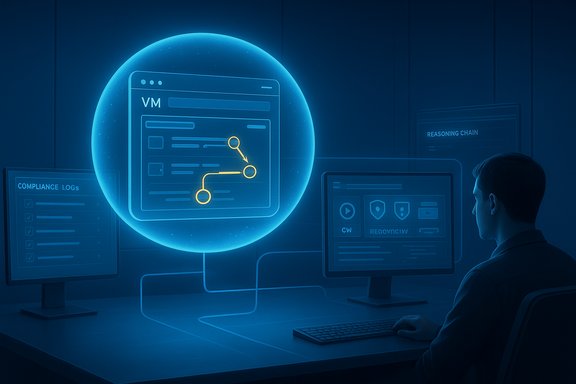
Microsoft’s move to give its Researcher agent a permissioned “Computer Use” capability — effectively a temporary, Microsoft‑hosted virtual computer the agent can operate to browse, sign in, click, type and even run short command‑line tests — marks the next practical stage in agentic AI: not just answering questions, but safely doing the necessary human steps to fetch or verify information that lives behind interactive UIs. That change is a deliberate response to the hard limitations of API‑only integrations and connector gaps, and it brings enterprise‑grade governance, credential handover primitives, visual audit trails, and explicit allow‑lists to the same class of UI automation that startups and competitors pushed into the market last year.
The story of “AI that can browse and act” accelerated in late 2024 when Anthropic introduced a capability called Computer Use that lets its Claude models interact with a virtual desktop: take screenshots, compute coordinates, move the mouse, click, type, and chain dozens or hundreds of steps inside a sandboxed environment. Independent reporting and Anthropic’s own documentation show the feature matured into an API‑centric toolset — with pixel‑counting, screenshot reasoning, and a developer pattern that runs the model’s tool requests in a contained virtual machine. Those capabilities demonstrated why an agentic model needs a real GUI session to reach content behind interactive logins and legacy apps. Microsoft’s announcement folds a comparable idea into Copilot Studio and the Researcher agent used inside Microsoft 365 Copilot: agents can now spin up an ephemeral VM or hosted browser, perform UI automation within strict tenant controls, and provide users with a visible “reasoning chain” (screenshots, step traces, and the ability to pause or takeover). Microsoft positions this as an evolution of Robotic Process Automation (RPA) — but with natural‑language authoring, model reasoning to handle UI drift, and first‑class governance baked into the agent authoring surface.
The capability is not a panacea. Prompt injection, UI fragility, data‑flow complexity and regulatory obligations mean that responsible deployment demands staged pilots, strong admin policies and human oversight. But for enterprises that correctly scope pilots — prioritise low‑risk high‑value processes, instrument DLP and logging, and demand measurable resilience — agentic computer use is a powerful new tool to automate previously impossible tasks and to turn hours of repetitive interaction into minutes of auditable, repeatable work.
Appendix — verification notes and cautionary points
Source: Blockchain News Microsoft Researcher AI Adds Secure Computer Use for Web Browsing and Multi-Step Task Automation | AI News Detail
 Background / Overview
The story of “AI that can browse and act” accelerated in late 2024 when Anthropic introduced a capability called Computer Use that lets its Claude models interact with a virtual desktop: take screenshots, compute coordinates, move the mouse, click, type, and chain dozens or hundreds of steps inside a sandboxed environment. Independent reporting and Anthropic’s own documentation show the feature matured into an API‑centric toolset — with pixel‑counting, screenshot reasoning, and a developer pattern that runs the model’s tool requests in a contained virtual machine. Those capabilities demonstrated why an agentic model needs a real GUI session to reach content behind interactive logins and legacy apps. Microsoft’s announcement folds a comparable idea into Copilot Studio and the Researcher agent used inside Microsoft 365 Copilot: agents can now spin up an ephemeral VM or hosted browser, perform UI automation within strict tenant controls, and provide users with a visible “reasoning chain” (screenshots, step traces, and the ability to pause or takeover). Microsoft positions this as an evolution of Robotic Process Automation (RPA) — but with natural‑language authoring, model reasoning to handle UI drift, and first‑class governance baked into the agent authoring surface. What “Computer Use” actually is — technical anatomy
Ephemeral hosted execution
When an agent hits a UI that requires interactive steps, it can create a short‑lived virtual machine or hosted browser instance where the automation runs. Microsoft’s implementation defaults to Microsoft‑hosted infrastructure (Windows 365‑style environments), reducing the need for customers to provision RPA runners, while allowing organisations to register their own runners if they prefer. The sandbox is ephemeral by design: state is discarded at session end unless an admin policy explicitly retains it.Visual audit and human‑in‑the‑loop controls
The environment produces screenshots and a textual trace of the agent’s reasoning, and the UI exposes real‑time visual progress. Users can watch the agent operate, pause the run, or take control. This visible audit trail is a deliberate countermeasure to concerns about opaque automation and silent actions.Virtual inputs, terminals and developer tooling
Agents use a textual control channel to issue simulated mouse and keyboard inputs and can run short scripts in an attached terminal for code testing or data extraction. Microsoft exposes the feature inside Copilot Studio as a first‑class tool that agent builders add to their flows, enabling UI automation when no API exists. The platform also provides starter templates for common enterprise tasks (data entry, invoice upload, market‑research crawls).Credentials, allow‑lists and least privilege
A major difference between naïve UI automation and this agent model is explicit credential handling. Microsoft describes a “secure handover” flow: if the run requires sign‑in, the agent will pause and prompt the human to enter credentials directly into the sandboxed browser, so secrets are never exposed to the model. Administrators can also configure credential vaulting and allow‑lists that strictly constrain the sites and desktop apps an agent may reach. Attempts to leave the allow‑list are blocked automatically.Why this matters: practical gaps agents needed to close
Most modern enterprise content lives behind complex, multi‑step UIs — legacy portals, vendor dashboards, paywalled research services, bespoke desktop apps — places where APIs are absent or inconsistent. Language models are excellent at planning and synthesis, but they hit a practical wall when they cannot execute the clicking, scrolling, and authentication required to retrieve the exact evidence the user needs. Running the work inside a disposable, auditable environment solves two key problems:- It gives agents the ability to fetch source material that only exists through an interactive UI, increasing the recall and verifiability of agent outputs.
- It provides a safer execution surface for generated code tests and experimental scripts that should not run on a primary workstation. The contained terminal lets agents validate code without risking the host.
How Microsoft’s approach compares to Anthropic and others
Anthropic’s Computer Use (announced October 2024) emphasized a developer pattern: the model proposes mouse/keyboard actions and relies on the embedding application to execute them inside a virtual display. The public demos highlighted pixel‑counting accuracy and the risk of prompt injection via visual content — real threats that require careful sandboxing and testing. Microsoft’s offering is positioned as an enterprise grade extension of Copilot Studio with three pragmatic differences:- First, Microsoft ships governance primitives (allow‑lists, tenant admin controls, credential vaulting and secure handover) as part of Copilot Studio rather than leaving them to the integrator to design.
- Second, the default execution runs on Microsoft‑hosted infrastructure with stated cloud‑boundary assurances for enterprise data, simplifying compliance conversations for many tenants.
- Third, Microsoft integrates the tool inside a broader agent authoring and testing UX that records step‑by‑step screenshots and textual reasoning for audit and debugging — a UX focused on human oversight.
Business and market implications
- Efficiency and monetization: Organizations that succeed at safely automating UI‑bound processes (AP, procurement, market scraping) can capture measurable efficiency gains. Industry analyses estimate generative AI and agentic automation may unlock trillions in economic value: McKinsey’s generative‑AI research identifies a multitrillion‑dollar opportunity (commonly summarized around a $2.6–$4.4 trillion annual value range across use cases). Those macro figures contextualize why vendors are racing to productize agent features.
- Commercial packaging: Microsoft’s Copilot family has been explicitly monetized: enterprise Copilot for Microsoft 365 has carried a list price that industry reporting and Microsoft communications have widely reported as roughly $30 per user per month (with qualifying Microsoft 365 plans required). That price point is an important commercial anchor for enterprises planning Copilot‑led automation pilots.
- Market sizing and opportunity: Analysts expect the generative/agentic AI segment to grow into a sizable market (multiple forecasts point to a hundred‑billion+ generative AI niche within a larger multi‑hundred‑billion AI software market). Statista and other market trackers forecast a generative AI market that could cross the $100B mark within a few years; these numbers help justify not only product R&D but also service firms that will package domain‑specific agents.
- Competitive dynamics: The browser and productivity suite are now a battleground. Microsoft is not alone: Anthropic, OpenAI, Google, and startups each offer different primitives (model‑level computer use, operator frameworks, or browser‑level agent modes). Enterprises will prioritize vendors that offer the right mix of accuracy, governance, and legal boundaries.
Security, regulatory and operational risks — the tradeoffs
Adding agentic UI automation widens the attack surface and changes governance responsibilities. The principal risks and mitigation patterns observed across public docs and reporting are:Prompt injection and visual attacks
Because agents reason from screenshots, malicious instructions embedded in a page’s content (images or HTML) can attempt to override or misdirect the agent. Anthropic and independent researchers flagged prompt injection as a concrete, heightened risk for computer‑use agents and recommend limiting access to trusted environments and strong input validation.Data exfiltration and compliance
Even with ephemeral hosts and allow‑lists, automation runs can transfer sensitive content to downstream systems. Organisations must map data flows, enforce Data Loss Prevention (DLP) policies, and instrument thorough audit logs. Microsoft’s documentation stresses that sessions run within Microsoft Cloud boundaries by default, but tenant admins must still model cross‑cloud connectors and review where any model reasoning payloads traverse.Fragility and operational reliability
Real UIs are messy: dynamic DOMs, localisation differences, CAPTCHAs, multi‑factor prompts, and non‑standard widgets can break automated flows. Vendors claim reasoning‑based recovery, but real‑world robustness will be measured in production‑grade error rates and how easily operators can author fallbacks. Pilot and staged rollout remain best practice.Regulatory context and transparency
Governments are already moving to impose transparency and safety requirements for AI. The EU’s AI Act rolled out initial provisions in 2025 and includes transparency obligations for certain high‑risk systems; the law’s phased enforcement and upcoming technical requirements increase the compliance burden on vendors and enterprise deployers of agentic AI. Enterprises must build auditable decision trails and demonstrate data governance to satisfy these requirements.Implementation checklist for IT leaders
Before enabling Computer Use or similar agentic features at scale, organisations should follow a staged, risk‑based pilot plan:- Define a small pilot: pick low‑sensitivity processes (e.g., public market research, approved invoice portals).
- Establish tenant and admin policies: enforce allow‑lists and per‑agent permissions; require explicit opt‑ins for Page Context and credential reuse.
- Use hosted runners first: accept Microsoft‑hosted ephemeral execution for predictable cloud boundaries while you learn operational behavior.
- Integrate DLP and SIEM: capture screenshots, reasoning chains and execution logs into existing telemetry for audit and incident response.
- Human oversight and staged autonomy: require confirmations for sensitive steps (payments, credentialed updates) and expose a visible “pause/takeover” control for operators.
Technical realities: how these agents work and their limits
Under the hood, modern agentic systems combine transformer‑based LLM reasoning with reinforcement‑style tool loops and deterministic UI control primitives. Anthropic’s documentation describes a “tool use” pattern where Claude returns structured tool requests (e.g., coordinates to click, a typed string) that an application executes inside a VM and returns screenshots and outputs for subsequent model steps. Microsoft’s Copilot Studio implements a similar control loop but layers enterprise governance and a developer UX for composing and testing agents. Both approaches reveal important practical limits:- Latency and reliability: multi‑step runs can take several seconds per action and require robust retry logic for flaky UIs. Benchmarks and third‑party tests show reasonable performance in constrained flows, but real‑world latency depends on network, VM performance, and page complexity.
- Error handling: agents must confirm outcomes (e.g., “Did the file upload succeed?”) rather than assume success; prompting for verification and screenshot checks are critical best practices.
- Model hallucination: agents can generate plausible but incorrect action sequences; guardrails include reasoning traces, human approvals, and sandboxed test runs.
Strengths and near‑term opportunities
- Reach: agents that can operate GUIs unlock content and workflows previously locked behind bespoke interfaces, reducing the need for expensive integrations.
- Speed: natural‑language authoring and model planning can replace brittle macro scripts and speed automation authoring for citizen developers.
- Auditability: visible screenshots and reasoning traces raise the bar for accountability compared with headless scripts or opaque server processes.
What to watch next — verification, metrics, and unknowns
- Resilience at scale: vendors claim “self‑healing” automation, but enterprises will want concrete failure‑rate metrics across diverse app classes (SaaS dashboards, legacy ERP clients, regional websites). Early public reporting is promising but not yet conclusive.
- Data residency realities: Microsoft’s assurances about cloud boundaries are helpful, but legal teams should verify where any third‑party models or connectors (Anthropic, Bedrock, etc. are invoked and whether data leaves a tenant’s approved jurisdiction.
- Regulation and transparency obligations: the EU AI Act and related codes of practice raise disclosure and documentation requirements — expect more stringent audit expectations for agentic systems.
Conclusion
Giving AI agents the ability to “use a computer” — to perform clicks, type into fields, and run scripts inside a controlled, ephemeral environment — is a pragmatic evolution that addresses a longtime practical gap: the web and enterprise software are full of valuable data accessible only through interactive UIs. Microsoft’s integration of this capability into Copilot Studio and Researcher shows how vendors are applying enterprise governance, secure credential handovers, and visible audit trails to reduce risk while enabling new automation.The capability is not a panacea. Prompt injection, UI fragility, data‑flow complexity and regulatory obligations mean that responsible deployment demands staged pilots, strong admin policies and human oversight. But for enterprises that correctly scope pilots — prioritise low‑risk high‑value processes, instrument DLP and logging, and demand measurable resilience — agentic computer use is a powerful new tool to automate previously impossible tasks and to turn hours of repetitive interaction into minutes of auditable, repeatable work.
Appendix — verification notes and cautionary points
- Anthropic’s “Computer Use” and its developer documentation (tools, coordinate support, and sandbox patterns) are publicly documented and were first widely covered in October 2024; the documentation explicitly warns about prompt injection and recommends containerised, minimal‑privilege environments.
- Microsoft’s Copilot Studio Computer Use announcement and product blog describe hosted ephemeral execution, secure credential handover, allow‑lists, and visual audit trails; early hands‑on and industry coverage (The Verge, Redmond Mag and others) confirm the product narrative while raising operational caveats.
- OpenAI’s re‑introduction of web browsing to ChatGPT (Browse with Bing) moved out of beta during 2023, demonstrating the industry trend toward internet‑connected reasoning. This earlier shift laid groundwork for the present wave of agentic browser capabilities.
- Market and macro claims: McKinsey’s generative AI research reports produce widely cited multitrillion‑dollar opportunity ranges; IDC’s “Global Datasphere” forecast that the world would generate ~175 zettabytes by 2025 is an established data‑growth benchmark; Statista and market trackers project generative AI and agentic segments to grow into the tens to hundreds of billions range in the coming years. These estimates are directional and differ by methodology; readers should treat them as high‑level sizing rather than precise contractual forecasts.
- Where claims were not verifiable in authoritative form (for example, a specific Forrester 2024 forecast stating a precise 25% investment increase in AI agents by 2025), the public record is mixed; such figures should be treated as industry commentary or vendor summaries unless traced to a named analyst report. Exercise caution and seek the original report for procurement decisions. (unverifiable / flagged).
Source: Blockchain News Microsoft Researcher AI Adds Secure Computer Use for Web Browsing and Multi-Step Task Automation | AI News Detail
