

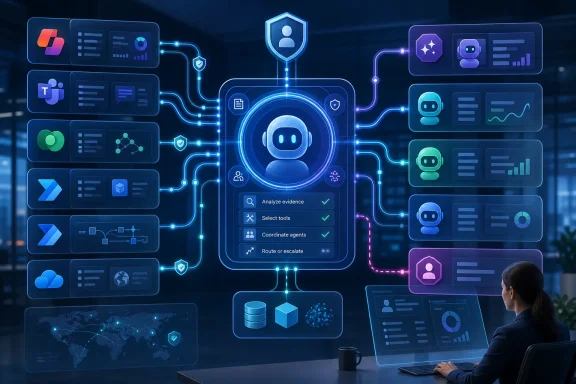
Reasoning models are pushing Microsoft Copilot Studio beyond its earlier role as a low-code chatbot and workflow builder, positioning it instead as an increasingly capable orchestration layer for enterprise AI agents. In a fireside chat with Cloud Wars and Dynamics Communities CEO John Siefert, Microsoft Principal Copilot Architect Dewain Robinson described a transition that matters to every organization evaluating Copilot Studio: the platform’s long-term value will depend less on how quickly teams can assemble a conversational interface and more on how reliably an agent can interpret goals, weigh evidence, select tools, coordinate work, and produce a defensible result.
That distinction may sound subtle, but it represents one of the biggest shifts in the enterprise AI market. Early generative AI deployments were often built around a straightforward pattern: retrieve content, summarize it, and present a fluent answer. The next phase is more demanding. Organizations want AI agents that can connect to business systems, identify what information matters, decide which action should happen next, escalate uncertainty, and complete multi-step tasks without forcing every possible path into a rigid decision tree.
For Windows users, Microsoft 365 administrators, Power Platform developers, and IT leaders, this evolution reframes the discussion around Microsoft Copilot Studio. Low-code authoring remains important, especially for organizations trying to widen access to AI development. But the strategic question is becoming whether Copilot Studio can serve as the control plane for trustworthy, observable, and cost-effective agentic workflows across the Microsoft ecosystem.
The first generation of enterprise copilots proved that large language models could make business information easier to access. Users could ask natural-language questions about a policy document, summarize a long Teams discussion, draft an email, or turn a collection of notes into an outline. Those functions remain useful, and they often deliver immediate productivity gains.
However, summarization is not the same as reasoning.
A system that summarizes a document can restate its content persuasively while still missing exceptions, confusing priorities, or failing to recognize that two sources conflict. It may retrieve relevant text without understanding which piece of information should govern a decision. In business settings, that gap can become costly very quickly.
Consider an employee-support agent asked to help a manager approve an international relocation. A retrieval-focused assistant might locate policy language about relocation allowances, summarize it, and provide a polished answer. A reasoning-oriented agent has a more complicated job:
That does not make the output automatically correct. Reasoning remains an AI capability, not a substitute for governance, verified enterprise data, or accountable human judgment. But it changes the ambition of what Copilot Studio agents can attempt.
Traditional automation handles this by forcing users through predefined forms and branches. That structure can be dependable, but it is often brittle. Every new exception can create another condition, another workflow branch, and another maintenance burden.
Generative orchestration offers an alternative. Instead of relying exclusively on trigger phrases and predetermined dialog paths, an agent can use the request, conversation context, tool descriptions, knowledge sources, and instructions to form a plan. It can determine whether it should answer from knowledge, call an API, invoke a workflow, ask a clarifying question, or hand the task to another specialized agent.
The promise is not that organizations can abandon structure. The promise is that structure can become more modular, contextual, and adaptive.
Low-code capabilities make it easier to create agent experiences without requiring every business team to build a custom application from scratch. Makers can define an agent’s purpose, connect knowledge sources, configure tools, set instructions, create workflows, and publish across supported channels. That accessibility is valuable in organizations where IT teams cannot meet every departmental automation request.
Yet a visually simple agent can conceal a complex runtime challenge.
When an employee asks an agent for help, the system may need to combine several capabilities:
But a large organization cannot realistically map every question, exception, and cross-functional request into an exhaustive conversation tree. The maintenance cost grows quickly, especially when policies, products, organizational structures, and backend systems change.
Copilot Studio’s generative orchestration model attempts to reduce that burden by allowing models to dynamically chain topics, tools, agents, and knowledge sources. In effect, the developer moves from authoring every route to defining capabilities, constraints, and intent.
That is a more scalable approach in theory, but it creates a new responsibility: makers must write better instructions, describe tools accurately, design knowledge sources carefully, and test behavior under realistic conditions.
The low-code interface may make agent creation easier. It does not remove the need for engineering discipline.
This is why orchestration deserves the attention Robinson assigns to it. The agent’s quality emerges from the whole system:
In conventional chatbot development, teams often encode intelligence through configuration. They specify routing rules, define conditions, build complex flows, construct prompt templates, and create branches for expected exceptions. This can provide predictability, but it also produces large, fragile implementations that demand continuous upkeep.
As foundation models improve, some of that intelligence can shift into the model layer.
The model can then perform more of the routing and sequencing work dynamically.
When more decisions move into model-driven orchestration, some behavior becomes less deterministic. The agent may choose a different tool path for similar requests, adapt to a new wording, or decide that a clarifying question is necessary. These can be desirable outcomes, but they require teams to shift from traditional rule testing toward broader evaluation practices.
A mature Copilot Studio deployment should include:
Not every question deserves a costly, slower reasoning process.
A user asking for the location of an office or the title of a document generally needs a fast, direct answer. A user asking an agent to reconcile vendor records, assess conflicting procurement proposals, synthesize internal research, or recommend a compliant process may justify more deliberate computation.
The key is matching the architecture to the use case.
A frontline customer-service agent should not spend an extended period reasoning about a simple shipping question. A finance agent reviewing a large set of documents before recommending an exception route may warrant additional processing time, especially if the alternative is an error that requires manual rework.
Organizations should be explicit about these differences. Users need to understand whether they are interacting with an agent built for immediate answers, transactional execution, deeper analysis, or some combination of all three.
That is an important product direction because it suggests Microsoft sees agent development as more than chat design. The authoring model increasingly revolves around defining:
The most effective enterprise designs will likely be hybrid.
Use deterministic automation where the rules are stable and the consequences of deviation are unacceptable. Use generative orchestration and reasoning where ambiguity, language understanding, contextual judgment, or multi-source synthesis create value.
This hybrid model allows Copilot Studio agents to act as an intelligent interface and orchestration layer while established systems of record retain control over formal transactions.
A basic FAQ bot with read-only access to public documentation has a limited risk profile. An agent that can query employee data, update customer records, launch workflows, send messages, access financial information, or coordinate other agents is fundamentally different. It needs enterprise-grade controls.
Identity should be explicit for both users and agents. Administrators need to know who requested an action, which agent performed it, which systems were accessed, and under what authorization model.
Enterprises should treat agent knowledge as a governed product. That means establishing ownership, review cycles, document lifecycle practices, metadata standards, and clear rules for which sources are authoritative.
Where practical, consequential actions should require confirmation, policy validation, or human approval. The correct goal is not maximum autonomy. It is appropriate autonomy.
An agent that works well in a controlled demo can still fail in production because users phrase requests unexpectedly, systems return incomplete data, or knowledge changes without notice. Continuous monitoring is not optional for enterprise AI. It is part of the product.
For consequential workflows, the important questions are not merely whether the response is articulate, but whether it is grounded in approved data, follows policy, uses the correct tools, respects permissions, and reaches an outcome that can be independently checked.
Security teams should treat AI agents as active participants in the environment, not as passive interfaces. Threat modeling must include the agent’s data access, tool access, instruction hierarchy, escalation behavior, and audit trail.
That does not mean organizations should avoid experimentation. It means pilot projects should be structured carefully, with clear exit criteria, limited scope, controlled data exposure, and a realistic plan for what happens if a feature changes before full production readiness.
The answer is not to avoid advanced models altogether. It is to architect for efficiency:
The attraction is not simply convenience. It is the possibility of reducing integration friction between AI interfaces and existing business processes.
A well-designed Copilot Studio agent could help employees navigate internal knowledge, initiate workflows, retrieve relevant records, coordinate tasks across systems, and surface exceptions to the right people. Rather than replacing every line-of-business application, the agent can become a more natural-language-oriented layer above them.
The emerging value lies in intelligent orchestration: combining reasoning-capable models with enterprise knowledge, actions, workflows, identity, governance, and observability. That is the foundation required for agents that do more than answer questions.
The move from simple retrieval and summarization to reasoning-assisted planning will not eliminate the need for developers, administrators, process owners, or security teams. In many ways, it raises the bar. Builders will need to focus less on manually scripting every branch and more on designing reliable tools, maintaining trustworthy knowledge, evaluating agent behavior, and defining safe boundaries for autonomy.
Copilot Studio’s low-code roots remain a strength because they broaden participation in AI development. But its future will be judged by something more difficult: whether it can help enterprises build agents that are not only conversational, but context-aware, action-capable, governable, and dependable.
That is where reasoning models can make the difference. They do not turn AI into an infallible decision-maker, and they do not remove the operational risks of deploying autonomous systems. What they can do is make Copilot Studio agents better able to navigate the messy, multi-step reality of enterprise work—provided the organizations deploying them treat orchestration, governance, and continuous evaluation as core design requirements rather than afterthoughts.
That distinction may sound subtle, but it represents one of the biggest shifts in the enterprise AI market. Early generative AI deployments were often built around a straightforward pattern: retrieve content, summarize it, and present a fluent answer. The next phase is more demanding. Organizations want AI agents that can connect to business systems, identify what information matters, decide which action should happen next, escalate uncertainty, and complete multi-step tasks without forcing every possible path into a rigid decision tree.
For Windows users, Microsoft 365 administrators, Power Platform developers, and IT leaders, this evolution reframes the discussion around Microsoft Copilot Studio. Low-code authoring remains important, especially for organizations trying to widen access to AI development. But the strategic question is becoming whether Copilot Studio can serve as the control plane for trustworthy, observable, and cost-effective agentic workflows across the Microsoft ecosystem.
 From Search-and-Summarize AI to Deliberative AI Agents
The first generation of enterprise copilots proved that large language models could make business information easier to access. Users could ask natural-language questions about a policy document, summarize a long Teams discussion, draft an email, or turn a collection of notes into an outline. Those functions remain useful, and they often deliver immediate productivity gains.However, summarization is not the same as reasoning.
A system that summarizes a document can restate its content persuasively while still missing exceptions, confusing priorities, or failing to recognize that two sources conflict. It may retrieve relevant text without understanding which piece of information should govern a decision. In business settings, that gap can become costly very quickly.
Consider an employee-support agent asked to help a manager approve an international relocation. A retrieval-focused assistant might locate policy language about relocation allowances, summarize it, and provide a polished answer. A reasoning-oriented agent has a more complicated job:
- Determine the employee’s country, role, employment status, and destination.
- Identify which policy version is current.
- Check whether the request falls into a regulated or high-risk category.
- Distinguish general guidance from mandatory approval requirements.
- Retrieve relevant information from HR, finance, legal, and travel systems.
- Recognize missing data rather than inventing an answer.
- Recommend the next action or route the case to an authorized reviewer.
That does not make the output automatically correct. Reasoning remains an AI capability, not a substitute for governance, verified enterprise data, or accountable human judgment. But it changes the ambition of what Copilot Studio agents can attempt.
Why the Difference Matters in Enterprise Workflows
Enterprise work rarely arrives in clean, one-step prompts. A customer might ask for an order status update, then ask to amend the delivery address, then report that the product is damaged, and finally request a replacement. Each portion of that conversation may require access to different systems, policies, permissions, and workflows.Traditional automation handles this by forcing users through predefined forms and branches. That structure can be dependable, but it is often brittle. Every new exception can create another condition, another workflow branch, and another maintenance burden.
Generative orchestration offers an alternative. Instead of relying exclusively on trigger phrases and predetermined dialog paths, an agent can use the request, conversation context, tool descriptions, knowledge sources, and instructions to form a plan. It can determine whether it should answer from knowledge, call an API, invoke a workflow, ask a clarifying question, or hand the task to another specialized agent.
The promise is not that organizations can abandon structure. The promise is that structure can become more modular, contextual, and adaptive.
Copilot Studio’s Real Value: Orchestration, Not Just Low-Code Design
Robinson’s central point—that Copilot Studio should be understood as an orchestration platform rather than merely a low-code tool—is particularly significant. The platform’s accessible visual authoring experience is a major advantage, but it is not the whole product story.Low-code capabilities make it easier to create agent experiences without requiring every business team to build a custom application from scratch. Makers can define an agent’s purpose, connect knowledge sources, configure tools, set instructions, create workflows, and publish across supported channels. That accessibility is valuable in organizations where IT teams cannot meet every departmental automation request.
Yet a visually simple agent can conceal a complex runtime challenge.
When an employee asks an agent for help, the system may need to combine several capabilities:
- Interpret the request and identify the user’s objective.
- Determine whether the task requires information, an action, or both.
- Choose the correct knowledge source, connector, workflow, API, or child agent.
- Collect missing details without asking unnecessary questions.
- Respect identity, permissions, business rules, and data boundaries.
- Validate outputs before presenting or executing a recommendation.
- Record activity in a way administrators can inspect and improve.
The Shift Away From Rigid Conversation Trees
Earlier chatbot platforms often required developers to predict user intent in advance. Builders created topics, trigger phrases, entities, branching logic, and fallback routes. For narrow scenarios, this remains a practical design pattern. A password-reset assistant, for example, may benefit from a highly controlled sequence that minimizes ambiguity and limits action scope.But a large organization cannot realistically map every question, exception, and cross-functional request into an exhaustive conversation tree. The maintenance cost grows quickly, especially when policies, products, organizational structures, and backend systems change.
Copilot Studio’s generative orchestration model attempts to reduce that burden by allowing models to dynamically chain topics, tools, agents, and knowledge sources. In effect, the developer moves from authoring every route to defining capabilities, constraints, and intent.
That is a more scalable approach in theory, but it creates a new responsibility: makers must write better instructions, describe tools accurately, design knowledge sources carefully, and test behavior under realistic conditions.
The low-code interface may make agent creation easier. It does not remove the need for engineering discipline.
Orchestration Is Where Agent Reliability Is Won or Lost
An impressive language model cannot compensate for poor tool design or unclear governance. If a tool is ambiguously named, exposes incomplete parameters, or returns inconsistent data, the agent may select it incorrectly or make poor use of its output. If the organization feeds the agent outdated policy documents, the model may reason carefully over the wrong facts.This is why orchestration deserves the attention Robinson assigns to it. The agent’s quality emerges from the whole system:
- Model capability
- Grounded enterprise knowledge
- Clear instructions
- Well-described tools and actions
- Identity and access controls
- Workflow reliability
- Monitoring and evaluation
- Human review for consequential outcomes
How Reasoning Models Change Copilot Studio Development
The most consequential part of the discussion is not simply that reasoning models can do more. It is that smarter models may change what developers need to build manually.In conventional chatbot development, teams often encode intelligence through configuration. They specify routing rules, define conditions, build complex flows, construct prompt templates, and create branches for expected exceptions. This can provide predictability, but it also produces large, fragile implementations that demand continuous upkeep.
As foundation models improve, some of that intelligence can shift into the model layer.
What Models May Handle More Effectively
Modern reasoning-capable models can potentially take on a broader set of tasks that previously required explicit configuration:- Identifying multiple intents within the same request.
- Extracting entities from conversational language.
- Resolving context from prior messages.
- Determining which tool or knowledge source is relevant.
- Building a plan across multiple steps.
- Comparing competing pieces of evidence.
- Identifying missing inputs.
- Generating a more coherent response from diverse system outputs.
- Recognizing when a simple answer is inadequate.
The model can then perform more of the routing and sequencing work dynamically.
Simpler Does Not Mean Effortless
There is an important caveat. A reduction in manual configuration should not be mistaken for a reduction in accountability.When more decisions move into model-driven orchestration, some behavior becomes less deterministic. The agent may choose a different tool path for similar requests, adapt to a new wording, or decide that a clarifying question is necessary. These can be desirable outcomes, but they require teams to shift from traditional rule testing toward broader evaluation practices.
A mature Copilot Studio deployment should include:
- Representative test sets covering normal, ambiguous, incomplete, and adversarial requests.
- Expected-outcome criteria, not just a pass-or-fail check on wording.
- Tool invocation tests to confirm that the agent selects the correct action.
- Grounding tests to measure whether answers remain tied to approved enterprise data.
- Permission tests to ensure that users only receive information they are authorized to access.
- Fallback tests for unavailable systems, incomplete records, and conflicting documentation.
- Human escalation paths for financial, legal, clinical, employment, and security-sensitive decisions.
Deep Reasoning Brings Benefits, but Also Trade-Offs
Copilot Studio’s deep reasoning capabilities are intended for complex tasks that benefit from more extensive logical analysis and step-by-step problem solving. In the current product direction, these capabilities are not necessarily applied to every interaction. That selective approach is sensible.Not every question deserves a costly, slower reasoning process.
A user asking for the location of an office or the title of a document generally needs a fast, direct answer. A user asking an agent to reconcile vendor records, assess conflicting procurement proposals, synthesize internal research, or recommend a compliant process may justify more deliberate computation.
The Case for Selective Reasoning
Using reasoning models only where they add value offers several benefits:- Lower latency for simple requests.
- Better cost control in environments where model usage is metered.
- More predictable user experiences for high-volume tasks.
- Improved quality on complicated analysis and decision-support workflows.
- Clearer design intent, because makers can identify which steps genuinely require deeper evaluation.
The Latency Problem Cannot Be Ignored
The trade-off is response time. Deep reasoning generally takes longer than lightweight conversational processing. In a consumer-style chat interaction, that delay may feel frustrating. In a high-stakes business workflow, it may be entirely reasonable if it produces a more dependable result.The key is matching the architecture to the use case.
A frontline customer-service agent should not spend an extended period reasoning about a simple shipping question. A finance agent reviewing a large set of documents before recommending an exception route may warrant additional processing time, especially if the alternative is an error that requires manual rework.
Organizations should be explicit about these differences. Users need to understand whether they are interacting with an agent built for immediate answers, transactional execution, deeper analysis, or some combination of all three.
The New Agent Experience Signals a Broader Product Direction
Copilot Studio’s newer agent experience reflects this shift toward more capable runtime orchestration. Rather than centering every implementation on explicit conversational topics, flows, and branching logic, the newer design emphasizes natural-language-first agent creation and an enhanced orchestration runtime.That is an important product direction because it suggests Microsoft sees agent development as more than chat design. The authoring model increasingly revolves around defining:
- Who the agent is
- What it knows
- What it can do
- Which model powers its reasoning
- Which boundaries it must observe
- How its behavior will be tested and monitored
Classic and New Approaches Will Coexist
The transition will not happen overnight. Traditional deterministic workflows remain valuable, especially in areas where precision, auditability, and fixed business logic are paramount. A payroll calculation, a regulatory form submission, or an approval chain may need explicit workflow logic even if an AI agent sits at the front end.The most effective enterprise designs will likely be hybrid.
Use deterministic automation where the rules are stable and the consequences of deviation are unacceptable. Use generative orchestration and reasoning where ambiguity, language understanding, contextual judgment, or multi-source synthesis create value.
This hybrid model allows Copilot Studio agents to act as an intelligent interface and orchestration layer while established systems of record retain control over formal transactions.
Governance Becomes More Important as Agents Become More Capable
The stronger the agent, the stronger the governance requirements.A basic FAQ bot with read-only access to public documentation has a limited risk profile. An agent that can query employee data, update customer records, launch workflows, send messages, access financial information, or coordinate other agents is fundamentally different. It needs enterprise-grade controls.
Key Governance Priorities for Copilot Studio
Organizations adopting reasoning-enabled agents should prioritize the following areas.Identity and Least-Privilege Access
Agents should have only the permissions required to complete their intended tasks. Broad access may make demonstrations look powerful, but it creates serious exposure when agents operate across sensitive data and connected systems.Identity should be explicit for both users and agents. Administrators need to know who requested an action, which agent performed it, which systems were accessed, and under what authorization model.
Knowledge Quality and Data Freshness
Reasoning can improve analysis, but it cannot rescue poor source material. Outdated policy documents, duplicate files, inconsistent SharePoint libraries, and unapproved content can undermine even the best orchestration layer.Enterprises should treat agent knowledge as a governed product. That means establishing ownership, review cycles, document lifecycle practices, metadata standards, and clear rules for which sources are authoritative.
Tool Safety and Action Boundaries
Tools should be narrowly scoped and clearly described. An action called “Update customer” is too vague. A better design separates sensitive operations and makes the implications clear: update address, create support ticket, issue refund request, modify renewal date, or submit for approval.Where practical, consequential actions should require confirmation, policy validation, or human approval. The correct goal is not maximum autonomy. It is appropriate autonomy.
Monitoring, Tracing, and Evaluation
Agent behavior must be observable. Teams need visibility into failed requests, tool selection, workflow errors, retrieved sources, escalation rates, latency, and recurring user dissatisfaction.An agent that works well in a controlled demo can still fail in production because users phrase requests unexpectedly, systems return incomplete data, or knowledge changes without notice. Continuous monitoring is not optional for enterprise AI. It is part of the product.
The Risks Behind the “Smarter Model” Narrative
The excitement around reasoning models is justified, but it should be tempered by realism. There are several risks that organizations need to confront before treating Copilot Studio agents as fully autonomous decision-makers.Reasoning Outputs Are Not Proof
A model may generate an explanation that sounds orderly and persuasive without accurately reflecting the best business conclusion. The ability to produce a plausible chain of reasoning should not be confused with verified truth.For consequential workflows, the important questions are not merely whether the response is articulate, but whether it is grounded in approved data, follows policy, uses the correct tools, respects permissions, and reaches an outcome that can be independently checked.
More Autonomy Can Expand the Attack Surface
An agent that can invoke tools and interact with data sources creates new security considerations. Prompt injection, malicious content embedded in documents, unsafe connector configurations, over-permissioned actions, and untrusted external data can all create avenues for misuse.Security teams should treat AI agents as active participants in the environment, not as passive interfaces. Threat modeling must include the agent’s data access, tool access, instruction hierarchy, escalation behavior, and audit trail.
Preview Features Require Extra Caution
Some advanced Copilot Studio capabilities, including elements of deep reasoning and the newer agent authoring experience, may be offered under preview or production-ready preview terms depending on the specific feature and tenant configuration. Such capabilities can change, have regional restrictions, or lack parity with established features.That does not mean organizations should avoid experimentation. It means pilot projects should be structured carefully, with clear exit criteria, limited scope, controlled data exposure, and a realistic plan for what happens if a feature changes before full production readiness.
Costs Can Rise in Unpredictable Ways
Agentic workflows can consume more resources than simple conversational AI. Multiple tool calls, lengthy context windows, deeper reasoning, agent-to-agent delegation, and repeated retries all add to operational cost.The answer is not to avoid advanced models altogether. It is to architect for efficiency:
- Use deep reasoning only for tasks that need it.
- Keep tool outputs concise and structured.
- Remove redundant knowledge sources.
- Design prompts and instructions for clarity.
- Track usage patterns by scenario.
- Set budgets and alerts before large-scale deployment.
- Compare outcomes against the cost of manual work and error correction.
What This Means for Windows and Microsoft-Centric IT Teams
For IT teams already operating in the Microsoft ecosystem, Copilot Studio’s evolution offers a potentially compelling path. It can connect agent experiences to the tools organizations already use: Microsoft 365 data, Teams, Power Automate, Power Platform connectors, Dataverse, Dynamics 365, Azure services, and Microsoft Entra identity controls.The attraction is not simply convenience. It is the possibility of reducing integration friction between AI interfaces and existing business processes.
A well-designed Copilot Studio agent could help employees navigate internal knowledge, initiate workflows, retrieve relevant records, coordinate tasks across systems, and surface exceptions to the right people. Rather than replacing every line-of-business application, the agent can become a more natural-language-oriented layer above them.
The Best Initial Use Cases
The most promising first deployments tend to share several characteristics:- The task is repetitive but includes moderate language variability.
- Relevant data lives in defined, governed systems.
- The agent can provide meaningful assistance without irreversible autonomy.
- Success can be measured clearly.
- A human reviewer can handle exceptions.
- The organization has an identifiable process owner.
- Internal IT support triage and knowledge assistance.
- Employee policy and HR service guidance.
- Sales enablement and account research.
- Customer-service case preparation.
- Procurement request routing.
- Project-status synthesis across approved data sources.
- Document intake, classification, and follow-up workflows.
- Compliance-oriented checklists with escalation paths.
The Strategic Takeaway: Build for Orchestration, Not Chat Alone
Dewain Robinson’s argument is ultimately a warning against evaluating Copilot Studio too narrowly. If organizations view the platform solely as a way to build chatbots through a low-code interface, they may miss the more consequential transformation underway.The emerging value lies in intelligent orchestration: combining reasoning-capable models with enterprise knowledge, actions, workflows, identity, governance, and observability. That is the foundation required for agents that do more than answer questions.
The move from simple retrieval and summarization to reasoning-assisted planning will not eliminate the need for developers, administrators, process owners, or security teams. In many ways, it raises the bar. Builders will need to focus less on manually scripting every branch and more on designing reliable tools, maintaining trustworthy knowledge, evaluating agent behavior, and defining safe boundaries for autonomy.
Copilot Studio’s low-code roots remain a strength because they broaden participation in AI development. But its future will be judged by something more difficult: whether it can help enterprises build agents that are not only conversational, but context-aware, action-capable, governable, and dependable.
That is where reasoning models can make the difference. They do not turn AI into an infallible decision-maker, and they do not remove the operational risks of deploying autonomous systems. What they can do is make Copilot Studio agents better able to navigate the messy, multi-step reality of enterprise work—provided the organizations deploying them treat orchestration, governance, and continuous evaluation as core design requirements rather than afterthoughts.
References
- Primary source: Cloud Wars
Published: 2026-07-22T13:00:00+00:00
Loading…
cloudwars.com - Official source: learn.microsoft.com
Loading…
learn.microsoft.com - Official source: microsoft.com
What’s new in Copilot Studio: May 2026 updates and features | Microsoft Copilot Blog
Explore what's new in Copilot Studio, May 2026: computer-using agents are now available, plus redesigned workflows and Work IQ extensibility.www.microsoft.com - Official source: cdn-dynmedia-1.microsoft.com