Microsoft’s internal Copilot usage study — an analysis of roughly 37.5 million anonymized conversations — and today’s avalanche of product announcements from Shopify and Adobe together make one thing unavoidable: conversational AI is no longer an experiment contained to code generation and Office productivity. It has already migrated into the private, everyday spaces of health, relationships, and shopping, and vendors are racing to turn that ambient engagement into infrastructure and revenue.
Background / Overview
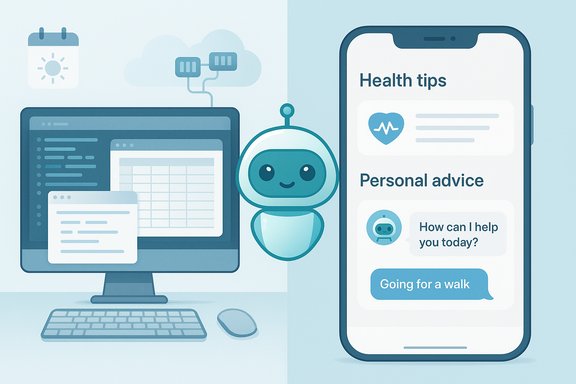
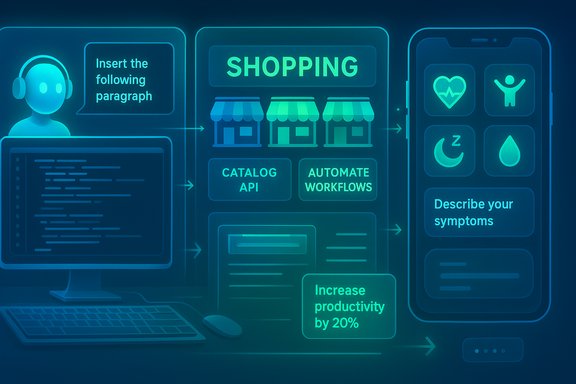
Microsoft’s Copilot Usage Report 2025 (reported as a preprint titled “It’s About Time”) analyzed conversation summaries captured between January and September 2025 and found a striking split in how people use conversational AI by device and time of day. Desktop sessions skew strongly toward productivity and programming during business hours, while mobile sessions are dominated — every hour, every day — by health and wellness queries and advice-seeking behavior. Microsoft says it analyzed ~37.5 million de‑identified conversations and relied on automated topic-and-intent classifiers rather than human reviewers to extract patterns.Parallel to that behavioral research, two major platform moves landed in a single news cycle: Shopify announced an extensive Winter ’26 Edition with 150+ AI updates, centered on a much smarter Sidekick assistant and features such as Agentic Storefronts, Catalog APIs, and tools that let merchants generate apps and automate workflows from plain English. Adobe, meanwhile, embedded Photoshop, Adobe Express, and Acrobat directly into ChatGPT so people can edit images and PDFs inside a chat interface. Both companies are shifting from treating AI as a bolt-on feature to building it into the plumbing of commerce and creativity.
What the Copilot study actually says — and what it leaves unsaid
Headline findings
- Microsoft reports ~37.5 million de-identified consumer conversations (January–September 2025). The dataset excludes enterprise and educational accounts and was analyzed via automated summarization and labeling.
- Top intents across Copilot were searching, advice, creating, learning, and technical support — with health and fitness ranked as the single most common topic-intent pairing on mobile throughout the period.
- Temporal rhythms matter: late-night hours show spikes in philosophy and intimate advice; weekdays favor programming; weekends favor gaming and leisure topics; January skewed toward programming but by September culture and society topics had grown.
How Microsoft collected the data (short version)
Microsoft reports that it did not retain raw chat logs for human review. Instead, a pipeline extracted summaries from conversations and machine classifiers labeled the summaries for topic and intent. That pipeline is a stronger privacy posture than storing raw text, but the public write-up omitted a technical appendix with sample-selection rules, geographic distribution, labeling accuracy metrics, and failure modes. That omission constrains external auditing of the numbers and means some claims remain company-provided rather than independently verifiable.Why the device/time split matters
Design and governance need to be context-aware. A Copilot integrated into Office should prioritize information density, multi-file context, and safe actioning of tasks. A phone-first Copilot needs to prioritize empathy, brief, evidence-backed triage for health questions, and clear escalation paths to human professionals where appropriate. Microsoft itself rolled product updates in the Copilot “Fall Release” that map directly onto these findings (long-term Memory, Copilot Groups, Mico avatar, Real Talk, Copilot for Health), which suggests product teams are using the usage data to justify companion-like features.Why health topping the list should matter to IT leaders, regulators, and users
Users are treating chatbots as advisors — with all the attendant risks
That health queries are the top mobile topic-intent pairing implies people are asking Copilot for symptom checks, wellness advice, medication information, and triage outside clinic hours. Conversational AIs can provide helpful pointers — for example, suggesting reputable resources or preparing users for a clinician visit — but they can also return outdated, incomplete, or dangerously incorrect guidance. The difference between information and actionable clinical advice is not academic: people sometimes act on what they read. Microsoft’s flagging of grounding strategies and health-specific features (Copilot for Health) helps, but safeguards and transparent provenance are non-negotiable.Risks to watch
- Hallucination risk: LLMs will invent plausible-sounding medical guidance when knowledge is incomplete.
- Overtrust and dependency: A friendly, persistent assistant (Mico avatars, memory) increases emotional engagement and perceived authority.
- Privacy leakage via summaries: Even sanitized summaries can encode sensitive signals; the pipeline’s de-identification efficacy matters.
- Regulatory exposure: Advice that appears medical/legal/financial can trigger sectoral regulation and liability.
Shopify’s Winter ’26 Edition: AI as commerce infrastructure
What Shopify shipped (high-level)
Shopify’s Winter ’26 Edition bills itself as a “Renaissance” for merchant tooling and includes 150+ product updates. The key bets:- Sidekick evolves from a text/voice assistant into a proactive, agentic collaborator that can:
- Generate custom admin apps from prompts.
- Build automations (Shopify Flow) from natural language.
- Edit themes and emails via plain English.
- Surface Sidekick “skills” merchants can reuse and share.
- Catalog API provides a single integration to access millions of products (developer availability announced).
- SimGym — AI shoppers trained on real session data to test store changes before launching them (an experiment in agentic simulation).
- Agentic Storefronts syndicate product availability across major AI platforms (so merchants “set once” and appear where conversational shopping happens).
Why this is significant
Shopify has essentially moved AI from optional software feature to an infrastructural layer that affects discovery, conversion, and merchant operations. Agentic capabilities — the ability for AI to perform multi-step tasks (create a discount, edit a theme, launch a campaign) — reduce friction and can meaningfully boost conversion when paired with Instant Checkout or agentic commerce protocols. Early Shopify metrics cited in earnings calls suggest AI-originated traffic and orders are multiplying, implying the business case for agentic commerce is material.Adobe + ChatGPT: editing and PDF workflows inside the chat
Adobe’s move to embed Photoshop, Adobe Express, and Acrobat into ChatGPT is a watershed for multimodal productivity. The integration lets users:- Edit photos (background removal, exposure, selective edits) using Photoshop features inside ChatGPT.
- Create and animate designs with Adobe Express elements.
- Merge, extract, redact, and manipulate PDFs via Acrobat in a chat flow.
Practical effects for creators and Windows users
- Casual users and social creators gain access to professional editing workflows without installing desktop apps.
- Professionals get a quick “first pass” editing layer from chat, then can continue in Photoshop or Acrobat for full control.
- The move strengthens ChatGPT as a creative hub and increases the stickiness of agentic workflows that combine generation, editing, and output in one place.
Cross-checking claims and independent verification
When an enterprise publishes usage claims at scale, good journalism and engineering discipline require cross-referencing. For the load-bearing claims:- Microsoft’s 37.5M-conversation figure and device/time-of-day findings are reported in multiple outlets and referenced on discussion platforms; Microsoft’s own Copilot releases and blog posts corroborate the product and privacy posture but do not publish a full technical appendix. Treat the high-level patterns as credible while noting the methodological transparency gap.
- Shopify’s Winter ’26 Edition and the Sidekick capabilities are documented in Shopify’s official Winter ’26 edition pages and changelog items and expanded in technical docs explaining limitations and plan gating. Independent coverage (TechCrunch, developer changelog) confirms the product framing.
- Adobe’s ChatGPT integrations are announced on Adobe’s newsroom and confirmed by Reuters, The Verge, TechCrunch and Apple-/app-store trackers. Those multiple sources corroborate availability and feature scope.
The tradeoffs and hard choices: benefits vs. risks
Tangible benefits
- Faster workflows: Copilot-style summarization and Sidekick app generation materially reduce repetitive work (drafting, admin scripting, theme edits).
- Lower barriers: Adobe-in-chat & Sidekick make pro tools accessible to non-experts, expanding the addressable market.
- New discovery channels: Agentic storefronts and Catalog APIs let merchants appear in AI-first shopping flows, shortening the path to purchase.
Material risks
- Safety & accuracy: Health, legal, and financial advice delivered conversationally can be mistaken as professional guidance. Systems need grounding, provenance, and explicit escalation channels.
- Privacy & data governance: Summary extraction protects raw text, but derived metadata can still be sensitive. Enterprises must treat these channels as high-risk data flows.
- Operational attack surface: Agentic features that can change themes, create discounts, or generate apps expand the scope of potential abuse — malicious prompts, compromised accounts, or poorly tested autogenerated code can cause real damage.
- Monoculture and lock-in: When ChatGPT, Copilot, and major platforms become hubs for editing, commerce, and discovery, smaller vendors risk being pushed to operate as dependent integrations rather than competitors.
Recommendations for Windows users, IT admins, and merchants
For enterprise IT / security teams
- Inventory where Copilot / Sidekick-like assistants are enabled and enumerate connectors (OneDrive, Gmail, Calendar, Shopify admin). Require explicit approvals for connectors that access PHI/PII.
- Enforce least privilege for agentic capabilities: restrict theme edits, discount creation, and app installation to trusted operator roles.
- Add monitoring and verification steps for autogenerated code or automations: require code reviews, sandbox testing, and CI checks before deploying generated apps.
- Demand SLAs or verifiable acceptance tests from vendors when agentic features are used for production workflows (rollback hooks, audit logs).
- For health-related AI surfaces, prefer vendor-supplied grounding sources and enable human escalation paths for triage cases.
For merchants using Sidekick
- Treat generated apps and automations as prototypes: test in a staging store before deploying to production.
- Use prompt versioning and Sidekick “skills” sparingly; document and audit shared skills for data exposure risk.
- Validate Catalog API product mappings and verify that Agentic Storefront syndication shows correct SKUs and pricing on partner AI platforms.
For creative professionals and power users
- Use Adobe-in-ChatGPT for quick iterations and proof-of-concept edits; when fidelity and provenance matter, continue work in native Photoshop/Acrobat to maintain control.
- Archive and verify AI-edited assets before publishing to maintain change provenance and IP traceability.
Design and regulatory implications — a short roadmap
- Product teams must adopt contextual affordances: different response styles and guardrails based on device, time, and the topic (e.g., stricter verification for health/legal topics on mobile). Microsoft’s own Copilot feature set maps tightly to this, but independent auditing of the safeguard implementations is essential.
- Regulators should require auditable disclosures for advice-like outputs (clear disclaimers, grounding metadata, and the ability to share the datasets used to ground medical/legal advice).
- Industry consortia should codify the agentic interface contract: how an AI declares the actions it will take, how consent is captured, and how rollbacks and audit logs are produced.
Final assessment: where we are and where this goes next
The pattern that emerges from Microsoft’s 37.5M-conversation analysis — that conversational AI is used as a confidant on phones and a coworker on desktops — is plausible, consequential, and supported by multiple independent news reports and Microsoft’s product moves. But it comes with an obvious caveat: the public write-up so far supplies high‑level patterns, not granular audit data, so precise representativeness remains a judgment call. Shopify’s move to bake Sidekick and agentic storefront mechanics into merchant tooling and Adobe’s embedding of creative apps into ChatGPT accelerate a larger market dynamic: AI is shifting from the edge (apps) to plumbing (platforms and protocols). That transition creates enormous opportunities — faster workflows, new discovery channels, lower creative friction — but also concentrates new systemic risks (misinformation, privacy exposure, automation errors) into fewer chokepoints.For Windows users, IT professionals, and merchants, the practical takeaway is to treat today’s chatbots as software with agency and impact. That means adjusting governance, adding test gates, and insisting on provenance. The companies shipping these capabilities have acknowledged the stakes by exposing controls and opt-ins; the missing piece is independent auditing and regulatory alignment to make those controls auditable and enforceable at scale. As vendors race to make conversational assistants more capable and more ambient, the most important design question won’t be whether the assistant can answer a query — it will be whether the system can explain why it answered that way, and who is accountable when the advice materially affects a person’s life. The usage data says people already trust these systems in intimate moments. It’s time product teams, enterprises, and policymakers built the safety and governance to match that trust.
Quick reference: the essential claims verified in this piece
- Microsoft analyzed ~37.5M de‑identified Copilot conversations (Jan–Sep 2025); desktop = productivity, mobile = health/advice.
- Shopify’s Winter ’26 Edition introduced 150+ AI updates centered on Sidekick, Catalog API, SimGym, and Agentic Storefronts.
- Adobe embedded Photoshop, Adobe Express and Acrobat into ChatGPT for free on desktop/web/iOS, enabling in-chat image and PDF edits.
Source: The Neuron
 Microsoft's 37M+ conversation study reveals surprising AI usage pattern