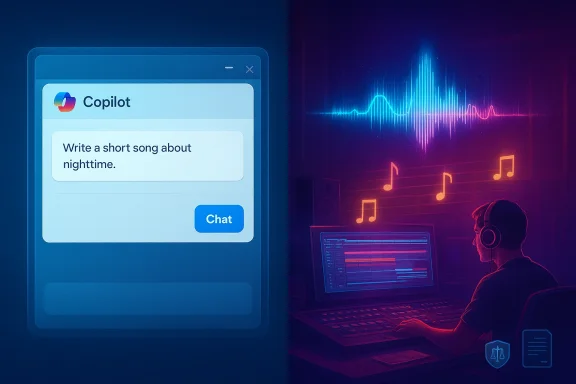
Microsoft Copilot’s new ability to generate songs from a single text prompt is exactly the kind of feature that makes generative AI feel both thrilling and a little unsettling. On the surface, it is a simple, consumer-friendly upgrade: type a few words, enable the Suno integration, and let Microsoft’s assistant spin them into music. But the fine print matters, because the catch is not just about paying to unlock better rights — it is about ownership, copyright, and how much of the creative process users actually control.
The timing is important, too. Microsoft has been steadily expanding Copilot beyond productivity into creative expression, while Suno has become one of the most visible names in AI music generation. Put together, the partnership shows how quickly AI tools are moving from drafting emails and summarizing documents to generating songs, complete with the legal and cultural headaches that come with synthetic creativity.
Microsoft’s Copilot ecosystem has always been more ambitious than a chatbot bolted onto Office apps. The company has been trying to position Copilot as a broad, cross-device assistant that can search, write, summarize, analyze, and now create media. That trajectory makes an AI music feature less of a gimmick than a logical extension of Microsoft’s product strategy, especially as the company works to keep Copilot visible in a crowded market.
The new song-generation capability is built around Suno, a startup focused on AI music creation. Microsoft’s earlier announcement in December 2023 framed the idea clearly: users could enable the Suno plugin inside Copilot and ask for a song with a short prompt, such as a pop track about family adventures. Microsoft presented the feature as a low-friction way to turn ideas into music, with Copilot handling lyrics and Suno generating the musical output.
That simplicity, however, is exactly why the catch matters. Suno’s own help pages now make a strong distinction between free and paid usage. If a song is created on the Basic free tier, Suno retains ownership and the output is only for non-commercial use. If the song is created on Pro or Premier, the user is considered the owner and receives commercial use rights, though Suno still warns that copyright protection is not guaranteed and depends on human contribution and local law.
What this means in practice is that Copilot is not just a songwriting toy. It is a gateway into a broader AI content economy where the legal status of output depends on subscription level, jurisdiction, and how much a human actually contributed. That is a very different proposition from pressing “generate” and assuming the results are yours to monetize.
Microsoft’s move also lands in the middle of an ongoing copyright fight around generative AI. Suno itself acknowledges that the legal landscape is “complex and dynamic,” and that users should consult an attorney if they need guidance. Meanwhile, the wider industry is still wrestling with lawsuits, licensing disputes, and unresolved questions about whether training data from copyrighted works creates liability for AI developers.
That matters because Microsoft is not asking users to learn music theory, rhythm notation, or production software. Instead, it is packaging songwriting as a conversation. That lowers the barrier dramatically, but it also compresses what used to be a layered creative process into a single interface action. The result is convenient, but convenience often hides complexity rather than removing it.
For casual users, that is likely sufficient. For more serious creators, though, it creates a new kind of limitation: the better the song you want, the more you have to think like a creative director rather than a musician. That is a subtle but important shift because it changes the nature of authorship itself.
There is also a strategic layer here. By integrating third-party creative tools into Copilot, Microsoft can make the product feel broader than a single model or interface. That could help Copilot become less of a chatbot and more of a platform, which is what Microsoft ultimately wants.
That kind of partnership also gives Microsoft plausible deniability on some of the messier questions. If users ask where the music comes from, Microsoft can point to Suno’s platform and licensing terms. If users ask who owns the output, Suno’s terms set the boundaries. In other words, Microsoft can offer the feature without having to answer every legal question on its own.
The partnership also reflects the way AI ecosystems are evolving. The biggest players increasingly want to be the front door rather than the engine room. Microsoft’s goal is to own the user relationship, even when a partner supplies the specialized capability.
There is also a branding issue. If users have a poor experience with the music output, they may blame Copilot even if Suno is responsible for the generation quality. That is the price of integration: the lead brand inherits both the upside and the friction.
That distinction is the catch in Microsoft’s headline-friendly pitch. The feature may be available inside Copilot, but the legal and economic value of the output depends on the terms attached to the underlying Suno account. Users who assume every generated track is theirs in the fullest sense could be setting themselves up for disappointment or, worse, disputes.
That means the feature has two audiences. Casual users can experiment, share, and enjoy the novelty. Serious creators, meanwhile, need to think about subscription status, intended distribution, and whether the output can survive scrutiny if they plan to publish it.
The deeper issue is that generative AI collapses the line between tool and creator. If you write a sentence and the system emits a full song, where exactly is the creative labor located? The law has not settled that question, and the answer may differ from one country to another.
That expansion also aligns with Microsoft’s broader AI strategy. The company wants Copilot to be the place where users start asking for help, whether they need a spreadsheet summary, a meeting recap, a graphic, or now a song. The more tasks Copilot can perform, the more likely it becomes a daily habit rather than a novelty.
There is also an important historical echo. Microsoft once experimented with music software in the Songsmith era, which generated accompaniment around vocal melodies. The company is now returning to music creation through a much more powerful AI stack and a much more mainstream consumer interface. That suggests continuity, not coincidence, in Microsoft’s creative ambitions.
But it also raises expectations. Once users see Copilot as a creator, they will judge it not only on utility but on taste, originality, and reliability. That is a much harder standard than simple productivity.
At the same time, casual users are also the most likely to misunderstand the rights issue. People may assume that if the song sounds original and came from their prompt, it belongs to them outright. That assumption is precisely what Suno’s terms complicate, especially on the free tier.
That accessibility can be empowering. It can also be misleading. Easy creation is not the same as clear ownership, and the difference matters when content leaves the realm of private play.
The question is whether that virality translates into trust. If users later discover that the song is not theirs to monetize or copyright in the way they assumed, enthusiasm can turn into skepticism fast.
Enterprise users also tend to care about reproducibility and auditability. If a marketing team generates a song for a campaign, the business may want to know who created it, which plan was used, whether commercial rights apply, and whether the output can be safely reused across channels. Those are governance questions, not just creative ones.
That means legal review is not optional for commercial use. Companies will need to treat AI music the same way they treat stock media, licensing, and other third-party creative assets.
For many firms, the safest path will be to limit AI music to internal drafts, brainstorming, or non-public experiments unless there is a clear commercial licensing path. That cautious stance may feel bureaucratic, but it is exactly what mature procurement cultures are built for.
This matters because AI assistants are increasingly judged as ecosystems, not single-function tools. Consumers and businesses alike are deciding which platform feels broad, useful, and worth paying for. Every new capability makes switching a little harder.
There is also a branding contrast here. Microsoft can absorb some controversy because Copilot is already a large, multifaceted product. Smaller rivals may decide that the reputational upside of AI music does not justify the legal exposure.
That does not mean all outputs are equal. It means competition will increasingly revolve around quality, licensing clarity, and ease of use rather than the mere existence of generative features.
It also opens the door to broader consumer and education use cases, especially for users who want quick, playful, low-stakes creation.
There is also a reputational risk for Microsoft if the integration becomes associated with copyright confusion rather than creativity.
Microsoft will also have to decide how central creative generation should become inside Copilot. Too much emphasis on gimmicky media features could dilute the product’s productivity identity. Too little could leave Microsoft looking like it is trailing competitors in one of the most visible AI categories.
Source: Mashable Microsoft Copilot now lets you create AI songs from text prompts
The timing is important, too. Microsoft has been steadily expanding Copilot beyond productivity into creative expression, while Suno has become one of the most visible names in AI music generation. Put together, the partnership shows how quickly AI tools are moving from drafting emails and summarizing documents to generating songs, complete with the legal and cultural headaches that come with synthetic creativity.
 Overview
Microsoft’s Copilot ecosystem has always been more ambitious than a chatbot bolted onto Office apps. The company has been trying to position Copilot as a broad, cross-device assistant that can search, write, summarize, analyze, and now create media. That trajectory makes an AI music feature less of a gimmick than a logical extension of Microsoft’s product strategy, especially as the company works to keep Copilot visible in a crowded market.The new song-generation capability is built around Suno, a startup focused on AI music creation. Microsoft’s earlier announcement in December 2023 framed the idea clearly: users could enable the Suno plugin inside Copilot and ask for a song with a short prompt, such as a pop track about family adventures. Microsoft presented the feature as a low-friction way to turn ideas into music, with Copilot handling lyrics and Suno generating the musical output.
That simplicity, however, is exactly why the catch matters. Suno’s own help pages now make a strong distinction between free and paid usage. If a song is created on the Basic free tier, Suno retains ownership and the output is only for non-commercial use. If the song is created on Pro or Premier, the user is considered the owner and receives commercial use rights, though Suno still warns that copyright protection is not guaranteed and depends on human contribution and local law.
What this means in practice is that Copilot is not just a songwriting toy. It is a gateway into a broader AI content economy where the legal status of output depends on subscription level, jurisdiction, and how much a human actually contributed. That is a very different proposition from pressing “generate” and assuming the results are yours to monetize.
Microsoft’s move also lands in the middle of an ongoing copyright fight around generative AI. Suno itself acknowledges that the legal landscape is “complex and dynamic,” and that users should consult an attorney if they need guidance. Meanwhile, the wider industry is still wrestling with lawsuits, licensing disputes, and unresolved questions about whether training data from copyrighted works creates liability for AI developers.
How Copilot’s AI Song Feature Works
At its core, the feature is intended to be almost frictionless. A user signs into Copilot with a Microsoft account, enables the Suno plugin, and types a short prompt describing the song they want. Microsoft’s 2023 announcement described the process as a prompt-driven workflow in which Copilot and Suno do the heavy lifting, matching the music to the cues in the user’s request.That matters because Microsoft is not asking users to learn music theory, rhythm notation, or production software. Instead, it is packaging songwriting as a conversation. That lowers the barrier dramatically, but it also compresses what used to be a layered creative process into a single interface action. The result is convenient, but convenience often hides complexity rather than removing it.
Prompting as production
The prompt is no longer just a request. In this setup, it becomes the entire creative brief, the concept, and the input to machine composition. That means the quality of the output depends not only on the model but on the user’s ability to describe mood, style, or theme with enough precision to steer the generation.For casual users, that is likely sufficient. For more serious creators, though, it creates a new kind of limitation: the better the song you want, the more you have to think like a creative director rather than a musician. That is a subtle but important shift because it changes the nature of authorship itself.
What Microsoft is really selling
Microsoft is not just selling songs; it is selling engagement. Every new creative feature increases the number of reasons users have to open Copilot, experiment, and return. In a market where many AI assistants are converging on similar capabilities, novelty is still a powerful retention tool.There is also a strategic layer here. By integrating third-party creative tools into Copilot, Microsoft can make the product feel broader than a single model or interface. That could help Copilot become less of a chatbot and more of a platform, which is what Microsoft ultimately wants.
- The feature is designed for low-friction music creation.
- Users interact through text prompts, not DAWs or composition tools.
- The integration makes Copilot feel more like a creative platform.
- Microsoft gains a new use case that can increase session time and repeat usage.
- The user experience hides much of the technical complexity behind the interface.
The Suno Partnership and Why It Matters
Suno is not a random add-on. It is one of the best-known names in consumer AI music generation, and that gives Microsoft an important shortcut into a category that would otherwise require building its own music engine from scratch. Microsoft has already shown it is willing to use partnerships to accelerate Copilot’s expansion, and Suno fits that pattern neatly.That kind of partnership also gives Microsoft plausible deniability on some of the messier questions. If users ask where the music comes from, Microsoft can point to Suno’s platform and licensing terms. If users ask who owns the output, Suno’s terms set the boundaries. In other words, Microsoft can offer the feature without having to answer every legal question on its own.
Why Suno is attractive to Microsoft
Suno has already done the hard work of making AI music feel accessible. It produces a result quickly, the interface is understandable to non-musicians, and the product has enough viral appeal to generate attention on its own. Microsoft benefits from borrowing that momentum without having to build a culture around music generation from zero.The partnership also reflects the way AI ecosystems are evolving. The biggest players increasingly want to be the front door rather than the engine room. Microsoft’s goal is to own the user relationship, even when a partner supplies the specialized capability.
The flip side of dependency
But partnerships can also expose strategic weakness. If Suno changes its pricing, licensing terms, or technical stack, Microsoft’s Copilot experience could change with it. That is especially relevant in a category where legal pressure and platform policy can shift quickly.There is also a branding issue. If users have a poor experience with the music output, they may blame Copilot even if Suno is responsible for the generation quality. That is the price of integration: the lead brand inherits both the upside and the friction.
- Suno gives Microsoft an instant music-generation engine.
- Microsoft avoids building a music model in-house.
- The deal strengthens Copilot’s image as a creative platform.
- Microsoft becomes partially dependent on Suno’s pricing and policy choices.
- User satisfaction will likely be judged against Copilot’s brand, not just Suno’s.
Ownership, Copyright, and the Catch
This is where the story becomes more than a novelty. Suno’s FAQ is unambiguous about the free tier: the company retains ownership of songs generated on the Basic plan, and users are limited to non-commercial use. On Pro or Premier, the user owns the song and gains commercial rights, but even then Suno says copyright protection is not guaranteed because AI-generated work may not meet the threshold for human authorship in every jurisdiction.That distinction is the catch in Microsoft’s headline-friendly pitch. The feature may be available inside Copilot, but the legal and economic value of the output depends on the terms attached to the underlying Suno account. Users who assume every generated track is theirs in the fullest sense could be setting themselves up for disappointment or, worse, disputes.
Free versus paid is not a small distinction
Many consumers instinctively assume that if a platform lets them generate content, they own it. AI music complicates that assumption. Suno’s current help pages draw a line between ownership and use rights, and the free tier is explicitly not meant for monetization.That means the feature has two audiences. Casual users can experiment, share, and enjoy the novelty. Serious creators, meanwhile, need to think about subscription status, intended distribution, and whether the output can survive scrutiny if they plan to publish it.
Copyright is still an unsettled field
Suno goes further and notes that even paid outputs may not qualify for copyright protection, because in the United States copyright generally protects material created by a human. Suno also says that writing a prompt does not, by itself, count as creating the song. That is a crucial point, because it undercuts the idea that a prompt alone establishes authorship in the traditional sense.The deeper issue is that generative AI collapses the line between tool and creator. If you write a sentence and the system emits a full song, where exactly is the creative labor located? The law has not settled that question, and the answer may differ from one country to another.
What users need to understand
- Free-tier songs are not commercial assets.
- Paid-tier songs may offer commercial use rights, but that is not the same as universal copyright certainty.
- Prompting alone may not satisfy authorship standards in many legal systems.
- Users who want to monetize should treat the output as legally cautious material, not a guaranteed asset.
- Suno itself recommends legal advice for users with serious rights concerns.
Why Microsoft Is Pushing Creative AI
Microsoft has spent years trying to make Copilot feel indispensable, and creativity is one of the most obvious growth vectors. Writing assistance helped introduce the brand to office workers, but creative generation broadens the audience to students, hobbyists, marketers, social creators, and anyone who wants instant output. Music is especially potent because it feels impressive even when the use case is playful rather than practical.That expansion also aligns with Microsoft’s broader AI strategy. The company wants Copilot to be the place where users start asking for help, whether they need a spreadsheet summary, a meeting recap, a graphic, or now a song. The more tasks Copilot can perform, the more likely it becomes a daily habit rather than a novelty.
A familiar playbook
Microsoft has done this before. The company has repeatedly taken complex functionality and wrapped it in a conversational layer, from office productivity to search and cloud collaboration. Copilot is simply the latest and most ambitious version of that approach, and music generation is a natural extension of the same logic.There is also an important historical echo. Microsoft once experimented with music software in the Songsmith era, which generated accompaniment around vocal melodies. The company is now returning to music creation through a much more powerful AI stack and a much more mainstream consumer interface. That suggests continuity, not coincidence, in Microsoft’s creative ambitions.
The platform logic
The real game is platform control. If Copilot becomes the place where people generate text, images, and songs, Microsoft gains stronger user lock-in and a richer understanding of behavior across creative tasks. That can improve monetization, subscription conversion, and ecosystem loyalty.But it also raises expectations. Once users see Copilot as a creator, they will judge it not only on utility but on taste, originality, and reliability. That is a much harder standard than simple productivity.
- Creative features help Copilot expand beyond office work.
- Music generation boosts the assistant’s consumer appeal.
- Microsoft is trying to make Copilot a daily habit.
- The feature fits a long-running strategy of turning complex tasks into conversational experiences.
- Historical products like Songsmith show that Microsoft has been circling this space for years.
Consumer Impact: Fun First, Friction Later
For ordinary users, the immediate value of Copilot’s music feature is obvious: it is fun. You can generate a personalized song in seconds, share it with friends, and enjoy the novelty of hearing a machine interpret your idea. For social media creators, that novelty can be useful in itself because attention is often the currency that matters most.At the same time, casual users are also the most likely to misunderstand the rights issue. People may assume that if the song sounds original and came from their prompt, it belongs to them outright. That assumption is precisely what Suno’s terms complicate, especially on the free tier.
What casual users get
The consumer case is not about professional composition. It is about instant gratification, experimentation, and a new form of self-expression that lowers the barrier to entry. Someone who never touched music software can still make something that feels personal.That accessibility can be empowering. It can also be misleading. Easy creation is not the same as clear ownership, and the difference matters when content leaves the realm of private play.
The social media factor
AI-generated songs are likely to spread because they are shareable. A funny prompt, a birthday song, or a meme-style track can travel quickly on platforms that reward novelty and brevity. That gives the feature viral potential, which is exactly what product teams look for in consumer AI.The question is whether that virality translates into trust. If users later discover that the song is not theirs to monetize or copyright in the way they assumed, enthusiasm can turn into skepticism fast.
- The feature is ideal for casual experimentation.
- It may encourage viral, shareable content.
- Users may misunderstand the difference between generation and ownership.
- The free tier is best seen as a playground, not a commercial studio.
- The strongest consumer value is novelty, not professional-grade production.
Enterprise Impact: Brand, Policy, and Governance
On the enterprise side, the implications are different and arguably more serious. Businesses are already adopting Copilot for writing, summarizing, and internal productivity, but creative generation introduces brand safety and licensing questions that procurement teams will not ignore. A company that uses AI-generated music in marketing, events, or internal media will need a clearer policy than “it came out of Copilot.”Enterprise users also tend to care about reproducibility and auditability. If a marketing team generates a song for a campaign, the business may want to know who created it, which plan was used, whether commercial rights apply, and whether the output can be safely reused across channels. Those are governance questions, not just creative ones.
Why businesses should be cautious
The biggest enterprise risk is overconfidence. Because the workflow is easy, a team might assume the output is ready for publication. But Suno’s own terms indicate that free-tier outputs are non-commercial, while even paid outputs may carry uncertainty around copyright protection.That means legal review is not optional for commercial use. Companies will need to treat AI music the same way they treat stock media, licensing, and other third-party creative assets.
Policy is now part of product adoption
Copilot’s creative features are not just a technology story. They are a policy story. If organizations want to let employees use AI-generated songs, they need guardrails around brand use, publication, attribution, and retention.For many firms, the safest path will be to limit AI music to internal drafts, brainstorming, or non-public experiments unless there is a clear commercial licensing path. That cautious stance may feel bureaucratic, but it is exactly what mature procurement cultures are built for.
- Enterprises need clear usage policies before allowing AI music.
- Commercial deployment requires careful rights verification.
- Marketing teams will be the most likely internal adopters.
- Governance matters as much as the underlying model quality.
- Copilot’s creative tools could become useful, but only with strong controls.
The Competitive Landscape
Microsoft’s move also signals pressure on the broader AI assistant market. If Copilot can generate text, images, and songs inside one environment, rival products will need their own creative hooks or stronger reasons to stay focused on productivity. The feature set becomes part of the battle for perceived completeness.This matters because AI assistants are increasingly judged as ecosystems, not single-function tools. Consumers and businesses alike are deciding which platform feels broad, useful, and worth paying for. Every new capability makes switching a little harder.
Rivals will respond differently
Some competitors will try to match the feature set directly. Others may avoid music generation and emphasize trust, accuracy, or enterprise controls instead. That split is likely because not every AI platform wants to absorb the same copyright and moderation risks.There is also a branding contrast here. Microsoft can absorb some controversy because Copilot is already a large, multifaceted product. Smaller rivals may decide that the reputational upside of AI music does not justify the legal exposure.
Market implications
The bigger market implication is that AI creativity is becoming normalized. What once sounded experimental is now part of mainstream product roadmaps, and that changes expectations across the industry. Users may soon assume that every assistant can generate some kind of media.That does not mean all outputs are equal. It means competition will increasingly revolve around quality, licensing clarity, and ease of use rather than the mere existence of generative features.
- AI music is now part of the mainstream platform race.
- Rivals may prioritize trust and governance instead of novelty.
- Microsoft can absorb more controversy than smaller competitors.
- Feature breadth is becoming a competitive advantage.
- The market is moving from “can it do it?” to “can I safely use it?”
Strengths and Opportunities
Microsoft’s Copilot-Suno integration has several real strengths. It makes music creation accessible, it expands Copilot’s creative identity, and it gives Microsoft a feature that can generate attention without requiring users to learn specialized software. If executed well, it could become one of those small-but-memorable tools that keeps people returning to the platform.It also opens the door to broader consumer and education use cases, especially for users who want quick, playful, low-stakes creation.
- Extremely low barrier to entry for non-musicians.
- Strong potential for viral sharing and social buzz.
- Helps Copilot evolve into a broader creative platform.
- Could attract younger and casual users who might not otherwise try Copilot.
- Useful for brainstorming, parody, and personal projects.
- Reinforces Microsoft’s image as an AI company beyond productivity.
- May encourage users to explore other Copilot features once inside the ecosystem.
Risks and Concerns
The risks are just as obvious, and they are not just legal. The feature could create false assumptions about ownership, encourage sloppy use in commercial settings, and provoke backlash if users feel the tool is making creativity feel cheaper rather than more accessible. In AI, novelty can mask policy debt for only so long.There is also a reputational risk for Microsoft if the integration becomes associated with copyright confusion rather than creativity.
- Ownership confusion between free and paid tiers.
- Commercial use limits may surprise casual users.
- Copyright protection remains jurisdiction-dependent and uncertain.
- Potential for misuse in marketing or publishing without proper review.
- Quality may be uneven, leading to novelty fatigue.
- Overreliance on a partner platform introduces strategic dependency.
- Ethical concerns about AI training data will continue to shadow the feature.
Looking Ahead
The next stage of this story will be less about whether Copilot can make songs and more about how people use them. If the feature stays mostly playful, it will likely be remembered as a clever consumer flourish. If creators and businesses start trying to monetize the output at scale, the copyright questions will become impossible to ignore.Microsoft will also have to decide how central creative generation should become inside Copilot. Too much emphasis on gimmicky media features could dilute the product’s productivity identity. Too little could leave Microsoft looking like it is trailing competitors in one of the most visible AI categories.
- Watch for changes in Suno’s licensing terms.
- Monitor whether Microsoft expands the feature beyond the current integration.
- Pay attention to copyright challenges or policy updates.
- Look for enterprise guidance on safe commercial use.
- Track whether Copilot creative tools become a core habit or remain a novelty.
Source: Mashable Microsoft Copilot now lets you create AI songs from text prompts