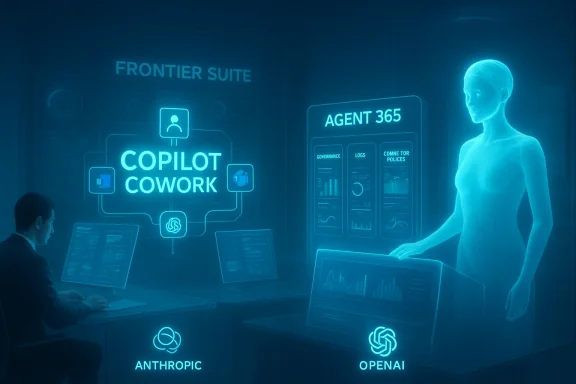
Microsoft’s latest Copilot wave makes an unmistakable bet: move past single‑turn assistance and turn workplace AI into agentic, multi‑step teammates that act on behalf of users — and give IT teams the governance tools to manage them at scale. The company’s March announcements bundle several product moves — a Copilot Cowork research preview built with Anthropic, expanded agentic experiences across Word, Excel, PowerPoint and Outlook, an upgraded Copilot Chat with multi‑model options, and the commercial launch plans for Microsoft Agent 365 and a new Microsoft 365 E7 “Frontier Worker” suite — that together push Copilot from helpful assistant to enterprise automation platform. petri.com/microsoft-365-copilot-agentic-experiences-copilot-cowork/)
Microsoft introduced Microsoft 365 Copilot as a productivity layer that embeds large language models across the Office apps, and it has steadily evolved from a conversational helper into a platform that hosts multiple models, agent templates, and governance telemetry. That strategic arc — from “assist” to “act” — is visible in the current announcements: agent modes inside Office apps, chat‑first “Office Agents,” model choice (OpenAI, Anthropic and Microsoft’s own engines), and a centralized control planr cataloging, observing, and securing agents.
These changes are not incremental UX polish. They map to a new operating model where AI agents can plan and execute multi‑step workflows — draft decks, run financial pulls, send follow‑ups, and schedule meetings — with minimal human prompting. Microsoft positions Work IQ and tenant‑level observability as the trust layer that keeps agentic automation auditable and secure. But the shift also raises immediate governance, cost, and accuracy questions for IT and compliance teams; those tradeoffs are woven through both Microsoft’s product collateral and early reporting.
Behind the scenes Cowork leverages model choice and grounding: Copilot routes subtasks (e.g., reasoning, data extraction, document synthesis) to the model best suited for that job and uses the tenant graph and Work IQ signals to ground outputs in corporate data. That architecture is consistent with Microsoft’s broader strategy of offering multiple foundation models (OpenAI, Anthropic, Azure Foundry and custom models) inside Copilot surfaces.
Excel’s Agent Mode will support a model switcher (Anthropic vs OpenAI choices) for tenants enrolled in the Frontier program and for commercial Copilot customers; that selector is an imver for IT teams who must route sensitive or regulated workloads to approved models.
Key features reported in the preview include:
Flag for readers: Because Agent 365 governs active, autonomous agents, its final contract language (what actions are billable, per‑agent vs per‑user metrics, and what telemetry is retained) will materially affect operational cost. Microsoft’s preview notes and early price signals are useful but prudent procurement should await the published commercial terms and licensing guidance.
This SKU matters because it attempts to normalize the cost of agentic automation inside a single per‑seat line item — a strategic move to prevent the erosion of per‑seat revenue as agute for certain human tasks. Industry analysts and early reporting frame E7 as Microsoft’s commercialization play to capture the agent economy inside tenant subscriptions.
Caveat: several outlets frame the $99 price and May 1 timing as company plans and market reporting, not as a universally accessible, globally posted SKU at the time of writing. Enterprises should verify final availability, carrier regions, and contract terms through Microsoft account teams.
For organizations, the near‑term playbook is clear: pilot intentionally, govern rigorously, and monitor costs closely. The promise is substantial — significant reductions in time to produce decks, reports and routine workflows — but the path to safe, reliable adoption will require disciplined governance and tight integration between product teams and security operations. If Microsoft’s Agent 365 and E7 packaging deliver on the promise of auditability and predictable economics, agents will become a new, productive layer of the enterprise stack. If not, organizations risk automated workflows that are hard to control and expensive to run.
The coming months — Frontier previews, the Agent 365 GA plan, and the E7 commercial rollout — will show whether Microsoft can turn agentic promise into enterprise reality. Keep an eye on tenant admin center notices, the Microsoft 365 admin center SKU pages, and your Microsoft account team for final commercial terms and rollout windows; treat early reports and press coverage as a clear directional signal, but validate contract and telemetry details before large‑scale rollouts.
Source: Petri IT Knowledgebase Microsoft 365 Copilot Gets New Agentic Experiences, Copilot Cowork Preview
 Background / Overview
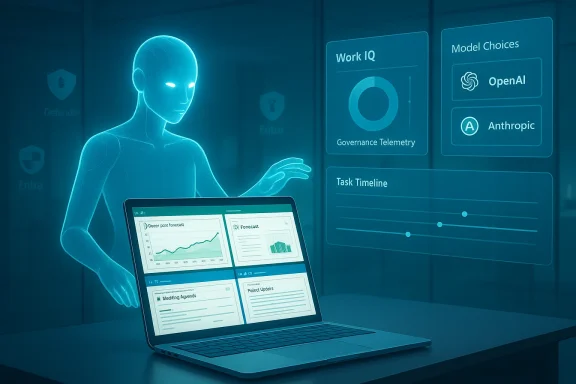
Microsoft introduced Microsoft 365 Copilot as a productivity layer that embeds large language models across the Office apps, and it has steadily evolved from a conversational helper into a platform that hosts multiple models, agent templates, and governance telemetry. That strategic arc — from “assist” to “act” — is visible in the current announcements: agent modes inside Office apps, chat‑first “Office Agents,” model choice (OpenAI, Anthropic and Microsoft’s own engines), and a centralized control planr cataloging, observing, and securing agents.These changes are not incremental UX polish. They map to a new operating model where AI agents can plan and execute multi‑step workflows — draft decks, run financial pulls, send follow‑ups, and schedule meetings — with minimal human prompting. Microsoft positions Work IQ and tenant‑level observability as the trust layer that keeps agentic automation auditable and secure. But the shift also raises immediate governance, cost, and accuracy questions for IT and compliance teams; those tradeoffs are woven through both Microsoft’s product collateral and early reporting.
What’s new, at a glance
- Copilot Cowork (research preview) — a turnkey, agentic assistant built with Anthropic that can orchestrate end‑to‑end meeting preparation and other multi‑step tasks. Available as a Frontier research preview for commercial customers in late March. ([petri.com](Microsoft 365 Copilot Gets New Agentic Experiences, Copilot Cowork Preview agentic experiences* — Agent Mode* for Word, Excel, PowerPoint, and Outlook that lets users hand off outcomes (e.g., “build a budget model and sanity‑check it”) to an agent that plans, executes, and iterates inside the document. Rolling out ram and in app previews.
- Copilot Chat enhancements — richer refinement flows, an Office Agent canvas, and support for multiple foundation models (OpenAI, Anthropic, Azure Foundry/custom models) within Copilot Chat for tenants enrolled in Frontier.
- Microsoft Agent 365 (GA planned May 1) — a governance and observability control plane to inventory agents, monitor behavior and performance, surface risk signals, and enforce security templates; priced at $15 per user per month for commercial customers in Microsoft’s public reporting.
- Microsoft 365 E7 Frontier Worker Suite (announced; GA May 1) — an enterprise SKU that bundles Microsoft 365 E5 + Copilot + Agent 365 + Entra Suite and advanced Defender/Purview/Intune features, reported at approximately $99 per user per month. Industry press coverage indicates this will be Microsoft’s premium, AI‑first enterprise bundle.
Copilot Cowork: an agent built to do the work
What it is and how it works
Copilot Cowork is presented as an agentic collaborator that can own complex, multi‑step jobs. Microsoft’s product briefings and reporting describe scenarios where Cowork will prepareng by collecting financial data, building a slide deck, drafting outreach emails, and reserving calendar blocks for prep — all executed through a single agent workflow. The feature is developed in partnership with Anthropic and will be available as a research preview to Frontier commercial customers later this month.Behind the scenes Cowork leverages model choice and grounding: Copilot routes subtasks (e.g., reasoning, data extraction, document synthesis) to the model best suited for that job and uses the tenant graph and Work IQ signals to ground outputs in corporate data. That architecture is consistent with Microsoft’s broader strategy of offering multiple foundation models (OpenAI, Anthropic, Azure Foundry and custom models) inside Copilot surfaces.
Why it matters
- It moves Copilot from “help me write this” to “pl” which increases productivity for scenario‑heavy work like sales, customer success, and finance.
- It demonstrates multi‑model orchestration in production: Microsoft is explicit that certain agent capabilities will prefer Claude (Anthropic) models in this preview. That gives customers choice but also creates a multi‑vendor governance surface.
Early constraints and signals
- Preview availability will be gated through Microsoft’s Frontier program; early adopters report tenant opt‑in and admin controls are required to enable Anthropic models and agent experiences. That means broader enterprise availability will be phased.
- Experience reliability and integration depth vary by tenant and language support; forums and early calls highlight tenant‑level "tenant not enabled" errors during Frontier rollouts. This is typical for coordinated, opt‑in previews but underscores that agentic productivity is still maturing.
Agentic experiences across Office apps
Agent Mode: in‑canvas automation for Word, Excel and PowerPoint
Agent Mode bring directly into Office documents and spreadsheets. Users can issue outcome‑oriented prompts (for example, “produce a three‑year forecast with scenario sensitivity”) and the agent will create, verify, and iteratively refine the workbook — including multi‑tab reasoning and sanity checks. Microsoft’s documentation and community previews show Agent Mode available in Excel for web and Windows (Frontier/preview channels) and appearing as in‑tools agents in the Microsoft 365 Copilot app.Excel’s Agent Mode will support a model switcher (Anthropic vs OpenAI choices) for tenants enrolled in the Frontier program and for commercial Copilot customers; that selector is an imver for IT teams who must route sensitive or regulated workloads to approved models.
PowerPoint and Word agent experiences
PowerPoint and Word agents promise to produce full slide decks and draft documents after an initial clarification phase, returning editable artifacts rather than simple prose blocks. Microsoft frames these agents as auditable — they keep an agent history, allow iterative refinement, and can be inspected via Agent 365 telemetry. Early demos emphasize that users can edit outputs and that agents aim to verify facts by consulting tenant data and external reasoning models.Copilot Chat: multi‑model options and in‑workspace agent building
Copilot Chat is evolving from a single chat pane into a richer workspace where users can build, refine, and deploy agents directly. The new experience includes:- A Tools/Agents pane with preinstalled Word/Excel/PowerPoint Agents.
- Model selection: Claude (Anthropic) and new OpenAI models are selectable engines in Copilot Chat and Researcher features for Frontier tenants.
- Refine flows: iterative content generation and in‑chat file creation that yields editable Office documents and slide decks.
Microsoft Agent 365: a control plane for the agent era
What Agent 365 does
Agent 365 is positioned as the enterprise control plane for AI agents: a central inventory, observability dashboards, behavior and performance metrics, risk signals (integrating Defender, Entra, Purview), and configurable security policy templates. Microsoft says Agent 365 helps businesses assess agent behavior, identify risks, and enforce governance — in effect, treating agents as managed identities that require lifecycle, auditing, and compliance controls.Key features reported in the preview include:
- Central agent registry and inventory
- Usage and performance insights
- Risk signals surfaced from Defender/Entra/Purview
- Configurable security policy templates and enforcement
- Observability and audit trails to satisfy compliance teams
Availability, pricing and caveats
Microsoft reported plans to make Agent 365 generally available on May 1, with a reported commercial price of $15 per user per month. Multiple trade outlets and product writeups repeat these specifics, and Microsoft’s preview materials and admin center notices describe Agent 365’s telemetry and template features for tenants. However, at the time of reporting the timeline and price were being published through press coverage and community posts rather than a single, consolidated press release, so IT teams should treat the May 1 GA date and the $15 figure as Microsoft’s stated plan in current briefings and media reports while watching the official Microsoft admin center for final SKU and billing language.Flag for readers: Because Agent 365 governs active, autonomous agents, its final contract language (what actions are billable, per‑agent vs per‑user metrics, and what telemetry is retained) will materially affect operational cost. Microsoft’s preview notes and early price signals are useful but prudent procurement should await the published commercial terms and licensing guidance.
Microsoft 365 E7 Frontier Worker Suite: packaging AI at enterprise scale
The reported Microsoft 365 E7 (Enterprise 7) package is Microsoft’s attempt to create a single, premium enterprise SKU that bundles AI agent governance, Copilot, and advanced security under one license. According to multiple industry reports, the new E7 tier folds Microsoft 365 E5, Microsoft 365 Copilot, Agent 365, Microsoft Entra Suite, and advanced Defender/Purview/Intune capabilities into a single package, with a headline price reported at around $99 per user per month. Publications including VentureBeat, Techzine and Windows‑focused outlets have covered this development as a major licensing change that could reshape enterprise SaaS procurement.This SKU matters because it attempts to normalize the cost of agentic automation inside a single per‑seat line item — a strategic move to prevent the erosion of per‑seat revenue as agute for certain human tasks. Industry analysts and early reporting frame E7 as Microsoft’s commercialization play to capture the agent economy inside tenant subscriptions.
Caveat: several outlets frame the $99 price and May 1 timing as company plans and market reporting, not as a universally accessible, globally posted SKU at the time of writing. Enterprises should verify final availability, carrier regions, and contract terms through Microsoft account teams.
Governance, security and compliance: what IT must plan for
Why agents change the threat model
AI agents that act introduce new risk vectors that go beyond generated content: automated communications, scheduled actions, data exfiltration via automated connectors, and the potential for poorly constrained agent workflows to create compliance violations. Microsoft’s introduction of Agent 365 and the Work IQ telemetry stack is a direct response — but it is not a full stop to the risks. Enterprises must adjust IAM policies, least‑privilege rules, and monitoring to account for agent identities and their lionr.com]Practical steps for IT teams
- Audit current Copilot usage and identify early agent candidates.
- Enforce tenant opt‑in policies for Frontier features; don’t leave Anthropic/OpenAI toggles open by default.
- Create and test security policy templates in Agent 365 previews before rolling agents into production.
- Instrument observability: add Defender/Entra/Purview integrations and set alert thresholds for high‑risk agent actions.
Governance design patterns
- Treat agents as long‑lived identities with lifecycle and access control separate from human users.
- Require human‑in‑the‑loop approval gates for agent actions that affect financial, HR, or customer data.
- Use tenant model routing to keep regulated workloads on approved models only (e.g., route PII processing to vetted models).
Adoption, cost and licensing implications
Microsoft’s pricing signals — Copilot per‑user list, the reported $15/month Agent 365 add‑on, and the $99 E7 bundle — reflect an attempt to make agentic capabilities predictable and packaged. But the economics for large organizations will be nuanced:- Consumption variability: agents generate events and interactions that may be metered; SharePoint agent interactions already have a consumption billing model. That means predictable per‑user license fees may be complemented by consumption meters.
- Seat arithmetic: bundling Copilot and Agent 365 into E7 is attractive for organizations ready to adopt agentic tools broadly; for others, the $15/user Agent 365 add‑on plus per‑interaction costs might bth.
- Procurement implications: legal and procurement teams must confirm data residency, subprocessors (Anthropic’s role), and SLAs for agent actions. Microsoft’s model for Anthropic indicates a subprocessor relationship under Microsoft’s direction and contractual safeguards for grounded features.
Strengths and strategic wins
- End‑to‑end automation: Copilot Cowork and Agent Mode make multi‑step workflows a first‑class scenario inside Office, significantly reducing friction for common knowledge‑work tasks.
- Model choice and orchestration: Supporting Anthropic, OpenAI and in‑house models gs to optimize for performance, cost, and regulatory concerns. This multi‑model approach reduces vendor lock‑in risk.
- Governance tooling: Agent 365 directly addresses the key enterprise need — how to observe, inventory and control agent behavior across large organizations. If the final product matches preview capabilities, it will be a major step toward operationalizing agents at scale.
Risks, unknowns and areas of caution
- Maturity and reliability: Agentic workflows require robust grounding and verification. Early previews show admin gating and tenant errors; production reliability across global tenants and languages remains a work in progress.
- Cost unpredictability: Consumption meters for agent interactions and per‑agent activity could produce surprise bills without careful monitoring. Preview documentation suggests pay‑as‑you‑go meters coexist with per‑user licenses.
- Governance gaps: Agent 365 promises central control, but the effectiveness of policy enforcement (especially across third‑party connectors and custom agents built in Copilot Studio) will determine whether IT can truly prevent “double agent” behavior. Early previews do not eliminate the need for bespoke retention and access controls.
- Regulatory and privacy concerns: Routing to third‑party models (Anthropic) introduces subprocessors and data handling differences that must be visible in contracts and tenant admin settings. Microsoft’s documentation lists Anthropic as an explicit subprocessor for certain capabilities, which requires review by privacy teams.
Recommended action plan for IT leaders
- Enroll a small cross‑functional team (security, legal, procurement, productivity champions) to evaluate Frontier features and the Agent 365 preview.
- Run a two‑quarter pilot focused on a single use case (sales meeting prep or marketing deck creation) to validate process, accuracy, and cost.
- Build tenant‑level policies: disable third‑party model routing for regulated data until legal sign‑off; require explicit human approvals for outbound actions.
- Instrument cost monitoring for agent interactions and set automated alerts for high usage. Use consumption meters as a signal to reconfigure agent behavior or escalate to engineering owners.
The larger picture: agents as the next platform
Microsoft’s Copilot wave is notable because it is an enterprise‑grade attempt to make agents manageable, auditable, and commercially viable for regulated customers. The combination of in‑app agent modes, chat‑first agent building, multi‑model support, and a governance plane is a comprehensive approach — and one that other cloud vendors and SaaS providers will likely emulate. However, turning agentic capability into reliable, predictable business automation requires more than features; it requires hardened policies, predictable billing, and cultural change around who owns agent outputs.Conclusion
Microsoft’s third wave of Copilot features marks a meaningful pivot: the company is no longer only delivering generative assistance; it is delivering agents that plan, act, and iterate inside the flow of work. Copilot Cowork, Agent Mode across Office apps, multi‑model Copilot Chat, Agent 365, and the planned E7 bundle combine to make agentic automation a practical enterprise capability — but they also shift complexity onto IT, security, and procurement teams.For organizations, the near‑term playbook is clear: pilot intentionally, govern rigorously, and monitor costs closely. The promise is substantial — significant reductions in time to produce decks, reports and routine workflows — but the path to safe, reliable adoption will require disciplined governance and tight integration between product teams and security operations. If Microsoft’s Agent 365 and E7 packaging deliver on the promise of auditability and predictable economics, agents will become a new, productive layer of the enterprise stack. If not, organizations risk automated workflows that are hard to control and expensive to run.
The coming months — Frontier previews, the Agent 365 GA plan, and the E7 commercial rollout — will show whether Microsoft can turn agentic promise into enterprise reality. Keep an eye on tenant admin center notices, the Microsoft 365 admin center SKU pages, and your Microsoft account team for final commercial terms and rollout windows; treat early reports and press coverage as a clear directional signal, but validate contract and telemetry details before large‑scale rollouts.
Source: Petri IT Knowledgebase Microsoft 365 Copilot Gets New Agentic Experiences, Copilot Cowork Preview