

Microsoft said on July 6, 2026 that it would cut about 4,800 jobs worldwide, roughly 2.1 percent of its workforce, with Australian roles among those affected, according to ABC News and company communications to staff. The layoffs are not just another fiscal-year trimming exercise. They are Microsoft’s clearest admission yet that the AI boom is changing the company’s cost structure faster than it can comfortably explain to employees, investors, and customers. For Windows users and IT pros, the immediate story is headcount; the larger one is a platform giant reallocating people, capital, and patience toward a future it has not yet fully monetized.
The awkwardness of Microsoft’s latest round of layoffs is that it arrives during a period of extraordinary corporate strength. This is not a company retreating from a failed product cycle or fighting for survival against a stronger rival. It is a company still selling cloud capacity, productivity software, security tooling, developer services, and enterprise AI at a scale most of the industry can only envy.
That makes the cuts harder, not easier, to interpret. When a shrinking company lays off workers, the explanation is obvious. When Microsoft lays off thousands while spending aggressively on AI infrastructure, the explanation becomes a map of where the company believes future profit will come from — and where it believes human labor no longer fits the model.
ABC News reported that Australian employees would be affected, though Microsoft had not disclosed which divisions or offices would bear the brunt. The company has roughly 3,000 employees in Australia across six offices, so even a small local impact will be watched closely by a market already debating whether the country’s AI buildout will create a durable tech workforce or simply pour money into construction, power, and imported cloud platforms.
Microsoft’s chief people officer Amy Coleman told employees that the eliminated roles were not being replaced by AI, according to ABC News. That distinction matters legally, reputationally, and internally. But it is also a narrower claim than it first appears. A role does not need to be replaced by a chatbot for AI to change the budget logic around it.
The better reading is that Microsoft is compressing some parts of the organization to pay for expansion elsewhere. AI does not have to be the direct substitute for a person to be the reason a job disappears. It can be the capital sink, the strategic priority, the new operating model, and the executive justification all at once.
There is construction work, electrical work, land acquisition, networking, power procurement, security, cooling, and ongoing operations. Those are real jobs and real investments. But they are not the same as a broad-based expansion in high-value local software roles, especially if the intellectual property, platform control, and margin capture remain concentrated in Redmond, Seattle, Silicon Valley, or a small number of hyperscale operators.
That is why the Australian angle is more than a local footnote. Microsoft can simultaneously invest in Australian infrastructure and reduce Australian headcount, because the modern cloud economy separates physical footprint from labor footprint. A region can become more important to the network while not necessarily becoming more important to the payroll.
This is the bargain governments are being asked to accept in the AI era. Data center investment is visible, measurable, and politically attractive. Workforce durability is harder to guarantee. The risk is that countries count cranes and megawatts as proof of participation in the AI boom while the more valuable layers — model development, platform pricing, enterprise integration, and developer ecosystems — remain elsewhere.
For Australian Microsoft staff, the lack of detail is its own form of pressure. A global percentage sounds clinical until it lands inside a local office. Employees do not experience layoffs as “2.1 percent”; they experience them as uncertainty over which team, which manager, which project, and which Monday morning calendar invite.
That is not trimming around the edges. It is a confession that Xbox grew into a structure Microsoft no longer believes can produce adequate returns. After years of buying studios, expanding Game Pass, acquiring Activision Blizzard, and presenting gaming as a strategic pillar, Microsoft is now trying to make the division look less like an empire and more like a portfolio.
The studio list tells the story. Compulsion Games and Double Fine Productions are expected to become independent again. Ninja Theory and Undead Labs are reportedly moving to new ownership arrangements intended to keep projects such as Senua and State of Decay 3 moving. Arkane, the French studio associated with Dishonored and the in-development Marvel’s Blade, is entering consultation over strategic options.
This is a softer landing than outright closures, and that distinction should not be dismissed. Microsoft was heavily criticized in previous gaming cuts when beloved studios and projects appeared to be sacrificed despite creative success. Spinouts and sales at least preserve the possibility of continuity for teams, intellectual property, and announced games.
But it is still a brutal signal. Microsoft spent years telling the market that scale would solve Xbox’s problems. Now it is saying that parts of that scale are the problem.
The flaw was never that the theory was irrational. The flaw was that games are expensive, unpredictable, culturally specific, and often slow to produce. A spreadsheet can treat studios as content engines; a development floor cannot. One prestige game can take six years, miss its window, arrive between platform transitions, or fail to convert critical admiration into subscription economics.
That tension has been visible for years. Microsoft’s acquisition of Activision Blizzard gave Xbox massive franchises and publishing heft, but it also raised the pressure to prove that owning more content actually improved the economics of the platform. Meanwhile, Sony and Nintendo continued to show that console identity, first-party discipline, and selective exclusivity still matter, even in a supposedly post-console world.
Microsoft has already been moving toward a more platform-agnostic posture, bringing more games to rival systems and focusing less on hardware exclusivity as the sole measure of success. That may be strategically correct. It may also be an admission that Xbox as a traditional console ecosystem has lost the right to demand unlimited patience from Microsoft’s capital allocation committee.
For players, the practical consequence is messy. More Microsoft games on more platforms may be good for access. But fewer internal studios, fewer employees, and more externalized ownership structures may mean a less coherent first-party identity. Xbox can become a bigger publisher and a smaller cultural force at the same time.
That is where AI becomes a force multiplier for austerity. It allows executives to argue that fewer people can support larger ambitions, even before the productivity gains are fully proven. It also raises the opportunity cost of every dollar spent outside the AI roadmap. A sales team, consulting group, or game studio is no longer judged only on its own performance; it is judged against the capital demands of model deployment, data centers, chips, and enterprise AI integration.
The irony is that Microsoft is one of the companies best positioned to profit from AI. Azure demand has been strengthened by enterprise interest in generative AI. Microsoft 365 Copilot gives the company a direct way to attach AI pricing to its most important productivity suite. GitHub Copilot has already made AI coding assistance a mainstream developer workflow rather than a lab demo.
But the cost side is enormous. AI infrastructure requires data centers, power, networking, GPUs, memory, and a tolerance for depreciation on hardware that can age quickly. A software company used to high margins is now spending like an industrial infrastructure company. That changes how every division is evaluated.
The phrase AI monetization has become a polite way of asking whether all of this spending will produce enough revenue soon enough. Microsoft’s layoffs are a partial answer: the company is not waiting for the final proof before making room in the budget.
Windows has already become a vehicle for Microsoft’s AI ambitions, from Copilot integrations to hardware messaging around neural processing units and AI PCs. The company wants Windows to be more than a legacy desktop operating system; it wants it to be the local front end of an AI-assisted productivity stack. That creates both opportunity and tension.
For enthusiasts, the concern is clutter and control. AI features can be useful, but they can also feel like yet another layer of cloud-connected behavior inserted into an operating system that users still expect to own. For administrators, the concern is governance: data boundaries, policy controls, licensing, user training, auditability, and the support burden when a feature arrives before the organization is ready for it.
Layoffs can sharpen those concerns. If Microsoft is reducing support, sales, consulting, or product-adjacent staff while pushing more AI into enterprise environments, customers will ask whether the company is improving the product or shifting implementation risk onto them. A Copilot license is not a deployment plan. An AI toggle is not a change-management strategy.
That is the part of the story Microsoft cannot solve with a memo. It has to prove that the AI push makes its ecosystem better, not merely more expensive and more complex.
Microsoft’s enterprise customers are already being asked to absorb a more complicated cost landscape. Security add-ons, E5 licensing, Copilot subscriptions, Azure consumption, endpoint management, cloud migration, compliance features, and premium support all compete for the same IT budget. AI arrives not as a free productivity miracle but as another line item requiring proof.
That proof is not always easy to produce. The value of AI assistants varies by role, data quality, user training, and process design. Some employees will save hours; others will generate prettier drafts of work they still must verify. For regulated businesses, the governance overhead can offset early gains.
This is why Microsoft’s own layoffs carry symbolic weight. If Microsoft is telling customers that AI unlocks productivity while simultaneously reducing staff to preserve margins and fund infrastructure, customers will reasonably ask whether they are being invited into the same bargain. Do more with less is not a product vision; it is a management demand.
There is also a vendor-risk angle. When a company reorganizes aggressively, customers watch for disruption in account coverage, support continuity, roadmap stability, and product quality. Microsoft is large enough to absorb a 2.1 percent cut without visible chaos, but the distribution of those cuts matters. A small reduction in the wrong specialized team can matter more than a large reduction in a generic function.
The language has changed from the post-pandemic correction era. In 2022 and 2023, many companies blamed overhiring, interest rates, and normalization after lockdown-driven demand. In 2026, the explanation is more strategic. Companies are not just correcting the past; they are funding a future they claim will be more automated, more efficient, and more AI-native.
That future may arrive. It may also arrive unevenly, with large firms using AI as a broad justification for cuts that would have happened anyway. The difficulty for workers and policymakers is that both things can be true. AI can genuinely change workflows while also becoming a convenient banner under which executives pursue ordinary cost reduction.
Microsoft’s statement that the eliminated jobs are not being replaced by AI is therefore best understood as a boundary around causation, not around context. The company is not saying AI has nothing to do with the restructuring. It is saying the jobs were not simply handed to machines. That leaves plenty of room for AI to be the gravitational center of the decision.
For the broader technology labor market, the implication is sobering. AI may create new jobs, but it is already changing which jobs companies defend during budget season. The safest roles will not simply be technical roles; they will be roles tied directly to revenue, infrastructure leverage, customer adoption, security, and measurable AI deployment.
That is the bind. Microsoft must spend aggressively to stay ahead in AI, because falling behind would threaten Azure, developer tooling, productivity software, and strategic relevance. But spending aggressively invites scrutiny, especially when the payback period remains uncertain and when competitors are making similar bets. If everyone builds capacity at once, pricing power becomes a central question.
The company’s relationship with OpenAI has given it a privileged position in the first phase of the generative AI race. But the market is maturing. Enterprises are becoming more selective. Open models, specialized models, and rival cloud offerings are improving. The easy narrative of inevitable AI upsell is giving way to procurement committees asking for measurable returns.
That is why the layoffs should be read as defensive as well as offensive. Microsoft is protecting margins while it builds. It is trying to convince investors that AI spending will not turn the company into a lower-margin infrastructure utility. It is also trying to convince customers that the same AI tools driving internal efficiency can justify higher external spending.
The risk is that those messages collide. If AI is so transformative that Microsoft can streamline its own workforce, customers may demand aggressive productivity evidence before paying more. If AI is not yet transformative enough to prove broad savings, investors may question the spending pace. Microsoft is trying to stand between those two audiences and satisfy both.
That has consequences for feature priorities. Expect more integration between Windows, Microsoft 365, Azure identity, endpoint management, and Copilot-branded services. Expect more pressure to make AI-capable hardware feel necessary, not optional. Expect Microsoft to keep looking for ways to turn the installed base into recurring revenue rather than one-time operating system loyalty.
This does not mean Windows enthusiasts are doomed to a worse product. Some AI-assisted features may become genuinely useful, especially in accessibility, search, automation, device management, and troubleshooting. Enterprise admins may benefit from better telemetry analysis, policy recommendations, and security summarization if Microsoft executes carefully.
But execution is the point. A leaner Microsoft that pushes more AI into Windows must also provide clearer controls, better documentation, predictable servicing, and credible privacy boundaries. Otherwise, the company risks turning AI from a selling point into another source of friction for the very administrators who keep Windows estates stable.
For gamers, the Windows impact is intertwined with Xbox’s identity crisis. If Xbox becomes more of a cross-platform publisher and less of a console-centric ecosystem, Windows gaming could benefit from broader PC-first thinking. Or it could suffer from a thinner first-party pipeline and continued uncertainty around Microsoft’s commitment to distinctive gaming experiences.
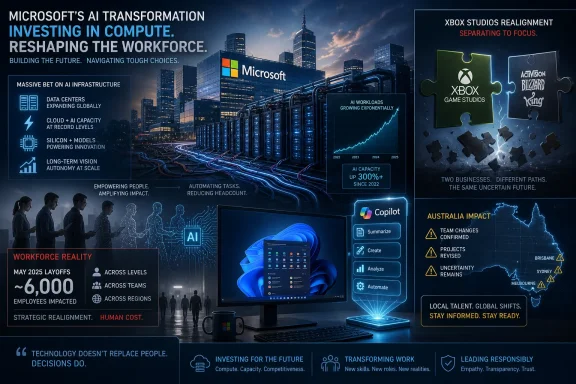 Microsoft Cuts People While Buying Compute
The awkwardness of Microsoft’s latest round of layoffs is that it arrives during a period of extraordinary corporate strength. This is not a company retreating from a failed product cycle or fighting for survival against a stronger rival. It is a company still selling cloud capacity, productivity software, security tooling, developer services, and enterprise AI at a scale most of the industry can only envy.That makes the cuts harder, not easier, to interpret. When a shrinking company lays off workers, the explanation is obvious. When Microsoft lays off thousands while spending aggressively on AI infrastructure, the explanation becomes a map of where the company believes future profit will come from — and where it believes human labor no longer fits the model.
ABC News reported that Australian employees would be affected, though Microsoft had not disclosed which divisions or offices would bear the brunt. The company has roughly 3,000 employees in Australia across six offices, so even a small local impact will be watched closely by a market already debating whether the country’s AI buildout will create a durable tech workforce or simply pour money into construction, power, and imported cloud platforms.
Microsoft’s chief people officer Amy Coleman told employees that the eliminated roles were not being replaced by AI, according to ABC News. That distinction matters legally, reputationally, and internally. But it is also a narrower claim than it first appears. A role does not need to be replaced by a chatbot for AI to change the budget logic around it.
The better reading is that Microsoft is compressing some parts of the organization to pay for expansion elsewhere. AI does not have to be the direct substitute for a person to be the reason a job disappears. It can be the capital sink, the strategic priority, the new operating model, and the executive justification all at once.
Australia Gets the Data Centers Before It Gets the Dividend
Australia’s place in this story is uncomfortable because it sits at the intersection of local ambition and global platform economics. The country is being pitched as a beneficiary of the AI infrastructure wave, with tens of billions of dollars in data center investment expected across the market. But data centers do not automatically produce the same employment profile as software offices, services teams, or local engineering hubs.There is construction work, electrical work, land acquisition, networking, power procurement, security, cooling, and ongoing operations. Those are real jobs and real investments. But they are not the same as a broad-based expansion in high-value local software roles, especially if the intellectual property, platform control, and margin capture remain concentrated in Redmond, Seattle, Silicon Valley, or a small number of hyperscale operators.
That is why the Australian angle is more than a local footnote. Microsoft can simultaneously invest in Australian infrastructure and reduce Australian headcount, because the modern cloud economy separates physical footprint from labor footprint. A region can become more important to the network while not necessarily becoming more important to the payroll.
This is the bargain governments are being asked to accept in the AI era. Data center investment is visible, measurable, and politically attractive. Workforce durability is harder to guarantee. The risk is that countries count cranes and megawatts as proof of participation in the AI boom while the more valuable layers — model development, platform pricing, enterprise integration, and developer ecosystems — remain elsewhere.
For Australian Microsoft staff, the lack of detail is its own form of pressure. A global percentage sounds clinical until it lands inside a local office. Employees do not experience layoffs as “2.1 percent”; they experience them as uncertainty over which team, which manager, which project, and which Monday morning calendar invite.
The Xbox Reset Turns Strategy Into Severance
The most dramatic part of the restructuring is inside Xbox, where the cuts are not merely a spreadsheet exercise but a visible reversal of Microsoft’s acquisition-era gaming strategy. As reported by Axios, GeekWire, PC Gamer, and other outlets, Microsoft is cutting thousands of Xbox roles and moving to separate several studios from the company. The figure widely reported for Xbox is 3,200 jobs, with about half affected immediately and the remainder expected over Microsoft’s fiscal year.That is not trimming around the edges. It is a confession that Xbox grew into a structure Microsoft no longer believes can produce adequate returns. After years of buying studios, expanding Game Pass, acquiring Activision Blizzard, and presenting gaming as a strategic pillar, Microsoft is now trying to make the division look less like an empire and more like a portfolio.
The studio list tells the story. Compulsion Games and Double Fine Productions are expected to become independent again. Ninja Theory and Undead Labs are reportedly moving to new ownership arrangements intended to keep projects such as Senua and State of Decay 3 moving. Arkane, the French studio associated with Dishonored and the in-development Marvel’s Blade, is entering consultation over strategic options.
This is a softer landing than outright closures, and that distinction should not be dismissed. Microsoft was heavily criticized in previous gaming cuts when beloved studios and projects appeared to be sacrificed despite creative success. Spinouts and sales at least preserve the possibility of continuity for teams, intellectual property, and announced games.
But it is still a brutal signal. Microsoft spent years telling the market that scale would solve Xbox’s problems. Now it is saying that parts of that scale are the problem.
Game Pass Was Not Enough to Suspend Gravity
The strategic bet behind modern Xbox was elegant in PowerPoint form. Microsoft would make gaming less dependent on console hardware by building a subscription and cloud distribution model around content, services, and reach. Own enough studios, feed enough games into Game Pass, and Xbox could become less like a console business and more like Netflix, Azure, or Microsoft 365.The flaw was never that the theory was irrational. The flaw was that games are expensive, unpredictable, culturally specific, and often slow to produce. A spreadsheet can treat studios as content engines; a development floor cannot. One prestige game can take six years, miss its window, arrive between platform transitions, or fail to convert critical admiration into subscription economics.
That tension has been visible for years. Microsoft’s acquisition of Activision Blizzard gave Xbox massive franchises and publishing heft, but it also raised the pressure to prove that owning more content actually improved the economics of the platform. Meanwhile, Sony and Nintendo continued to show that console identity, first-party discipline, and selective exclusivity still matter, even in a supposedly post-console world.
Microsoft has already been moving toward a more platform-agnostic posture, bringing more games to rival systems and focusing less on hardware exclusivity as the sole measure of success. That may be strategically correct. It may also be an admission that Xbox as a traditional console ecosystem has lost the right to demand unlimited patience from Microsoft’s capital allocation committee.
For players, the practical consequence is messy. More Microsoft games on more platforms may be good for access. But fewer internal studios, fewer employees, and more externalized ownership structures may mean a less coherent first-party identity. Xbox can become a bigger publisher and a smaller cultural force at the same time.
AI Is Not Replacing Every Job, but It Is Repricing Every Job
Microsoft’s insistence that the cut roles are not being replaced by AI deserves to be taken seriously, but not literally enough to end the conversation. Companies rarely replace jobs in a one-for-one theatrical way. They reorganize workflows, automate pieces of tasks, slow hiring, reduce management layers, consolidate support functions, and redirect budgets toward higher-priority initiatives.That is where AI becomes a force multiplier for austerity. It allows executives to argue that fewer people can support larger ambitions, even before the productivity gains are fully proven. It also raises the opportunity cost of every dollar spent outside the AI roadmap. A sales team, consulting group, or game studio is no longer judged only on its own performance; it is judged against the capital demands of model deployment, data centers, chips, and enterprise AI integration.
The irony is that Microsoft is one of the companies best positioned to profit from AI. Azure demand has been strengthened by enterprise interest in generative AI. Microsoft 365 Copilot gives the company a direct way to attach AI pricing to its most important productivity suite. GitHub Copilot has already made AI coding assistance a mainstream developer workflow rather than a lab demo.
But the cost side is enormous. AI infrastructure requires data centers, power, networking, GPUs, memory, and a tolerance for depreciation on hardware that can age quickly. A software company used to high margins is now spending like an industrial infrastructure company. That changes how every division is evaluated.
The phrase AI monetization has become a polite way of asking whether all of this spending will produce enough revenue soon enough. Microsoft’s layoffs are a partial answer: the company is not waiting for the final proof before making room in the budget.
The Layoff Memo Is Now Part of the Product Strategy
One reason these cuts matter to WindowsForum readers is that Microsoft’s internal allocation choices eventually become product behavior. When the company reorganizes around AI, the consequences show up in Windows, Microsoft 365, Azure, developer tooling, endpoint management, and support channels. Users may not care which cost center paid for a feature, but they do feel the results.Windows has already become a vehicle for Microsoft’s AI ambitions, from Copilot integrations to hardware messaging around neural processing units and AI PCs. The company wants Windows to be more than a legacy desktop operating system; it wants it to be the local front end of an AI-assisted productivity stack. That creates both opportunity and tension.
For enthusiasts, the concern is clutter and control. AI features can be useful, but they can also feel like yet another layer of cloud-connected behavior inserted into an operating system that users still expect to own. For administrators, the concern is governance: data boundaries, policy controls, licensing, user training, auditability, and the support burden when a feature arrives before the organization is ready for it.
Layoffs can sharpen those concerns. If Microsoft is reducing support, sales, consulting, or product-adjacent staff while pushing more AI into enterprise environments, customers will ask whether the company is improving the product or shifting implementation risk onto them. A Copilot license is not a deployment plan. An AI toggle is not a change-management strategy.
That is the part of the story Microsoft cannot solve with a memo. It has to prove that the AI push makes its ecosystem better, not merely more expensive and more complex.
Enterprise IT Will Read This as a Budget Signal
Administrators and CIOs are unlikely to view these layoffs as isolated human resources news. They will see them as a signal about Microsoft’s priorities for the next fiscal year: AI deployment, cloud consumption, margin protection, and portfolio discipline. Those priorities will shape licensing negotiations as surely as they shape org charts.Microsoft’s enterprise customers are already being asked to absorb a more complicated cost landscape. Security add-ons, E5 licensing, Copilot subscriptions, Azure consumption, endpoint management, cloud migration, compliance features, and premium support all compete for the same IT budget. AI arrives not as a free productivity miracle but as another line item requiring proof.
That proof is not always easy to produce. The value of AI assistants varies by role, data quality, user training, and process design. Some employees will save hours; others will generate prettier drafts of work they still must verify. For regulated businesses, the governance overhead can offset early gains.
This is why Microsoft’s own layoffs carry symbolic weight. If Microsoft is telling customers that AI unlocks productivity while simultaneously reducing staff to preserve margins and fund infrastructure, customers will reasonably ask whether they are being invited into the same bargain. Do more with less is not a product vision; it is a management demand.
There is also a vendor-risk angle. When a company reorganizes aggressively, customers watch for disruption in account coverage, support continuity, roadmap stability, and product quality. Microsoft is large enough to absorb a 2.1 percent cut without visible chaos, but the distribution of those cuts matters. A small reduction in the wrong specialized team can matter more than a large reduction in a generic function.
The Industry’s Layoff Cycle Has Learned to Speak AI
Microsoft is not acting in a vacuum. Amazon, Meta, Atlassian, WiseTech Global, and other technology companies have all made cuts while investing heavily in AI or automation. The pattern is now familiar: leaders promise transformation, investors demand discipline, and employees discover that the transformation budget has to come from somewhere.The language has changed from the post-pandemic correction era. In 2022 and 2023, many companies blamed overhiring, interest rates, and normalization after lockdown-driven demand. In 2026, the explanation is more strategic. Companies are not just correcting the past; they are funding a future they claim will be more automated, more efficient, and more AI-native.
That future may arrive. It may also arrive unevenly, with large firms using AI as a broad justification for cuts that would have happened anyway. The difficulty for workers and policymakers is that both things can be true. AI can genuinely change workflows while also becoming a convenient banner under which executives pursue ordinary cost reduction.
Microsoft’s statement that the eliminated jobs are not being replaced by AI is therefore best understood as a boundary around causation, not around context. The company is not saying AI has nothing to do with the restructuring. It is saying the jobs were not simply handed to machines. That leaves plenty of room for AI to be the gravitational center of the decision.
For the broader technology labor market, the implication is sobering. AI may create new jobs, but it is already changing which jobs companies defend during budget season. The safest roles will not simply be technical roles; they will be roles tied directly to revenue, infrastructure leverage, customer adoption, security, and measurable AI deployment.
The Stock Market Wants Proof, Not Sympathy
Investors are unlikely to reward Microsoft purely because it cut 4,800 jobs. Workforce reductions at a company of Microsoft’s scale are not automatically transformative. The market’s real question is whether the company can turn extraordinary AI spending into durable, high-margin revenue streams before infrastructure costs become a drag on free cash flow.That is the bind. Microsoft must spend aggressively to stay ahead in AI, because falling behind would threaten Azure, developer tooling, productivity software, and strategic relevance. But spending aggressively invites scrutiny, especially when the payback period remains uncertain and when competitors are making similar bets. If everyone builds capacity at once, pricing power becomes a central question.
The company’s relationship with OpenAI has given it a privileged position in the first phase of the generative AI race. But the market is maturing. Enterprises are becoming more selective. Open models, specialized models, and rival cloud offerings are improving. The easy narrative of inevitable AI upsell is giving way to procurement committees asking for measurable returns.
That is why the layoffs should be read as defensive as well as offensive. Microsoft is protecting margins while it builds. It is trying to convince investors that AI spending will not turn the company into a lower-margin infrastructure utility. It is also trying to convince customers that the same AI tools driving internal efficiency can justify higher external spending.
The risk is that those messages collide. If AI is so transformative that Microsoft can streamline its own workforce, customers may demand aggressive productivity evidence before paying more. If AI is not yet transformative enough to prove broad savings, investors may question the spending pace. Microsoft is trying to stand between those two audiences and satisfy both.
The Windows Ecosystem Will Feel the Reallocation
For the Windows ecosystem, the layoffs are another reminder that Microsoft’s center of gravity has shifted. Windows remains essential, but it is no longer the company’s sole organizing principle. It is a client endpoint, an enterprise surface, a security boundary, a developer workstation, a gaming platform, and increasingly an AI access layer.That has consequences for feature priorities. Expect more integration between Windows, Microsoft 365, Azure identity, endpoint management, and Copilot-branded services. Expect more pressure to make AI-capable hardware feel necessary, not optional. Expect Microsoft to keep looking for ways to turn the installed base into recurring revenue rather than one-time operating system loyalty.
This does not mean Windows enthusiasts are doomed to a worse product. Some AI-assisted features may become genuinely useful, especially in accessibility, search, automation, device management, and troubleshooting. Enterprise admins may benefit from better telemetry analysis, policy recommendations, and security summarization if Microsoft executes carefully.
But execution is the point. A leaner Microsoft that pushes more AI into Windows must also provide clearer controls, better documentation, predictable servicing, and credible privacy boundaries. Otherwise, the company risks turning AI from a selling point into another source of friction for the very administrators who keep Windows estates stable.
For gamers, the Windows impact is intertwined with Xbox’s identity crisis. If Xbox becomes more of a cross-platform publisher and less of a console-centric ecosystem, Windows gaming could benefit from broader PC-first thinking. Or it could suffer from a thinner first-party pipeline and continued uncertainty around Microsoft’s commitment to distinctive gaming experiences.
The Hard Numbers Make the Soft Promises Easier to Test
The concrete facts are now sharp enough that Microsoft’s narrative can be tested over the next year. The company is cutting thousands of roles globally, Australia is among the affected markets, Xbox is undergoing its largest reported restructuring in years, and AI infrastructure remains the spending priority. That combination leaves little room for vague optimism.- Microsoft’s July 2026 cuts affect about 4,800 employees worldwide, or roughly 2.1 percent of the company’s global workforce.
- Australian roles are affected, but Microsoft has not publicly detailed which local offices, teams, or functions will be hit.
- Xbox is absorbing the most visible restructuring, with thousands of jobs being eliminated and several studios leaving Microsoft ownership or entering strategic review.
- Microsoft says the eliminated roles are not being replaced by AI, but the company also acknowledges that AI is changing how work gets done.
- The practical test for customers will be whether Microsoft can pair AI investment with better products, clearer controls, and support that does not feel thinner.
- The practical test for investors will be whether Azure, Copilot, and enterprise AI services can grow fast enough to justify the infrastructure spending behind them.
References
- Primary source: RS Web Solutions
Published: 2026-07-07T22:30:08.965931
Microsoft Job Cuts Impact 4,800 Employees Worldwide Including Australia
Microsoft cuts 4,800 jobs worldwide with Australian employees among those impacted. Discover what this means for the tech giant and the future workforce.www.rswebsols.com - Related coverage: gematsu.com
Xbox to lay off 3,200 employees, divest five studios - Gematsu
Xbox has announced a major restructuring, reducing its headcount by 3,200 employees throughout fiscal year 2027, with 1,600 roles eliminated today.www.gematsu.com - Related coverage: abc.net.au
Microsoft to cut 2.1pc of its global workforce including some Australian roles, the ABC understands - ABC News
ABC News understands Microsoft Australia staff will be impacted by the tech giant's latest round of lay-offs. Microsoft will cut about 2.1 per cent of its global workforce. www.abc.net.au
- Related coverage: techspot.com
Microsoft is cutting 3,200 Xbox jobs and spinning off four game studios | TechSpot
In a public memo to Xbox employees, CEO Asha Sharma confirmed that Microsoft will eliminate approximately 3,200 positions across the gaming division between now and July 2027,...www.techspot.com - Related coverage: windowscentral.com
Xbox's big "reset" cuts: Compulsion, Double Fine, Undead Labs, Ninja Theory to leave Xbox — 3,200 roles to be removed | Windows Central
Xbox's expected cuts have been revealed. It'll be the single biggest staff reduction event in the platform's history — although no announced projects have been cancelled, and no studios have been closed (so far).www.windowscentral.com - Related coverage: geekwire.com
Microsoft cuts 4,800 jobs, about 2% globally, revamps salesforce and launches massive Xbox overhaul – GeekWire
Microsoft is cutting 4,800 jobs and overhauling its Xbox gaming business in what its new gaming CEO calls the biggest restructuring in Xbox history, while reshaping its sales and consulting division amid record AI spending and a 30% stock slide.www.geekwire.com
- Related coverage: abcnews.com
Microsoft is laying off 4,800 workers: 'AI is changing how work gets done' - ABC News
The job cuts amount to 2.1% of Microsoft's global workforce.abcnews.com
- Related coverage: keengamer.com
XBOX Cuts 3,200 Jobs and Four Studios Leave in Historic Restructure
Get the full breakdown of the XBOX layoffs 2026, from the 3,200 job cuts to the studios leaving Microsoft and what upcoming games survive.www.keengamer.com - Related coverage: dexerto.com
Xbox sells off four studios as company confirms 3,200 job cuts - Dexerto
Xbox began cutting 3,200 jobs and confirmed four studios were leaving as Sharma called the business “not healthy”www.dexerto.com - Related coverage: fortune.com
Xbox's CEO on 3,200 layoffs, four studios cut, and her warning that 'we spread ourselves too thin' | Fortune
Asha Sharma unveiled sweeping changes at the Microsoft unit Monday, including downsizing that will impact 20% of staff.fortune.com
- Related coverage: cbsnews.com
Microsoft to cut more than 3,000 jobs from ailing Xbox unit - CBS News
Microsoft moves to slash costs as the video game industry faces what the tech giant calls the "most severe hardware crisis in its history."www.cbsnews.com