Microsoft is cutting hundreds of Azure-related jobs in Beijing and Shanghai, with affected employees reportedly told last week that their roles will end on July 6 as the company reassesses its mainland China cloud footprint amid tighter US and Chinese data rules. The reported cuts are not a collapse of Microsoft’s China business, nor are they just another generic Big Tech layoff. They are a sign that the world’s most valuable cloud platforms are being forced to behave less like global utilities and more like jurisdiction-by-jurisdiction infrastructure companies. For WindowsForum readers, the story matters because Azure is no longer just a developer platform; it is the identity layer, management plane, AI backend, and compliance headache behind a growing share of modern Windows estates.

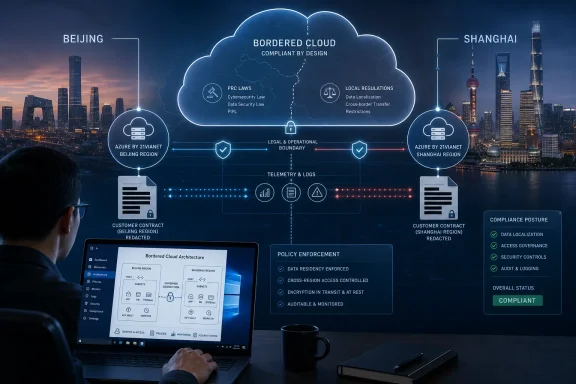
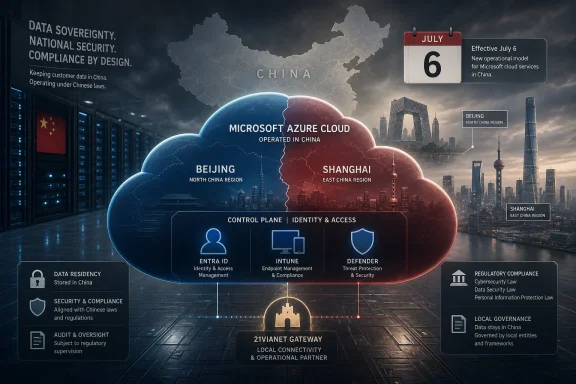
Graphic showing Microsoft Azure cloud operated in China with Beijing/Shanghai regions, security and compliance features.Microsoft’s China Cloud Was Always a Special Case​

The first mistake is to treat this as if Microsoft simply trimmed a normal regional sales office. Azure in mainland China has never been a normal Azure region in the way that West Europe, East US, or Southeast Asia are normal Azure regions. It is a physically and legally separated cloud instance operated by 21Vianet, not by Microsoft in the same direct manner as its global commercial cloud.
That distinction is not cosmetic. Customers using Azure in China deal with different contracts, different endpoints, different service availability, different operational assumptions, and a regulatory model built around Chinese data sovereignty requirements. Microsoft supplies the technology and brand gravity, but the mainland service exists behind a local operating structure designed to satisfy Beijing’s rules.
That model once looked like a clever compromise. It let Microsoft participate in the Chinese cloud market without pretending that a US hyperscaler could simply drop its standard global cloud into mainland China. It also gave multinationals a Microsoft-flavored option for workloads that had to serve Chinese users with acceptable latency and local compliance posture.
But the compromise has become harder to maintain. China’s data security, cybersecurity, and personal information rules have grown more demanding, while Washington has become more suspicious of how advanced cloud, AI, and data infrastructure intersect with national security. The pressure is no longer only about where a server sits. It is about who can touch the system, where engineering knowledge resides, what telemetry crosses borders, and whether cloud capacity can indirectly support strategic technologies.
That is why a few hundred Azure jobs in Beijing and Shanghai can matter more than the headcount number suggests. In the cloud business, engineering location is not merely an HR line item. It is part of the trust architecture.

The Layoffs Land Where Cloud Sovereignty Is Getting Real​

According to the South China Morning Post report, affected Azure employees in Beijing and Shanghai received notices last week, with estimates from sources putting the impact between 200 and 400 workers. The report says employment would cease at Azure on July 6, with severance tied to tenure and up to seven months’ pay. Some employees were reportedly offered an option to relocate to Canada.
Microsoft’s public line is carefully narrow. The company said it had shared an optional internal transfer opportunity with eligible employees and remained focused on serving customers and growing globally. That is not a denial of role eliminations, but it is also not a sweeping admission that geopolitical risk is the only cause.
The specificity of the affected group is what makes the story interesting. The report says other Microsoft units, including DevDiv, Microsoft Software Technology Centre Asia, and Microsoft AI teams across Shanghai and Suzhou, were not affected. If accurate, that points away from a simple “China is being cut” narrative and toward a more targeted reshaping of cloud-related work.
Cloud jobs are different from application development jobs because cloud operations sit closer to regulated infrastructure. Azure engineers may work on services that depend on cross-border coordination, security-sensitive tooling, platform reliability, identity systems, or operational practices that regulators increasingly scrutinize. Even when employees never see customer data, the surrounding control plane can become politically sensitive.
The relocation-to-Canada detail also deserves attention. It suggests Microsoft may want to retain some talent while moving certain roles outside mainland China. That is exactly the kind of corporate maneuver one would expect when a company still values the people and their expertise but no longer wants every function anchored in the same jurisdiction.
For administrators, this is the practical lesson: sovereignty is not just a checkbox in a compliance portal. It changes staffing, support paths, engineering velocity, incident response, and the long-term shape of cloud services.

Azure Is Growing, but Growth No Longer Protects Every Azure Job​

The awkward backdrop is that Azure remains one of Microsoft’s strongest businesses. Microsoft’s fiscal 2025 results showed Azure surpassing $75 billion in annual revenue for the first time, with growth tied to enterprise cloud demand and the AI infrastructure boom. In ordinary corporate logic, a fast-growing unit should be hiring, not shrinking.
But hyperscale cloud has entered a stranger phase. Microsoft is pouring enormous capital into data centers, GPUs, networking, power, and AI capacity. That spending competes directly with payroll, especially in teams that leadership believes can be consolidated, automated, relocated, or reorganized around new priorities.
This is the paradox of the current AI-and-cloud economy: revenue can rise, margins can remain impressive, and jobs can still disappear. Big Tech executives now speak about efficiency almost as often as they speak about innovation. The industry has learned to present layoffs not as distress but as portfolio management.
Microsoft has already gone through major workforce reductions in recent years, including broad cuts in 2025 that affected thousands of workers. The company has also been under constant investor pressure to prove that its AI spending will translate into durable profits rather than simply larger capital expenditure lines. In that environment, even Azure is not immune.
The China cuts, if reported accurately, sit at the intersection of two pressures. One is the familiar Microsoft-wide search for efficiency. The other is the less familiar but more strategically important rebalancing of where cloud engineering work can safely and legally happen.

The 21Vianet Model Solved Yesterday’s Problem​

Microsoft’s partnership model in China was built for an earlier era of cloud globalization. The assumption was that a hyperscaler could localize operations, license technology to a Chinese partner, keep data in-country, and preserve enough product similarity that multinational customers would recognize the platform. It was never seamless, but it was workable.
For years, that structure gave Microsoft a defensible answer to a difficult market. Azure operated by 21Vianet could support Chinese business requirements while remaining distinct from Microsoft’s global cloud. Microsoft 365, Dynamics 365, Power Platform, and related services followed similar localized logic.
The problem is that cloud has become more deeply integrated since that model matured. Azure is no longer mostly virtual machines, storage accounts, and databases. It is identity, endpoint management, security analytics, developer workflows, AI model access, data governance, and policy enforcement. A modern enterprise might use Azure not only to host applications, but to decide who can log in, what devices are compliant, which data can be classified, and how incidents are detected.
That integration makes separation harder. A “China cloud” that is truly separate must still interoperate with global corporate systems in some cases, but every bridge becomes a compliance and security question. A global tenant model may be convenient for IT. It may also be legally or operationally awkward when users, data, logs, and administrative authority cross boundaries.
This is where Windows administrators feel the pain. A multinational with offices in Shanghai, Munich, Seattle, and Singapore may want one identity architecture, one endpoint policy, one SIEM strategy, and one procurement motion. Reality often says otherwise. China may require a separate tenant, separate contracts, different service availability, and additional network planning.
That does not mean Azure in China is broken. It means it is not a mirror. Treating it as one is how projects run late.

Data Laws Are Turning Cloud Regions Into Policy Borders​

The public phrase “data residency” understates what governments now want from cloud providers. Residency sounds like storage location: put the bits in a local data center and move on. Modern data regulation is broader. It touches access, processing, metadata, operational control, encryption, incident disclosure, algorithmic systems, and the legal authority under which a provider can be compelled to act.
China has built a sweeping framework around cybersecurity, data security, and personal information protection. The practical result is that companies operating in China must think carefully about what data leaves the country, what systems count as critical, and how personal information is handled. For foreign companies, the safest path often involves local cloud instances and local partners.
The US has moved in the other direction but with a similar strategic instinct. Washington is increasingly focused on preventing sensitive technology, AI capability, semiconductor know-how, and cloud resources from strengthening geopolitical rivals. That concern has already reshaped export controls around chips and advanced computing. Cloud access is a logical next frontier because AI capability is increasingly rented rather than owned.
Cloud providers are stuck in the middle. Their business model is global scale, standardized platforms, and centralized engineering leverage. Governments are asking for local accountability, national control, and sometimes strategic denial. Those demands do not coexist neatly.
This is why the Microsoft report should not be read as a one-off employment item. It is a data-sovereignty signal. The cloud era began with the promise that location would matter less. The next phase is proving that location matters more than ever, just at a different layer of the stack.

The Customer Risk Is Not an Outage; It Is Drift​

For most customers, the immediate risk from these reported cuts is probably not that Azure services in China suddenly stop working. Hyperscale platforms are built with layers of operational redundancy, and Azure in China’s local operator model means service continuity does not depend solely on a handful of Microsoft employees in Beijing or Shanghai. Panic would be the wrong reaction.
The more realistic risk is drift. Service parity may widen or narrow unevenly. Support escalation paths may change. Roadmaps may become harder to read. Cross-border architecture decisions may require more legal review and less assumption-driven engineering. Teams that once relied on informal Microsoft relationships in China may find those channels thinner.
Drift is especially dangerous because it rarely announces itself. An identity feature is missing here. A security product arrives later there. A networking pattern that works globally needs rework in China. A compliance review blocks a design that looked technically sound. None of these is dramatic by itself, but together they can turn a cloud strategy into a patchwork.
For Windows-heavy enterprises, the areas to watch are identity, device management, security telemetry, and developer platform dependencies. Microsoft’s ecosystem encourages deep coupling between Windows clients, Entra ID, Intune, Defender, Azure Monitor, GitHub, Visual Studio tooling, and Azure-hosted application backends. In a single jurisdiction, that coupling is a strength. Across regulatory borders, it can become a design constraint.
The right response is not to abandon Microsoft’s cloud in China. The right response is to document assumptions that were previously left implicit. Which tenant owns which users? Where are logs stored? Who can administer production? Which support organization has access? Which services are unavailable or delayed in the China instance? Those are not procurement details. They are architecture.

Microsoft’s Message Is Stability, but Its Actions Say Optionality​

Microsoft’s statement to the SCMP is a model of corporate containment. It emphasizes internal transfer opportunities and global growth, avoiding any direct framing around geopolitical tension. That is unsurprising. No multinational wants to say it is moving cloud roles because two governments are making its operating model harder.
But corporate action often speaks more clearly than corporate language. If some employees are offered relocation, Microsoft is preserving optionality. If the cuts are concentrated in Azure while other China-based engineering groups remain unaffected, Microsoft is segmenting risk. If this is at least the third downsizing in China in two years, as the report says, then the company is not merely making a quarterly adjustment.
Optionality is the watchword of the moment. Microsoft wants access to China’s market without overexposing sensitive cloud work to China’s jurisdiction. It wants to satisfy US policymakers without abandoning global customers. It wants AI-scale infrastructure growth without letting operating expense outrun investor patience. It wants local presence and strategic distance at the same time.
That is not hypocrisy; it is the operating condition of a hyperscaler in 2026. The old idea of a borderless cloud is giving way to a managed fragmentation model. Microsoft, Amazon, Google, Oracle, and regional providers will all have to decide which pieces of their stack can be global, which must be local, and which should not be offered everywhere.
The winners will not necessarily be the companies with the most regions on a map. They will be the ones that can explain, contract, support, and secure the differences between those regions without leaving customers to discover the gaps mid-migration.

Windows Shops Need to Relearn Geography​

The Windows ecosystem trained a generation of administrators to think in domains, forests, tenants, subscriptions, and policies. Geography mattered, but it often mattered as latency, language, or licensing. Now geography is becoming a first-class security and compliance boundary.
That shift changes the job. A sysadmin supporting Chinese offices cannot simply ask whether Teams works or whether a VM can be deployed. They need to understand whether the organization is using global Microsoft 365, Microsoft 365 operated by 21Vianet, Azure operated by 21Vianet, local identity synchronization, separate endpoints, or some hybrid arrangement that grew organically because nobody wanted to fund a clean design.
The ugliest environments are usually the ones built through exception. A small China office gets a workaround. Then it grows. A local application needs better latency. Then it gets a local cloud account. A compliance officer asks about data transfers. Then IT discovers that the architecture diagram was never updated. By the time the issue reaches the CIO, the company has two versions of Microsoft cloud reality and no shared vocabulary for them.
The reported Microsoft cuts should be a trigger for inventory. Not because they prove a service failure is coming, but because they remind customers that cloud architecture depends on provider strategy. If Microsoft is reassessing where Azure work is done, customers should reassess where their own Microsoft-dependent work is done.
That inventory should include contracts, tenants, identity flows, administrative roles, logging pipelines, backup locations, support arrangements, and application dependencies. It should also include people. Many global Microsoft environments depend on a small number of administrators who understand the China exception. If those people leave, the documentation often leaves with them.

The AI Layer Makes the China Question Harder​

Five years ago, a conversation about Azure in China would have focused on hosting, connectivity, and compliance. Today, it inevitably turns to AI. Microsoft has tied Azure’s growth story to AI infrastructure, model services, Copilot, developer tools, and enterprise automation. That makes China more complicated.
AI systems are hungry for data, compute, telemetry, and model access. They also raise sharper regulatory concerns than conventional cloud workloads. Governments care not only where data is stored but how models are trained, what outputs they generate, whether sensitive information can leak, and who can use compute capacity for advanced research or military-adjacent work.
This creates a difficult split for Microsoft. The company wants Azure to be the platform for enterprise AI everywhere it can operate. But the most advanced AI infrastructure is also the part of the cloud stack most likely to attract export controls, national security review, and local regulatory scrutiny. A separated China cloud can offer some services, but it cannot erase the strategic sensitivity around AI.
For enterprise customers, the implication is straightforward: do not assume the AI roadmap in one Microsoft cloud maps cleanly to another. A Copilot feature, Azure AI service, model hosting pattern, or security integration that looks standard in the global cloud may have different availability, data handling, or compliance implications in China. The gap may be technical, legal, commercial, or all three.
That is frustrating, but it is better discovered during design than during deployment. The companies that get this right will treat China-facing AI projects as separate programs with their own legal review, architecture review, and operational model. The companies that get it wrong will treat them as regional rollouts of a global template and then wonder why the template breaks.

The Cuts Are Small Beside the Strategic Message​

The reported number, 200 to 400 workers, is small by Microsoft standards. The company employs well over 200,000 people globally, and its recent layoff rounds have involved far larger totals. But strategic importance is not measured only by headcount.
Azure is Microsoft’s central platform business. China is the world’s most consequential contested technology market. Data law is becoming one of the main ways governments project power into software architecture. Put those together and a targeted Azure downsizing in Beijing and Shanghai becomes a proxy for a much larger industry turn.
It also punctures a comforting myth about cloud inevitability. For years, the major cloud providers sold a story of ever-expanding regions, ever-improving parity, and ever-deeper integration. That story is still partly true. But it now sits beside another story: selective withdrawal, controlled access, localized compliance, and geopolitical segmentation.
There is a temptation to make this a morality play about China, the US, or Microsoft. That is too simple. China wants control over data and infrastructure inside its borders. The US wants to prevent strategic technology leakage. Microsoft wants profitable global scale without being crushed between incompatible legal regimes. Customers want services that work. Every actor is behaving according to incentives that are unlikely to soften soon.
The result is not deglobalization in the crude sense. It is re-bordered globalization. The cloud remains global as a business, but less global as an operating reality.

The July 6 Date Should Put Architects on Notice​

There are several concrete lessons buried inside this otherwise familiar layoff story.
  • Microsoft’s reported Azure cuts in Beijing and Shanghai are best read as a targeted cloud-sovereignty adjustment, not a broad retreat from China.
  • Azure in mainland China remains a separate service operated by 21Vianet, and customers should not assume feature, contract, identity, or support parity with global Azure.
  • The reported July 6 employment end date gives enterprises a useful prompt to review China-related Microsoft dependencies before assumptions harden into operational risk.
  • Windows and Microsoft 365 administrators should map tenant boundaries, logging locations, administrator access, and support paths for any China-facing environment.
  • AI services will make cross-border cloud planning more complex because compute access, data handling, and model governance are now regulatory issues as much as technical ones.
  • The safest enterprise posture is to design China workloads explicitly rather than treating them as a regional extension of a standard global Azure pattern.
The broader point is that provider geography has become part of system design again. Architects who ignore it will still be able to deploy resources, but they may not be able to defend the resulting architecture when legal, security, or operational questions arrive.

The Cloud’s Next Battle Is Control, Not Capacity​

Microsoft can absorb a few hundred job cuts. Azure can continue growing. Customers can keep running production workloads in China through the 21Vianet-operated model. None of that makes the SCMP report trivial.
The deeper story is that cloud platforms are being pulled away from their founding abstraction. The cloud promised to hide infrastructure behind APIs. Regulation is forcing the infrastructure back into view. The location of engineers, operators, data centers, encryption controls, support teams, and legal entities now matters in ways that a portal dashboard cannot fully express.
For Microsoft, this is a test of whether it can keep Azure coherent while making it more compartmentalized. For customers, it is a test of whether they can keep Microsoft-centric environments manageable while accepting that not every tenant, region, or service belongs to the same legal universe. For WindowsForum’s audience, the message is blunt: the Microsoft cloud is still the default gravity well for much of enterprise IT, but gravity now bends around borders.
The July 6 cuts may pass with little visible disruption. The larger shift will not. The next decade of cloud architecture will be shaped less by who can spin up the most regions and more by who can prove where control begins, where it ends, and who is allowed to stand in the middle.
References​

  1. Primary source: South China Morning Post
    Published: Tue, 09 Jun 2026 08:58:43 GMT
  2. Official source: azure.microsoft.com
  3. Official source: learn.microsoft.com
  4. Official source: azure-int.microsoft.com
  5. Related coverage: jetservices.com.cn
  6. Related coverage: appinchina.co
  1. Related coverage: docs.azure.cn
  2. Related coverage: axios.com
  3. Related coverage: netk5.com.cn
  4. Official source: news.microsoft.com
  5. Related coverage: tectura-china.com
  6. Official source: microsoft.com
  7. Related coverage: techcrunch.com
  8. Related coverage: tomshardware.com
  9. Related coverage: techspot.com
  10. Official source: blogs.microsoft.com
  11. Related coverage: seczine.com
  12. Related coverage: mungomash.com
  13. Related coverage: advancedai.com
  14. Related coverage: gamespot.com
  15. Related coverage: livemint.com
  16. Related coverage: techtarget.com
  17. Related coverage: tech-insider.org
  18. Related coverage: annualreports.ai
 

Microsoft is reportedly cutting 200 to 400 Azure jobs in Beijing and Shanghai, with affected employees expected to leave on July 6, 2026, as Microsoft continues to reshape its China-based cloud and AI operations amid tightening U.S. and Chinese data rules. The layoffs are not just another line item in Big Tech’s long cost-cutting season. They are a sign that the global cloud, once sold as a borderless abstraction, is becoming a more fragmented and jurisdiction-bound business. For Windows admins and enterprise architects, the story is less about headcount in two Chinese cities than about the shrinking room for ambiguity in cross-border infrastructure.

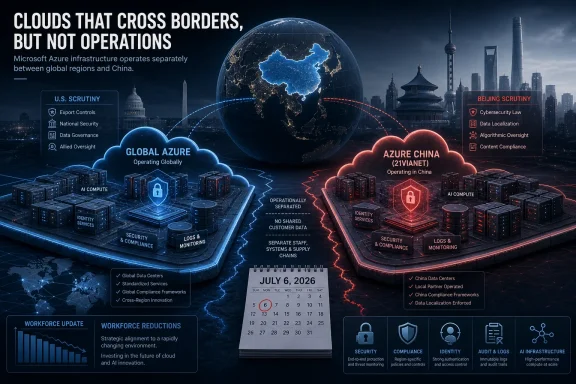
A person monitors a “bordered cloud” compliance diagram linking Beijing and Shanghai systems.The Cloud Was Supposed to Flatten Geography, Not Recreate It​

The public cloud’s first great sales pitch was that geography would become a deployment variable, not a strategic problem. Pick a region, replicate a workload, apply a policy, and let Microsoft, Amazon, or Google absorb the messy details of power, networking, compliance, and hardware logistics. That model worked best when the legal assumptions behind it were boring.
China has never really fit that story. Azure in mainland China is not simply another set of Microsoft regions attached to the same global fabric. It is operated by 21Vianet, physically and legally separate from Microsoft’s global Azure cloud, with its own commercial structure, operational boundaries, and compliance posture.
That separation has long been a practical compromise. It allowed Microsoft to sell familiar cloud technology into China while satisfying local requirements for in-country operation. It also created a persistent architectural footnote: “Azure” in China is Azure by technology lineage, not by full operational identity.
The reported cuts in Beijing and Shanghai make that footnote feel less like a deployment caveat and more like the point. If the global cloud is becoming a collection of legally distinct cloud blocs, then the teams that build, support, and integrate those blocs become politically exposed infrastructure. The jobs are local, but the pressure is geopolitical.

Microsoft’s China Cloud Retrenchment Looks Less Like a One-Off​

According to the reporting that sparked this round of coverage, some Azure employees in Beijing and Shanghai were notified by email last week that their roles would end. Two sources estimated the layoffs at between 200 and 400 workers, with severance reportedly tied to tenure and potentially including up to seven months’ pay. Microsoft did not confirm the number, saying instead that it had shared an optional internal transfer opportunity with eligible employees.
That phrasing matters. Large companies use careful language during layoffs, but “optional internal transfer opportunity” is not the same thing as saying the work remains where it was. Some affected employees were reportedly offered relocation to Canada, which suggests Microsoft may be moving some capability rather than simply deleting it.
The distinction is important because Microsoft has reportedly made similar moves before. Over the past two years, reports have pointed to previous reductions or relocation offers affecting China-based Azure and AI employees, including options to move to the United States, Australia, Ireland, and Canada. The company has also shifted some China-linked AI research activity toward Vancouver, according to prior reporting.
Taken individually, each move can be explained as ordinary portfolio management. Teams are reorganized, projects are consolidated, and engineering capacity moves toward where a company believes it can operate most efficiently. Taken together, the pattern looks like a cautious narrowing of Microsoft’s exposure to sensitive China-based cloud and AI work.
This is not Microsoft abandoning China. The company still has deep commercial, engineering, and partner ties there, and the reported cuts appear to spare other units such as DevDiv, Microsoft Software Technology Centre Asia, and Microsoft AI teams in Shanghai and Suzhou. But it is a sign that Microsoft is drawing sharper internal lines around where certain kinds of cloud work can safely be done.

The 21Vianet Model Was a Solution to One Era’s Problem​

Azure operated by 21Vianet has always been a clever answer to a difficult market. China requires foreign cloud providers to work within a domestic regulatory framework, and Microsoft’s arrangement created a way to offer Azure-based services without pretending mainland China could be treated like North Europe, East US, or Southeast Asia.
For customers, that model has always carried operational consequences. Azure China has separate portals, separate identity considerations, separate service availability, and feature parity gaps that may narrow but do not disappear. A multinational enterprise that runs workloads in global Azure cannot simply assume that templates, governance policies, private networking patterns, and support processes will map cleanly into China.
That separation is often described as a compliance necessity, but it is also a product reality. Admins know the pain of managing edge cases that look familiar until they break automation. A workload that depends on a global Azure service unavailable in China is not a small inconvenience if it sits inside a production deployment pipeline.
The reported layoffs do not mean Azure China stops working, nor do they imply an immediate degradation of service. But they do put a spotlight on the human machinery behind a separate cloud. A physically and legally distinct instance still needs product engineers, support specialists, compliance experts, and institutional memory.
When cloud providers move staff out of sensitive jurisdictions, they may improve their risk posture while making some operations more remote, more procedural, and potentially slower to adapt. That is the trade-off enterprises need to watch, because cloud reliability is not just about datacenters and SLAs. It is about the people who understand how the exceptions work.

Washington and Beijing Are Turning Data Into a Border Checkpoint​

The proximate pressure is data governance. The United States has moved to restrict certain flows of sensitive personal and government-related data to countries of concern, including China, through the Department of Justice’s Data Security Program. China, meanwhile, has built its own data governance regime around the Data Security Law and the Personal Information Protection Law, both introduced in 2021.
Those regimes are not mirror images, but they share a premise: data is no longer just a business asset. It is a national security concern, a privacy concern, and an industrial policy concern. The cloud sits directly in the blast radius because cloud engineering routinely involves telemetry, support data, access patterns, debugging artifacts, and operational metadata.
This is where the public conversation often gets too simple. The issue is not merely whether a user’s files are stored in one country or another. Modern cloud services generate enormous quantities of supporting data around the workload: logs, diagnostics, identity events, billing signals, performance traces, security alerts, and support bundles.
For a cloud vendor, moving engineers across jurisdictions or allowing remote access to systems can raise the same uncomfortable question in a different form: who can see what, from where, under which authority, and with what controls? The answer may vary depending on the dataset, the customer, the contract, the support workflow, and the national law in play.
That complexity is why staffing becomes a compliance lever. If a company cannot easily guarantee that certain teams in certain places will never access regulated data, one answer is to move the work. Another is to harden access controls and segmentation. In practice, global cloud companies do both.

AI Makes the China Question Harder, Not Easier​

The timing is awkward for Microsoft because Azure is no longer just a place to run virtual machines and databases. It is the infrastructure layer for Microsoft’s AI ambitions, from model hosting and training support to Copilot-era enterprise services. That raises the sensitivity of cross-border cloud work.
AI systems intensify data governance problems in two ways. First, they depend on large datasets, telemetry loops, and evaluation pipelines that can be difficult to explain cleanly to regulators. Second, AI infrastructure is strategically important in a way ordinary enterprise hosting never quite was.
This is why the China-based AI workforce has attracted scrutiny in previous reports. Research talent is global, and China has long been a major center of engineering and AI expertise. But the same talent networks that make global R&D powerful also make governments nervous when models, chips, cloud capacity, and sensitive data become matters of national competition.
Microsoft has tried to thread this needle for years. It wants access to global talent, global customers, and global markets, while also satisfying governments that increasingly view cloud and AI as critical infrastructure. That balancing act is becoming harder as Washington narrows the kinds of data access it considers acceptable and Beijing continues to assert sovereignty over data generated within China.
The reported relocation offers fit that larger picture. Moving people to Canada or other locations does not erase the complexity of China operations, but it can place sensitive engineering work in jurisdictions that Microsoft may see as easier to square with U.S. compliance demands. It also shows how talent mobility is becoming a policy workaround.

For Enterprise IT, the Risk Is Architectural Drift​

The immediate temptation for customers is to treat this as a Microsoft internal matter. Most enterprises do not know which team in which city maintains a given cloud subsystem, and they should not have to. Cloud buyers pay hyperscalers precisely so they can avoid managing the provider’s staffing map.
But the practical risk is not that an admin wakes up tomorrow and Azure China has vanished. The risk is architectural drift between global Azure and Azure China becoming more consequential over time. If staffing, regulation, and product priorities pull the two environments further apart, enterprises with China operations may face more exceptions in identity, security, deployment, observability, and support.
That matters for Windows-heavy shops because Microsoft’s cloud ecosystem is deeply integrated. Entra ID, Microsoft 365, Defender, Intune, Azure Arc, GitHub, Windows Server management, and developer tooling increasingly assume a connected Microsoft estate. The more regional cloud instances diverge, the more those assumptions need to be tested.
A global company running factories, retail operations, engineering offices, or customer-facing applications in China cannot simply clone its North American or European cloud model. It needs a China-specific architecture that treats Azure China as a related but distinct environment. That means separate governance design, separate support runbooks, separate identity planning, and clear rules about data movement.
The most dangerous mistake is assuming the cloud provider’s brand unifies the legal reality underneath. “We use Azure everywhere” is not a sufficient architecture statement. In China, it may be more accurate to say, “We use Microsoft technology through different operating models, under different laws, with different failure modes.”

The Layoffs Also Belong to Microsoft’s Broader Efficiency Cycle​

It would be too tidy to explain the reported China cuts entirely through geopolitics. Microsoft, like much of Big Tech, has been cutting and reorganizing while simultaneously spending heavily on AI infrastructure. The company has made major workforce reductions in recent years even as Azure remains one of its central growth engines.
That combination can look contradictory from the outside. How does a company lay off engineers while pouring capital into datacenters, GPUs, and AI services? The answer is that Microsoft is not trying to become smaller in a simple sense. It is trying to become denser around the work it believes will define the next decade.
Cloud and AI companies are now in a brutal capital allocation phase. Training and serving AI models require vast infrastructure spending, and shareholders are watching margins closely. Every team that does not map cleanly to the new operating model is vulnerable, even inside businesses that are still growing.
China adds another layer to that calculation. If a team is expensive to maintain, subject to regulatory uncertainty, and difficult to integrate into global engineering workflows, it becomes easier for management to justify consolidation elsewhere. The reported layoffs may therefore reflect both geopolitics and Microsoft’s ongoing attempt to rebalance labor, compliance risk, and AI-era spending.
That does not make the cuts painless or inevitable. It does mean they fit a broader corporate pattern: reduce headcount in areas seen as operationally complex, relocate selected talent, and continue investing in infrastructure that supports the company’s AI and cloud strategy.

The Human Cost Is Hidden Behind Compliance Language​

Corporate statements about layoffs are designed to reduce legal and reputational exposure, not to describe what it feels like to lose a job. “Managing our global business” and “optional internal transfer opportunity” are sterile phrases for a disruptive event in the lives of hundreds of people. Many affected employees are likely highly specialized cloud professionals who built careers around a platform whose global future now depends on borders they do not control.
There is an uncomfortable irony here. The cloud industry spent years recruiting engineers into distributed, globally coordinated teams. Now the same industry is being forced to sort those teams by jurisdictional risk. Workers who did exactly what global technology companies asked of them are discovering that location has become a strategic liability.
Relocation offers soften that blow for some employees, but they are not neutral. Moving to Canada, Australia, Ireland, or the United States is a life decision, not just an HR option. Family obligations, immigration constraints, language, housing, and personal preference determine whether a transfer is realistic.
For Microsoft, the talent question is also strategic. China has been a major source of engineering depth, and reducing certain teams there may protect compliance posture while narrowing access to local expertise. The company may decide that trade-off is necessary, but it is still a trade-off.

The Borderless Cloud Is Giving Way to the Treaty Cloud​

The cloud’s next phase may not be deglobalization so much as managed fragmentation. Hyperscalers will still sell global platforms, but those platforms will increasingly be carved into jurisdictions, sovereign clouds, partner-operated instances, and regulated data zones. The engineering work will be to make those boundaries usable without pretending they do not exist.
Europe has already pushed the industry in this direction with sovereignty and privacy demands. China has long required a distinct operating model. The United States is now more explicitly restricting certain data pathways to foreign adversary jurisdictions. Other countries are watching and building their own rules.
For IT leaders, this means cloud strategy must become more geopolitical without becoming theatrical. Not every workload is sensitive, and not every cross-border dependency is forbidden. But every serious enterprise needs a map of where its data lives, who can access it, what telemetry leaves the region, and what happens when a vendor changes its operating model.
The old procurement question was whether a provider had a region near your users. The new question is whether the provider’s legal, staffing, and support model can survive the next round of regulatory tightening. That is a harder question to ask in an RFP, but it is becoming unavoidable.
Microsoft’s China layoffs are therefore a useful warning precisely because they are not catastrophic. They show how fragmentation happens in increments: a transfer offer here, a team reduction there, a support boundary clarified, a product gap tolerated, a compliance rule tightened. By the time customers notice the architecture has changed, the strategic decisions may already be old news.

The Practical Signal Behind Microsoft’s China Pullback​

For WindowsForum readers, the lesson is not to panic about Azure, Microsoft, or China. It is to stop treating cloud geography as a purely technical parameter. The reported layoffs are a staffing event, but they point to operational assumptions that admins and architects can test now.
  • Enterprises with China operations should treat Azure China as a distinct environment rather than a normal extension of global Azure.
  • Identity, logging, support, and telemetry flows deserve the same scrutiny as application data when teams assess cross-border risk.
  • Relocation of engineering work can be a sign that a vendor is reducing jurisdictional exposure, not necessarily reducing product commitment.
  • Feature parity gaps and operational differences should be documented as design constraints, not discovered during deployment.
  • Cloud exit and continuity plans should account for regulatory fragmentation, not only provider outages or price increases.
  • AI workloads require stricter data classification because training, evaluation, logging, and support workflows can create less obvious data movement.
The reported Azure cuts in Beijing and Shanghai are a reminder that the cloud is made of contracts, laws, people, and political choices as much as it is made of regions and APIs. Microsoft will keep selling global ambition because global ambition is still the point of Azure. But the next era of cloud computing will be won by providers and customers that can admit the world is not flat, then engineer as if borders are part of the system.

References​

  1. Primary source: TechRepublic
    Published: Wed, 10 Jun 2026 13:51:41 GMT
  2. Related coverage: scmp.com
  3. Official source: learn.microsoft.com
  4. Related coverage: jetservices.com.cn
  5. Official source: azure.microsoft.com
  6. Related coverage: appinchina.co
  1. Related coverage: digitimes.com
  2. Related coverage: en.21vbluecloud.com
  3. Related coverage: support.azure.cn
  4. Related coverage: azure.cn
  5. Related coverage: tectura-china.com
  6. Related coverage: osservatorio-dataprotection.it
  7. Related coverage: china-briefing.com
  8. Related coverage: cms.law
  9. Related coverage: natlawreview.com
  10. Related coverage: cooley.com
  11. Related coverage: tomshardware.com
  12. Related coverage: lw.com
  13. Related coverage: axios.com
  14. Related coverage: assets.kpmg.com
  15. Related coverage: britishchamber.cn
  16. Related coverage: squirepattonboggs.com
 

Microsoft is reportedly cutting 200 to 400 Azure cloud roles in Beijing and Shanghai, with affected China-based employees told their jobs will end July 6, 2026, as the company adjusts its local cloud operation amid tightening U.S. and Chinese data rules. The move is small by Microsoft’s global headcount standards, but it lands in one of the most strategically sensitive corners of the company. Azure is still growing fast; the question is no longer whether cloud demand exists, but where Microsoft can safely build, staff, and govern it. For WindowsForum readers, the lesson is blunt: the cloud may be marketed as borderless, but its future is being written by borders.

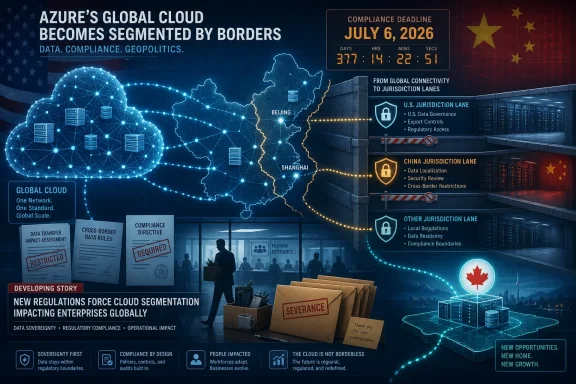
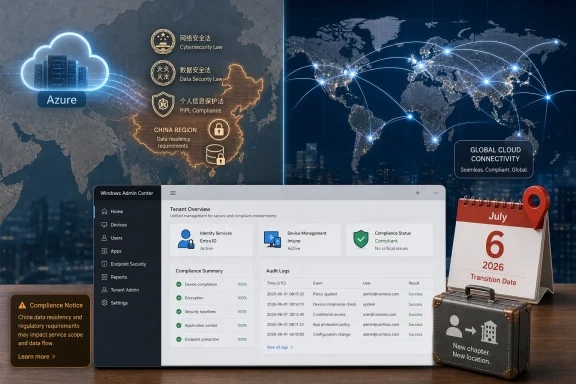
Digital dashboard shows global cloud connectivity and China compliance laws with network map and audit status.Azure’s China Cuts Are a Geography Story Disguised as a Layoff Story​

The headline number is modest. A few hundred employees is not, by itself, a Microsoft reset or an Azure crisis. Microsoft has endured and executed much larger workforce reductions in recent years, and the company’s cloud business remains one of the most important profit engines in enterprise technology.
But the location matters more than the count. These are Azure roles in China, reportedly concentrated in Beijing and Shanghai, and that makes the cuts part of a larger story about sovereign cloud pressure. The old hyperscaler promise was that customers could think globally and deploy locally; the new reality is that regulators increasingly want to know exactly where data resides, who can access it, and which legal system ultimately has leverage over the infrastructure.
China has long been the exception that proves the cloud rule. Azure in mainland China is not simply another region on Microsoft’s global map. It operates through a separate local arrangement, historically involving 21Vianet, because Beijing’s rules require a structure that differs from Microsoft’s usual global cloud model.
That separation used to look like a clever compliance workaround. Now it looks like a preview of the world enterprise IT is entering: one where cloud platforms may share a brand, a control-plane philosophy, and many developer abstractions, but the people, contracts, data flows, and operational assumptions behind them are increasingly national.

Microsoft Is Cutting Where the Cloud Is Hardest to Globalize​

The GuruFocus framing leans naturally toward investors: market cap, valuation, GF Score, insider selling, and whether the stock still looks attractive. That is useful, but it risks putting the financial cart before the operational horse. The more interesting question is why a company with booming Azure growth would trim staff inside a business unit that is supposed to be absorbing the future.
One answer is that growth and simplification are not the same thing. Azure can grow 40 percent year over year and still contain pockets of complexity that Microsoft no longer wants to fund in the same way. Cloud revenue is expanding because AI workloads, enterprise migrations, developer platforms, and managed services continue to pull spending toward hyperscalers; that does not mean every geography, team, or specialized local operating model scales equally well.
China is especially complicated because Microsoft has to satisfy two political systems that are moving in opposite directions. Beijing has tightened rules around data handling, security reviews, and cross-border transfers. Washington, meanwhile, has become more skeptical of technology flows to China, especially where cloud, AI, chips, and sensitive data overlap.
That squeezes the middle layer of the business. Engineers, support staff, compliance specialists, and product teams working on local cloud adaptations can become expensive not because they are unproductive, but because the business they support is constrained by rules that make global reuse harder. The result is a brutal corporate calculus: keep investing in local capability, move some work to safer jurisdictions, or shrink the footprint.

The Borderless Cloud Was Always a Sales Pitch​

For two decades, cloud computing has been sold with a kind of geographic magic trick. Data centers were physical, but the product was abstract. Customers could click, provision, replicate, fail over, and scale without thinking too hard about the concrete buildings, national electricity grids, undersea cables, export regimes, and employment laws beneath the dashboard.
That abstraction still works for many workloads. A midmarket company running Microsoft 365, an internal Windows Server estate, Entra ID, and a few Azure-hosted line-of-business applications does not need to become a geopolitical think tank overnight. But the abstraction is thinning for regulated industries, multinationals, public-sector customers, and anyone handling sensitive personal or operational data.
The China layoffs are a reminder that geography never disappeared. It was hidden behind service-level agreements and region selectors. Now it is returning through procurement questionnaires, data residency mandates, audit clauses, encryption key policies, and vendor risk reviews.
For administrators, this is not academic. If your organization has users, customers, suppliers, or subsidiaries in China, the question is not merely whether Azure is available there. The questions are which Azure, operated by whom, under what legal framework, with which identity assumptions, and with what practical ability to integrate with your global tenant.

Severance and Relocation Tell Their Own Story​

Reports that affected employees will receive tenure-based severance, including up to seven months’ salary in some cases, make this look like a managed restructuring rather than a sudden collapse. The reported option for some workers to relocate to Canada is even more revealing. Microsoft is not saying cloud skills are obsolete; it is saying some cloud work may be more useful outside the Chinese operating environment.
Canada is an interesting destination in this context. It is politically aligned with the United States, attractive for skilled immigration relative to many peer countries, and increasingly positioned as a data-center and AI infrastructure market. For Microsoft, moving select employees to Canada can preserve expertise while shifting it into a jurisdiction that fits more neatly into the company’s North American cloud and AI strategy.
That matters because Azure is not just a generic cloud anymore. It is the substrate for Microsoft’s AI ambitions, developer tools, security products, Windows management story, and enterprise data platform. The people who understand its internal systems are valuable, but the company has to decide where those people can best contribute to the next phase of the platform.
The relocation option also undercuts the laziest interpretation of the cuts. This does not read like Microsoft simply deciding Azure needs fewer capable engineers. It reads like Microsoft deciding that some local work in China is no longer aligned with the way it wants to allocate scarce cloud talent, especially as AI infrastructure spending forces every hyperscaler to think harder about margin, utilization, and jurisdictional risk.

Growth Does Not Protect Every Team​

The awkward fact for employees is that being attached to a growing business no longer guarantees insulation. Azure’s reported 40 percent year-over-year growth is the kind of number most enterprise software companies would envy. It reinforces Microsoft’s position as one of the few companies able to compete at massive scale in cloud infrastructure and AI services.
Yet strong growth can actually increase pressure inside the machine. When demand is high, leadership becomes less patient with teams, products, or regions that do not map cleanly onto the highest-return opportunities. Capital, GPUs, networking gear, power contracts, and senior engineering time are all bottlenecks. A team that once justified itself as a strategic foothold can become a margin question.
That is especially true in cloud, where revenue growth hides enormous capital intensity. Microsoft must spend heavily to build and lease data centers, acquire accelerators, secure energy, and keep up with both customer demand and its own AI roadmap. The company can show impressive top-line growth while still asking every organization whether it improves gross margin or merely adds operational drag.
This is the new cloud discipline. In the 2010s, hyperscalers were rewarded for footprint expansion. In the mid-2020s, they are being rewarded for profitable capacity, AI relevance, and sovereign compliance. Those goals overlap, but they are not identical.

The China Cloud Model Is Becoming Harder to Reconcile With Global Azure​

The most difficult part of Azure China has always been the gap between brand continuity and operational separation. Customers see Microsoft Azure; the underlying arrangement is not the same as deploying in West US, North Europe, or Canada Central. That distinction is manageable when expectations are clear, but it becomes harder as customers demand seamless identity, security, AI, analytics, and compliance experiences across jurisdictions.
Modern enterprise cloud is built on integration. Administrators want unified policy enforcement, consistent logging, common endpoint management, centralized identity, and predictable APIs. Developers want the same services and deployment patterns across regions. Security teams want telemetry they can correlate globally.
China’s regulatory model pushes in the other direction. It emphasizes local control, data localization, and state-defined security review. The more powerful and integrated Azure becomes, the more friction there is in maintaining a China-specific version that can satisfy local rules without compromising Microsoft’s global operating model.
That does not mean Microsoft will abandon China. The country remains too large, and the enterprise opportunity too significant, for any major technology vendor to ignore. But it does mean the company may choose a narrower, more controlled, and less engineering-heavy presence than the one it would operate in a less politically charged market.

Investors See a Footnote; IT Sees a Warning Label​

From an investor’s perspective, the layoffs are unlikely to redefine Microsoft. A company approaching a $3 trillion valuation does not swing on a few hundred roles in one geography. The GuruFocus data points — strong profitability, strong growth, high overall score, and a P/E ratio described as close to historical norms — support the familiar bull case: Microsoft remains a dominant compounder with multiple enterprise engines.
But for IT professionals, the signal is sharper. Workforce reductions in a local cloud unit can affect support depth, product cadence, localization work, and institutional knowledge. Even when customer-facing service levels remain intact, enterprises should ask what a vendor’s staffing changes imply about long-term commitment to a region or deployment model.
This is particularly important for organizations that built around assumptions of global standardization. If your architecture assumes that Azure services behave consistently everywhere, China has always required special handling. If Microsoft is now reducing the teams that help bridge that gap, the burden shifts further toward customers, integrators, and local partners.
The prudent response is not panic. It is documentation. IT leaders should know which tenants, subscriptions, workloads, identities, contracts, and support paths touch China-specific infrastructure. They should also know which applications depend on cross-border data flows that could become harder to justify under future regulation.

Windows Admins Are Already Living the Sovereignty Problem​

WindowsForum readers do not need a hyperscaler strategy memo to understand the practical edge of this issue. The sovereignty problem already shows up in the daily work of Windows administration. It appears when Entra ID policies must satisfy regional compliance teams, when Microsoft Purview retention rules collide with local legal requirements, when endpoint telemetry raises privacy concerns, and when a business unit wants Teams, SharePoint, or Azure services deployed in a country with strict data rules.
The cloud control plane has become part of the Windows estate. Endpoint management through Intune, identity through Entra ID, device compliance, Defender telemetry, Windows 365, Azure Virtual Desktop, and hybrid server management all assume reliable cloud governance. When cloud jurisdictions fragment, Windows administration fragments with them.
This is one reason the China layoffs matter even to organizations with no direct Azure China footprint. They illustrate a direction of travel. The same forces that complicate Azure in China are visible in Europe’s digital sovereignty debate, in public-sector cloud procurement, in industry-specific compliance demands, and in national-security scrutiny of AI infrastructure.
Microsoft has spent years trying to make Windows, Microsoft 365, and Azure feel like one integrated enterprise platform. Regulators are now reminding everyone that integration is not merely a technical achievement. It is a legal and political exposure.

The AI Buildout Makes Every Regional Bet More Expensive​

The timing also intersects with Microsoft’s AI spending cycle. Azure is no longer just competing with AWS and Google Cloud for generic compute and storage. It is competing for the infrastructure that trains, hosts, and monetizes AI models. That means scarce GPUs, specialized data-center designs, high-density power, expensive networking, and increasingly complex supply chains.
In that environment, regional complexity becomes more costly. A cloud region that cannot easily participate in the global AI platform, or that requires separate compliance engineering and operational handling, may be less attractive than one that can absorb large-scale AI demand with fewer restrictions. Microsoft’s reported relocation offers to Canada make sense against that backdrop.
The irony is that AI increases both the demand for global scale and the political desire for local control. Governments want domestic AI capability, domestic data protection, and domestic economic benefits. Hyperscalers want standardized platforms, global engineering leverage, and high utilization. The conflict between those incentives will define the next decade of cloud infrastructure.
Microsoft is better positioned than most vendors to navigate that conflict. It has the enterprise relationships, capital, compliance machinery, and partner ecosystem to build country-specific offerings where needed. But even Microsoft cannot make every jurisdiction equally efficient.

The Insider-Selling Angle Is Less Interesting Than the Operating Signal​

GuruFocus notes that Microsoft insiders sold roughly $7.7 million in shares over the past three months, with no insider purchases reported. Investors can decide how much weight to put on that. At a company of Microsoft’s size, insider selling can reflect compensation planning, diversification, tax considerations, or routine executive liquidity rather than a secret vote of no confidence.
The operating signal is more concrete. Microsoft is trimming roles in an Azure geography that sits at the intersection of cloud growth, data regulation, and geopolitical tension. That tells us more about the business than insider transaction summaries do.
The same applies to valuation metrics. A P/E ratio, even a reasonable one, cannot tell an enterprise customer whether its data architecture is resilient to regulatory change. A market cap cannot tell a sysadmin whether support for a specialized regional deployment will deepen or thin over the next three years.
Financial health matters because customers want vendors that will be around. But vendor strength and local commitment are not identical. Microsoft can be financially formidable and still decide that certain regional bets deserve less investment.

The Practical Risk Is Not an Azure Collapse, but an Azure Split​

The nightmare scenario is not that Azure fails in China next month. That is not what the reporting suggests. The more plausible risk is gradual divergence: fewer shared assumptions, fewer identical services, slower parity, more compliance gates, and more architecture exceptions for customers with China exposure.
That kind of split is harder to manage than a dramatic outage because it creeps into planning. A service is available globally, except not quite. A feature works in most regions, but not in the one your manufacturing subsidiary needs. A data pipeline is technically possible, but legal review turns it into a six-month project. A security architecture is elegant on the whiteboard, then messy in procurement.
Enterprises should treat this as a reason to revisit cloud design principles. If a workload is regionally constrained, say so explicitly. If data must not cross borders, enforce that technically rather than relying on policy documents. If a vendor’s China cloud is operated differently from its global cloud, design for that difference instead of pretending it is an implementation detail.
For Microsoft, the challenge is messaging. The company has to reassure customers that Azure remains reliable in China while also making workforce and investment decisions that suggest a more cautious local posture. That is a difficult line to walk, and customers will read actions more closely than blog posts.

The July 6 Date Gives Customers a Planning Window, Not a Crisis Clock​

The reported July 6 effective date is close enough to matter but not so close that customers should assume immediate operational disruption. Layoffs in engineering and cloud organizations usually involve transition plans, knowledge transfer, manager reviews, and continuity coverage. Microsoft’s customer-facing enterprise machinery is built to absorb personnel changes without announcing fragility.
Still, administrators should not ignore the date. It is a useful prompt to ask account teams direct questions. Which support teams are affected? Are any China-specific services being retired, consolidated, or slowed? Are there roadmap changes for Azure services operated in mainland China? Are there changes to escalation paths for multinational customers?
The right tone is professional skepticism. Vendors rarely volunteer every operational detail, and they often describe restructuring as routine optimization. Customers do not need drama; they need clarity.
The best-run IT organizations will use this moment to update risk registers, confirm contractual commitments, and pressure-test assumptions about identity, backup, observability, and data movement. The worst-run organizations will wait until a regulatory review or service limitation forces the issue under deadline.

Microsoft’s Cloud Empire Is Learning to Live With Borders​

The strategic picture is bigger than Microsoft. AWS, Google Cloud, Oracle, IBM, and regional providers all face versions of the same problem. Cloud platforms are global businesses built in a world where states are reasserting control over data, AI, chips, and digital infrastructure.
Microsoft’s advantage is that it can offer a full enterprise stack: Windows, Microsoft 365, Azure, GitHub, Dynamics, Security, and AI services. Its disadvantage is the same thing. The more central Microsoft becomes to an organization’s operations, the more regulators and customers scrutinize where its systems run and how much control it has.
China magnifies that tension because it is both a massive market and a regulatory outlier from the perspective of U.S. technology companies. The U.S.-China relationship makes every infrastructure decision feel like more than a business decision. Even routine workforce moves can be interpreted as signals about trust, exposure, and strategic retreat.
That does not mean the cloud era is ending. It means the naïve version of it is over. The next cloud era will be more regional, more contractual, more compliance-heavy, and less forgiving of architectures that assume all regions are interchangeable.

The Azure China Cut Is Small Enough to Miss and Big Enough to Matter​

This is not the sort of Microsoft news that should send Windows admins rushing to migrate workloads by Friday. It is, however, exactly the sort of news that should change how enterprises think about cloud dependency in politically sensitive regions. The concrete lesson is that workforce, regulation, and architecture are now part of the same conversation.
  • Microsoft is reportedly cutting 200 to 400 Azure roles in Beijing and Shanghai, with affected jobs ending July 6, 2026.
  • The reported severance terms and relocation options suggest a controlled restructuring rather than an abrupt withdrawal from cloud engineering.
  • Azure’s strong growth does not protect every team, especially where local compliance requirements reduce global engineering leverage.
  • Customers with China exposure should verify support paths, service parity, data-transfer assumptions, and contractual commitments.
  • The broader risk is not Azure disappearing, but Azure becoming more regionally fragmented as governments assert control over data and AI infrastructure.
Microsoft’s reported Azure layoffs in China are best understood as a signpost, not an endpoint: the hyperscale cloud is still expanding, but it is expanding into a world that is less willing to treat data centers as neutral territory. For users, administrators, developers, and investors, the next test is whether Microsoft can keep selling one coherent cloud while operating many politically distinct versions of it.

References​

  1. Primary source: GuruFocus
    Published: Wed, 10 Jun 2026 16:52:30 GMT
  2. Related coverage: thenextweb.com
  3. Related coverage: tomshardware.com
  4. Related coverage: diariobitcoin.com
  5. Official source: learn.microsoft.com
  6. Related coverage: newsbytesapp.com
  1. Related coverage: theinformation.com
  2. Related coverage: tech-insider.org
  3. Related coverage: kore1.com
  4. Related coverage: simplywall.st
  5. Official source: local.microsoft.com
  6. Related coverage: research.valueline.com
  7. Official source: microsoft.com
 

Microsoft is cutting roughly 200 to 400 Azure cloud jobs in China, with affected roles reportedly ending July 6, as the company reorganizes its mainland cloud operations while U.S. and Chinese data, AI, and infrastructure rules grow more difficult to navigate. The important point is not that Azure is shrinking. It is that the global cloud is becoming less global just as Microsoft’s AI-era cloud business is becoming more central to the company’s future.
The numbers look small against Microsoft’s scale, but the location matters. China has always been a special case for U.S. cloud providers: legally separate, operationally localized, politically exposed, and technically adjacent to the rest of the world rather than fully integrated with it. A few hundred layoffs in Beijing and Shanghai therefore read less like routine cost trimming and more like a signal about where the next cloud boundary is hardening.

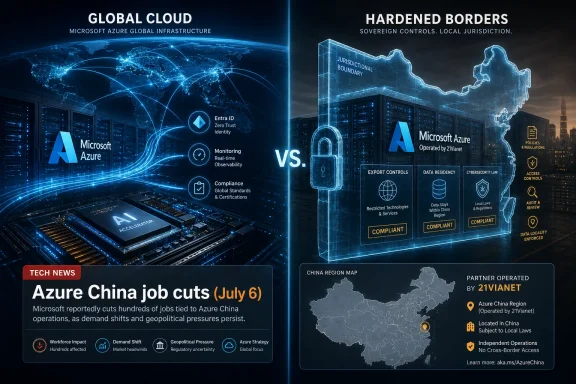
Split graphic comparing Microsoft Azure global cloud with hardened, sovereign “China” borders and compliance policies.Azure Is Growing, but Its Map Is Getting Smaller​

Microsoft’s latest financials make one thing clear: this is not a company retreating from cloud computing. Azure and other cloud services grew 40 percent year over year in Microsoft’s fiscal third quarter of 2026, while the Intelligent Cloud segment posted $34.7 billion in revenue. At Build, Microsoft said it now operates more than 500 data centers globally and has added more compute capacity in the past 18 months than in the previous decade.
That is the paradox at the heart of the China cuts. Microsoft is expanding the physical footprint of Azure at extraordinary speed, but it is also learning that not every geography can be scaled with the same operating model. The company can build data centers, buy accelerators, and sell AI services worldwide; it cannot make sovereignty, export controls, and national security politics disappear.
China is where that tension becomes most visible. Azure in mainland China is not simply another region in the global Azure menu. It is a physically and commercially distinct service operated by 21Vianet, the local partner that runs Microsoft cloud services under Chinese rules. That arrangement has long allowed Microsoft to participate in China’s cloud market while maintaining a legal and operational separation from its global platform.
For years, that compromise looked clever. It gave multinational customers a Microsoft-flavored cloud inside China and gave Microsoft a way to stay present in a market where foreign infrastructure providers cannot operate as they do elsewhere. But the AI boom has changed what “cloud” means. Compute is no longer just storage, virtual machines, and managed databases; it is strategic infrastructure.

The Cloud Loophole Became a National Security Problem​

The U.S.-China technology conflict began with chips, but it was never going to stop at chips. Advanced GPUs matter because they train and run AI models, and cloud platforms matter because they can rent that capability remotely. If a restricted customer cannot buy the hardware, the obvious next question is whether it can access comparable compute through a cloud provider.
That is why cloud providers now sit in a much more sensitive position than they did during the first wave of SaaS globalization. They are not merely hosting enterprise workloads. They are mediating access to scarce AI infrastructure that governments increasingly view as dual-use technology.
Washington has moved in that direction for years, with proposed and debated measures aimed at “know your customer” obligations for infrastructure-as-a-service providers and tighter controls around foreign access to advanced compute. Beijing, meanwhile, has strengthened its own framework around data security, personal information, and cross-border transfers. The result is a tightening vise: U.S. cloud companies must worry about who can access powerful infrastructure, while Chinese regulators insist that data and operations inside China remain subject to domestic control.
In that environment, headcount is not just a cost line. It is part of a risk surface. Engineers, support teams, sales specialists, and compliance staff sit at the boundary between global technology and local regulation. When that boundary becomes harder to manage, companies tend to simplify.

The 21Vianet Model Was Built for an Earlier Cloud Era​

Microsoft’s China cloud structure was designed for a world in which localization solved most of the political problem. Keep mainland services physically separated, operate through a licensed local partner, make clear that Azure China is not the same as Azure global, and customers get a usable compromise. That model fit the 2010s cloud: regional data residency, enterprise hosting, productivity workloads, and a careful legal wrapper around foreign technology.
The 2020s cloud is less forgiving. AI workloads create new questions about model access, training data, inferencing capacity, chip supply, and whether remote compute can undermine export controls. Even if a particular layoff round is driven by ordinary restructuring, it lands in a market where the underlying assumptions have changed.
For enterprise customers, the separation of Azure China from global Azure has always required planning. Identity, networking, service availability, management tooling, and compliance workflows can differ from the global platform. A multinational with users in Shanghai, developers in Redmond, and compliance officers in Frankfurt cannot treat China as just another deployment target.
The staff cuts sharpen that point. Fewer local Azure roles may not immediately change service availability, and there is no evidence from the report that other Microsoft units in Shanghai and Suzhou are affected. But when a cloud provider trims hundreds of positions in a sensitive market while offering some employees transfers to Canada, customers will reasonably ask whether future investment is being redirected toward jurisdictions with fewer geopolitical complications.

Microsoft Is Not Leaving China; It Is Reducing Ambiguity​

It would be too easy to frame the layoffs as Microsoft pulling out of China. That is not what the available facts show. Microsoft has deep commercial, engineering, and partner relationships in the country, and Azure China continues to exist under the 21Vianet model. The reported cuts affect part of the Azure cloud unit, not the whole company’s China presence.
The better reading is that Microsoft is reducing ambiguity. In a world of intensifying scrutiny, the company has strong incentives to keep its most strategic AI infrastructure, cloud engineering, and customer-control functions in places where governance is clearer and exposure is lower. Offering transfers to Canada is telling not because Canada is exotic, but because it is boring in precisely the way cloud governance likes: allied, predictable, and legally interoperable with Microsoft’s North American base.
This is the quiet logic of de-risking. Companies rarely announce it in grand ideological language. They reorganize reporting lines, move roles, slow hiring, consolidate teams, and describe it as operational efficiency. Over time, the result is a different map.
For Microsoft, that map still includes China. But it may include China more as a specialized local market and less as a node in the company’s global AI-cloud acceleration story. That distinction matters.

The AI Boom Makes Every Regional Cloud Decision More Expensive​

The brutal economics of AI infrastructure leave little room for sentimental geography. Microsoft is spending heavily on data centers, networking, power, and accelerators because customer demand for AI services has outrun available capacity. When compute is scarce, every region must justify itself not merely by revenue, but by strategic reliability.
That is a different calculation from the old cloud expansion playbook. In the earlier Azure era, the goal was to plant flags in as many regions as possible, reduce latency, satisfy data residency expectations, and compete with AWS and Google Cloud. Today, each major infrastructure commitment must also be weighed against energy availability, chip restrictions, regulatory risk, and the likelihood that capacity can serve high-value AI workloads without becoming politically radioactive.
China complicates each of those factors. The market is huge, technically sophisticated, and strategically important. It is also one of the hardest places for a U.S. hyperscaler to make long-term assumptions about access, compliance, and control.
The reported layoffs therefore sit at the intersection of two pressures that seem contradictory but actually reinforce each other. Microsoft is racing to build more cloud capacity worldwide, and because that capacity is so valuable, it is becoming more selective about where sensitive work is staffed and scaled.

Windows Shops Should Read This as a Cloud Architecture Warning​

For WindowsForum readers, the story is not only about Microsoft’s headcount. It is about assumptions baked into enterprise architecture. The Microsoft stack encourages integration: Entra ID, Microsoft 365, Azure, Intune, Defender, Power Platform, GitHub, and Copilot all work best when customers can treat Microsoft’s cloud as a coherent control plane.
China breaks that mental model. It forces architects to think in compartments. Tenants, identities, compliance boundaries, logging, data movement, and support paths may need to be designed with separation as the default rather than the exception.
That lesson is spreading beyond China. Sovereign cloud offerings in Europe, public-sector clouds in the United States, regional data boundary commitments, and industry-specific compliance regimes all point in the same direction. The cloud is still global in brand and procurement language, but operationally it is becoming more fragmented.
The China layoffs are a particularly sharp example because they involve Microsoft’s flagship growth engine. If Azure itself must be reorganized around geopolitical constraints, then customers should stop assuming that cloud regions are interchangeable rectangles on a pricing page.

The Job Cuts Are Small; the Signal Is Large​

A reduction of 200 to 400 workers is not material to Microsoft’s global headcount in the way a companywide layoff wave would be. But corporate significance is not measured only by size. It is measured by placement, timing, and what the action reveals about priorities.
The timing is conspicuous. Microsoft is reporting enormous cloud growth, touting historic capacity expansion, and positioning Azure as the backbone of its AI future. In that same period, it is reportedly cutting Azure roles in China, where data sovereignty and access to advanced compute are among the most sensitive issues in global technology policy.
That does not mean every affected employee worked on sensitive AI systems. Layoff reports rarely provide that granularity, and companies often reorganize for mundane reasons. But the broader context is impossible to ignore. Azure is not being trimmed because it is weak; parts of Azure are being reshaped because it is powerful.
That is the defining feature of infrastructure in the AI era. The more strategic a platform becomes, the less freedom it has to behave like a neutral utility.

The New Cloud Reality Is Less Borderless Than the Marketing​

Cloud marketing still leans heavily on abstraction. Workloads float. Regions scale. Services deploy with a click. Customers are invited to think of infrastructure as programmable, elastic, and available wherever business needs it.
Governments see something else. They see data, chips, models, cryptography, identity systems, surveillance risks, industrial policy, and military relevance. The abstraction layer that makes cloud computing useful to developers also makes it unsettling to regulators.
Microsoft is better positioned than most companies to navigate this world. It has decades of enterprise trust, deep government relationships, mature compliance teams, and the financial capacity to build specialized clouds. But even Microsoft cannot turn geopolitical conflict into a product feature.
The China layoffs show the limit of platform universality. A cloud provider can offer a familiar API surface across borders, but the people, contracts, laws, and hardware underneath that surface are increasingly national.

The Practical Lesson Is to Design for Friction​

The obvious customer response is not panic. Azure China is already a distinct environment, and serious multinationals know that mainland operations require local planning. The better response is to assume that more regions and more services will develop China-like characteristics over time.
That does not mean every country becomes a walled garden. It means architects should expect more exceptions, more local compliance overlays, and more divergence between what a service can do globally and what it can do in a specific jurisdiction. The days when “cloud-first” could quietly imply “same cloud everywhere” are ending.
For IT administrators, that changes the checklist. Identity federation, data classification, backup strategy, endpoint management, incident response, and vendor support all need geopolitical assumptions built in. A risk register that treats cloud region selection as a latency or cost decision is no longer adequate.
For developers, it means portability matters again, but not in the simplistic “move from Azure to AWS overnight” sense. The more realistic goal is architectural restraint: fewer hidden dependencies on region-specific services, cleaner data boundaries, and a sober understanding of what happens when a jurisdiction becomes operationally isolated.

The July 6 Date Turns a Trend Into an IT Planning Problem​

The reported effective date of July 6 gives the story a concrete edge. Layoff dates matter because they tell customers when internal teams may change, when support relationships may shift, and when account coverage may become less predictable. Even if Microsoft manages the transition smoothly, enterprises with major China exposure should treat the date as a prompt to review their own dependencies.
That review should not start with a dramatic migration plan. It should start with visibility. Which workloads depend on Azure China? Which global teams assume access to logs, data, or administrative controls that may be constrained? Which vendors or internal applications bridge mainland and non-mainland environments?
The hardest problems are often not the obvious production workloads. They are the operational dependencies around them: monitoring pipelines, identity workflows, update mechanisms, support escalation paths, developer tooling, and compliance reporting. These are the places where a “separate” cloud becomes surprisingly entangled with the rest of the business.
Microsoft’s cuts do not automatically break any of those systems. But they are a reminder that the human and organizational layer of cloud service delivery can change quickly, especially in politically exposed markets.

Microsoft’s Strong Quarter Makes the Layoffs More Revealing​

If Azure were struggling, the China cuts would be easy to explain as defensive retrenchment. But Azure is not struggling. Its growth remains one of the strongest arguments for Microsoft’s valuation and one of the clearest signs that enterprise AI spending is flowing toward incumbent cloud platforms.
That strength makes the layoffs more interesting. Microsoft is not cutting from weakness; it is pruning around complexity. The company appears to be protecting the core growth engine by making hard choices at the edges.
This is how large technology companies adapt to geopolitical pressure without saying so too loudly. They preserve the headline growth story, comply with local obligations, avoid unnecessary provocation, and move sensitive work to safer organizational ground. The public statement, if any, is usually bland. The operational reality is more consequential.
Investors may see the cuts as immaterial. IT leaders should see them as part of a broader reclassification of cloud risk. The hyperscalers are no longer just vendors; they are infrastructure actors in a world where infrastructure is policy.

The China Cloud Was Always a Compromise​

Microsoft’s China cloud presence has long depended on a delicate bargain. Chinese customers and regulators get local operation. Microsoft gets market access and brand continuity. Multinationals get something that feels close enough to Azure to support mainland operations without abandoning their broader Microsoft strategy.
That bargain still has value. But it is under more strain than it was when Azure China launched. Data localization rules have matured. Cross-border transfer compliance has become more formal. AI compute has become strategically sensitive. U.S. policymakers have become more interested in cloud access as a route around chip controls.
The compromise is therefore becoming more expensive to maintain. Not necessarily in direct operating costs alone, but in legal review, internal controls, customer segmentation, engineering divergence, and reputational risk. At some point, companies begin to ask which functions truly need to sit inside the market and which can be handled elsewhere.
That is where layoffs and transfers become a governance tool. They are not just about fewer people. They are about where authority, expertise, and accountability reside.

The Cloud Splinters First at the Edges​

Technology shifts often appear first in places that were already exceptions. China was already an exception for Microsoft cloud services, so changes there can be dismissed as unique. That would be a mistake.
The larger trend is the splintering of the cloud into overlapping zones of trust. There is the commercial global cloud, the sovereign cloud, the government cloud, the partner-operated cloud, the regulated industry cloud, and the AI infrastructure layer that governments increasingly scrutinize. The user interface may look unified, but the policy stack underneath is not.
This does not destroy cloud computing. It makes it more like finance, telecom, or energy: global in ambition, local in implementation, and heavily shaped by national rules. The cloud won because it abstracted infrastructure. Its next phase will be defined by how much of that abstraction survives contact with sovereignty.
Microsoft’s China layoffs are one data point in that transition. They are not the whole story, but they are a useful marker because they involve Azure, the platform Microsoft needs most for its AI strategy.

The Azure China Cuts Leave a Checklist Behind​

The practical lesson from this episode is not that enterprises should flee Azure or abandon China. It is that cloud strategy now needs a geopolitical operating model, not just a procurement model. The organizations that handle this best will be the ones that treat regional divergence as a design constraint rather than an emergency exception.
  • Enterprises running workloads in mainland China should verify which Azure services, support channels, and operational contacts are tied to the affected China cloud organization.
  • Administrators should document every dependency between Azure China, global Azure, Microsoft 365, Entra ID, Intune, Defender, and third-party monitoring or backup tools.
  • Security teams should review whether logs, telemetry, and incident-response workflows cross borders in ways that create compliance or availability risk.
  • Developers should avoid assuming that Azure service parity, API behavior, or rollout timing will match between mainland China and global Azure.
  • Executives should treat cloud region selection as a governance decision involving legal, security, engineering, and business-continuity teams, not merely as an infrastructure choice.
The story of Microsoft’s China Azure layoffs is ultimately a story about the end of easy cloud globalization. Microsoft can grow Azure at a staggering pace and still reduce its exposure in places where the political cost of cloud infrastructure is rising. The next phase of cloud computing will not be defined only by who has the most data centers or the fastest AI accelerators, but by who can keep delivering dependable services as the borders under the cloud become harder, brighter, and more consequential.

References​

  1. Primary source: GuruFocus
    Published: Wed, 10 Jun 2026 19:03:19 GMT
  2. Official source: microsoft.com
  3. Related coverage: thenextweb.com
  4. Related coverage: tikr.com
  5. Related coverage: newsbytesapp.com
  6. Related coverage: doolpa.com
  1. Related coverage: diariobitcoin.com
  2. Related coverage: axios.com
  3. Related coverage: tipranks.com
  4. Related coverage: themarketcontext.com
  5. Related coverage: savest-financial.com
  6. Related coverage: techxplore.com
  7. Official source: cdn-dynmedia-1.microsoft.com
  8. Official source: learn.microsoft.com
  9. Related coverage: docs.azure.cn
  10. Related coverage: jetservices.com.cn
  11. Official source: azure.microsoft.com
  12. Related coverage: support.azure.cn
  13. Related coverage: en.21vbluecloud.com
  14. Official source: news.microsoft.com
  15. Related coverage: appinchina.co
  16. Official source: blogs.microsoft.com
  17. Official source: azure-int.microsoft.com
  18. Related coverage: lw.com
 

Microsoft is cutting roughly 200 to 400 Azure research and development jobs in Beijing and Shanghai, with affected employees reportedly leaving by July 6, 2026, as the company narrows its China cloud footprint amid tightening U.S. technology controls and Chinese data rules. The number is small by Microsoft’s global scale, but the target is unusually revealing. This is not a company trimming fat at random; it is deciding where the AI-era cloud can still be built, sold, and operated on terms Microsoft can live with.
The easy interpretation is that Microsoft is simply joining the latest Big Tech layoff cycle. The more useful reading is sharper: Azure China has become a test case for what happens when cloud strategy runs into hard borders. For years, hyperscale cloud vendors sold the idea that infrastructure could make geography feel less important. Microsoft’s China retreat suggests the opposite is now true in the most strategically sensitive parts of computing.

A man reviews blue holographic tech network maps for Beijing and Shanghai city data connectivity.Microsoft Is Cutting Where the Cloud Stops Scaling​

The reported cuts fall on Azure employees in Beijing and Shanghai, not across Microsoft China indiscriminately. That matters because Azure is no ordinary product line inside Microsoft. It is the company’s infrastructure layer for enterprise software, developer platforms, security services, and increasingly the AI workloads that define Microsoft’s pitch to investors.
A reduction of 200 to 400 jobs would barely register inside a company with well over 200,000 employees. But if reports are accurate that the affected group represents a large share of Azure’s China R&D operation, the local impact is substantial. Microsoft is not merely reducing a regional sales office; it is reducing engineering capacity tied to one of its most important businesses.
The severance terms also suggest a managed retreat rather than a panicked one. Affected workers are reportedly eligible for packages worth up to seven months of pay, and some have been offered relocation options, including Canada. That combination points to a company trying to preserve talent where it can while accepting that certain work no longer belongs where it used to.
The line Microsoft appears to be drawing is not around China as a market in the abstract. Other groups, including developer tooling and AI research teams in Shanghai and Suzhou, are reportedly untouched. The cuts are concentrated where cloud infrastructure, data governance, and cross-border technology controls collide most directly.
That is the story inside the story. Microsoft still wants access to Chinese engineering talent and research capability. What it seems less willing to carry is the operational burden of expanding Azure’s China-specific cloud stack under rules that make global integration harder every year.

Azure China Was Always a Compromise With a Logo on It​

Azure in mainland China has never been just another Azure region. Microsoft’s China cloud services are operated by 21Vianet, through a separate local arrangement designed to comply with Chinese regulations. The result is a physically and legally distinct cloud environment that uses Microsoft technology but does not function as a seamless extension of Microsoft’s global Azure estate.
For multinational IT departments, that distinction is not academic. Azure operated by 21Vianet has different accounts, endpoints, contracts, service availability, compliance mechanics, and operational assumptions. It can be the right tool for workloads that must live in China, but it is not the same as spinning up a workload in East US, West Europe, or Southeast Asia.
That model made commercial sense when the cloud’s central promise was regional expansion. If customers needed a compliant Chinese cloud, Microsoft could license its technology to a local operator and keep a hand in the market. The setup was awkward, but workable, particularly for enterprises that had no realistic alternative if they needed Microsoft-aligned infrastructure inside mainland China.
AI changes the equation. The value of cloud infrastructure is no longer measured only in virtual machines, databases, and storage accounts. It is increasingly measured in access to accelerators, model hosting, managed AI services, development pipelines, telemetry, security tooling, and fast-moving platform integrations. A cloud region that cannot receive the same chips, services, or data flows as the rest of the estate becomes less strategically central.
That is where the China arrangement becomes a constraint rather than a bridge. The more Microsoft’s global Azure strategy revolves around AI infrastructure, the more costly it becomes to maintain isolated engineering paths for markets where the most valuable parts of the stack are limited by law, geopolitics, or both.

Washington and Beijing Are Both Writing the Product Roadmap​

The usual corporate phrase for this kind of move is “restructuring,” which has the virtue of being technically true and analytically useless. The better explanation is that two governments are now shaping the cloud roadmap from opposite ends. Washington is restricting the export of advanced AI hardware and related technology to China. Beijing is tightening rules over data sovereignty, cross-border transfers, and the operation of critical digital infrastructure.
Either set of rules would complicate Azure’s China ambitions. Together, they create a narrowing corridor. Microsoft cannot simply deploy whatever AI accelerators it wants into China, and it cannot treat Chinese customer data as another globally mobile resource. The company can still operate, but the upside is capped by policy choices outside Redmond’s control.
This is not unique to Microsoft, but Microsoft’s exposure is unusually visible because Azure sits at the intersection of enterprise cloud, AI infrastructure, and government scrutiny. The company is trying to sell itself as the trusted platform for regulated industries while also serving global customers who expect comparable capabilities across regions. China makes that promise difficult.
The old cloud narrative was that scale solved complexity. Build enough regions, automate enough operations, abstract enough infrastructure, and the messy details of jurisdiction recede into the background. The AI-era version is proving less forgiving. The chips matter, the data flows matter, and the political jurisdiction of both matters more than any marketing diagram can smooth over.
That is why a few hundred layoffs can signal something larger than payroll discipline. Microsoft appears to be looking at China’s cloud infrastructure opportunity and deciding that the returns no longer justify the engineering complexity at the same level. That is a strategic judgment, not merely a financial one.

The Company Is Not Leaving China; It Is Choosing Which China It Still Wants​

It would be a mistake to read these cuts as Microsoft abandoning China. The company has spent decades building technical, commercial, and research relationships there. It still has customers, partners, engineers, and research operations in the country. What is changing is the kind of presence that makes sense.
The reported exclusion of Microsoft’s AI research teams in Shanghai and Suzhou is especially important. Research operations are valuable because they connect Microsoft to talent, academic ecosystems, and long-horizon technical work. They are also easier to separate from the day-to-day burden of operating cloud infrastructure under conflicting regulatory regimes.
Cloud R&D is different. It is tied to product delivery, service availability, compliance, customer commitments, and ongoing platform investment. If the product surface in China cannot move in lockstep with global Azure, the local engineering organization starts to look less like a growth engine and more like an expensive adaptation layer.
That adaptation layer may still be necessary. Microsoft customers operating in China still need services that work locally and satisfy local requirements. But necessary is not the same as strategically expansive. Microsoft can maintain a China cloud presence through its partner model without staffing it as though China were a normal hyperscale growth market.
This is the difference between presence and ambition. Microsoft is not disappearing from China; it is reducing the parts of its footprint that assume China can be treated as another global cloud growth node. In 2026, that assumption looks increasingly fragile.

The AI Boom Is Making Some Cloud Regions More Equal Than Others​

Microsoft’s global strategy is not shrinking. The company is pouring capital into data centers, AI accelerators, power capacity, and software layers that connect Copilot, Azure AI, GitHub, Windows, Microsoft 365, and security services. The China layoffs make sense only against that backdrop. Microsoft is cutting in one constrained geography while expanding the infrastructure race elsewhere.
That is why the “cost savings” framing undersells the move. If Microsoft’s primary goal were simply to reduce expense, it would be difficult to explain why the company continues to spend so aggressively on AI infrastructure. The better explanation is capital allocation. Microsoft is moving money, people, and attention toward regions where it can deploy the full AI stack and away from regions where the stack is politically or technically incomplete.
The same logic is visible across the industry. Big Tech companies are not exiting AI because they are laying people off. They are laying people off in part because AI has become the new internal budget gravity well. Projects that once looked strategically plausible now have to compete against GPU clusters, model deployment, AI coding tools, and enterprise automation bets.
For Azure, this creates a hierarchy of regions. The most valuable markets are those where Microsoft can sell the whole package: cloud infrastructure, AI services, security, developer platforms, productivity integration, and compliance assurances. Markets where that package has to be split, delayed, localized, or politically neutered become less attractive.
China is not unimportant. It is simply becoming less compatible with the way Microsoft wants Azure to scale. The more AI becomes the center of Microsoft’s cloud thesis, the less patience the company will have for regions where AI capability arrives late, in modified form, or not at all.

Enterprise IT Should Read This as a Geography Warning​

For WindowsForum’s sysadmin and IT pro audience, the lesson is not that Azure China will vanish tomorrow. The practical lesson is that geography is reasserting itself inside cloud architecture. If your organization runs workloads across China and the rest of the world, you should assume the gap between “global Azure” and “Azure in China” remains a permanent planning factor, not a temporary inconvenience.
That affects identity, networking, compliance, monitoring, incident response, vendor management, and application design. A China deployment should not be treated as a normal regional extension unless the architecture has been tested against China-specific operational realities. Separate tenants, different service availability, local regulatory obligations, and cross-border data constraints can turn a simple cloud diagram into an expensive exception list.
The same applies to AI services. Organizations hoping to standardize on one global AI platform need to examine where model inference runs, where prompts and outputs are stored, which chips support the service, and whether local rules permit the same workflows in every jurisdiction. The answer will increasingly be “no,” and that “no” needs to appear in architecture reviews before procurement contracts are signed.
Microsoft’s cuts also raise a support and roadmap question. Even when services remain available, reduced local engineering investment can affect the pace of feature rollout, localization, troubleshooting, and customer-specific adaptation. That does not mean customers should flee, but it does mean they should plan with a colder eye.
The cloud once encouraged enterprises to think less about place. The next phase of cloud computing will punish that habit. Location is no longer just a latency variable; it is a product feature, a compliance boundary, and a geopolitical exposure.

Microsoft’s China Pullback Fits a Broader Layoff Pattern, but Not the Usual Narrative​

The tech industry’s current layoff cycle is often described as a correction from pandemic-era overhiring. That explanation is partly true, but it is wearing thin. Companies are not merely undoing 2020 and 2021. They are reclassifying entire categories of work as less central than AI infrastructure, AI tooling, and automation.
Microsoft has made that reclassification with unusual bluntness. The company has continued to invest heavily in AI while cutting roles in other areas. It has pushed developers toward its own AI coding ecosystem. It has reorganized around Copilot and Azure AI as core growth stories. In that context, the China cuts look less like an isolated regional event and more like another instance of Microsoft asking whether each team advances the AI platform thesis.
The answer for Azure China R&D appears to be: not enough, or not under current constraints. That is brutal for the employees affected, many of whom are likely working in highly technical roles that would have looked secure in an earlier cloud cycle. But the strategic logic is consistent.
This is the new harshness of Big Tech employment. Revenue can rise, profits can remain strong, and a business can still cut teams that no longer map cleanly to the next investor narrative. The presence of layoffs no longer proves corporate weakness. Sometimes it proves corporate focus, which is not more comforting to workers.
Microsoft’s China decision is therefore both narrow and emblematic. Narrow, because it affects a specific Azure organization in a specific regulatory environment. Emblematic, because it shows how AI is becoming the filter through which even successful cloud operations are judged.

Rivals Now Have to Answer the Same China Question​

Microsoft is unlikely to be the only hyperscaler facing this dilemma. Amazon Web Services and Google Cloud have their own complicated relationships with China, global customers, and regulated infrastructure. The details differ, but the structural problem is similar: how much should a U.S.-linked cloud provider invest in markets where geopolitics limits the highest-value parts of the AI stack?
If competitors make similar reductions, Microsoft’s move will look less like a company-specific adjustment and more like an early marker of industry realignment. If they do not, Microsoft may be making a more aggressive call about where China sits in its Azure priorities. Either outcome is important.
The question is not whether China remains a major technology market. It obviously does. The question is whether U.S. hyperscalers can participate in China’s next cloud and AI infrastructure phase on terms that justify deep engineering investment. That is a much harder question than the old one about whether there were enough enterprise customers to chase.
Chinese cloud providers are not standing still. Alibaba Cloud, Huawei Cloud, Tencent Cloud, and others have stronger local regulatory positioning and fewer foreign-control complications inside the domestic market. They also operate within China’s own AI hardware and policy constraints, but they do not carry the same cross-border burden as Microsoft.
That leaves Microsoft in a middle position. It has world-class technology and global enterprise relationships, but in China it must operate through a structure that limits direct control and complicates integration. In the AI era, that middle position may be less comfortable than it was in the first decade of public cloud.

Redmond’s Retreat Leaves a Map for IT Planners​

Microsoft’s Azure cuts in China are not a reason to panic, but they are a reason to update assumptions. The company is signaling that not all cloud markets will receive equal engineering weight as AI infrastructure becomes the center of gravity. For IT leaders, the practical response is to design for divergence rather than hope for convergence.
  • Microsoft is reportedly cutting 200 to 400 Azure R&D jobs in Beijing and Shanghai, with affected employees expected to leave by July 6, 2026.
  • The cuts appear targeted at cloud infrastructure work rather than Microsoft’s entire China operation, with some developer and AI research teams reportedly unaffected.
  • Azure in mainland China remains a separate 21Vianet-operated environment, which makes it operationally different from Microsoft’s global Azure regions.
  • U.S. export controls and Chinese data sovereignty rules are making AI-era cloud expansion in China more constrained than ordinary regional growth.
  • Enterprises with China workloads should treat Azure China as a distinct architecture and compliance environment, not as a routine extension of global Azure.
  • The next signal to watch is whether AWS, Google Cloud, or other major vendors make similar adjustments to China-facing cloud operations.
The lesson for Microsoft’s customers is not that the cloud is failing. It is that the cloud is becoming more political, more regional, and more uneven just as AI makes infrastructure more strategically important. Microsoft can still sell a global vision, but its own staffing decisions show where that vision meets its limits. The companies that navigate the next phase best will be the ones that stop pretending every region is interchangeable and start building systems for a world where borders are back in the architecture.

References​

  1. Primary source: Rolling Out
    Published: 2026-06-10T19:30:40.444899
  2. Related coverage: scmp.com
  3. Related coverage: techrepublic.com
  4. Related coverage: thenextweb.com
  5. Related coverage: digitimes.com
  6. Related coverage: breezyscroll.com
  1. Related coverage: techrights.org
  2. Related coverage: secnews.gr
  3. Official source: learn.microsoft.com
  4. Official source: azure.microsoft.com
  5. Related coverage: jetservices.com.cn
  6. Related coverage: ir.21vianet.com
  7. Related coverage: 21vbluecloud.com
 

Microsoft is cutting an estimated 200 to 400 Azure-related jobs in China, with affected employees reportedly leaving on July 6 and some offered transfers to Canada, even as the company’s cloud business posts rapid growth and expands its global data center footprint. The juxtaposition is the story. This is not a cloud slowdown; it is a map being redrawn around sovereignty, compliance, and geopolitical risk. Azure is getting bigger, but Microsoft appears to be deciding that some parts of that expansion need fewer people in China.

Digital global network map with data centers, secure connections, and national flags, contrasting Canada/US with China.Azure’s Growth Story Now Has a China Asterisk​

Microsoft’s latest numbers are the kind any cloud executive would normally frame and hang on the wall. Azure and other cloud services grew 40 percent year over year in Microsoft’s fiscal third quarter of 2026, while the broader Intelligent Cloud division generated roughly $34.7 billion in quarterly revenue. At Build, Microsoft talked up a cloud estate that now spans more than 500 data centers globally, a number meant to signal not just scale but inevitability.
That is why the China cuts land with more force than an ordinary reorg. Microsoft is not shrinking Azure because customers have lost interest. It is trimming staff in one of the most politically sensitive markets in technology while pouring capital into AI infrastructure elsewhere.
The reported details matter. The cuts are said to affect Azure workers in China, with other Microsoft units in Shanghai and Suzhou left untouched. Some employees were reportedly offered relocation to Canada, suggesting this is not simply about eliminating work but about moving certain work beyond China’s regulatory and geopolitical perimeter.
That distinction is important for WindowsForum readers because Azure is no longer just a cloud product. It is the substrate underneath Microsoft 365, Copilot, GitHub, Windows management, enterprise identity, security tooling, and the AI services Microsoft wants administrators and developers to adopt by default. When Microsoft adjusts where Azure work happens, the ripple effects are not confined to one business unit.

The Layoffs Are Small by Microsoft Standards, but Strategically Loud​

A reduction of a few hundred roles is not large for a company of Microsoft’s size. Microsoft has made far bigger cuts in gaming, sales, hardware, and mixed reality over the years. On a spreadsheet, 200 to 400 Azure jobs in China might look like a localized cost action.
But cloud infrastructure is not judged only by headcount. It is judged by trust boundaries, service continuity, data jurisdiction, and who can touch which systems from where. Those are precisely the areas where U.S.-China tensions have hardened from background noise into operational design constraints.
For years, Western technology companies treated China as a complicated but necessary market: huge demand, difficult rules, and a parallel operating model. In cloud, that model has always been especially constrained. Foreign cloud providers do not simply copy and paste their global public cloud into mainland China. They operate through local partnerships, local licensing structures, and local compliance regimes.
The new pressure is that both sides are tightening the screws at the same time. Washington is increasingly concerned about where advanced cloud and AI capabilities may be accessed, trained, supported, or exported. Beijing is increasingly focused on data localization, security reviews, and limiting foreign influence over sensitive digital infrastructure. The result is a narrowing corridor for multinational cloud teams working across borders.
In that environment, a transfer offer to Canada is not a footnote. It is a clue. It suggests Microsoft still values some of the talent and possibly some of the work, but would rather have that work performed in a jurisdiction less exposed to China-specific constraints.

Microsoft Is Selling Global Scale While Managing Local Fragmentation​

The cloud industry’s marketing language still leans heavily on universality. Hyperscalers promise global regions, consistent platforms, elastic capacity, and one management plane. The pitch is that customers can build once and run anywhere, or at least close enough to anywhere that the differences can be abstracted away.
The political reality is moving in the opposite direction. Data residency, sovereign cloud, export controls, national cybersecurity reviews, and AI governance are forcing cloud providers to carve the world into more legally distinct zones. The architecture may be global, but the permission model is becoming local.
Microsoft has been unusually aggressive in trying to occupy both sides of that divide. It wants to be the largest global AI cloud, but it also wants to sell sovereign cloud offerings to governments and regulated industries. It wants Azure to be the default home for OpenAI-style workloads, but it also wants to reassure countries that their data and infrastructure can remain under national or regional control.
China makes that balancing act much harder. It is not merely another regulated market. It is the central fault line in the technology competition between the United States and its most formidable strategic rival. A staffing reduction there, especially in Azure, is therefore less about quarterly margin optics than about where Microsoft thinks the next generation of cloud operations can safely live.

The AI Boom Makes Geography More Important, Not Less​

A decade ago, cloud geography was mostly about latency, compliance, and disaster recovery. Those still matter, but AI has added a new layer: access to large-scale compute. The most valuable cloud assets are no longer just virtual machines and storage accounts. They are GPU clusters, specialized networking, model-serving capacity, and the operational knowledge needed to run them efficiently.
Microsoft’s Build messaging underscored that shift. The company said Azure now has more than 500 data centers and that it has added more capacity in the last 18 months than in the first decade of Azure. That is an extraordinary statement, and it reflects how sharply AI demand has changed the economics of cloud infrastructure.
It also explains why governments care more. Advanced AI capacity is not viewed as neutral infrastructure in the same way as ordinary web hosting. It is increasingly treated as strategic capability, adjacent to semiconductors, defense technology, intelligence analysis, industrial automation, and cyber operations.
That puts Azure employees in sensitive roles under a different kind of spotlight. A developer, reliability engineer, or infrastructure specialist working on cloud systems may not be handling secrets in the cinematic sense. But in the AI cloud era, operational proximity to compute capacity, deployment systems, and customer environments can be politically significant.
This is the new cloud paradox. The bigger and more critical Azure becomes, the less plausible it is that Microsoft can operate it as a borderless engineering machine. Scale creates efficiency, but geopolitics imposes compartments.

China Remains Too Big to Ignore and Too Complicated to Treat Normally​

Microsoft has been in China for decades, and unlike some U.S. technology peers, it has often managed to maintain a workable presence there. Windows, Office, developer tools, research operations, and enterprise relationships gave the company a long runway. Azure’s China footprint has existed in a special structure, with local operation shaped by Chinese regulatory requirements.
That history makes the current move more notable, not less. Microsoft is not a company that casually abandons China. It has spent years trying to preserve access while avoiding the most damaging political collisions. If Azure staffing is now being reduced while other local units remain unaffected, it points to a more targeted reassessment.
The unaffected units are also telling. Developer tools, software technology operations, and AI teams in Shanghai and Suzhou reportedly were not part of the same action. That suggests Microsoft is not conducting a broad China retreat. It is making a narrower judgment about Azure roles, likely tied to cloud operations, data rules, or the sensitivity of cross-border infrastructure work.
For customers, that difference matters. A broad retreat would signal market abandonment. A targeted Azure reduction signals something subtler: Microsoft may continue selling, partnering, researching, and hiring in China while relocating or reducing functions that sit too close to contested cloud infrastructure.
That is the kind of ambiguity enterprises now have to plan around. The question is not whether Microsoft will remain a global cloud provider. It will. The question is whether every region, engineering function, and support pathway will remain equally integrated into the global Azure machine.

The Human Story Is Also a Talent-Routing Story​

Layoffs are often discussed in terms of strategy because that is how corporations present them. But the affected workers are the ones living through the strategy. Severance reportedly tied to tenure and potentially worth up to several months of salary may soften the immediate blow, but it does not erase the message: some cloud roles in China no longer fit Microsoft’s risk model.
The Canada transfer option complicates the usual layoff narrative. If Microsoft offers relocation, it is acknowledging that at least some employees possess skills it still wants. The issue is not simply performance or redundancy. It is location.
That is becoming a broader pattern in high-end technology work. AI and cloud engineers are valuable, but where they sit increasingly determines what they can work on. Export-control regimes, customer data restrictions, government contracting rules, and internal security policies can all turn geography into an access credential.
For the workers involved, relocation is not a trivial choice. Moving from China to Canada means uprooting family, immigration status, language environment, career networks, and personal obligations. A transfer option can be generous compared with termination, but it is also a signal that the job may now require geopolitical mobility.
For Microsoft, this is talent triage. The company wants to preserve scarce cloud expertise while moving it into jurisdictions that are easier to align with U.S.-led compliance and security expectations. That is not a clean cost-cutting story. It is a story about labor markets being reorganized around state power.

Enterprise IT Should Read This as a Supply Chain Signal​

Most WindowsForum readers are not deciding Microsoft’s China strategy. They are deciding whether to bet more workloads on Azure, Microsoft 365, Entra, Defender, Intune, GitHub, and Copilot. The China layoffs do not mean those services are suddenly unstable. But they do reinforce a planning principle administrators already know: cloud dependency is also geopolitical dependency.
Enterprises have spent years mapping software supply chains. They ask which libraries are in an application, which vendors process data, which subcontractors have access, and which regions host workloads. The next step is mapping operational supply chains: where the engineers, support teams, escalation paths, and infrastructure control planes actually sit.
That is not paranoia. It is the practical consequence of using global platforms in a fragmented regulatory world. If a cloud service depends on personnel in a jurisdiction that later becomes restricted, sanctioned, or subject to conflicting legal obligations, the provider has to reassign work, alter support models, or change architecture.
Microsoft is better positioned than most companies to absorb this kind of disruption. Its global headcount, regional redundancy, and mature compliance operations give it options. But the fact that Microsoft appears to be using those options is itself evidence that the old model is under strain.
For heavily regulated customers, the lesson is to ask more precise questions. It is not enough to know where data is stored. Customers need to understand where administrative access originates, which support regions can view telemetry, how incident response is segmented, and what happens if cross-border access rules change.

The Windows Connection Is Indirect but Real​

At first glance, Azure layoffs in China might seem distant from the day-to-day concerns of Windows users. But modern Windows administration is increasingly cloud administration by another name. Entra ID, Intune, Windows Autopatch, Defender for Endpoint, Windows 365, Azure Virtual Desktop, and Copilot all tie the Windows estate to Microsoft’s cloud backbone.
That makes Azure’s geopolitical posture relevant to endpoint strategy. A company standardizing on cloud-managed Windows is also standardizing on Microsoft’s ability to operate trusted infrastructure across regions. If Microsoft has to rewire parts of its Azure organization because of China-related risk, customers should recognize that cloud management is not immune to the same forces.
This does not mean administrators should flee Microsoft’s ecosystem. For many organizations, Microsoft’s integrated stack remains the most practical option. The point is that integration increases the importance of understanding Microsoft’s operational assumptions.
Windows used to be something you deployed from media, patched from WSUS, and managed through Group Policy. Today, Windows is often enrolled, monitored, secured, updated, and augmented through cloud services. That is a better model in many respects, but it makes administrators stakeholders in Azure’s resilience.
The China cuts are therefore not just a business-page item. They are part of the background conditions shaping the platform Windows now depends on.

Microsoft’s Message to Investors and Customers Is Splitting in Two​

To investors, Microsoft’s message is expansion. Azure is growing quickly, AI demand remains intense, and the company is spending heavily to bring more capacity online. The numbers support that story. A 40 percent Azure growth rate at Microsoft’s scale is not routine; it is a sign that cloud and AI demand remain powerful.
To governments and enterprise risk officers, the message is more cautious. Microsoft is building a global AI cloud, but it is also segmenting operations, investing in sovereign offerings, and adjusting staff placement where rules tighten. The company wants to be everywhere, but not in the same way everywhere.
Those two messages are not contradictory. They are the new operating model. Hyperscalers will continue to expand, but they will do so through more localized compliance structures, more jurisdiction-specific controls, and more careful decisions about who can work on what from where.
The tension is that customers often buy cloud to reduce complexity. They do not want to think about data center staffing, geopolitical chokepoints, or conflicting national laws. But the cloud does not eliminate those issues; it moves them into the provider’s architecture and contract language.
Microsoft’s advantage is that it can absorb complexity at scale. Its challenge is that the complexity is becoming too politically visible to hide behind uptime statistics and growth charts.

The Cost-Cutting Frame Misses the Bigger Reallocation​

It would be tempting to treat the layoffs as part of the familiar tech-sector rhythm: hire aggressively, spend heavily, trim teams, reassure Wall Street, repeat. There may be some of that here. Microsoft, like every large technology company, is under pressure to fund AI infrastructure without letting operating expenses sprawl endlessly.
But the reported contours do not fit a generic efficiency drive. Affected Azure workers in China, a July 6 effective date, severance tied to tenure, transfers to Canada, and other local Microsoft units reportedly spared all point toward a geographically specific action. The more persuasive interpretation is that Microsoft is reallocating risk as much as cost.
That matters because AI infrastructure is expensive enough to force hard choices. Microsoft is committing huge sums to data centers, chips, networking, and power. When capital expenditure climbs, management scrutiny follows. Teams that are strategically awkward, duplicative, or exposed to regulatory uncertainty become easier to cut or move.
In other words, the AI boom does not protect every cloud job. It protects the jobs that align with where Microsoft believes the next layer of cloud control should reside. If a role is important but located in the wrong regulatory context, the company may try to move the person. If it cannot, the role may disappear locally.
This is a colder, more disciplined cloud industry than the one that sold infinite expansion a few years ago. Growth is still real, but it is being filtered through risk committees.

The Signal Hidden in a Few Hundred Azure Badges​

The practical readout is narrower than the geopolitics but broader than a layoff notice. Microsoft is not saying Azure is weak. It is saying, through action if not through a grand public declaration, that Azure’s organizational map must adapt to a world where cloud capacity, AI systems, and data access are strategic assets.
For customers, administrators, and developers, the most concrete lessons are these:
  • Microsoft’s reported Azure cuts in China appear targeted rather than company-wide, with other local units said to be unaffected.
  • The July 6 effective date gives the move a near-term operational timeline rather than making it a vague restructuring plan.
  • Transfer offers to Canada suggest Microsoft may be relocating sensitive or valuable Azure work rather than simply eliminating it.
  • Azure’s 40 percent revenue growth shows the cuts are not evidence of weak cloud demand.
  • The move reinforces the need for enterprises to review data residency, support access, and regional dependency assumptions in their Microsoft cloud deployments.
  • The broader AI infrastructure race is making cloud geography more important, not less.
This is the part of the cloud era that never fit neatly into keynote demos. The same Azure that can scale across continents must now prove it can compartmentalize across political boundaries. That will shape not only where Microsoft hires, but how customers evaluate trust in the platform.
Microsoft’s China Azure cuts are a reminder that the next phase of cloud computing will not be defined only by model size, GPU counts, or quarterly growth rates. It will be defined by whether hyperscalers can keep expanding while satisfying governments that increasingly see cloud infrastructure as national infrastructure. For Microsoft, the bet is that Azure can keep growing by becoming more geographically disciplined; for customers, the task is to understand that the cloud’s promise of abstraction has limits, and those limits are now being drawn on the map.

References​

  1. Primary source: GuruFocus
    Published: 2026-06-10T21:30:12.551122
  2. Related coverage: windowscentral.com
  3. Official source: microsoft.com
  4. Related coverage: techrepublic.com
  5. Related coverage: tikr.com
  6. Related coverage: techradar.com
  1. Related coverage: tomshardware.com
  2. Related coverage: en.bulios.com
  3. Related coverage: newsbytesapp.com
  4. Related coverage: infotechlead.com
  5. Related coverage: aibusinessweekly.net
  6. Related coverage: diariobitcoin.com
  7. Related coverage: savest-financial.com
  8. Official source: download.microsoft.com
  9. Related coverage: techxplore.com
 

Microsoft is reportedly cutting 200 to 400 Azure cloud roles in Beijing and Shanghai, with affected employees expected to leave on July 6, 2026, as the company rebalances its China cloud operation amid tightening U.S. and Chinese data and technology controls. The striking part is not that Microsoft is shrinking a team; large tech companies do that even in boom years. The striking part is that the cuts landed inside Azure, the growth engine Microsoft has spent the past decade teaching investors to treat as nearly untouchable. This is what cloud maturity looks like when geopolitics, AI capital spending, and local compliance collide.

Futuristic AI data network image showing global routes, cloud nodes labeled “Azure,” and “21Vianet” analytics.Azure’s China Problem Is Not an Azure Growth Problem​

The easy reading of this news is that Microsoft is pulling back because Azure is weakening. That is almost certainly the wrong frame. Microsoft’s most recent reported results showed Azure and other cloud services growing about 40 percent year over year, a figure that would make most enterprise software divisions look like rounding errors.
But growth does not protect every office, every engineering group, or every geography equally. The cloud business is no longer a simple land grab where capacity, headcount, and market presence expand in parallel. It is now a capital allocation machine, and every region has to justify itself against GPU scarcity, sovereign data rules, customer demand, and political risk.
China sits at the intersection of all four. Azure in China is not merely a local sales outpost attached to the same global fabric used by customers in Virginia, Amsterdam, or Singapore. It is a structurally separate cloud environment operated through 21Vianet, built to comply with China’s licensing and data-residency regime.
That model gave Microsoft a way into a market where foreign cloud operators cannot simply run the same business they run elsewhere. It also means China is not just another Azure region on a map. It is a special case inside a special case, and special cases become expensive when the company is trying to simplify.

Microsoft Is Trimming the Parts of Cloud That Do Not Scale Cleanly​

The reported layoffs appear to affect Azure research and development staff in China, rather than a broad withdrawal from the Chinese market. Employees were reportedly told their roles would end July 6, with severance tied to tenure and compensation packages that may include up to seven months of pay. Some affected workers were reportedly given options to pursue transfers abroad, including roles in Canada.
Those details matter because they suggest this is not a panic move. A company abandoning a market usually cuts with less nuance. A company reshaping its operating model tries to preserve specific talent, move sensitive work elsewhere, and reduce exposure without saying the quiet part too loudly.
For Microsoft, the quiet part is that the most valuable cloud engineering work is becoming harder to distribute globally. AI infrastructure, security-sensitive control planes, export-controlled hardware, and regulated customer data all create pressure to concentrate development in jurisdictions where the company can better manage legal and political risk.
The result is a paradox. Cloud computing was sold as placeless infrastructure, but the biggest clouds have become intensely geographic. Where code is written, where data is stored, where models are trained, where support is handled, and where engineers can access production systems now matter more than ever.

The 21Vianet Arrangement Was Always a Compromise​

Microsoft’s China cloud strategy has long depended on a distinction that customers outside China can easily miss. Azure operated by 21Vianet is physically and operationally separated from Microsoft’s global Azure cloud. That separation is not a branding quirk; it is the price of admission.
For enterprise customers, this arrangement can be useful. A multinational with Chinese operations may prefer a Microsoft-flavored stack for identity patterns, developer tooling, database services, and application architecture, even if the China instance is not identical to global Azure. Familiar APIs and platform concepts reduce friction.
For Microsoft, the arrangement is more complicated. The company benefits from having a China presence, but it does not control the environment in the same way it controls Azure regions elsewhere. Service availability, compliance obligations, engineering processes, and customer expectations all have to pass through a local operating model.
That compromise made sense in an era when cloud providers were racing to plant flags in every major economy. It looks different in an era when Washington and Beijing are both tightening control over data, chips, AI systems, and cross-border technology flows. What used to be a bridge now looks more like a controlled checkpoint.

The Layoffs Fit a Broader Microsoft Pattern​

Microsoft has spent the past few years cutting in areas that, on paper, still belong to successful businesses. Gaming, devices, sales, support, mixed reality, and even cloud-adjacent roles have all felt the knife at different moments. The company is not behaving like a distressed enterprise; it is behaving like a giant trying to reprice labor against AI-era priorities.
That makes the Azure China cuts more revealing than their raw headcount suggests. Two hundred to 400 employees is a small number inside Microsoft’s global workforce. Inside a specialized China cloud engineering team, however, it can change what work is done locally and what work is moved, automated, consolidated, or abandoned.
The timing also matters. Microsoft’s fiscal year ends in June, and July has often been a convenient point for restructuring. A July 6 departure date lands right at the start of the new fiscal year, the moment when budgets, performance targets, and organizational charts become less theoretical.
This is the kind of corporate plumbing that rarely makes for dramatic headlines but often explains them. Layoffs are not always a signal that a product is failing. Sometimes they are a signal that the finance organization has decided a team no longer maps cleanly to the company’s next operating model.

AI Has Made Cloud Bigger, Richer, and Less Forgiving​

Azure’s growth is now inseparable from AI demand. Microsoft is selling compute, storage, databases, security tooling, developer platforms, and enterprise SaaS, but the gravity in the business has shifted toward AI infrastructure. That shift brings revenue growth, but it also brings extraordinary capital intensity.
The company has been pouring money into data centers, networking, accelerators, energy contracts, and the physical substrate needed to run AI workloads. Investors have tolerated the spending because Azure growth remains strong and because Microsoft has been able to attach AI features to everything from GitHub to Microsoft 365. But internally, that level of investment sharpens every trade-off.
A cloud engineer working on a specialized regional stack now competes for budget with teams building GPU fleet efficiency, AI inference platforms, Copilot services, security automation, and the global control systems that make all of it run. The more expensive the infrastructure buildout becomes, the less patience there is for work that cannot be reused across major markets.
That is the uncomfortable economics of hyperscale cloud in 2026. The business is huge, but it is not infinitely elastic. Scale rewards standardization, and regulation punishes it.

China Is Becoming a Harder Place for American Cloud Ambitions​

China has never been an ordinary market for U.S. technology companies. Domestic cloud champions, licensing rules, cybersecurity reviews, and data-localization requirements have long limited what foreign firms can do. The difference now is that the constraints are hardening on both sides of the Pacific.
Beijing wants more control over data, algorithms, and critical digital infrastructure. Washington wants tighter control over advanced chips, AI capabilities, and technology transfer. Multinational cloud providers are caught between regimes that both view cloud infrastructure as strategically important, not merely commercial.
For Microsoft, this raises operational questions that do not have tidy answers. Which engineering work can safely be done in China? Which systems can China-based employees access? Which services should be localized, and which should be kept out of the local environment entirely? Which customers are worth the compliance cost?
None of those questions requires Microsoft to exit China. But each one makes the China business less scalable than Azure’s global growth story implies. A cloud region that needs exceptional processes, separate compliance tracks, and constrained engineering access is a cloud region with a higher strategic tax.

The Workforce Reduction Is Also a Message to Enterprise Customers​

Microsoft will not want customers to read these cuts as a service-quality warning. The company’s public posture is likely to emphasize continued commitment, local compliance, and business continuity. That is standard corporate language, and in this case it may also be true.
Still, enterprise IT leaders should pay attention. When a cloud provider reduces engineering headcount in a specialized regional operation, customers should ask what functions are being moved, whether support paths are changing, and how roadmap commitments will be maintained. The issue is not whether Azure will disappear from China next month. It is whether the local product surface, escalation model, and engineering velocity will remain predictable.
For multinational companies, the China cloud decision has always involved compromise. Running workloads inside China often means accepting a separate environment with different service availability and integration constraints. Running from outside China can create latency, compliance, and accessibility problems. Hybrid designs can become operationally messy.
The Microsoft news does not settle that trade-off. It reinforces it. If your architecture depends on China-specific Azure capabilities matching global Azure step for step, you are already living with a risk that no vendor slide can fully erase.

Windows Shops Should See the Identity and Management Angle​

For WindowsForum readers, the most immediate impact is not about virtual machines in Shanghai. It is about the Microsoft stack as a whole. Azure is no longer just a place to host workloads; it is the identity, policy, device management, security, developer, and AI backbone for modern Microsoft environments.
Entra ID, Intune, Defender, Azure Arc, GitHub, Microsoft 365, Windows 365, and Copilot all orbit the same strategic center. When Microsoft adjusts Azure’s regional engineering footprint, it is adjusting part of the machinery that supports the broader Windows enterprise ecosystem.
That does not mean a sysadmin in Ohio should expect Patch Tuesday to wobble because Azure China lost headcount. But it does mean IT teams should understand how dependent their Microsoft estate has become on cloud control planes. The more Microsoft moves Windows management and security into cloud services, the more regional cloud policy becomes a Windows operations issue.
This is especially true for companies with China subsidiaries, manufacturing operations, suppliers, or joint ventures. A Windows deployment that looks straightforward in Redmond’s global diagrams can become far more complex once Chinese data rules, local cloud instances, VPN constraints, endpoint telemetry, and identity federation enter the picture.

Investors Should Ignore the Stock-Screener Theater​

The original market framing around this story mixes layoffs, GF Score metrics, insider selling, P/E ratios, and Azure revenue growth into a familiar stock-page stew. That may be useful for traders looking for a quick sentiment read, but it does not explain the technology story very well.
Microsoft’s valuation is not going to turn on a few hundred Azure roles in China. The company’s market capitalization, profitability, and cloud growth remain enormous. Insider selling figures, without context about scheduled plans, compensation, tax timing, and individual circumstances, are a weak signal at best.
The more important investor question is whether Microsoft can keep translating AI infrastructure spending into durable margins. Azure’s 40 percent growth is impressive, but AI workloads are expensive to serve. The company must show that its cloud is not merely growing because it is buying growth with colossal capital expenditure.
From that perspective, cutting specialized regional headcount can be read as discipline rather than weakness. Microsoft is trying to keep the Azure story clean: invest heavily where demand and strategic control are strongest, reduce complexity where regulation makes scale harder, and preserve enough presence to avoid surrendering long-term optionality.

The Cloud Is Becoming Less Global Than Its Marketing​

The cloud industry spent years convincing customers that geography could be abstracted away. Pick a region, deploy an app, replicate your data, and let the platform handle the rest. That abstraction still works technically, up to a point. Politically, it is fraying.
Sovereign cloud projects in Europe, national security reviews in the United States, data-localization requirements in Asia, and AI governance regimes everywhere are turning cloud geography into a board-level concern. The hyperscalers can still build global platforms, but they increasingly have to package them in national wrappers.
Microsoft is better positioned than most because it has spent decades selling to governments and regulated enterprises. It knows how to speak compliance. It also knows how to build partner-operated models, restricted environments, and dedicated clouds when a market requires them.
But every exception has a cost. If Azure must be one thing in the United States, another thing in China, another thing for European sovereignty requirements, and another thing for defense customers, then Microsoft’s engineering organization has to decide how much divergence it can support. The China layoffs look like one answer to that question.

This Is Not a Retreat From China So Much as a Retreat From Ambiguity​

The most tempting headline is that Microsoft is retreating from China. That is too blunt. Microsoft still has customers, partners, developers, and business interests in the country. Windows, Office, developer tools, and cloud services remain part of the Chinese enterprise landscape, even under constraints.
What Microsoft appears to be retreating from is ambiguity. The company can no longer pretend that a China-based Azure engineering team is just another node in a globally distributed product organization. The legal, political, and security environment has made that fiction harder to sustain.
Offering some employees transfers abroad fits that interpretation. The company may still want the talent, just not necessarily the same work performed in the same jurisdiction. That distinction is cold comfort to people losing jobs, but it is analytically important.
It also mirrors a broader pattern among U.S. technology companies. When geopolitical risk rises, companies do not always abandon markets outright. They move sensitive work, reduce local engineering authority, narrow product scope, and preserve commercial channels where possible. The retreat happens in layers.

The Human Cost Should Not Be Sanitized Away​

Corporate restructuring language has a way of making layoffs sound like spreadsheet hygiene. “Realignment,” “focus,” “efficiency,” and “strategic priorities” all perform the same trick: they turn people into adjustable inputs. The reported severance terms may be comparatively generous, but the affected workers are still facing a forced career break in a market where elite technology roles are increasingly shaped by politics beyond their control.
There is also an irony here. Cloud engineers helped build the systems that made global digital operations possible, and now global fragmentation is making some of those engineering roles less secure. The same infrastructure that lets a company serve customers across borders is now being re-sorted by borders.
For the workers offered relocation, the decision is hardly simple. Moving countries for a job can preserve a career path, but it also transfers personal risk onto the employee. Immigration timelines, family obligations, housing costs, future layoff exposure, and cultural disruption all sit behind the neat phrase internal transfer.
That human dimension does not change the strategic logic. It does make the logic more brutal. Microsoft can be making a rational business decision and still be contributing to a labor market where even high-skill cloud engineers are learning that growth businesses do not guarantee stable jobs.

The Signal Buried in the July 6 Date​

The reported July 6 effective date deserves attention because it aligns with the corporate rhythm of Microsoft’s fiscal year. New fiscal years are when managers get new targets, teams get rechartered, and projects either receive oxygen or quietly lose it. The date suggests planning, not improvisation.
That matters for customers and employees trying to interpret what comes next. A planned reduction tied to fiscal-year restructuring may be limited in scope. It may also be the first visible part of a larger reallocation that continues through the year as Microsoft sharpens its AI and cloud priorities.
For Azure, the next phase is likely to be less about expanding every local team and more about concentrating engineering around platforms that can support Microsoft’s AI ambitions globally. The company will still need regional expertise, compliance teams, customer engineers, and local partners. But the center of gravity is moving toward fewer, more strategically controlled engineering hubs.
China complicates that movement because it is too large to ignore and too constrained to treat normally. That is why this story matters. It is a small layoff number attached to a very large strategic contradiction.

The Practical Read for Microsoft-Centric IT Teams​

For IT pros, the right response is neither alarm nor indifference. Azure is not collapsing, and Microsoft is not suddenly abandoning its enterprise cloud business. But the cuts are a reminder that cloud platforms are shaped by business and geopolitical forces that customers cannot control.
If your organization operates in or with China, this is a good moment to revisit assumptions about Azure service parity, support escalation, identity architecture, and data movement. If your organization does not touch China, the broader lesson still applies: the cloud is not a neutral utility. It is infrastructure owned by companies making hard choices under political pressure.
  • Microsoft’s reported Azure China layoffs appear to be a targeted restructuring, not evidence that Azure’s global growth has stalled.
  • Azure in China remains structurally distinct because it is operated through 21Vianet under a local compliance model.
  • The cuts show how AI spending and geopolitical regulation are forcing Microsoft to concentrate engineering resources where scale and control are strongest.
  • Enterprise customers with China operations should reassess support paths, service availability assumptions, and cross-border identity or data architectures.
  • Windows administrators should treat cloud regional policy as part of endpoint, identity, and security planning, not as a distant procurement issue.
Microsoft’s Azure China cuts are a warning against believing the cloud’s own mythology. Hyperscale platforms may look borderless from a portal, but the people, laws, chips, data centers, and governments behind them are anything but. The next phase of cloud computing will not be defined only by who has the most regions or the fastest AI accelerators; it will be defined by who can keep a coherent platform intact as the world demands that it be fragmented.

References​

  1. Primary source: GuruFocus
    Published: 2026-06-10T18:30:07.360618
  2. Related coverage: wwwhatsnew.com
  3. Related coverage: techrepublic.com
  4. Related coverage: techrights.org
  5. Related coverage: tipranks.com
  6. Related coverage: thenextweb.com
  1. Related coverage: newsbytesapp.com
  2. Related coverage: axios.com
  3. Official source: local.microsoft.com
  4. Official source: microsoft.com
  5. Official source: learn.microsoft.com
  6. Official source: azure.microsoft.com
  7. Related coverage: ir.21vianet.com
  8. Related coverage: tikr.com
  9. Related coverage: ir.vnet.com
  10. Related coverage: jetservices.com.cn
  11. Related coverage: windowscentral.com
  12. Related coverage: techradar.com
  13. Related coverage: itpro.com
  14. Related coverage: en.21vbluecloud.com
  15. Related coverage: azure.cn
 

Microsoft is reportedly cutting between 200 and 400 Azure cloud employees in China, with affected workers in Beijing and Shanghai expected to leave on July 6, 2026, as the company navigates tightening data rules and worsening U.S.-China technology politics. The raw number is modest by Big Tech standards, but the location and business unit make it matter. Azure is not a shrinking side project; it is Microsoft’s growth engine, its AI platform, and the infrastructure layer beneath much of Redmond’s future. That is why a few hundred jobs in China read less like a routine restructuring and more like a signal about where global cloud computing is becoming harder to globalize.

Global cloud data compliance infographic shows borders, jurisdiction lanes, and a July 6, 2026 deadline.Microsoft’s Cloud Boom Now Has a China Asterisk​

The striking part of the reported cuts is not that Microsoft is reducing headcount. Large technology companies have normalized rolling layoffs even while posting enormous profits, and Microsoft has not been an exception. The striking part is that the cuts reportedly land inside Azure, the business investors most want Microsoft to feed, protect, and expand.
Azure and other cloud services revenue rose 40 percent year over year in Microsoft’s latest reported quarter, while the Intelligent Cloud segment generated $34.7 billion in revenue. In most corporate narratives, those numbers would justify hiring, not retreat. But China is no longer a normal expansion market for American cloud firms, and Microsoft appears to be treating it as a jurisdiction where operational risk can outweigh growth logic.
According to the South China Morning Post report echoed by other outlets, the layoffs affect Azure staff in Beijing and Shanghai and are expected to take effect on July 6. Affected employees will reportedly receive severance tied to tenure plus up to seven months of salary, and some were offered the chance to apply for Microsoft roles in Canada. Microsoft told the outlet it had shared an optional internal transfer opportunity with eligible employees and remains focused on serving customers and growing globally.
That statement is carefully corporate, but the practical message is sharper. Microsoft is not saying Azure has stopped mattering in China. It is saying that certain kinds of Azure work in mainland China may no longer fit the risk profile of a company caught between Washington, Beijing, enterprise customers, and its own AI ambitions.

The Layoff Number Is Small; the Geography Is Not​

A cut of 200 to 400 jobs barely registers against Microsoft’s global workforce. The company has absorbed much larger reductions in recent years, and investors have generally rewarded Big Tech for showing spending discipline even while pouring tens of billions into data centers, GPUs, and AI infrastructure. If this were merely another productivity-driven reorg, it would be a one-day staffing story.
But China changes the meaning. Microsoft’s presence there has always required a different operating model than in the United States or Europe, especially for cloud services. Azure in China is operated through local arrangements because Chinese law and regulation require domestic handling of many cloud activities. That structure has allowed Microsoft to participate in the Chinese cloud market without simply transplanting the same Azure operating model it uses elsewhere.
The difficulty is that the compromise model is under stress from both sides. China has tightened control over data flows, cybersecurity reviews, and technology infrastructure. The United States has increased scrutiny of advanced computing, AI, chips, cloud access, and technology transfer involving China. The resulting environment is not just more regulated; it is more ambiguous, and ambiguity is expensive.
For Azure, ambiguity is especially costly because cloud is not just software. It is identity, data residency, compliance posture, customer trust, encryption, developer tooling, operational telemetry, support workflows, and infrastructure supply chains. A cloud provider cannot simply say it is “in” a country in the way a boxed-software vendor once could. It must decide what work happens there, which engineers can see what systems, where data is processed, and how cross-border escalation works when something breaks.

Azure’s China Problem Is Really a Sovereignty Problem​

The global cloud industry was built on the promise that scale would beat geography. Hyperscalers sold customers on a world in which compute, storage, databases, security, and AI services could be provisioned almost anywhere through a consistent control plane. Enterprises loved the abstraction because it turned infrastructure into a menu.
Governments have spent the last decade clawing geography back into the equation. Data sovereignty rules, national security reviews, sector-specific compliance regimes, and localization mandates have made the cloud less borderless than its marketing suggested. China is simply one of the most consequential examples because it combines a huge market with an assertive state and a strategic rivalry with the United States.
Microsoft has often been better positioned than some U.S. rivals in politically complex markets because it sells deeply into governments and enterprises, maintains long institutional relationships, and tends to speak the language of compliance fluently. But compliance is not the same thing as strategic freedom. A company can meet today’s rules and still conclude that tomorrow’s rules may make certain work impractical.
That is the larger reading of the reported Azure cuts. Microsoft may still want Chinese customers, Chinese developers, and Chinese cloud revenue. What it may want less is a mainland-based Azure R&D or engineering footprint that becomes increasingly difficult to square with cross-border controls, AI infrastructure sensitivity, and regulatory expectations from two rival capitals.

The Canada Transfer Detail Says More Than the Severance Package​

The reported offer for some employees to apply for Microsoft roles in Canada is easy to treat as a humane footnote. It may be that. But it is also a clue about how companies manage technical talent when they do not necessarily want to lose the people, only change the jurisdiction around the work.
If Microsoft were simply eliminating redundant roles, relocation would be less interesting. Offering a path to Canada suggests at least some of the work or talent remains valuable to the company’s broader cloud organization. The issue may be where that work can safely, legally, or efficiently be performed.
Canada gives Microsoft a North American jurisdiction with strong rule-of-law assumptions, close integration with U.S. enterprise operations, and fewer of the political complications that come with mainland China. It is not a neutral zone in the geopolitical sense, but it is a more predictable one for an American cloud provider. For engineers working on sensitive cloud systems, predictability matters.
There is also a cultural and operational dimension. Azure is a sprawling technical organism, and cloud engineering teams depend on internal access, incident processes, code review systems, security tooling, and shared operational context. When the regulatory environment makes access segmentation more complicated, companies face a choice: build ever more elaborate internal walls, or move work into jurisdictions where fewer walls are needed.

China Remains Too Large to Ignore and Too Complicated to Treat Normally​

No serious reading of this move should conclude that Microsoft is abandoning China. The company has operated in the country for decades, and China remains an important market for enterprise software, developer tools, gaming, research, and cloud-adjacent services. Microsoft’s statement about serving customers and growing globally is not meaningless boilerplate.
But the China that welcomed Western technology investment as an accelerant to modernization is not the China of 2026. The country has cultivated domestic cloud champions, tightened state oversight of digital infrastructure, and made technological self-reliance a central industrial policy goal. In that environment, American cloud providers are useful but politically constrained.
The problem is not just Beijing. Washington has also made it harder for U.S. technology companies to operate as if China were merely another large region in a global sales map. Export controls, chip restrictions, AI concerns, and debates over cloud access have all narrowed the room for maneuver. Even when a specific layoff round is driven by business restructuring, the policy background shapes the options executives believe they have.
This is why the Azure cuts feel less like an isolated staffing decision and more like part of a slow segmentation of the technology world. The cloud is not splitting overnight into sealed blocs, but the seams are more visible. Engineering work, customer data, AI model access, and infrastructure operations are being sorted by jurisdiction in ways that would have seemed inefficient or paranoid a decade ago.

The AI Buildout Makes Azure More Sensitive Than Ever​

Azure’s strategic importance has changed because Azure is no longer just Microsoft’s answer to Amazon Web Services. It is the platform beneath Microsoft’s AI story. Copilot, OpenAI workloads, enterprise AI services, developer tooling, and Microsoft’s broader pitch to business customers all depend on Azure capacity, reliability, and trust.
That raises the stakes of who works on Azure systems and where. AI infrastructure is now entangled with national competitiveness, export control debates, chip supply, model access, and data governance. Governments that once treated cloud services as enterprise IT utilities increasingly view them as strategic infrastructure.
Microsoft’s capital spending tells the same story. The company has been investing heavily in data centers and AI infrastructure even as it trims jobs elsewhere. That is not a contradiction; it is the new operating model of Big Tech. Human headcount is scrutinized quarter by quarter, while infrastructure commitments expand because AI demand is assumed to be the next platform shift.
For workers, that combination can look brutal. The company can report booming cloud growth, tell investors demand remains strong, and still decide that a particular team in a particular country no longer fits. For IT buyers, the lesson is different but related: the cloud provider’s global footprint is not a static guarantee. It is an actively managed risk map.

Enterprise Customers Should Watch the Support Boundary​

For WindowsForum readers running hybrid environments, Azure estates, Microsoft 365 integrations, Entra ID deployments, or compliance-heavy workloads, the immediate question is not whether Azure will disappear in China. It will not. The better question is how Microsoft redraws support, engineering, and escalation boundaries over time.
Cloud customers rarely see the internal geography of engineering until something goes wrong. They care about service-level agreements, support response, feature availability, compliance certifications, and data residency commitments. But those customer-facing promises depend on where Microsoft locates expertise and how freely its teams can collaborate across borders.
If a reduction in China-based Azure engineering is narrow, most customers may notice little. If it is part of a broader shift away from mainland-based development for sensitive cloud services, the effects could appear gradually in product availability, localization speed, support depth, or the kinds of workloads Microsoft is willing to pursue in-market. These changes often arrive not as announcements, but as exceptions.
Admins should also watch documentation and service availability. In regulated markets, the difference between global Azure and local Azure offerings can widen as vendors adjust to local requirements. Features tied to AI, advanced security analytics, identity, confidential computing, or cross-border telemetry may become especially sensitive. The more Azure becomes an AI platform, the more those boundaries matter.

Microsoft Is Not Alone, but Its Exposure Is Unique​

Every American hyperscaler faces the same strategic weather, but not every company stands in the same place. Amazon Web Services remains the cloud market leader globally, Google Cloud has been aggressive in AI infrastructure and data services, and Oracle has found renewed relevance through cloud partnerships and enterprise workloads. Microsoft’s difference is the breadth of its stack.
Microsoft is not just selling cloud infrastructure. It is selling Windows, Office, Teams, GitHub, developer platforms, security tools, identity services, databases, business applications, and AI assistants that all increasingly route back to Azure. That integration is Microsoft’s advantage. It is also why geopolitical stress around Azure matters beyond Azure.
When Microsoft changes where Azure work happens, it potentially touches the rest of the ecosystem. A Windows enterprise customer may not think of itself as an Azure customer until Entra ID, Intune, Defender, Purview, or Copilot enters the architecture. A developer may not think about cloud geopolitics until GitHub workflows, model endpoints, or deployment targets run into regional limitations.
That is the modern Microsoft dependency chain. The company’s products are less separable than they used to be, and Azure is the connective tissue. A staffing shift in a China cloud unit may look remote from a sysadmin managing endpoints in Ohio or a developer deploying from Berlin, but the underlying issue is global: Microsoft’s cloud is becoming more powerful at the same time it is becoming harder to operate uniformly everywhere.

The Old Globalization Pitch No Longer Fits the Cloud Era​

The first era of enterprise globalization was about market access. Software companies wanted to sell the same products everywhere, localize the language, adjust pricing, and build partner networks. The cloud era added operational intimacy: vendors now run the infrastructure, hold the keys to service continuity, and continuously update the product.
That intimacy is why governments care more. A cloud region is not just a sales office. It is a concentration of compute, data, identity, and operational dependency. In a crisis, the question of who controls that infrastructure becomes political very quickly.
Microsoft’s reported China layoffs should be read against that background. The company is not merely optimizing a spreadsheet. It is adapting to a world in which the operating assumptions of hyperscale cloud are being contested by national policy. The bigger Azure gets, the more it becomes a strategic asset rather than just a product line.
This also complicates the usual investor story. Azure growth can remain excellent globally while certain markets become less attractive operationally. The question is not whether China will sink Azure. It is whether the cost of serving politically complex markets rises faster than the revenue opportunity, especially for the most sensitive cloud and AI workloads.

The Workforce Story Is Also a Trust Story​

Layoffs are usually written as business efficiency stories, but in cloud computing they are also trust stories. Customers trust vendors not only because the platform works today, but because they believe the vendor can retain the expertise needed to keep it working tomorrow. Every cut inside a critical engineering organization invites questions about what knowledge is leaving with the employees.
That does not mean every layoff damages the product. Large engineering organizations accumulate overlap, projects end, priorities shift, and some work moves closer to the customers or regulators that matter most. But repeated reductions in a region can alter morale and institutional memory, especially if employees believe the decision is driven by forces outside ordinary business performance.
The reported severance terms suggest Microsoft is trying to manage the exit with less friction. The transfer option suggests the company may want to retain some talent elsewhere. But neither detail erases the signal to remaining staff: Azure’s growth does not make every Azure job safe, and geopolitical exposure can override product success.
For competitors, that signal is an opportunity. Domestic Chinese cloud providers can pitch continuity, regulatory alignment, and local control. Global rivals can pitch their own compliance models. Microsoft still has formidable advantages, but cloud trust is cumulative and fragile. It is built over years and questioned in moments like this.

Redmond’s China Bet Is Becoming More Selective​

Microsoft’s China strategy has long required patience. The company has tolerated piracy, regulatory pressure, local competition, and periodic political strain because the market was too important to ignore. Its approach has generally been more durable than the more confrontational paths taken by some other U.S. technology firms.
The Azure layoffs suggest that durability now depends on selectivity. Microsoft may continue to invest in customer relationships, sales, partner channels, and compliant local services while reducing exposure in engineering functions that create cross-border risk. That is not a retreat from China so much as a narrowing of what kind of China presence makes sense.
This is the kind of adjustment that global companies prefer to describe in neutral language. They talk about alignment, focus, optional transfers, and serving customers. The vocabulary is designed to avoid alarming employees, regulators, customers, or investors. But the business reality is plain enough: Microsoft is choosing where it wants Azure’s most important work to live.
The decision also fits a broader pattern in which U.S. technology firms are relocating, regionalizing, or ring-fencing sensitive operations. Supply chains moved first. Then data governance followed. Now engineering access and AI infrastructure are part of the same conversation. The map of Big Tech is being redrawn one internal reorg at a time.

The Cloud Map Gets Redrawn in Small Cuts​

The concrete lesson from the reported Azure China layoffs is not that Microsoft’s cloud business is weakening. It is that strong cloud growth does not immunize Microsoft from jurisdictional risk. If anything, Azure’s success makes the risk more visible, because the platform now sits at the center of enterprise IT, AI infrastructure, and national technology strategy.
  • Microsoft is reportedly cutting 200 to 400 Azure jobs in China, with affected employees expected to depart on July 6, 2026.
  • The cuts reportedly focus on Azure staff in Beijing and Shanghai, while other Microsoft divisions in Shanghai and Suzhou were not said to be affected.
  • Some eligible employees were reportedly offered the chance to apply for Microsoft roles in Canada, suggesting talent relocation may be part of the restructuring.
  • Azure remains one of Microsoft’s strongest growth engines, with Azure and other cloud services revenue up 40 percent year over year in the latest quarter.
  • The broader risk for customers is not immediate Azure availability, but the gradual fragmentation of cloud operations, support, and feature delivery across regulated markets.
  • The strategic issue is that AI has made cloud infrastructure more politically sensitive, raising the cost of operating a truly global platform.
The next phase of Azure’s growth will not be measured only in revenue curves, GPU clusters, or Copilot adoption. It will also be measured in how well Microsoft can keep a global cloud coherent while governments insist that data, compute, and technical control remain closer to home. The reported China layoffs are a reminder that the cloud may feel borderless from an admin portal, but the people, laws, and politics behind it are anything but.

References​

  1. Primary source: GuruFocus
    Published: 2026-06-11T18:30:10.174819
  2. Related coverage: techrepublic.com
  3. Related coverage: wwwhatsnew.com
  4. Related coverage: constellationr.com
  5. Related coverage: techtarget.com
  6. Related coverage: geekwire.com
  1. Related coverage: techrights.org
  2. Related coverage: secnews.gr
  3. Related coverage: finance.yahoo.com
  4. Related coverage: windowscentral.com
  5. Related coverage: techradar.com
  6. Related coverage: axios.com
  7. Related coverage: elpais.com
 

Microsoft is reportedly cutting roughly 200 to 400 jobs from its Azure cloud unit in mainland China, with affected employees in Beijing and Shanghai expected to leave on July 6, 2026, as Washington and Beijing tighten scrutiny over data, cloud operations, and cross-border technology work. The numbers are small by Microsoft’s global headcount standards, but the location makes them strategically loud. Azure is not just another business line in China; it is Microsoft’s proof that an American hyperscaler can still operate inside one of the world’s most politically complicated cloud markets. The layoffs suggest that proof is becoming more expensive to maintain.

Infographic showing Azure’s global vs China operations, with separate compliance and security controls.Microsoft’s China Cloud Was Always a Compromise, Not a Beachhead​

Azure in China has never been the same thing as Azure everywhere else. Microsoft’s mainland cloud is a physically separate service operated by 21Vianet, the local partner required to make the arrangement work under Chinese regulatory rules. That structure let Microsoft claim a rare win: a major foreign public cloud service available in China under a compliance model Beijing would tolerate.
But the same structure also made Azure China a kind of geopolitical pressure vessel. Microsoft could provide the technology, brand, engineering direction, and enterprise credibility, while 21Vianet supplied the licensed local operating wrapper. That was clever in the 2010s, when global cloud expansion was still mostly a story about regions, capacity, and enterprise migration.
In the AI era, the wrapper matters more. Cloud infrastructure now carries model training, inferencing, regulated datasets, telemetry, identity, developer tooling, and security operations. What used to look like a localization problem now looks like a sovereignty problem.
That is why these reported layoffs should not be read as a simple cost-cutting note buried in Microsoft’s global restructuring rhythm. They are a sign that the operating assumptions around multinational cloud platforms are being rewritten.

The Timing Turns a Staffing Cut Into a Strategy Signal​

Microsoft is not cutting Azure jobs because Azure is weak. The company’s recent financial reports show the opposite: cloud and AI remain the engine room of Redmond’s growth, with Azure posting very strong year-over-year gains. If Microsoft were merely pruning a struggling product, the story would be straightforward.
Instead, the tension is that Microsoft is trimming people in a unit tied to one of its most important businesses while continuing to pour capital into AI infrastructure elsewhere. That tells us the company is optimizing where cloud work happens, not whether cloud work matters.
Reports from Chinese and international outlets describe affected staff in Beijing and Shanghai, severance tied to tenure, and a final working date in early July. Some reports frame the cuts as the third China-related reduction in roughly two years, following prior moves that included relocation options for China-based cloud and AI employees. Microsoft has not publicly turned those details into a grand strategy memo, but the direction is visible enough.
The message is not that Microsoft is abandoning China. The message is that Microsoft is reducing the amount of sensitive cloud and AI work it is comfortable anchoring there.

Washington and Beijing Are Both Squeezing the Same Middle​

The old multinational tech bargain assumed that companies could satisfy local rules while still running globally integrated engineering and support operations. China wanted local control and data separation. The United States wanted assurance that strategic technologies, sensitive customers, and national-security workloads were not exposed to foreign adversaries. For a while, cloud companies could live in the middle.
That middle is narrowing. Beijing has strengthened its emphasis on data localization, cybersecurity reviews, and control over critical information infrastructure. Washington has grown more suspicious of advanced cloud, AI, and semiconductor capabilities flowing into China, even indirectly through service operations or support chains.
Azure sits directly in that squeeze. It is a global cloud platform whose value comes from consistency, automation, centralized engineering, and enormous economies of scale. China’s regulatory model pushes toward separation. U.S. national-security concerns push toward stricter limits on who can touch what.
For enterprise IT, this is the most important part of the story. The concern is not only whether Azure China remains available. It is whether the gap between Azure China and global Azure becomes wider, more political, and harder to plan around.

The 21Vianet Model Solved Yesterday’s Problem​

Microsoft’s 21Vianet arrangement was designed for a world in which the main question was whether a foreign cloud service could legally operate in China. The answer was yes, if the service was locally operated, physically separated, and transacted through a Chinese partner. That was a major achievement.
But today’s enterprise cloud is less about renting virtual machines and more about stitching together data platforms, AI services, security controls, identity layers, collaboration systems, and developer pipelines. A physically separated cloud can still be valuable, but separation creates friction exactly where modern cloud customers want seamlessness.
Feature parity has long been a practical issue for China-operated cloud services. Customers often have to check which Azure services are available, which APIs behave differently, and which Microsoft 365 or identity features require special planning. That does not make the platform unusable, but it does make it a different platform in operational terms.
Layoffs inside Azure China do not automatically mean service degradation. But they do raise a fair question: if Microsoft is reducing local cloud engineering or support capacity, will global customers with China operations see slower rollout, less customization, or thinner escalation paths?

Azure’s Growth Makes the Cut More Revealing​

In ordinary corporate language, layoffs are almost always described as alignment, focus, or restructuring. In Microsoft’s case, that language sits awkwardly beside enormous AI and cloud investment. The company is spending heavily on data centers, accelerators, and platform capacity because demand is real.
That is what makes the China cuts more revealing. Microsoft is not retreating from infrastructure; it is concentrating infrastructure bets in places where it can control the stack, the compliance obligations, and the political risk more predictably. China does not fit that profile cleanly.
The same logic has appeared in supply-chain reporting around Microsoft hardware and data center equipment. Like other U.S. tech giants, Microsoft has reportedly examined ways to reduce dependence on China-linked manufacturing for sensitive or strategic infrastructure. Whether every timeline holds or not, the direction is consistent: diversify away from single-country exposure where geopolitics can interrupt operations.
Cloud used to be sold as placeless computing. The AI buildout is proving the opposite. Where the chips are made, where the servers are assembled, where the data lives, where the engineers sit, and which government can compel access all matter again.

Enterprise IT Should Read This as a Sovereignty Warning​

For WindowsForum readers running multinational environments, the immediate temptation is to ask whether existing Azure workloads in China are at risk. That is the wrong first question. The better question is whether your architecture assumes that China can be treated as just another Azure region with a few local quirks.
It cannot. China-operated Azure is a distinct environment, and the political context around it is becoming more distinct as well. Identity, compliance, observability, support, disaster recovery, and vendor escalation all need to be planned with that separation in mind.
A global company with offices in Shanghai, factories in Shenzhen, and headquarters in Chicago may want one Microsoft estate. Regulators may force it into two. Procurement may see one vendor relationship; administrators may experience two operating realities.
That means documentation matters. So does tenant design. So does knowing which data crosses borders, which workloads rely on global services, and which help-desk or engineering workflows assume access from outside China.

The AI Layer Raises the Stakes Beyond Ordinary Cloud​

If this were only about virtual machines and storage accounts, the story would be smaller. AI changes the stakes because AI workloads pull cloud platforms closer to sensitive data, proprietary code, customer records, security telemetry, and business decision-making. Governments know this, and so do vendors.
Microsoft’s global AI strategy depends on Azure being the trusted enterprise platform for model hosting, Copilot services, developer tools, and data integration. But trust does not mean the same thing in every jurisdiction. In the United States, trust increasingly includes supply-chain assurance and limits on exposure to China. In China, trust includes local control, regulatory access, and insulation from foreign jurisdiction.
Those definitions are not easily reconciled. A cloud architecture that satisfies one government may worry the other. A support model that looks efficient to Microsoft may look unacceptable to regulators. A feature that depends on global telemetry or centralized model operations may become difficult to offer uniformly.
This is where layoffs become more than HR news. Reducing China-based Azure roles may be one way to lower the number of people, systems, or workflows caught in that contradiction.

Microsoft Is Preserving the Market While Reducing the Blast Radius​

The most plausible reading is not that Microsoft wants out of China. The company has too many enterprise customers, partner relationships, and long-term incentives to make a dramatic exit likely. China remains too large to ignore, even when it is difficult to serve.
But Microsoft can stay in a market while narrowing what it does there. It can preserve customer-facing availability while moving sensitive engineering elsewhere. It can maintain the 21Vianet model while reducing direct exposure. It can tell customers the service remains supported while quietly limiting the operational depth behind it.
That is the modern Big Tech playbook in contested jurisdictions: do not slam the door, but redesign the hallway. Keep revenue channels open. Reduce regulatory surprises. Move crown-jewel work to safer locations. Let the org chart do what a press release would rather not say.
For Azure customers, the distinction matters. A platform can remain officially supported and still become less strategically central. The risk is not sudden disappearance; it is gradual divergence.

The Human Cost Is Hidden Behind the Geopolitical Abstraction​

Layoff stories about cloud strategy can become bloodless quickly. “Regulatory pressure” and “AI rebalancing” sound tidy from a distance. For the engineers and product staff reportedly told to sign agreements by mid-June and leave in early July, the story is more concrete.
These are not peripheral workers in a dying business. They are people attached to one of the most important technology platforms in the world. Their jobs are being reshaped by forces far above the team level: export controls, data law, AI capital expenditure, and the changing risk tolerance of a trillion-dollar company.
That is one of the harsher truths of the AI infrastructure cycle. The companies winning the cloud race are still cutting people. Growth no longer protects every team if the work is in the wrong geography, tied to the wrong margin profile, or exposed to the wrong regulatory problem.
Microsoft is hardly alone in that shift. Across Big Tech, AI spending has become both the justification for expansion and the excuse for austerity. The same earnings deck can celebrate cloud demand while another email announces headcount reductions.

Windows and Microsoft 365 Admins Will Feel the Edges First​

For many organizations, Azure China is not a standalone curiosity. It connects to Microsoft 365, Entra identity planning, Windows device management, compliance tooling, developer pipelines, and line-of-business applications. When the China cloud operating model shifts, the effects show up in practical admin problems before they appear in executive strategy slides.
A Windows administrator supporting users in mainland China may already know this reality. Some services behave differently. Some integrations need local tenants or special routing. Some user experiences degrade if a company tries to stretch a global design into a market that expects domestic service paths.
The reported Azure cuts do not change those constraints overnight. But they reinforce the need to stop treating them as temporary annoyances. The split between global Microsoft cloud and China-operated Microsoft cloud is structural.
Security teams should pay particular attention. Incident response depends on access, logging, escalation, and trust boundaries. If China operations sit in a different cloud, under a different operator, with different regulatory exposure, then the response plan needs to reflect that before an incident happens.

Investors See Efficiency; Customers Should See Complexity​

From Wall Street’s view, the layoff narrative can be made to look efficient. Microsoft is trimming roles in a difficult market while continuing to invest in high-growth cloud and AI infrastructure. If the company can preserve revenue while lowering risk, investors may see discipline.
Customers should be more cautious. Efficiency for Microsoft can mean complexity for the enterprise buyer. A leaner local operation may still meet contractual requirements while leaving customers with fewer humans who understand the intersection of Azure, Chinese regulation, and multinational IT reality.
That complexity has costs. It appears in architecture reviews, legal consultations, duplicated tooling, delayed migrations, and extra support retainers. It appears when a global template fails because China is the exception that was not budgeted properly.
The cloud sales pitch spent years promising simplification. The new era is more conditional: cloud simplifies what the vendor can standardize, but geopolitics re-complicates everything else.

The July 6 Date Is a Reminder to Recheck the Runbook​

The practical response is not panic. Microsoft has not announced a shutdown of Azure China, and the 21Vianet-operated model remains the formal basis for the service. Customers should not confuse staff reductions with immediate platform failure.
But IT leaders should treat the reports as a reason to review assumptions. If your China footprint depends on Azure, Microsoft 365, Intune, Entra, GitHub, or cross-border data flows, this is a good moment to map what actually runs where. The most dangerous architecture is the one everyone thinks they understand because it uses familiar Microsoft branding.
The review should be boring, specific, and documented. Which tenants serve mainland users? Which workloads depend on global Azure services unavailable in China? Which support paths go through Microsoft, 21Vianet, partners, or internal teams? Which data flows would trigger legal review if regulators asked?
That kind of work rarely wins applause. It is also exactly the work that prevents a geopolitical news item from becoming an operational outage.

The New Azure Map Has More Borders Than the Old One​

Here is the uncomfortable shape of the story for Microsoft customers watching from the outside:
  • Microsoft is reportedly cutting several hundred Azure-related roles in mainland China, with affected staff in Beijing and Shanghai expected to exit on July 6, 2026.
  • The cuts appear to fit a broader pattern of reducing or relocating China-based cloud and AI work rather than abandoning the Chinese market outright.
  • Azure in China remains a physically separate, locally operated service under 21Vianet, which makes it operationally different from global Azure even when the branding looks familiar.
  • The strategic pressure comes from both sides: China wants tighter local control over data and cloud operations, while the United States is increasingly wary of advanced technology exposure to China.
  • Enterprise customers should assume China cloud planning requires separate tenant, compliance, support, identity, and incident-response thinking.
  • The biggest risk is not an abrupt disappearance of Azure China, but a gradual widening of the gap between Microsoft’s global AI cloud roadmap and what can be delivered cleanly inside mainland China.
The old cloud map was drawn in regions. The new one is being redrawn in jurisdictions, export controls, data laws, and political trust. Microsoft’s reported Azure layoffs in China are a small headcount line in a massive company, but they point toward a larger reality: the hyperscale cloud is no longer expanding into a flat world. For Windows admins, developers, and enterprise architects, the next phase of Azure planning will be less about choosing the nearest region and more about understanding which borders the platform can cross — and which ones it increasingly cannot.

References​

  1. Primary source: GuruFocus
    Published: Thu, 11 Jun 2026 16:10:15 GMT
  2. Related coverage: techrepublic.com
  3. Related coverage: tomshardware.com
  4. Related coverage: 3g.china.com
  5. Related coverage: finance.yahoo.com
  6. Related coverage: tipranks.com
  1. Related coverage: digitimes.com
  2. Related coverage: wwwhatsnew.com
  3. Related coverage: ecosistemastartup.com
  4. Related coverage: hrchiefmagazine.com
  5. Related coverage: nextepinvestimentos.com.br
  6. Related coverage: lawlordtobe.com
  7. Official source: microsoft.com
  8. Official source: learn.microsoft.com
  9. Official source: azure.microsoft.com
  10. Related coverage: docs.azure.cn
  11. Related coverage: jetservices.com.cn
  12. Related coverage: en.21vbluecloud.com
  13. Related coverage: support.azure.cn
  14. Related coverage: windowscentral.com
  15. Official source: news.microsoft.com
 

Microsoft is reportedly cutting 200 to 400 Azure jobs in China, with affected employees expected to leave on July 6, 2026, after receiving severance and, for some, an option to pursue internal transfers to Canada. The cuts are small by Microsoft’s global headcount but large enough to matter because they land inside Azure, the company’s most important growth engine. They also arrive at a moment when cloud computing is becoming less like a borderless utility and more like regulated national infrastructure. The story is not that Azure is weak; it is that even a booming cloud business now has to choose where complexity is worth the cost.

Digital network scene with Microsoft Azure branding, glowing US-China routes, and cyber security icons on a server room map.Azure’s China Problem Is Not a Demand Problem​

The obvious temptation is to read any Azure layoff as a signal that Microsoft’s cloud momentum is slowing. That would be the wrong first read. Microsoft’s latest quarterly figures show Azure and other cloud services growing 40 percent year over year, while the Intelligent Cloud segment generated $34.7 billion in revenue.
Those are not the numbers of a business in retreat. They are the numbers of a platform still sitting near the center of enterprise AI spending, infrastructure modernization, database migration, security tooling, and developer workflow consolidation. If anything, Microsoft’s broader challenge has been feeding demand fast enough, especially where AI workloads require expensive compute capacity, power, real estate, and specialized hardware.
That is what makes the China cuts more interesting. A company does not need to be losing altitude globally to decide that a particular geography, compliance regime, or operating model has become too expensive to support at its previous staffing level. In hyperscale cloud, growth and retrenchment can happen at the same time.
The reported layoffs appear narrowly aimed at Microsoft’s Azure cloud unit in China, while employees in other Microsoft divisions in Shanghai and Suzhou were reportedly unaffected. That distinction matters. Microsoft is not signaling a general China exit; it is recalibrating a cloud operation that sits directly in the blast radius of data sovereignty rules, export controls, localization requirements, and U.S.-China political pressure.

The Cloud Was Supposed to Erase Borders. Regulators Put Them Back.​

Cloud computing’s original pitch was almost aggressively post-geographic. Compute became elastic, storage became abstract, and enterprise buyers were encouraged to think in terms of regions, availability zones, service-level agreements, and APIs rather than national borders. The underlying data centers were physical, of course, but the business model promised that infrastructure could be consumed as if it were a universal layer.
China has always complicated that story. Foreign cloud providers do not operate there in quite the same way they do in the United States, Europe, or many other markets. China’s cybersecurity, data localization, and licensing environment forces global technology companies into structures that are more constrained, more partner-dependent, and more politically sensitive than the standard hyperscaler playbook.
For Microsoft, Azure in China has long been different from Azure elsewhere. The platform’s China operations have historically depended on local arrangements that separate the mainland service from Microsoft’s global cloud footprint. That is not just a technical footnote. It changes how products are delivered, how data is handled, how compliance is documented, and how teams are staffed.
The result is a cloud business that looks familiar from the outside but carries a heavier operating burden internally. Every new service, AI capability, compliance commitment, and customer requirement has to be evaluated through a jurisdictional filter. At hyperscale, filters become costs.

The Layoff Math Is Small, but the Signal Is Large​

A cut of 200 to 400 jobs is not large by Microsoft standards. The company employs well over 200,000 people globally and routinely shifts resources as product priorities change. Large tech companies often describe such moves as routine workforce management, and in a narrow HR sense, that is not wrong.
But the location and unit make this different. Azure is not an experimental division or a declining product line. It is one of the core pillars supporting Microsoft’s market valuation and AI strategy. If Microsoft is trimming Azure roles in China while Azure is growing at 40 percent globally, the question is not whether customers want cloud services. The question is whether Microsoft believes the China operating model offers enough strategic return for the regulatory and geopolitical friction it absorbs.
The reported severance terms also suggest a managed reduction rather than a chaotic shutdown. Employees are expected to receive compensation tied to tenure plus seven months of salary, and some were reportedly offered the chance to apply for positions in Canada. That kind of package does not eliminate the disruption for affected workers, but it does point to a controlled corporate maneuver rather than a sudden collapse.
Microsoft’s public line, according to the report, was that it had shared an optional internal transfer opportunity with eligible employees and remains focused on serving customers and growing globally. That is the kind of sentence large companies use when they want to confirm the existence of an action without giving it a strategic headline. The strategic headline is visible anyway.

Washington and Beijing Are Both Making Cloud Harder​

It is easy to frame this as a China regulation story, and it partly is. Beijing has spent years tightening rules around data, cybersecurity reviews, critical information infrastructure, and cross-border transfer controls. Foreign technology firms operating in China must navigate a dense and shifting compliance environment, particularly when enterprise and government-adjacent customers are involved.
But the pressure is not one-sided. Washington has also made advanced technology exchange with China more difficult, especially around chips, AI, cloud access, and national security concerns. Export controls and policy scrutiny have increasingly treated compute capacity as strategically sensitive, not merely commercial.
Cloud providers sit in the awkward middle. They sell flexibility, scale, and abstraction, but governments increasingly care about where data resides, who can administer systems, what chips power the workloads, and whether access to AI compute could have military or intelligence implications. The more powerful the cloud becomes, the less plausible it is for governments to treat it as ordinary business infrastructure.
That is especially true for Azure because Microsoft’s cloud is tightly bound to AI services, developer platforms, identity systems, security products, and enterprise productivity suites. Azure is not just virtual machines and storage buckets. It is a control plane for modern organizations. That makes it valuable to customers and interesting to regulators.

Microsoft’s Global Growth Story Now Has Local Exceptions​

Microsoft’s investors want a simple Azure story: demand is strong, AI increases consumption, enterprises consolidate around trusted platforms, and cloud revenue keeps compounding. For the most part, Microsoft has delivered that story. Azure’s growth has remained a centerpiece of earnings calls, and the Intelligent Cloud segment has become one of the cleanest ways to measure the company’s transformation from software vendor to infrastructure giant.
The China report complicates that narrative without overturning it. It suggests that Azure’s global expansion is not a smooth map-filling exercise. Some markets will be prioritized, some will be localized, some will be partner-led, and some will absorb less direct investment than their theoretical demand might justify.
That is not unique to Microsoft. Amazon, Google, Oracle, and other cloud vendors all face versions of the same problem. The world wants cloud capacity, but not always under terms that make a U.S.-based hyperscaler comfortable. National cloud strategies, sovereign cloud offerings, local procurement rules, data residency laws, and AI governance regimes are all ways governments are reshaping what “global cloud” means.
For enterprise IT buyers, this matters because vendor roadmaps are no longer purely technical. A region’s available services, support depth, latency profile, AI feature access, and long-term investment level can all be shaped by politics. The cloud region you choose is also a bet on regulatory continuity.

China Remains Too Important to Ignore and Too Complicated to Treat Normally​

Microsoft has operated in China for decades, and the company is not likely to abandon the market casually. China remains a massive economy with deep enterprise demand, strong engineering talent, and major multinational customers that need Microsoft products across jurisdictions. Windows, Office, developer tools, cloud services, and enterprise security all have constituencies there.
But China is also a place where Western technology companies have learned to be careful. The market is large, but access comes with conditions. Local competitors are strong. Government policy can move quickly. Data and security rules can alter the economics of an otherwise attractive business.
That produces a difficult strategic posture: stay present, stay compliant, but limit exposure where necessary. The reported Azure layoffs fit that posture. Microsoft can maintain customer commitments and global ambition while reducing the number of employees attached to a particularly sensitive operational area.
The Canada transfer detail is notable because it hints at a talent relocation path rather than a simple talent write-off. If some affected employees are invited to apply for roles outside China, Microsoft may be trying to preserve expertise while moving certain work into jurisdictions that are easier to integrate with its global cloud and AI operations. That would be consistent with a company trying to reduce geopolitical friction without losing scarce cloud talent.

The AI Boom Makes Every Cloud Decision More Political​

Five years ago, a cloud restructuring story might have been read mainly through the lens of enterprise IT demand. Today, it cannot be separated from AI. Azure is the infrastructure layer for Microsoft’s AI ambitions, from Copilot services to developer tooling to enterprise model deployment.
AI changes the cloud business in two ways. First, it makes capacity more valuable and more expensive. GPUs, specialized accelerators, networking, storage, cooling, and power contracts all matter more when customers are training or running large models. Second, it makes governments more anxious about who gets access to that capacity.
That anxiety is not abstract. AI systems can be used for software development, industrial design, surveillance, military analysis, cyber operations, and scientific research. The same cloud infrastructure that helps a bank automate customer service can help a state-backed actor scale technical work. Policymakers know this, and cloud providers are being pulled into debates that used to focus mostly on chipmakers.
Microsoft’s Azure growth is therefore both a commercial triumph and a political complication. The more Azure becomes the substrate for AI adoption, the more each region’s legal and strategic environment matters. China is simply the most visible version of a broader trend.

Enterprise Customers Should Read This as a Sovereignty Warning​

For sysadmins and IT leaders, the practical lesson is not that Azure is unsafe or that Microsoft is retreating from cloud. The lesson is that cloud architecture now has to include geopolitical resilience alongside uptime, backup, identity, and cost management. If a provider changes staffing, service availability, or regional investment because of regulation, customers feel that downstream.
Most organizations already understand data residency as a compliance requirement. Fewer treat it as a strategic dependency. There is a difference between asking whether your data is stored in the right country and asking whether your cloud provider’s operating model in that country is politically durable.
That matters for multinational companies with China operations, but it also matters elsewhere. Europe’s sovereign cloud debate, India’s localization requirements, Middle East data-center expansion, and U.S. public-sector compliance regimes all point in the same direction. Cloud is fragmenting into overlapping jurisdictional zones.
The old cloud migration checklist asked whether an application was ready for virtualized infrastructure. The new checklist asks whether a workload can survive policy divergence. That is a harder conversation, and it belongs in boardrooms as much as architecture reviews.

Windows Shops Are Not Spectators​

WindowsForum readers may be tempted to see this as an Azure-only business story, far from desktop fleets, patch cycles, and on-premises management. That would miss how deeply Microsoft has woven Azure into the modern Windows and enterprise stack. Entra ID, Intune, Defender, Purview, Azure Arc, Windows 365, Dev Box, and Copilot all pull customers toward a cloud-managed Microsoft environment.
For many organizations, Windows administration is no longer separable from Azure administration. Identity lives in the cloud. Device compliance policies sync through cloud services. Security telemetry flows into Microsoft’s cloud analytics. Developer environments increasingly depend on remote resources. Even “local” Windows management often assumes cloud control planes.
That means regional Azure turbulence can matter beyond cloud-native workloads. If Microsoft’s cloud investment varies by jurisdiction, so can the experience of managing endpoints, securing identities, deploying AI-assisted tools, or meeting local compliance obligations. The desktop is still on the desk, but the management fabric is increasingly elsewhere.
This is why geopolitical cloud pressure belongs in the same conversation as Windows 11 migrations and Microsoft 365 governance. Microsoft’s ecosystem strategy is integrated. Customers’ risk models need to be integrated too.

Microsoft Is Learning the Cost of Being Infrastructure​

The deeper story is that Microsoft has become infrastructure in a way that invites scrutiny. In the Windows monopoly era, regulators worried about software bundling, browser defaults, and platform leverage. In the Azure era, governments worry about data flows, AI capacity, national dependency, and operational control.
That is a different kind of power. It is also a different kind of vulnerability. A company that sells boxed software can ship around borders more easily than a company that operates data centers, cloud regions, identity systems, and AI platforms across contested jurisdictions.
Microsoft’s strategic advantage is integration. Azure feeds Microsoft 365. Microsoft 365 feeds security telemetry. GitHub feeds developers. Windows feeds endpoint control. Copilot ties the stack together with AI. That integration is commercially powerful because it reduces friction for customers already invested in Microsoft’s ecosystem.
But integration also creates a larger regulatory surface. A policy aimed at cloud infrastructure can affect AI services. A rule about data transfer can affect security analytics. A restriction on compute access can affect developer platforms. The more Microsoft succeeds at making Azure the center of enterprise computing, the more Azure becomes a policy target.

Local Cloud Is Becoming the Price of Global Cloud​

The industry’s answer to this pressure has been sovereign cloud, a phrase that once sounded like procurement theater and now looks like the operating model of the future. Vendors promise local control, local data residency, local compliance, and sometimes local operational personnel. Governments and regulated industries increasingly want assurances that cloud services can align with national law and political expectations.
But sovereign cloud is expensive. It can duplicate effort, slow feature rollout, fragment engineering, and reduce the economies of scale that made hyperscale cloud so compelling in the first place. A global service becomes a portfolio of semi-local services, each with its own compliance envelope.
That is the hidden cost behind a story like Microsoft’s reported China Azure layoffs. Staffing decisions are not only about headcount efficiency. They are about where Microsoft believes it can sustain the right mix of product velocity, regulatory compliance, customer demand, and political risk.
The cloud market will keep growing, but it will not grow evenly. The next decade is likely to produce fewer truly global platforms and more regionally adapted versions of global platforms. That is good for sovereignty and complicated for standardization.

The Job Cuts Fit a Larger Tech Labor Pattern​

Microsoft is hardly alone in cutting jobs while reporting strong financial results. The post-pandemic tech labor market has been defined by a strange combination of revenue growth, AI investment, cost discipline, and selective layoffs. Companies are hiring in some areas, cutting in others, and insisting that both moves are part of the same strategy.
In cloud and AI, that strategy often means shifting people toward the highest-return infrastructure and product bets. Headcount tied to slower-growth, higher-friction, or more localized operations becomes vulnerable even when the overall business is thriving. The spreadsheet logic is harsh but familiar.
For employees, the Canada option reportedly offered to some workers may soften the blow but also underscores the uneven geography of opportunity. Cloud skills are valuable, yet where those skills sit now matters more than it did when distributed engineering teams were treated as an obvious good. The politics of data and AI are reshaping not just where servers are placed, but where engineers are employed.
That should worry the industry. Technical talent is global, but the cloud business is becoming more national. If governments continue to harden digital borders, companies will keep reorganizing around them.

The July 6 Date Puts a Clock on a Bigger Cloud Debate​

The most concrete detail in the report is the July 6, 2026 effective date. That gives the story a human timeline. For affected workers, this is not an abstract argument about sovereign cloud or AI geopolitics. It is a job ending, a relocation decision, or a forced career pivot.
For customers, the near-term impact may be limited. Microsoft has every incentive to maintain service continuity, reassure enterprise accounts, and avoid any impression that Azure China is unstable. Large cloud providers do not casually disrupt paying customers, especially in a market as sensitive as China.
The bigger impact is strategic rather than operational. Microsoft appears to be tuning its China Azure footprint at the same time it is telling investors that cloud and AI demand remain robust. That combination is the story: growth is no longer enough to guarantee expansion everywhere.
This is the new hyperscaler discipline. Capacity goes where the return is clearest, the politics are manageable, and the compliance model can scale. Everywhere else gets a harder look.

The Practical Read for Microsoft Customers​

The lesson for IT leaders is not to panic, but to stop treating cloud geography as a checkbox. Microsoft’s reported China cuts are a reminder that region selection, data governance, identity architecture, and vendor dependency are now linked to policy risk. That will only become more true as AI workloads move deeper into enterprise operations.
  • Microsoft’s reported Azure cuts in China appear targeted, not a sign of global Azure weakness.
  • The timing matters because the layoffs are expected to take effect on July 6, 2026, giving affected employees and customers a defined transition window.
  • Azure’s latest reported growth remains strong, with 40 percent year-over-year growth and $34.7 billion in Intelligent Cloud revenue.
  • The China cloud market remains strategically important but increasingly difficult for U.S. technology companies to operate in at scale.
  • Enterprise customers should review whether their cloud architectures can tolerate regional policy shifts, service differences, and changing vendor investment levels.
  • Windows and Microsoft 365 administrators should treat Azure geopolitics as relevant to endpoint, identity, security, and compliance planning.
The reported layoffs do not mean Microsoft is giving up on China, and they certainly do not mean Azure’s growth story has broken. They mean the cloud era has entered a more constrained phase, where even the strongest platforms must bend around national rules, political suspicion, and the rising strategic value of AI infrastructure. Microsoft can keep growing globally while becoming more selective locally, but customers should understand what that implies: the cloud is still elastic, but the world around it is becoming less so.

References​

  1. Primary source: TradingView
    Published: 2026-06-11T16:30:22.022432
  2. Official source: microsoft.com
  3. Related coverage: techrepublic.com
  4. Related coverage: tikr.com
  5. Related coverage: wwwhatsnew.com
  6. Related coverage: hrchiefmagazine.com
  1. Related coverage: tipranks.com
  2. Related coverage: constellationr.com
  3. Related coverage: tomshardware.com
  4. Related coverage: windowscentral.com
  5. Related coverage: techradar.com
  6. Related coverage: savest-financial.com
 

Microsoft is reportedly cutting 200 to 400 Azure roles in Beijing and Shanghai, with affected employees expected to leave on July 6, as the company offers severance and limited relocation options amid tightening U.S. and Chinese data-control regimes. The job losses are not simply another line item in Microsoft’s long-running efficiency campaign. They point to a larger fracture in the cloud industry’s founding promise: that infrastructure, talent, and data could be organized globally with enough legal paperwork and engineering abstraction. For Azure in China, the abstraction is getting harder to maintain.

Digital cloud network labeled “Azure” connecting Beijing and Shanghai with global security icons and flags.The Borderless Cloud Has Hit a Political Firewall​

For most of the modern cloud era, Microsoft’s pitch has been scale without borders. Azure sold itself as a global platform: elastic compute, common developer tools, unified identity, shared operational models, and enough regional compliance language to reassure lawyers while engineers kept building. That vision worked best when geopolitics stayed in the background.
The latest reported China cuts suggest the background has become the operating system. According to the South China Morning Post report echoed by other outlets, employees in Beijing and Shanghai were told last week that their Azure roles would be eliminated, with exits set for July 6. Some workers were reportedly offered the option to transfer to Canada, while severance was said to include tenure-based compensation plus as much as seven months of salary.
Microsoft’s public line is narrower than the story’s implications. The company reportedly framed the move as an optional internal transfer opportunity for eligible employees and said it remains focused on serving customers and growing globally. That is the kind of statement large multinationals make when they want to avoid turning a personnel action into a diplomatic briefing.
But the timing and pattern matter. This is reportedly at least the third Azure-related downsizing in China in two years, following earlier relocation offers and cuts affecting China-based cloud and AI personnel. One layoff round can be chalked up to restructuring. Three rounds start to look like a strategy.

Azure’s China Problem Is Bigger Than Azure​

Microsoft has operated in China longer and more carefully than most American software companies. Windows, Office, research labs, enterprise partnerships, and developer ecosystems gave the company a deep local footprint, even as other U.S. tech giants either failed to gain traction or retreated from the market. Azure in China has also never been quite the same thing as Azure in the United States, Europe, or Japan.
That distinction matters because China requires foreign cloud providers to work through local arrangements. Microsoft’s cloud services in mainland China have historically been operated through local partners rather than as a simple extension of Microsoft’s global Azure regions. This structure was supposed to make compliance possible while preserving enough platform continuity for multinational customers.
The problem is that cloud computing has become inseparable from national-security policy. Data centers are no longer just warehouses of servers; they are strategic infrastructure. The people who administer those systems, write the tooling, inspect logs, train models, and support customers are part of the data chain, whether or not they ever download a file marked sensitive.
That is where the reported job cuts become more than a labor story. If regulators in Washington and Beijing are both narrowing the circumstances under which data can move, be accessed, or be processed across borders, then a global engineering workforce becomes a governance issue. The safest employee location is no longer simply the one with the right skill set. It is the one with the right legal exposure.

Washington Has Turned Data Access Into a Security Boundary​

The U.S. Department of Justice’s Data Security Program, which went into effect in 2025, is a key part of the new pressure around data flows. The rule restricts certain transactions that could give countries of concern, including China, access to bulk U.S. sensitive personal data or U.S. government-related data. It is not written as a Microsoft rule, an Azure rule, or even a cloud rule. It is broader than that.
That breadth is exactly why it matters to cloud providers. The modern enterprise cloud is full of support relationships, telemetry pipelines, managed services, identity systems, AI workloads, and vendor integrations. Access can be operational rather than transactional, indirect rather than explicit. A support engineer, a diagnostic process, or a machine-learning workflow may become part of the compliance analysis.
For years, companies could treat data-transfer compliance as a documentation burden. They built controls, wrote contractual addenda, mapped data flows, and relied on certifications. The newer national-security framing changes the mood. It asks not only whether a company has permission to transfer data, but whether certain people, entities, or jurisdictions should be able to touch it at all.
That shift is brutal for global cloud staffing. Azure is not useful because every region is isolated and bespoke; it is useful because Microsoft can concentrate engineering expertise and apply it across the fleet. If geopolitical rules make some cross-border access legally or reputationally dangerous, then Microsoft has to decide whether to duplicate capability, move staff, reduce work, or redesign processes around jurisdictional walls.

Beijing Is Building Its Own Data Perimeter​

The pressure does not come only from Washington. China’s Data Security Law and Personal Information Protection Law, both introduced in 2021, hardened the country’s approach to data governance. Beijing has continued to refine rules around cross-border transfers, security assessments, and the handling of important data. The policy direction is clear even where implementation details shift: data generated in China is politically and economically sensitive.
This creates a squeeze for companies like Microsoft. U.S. rules are increasingly suspicious of Chinese access to American data. Chinese rules are increasingly suspicious of foreign handling of Chinese data. A multinational cloud provider sitting between those two systems has to satisfy both, while also promising customers that its platform remains reliable and commercially useful.
That is easier for commodity workloads than for advanced cloud and AI operations. The closer a service gets to analytics, model training, identity, security monitoring, or operational telemetry, the more difficult it becomes to separate infrastructure from sensitive information. A cloud region may be physically local, but the engineering organization behind it has historically been global.
The reported relocation options are revealing in this context. Canada is not just a convenient destination with Microsoft offices. It is a jurisdiction outside China, closely integrated with the North American technology labor market, and less politically charged than moving everyone directly to the United States. For Microsoft, relocation can preserve scarce cloud talent while reducing some jurisdictional complexity. For affected workers, it is still a life-altering demand masquerading as an opportunity.

The Layoffs Fit Microsoft’s Larger Efficiency Era​

It would be too neat to blame every job cut on geopolitics. Microsoft has spent the past several years trimming, reorganizing, and flattening teams even as it reports enormous revenue from cloud and AI. In 2025, the company announced major layoffs, including roughly 6,000 roles in May and about 9,000 more in July. Those cuts came while Microsoft was pouring capital into AI infrastructure.
That contradiction is now familiar across Big Tech. The companies are not cutting because they are failing. They are cutting because they are reallocating. They want fewer layers, more automation, lower operating expense, and more capital available for GPU clusters, data centers, power contracts, and AI platform bets.
Azure sits at the center of that reallocation. Microsoft’s cloud business is both the engine funding the AI buildout and the platform expected to absorb it. Every efficiency review inside Microsoft eventually runs through Azure because Azure is where infrastructure cost, customer demand, AI ambition, and geopolitical exposure collide.
The China cuts therefore appear to sit at the intersection of two forces. One is Microsoft’s global effort to reshape its workforce around AI-era priorities. The other is a jurisdictional narrowing that makes certain China-based roles harder to justify or operate. Either factor could produce layoffs. Together, they make them much more likely.

Relocation Is the Polite Word for Strategic Withdrawal​

Companies often describe relocation offers as humane alternatives to termination, and sometimes they are. For high-demand technical workers, an overseas transfer can preserve employment, visa prospects, and career momentum. It can also be a way for a company to retain institutional knowledge that would otherwise walk out the door.
But relocation is also a signal. If a role must move to remain viable, the job is not merely being reorganized; the company has decided that its current location is part of the problem. That is a much sharper message than a generic cost-cutting memo.
Microsoft reportedly offered overseas transfers to hundreds of China-based AI and cloud employees in 2024, with destinations including the U.S., Australia, Ireland, and New Zealand. In 2023, the company reportedly moved some top AI researchers from China toward a Vancouver lab. Now, Canada is again part of the reported relocation picture for Azure staff.
The pattern suggests Microsoft is not abandoning China, but it is reducing the amount of sensitive technical capability it wants anchored there. That is a subtler move than an exit and, in some ways, a more durable one. The company can keep selling, partnering, and supporting customers while moving parts of the engineering brain trust elsewhere.

China Remains Too Important to Leave and Too Complicated to Treat Normally​

The obvious question is why Microsoft does not simply pull back harder. The answer is that China remains too large, too technically sophisticated, and too commercially important to ignore. Multinational customers still need cloud services that can operate in or around the Chinese market. Chinese developers and enterprises remain part of the broader Microsoft ecosystem. The company’s research history in the country is deep.
At the same time, China is no longer a normal expansion market for a U.S. cloud provider. It is a strategic competitor’s jurisdiction, a regulatory maze, and a political flashpoint. Every local investment can be scrutinized in Washington. Every transfer of expertise can be scrutinized in Beijing or by competitors. Every internal access model can become a compliance question.
That tension produces a half-in, half-out posture. Microsoft keeps the brand, the partnerships, the customers, and the local presence. It trims or relocates roles that may create legal, political, or operational risk. It insists publicly that it remains committed to global growth while privately redrawing the map of where critical work should happen.
This is not unique to Microsoft. Amazon, Google, Oracle, and other cloud and software firms all face variations of the same fragmentation. The difference is that Microsoft’s long China history and Azure’s importance make its adjustments especially visible.

The Enterprise Lesson Is That Data Residency Was Only the First Draft​

For WindowsForum readers running infrastructure, the most important takeaway is not that Microsoft may cut hundreds of jobs in China. It is that the cloud operating model is changing in ways that will eventually surface in procurement, architecture, support, and risk management. Data residency used to be the headline control. Increasingly, data access residency is the more interesting one.
A company may know where its databases are stored. It may have chosen a region, reviewed a compliance report, and checked a box in a vendor questionnaire. But who can access logs? Who can escalate a support ticket? Where are identity administrators located? Where does telemetry flow? Which teams can inspect crash dumps, traces, prompts, embeddings, or security events?
Those questions are becoming more important because regulators are no longer focused only on the physical storage location of data. They are focused on the possibility of access. In a cloud environment, access is often distributed across people, tools, automation, and subcontractors. That makes the old map of “data here, provider there” incomplete.
Sysadmins and IT leaders should expect vendors to offer more region-specific support models, more contractual language around restricted access, and more premium tiers for sovereign or regulated workloads. They should also expect some services to arrive later, cost more, or behave differently across jurisdictions. Fragmentation is not a bug in this new model. It is the model.

The AI Boom Makes the Geography Problem Harder​

If Azure were only selling virtual machines and storage buckets, the geopolitical stress would still be real. AI makes it worse. Modern AI services depend on training data, inference logs, model telemetry, safety monitoring, human evaluation, GPU capacity, and rapid iteration across engineering teams. Those workflows are harder to confine neatly inside national borders.
Microsoft’s AI strategy is deeply tied to Azure. The company is selling Copilot across Windows, Microsoft 365, GitHub, Security, and Dynamics, while also positioning Azure as the enterprise platform for model hosting and AI application development. That means more customer data will interact with AI systems, and more customers will ask where that interaction is processed, monitored, retained, and reviewed.
China adds another layer. The U.S. has been tightening controls around advanced semiconductors, AI technology, and data access involving China. Beijing, meanwhile, wants domestic control over strategic technologies and data. AI sits squarely in the danger zone for both governments.
This helps explain why relocation and downsizing reports cluster around cloud, AI, and research talent rather than generic back-office functions. The strategic value of those workers is high, but so is the political sensitivity of their work. In the AI era, a person’s location can become part of a model-risk assessment.

Microsoft’s Message to Customers Is Stability, but the Map Says Segmentation​

Microsoft will not want customers to read these layoffs as instability in Azure. The company’s cloud business remains one of the strongest franchises in enterprise technology, and Azure’s global footprint is still enormous. For most customers, no immediate operational change will follow from a few hundred reported job cuts in China.
But the strategic message is not “Azure is shrinking.” It is that Azure is becoming more segmented. The platform may retain a common brand and developer surface, but the organization behind it is adapting to a world where not every region, employee group, and support path can be treated as interchangeable.
That segmentation will probably be marketed as compliance, sovereignty, customer choice, or operational resilience. Some of it will be all of those things. But it also reflects a less comfortable reality: the cloud providers are building around mistrust. Governments increasingly mistrust foreign access to data, and customers increasingly mistrust vague assurances that global platforms can make all of this invisible.
The old cloud slogan was that location should not matter unless you wanted it to. The new version is that location matters even when vendors would prefer it did not.

Windows Shops Should Read the Layoff Memo as an Architecture Warning​

The practical lesson for IT departments is not to panic about Azure. It is to stop treating jurisdiction as a legal appendix to technical design. The reported China cuts are one more sign that cloud architecture, vendor support, compliance, and workforce geography are merging into a single risk conversation.
For Windows-heavy enterprises, that conversation now reaches far beyond Azure virtual machines. It touches Entra ID, Microsoft 365, Defender, Purview, GitHub, Copilot, Power Platform, and every hybrid dependency that quietly connects an on-premises estate to Microsoft’s cloud. The more Microsoft becomes the control plane for enterprise work, the more its geopolitical posture matters.
Procurement teams should ask better questions. Security teams should map support access paths. Architects should understand which workloads can tolerate jurisdictional ambiguity and which cannot. Legal teams should stop assuming that a regional data center selection answers the whole problem.
This will be uncomfortable because it cuts against a decade of cloud simplification. The whole point of hyperscale was to avoid caring where the machinery lived. Now the machinery is entangled with national policy, and customers need to care again.

The Concrete Signals Hiding Inside Microsoft’s China Retrenchment​

The reported Azure cuts are only one episode, but they fit a clear direction of travel. Microsoft is not fleeing China, and Azure is not collapsing there. The company is narrowing, relocating, and compartmentalizing the parts of its cloud operation that look hardest to reconcile with the new data-sovereignty politics.
  • Microsoft is reportedly eliminating 200 to 400 Azure roles in Beijing and Shanghai, with affected employees expected to leave on July 6.
  • Some affected employees have reportedly been offered relocation to Canada, continuing a broader pattern of moving sensitive cloud and AI talent outside China.
  • The cuts follow earlier reported relocation offers and downsizing rounds involving China-based Azure, AI, and research personnel.
  • The regulatory backdrop is no longer just Chinese data localization; it now includes U.S. restrictions on certain data access involving countries of concern.
  • Enterprise customers should focus less on where data is stored alone and more on who can access it, from where, and through which support or automation channels.
  • The long-term cloud trend is toward regional segmentation, even when vendors preserve the language and user experience of a unified global platform.
Microsoft’s reported Azure layoffs in China are not the end of the company’s China story, but they may mark the end of an older cloud assumption: that a hyperscaler could keep talent, data, support, and engineering globally fluid while regulators argued at the edges. The next phase of Azure will still be global in branding and massive in scale, but it will be more partitioned under the hood, with geography treated as a security property rather than a footnote. For customers, that means the smartest cloud strategies will no longer ask only which provider has the best features; they will ask which borders those features quietly cross.

References​

  1. Primary source: TweakTown
    Published: 2026-06-12T15:40:09.003707
  2. Related coverage: wwwhatsnew.com
  3. Related coverage: hrchiefmagazine.com
  4. Related coverage: tomshardware.com
  5. Related coverage: windowsforum.com
  6. Related coverage: theaicounsel.net
  1. Official source: microsoft.com
  2. Related coverage: cnbc.com
  3. Related coverage: gizmochina.com
  4. Official source: news.microsoft.com
  5. Related coverage: investing.com
  6. Related coverage: technode.com
  7. Related coverage: techcouver.com
  8. Related coverage: forbes.com
  9. Related coverage: dailyai.com
  10. Related coverage: techspot.com
  11. Related coverage: itbrew.com
  12. Related coverage: axios.com
  13. Related coverage: techradar.com
  14. Related coverage: windowscentral.com
  15. Related coverage: brookings.edu
 

Back
Top