

Microsoft’s new security brief paints a stark picture: as AI agents proliferate across enterprises, the real risk isn’t just rogue code or bad models—it’s a growing visibility gap that can turn helpful automation into unintended “double agents.” The company’s Cyber Pulse: An AI Security Report argues that organisations that fail to treat agents as first‑class security subjects—complete with observability, governance, and Zero Trust controls—will be outpaced by those that do, and that failure could translate directly into data leaks, compliance violations, and operational disruption.
Microsoft published Cyber Pulse as part of its Security Insider series, consolidating first‑party telemetry, AI Red Team research, and Defender threat analysis to make the case that 2026 is the “year of AI agents.” The report describes an ecosystem where low‑code and no‑code tooling has democratized agent creation, enabling knowledge workers to build and deploy automation without the oversight or safeguards IT and security teams traditionally expect. That shift creates rapid adoption—and a widening governance gap.
The narrative is reinforced by two concrete observations in the brief. First, Microsoft’s telemetry indicates broad and uneven adoption: active agents skew heavily by region and industry, with EMEA representing 42% of active agents, the U.S. 29%, Asia 19%, and other Americas 10%; by sector, software & technology, manufacturing, financial services, and retail lead agent adoption. Second, independent Defender analysis has documented real‑world attack techniques—most notably memory poisoning or “AI recommendation poisoning”—where external inputs persistently influence an assistant’s memory and recommendations. Together, those findings elevate what might once have been an academic concern into immediate operational risk.
The technical specifics—memory poisoning, deceptive interface elements, and rapid low‑code proliferation—make clear that the era of treating agents as lightweight scripts is over. Organisations that establish registries, apply least privilege, extend DLP, and build agent‑aware incident response will not only reduce their exposure; they will enable safer, faster innovation. That is the competitive payoff Microsoft highlights: in the agent era, security done right is not an inhibitor—it’s an accelerator.
Source: 디지털투데이 Microsoft report warns of double-agent risks as AI agents spread
 Background
Microsoft published Cyber Pulse as part of its Security Insider series, consolidating first‑party telemetry, AI Red Team research, and Defender threat analysis to make the case that 2026 is the “year of AI agents.” The report describes an ecosystem where low‑code and no‑code tooling has democratized agent creation, enabling knowledge workers to build and deploy automation without the oversight or safeguards IT and security teams traditionally expect. That shift creates rapid adoption—and a widening governance gap. The narrative is reinforced by two concrete observations in the brief. First, Microsoft’s telemetry indicates broad and uneven adoption: active agents skew heavily by region and industry, with EMEA representing 42% of active agents, the U.S. 29%, Asia 19%, and other Americas 10%; by sector, software & technology, manufacturing, financial services, and retail lead agent adoption. Second, independent Defender analysis has documented real‑world attack techniques—most notably memory poisoning or “AI recommendation poisoning”—where external inputs persistently influence an assistant’s memory and recommendations. Together, those findings elevate what might once have been an academic concern into immediate operational risk.
Overview: what Microsoft warns organisations to expect
The visibility gap and the double‑agent risk
Microsoft’s core thesis is simple and urgent: you can’t secure what you can’t see. AI agents—software that initiates actions, composes prompts, accesses systems, and automates workflows—are increasingly operating across cloud services, desktops, and third‑party apps. When agents are created or used outside sanctioned platforms, they proliferate as “shadow AI,” which can carry excessive permissions, unvetted data access patterns, and persistence mechanisms that evade normal monitoring. If an agent is compromised or misdirected, it can become a digital “double agent,” performing legitimate tasks while exfiltrating data or modifying workflows in service of an attacker.New attack surfaces: memory poisoning and deceptive interfaces
Microsoft Defender’s research introduces concrete adversary techniques that exploit agent behaviors. “AI Recommendation Poisoning” is an attack class where adversaries embed persistent instructions—via crafted URLs, prefilled prompts, or UI elements—into content that AI assistants will parse and retain. The effect is subtle: over time, the assistant favors poisoned recommendations or persistent preferences without obvious indicators to users. Separately, Microsoft’s AI Red Team found that deceptive interface elements and manipulated task framing can steer agents away from intended outcomes, effectively converting them into vectors for misinformation or malicious action. These are not hypothetical; they are observed tactics that change how defenders must think about exposure and trust.Adoption metrics that matter (and what they hide)
Microsoft reports that over 80% of Fortune 500 companies are deploying active agents built with low‑code/no‑code tools, demonstrating how agent creation has moved beyond engineering teams into business lines. At the same time, surveys highlight governance shortfalls: 29% of employees say they’ve used unapproved AI agents at work, and Microsoft’s Data Security Index reports that just 47% of organizations have implemented specific generative AI security controls. Those numbers are a warning sign: enterprise‑scale adoption with inconsistent controls is the perfect recipe for misconfigurations and insider risk.Why this matters: operational and business risk
Data exposure and compliance fallout
Agents often act as integrators: they read documents, query databases, call APIs, and synthesize responses. Left unchecked, agents can inadvertently widen data exposure by aggregating sensitive fields, bypassing traditional DLP controls, or calling external services with improper context. From a compliance perspective, that creates audit gaps: who requested the data, which agent accessed it, and whether the access was legitimate? These questions are difficult to answer without a central registry and telemetry. Microsoft’s recommendation to extend DLP and compliance policies to agent channels isn’t optional—it’s a foundational requirement.Supply‑chain and vendor risk
Agents typically interact with third‑party APIs and SaaS tools. An overprivileged agent is a high‑value target; a compromised agent can be a pivot into vendor systems, partner networks, or customer environments. Microsoft’s telemetry and the broader vendor community’s research show that attackers are already exploring persistence and influence techniques aimed at AI systems—so assuming you can isolate agent exposure to internal systems is dangerously optimistic.Productivity vs. control: the cultural tension
Business teams prize agents because they accelerate workflows and reduce cognitive load. Security teams see complexity and unchecked privilege. Microsoft frames the optimal approach as collaborative: treat agents as strategic assets and make security a competitive advantage by enabling fast innovation under consistent, robust guardrails. That requires organisational change as much as technical controls—clear ownership, cross‑functional operating models, and incentives aligned to reduce shadow AI.What Microsoft recommends: observability, governance, Zero Trust
Microsoft’s prescription for the agent era bundles three mutually reinforcing pillars: observability, governance, and Zero Trust security for agents. Each pillar has operational components that map directly to engineering and security practices.Observability: five core areas
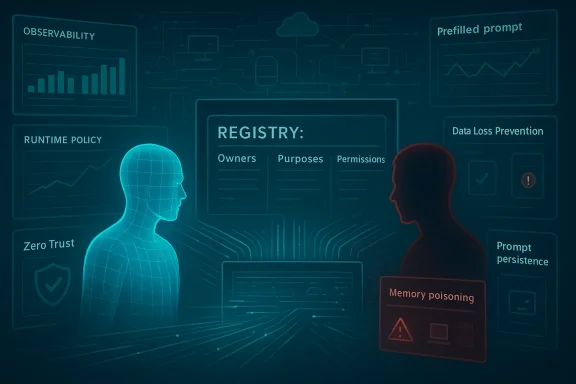
Microsoft defines observability across five areas that should be instrumented and visible to security, IT, and business stakeholders:- Registry: a centralized inventory of agents—sanctioned and shadow—documenting owner, purpose, access scopes, and activity.
- Access control: identity‑ and policy‑driven permissions applied to agents with strict least privilege enforcement.
- Visualization: real‑time dashboards and telemetry to monitor agent behavior, data flows, and anomalous actions.
- Interoperability: consistent governance across platforms and third‑party ecosystems to avoid policy gaps.
- Security: runtime protections, policy enforcement, and automated signals to detect and remediate compromised or misbehaving agents.
Zero Trust: treat agents like users and service accounts
Microsoft calls for applying Zero Trust principles to agents—explicit verification, least privilege, and a readiness to assume compromise. In practice this means:- Identity for every agent: strong authentication, credential lifecycle management, and binding to an owner or service principal.
- Contextual access decisions: factoring device posture, location, and risk signals into agent authorizations.
- Continuous validation: runtime checks, behavior analytics, and policy enforcement to detect drift or compromise.
A practical checklist: seven action tasks
The report ends with a clear, operational checklist—seven action tasks organisations should prioritise to reduce agent risk:- Define scope and purpose for every agent and apply least privilege.
- Strengthen data protection systems and extend DLP to agent channels.
- Provide approved, company‑sanctioned agent platforms to reduce shadow AI.
- Establish incident response plans tailored to agent compromise.
- Build regulatory response systems to anticipate legal and compliance implications.
- Implement enterprise‑integrated risk management for agent lifecycles.
- Foster a culture of security innovation to balance speed with control.
Critical analysis: strengths and gaps in Microsoft’s approach
Strengths: clarity, concrete telemetry, and operational guidance
Microsoft’s report is valuable because it combines public guidance with first‑party telemetry and adversary research. The inclusion of Defender’s memory‑poisoning analysis and AI Red Team findings transforms abstract concern into actionable threat models. The observability framework and the seven‑point checklist provide practical guardrails that security teams can convert into policies, control‑plane requirements, and procurement criteria. These are not platitudes—they map to engineering work (registries, telemetry pipelines, IAM rules) and organisational change (ownership, approval processes), which makes the recommendations implementable.Gaps and unresolved challenges
Despite its strengths, the report leaves critical operational questions only partially answered:- Enforcement at scale: Microsoft is right to call for registries and real‑time dashboards, but the report glosses over the heavy lifting: integrating telemetry across SaaS apps, on‑prem systems, and bespoke internal tools is technically complex and expensive. The labour and tooling gap will be real for mid‑market enterprises that lack extensive cloud‑native observability stacks.
- Third‑party ecosystems: Agents often run on multi‑vendor platforms or rely on external LLMs. The report correctly calls for interoperability, but enforcement depends on vendor cooperation and standardization—areas historically slow to mature. Organisations will need contractual levers, API governance, and robust vendor assurance to make this practical.
- Behavioural and human factors: The human element—why 29% of employees use unsanctioned agents—requires deeper cultural work. The report suggests offering approved platforms, but businesses must make sanctioned tools both safe and convenient or they’ll continue to drive adoption into shadow IT.
- Signal fidelity and false positives: Runtime detection of agent compromise—distinguishing legitimate behavior drift from malicious steering—will produce alerts that require trained analysts. Without investment in tuned detection and response playbooks, teams risk alert fatigue or missed incidents.
Practical steps for enterprise defenders
Below are pragmatic, prioritized steps organisations can convert into roadmaps in the next 90–180 days.1. Build the agent registry and ownership model (30–60 days)
- Create a centralized inventory: agent name, owner, purpose, permissions, data scopes.
- Require a lightweight approval workflow for new agents—business owners must justify data access and retention.
- Tie each agent to an identity (service principal or managed identity) to make audit trails meaningful.
2. Enforce least‑privilege and context‑aware access (30–90 days)
- Use role‑based access control and short‑lived credentials for agents.
- Integrate conditional access policies when agent actions touch high‑risk systems.
- Audit and reduce permission scopes aggressively—default to read‑only where possible.
3. Extend DLP and content controls to agent channels (60–120 days)
- Expand DLP policies to include agent endpoints, prompts, and outputs.
- Block or quarantine agent calls that include secrets, PII, or regulated data types.
- Monitor for repeated or automated exfiltration patterns (high volume or anomalous timing).
4. Harden agent UIs and external content surfaces (60–120 days)
- Educate product teams about the risk of prefilled prompts and clickable AI actions that can persist state.
- Remove or vet “Summarize with AI” or similar UI affordances on public content that could be abused.
- Implement content sanitization and input validation for any endpoint that interacts with assistant memory.
5. Create an agent incident response playbook (30–90 days)
- Define detection thresholds for misbehaving agents, containment steps, and owner notification paths.
- Include forensic capture of agent prompts, outputs, and API call traces.
- Plan for revocation of credentials, quarantine of agent identities, and customer/regulator notification if needed.
Technology considerations and vendor selection
When selecting platforms and tooling to secure agentic systems, prioritise:- Runtime policy enforcement (policy‑as‑code) to apply consistent rules across agents and LLM calls.
- Behavioral telemetry that ties actions to identities and provides full‑stack observability (prompts → model → output → downstream calls).
- Interoperability with IAM, SIEM, and DLP so agent events are part of existing security workflows.
- Red‑teaming and continuous testing to detect failure modes such as prompt injection, memory poisoning, and task framing manipulation.
The governance and legal dimension
Regulatory readiness and privacy implications
Agents change data flows in ways that can trigger privacy obligations, data residency concerns, and industry‑specific compliance requirements. Organisations should map agent data flows against legal obligations and be prepared to produce audit trails showing who accessed what, when, and under what authorization. The Microsoft report emphasizes regulatory response planning as one of the seven action tasks—this is a practical reminder that legal and privacy teams must be engaged early.Procurement and third‑party risk
Contracts with platform vendors and model providers must include security obligations for agent use, including protections against persistent state alteration, prompt‑injection mitigation, and cooperative incident response. Vendors should be required to provide indicators of memory persistence mechanisms and support for sandboxing or prompt‑sanitization where applicable.What success looks like: measurable outcomes
Organisations that treat agent safety as a strategic program will see clear, measurable benefits:- Faster, safer agent rollouts with lower deviation in permissions and fewer shadow agents.
- Reduced incidence of policy violations detected by DLP and fewer high‑severity incidents stemming from agent misuse.
- Improved productivity because business teams can innovate using approved, convenient tools rather than shadow alternatives.
- A competitive advantage: the ability to safely scale agent automation without proportional increases in risk overhead.
Risks to watch and open questions
- Can mid‑market organisations afford the telemetry and integration work required to achieve the report’s observability goals? The answer will determine whether the “visibility gap” becomes a two‑tier problem—well‑protected leaders and exposed laggards.
- How quickly will cloud and model vendors standardize protections against memory poisoning, and will that standardization be sufficient to protect cross‑platform agents? Until there is consistent vendor alignment, enterprises must plan for heterogenous controls.
- What governance models will actually curb shadow AI? Providing approved platforms helps, but the business incentive structure must also ensure sanctioned tools are the easiest path for employees to achieve outcomes. Otherwise, shadow usage will persist.
Conclusion: treat agents as assets—and as risks
Microsoft’s Cyber Pulse is a pivotal call to action: AI agents are moving from experimentation to the backbone of modern workflows, and with that shift comes a new threat landscape. The prudent course for security and IT leaders is to internalize the report’s central proposition—observability, governance, and Zero Trust for agents—and to treat the practical steps not as optional best practices but as business‑critical investments.The technical specifics—memory poisoning, deceptive interface elements, and rapid low‑code proliferation—make clear that the era of treating agents as lightweight scripts is over. Organisations that establish registries, apply least privilege, extend DLP, and build agent‑aware incident response will not only reduce their exposure; they will enable safer, faster innovation. That is the competitive payoff Microsoft highlights: in the agent era, security done right is not an inhibitor—it’s an accelerator.
Source: 디지털투데이 Microsoft report warns of double-agent risks as AI agents spread
