

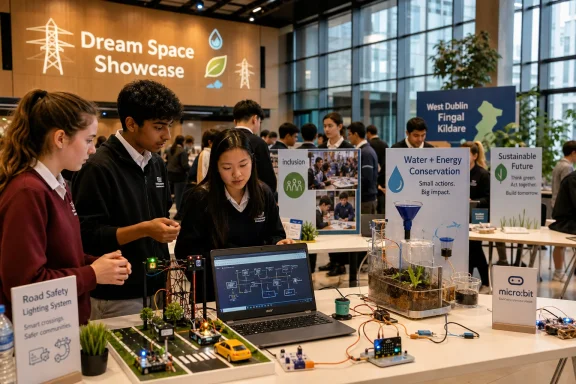
Microsoft used a two-day Dream Space Showcase at One Microsoft Place in Dublin to bring more than 500 students from West Dublin, Fingal and Kildare together after a year-long STEM programme tied directly to communities near its current and proposed data centre operations. The event was not merely a school exhibition with corporate branding; it was Microsoft testing a more local answer to one of the central tensions of the AI boom. If hyperscale infrastructure is going to reshape towns, grids, water systems and labour markets, the company is arguing that the next generation living beside that infrastructure should at least get more than construction traffic and planning notices. The interesting question is whether this kind of programme becomes a durable social compact or remains a polished side stage to the much larger data centre build-out.
The showcase gathered students from 15 primary and post-primary schools across Kildare, Fingal and South Dublin, with more than 100 projects presented over two days. The projects were not framed as abstract coding exercises. Students were asked to tackle issues visible in their own communities: sustainability, energy conservation, road safety, water usage and social inclusion.
That matters because data centres are no longer invisible industrial plumbing. In Ireland, as in much of Europe and the United States, they sit at the intersection of economic development, energy policy, climate targets and local planning politics. Microsoft’s message here is straightforward: if its cloud and AI infrastructure is becoming part of the physical geography of local communities, then its education investments should be local too.
The company has chosen Dream Space as the vehicle for that argument. Launched in 2018 at Microsoft Ireland’s Leopardstown campus, Dream Space began as an immersive STEM education initiative for students and teachers. It has since grown into a broader portfolio of programmes spanning in-person learning, classroom support, online content and partnerships across Ireland.
The new Data Centre Communities strand narrows that broad mission into something more politically and socially specific. It is aimed at students in areas near Microsoft’s current and proposed data centre operations. That is not a minor detail; it is the frame that turns a feel-good STEM showcase into a statement about how Big Tech wants to be seen in the places where its infrastructure lands.
Each participating school received more than €5,000 worth of hardware and funding, including micro:bits, laptops and circuitry kits. That kind of equipment matters in classrooms where STEM can otherwise remain theoretical, especially for younger students who may never have handled programmable hardware before. A micro:bit is not a GPU cluster, but it can be a first encounter with the idea that software changes the physical world.
The projects themselves also reveal how Microsoft wants the programme understood. Sustainability, water usage and energy conservation are not random themes. They map closely to the public concerns that follow modern data centres, particularly in regions where citizens are already asking how much electricity and water should be reserved for cloud infrastructure.
This is where the showcase becomes more than an education story. Microsoft is implicitly inviting students to see technology as a tool for local problem-solving, while also positioning itself as a neighbour invested in community resilience. That is smart public affairs, but it is also a real pedagogical choice: the company could have run a generic coding competition and did not.
The programme’s original ambition was to expose students and teachers to STEM learning in a more practical, creative and inclusive way. That still sounds like corporate education boilerplate, but the operating model has become more layered over time. Dream Space now includes physical hubs, digital content, school-based engagement, teacher support and initiatives aimed at inclusion and AI readiness.
The Data Centre Communities programme is one of more than 14 Dream Space initiatives. That breadth is worth noting because Microsoft is no longer merely hosting field trips at its Dublin campus. It is building a repeatable education platform that can be pointed at different policy priorities: digital literacy, AI skills, teacher enablement, inclusion, regional access and now community relations around cloud infrastructure.
For Microsoft, that is the strategic advantage of Dream Space. It gives the company a local, trusted education brand that can carry heavier messages than “learn to code.” When Lavinia Morris, General Manager for EMEA Data Centre Operations at Microsoft, says community investment should be felt “in ways that matter locally,” she is not talking only about education. She is talking about licence to operate.
That shift changes the politics of STEM outreach. A decade ago, a programme like Dream Space could be read mostly as workforce development. Today, it also reads as community negotiation. Microsoft needs more people with digital skills, but it also needs local communities to believe the AI economy has something in it for them.
That is why the geography of this programme is important. West Dublin, Fingal and Kildare are not just convenient school catchments for a Dublin campus event. They are places where data centre development, industrial land use, grid capacity and community benefit are no longer abstract subjects.
The company’s pitch is that students in those areas should be equipped to participate in the future being built around them. That is a reasonable argument. But it also raises a harder point: education programmes cannot substitute for transparent planning, environmental accountability or meaningful local consultation.
That matters for WindowsForum readers because too many digital skills conversations are still stuck in a pipeline mentality. Teach enough coding, produce enough workers, fill enough roles. That may satisfy a workforce forecast, but it does not produce technically literate citizens who can interrogate how systems are designed, deployed and governed.
The student quote Microsoft highlighted from Abhijeet Aradeep of St Mark’s Senior National School in Tallaght captures the point neatly. He described learning how technology could help the environment and said the experience showed that small ideas can make a difference. Strip away the press-release sheen and there is a real educational premise there: agency is as important as aptitude.
The teacher perspective reinforces it. Martin Durkin of St Mark’s said the hardware and hands-on resources made STEM easier to bring into the classroom in an engaging way. That is often the missing layer in corporate education announcements. Sending devices is easy; making them usable in a busy classroom is harder.
But hardware alone has a poor track record as an education strategy. Schools have drawers full of devices that became obsolete, underused or administratively burdensome because the training, curriculum and support never arrived. Microsoft appears to understand that risk, at least in the design described for this programme.
The structured learning journey is the more important piece. Students engaged through classroom activities, Dream Space TV and hands-on sessions supported by a dedicated teacher. That combination gives schools multiple entry points rather than assuming every teacher has the time, confidence or specialist background to build a STEM programme from scratch.
For IT professionals, this is the familiar lesson of any deployment. Procurement is not adoption. Adoption requires support, workflow integration, feedback loops and someone accountable when the shiny kit stops being shiny.
That is a softer phrase than “areas affected by data centre development,” but the softness is the point. Microsoft is trying to write a different narrative around hyperscale infrastructure at a moment when communities are increasingly aware of the trade-offs. Data centres bring investment and jobs, but they also raise questions about power demand, water use, land use, noise, grid strain and the distribution of benefits.
Education is one of the least controversial benefits a company can offer. Few people object to students receiving STEM resources, and rightly so. But the legitimacy of the broader bargain depends on whether such programmes are additive or compensatory.
If Dream Space is part of a wider package that includes energy transparency, sustainability commitments, local procurement, consultation and long-term community investment, it can strengthen trust. If it is used as a shiny object to distract from infrastructure concerns, communities will eventually notice.
That proximity matters. Students visiting One Microsoft Place are not walking into a neutral science museum. They are entering the European footprint of one of the companies defining cloud computing, enterprise software, AI infrastructure and productivity platforms. The architecture of the experience tells students that STEM is not distant; it is connected to employers, products and systems already shaping their lives.
There is obvious power in that. A student who sees classmates present a road-safety prototype or a water-conservation idea inside Microsoft’s campus may begin to imagine a place for themselves in technical work. The programme’s emphasis on confidence and ambition is not incidental.
There is also a risk. Corporate campuses can make technology feel inevitable and benevolent, when the real world is messier. A mature STEM education effort should help students build things, but also ask who benefits, who pays, who is excluded and what systems demand from the environment.
Ireland has been a particularly important market in the European data centre conversation because of its concentration of cloud infrastructure and its role in the multinational technology economy. The country has benefited from tech investment, but public debate has also focused on electricity demand and infrastructure constraints. Against that backdrop, a community STEM programme near data centre operations is inevitably read through a wider lens.
Microsoft’s most defensible argument is that digital infrastructure should produce local social value, not only global platform value. A student in Kildare or Fingal should not experience the AI economy merely as a facility on the edge of town. They should have a route into the skills, jobs and civic literacy that economy requires.
But that argument is strongest when Microsoft acknowledges the trade-offs plainly. Community investment is not a moral offset for resource consumption. It is one part of a larger accountability framework.
Programmes like this tend to face three tests. The first is continuity: whether schools can rely on support beyond a single academic cycle. The second is depth: whether students progress from introductory activities into more advanced learning pathways. The third is independence: whether the educational value can stand on its own even when it serves a corporate narrative.
Microsoft has some advantages here. Dream Space already has institutional history, staff expertise and a national profile. It is not a one-off grant hastily assembled to support a planning application.
Still, durability will require more than annual showcases. The company should be judged on whether students keep engaging, whether teachers gain lasting capacity, whether schools in less advantaged areas see measurable benefits and whether the programme opens doors beyond the day at One Microsoft Place.
The best outcome is not that students become Microsoft loyalists. It is that they become more capable builders, more critical users and more confident participants in a society mediated by software and infrastructure. If a student learns to code a sensor project and also learns to ask why water usage matters, that is a better result than brand affinity.
That distinction matters because the next decade of computing will not be defined only by devices and operating systems. It will be defined by AI services, cloud dependencies, distributed infrastructure and local fights over who gets capacity and who bears cost. STEM education that ignores those realities is incomplete.
Dream Space, at its best, appears to lean toward a broader model. Its emphasis on empathy, creativity, ethical decision-making and collaboration suggests Microsoft knows technical skills alone are not enough. The Data Centre Communities programme will be worth watching because it places that model directly beside the infrastructure debate.
The programme also demonstrates how corporate resources can be useful when they are channelled through schools rather than dropped on them. Funding, devices, curriculum, teacher support and a public showcase form a more coherent package than any single intervention. Students need tools, but they also need deadlines, audiences and adults who take their ideas seriously.
The limits are equally clear. Community STEM investment cannot answer every criticism of data centre expansion. It can build trust, but only if paired with openness about environmental impact, infrastructure demand and long-term local benefit.
 Microsoft Puts a Classroom Face on the Data Centre Boom
The showcase gathered students from 15 primary and post-primary schools across Kildare, Fingal and South Dublin, with more than 100 projects presented over two days. The projects were not framed as abstract coding exercises. Students were asked to tackle issues visible in their own communities: sustainability, energy conservation, road safety, water usage and social inclusion.That matters because data centres are no longer invisible industrial plumbing. In Ireland, as in much of Europe and the United States, they sit at the intersection of economic development, energy policy, climate targets and local planning politics. Microsoft’s message here is straightforward: if its cloud and AI infrastructure is becoming part of the physical geography of local communities, then its education investments should be local too.
The company has chosen Dream Space as the vehicle for that argument. Launched in 2018 at Microsoft Ireland’s Leopardstown campus, Dream Space began as an immersive STEM education initiative for students and teachers. It has since grown into a broader portfolio of programmes spanning in-person learning, classroom support, online content and partnerships across Ireland.
The new Data Centre Communities strand narrows that broad mission into something more politically and socially specific. It is aimed at students in areas near Microsoft’s current and proposed data centre operations. That is not a minor detail; it is the frame that turns a feel-good STEM showcase into a statement about how Big Tech wants to be seen in the places where its infrastructure lands.
The Showcase Was a Celebration, but the Subtext Was Infrastructure
On the surface, the event had all the ingredients of a classic student innovation fair. Pupils built projects, explained their ideas, demonstrated prototypes and spoke about problems they cared about. Microsoft supplied hardware, structured lessons, Dream Space TV content and support from a dedicated Dream Space teacher.Each participating school received more than €5,000 worth of hardware and funding, including micro:bits, laptops and circuitry kits. That kind of equipment matters in classrooms where STEM can otherwise remain theoretical, especially for younger students who may never have handled programmable hardware before. A micro:bit is not a GPU cluster, but it can be a first encounter with the idea that software changes the physical world.
The projects themselves also reveal how Microsoft wants the programme understood. Sustainability, water usage and energy conservation are not random themes. They map closely to the public concerns that follow modern data centres, particularly in regions where citizens are already asking how much electricity and water should be reserved for cloud infrastructure.
This is where the showcase becomes more than an education story. Microsoft is implicitly inviting students to see technology as a tool for local problem-solving, while also positioning itself as a neighbour invested in community resilience. That is smart public affairs, but it is also a real pedagogical choice: the company could have run a generic coding competition and did not.
Dream Space Has Become Microsoft Ireland’s Long Game
Dream Space is now old enough to be judged as more than a launch announcement. Microsoft says it has invested more than €12 million in the programme to date, and recent reporting around the broader Dream Space effort has put student reach at more than half a million since 2018. Those are substantial figures for a country-scale education initiative, even allowing for the obvious reputational upside to Microsoft.The programme’s original ambition was to expose students and teachers to STEM learning in a more practical, creative and inclusive way. That still sounds like corporate education boilerplate, but the operating model has become more layered over time. Dream Space now includes physical hubs, digital content, school-based engagement, teacher support and initiatives aimed at inclusion and AI readiness.
The Data Centre Communities programme is one of more than 14 Dream Space initiatives. That breadth is worth noting because Microsoft is no longer merely hosting field trips at its Dublin campus. It is building a repeatable education platform that can be pointed at different policy priorities: digital literacy, AI skills, teacher enablement, inclusion, regional access and now community relations around cloud infrastructure.
For Microsoft, that is the strategic advantage of Dream Space. It gives the company a local, trusted education brand that can carry heavier messages than “learn to code.” When Lavinia Morris, General Manager for EMEA Data Centre Operations at Microsoft, says community investment should be felt “in ways that matter locally,” she is not talking only about education. She is talking about licence to operate.
The AI Future Needs Workers, but It Also Needs Consent
The AI boom has made data centres newly visible. The public used to encounter the cloud mostly as a metaphor: files synced, videos streamed, apps updated, Windows accounts authenticated. Generative AI has made the backend harder to ignore because it demands vast compute capacity, new chip deployments and more aggressive infrastructure expansion.That shift changes the politics of STEM outreach. A decade ago, a programme like Dream Space could be read mostly as workforce development. Today, it also reads as community negotiation. Microsoft needs more people with digital skills, but it also needs local communities to believe the AI economy has something in it for them.
That is why the geography of this programme is important. West Dublin, Fingal and Kildare are not just convenient school catchments for a Dublin campus event. They are places where data centre development, industrial land use, grid capacity and community benefit are no longer abstract subjects.
The company’s pitch is that students in those areas should be equipped to participate in the future being built around them. That is a reasonable argument. But it also raises a harder point: education programmes cannot substitute for transparent planning, environmental accountability or meaningful local consultation.
The Strongest Part of the Programme Is Its Refusal to Treat STEM as a Silo
One of the better instincts in the Dream Space model is that it does not appear to define STEM as a narrow march toward coding syntax. Students worked on projects tied to the UN Sustainable Development Goals and local challenges. They were asked to think about environmental trade-offs, social inclusion and practical interventions.That matters for WindowsForum readers because too many digital skills conversations are still stuck in a pipeline mentality. Teach enough coding, produce enough workers, fill enough roles. That may satisfy a workforce forecast, but it does not produce technically literate citizens who can interrogate how systems are designed, deployed and governed.
The student quote Microsoft highlighted from Abhijeet Aradeep of St Mark’s Senior National School in Tallaght captures the point neatly. He described learning how technology could help the environment and said the experience showed that small ideas can make a difference. Strip away the press-release sheen and there is a real educational premise there: agency is as important as aptitude.
The teacher perspective reinforces it. Martin Durkin of St Mark’s said the hardware and hands-on resources made STEM easier to bring into the classroom in an engaging way. That is often the missing layer in corporate education announcements. Sending devices is easy; making them usable in a busy classroom is harder.
Hardware Is the Hook, but Teacher Support Is the Multiplier
The €5,000-plus package per school is tangible, and tangible matters. Laptops, circuitry kits and micro:bits are the kind of resources students can touch and teachers can build lessons around. In under-resourced or stretched classrooms, even modest hardware investments can change the kinds of projects that are possible.But hardware alone has a poor track record as an education strategy. Schools have drawers full of devices that became obsolete, underused or administratively burdensome because the training, curriculum and support never arrived. Microsoft appears to understand that risk, at least in the design described for this programme.
The structured learning journey is the more important piece. Students engaged through classroom activities, Dream Space TV and hands-on sessions supported by a dedicated teacher. That combination gives schools multiple entry points rather than assuming every teacher has the time, confidence or specialist background to build a STEM programme from scratch.
For IT professionals, this is the familiar lesson of any deployment. Procurement is not adoption. Adoption requires support, workflow integration, feedback loops and someone accountable when the shiny kit stops being shiny.
Data Centre Communities Are Not Just Another Audience Segment
The phrase data centre communities deserves scrutiny. It is doing a lot of work. It recasts places near infrastructure projects not simply as hosts, objectors, beneficiaries or planning stakeholders, but as communities with whom Microsoft wants an ongoing relationship.That is a softer phrase than “areas affected by data centre development,” but the softness is the point. Microsoft is trying to write a different narrative around hyperscale infrastructure at a moment when communities are increasingly aware of the trade-offs. Data centres bring investment and jobs, but they also raise questions about power demand, water use, land use, noise, grid strain and the distribution of benefits.
Education is one of the least controversial benefits a company can offer. Few people object to students receiving STEM resources, and rightly so. But the legitimacy of the broader bargain depends on whether such programmes are additive or compensatory.
If Dream Space is part of a wider package that includes energy transparency, sustainability commitments, local procurement, consultation and long-term community investment, it can strengthen trust. If it is used as a shiny object to distract from infrastructure concerns, communities will eventually notice.
Microsoft’s Ireland Story Is Bigger Than One Showcase
Microsoft Ireland has long been more than a sales office. One Microsoft Place, opened in 2018, became a major hub for the company’s Irish operations and a visible symbol of Dublin’s role in the European technology economy. Dream Space was built into that campus story from the start.That proximity matters. Students visiting One Microsoft Place are not walking into a neutral science museum. They are entering the European footprint of one of the companies defining cloud computing, enterprise software, AI infrastructure and productivity platforms. The architecture of the experience tells students that STEM is not distant; it is connected to employers, products and systems already shaping their lives.
There is obvious power in that. A student who sees classmates present a road-safety prototype or a water-conservation idea inside Microsoft’s campus may begin to imagine a place for themselves in technical work. The programme’s emphasis on confidence and ambition is not incidental.
There is also a risk. Corporate campuses can make technology feel inevitable and benevolent, when the real world is messier. A mature STEM education effort should help students build things, but also ask who benefits, who pays, who is excluded and what systems demand from the environment.
The Community Benefit Question Will Only Get Sharper
The timing of this showcase is notable because AI has intensified scrutiny of every major cloud provider’s physical footprint. Microsoft, Amazon, Google and others are competing to build capacity for AI models and services that require enormous compute resources. That competition increasingly shows up in planning filings, grid connection debates and local political arguments.Ireland has been a particularly important market in the European data centre conversation because of its concentration of cloud infrastructure and its role in the multinational technology economy. The country has benefited from tech investment, but public debate has also focused on electricity demand and infrastructure constraints. Against that backdrop, a community STEM programme near data centre operations is inevitably read through a wider lens.
Microsoft’s most defensible argument is that digital infrastructure should produce local social value, not only global platform value. A student in Kildare or Fingal should not experience the AI economy merely as a facility on the edge of town. They should have a route into the skills, jobs and civic literacy that economy requires.
But that argument is strongest when Microsoft acknowledges the trade-offs plainly. Community investment is not a moral offset for resource consumption. It is one part of a larger accountability framework.
A Showcase Can Inspire, but Scale Is the Real Test
The inaugural nature of the Data Centre Communities showcase makes it easy to celebrate. More than 500 students, 15 schools and 100 projects are impressive numbers for a first-year initiative. The harder question is what happens in year three, year five and year ten.Programmes like this tend to face three tests. The first is continuity: whether schools can rely on support beyond a single academic cycle. The second is depth: whether students progress from introductory activities into more advanced learning pathways. The third is independence: whether the educational value can stand on its own even when it serves a corporate narrative.
Microsoft has some advantages here. Dream Space already has institutional history, staff expertise and a national profile. It is not a one-off grant hastily assembled to support a planning application.
Still, durability will require more than annual showcases. The company should be judged on whether students keep engaging, whether teachers gain lasting capacity, whether schools in less advantaged areas see measurable benefits and whether the programme opens doors beyond the day at One Microsoft Place.
The Best Outcome Is Not More Microsoft Fans
For a WindowsForum audience, it is tempting to view this story through the familiar Microsoft lens: another corporate initiative, another community programme, another polished quote about the AI future. That reading is not wrong, but it is incomplete. The more interesting story is what kind of technical citizenship these programmes produce.The best outcome is not that students become Microsoft loyalists. It is that they become more capable builders, more critical users and more confident participants in a society mediated by software and infrastructure. If a student learns to code a sensor project and also learns to ask why water usage matters, that is a better result than brand affinity.
That distinction matters because the next decade of computing will not be defined only by devices and operating systems. It will be defined by AI services, cloud dependencies, distributed infrastructure and local fights over who gets capacity and who bears cost. STEM education that ignores those realities is incomplete.
Dream Space, at its best, appears to lean toward a broader model. Its emphasis on empathy, creativity, ethical decision-making and collaboration suggests Microsoft knows technical skills alone are not enough. The Data Centre Communities programme will be worth watching because it places that model directly beside the infrastructure debate.
The Small Projects Point to the Larger Bargain
The most concrete lesson from the showcase is that local problems make better STEM prompts than generic assignments. Road safety, energy conservation, water usage and inclusion are issues students can see, discuss and test ideas against. That gives technical learning a reason to exist beyond the classroom.The programme also demonstrates how corporate resources can be useful when they are channelled through schools rather than dropped on them. Funding, devices, curriculum, teacher support and a public showcase form a more coherent package than any single intervention. Students need tools, but they also need deadlines, audiences and adults who take their ideas seriously.
The limits are equally clear. Community STEM investment cannot answer every criticism of data centre expansion. It can build trust, but only if paired with openness about environmental impact, infrastructure demand and long-term local benefit.
- Microsoft brought more than 500 students from West Dublin, Fingal and Kildare to One Microsoft Place for the first Dream Space Showcase focused on Data Centre Communities.
- The year-long programme involved 15 primary and post-primary schools and produced more than 100 student projects tied to local challenges.
- Each participating school received more than €5,000 in hardware and funding, including micro:bits, laptops and circuitry kits.
- The initiative extends Dream Space, Microsoft Ireland’s STEM education programme launched in 2018, which has received more than €12 million in investment to date.
- The programme’s real significance is its link between AI-era infrastructure and local education, not simply its role as a student showcase.
References
- Primary source: Microsoft Source
Published: Thu, 18 Jun 2026 15:33:24 GMT
From Ideas to Impact: Celebrating a Year of STEM Learning in our Data Centre Communities - Source EMEA
Discover how Microsoft's Dream Space initiative empowers students in data centre communities with critical STEM skills, fostering innovation, sustainability, and confidence for an AI-driven future.news.microsoft.com - Official source: dreamspace.microsoft.com
- Official source: cdn-dynmedia-1.microsoft.com
Stats_Economic&Social
NO REPRO FEE. 22/11/2020. Microsoft announces creation of 200 engineering roles as it unveils new €27m Engineering Hub: Photographs show inside Microsoft's new €27m Engineering Hub as Microsoft Ireland announced the creation of 200 engineering roles at its Engineering Hub in Leopardstown...cdn-dynmedia-1.microsoft.com
- Related coverage: cfotech.ie
Microsoft Dream Space reaches 550,000 students in Ireland
The milestone comes as Irish schools widen STEM and AI learning, with 1,000 pupils showcasing projects on rural safety, inclusion and sustainability. cfotech.ie
- Related coverage: irishtimes.com
More than 550,000 students reached through Microsoft Stem and artificial intelligence programme – The Irish Times
Communication tool for non-verbal students and road-safety system for country roads among projects presented at national showcasewww.irishtimes.com
- Official source: pulse.microsoft.com
Dream Space: A Catalyst for Education Change – Microsoft Pulse
 pulse.microsoft.com
- Official source: blogs.microsoft.com
Igniting a new era of transformation at Microsoft in Ireland - The Official Microsoft Blog
Today I had the pleasure of joining the prime minister of Ireland (or Taoiseach, as we say in Irish), Leo Varadkar, and my colleague Cathriona Hallahan, the managing director of Microsoft Ireland, to officially open our new $165 million, 365,000-square foot campus in Dublin – fast becoming a...blogs.microsoft.com - Related coverage: windowscentral.com
Microsoft opens up new €134 million campus in Dublin | Windows Central
The new campus will house 2,000 employees and marks the completion of just under three years of construction.www.windowscentral.com - Related coverage: techcentral.ie
Microsoft invests further €3m in Dream Space education hub - TechCentral.ie
Microsoft is to invest €3 million in its multi-million-euro innovation and education hub, Microsoft Dream Space, over the next four years. This expansion of Microsoft Dream Space will support the evolution of the STEM education programme and provide almost 1,000,000 students, as well as their...www.techcentral.ie - Related coverage: data.oireachtas.ie
- Official source: local.microsoft.com
- Related coverage: indecon.ie
Stats_Economic&Social
NO REPRO FEE. 22/11/2020. Microsoft announces creation of 200 engineering roles as it unveils new €27m Engineering Hub: Photographs show inside Microsoft's new €27m Engineering Hub as Microsoft Ireland announced the creation of 200 engineering roles at its Engineering Hub in Leopardstown...www.indecon.ie
