

Microsoft introduced the Driver Quality Initiative at WinHEC 2026 in Taipei on May 14, 2026, promising new engineering, certification, lifecycle, and telemetry measures to improve Windows driver reliability across OEMs, ODMs, silicon vendors, hardware makers, and Windows Update. The pitch is simple enough: Windows cannot feel modern if the layer between the operating system and the hardware remains a roulette wheel. The harder truth is that Microsoft is trying to fix a problem it can influence but does not fully control. Driver quality is where Windows’ greatest strength—its vast hardware ecosystem—keeps turning into its most visible weakness.
WinHEC used to be one of the places where Microsoft told the PC industry what kind of Windows future it wanted. Then the conference faded from regular view, and the ecosystem kept moving anyway: ARM PCs, AI accelerators, new display stacks, USB-C chaos, Bluetooth everything, firmware update pipelines, gaming handhelds, security agents, and ever more vendor utilities burrowing into the OS.
That makes the return of WinHEC in 2026 more than nostalgia. Microsoft is signaling that Windows quality cannot be solved only through Insider builds, Feedback Hub posts, and emergency Known Issue Rollbacks after something breaks. It needs the companies that write firmware, drivers, companion apps, device extensions, and update metadata in the same conversation before millions of PCs inherit the mistake.
The Driver Quality Initiative, or DQI, is therefore not just a driver program. It is Microsoft’s attempt to reassert platform governance over a Windows hardware ecosystem that has become both technically richer and operationally messier. The company is not saying Windows drivers are suddenly broken; it is saying the old quality bar is no longer good enough for the way Windows is used now.
That distinction matters. A PC in 2026 is no longer a beige box with a handful of stable peripherals. It is a power-managed, sensor-filled, security-hardened, cloud-updated, AI-accelerated machine where one flaky driver can mean battery drain, overheating, camera failures, failed upgrades, blue screens, degraded gaming performance, or a help desk ticket that says only: “Windows is broken.”
That is the central political problem of Windows quality. Microsoft owns the brand and the update channel, but not every line of code running in the most privileged parts of the system. A bad storage, networking, graphics, audio, camera, printer, Bluetooth, or security driver can make the entire PC feel unreliable even when the Windows kernel is doing exactly what it was designed to do.
For enthusiasts, that often becomes a familiar ritual: uninstall the device, roll back the driver, block the update, install the vendor package, discover Windows Update has replaced it again, and then search forums for the one driver version that does not make the machine behave badly. For administrators, the same problem appears at fleet scale, where driver regressions are not annoyances but change-management failures.
DQI is Microsoft’s acknowledgment that the user-facing boundary between Windows and drivers is meaningless in practice. If a laptop fan screams after an update, if Wi-Fi disappears after resume, if a docking station fails after Patch Tuesday, or if a graphics driver quietly downgrades performance, Windows takes the reputational hit. The ecosystem may share responsibility, but users assign blame to the platform they can see.
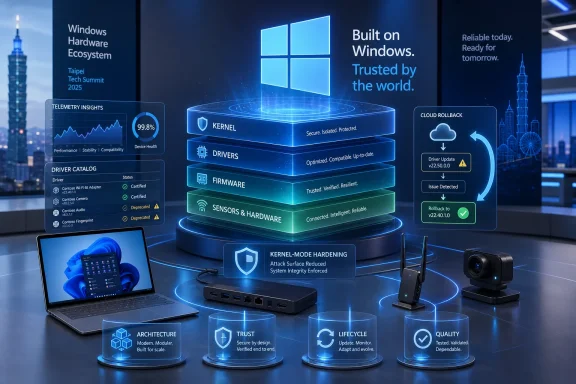
The architecture pillar is the most consequential. Microsoft says it is investing in hardening kernel-mode drivers and encouraging movement from third-party kernel code toward user-mode drivers or Microsoft-authored class drivers where practical. That is not a small shift. Kernel mode is powerful because it sits close to the hardware and the operating system’s core, but it is dangerous for the same reason: a bad kernel driver can take the whole machine down.
This is the long shadow of Windows’ openness. The platform became dominant partly because hardware makers could integrate deeply and differentiate aggressively. But every extra kernel component increases the blast radius of a defect. Microsoft’s recent resiliency work, sharpened by the industry’s post-CrowdStrike focus on kernel risk, is now bleeding into the broader driver ecosystem.
The trust pillar is less glamorous but just as important. Updated Windows Hardware Compatibility Program requirements, stronger partner verification, and expanded automated analysis are not exciting for users, but they are the machinery by which Microsoft can raise the cost of shipping sloppy drivers. Certification has always been part of Windows hardware life; DQI suggests Microsoft wants it to become a more active quality lever rather than a box checked on the way to distribution.
Lifecycle is where many real-world problems live. Windows Update is not just an operating system patch pipeline; it is also a driver distribution system, and that has made it both powerful and irritating. Microsoft now says it wants better catalog hygiene, including deprecating outdated or low-quality drivers. That phrase will sound dry until you have watched Windows repeatedly offer a driver older or worse than the one already installed.
Quality measures may be the most overdue change. Crash telemetry matters, but it is a crude proxy for the Windows experience. A driver can avoid blue screens while still causing battery drain, latency spikes, thermal throttling, failed sleep states, broken device functionality, or performance regressions. By expanding measurements beyond crashes into stability, functionality, performance, power, and thermal impact, Microsoft is admitting that “does not crash” is not the same as “is good.”
This is especially visible with graphics, audio, networking, and peripheral drivers. Vendor packages may include newer control panels, game optimizations, device-specific tuning, or OEM customizations that do not map cleanly to the version Windows Update thinks is best. When the metadata is wrong, the result can feel like Windows is fighting the user.
Microsoft’s plan to deprecate outdated or low-quality drivers from the Windows Update catalog is therefore not housekeeping; it is platform hygiene. A distribution channel with stale or misranked drivers becomes a reliability risk. The catalog needs to know not only what can install, but what should no longer be offered because the ecosystem has learned better.
The same logic sits behind Cloud-Initiated Driver Recovery, Microsoft’s related effort to roll back problematic drivers delivered through Windows Update. The idea is appealing: if a driver update causes widespread trouble, Microsoft can remotely trigger a return to a known-good driver without requiring every user or OEM to manually intervene. That turns rollback from a support article into an operational control.
But remote rollback also raises the bar for Microsoft’s own judgment. If Windows Update is going to push drivers and then pull them back from the cloud when necessary, administrators will want visibility, auditability, and predictable controls. Consumers want the machine to heal itself; enterprises want to know exactly what changed, when it changed, and how to stop it happening again.
For decades, Windows tolerated a model in which vendors could treat kernel access as a default route to performance, compatibility, or differentiation. That model made sense when the PC ecosystem needed maximum flexibility and when many device categories lacked mature standardized class drivers. It makes less sense in a world where one bad privileged component can affect millions of systems overnight.
Microsoft’s investments in user-mode driver support, first-party class drivers, DMA protections, and device-class standardization all point in the same direction. The company wants more hardware to work through safer abstractions and fewer vendor-specific kernel hooks. That is a security story, but it is also a reliability story.
The tradeoff is that vendors often use custom drivers to differentiate. Audio tuning, camera effects, connectivity enhancements, power policies, gaming features, AI accelerators, and device utilities all become part of the OEM sales pitch. Microsoft’s job is to preserve useful differentiation while eliminating the brittle plumbing that makes a PC feel cursed after an update.
That is harder than it sounds. Standardization can improve quality, but it can also flatten features if the class driver does not support what hardware makers want to build. Microsoft’s promise, then, is not simply “less kernel code.” It is “less risky kernel code, and better shared infrastructure where custom code is no longer worth the risk.”
DQI does not directly present itself as an anti-bloat campaign, but better driver architecture and lifecycle discipline inevitably challenge that ecosystem. If Windows provides stronger class drivers, clearer driver health signals, and safer update mechanisms, it becomes harder for vendors to justify sprawling support software that exists mainly to compensate for platform gaps.
This matters for performance, one of the complaints reportedly tied to Microsoft’s broader Windows quality push. Users often experience “Windows is slow” as a single impression, but the causes are distributed: startup services, vendor utilities, aggressive background updaters, inefficient drivers, poor power management, and security tools all contribute. The operating system gets blamed for the sum of decisions made across the PC supply chain.
A cleaner driver model will not magically make every OEM image tasteful. It will not stop vendors from shipping companion apps, nor should it; some hardware genuinely benefits from rich configuration software. But it can move more of the basic device experience into predictable Windows-managed paths, leaving optional utilities to add value instead of propping up core functionality.
For sysadmins, that is the difference between a manageable fleet and a collection of vendor snowflakes. The more Windows can rely on stable in-box components and trustworthy update metadata, the easier it becomes to deploy hardware at scale without building a custom superstition around every model.
That is why measuring power and thermal impact is an important step. Modern Windows laptops live or die by sleep reliability, battery life, fan behavior, and responsiveness under mixed workloads. A driver can pass conventional validation and still create a machine that feels worse than its spec sheet.
Performance measurement is similarly tricky. A driver update may improve one workload while degrading another. A gaming driver may optimize a major title while introducing instability in a creative app. A Wi-Fi driver may improve throughput while hurting roaming behavior. Real quality metrics must account for the messy diversity of Windows usage rather than collapse everything into a single pass-fail signal.
Microsoft also has to decide how transparent these signals will be. Partners at WinHEC reportedly welcomed open methodology and phased lifecycle states, which is encouraging. But users and administrators need more than reassurance. They need driver history, health signals, rollback clarity, and policy controls that make the system’s decisions intelligible.
This is where Microsoft can learn from its own update history. Windows Update has become more communicative over time, but driver updates still often feel opaque. If DQI produces better internal telemetry but leaves users guessing why a driver was installed, withheld, deprecated, or rolled back, it will solve only half the trust problem.
That is why DQI has to fit the realities of deployment rings, device models, procurement cycles, and compliance requirements. IT departments do not want driver innovation as a surprise. They want predictable channels, deferral options, reporting, rollback, and a way to distinguish urgent security updates from routine device maintenance.
Cloud-triggered recovery could be a gift in this environment, but only if it integrates cleanly with enterprise controls. A rollback that saves consumers from a broken driver might still alarm an administrator if it changes a regulated fleet without adequate notice. Microsoft’s challenge is to make remediation fast without making it feel unilateral.
The same applies to deprecating bad drivers. Removing a low-quality driver from the catalog is sensible, but enterprises may still have edge cases where an old driver is bound to a validated hardware setup. Microsoft does not need to preserve every legacy path forever, but it does need clear lifecycle states so administrators can plan rather than discover.
This is the enterprise bargain Microsoft keeps having to strike with Windows. The consumer OS must heal and simplify. The business OS must explain and obey. DQI will be judged by whether it can do both at once.
DQI’s emphasis on shared quality, roadmap clarity, and transparent metrics is a way of reducing that ambiguity. If quality signals become clearer and driver lifecycle states become more visible, it should be harder for any participant to shrug. A driver that fails power, thermal, stability, or functionality expectations should carry a reputational cost inside the ecosystem before users become the test lab.
That does not mean Microsoft can simply dictate quality by fiat. Windows’ hardware breadth is not a controlled appliance model, and that remains a feature. The PC is compelling because vendors can build strange, cheap, premium, specialized, repairable, overpowered, underpowered, modular, and experimental machines that all run the same OS.
But openness without accountability becomes entropy. The point of DQI is to preserve Windows’ hardware diversity while making the baseline experience less random. If Microsoft pushes too hard, partners will complain about constraint. If it pushes too softly, users will keep treating driver updates as a weather event.
The return of WinHEC suggests Microsoft knows it cannot solve this through documentation alone. Engineers need shared labs, early alignment, crash analysis, driver hardening guidance, and direct access to the people building the platform. That is old-fashioned ecosystem work, and Windows needs more of it.
Drivers are a rational place to focus because they sit at the intersection of performance, reliability, security, and hardware compatibility. They are also one of the least visible causes of visible pain. Fixing them produces improvements users may never consciously notice, which is exactly how platform work should feel.
The risk is that Microsoft overpromises a systemic fix and delivers incremental process changes that only insiders can see. Better WHCP requirements, stronger catalog hygiene, and improved telemetry are worthwhile, but users will judge the outcome by whether their PCs sleep properly, update safely, keep their preferred drivers, avoid blue screens, and stop mysteriously degrading after routine maintenance.
There is also the matter of time. Driver ecosystems do not turn quickly. Hardware already in the field has old assumptions baked in. Vendors have release cycles, certification costs, and competing priorities. Some devices will never receive ideal modern drivers. Some low-cost hardware will remain barely maintained.
That means DQI is less likely to produce a single “fixed Windows drivers” moment than a gradual tightening of the floor. The best version of this initiative is boring: fewer bad drivers offered, fewer catastrophic regressions, better rollback when mistakes happen, more devices using safer class drivers, and better signals when something starts to go wrong.
If the answer is yes, DQI will become more than a WinHEC talking point. It will be the infrastructure behind a Windows ecosystem that can make mistakes without turning those mistakes into week-long support sagas. If the answer is no, the initiative will join the long shelf of Microsoft quality resets that sounded right and changed too little.
The user experience stakes are larger than they may appear. Windows is competing not only against macOS, ChromeOS, Linux desktops, and mobile platforms, but against the expectation that computers should feel appliance-like when doing ordinary things. A PC can remain open, upgradeable, and diverse while still being less capricious.
Microsoft has often leaned on backward compatibility as both virtue and excuse. DQI suggests the company understands that compatibility must now be paired with active curation. Supporting everything is not the same as treating every driver as equally healthy, current, or trustworthy.
Source: Neowin Microsoft promises to fix driver quality in Windows, here's how
 Microsoft Is Reopening the Hardware Conversation It Let Go Quiet
WinHEC used to be one of the places where Microsoft told the PC industry what kind of Windows future it wanted. Then the conference faded from regular view, and the ecosystem kept moving anyway: ARM PCs, AI accelerators, new display stacks, USB-C chaos, Bluetooth everything, firmware update pipelines, gaming handhelds, security agents, and ever more vendor utilities burrowing into the OS.That makes the return of WinHEC in 2026 more than nostalgia. Microsoft is signaling that Windows quality cannot be solved only through Insider builds, Feedback Hub posts, and emergency Known Issue Rollbacks after something breaks. It needs the companies that write firmware, drivers, companion apps, device extensions, and update metadata in the same conversation before millions of PCs inherit the mistake.
The Driver Quality Initiative, or DQI, is therefore not just a driver program. It is Microsoft’s attempt to reassert platform governance over a Windows hardware ecosystem that has become both technically richer and operationally messier. The company is not saying Windows drivers are suddenly broken; it is saying the old quality bar is no longer good enough for the way Windows is used now.
That distinction matters. A PC in 2026 is no longer a beige box with a handful of stable peripherals. It is a power-managed, sensor-filled, security-hardened, cloud-updated, AI-accelerated machine where one flaky driver can mean battery drain, overheating, camera failures, failed upgrades, blue screens, degraded gaming performance, or a help desk ticket that says only: “Windows is broken.”
The Driver Is Where Users Stop Caring Who Is at Fault
Microsoft’s bluntest argument is also its strongest: when a driver fails, users experience it as a device problem. They do not care whether the fault belongs to Microsoft, the OEM, the silicon vendor, the peripheral maker, or a third-party software package that shipped a kernel component years ago and was never updated properly.That is the central political problem of Windows quality. Microsoft owns the brand and the update channel, but not every line of code running in the most privileged parts of the system. A bad storage, networking, graphics, audio, camera, printer, Bluetooth, or security driver can make the entire PC feel unreliable even when the Windows kernel is doing exactly what it was designed to do.
For enthusiasts, that often becomes a familiar ritual: uninstall the device, roll back the driver, block the update, install the vendor package, discover Windows Update has replaced it again, and then search forums for the one driver version that does not make the machine behave badly. For administrators, the same problem appears at fleet scale, where driver regressions are not annoyances but change-management failures.
DQI is Microsoft’s acknowledgment that the user-facing boundary between Windows and drivers is meaningless in practice. If a laptop fan screams after an update, if Wi-Fi disappears after resume, if a docking station fails after Patch Tuesday, or if a graphics driver quietly downgrades performance, Windows takes the reputational hit. The ecosystem may share responsibility, but users assign blame to the platform they can see.
The Four-Pillar Plan Is Really About Control
Microsoft describes DQI around four pillars: architecture, trust, lifecycle, and quality measures. That sounds like standard corporate scaffolding, but underneath it is a fairly coherent plan to reduce the number of ways a driver can damage the Windows experience.The architecture pillar is the most consequential. Microsoft says it is investing in hardening kernel-mode drivers and encouraging movement from third-party kernel code toward user-mode drivers or Microsoft-authored class drivers where practical. That is not a small shift. Kernel mode is powerful because it sits close to the hardware and the operating system’s core, but it is dangerous for the same reason: a bad kernel driver can take the whole machine down.
This is the long shadow of Windows’ openness. The platform became dominant partly because hardware makers could integrate deeply and differentiate aggressively. But every extra kernel component increases the blast radius of a defect. Microsoft’s recent resiliency work, sharpened by the industry’s post-CrowdStrike focus on kernel risk, is now bleeding into the broader driver ecosystem.
The trust pillar is less glamorous but just as important. Updated Windows Hardware Compatibility Program requirements, stronger partner verification, and expanded automated analysis are not exciting for users, but they are the machinery by which Microsoft can raise the cost of shipping sloppy drivers. Certification has always been part of Windows hardware life; DQI suggests Microsoft wants it to become a more active quality lever rather than a box checked on the way to distribution.
Lifecycle is where many real-world problems live. Windows Update is not just an operating system patch pipeline; it is also a driver distribution system, and that has made it both powerful and irritating. Microsoft now says it wants better catalog hygiene, including deprecating outdated or low-quality drivers. That phrase will sound dry until you have watched Windows repeatedly offer a driver older or worse than the one already installed.
Quality measures may be the most overdue change. Crash telemetry matters, but it is a crude proxy for the Windows experience. A driver can avoid blue screens while still causing battery drain, latency spikes, thermal throttling, failed sleep states, broken device functionality, or performance regressions. By expanding measurements beyond crashes into stability, functionality, performance, power, and thermal impact, Microsoft is admitting that “does not crash” is not the same as “is good.”
Windows Update Needs a Memory, Not Just a Pipeline
The promise to clean up driver lifecycle management is where DQI will either become meaningful or dissolve into conference language. Windows users have long tolerated an uncomfortable contradiction: Windows Update is supposed to keep systems healthy, yet it can also reintroduce driver versions that users, vendors, or administrators thought they had escaped.This is especially visible with graphics, audio, networking, and peripheral drivers. Vendor packages may include newer control panels, game optimizations, device-specific tuning, or OEM customizations that do not map cleanly to the version Windows Update thinks is best. When the metadata is wrong, the result can feel like Windows is fighting the user.
Microsoft’s plan to deprecate outdated or low-quality drivers from the Windows Update catalog is therefore not housekeeping; it is platform hygiene. A distribution channel with stale or misranked drivers becomes a reliability risk. The catalog needs to know not only what can install, but what should no longer be offered because the ecosystem has learned better.
The same logic sits behind Cloud-Initiated Driver Recovery, Microsoft’s related effort to roll back problematic drivers delivered through Windows Update. The idea is appealing: if a driver update causes widespread trouble, Microsoft can remotely trigger a return to a known-good driver without requiring every user or OEM to manually intervene. That turns rollback from a support article into an operational control.
But remote rollback also raises the bar for Microsoft’s own judgment. If Windows Update is going to push drivers and then pull them back from the cloud when necessary, administrators will want visibility, auditability, and predictable controls. Consumers want the machine to heal itself; enterprises want to know exactly what changed, when it changed, and how to stop it happening again.
The Kernel Is No Longer a Free Innovation Zone
The most important long-term movement in DQI is Microsoft’s effort to reduce unnecessary kernel-mode exposure. That does not mean kernel drivers disappear. Graphics, storage, endpoint security, and other classes of software still have cases where deep access is necessary. But the burden of proof is shifting.For decades, Windows tolerated a model in which vendors could treat kernel access as a default route to performance, compatibility, or differentiation. That model made sense when the PC ecosystem needed maximum flexibility and when many device categories lacked mature standardized class drivers. It makes less sense in a world where one bad privileged component can affect millions of systems overnight.
Microsoft’s investments in user-mode driver support, first-party class drivers, DMA protections, and device-class standardization all point in the same direction. The company wants more hardware to work through safer abstractions and fewer vendor-specific kernel hooks. That is a security story, but it is also a reliability story.
The tradeoff is that vendors often use custom drivers to differentiate. Audio tuning, camera effects, connectivity enhancements, power policies, gaming features, AI accelerators, and device utilities all become part of the OEM sales pitch. Microsoft’s job is to preserve useful differentiation while eliminating the brittle plumbing that makes a PC feel cursed after an update.
That is harder than it sounds. Standardization can improve quality, but it can also flatten features if the class driver does not support what hardware makers want to build. Microsoft’s promise, then, is not simply “less kernel code.” It is “less risky kernel code, and better shared infrastructure where custom code is no longer worth the risk.”
DQI Is Also a Quiet Rebuke of PC Bloat
Driver quality is not limited to.sys files and crash dumps. Modern Windows devices often arrive with a stack of services, tray apps, control panels, update agents, telemetry helpers, firmware utilities, and branded experience layers. Some are necessary. Some are useful. Some are clearly there because an OEM business deal outlived its technical justification.DQI does not directly present itself as an anti-bloat campaign, but better driver architecture and lifecycle discipline inevitably challenge that ecosystem. If Windows provides stronger class drivers, clearer driver health signals, and safer update mechanisms, it becomes harder for vendors to justify sprawling support software that exists mainly to compensate for platform gaps.
This matters for performance, one of the complaints reportedly tied to Microsoft’s broader Windows quality push. Users often experience “Windows is slow” as a single impression, but the causes are distributed: startup services, vendor utilities, aggressive background updaters, inefficient drivers, poor power management, and security tools all contribute. The operating system gets blamed for the sum of decisions made across the PC supply chain.
A cleaner driver model will not magically make every OEM image tasteful. It will not stop vendors from shipping companion apps, nor should it; some hardware genuinely benefits from rich configuration software. But it can move more of the basic device experience into predictable Windows-managed paths, leaving optional utilities to add value instead of propping up core functionality.
For sysadmins, that is the difference between a manageable fleet and a collection of vendor snowflakes. The more Windows can rely on stable in-box components and trustworthy update metadata, the easier it becomes to deploy hardware at scale without building a custom superstition around every model.
Measurement Is the Part Microsoft Has to Get Right
Microsoft’s expanded driver quality metrics sound sensible, but the devil is in how they are weighted. A driver that causes crashes is obviously bad. A driver that increases idle power draw by 8 percent, adds two seconds to resume, or raises surface temperature under video calls is more ambiguous but still deeply relevant to user satisfaction.That is why measuring power and thermal impact is an important step. Modern Windows laptops live or die by sleep reliability, battery life, fan behavior, and responsiveness under mixed workloads. A driver can pass conventional validation and still create a machine that feels worse than its spec sheet.
Performance measurement is similarly tricky. A driver update may improve one workload while degrading another. A gaming driver may optimize a major title while introducing instability in a creative app. A Wi-Fi driver may improve throughput while hurting roaming behavior. Real quality metrics must account for the messy diversity of Windows usage rather than collapse everything into a single pass-fail signal.
Microsoft also has to decide how transparent these signals will be. Partners at WinHEC reportedly welcomed open methodology and phased lifecycle states, which is encouraging. But users and administrators need more than reassurance. They need driver history, health signals, rollback clarity, and policy controls that make the system’s decisions intelligible.
This is where Microsoft can learn from its own update history. Windows Update has become more communicative over time, but driver updates still often feel opaque. If DQI produces better internal telemetry but leaves users guessing why a driver was installed, withheld, deprecated, or rolled back, it will solve only half the trust problem.
Enterprises Will Judge the Initiative by the Blast Radius
For home users, a bad driver is usually a personal frustration. For enterprises, it is a coordination failure. A single driver regression can affect VPN connectivity, docking stations, smart card readers, Teams peripherals, BitLocker recovery flows, display output, sleep states, or line-of-business hardware that nobody wants to touch because it technically still works.That is why DQI has to fit the realities of deployment rings, device models, procurement cycles, and compliance requirements. IT departments do not want driver innovation as a surprise. They want predictable channels, deferral options, reporting, rollback, and a way to distinguish urgent security updates from routine device maintenance.
Cloud-triggered recovery could be a gift in this environment, but only if it integrates cleanly with enterprise controls. A rollback that saves consumers from a broken driver might still alarm an administrator if it changes a regulated fleet without adequate notice. Microsoft’s challenge is to make remediation fast without making it feel unilateral.
The same applies to deprecating bad drivers. Removing a low-quality driver from the catalog is sensible, but enterprises may still have edge cases where an old driver is bound to a validated hardware setup. Microsoft does not need to preserve every legacy path forever, but it does need clear lifecycle states so administrators can plan rather than discover.
This is the enterprise bargain Microsoft keeps having to strike with Windows. The consumer OS must heal and simplify. The business OS must explain and obey. DQI will be judged by whether it can do both at once.
The PC Industry Has to Give Up Some Comfortable Ambiguity
Microsoft is framing DQI as a partnership, and that is accurate. But partnership language can obscure the uncomfortable part: the PC ecosystem has benefited from ambiguity around responsibility. When something breaks, the OEM can blame Windows, Microsoft can point to the driver, the silicon vendor can point to the OEM package, and the user can lose an afternoon.DQI’s emphasis on shared quality, roadmap clarity, and transparent metrics is a way of reducing that ambiguity. If quality signals become clearer and driver lifecycle states become more visible, it should be harder for any participant to shrug. A driver that fails power, thermal, stability, or functionality expectations should carry a reputational cost inside the ecosystem before users become the test lab.
That does not mean Microsoft can simply dictate quality by fiat. Windows’ hardware breadth is not a controlled appliance model, and that remains a feature. The PC is compelling because vendors can build strange, cheap, premium, specialized, repairable, overpowered, underpowered, modular, and experimental machines that all run the same OS.
But openness without accountability becomes entropy. The point of DQI is to preserve Windows’ hardware diversity while making the baseline experience less random. If Microsoft pushes too hard, partners will complain about constraint. If it pushes too softly, users will keep treating driver updates as a weather event.
The return of WinHEC suggests Microsoft knows it cannot solve this through documentation alone. Engineers need shared labs, early alignment, crash analysis, driver hardening guidance, and direct access to the people building the platform. That is old-fashioned ecosystem work, and Windows needs more of it.
The Promise Is Bigger Than Drivers, and So Is the Risk
DQI lands in the middle of a broader Microsoft effort to make Windows 11 feel less neglected. Reports about the “Windows K2” quality push, recent Release Preview improvements, and Microsoft’s own resiliency messaging all point toward the same internal realization: users are tired of hearing that Windows is evolving if the everyday experience still feels inconsistent.Drivers are a rational place to focus because they sit at the intersection of performance, reliability, security, and hardware compatibility. They are also one of the least visible causes of visible pain. Fixing them produces improvements users may never consciously notice, which is exactly how platform work should feel.
The risk is that Microsoft overpromises a systemic fix and delivers incremental process changes that only insiders can see. Better WHCP requirements, stronger catalog hygiene, and improved telemetry are worthwhile, but users will judge the outcome by whether their PCs sleep properly, update safely, keep their preferred drivers, avoid blue screens, and stop mysteriously degrading after routine maintenance.
There is also the matter of time. Driver ecosystems do not turn quickly. Hardware already in the field has old assumptions baked in. Vendors have release cycles, certification costs, and competing priorities. Some devices will never receive ideal modern drivers. Some low-cost hardware will remain barely maintained.
That means DQI is less likely to produce a single “fixed Windows drivers” moment than a gradual tightening of the floor. The best version of this initiative is boring: fewer bad drivers offered, fewer catastrophic regressions, better rollback when mistakes happen, more devices using safer class drivers, and better signals when something starts to go wrong.
The Real Test Will Be the Next Bad Update
Every quality initiative sounds convincing before the next incident. The meaningful test comes when a widely distributed driver breaks something important. Does Microsoft detect the issue faster? Does Windows Update stop offering the driver? Does Cloud-Initiated Driver Recovery restore affected machines cleanly? Do administrators get useful information? Do users understand what happened?If the answer is yes, DQI will become more than a WinHEC talking point. It will be the infrastructure behind a Windows ecosystem that can make mistakes without turning those mistakes into week-long support sagas. If the answer is no, the initiative will join the long shelf of Microsoft quality resets that sounded right and changed too little.
The user experience stakes are larger than they may appear. Windows is competing not only against macOS, ChromeOS, Linux desktops, and mobile platforms, but against the expectation that computers should feel appliance-like when doing ordinary things. A PC can remain open, upgradeable, and diverse while still being less capricious.
Microsoft has often leaned on backward compatibility as both virtue and excuse. DQI suggests the company understands that compatibility must now be paired with active curation. Supporting everything is not the same as treating every driver as equally healthy, current, or trustworthy.
The Windows Driver Deal Is Being Rewritten in Public
The concrete message for WindowsForum readers is that Microsoft is not merely promising fewer blue screens. It is trying to change the contract among Windows, hardware makers, update distribution, and the people who have to live with the results.- Microsoft introduced DQI at WinHEC 2026 as an ecosystem-wide push to improve Windows driver reliability, security, performance, and lifecycle management.
- The initiative builds on the Windows Resiliency Initiative and pushes more driver work toward safer models, including user-mode drivers and Microsoft-authored class drivers where practical.
- Windows Update catalog hygiene is becoming a central quality issue, with Microsoft aiming to remove or deprecate outdated and low-quality drivers rather than keep serving them indefinitely.
- Cloud-based driver rollback could reduce the pain of bad driver updates, but enterprises will need visibility and control for it to be trusted at scale.
- Microsoft’s broader measurements will look beyond crashes to include stability, functionality, performance, power use, and thermal behavior.
- The initiative will succeed only if users see fewer regressions and administrators get clearer tools, not merely if partners attend more workshops.
Source: Neowin Microsoft promises to fix driver quality in Windows, here's how
