

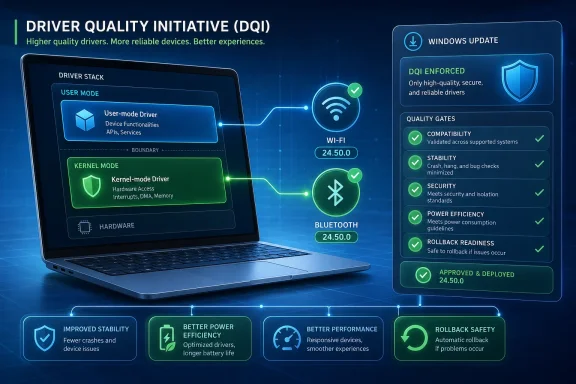
Microsoft’s Driver Quality Initiative began surfacing in public Windows 11 driver packages on June 30, 2026, when Intel posted version 24.50.0 Wi-Fi and Bluetooth drivers that explicitly align with Microsoft’s Windows ecosystem quality push. That sentence sounds bureaucratic because the news itself is bureaucratic. But buried inside Intel’s routine wireless update is the start of a larger Windows bet: Microsoft is trying to make driver quality less dependent on heroic vendor discipline and more dependent on enforceable platform rules.
The stakes are bigger than a wireless changelog. Drivers are the layer where Windows inherits the habits, shortcuts, bugs, and priorities of the entire PC hardware industry. If Microsoft can make that layer boring, Windows 11 becomes more stable; if it cannot, the operating system will keep being blamed for failures that technically began somewhere else.
For months, Microsoft’s Driver Quality Initiative sounded like a conference-stage answer to a familiar Windows problem. Bad drivers can crash machines, drain batteries, break sleep states, destabilize audio and Bluetooth, or turn a clean Windows Update cycle into an afternoon of rollback archaeology. DQI promised to raise standards across that mess.
Intel’s 24.50.0 wireless release matters because it moves DQI from promise to artifact. The Wi-Fi and Bluetooth packages are not a white paper, a keynote slide, or a future certification checklist. They are downloadable drivers for real Windows 10 and Windows 11 systems, with Intel saying the release incorporates enhancements aligned with Microsoft’s Windows ecosystem quality initiative.
That does not mean every PC with an Intel wireless adapter suddenly becomes more reliable overnight. Driver work is cumulative, and wireless stacks are notoriously sensitive to firmware, chipset generation, access point behavior, OEM customization, power policy, and Windows build. But it does mean one of Microsoft’s most important silicon partners is now visibly folding Microsoft’s new driver-quality language into production releases.
That visibility is the point. DQI will only matter if OEMs, silicon vendors, and peripheral makers treat it as a shipping discipline rather than a compliance slogan. Intel’s changelog is a small signal, but small signals are how platform shifts become normal.
That distinction has haunted Windows for decades. The PC’s openness is its great commercial advantage and its great reliability tax. Microsoft does not control every network adapter, audio codec, printer, camera, storage controller, fingerprint reader, RGB controller, docking station, and firmware bridge that Windows is expected to support. Yet when one of those components misbehaves, the user rarely blames the vendor logo printed in six-point type on a driver package. The user blames Windows.
DQI is Microsoft’s attempt to narrow that accountability gap. The company is pushing partners toward Microsoft-authored class drivers and user-mode drivers where possible, while hardening kernel-mode drivers where kernel access remains necessary. The logic is not new, but the urgency is. A modern Windows laptop is no longer judged only by whether it boots and runs Office; it is judged by whether it sleeps properly, wakes instantly, preserves battery life, stays cool, survives updates, and avoids random device weirdness after Patch Tuesday.
That is why this initiative is about more than blue screens. A driver can be “working” and still be bad. It can reconnect slowly after sleep, hold the CPU awake, mishandle power states, spike thermals, degrade Wi-Fi roaming, or silently reduce battery life. Microsoft’s newer quality framing treats those behaviors as driver-quality failures, not merely user annoyances.
But the security subtext is impossible to miss. Kernel-mode code is privileged code, and privileged code expands the blast radius of every bug. A driver flaw can become a stability problem, a security problem, or both. The industry has already learned this lesson repeatedly through vulnerable signed drivers, anti-cheat controversies, endpoint security failures, and old driver packages that linger long after their maintainers have moved on.
Microsoft’s answer is not to abolish third-party kernel code. It is to make that code justify itself. If a device can work through a Microsoft class driver, it should. If a driver can run in user mode, it should. If it must run in kernel mode, it should face stronger testing, better guardrails, and more scrutiny before it reaches customers.
That is a more pragmatic strategy than pretending Windows can become a sealed appliance overnight. The PC ecosystem is too broad for that. But it also marks a philosophical shift: kernel access is being treated less like the default path for hardware enablement and more like an exception that carries obligations.
Windows Update is supposed to spare ordinary users from hunting vendor websites, decoding model numbers, and choosing between three nearly identical packages with different OEM stamps. In practice, driver delivery through Windows Update has long been a source of suspicion among power users. The recurring complaint is familiar: a user installs a newer vendor driver manually, only for Windows Update to offer or install an older, less suitable, or OEM-modified driver later.
DQI’s lifecycle ambitions matter because driver quality is not only about what vendors build. It is also about what Windows chooses to distribute, when it distributes it, and whether it knows enough to avoid pushing a regression broadly. A better driver pipeline must be able to distinguish between “newer,” “approved,” “safe for this hardware ID,” and “actually the right choice for this machine.”
That is harder than it sounds. The Windows install base contains countless combinations of hardware, BIOS revisions, regional SKUs, enterprise images, docking configurations, and user-installed utilities. A driver that works well on one Intel wireless module in one OEM laptop may behave differently on another system with a different antenna design, firmware bundle, or power-management policy.
Still, Microsoft cannot keep treating driver delivery as a clerical exercise. If Windows Update is going to be the front door for driver maintenance, it must also become better at rejecting low-quality or stale packages. Otherwise DQI will look like a laboratory discipline that collapses the moment it reaches consumer machines.
They are also a frequent source of vague user complaints. “My Bluetooth keeps dropping.” “Wi-Fi is slow after sleep.” “Teams audio breaks when I switch headsets.” “The laptop gets hot in the bag.” These are not always driver bugs, but drivers are often in the chain of responsibility. That makes wireless a good proving ground for Microsoft’s broader argument that driver quality should include performance, power, and thermal behavior rather than merely device enumeration.
Intel’s role is also strategically important. The company remains deeply embedded in the Windows PC ecosystem, not just through CPUs but through connectivity, platform firmware relationships, reference designs, and OEM coordination. When Intel adopts Microsoft’s driver-quality framing, it gives other vendors a template and a competitive nudge.
The open question is whether this becomes a broad vendor movement or a line item that appears in selected release notes. Intel wireless is a start. Graphics, storage, audio, chipset, camera, and peripheral drivers will be the real stress test.
Graphics drivers are among the most complex software components on a Windows PC. They span performance tuning, game compatibility, media encode and decode, display output, power management, AI acceleration, application profiles, hybrid graphics, and frequent bug fixes. They also exist in a market where vendors compete aggressively on day-one support and performance optimizations.
That makes graphics a difficult fit for any initiative that sounds like standardization. Microsoft can encourage better quality gates, safer architecture, and more predictable lifecycle management, but GPU vendors will resist anything that slows their release cadence or limits low-level optimization. Gamers, creators, and workstation users may say they want stability, but they also want fixes for the game, app, or monitor bug they encountered yesterday.
This is where DQI’s credibility will be tested. If Microsoft can make driver quality rules compatible with rapid vendor iteration, the initiative becomes a genuine platform improvement. If it turns into another layer of ceremony vendors route around when deadlines tighten, its impact will be uneven.
The best outcome is not fewer driver updates. It is fewer reckless driver updates. Windows users do not need the driver ecosystem to become timid; they need it to become less chaotic.
The industry has already moved toward more standardized printing models, but the scars remain. Anyone who has administered office printers knows the pattern: a driver package installs more than a driver, brings along services and utilities, behaves differently per vendor, and then becomes a maintenance liability. Microsoft’s printer reforms are an attempt to reduce that surface area.
DQI applies similar logic more broadly. The fewer bespoke components Windows needs to trust deeply, the fewer ways a vendor can destabilize the machine. Standard class drivers are not glamorous, but glamour is not the point. Predictability is.
That said, standardization has a cost. Vendor-specific drivers often exist because hardware makers want to expose features, tune behavior, or differentiate products. Microsoft’s challenge is to make the standardized path good enough that vendors do not see it as a downgrade and users do not lose capabilities they actually value.
The enterprise driver problem is especially painful because it is probabilistic. One driver package can behave acceptably on most machines and still break a meaningful subset. That subset may be tied to a BIOS revision, docking station, VPN client, security agent, or peripheral fleet. The administrator then has to determine whether the problem is Windows, the driver, the OEM image, the hardware batch, or some interaction among all of them.
Better lifecycle controls could help. Stronger quality measures could help. More user-mode isolation could help. But IT departments will still need visibility. A cleaner driver ecosystem should not mean a more opaque one.
Microsoft’s task is to improve trust without asking administrators to surrender control. Enterprises will want to know which drivers are being offered, why they are being offered, how broadly they have been deployed, what telemetry says about failures, and how quickly a bad package can be blocked or rolled back. DQI’s practical value will depend as much on operational tooling as on driver architecture.
That invisibility creates a communications problem for Microsoft. AI features, visual redesigns, and new apps are easy to market. Driver hygiene is not. Yet driver hygiene may do more for everyday Windows satisfaction than another Copilot entry point or Start menu experiment.
The ordinary Windows user does not care whether a driver is user-mode, kernel-mode, class-based, WHQL-certified, or aligned with a quality initiative. They care whether the machine behaves. Microsoft’s best chance of winning back goodwill is not to explain DQI loudly, but to make the problems it targets happen less often.
That is also why Intel’s release is worth watching without overhyping. A single driver package is not a turning point. It is a marker that the ecosystem is beginning to absorb Microsoft’s new rules.
The timing is not accidental. Windows 11 is no longer a new operating system finding its footing. It is the mainstream Windows platform, and Microsoft is simultaneously pushing AI PCs, new silicon capabilities, security baselines, and continued migration from older versions. That strategy depends on trust. Users and administrators are less likely to embrace new platform layers if the old ones still feel fragile.
Driver quality sits beneath all of it. AI accelerators need drivers. Cameras and microphones need drivers. Wi-Fi and Bluetooth need drivers. Security features rely on kernel integrity and trusted components. Power efficiency depends on coordination among firmware, drivers, and Windows. If that foundation is unreliable, the rest of Microsoft’s Windows story weakens.
DQI is therefore not a side quest. It is infrastructure work for the next phase of Windows.
Microsoft can publish standards, but standards become meaningful only when they affect shipping decisions. That means rejecting drivers that would previously have passed, delaying packages that need more testing, nudging vendors away from bespoke kernel code, and resisting pressure to preserve old behaviors indefinitely.
This is where Microsoft’s role as both platform owner and ecosystem partner becomes uncomfortable. The company needs Intel, AMD, Qualcomm, Nvidia, Realtek, MediaTek, Synaptics, printer makers, docking vendors, and countless OEMs to keep Windows hardware broad and competitive. But it also needs to tell those partners “no” more often when their software weakens the platform.
The phrase driver quality sounds neutral. In practice, it is a power negotiation.
The implications are larger. Microsoft is trying to move Windows driver development toward a model where stability, security, power, thermals, and lifecycle behavior are first-order requirements. Intel’s wireless stack is one of the first visible places where that agenda is showing up in shipping code.
The sensible reaction is cautious optimism. DQI will not eliminate bad drivers, and it will not make every vendor package safe, fast, and perfectly matched to every PC. But it may reduce the number of avoidable failures that have made Windows driver maintenance feel like a recurring tax.
The stakes are bigger than a wireless changelog. Drivers are the layer where Windows inherits the habits, shortcuts, bugs, and priorities of the entire PC hardware industry. If Microsoft can make that layer boring, Windows 11 becomes more stable; if it cannot, the operating system will keep being blamed for failures that technically began somewhere else.
 Intel’s Changelog Turns Microsoft’s Driver Plan Into Something Users Can Install
For months, Microsoft’s Driver Quality Initiative sounded like a conference-stage answer to a familiar Windows problem. Bad drivers can crash machines, drain batteries, break sleep states, destabilize audio and Bluetooth, or turn a clean Windows Update cycle into an afternoon of rollback archaeology. DQI promised to raise standards across that mess.Intel’s 24.50.0 wireless release matters because it moves DQI from promise to artifact. The Wi-Fi and Bluetooth packages are not a white paper, a keynote slide, or a future certification checklist. They are downloadable drivers for real Windows 10 and Windows 11 systems, with Intel saying the release incorporates enhancements aligned with Microsoft’s Windows ecosystem quality initiative.
That does not mean every PC with an Intel wireless adapter suddenly becomes more reliable overnight. Driver work is cumulative, and wireless stacks are notoriously sensitive to firmware, chipset generation, access point behavior, OEM customization, power policy, and Windows build. But it does mean one of Microsoft’s most important silicon partners is now visibly folding Microsoft’s new driver-quality language into production releases.
That visibility is the point. DQI will only matter if OEMs, silicon vendors, and peripheral makers treat it as a shipping discipline rather than a compliance slogan. Intel’s changelog is a small signal, but small signals are how platform shifts become normal.
The Kernel Is Still Windows’ Most Dangerous Neighborhood
Microsoft’s driver push is built around a simple observation: code running close to the Windows kernel has enormous power to ruin the user experience. A buggy app can crash itself. A buggy kernel-mode driver can crash the system.That distinction has haunted Windows for decades. The PC’s openness is its great commercial advantage and its great reliability tax. Microsoft does not control every network adapter, audio codec, printer, camera, storage controller, fingerprint reader, RGB controller, docking station, and firmware bridge that Windows is expected to support. Yet when one of those components misbehaves, the user rarely blames the vendor logo printed in six-point type on a driver package. The user blames Windows.
DQI is Microsoft’s attempt to narrow that accountability gap. The company is pushing partners toward Microsoft-authored class drivers and user-mode drivers where possible, while hardening kernel-mode drivers where kernel access remains necessary. The logic is not new, but the urgency is. A modern Windows laptop is no longer judged only by whether it boots and runs Office; it is judged by whether it sleeps properly, wakes instantly, preserves battery life, stays cool, survives updates, and avoids random device weirdness after Patch Tuesday.
That is why this initiative is about more than blue screens. A driver can be “working” and still be bad. It can reconnect slowly after sleep, hold the CPU awake, mishandle power states, spike thermals, degrade Wi-Fi roaming, or silently reduce battery life. Microsoft’s newer quality framing treats those behaviors as driver-quality failures, not merely user annoyances.
DQI Is a Quality Program With a Security Subtext
Microsoft is not presenting DQI as a kernel lockdown campaign, and that distinction matters. Windows will continue to need third-party drivers, including kernel-mode drivers, because PC hardware diversity is real. A gaming GPU, Wi-Fi 7 adapter, enterprise VPN filter, accessibility device, and industrial controller do not all fit neatly inside the same generic driver model.But the security subtext is impossible to miss. Kernel-mode code is privileged code, and privileged code expands the blast radius of every bug. A driver flaw can become a stability problem, a security problem, or both. The industry has already learned this lesson repeatedly through vulnerable signed drivers, anti-cheat controversies, endpoint security failures, and old driver packages that linger long after their maintainers have moved on.
Microsoft’s answer is not to abolish third-party kernel code. It is to make that code justify itself. If a device can work through a Microsoft class driver, it should. If a driver can run in user mode, it should. If it must run in kernel mode, it should face stronger testing, better guardrails, and more scrutiny before it reaches customers.
That is a more pragmatic strategy than pretending Windows can become a sealed appliance overnight. The PC ecosystem is too broad for that. But it also marks a philosophical shift: kernel access is being treated less like the default path for hardware enablement and more like an exception that carries obligations.
Windows Update Is Where Driver Theory Meets User Anger
The most politically sensitive part of driver quality is not the driver model. It is delivery.Windows Update is supposed to spare ordinary users from hunting vendor websites, decoding model numbers, and choosing between three nearly identical packages with different OEM stamps. In practice, driver delivery through Windows Update has long been a source of suspicion among power users. The recurring complaint is familiar: a user installs a newer vendor driver manually, only for Windows Update to offer or install an older, less suitable, or OEM-modified driver later.
DQI’s lifecycle ambitions matter because driver quality is not only about what vendors build. It is also about what Windows chooses to distribute, when it distributes it, and whether it knows enough to avoid pushing a regression broadly. A better driver pipeline must be able to distinguish between “newer,” “approved,” “safe for this hardware ID,” and “actually the right choice for this machine.”
That is harder than it sounds. The Windows install base contains countless combinations of hardware, BIOS revisions, regional SKUs, enterprise images, docking configurations, and user-installed utilities. A driver that works well on one Intel wireless module in one OEM laptop may behave differently on another system with a different antenna design, firmware bundle, or power-management policy.
Still, Microsoft cannot keep treating driver delivery as a clerical exercise. If Windows Update is going to be the front door for driver maintenance, it must also become better at rejecting low-quality or stale packages. Otherwise DQI will look like a laboratory discipline that collapses the moment it reaches consumer machines.
Intel Is the Right First Public Test Case
Intel wireless drivers are an especially useful early signal because they sit at the intersection of everyday frustration and platform complexity. Wi-Fi and Bluetooth are not optional niceties anymore. They are how laptops join meetings, pair headsets, connect keyboards, roam across offices, wake from sleep, and preserve battery life while appearing always available.They are also a frequent source of vague user complaints. “My Bluetooth keeps dropping.” “Wi-Fi is slow after sleep.” “Teams audio breaks when I switch headsets.” “The laptop gets hot in the bag.” These are not always driver bugs, but drivers are often in the chain of responsibility. That makes wireless a good proving ground for Microsoft’s broader argument that driver quality should include performance, power, and thermal behavior rather than merely device enumeration.
Intel’s role is also strategically important. The company remains deeply embedded in the Windows PC ecosystem, not just through CPUs but through connectivity, platform firmware relationships, reference designs, and OEM coordination. When Intel adopts Microsoft’s driver-quality framing, it gives other vendors a template and a competitive nudge.
The open question is whether this becomes a broad vendor movement or a line item that appears in selected release notes. Intel wireless is a start. Graphics, storage, audio, chipset, camera, and peripheral drivers will be the real stress test.
Graphics Will Be the Hardest Place to Make the Philosophy Stick
The source material hints that Intel GPU drivers may eventually receive similar changes. If that happens, DQI will enter more contentious territory.Graphics drivers are among the most complex software components on a Windows PC. They span performance tuning, game compatibility, media encode and decode, display output, power management, AI acceleration, application profiles, hybrid graphics, and frequent bug fixes. They also exist in a market where vendors compete aggressively on day-one support and performance optimizations.
That makes graphics a difficult fit for any initiative that sounds like standardization. Microsoft can encourage better quality gates, safer architecture, and more predictable lifecycle management, but GPU vendors will resist anything that slows their release cadence or limits low-level optimization. Gamers, creators, and workstation users may say they want stability, but they also want fixes for the game, app, or monitor bug they encountered yesterday.
This is where DQI’s credibility will be tested. If Microsoft can make driver quality rules compatible with rapid vendor iteration, the initiative becomes a genuine platform improvement. If it turns into another layer of ceremony vendors route around when deadlines tighten, its impact will be uneven.
The best outcome is not fewer driver updates. It is fewer reckless driver updates. Windows users do not need the driver ecosystem to become timid; they need it to become less chaotic.
The Printer Lesson Still Looms Over Every Driver Reform
Microsoft’s separate Windows Ready Print effort belongs in the same conversation because printer drivers are the cautionary tale for the whole Windows driver ecosystem. Printers spent years as a monument to vendor-specific driver bloat, brittle utilities, inconsistent update behavior, and support nightmares that outlived the hardware itself.The industry has already moved toward more standardized printing models, but the scars remain. Anyone who has administered office printers knows the pattern: a driver package installs more than a driver, brings along services and utilities, behaves differently per vendor, and then becomes a maintenance liability. Microsoft’s printer reforms are an attempt to reduce that surface area.
DQI applies similar logic more broadly. The fewer bespoke components Windows needs to trust deeply, the fewer ways a vendor can destabilize the machine. Standard class drivers are not glamorous, but glamour is not the point. Predictability is.
That said, standardization has a cost. Vendor-specific drivers often exist because hardware makers want to expose features, tune behavior, or differentiate products. Microsoft’s challenge is to make the standardized path good enough that vendors do not see it as a downgrade and users do not lose capabilities they actually value.
For IT Pros, The Promise Is Fewer Mystery Regressions
Enterprise administrators will judge DQI less by slogans and more by incident volume. A driver-quality initiative succeeds in the enterprise when fewer help desk tickets begin with “after the update,” when fewer machines need driver pinning, and when fewer deployment rings are halted because a peripheral class starts misbehaving.The enterprise driver problem is especially painful because it is probabilistic. One driver package can behave acceptably on most machines and still break a meaningful subset. That subset may be tied to a BIOS revision, docking station, VPN client, security agent, or peripheral fleet. The administrator then has to determine whether the problem is Windows, the driver, the OEM image, the hardware batch, or some interaction among all of them.
Better lifecycle controls could help. Stronger quality measures could help. More user-mode isolation could help. But IT departments will still need visibility. A cleaner driver ecosystem should not mean a more opaque one.
Microsoft’s task is to improve trust without asking administrators to surrender control. Enterprises will want to know which drivers are being offered, why they are being offered, how broadly they have been deployed, what telemetry says about failures, and how quickly a bad package can be blocked or rolled back. DQI’s practical value will depend as much on operational tooling as on driver architecture.
Consumers Will Notice Only If Nothing Happens
Driver quality is one of those platform improvements that users notice mostly in its absence. Nobody writes a glowing post because Bluetooth reconnected correctly for the 400th time. Nobody praises the Wi-Fi driver because the laptop slept without draining 18 percent overnight. Reliability is invisible until it fails.That invisibility creates a communications problem for Microsoft. AI features, visual redesigns, and new apps are easy to market. Driver hygiene is not. Yet driver hygiene may do more for everyday Windows satisfaction than another Copilot entry point or Start menu experiment.
The ordinary Windows user does not care whether a driver is user-mode, kernel-mode, class-based, WHQL-certified, or aligned with a quality initiative. They care whether the machine behaves. Microsoft’s best chance of winning back goodwill is not to explain DQI loudly, but to make the problems it targets happen less often.
That is also why Intel’s release is worth watching without overhyping. A single driver package is not a turning point. It is a marker that the ecosystem is beginning to absorb Microsoft’s new rules.
The Windows 11 Quality Push Is Becoming a Platform Bargain
Microsoft has spent years asking users to accept more aggressive update models, stricter hardware requirements, and a faster-moving Windows feature cadence. In return, users have reasonably expected a more reliable platform. DQI is part of Microsoft trying to make good on that bargain.The timing is not accidental. Windows 11 is no longer a new operating system finding its footing. It is the mainstream Windows platform, and Microsoft is simultaneously pushing AI PCs, new silicon capabilities, security baselines, and continued migration from older versions. That strategy depends on trust. Users and administrators are less likely to embrace new platform layers if the old ones still feel fragile.
Driver quality sits beneath all of it. AI accelerators need drivers. Cameras and microphones need drivers. Wi-Fi and Bluetooth need drivers. Security features rely on kernel integrity and trusted components. Power efficiency depends on coordination among firmware, drivers, and Windows. If that foundation is unreliable, the rest of Microsoft’s Windows story weakens.
DQI is therefore not a side quest. It is infrastructure work for the next phase of Windows.
The Real Test Is Whether Microsoft Can Enforce Taste
The difficulty with quality initiatives is that everyone agrees with them until they impose costs. No hardware vendor announces that it prefers unstable drivers. No OEM says it wants worse battery life. The conflict appears when a launch date approaches, a customer demands a feature, a legacy component needs support, or a vendor utility depends on privileged hooks.Microsoft can publish standards, but standards become meaningful only when they affect shipping decisions. That means rejecting drivers that would previously have passed, delaying packages that need more testing, nudging vendors away from bespoke kernel code, and resisting pressure to preserve old behaviors indefinitely.
This is where Microsoft’s role as both platform owner and ecosystem partner becomes uncomfortable. The company needs Intel, AMD, Qualcomm, Nvidia, Realtek, MediaTek, Synaptics, printer makers, docking vendors, and countless OEMs to keep Windows hardware broad and competitive. But it also needs to tell those partners “no” more often when their software weakens the platform.
The phrase driver quality sounds neutral. In practice, it is a power negotiation.
The First Intel Packages Are a Small Sign With Large Implications
The immediate facts are modest. Intel released Wi-Fi and Bluetooth driver version 24.50.0 on June 30, 2026. The Wi-Fi release notes say the drivers include enhancements aligned with Microsoft’s Windows ecosystem quality initiative. The Bluetooth release carries similar positioning. Users with supported Intel wireless hardware may eventually receive those drivers directly from Intel, an OEM support page, or Windows Update, depending on the system.The implications are larger. Microsoft is trying to move Windows driver development toward a model where stability, security, power, thermals, and lifecycle behavior are first-order requirements. Intel’s wireless stack is one of the first visible places where that agenda is showing up in shipping code.
The sensible reaction is cautious optimism. DQI will not eliminate bad drivers, and it will not make every vendor package safe, fast, and perfectly matched to every PC. But it may reduce the number of avoidable failures that have made Windows driver maintenance feel like a recurring tax.
The Practical Wins Will Arrive Quietly
The near-term lesson for Windows users and administrators is not to chase Intel 24.50.0 as though it were a magic fix. The better lesson is to watch how driver release notes, Windows Update behavior, OEM validation, and rollback mechanisms change over the rest of 2026.- Intel’s 24.50.0 Wi-Fi and Bluetooth releases are among the first visible production drivers to reflect Microsoft’s newer driver-quality push.
- Microsoft’s DQI effort is aimed at stability, security, performance, power efficiency, thermal behavior, and cleaner driver lifecycle management.
- The initiative favors Microsoft class drivers and user-mode drivers where possible, while tightening expectations for kernel-mode drivers that remain necessary.
- Windows Update driver delivery is a central part of the story because a good driver can still become a bad experience if it is offered to the wrong machine at the wrong time.
- Enterprise administrators should watch for fewer post-update regressions, better rollback behavior, and clearer vendor documentation before declaring the initiative a success.
- The hardest tests will come in complex driver categories such as graphics, audio, docking, printing, and security-adjacent software.
References
- Primary source: Windows Report
Published: 2026-07-02T06:18:12.995408
Loading…
windowsreport.com - Official source: learn.microsoft.com
Loading…
learn.microsoft.com - Related coverage: intel.com
Intel® Wireless Wi-Fi Drivers for Windows® 10 and Windows 11*
This download installs the Windows® 10 and Windows 11* Wi-Fi package drivers 23.90.0 for the Intel® Wi-Fi 7/Wi-Fi 6E/Wi-Fi 6 and Intel® 9000 series Wireless Adapters www.intel.com
- Related coverage: downloadmirror.intel.com
Loading…
downloadmirror.intel.com - Related coverage: techspot.com
Loading…
www.techspot.com - Official source: support.microsoft.com
- Official source: blogs.windows.com
Raising the bar together. Introducing the Driver Quality Initiative at WinHEC 2026
There are moments in this industry when you can feel the ecosystem lean in. This week in Taipei was one of them. For two days at WinHEC 2026 (Windows Hardware Engineering Conference) — Microsoft’s first WinHEC since 2018 — we had the privilegeblogs.windows.com - Related coverage: windowslatest.com
Loading…
www.windowslatest.com - Related coverage: intel.co.jp
Loading…
www.intel.co.jp - Related coverage: windowscentral.com
Loading…
www.windowscentral.com - Related coverage: pcgamer.com
Microsoft says it's going to 'fundamentally raise the bar' on driver quality, reliability and security across Windows | PC Gamer
Start your engines.www.pcgamer.com - Related coverage: techradar.com
Loading…
www.techradar.com