

Microsoft launched Microsoft Elevate for Educators in Korea in June 2026, pairing its global teacher community with a Seoul National University-localized AI literacy credential program for Korean educators, school leaders, nonprofit professionals, and eventually K–12 teachers. The announcement is not just another skilling initiative from a hyperscaler with an education division. It is Microsoft’s clearest Korea-specific attempt to make teachers, rather than tools, the center of the AI classroom story. That distinction matters because the most urgent education problem in 2026 is no longer whether students and teachers will use AI, but whether institutions can build enough judgment around its use before the technology becomes invisible.
The obvious reading of Microsoft Elevate for Educators is that it is a product-adjacent professional development program. It gives educators a community, credentials, training pathways, and recognition tracks; it also keeps Microsoft’s education brand close to the people deciding how AI appears in classrooms. That is true, but it is also too shallow.
The more interesting move is rhetorical. Microsoft is positioning Elevate not as a shortcut to more AI usage, but as a framework for better AI usage. In the company’s Korea announcement, the recurring nouns are not “automation,” “efficiency,” or “disruption.” They are “capacity,” “judgment,” “responsibility,” “critical thinking,” and “care.”
That language reflects a shift across the education technology market. The first wave of generative AI in schools was shaped by panic and novelty: cheating, lesson-plan generation, chatbot bans, plagiarism detectors, productivity hacks, and a thousand improvised classroom policies. The second wave is more institutional. Governments and vendors now understand that the absence of rules does not stop AI adoption; it merely pushes adoption into private accounts, student phones, and teacher-by-teacher improvisation.
Microsoft’s bet in Korea is that the teacher is the only scalable governance layer the classroom actually has. Policies matter, curricula matter, and platform controls matter, but the real-time decision about whether AI is deepening learning or flattening it still happens between a student, a task, and an educator.
The risks are familiar but still poorly absorbed. If AI is used as a universal answer machine, it can weaken the parts of learning that depend on productive struggle: memory formation, reasoning, revision, argument, and the confidence to sit with uncertainty. If it becomes an invisible co-author, schools may lose trust in student work. If it is banned without credible alternatives, students learn to hide usage rather than interrogate it.
The Microsoft-cited 2025 AI in Education survey conducted by PSB Insights and Microsoft found that 76 percent of school and institutional leaders agreed AI literacy should be fundamental to every student’s learning. UNESCO, meanwhile, has warned that fewer than 10 percent of schools and universities globally have formal policies or guidelines for generative AI. The gap between those two numbers is the whole story: leaders increasingly agree on the destination, but most institutions have not built the road.
That is where Microsoft sees an opening. Elevate for Educators is not merely a training catalog; it is a bid to occupy the messy middle between global AI enthusiasm and local classroom practice. Korea is a particularly useful proving ground because its government has already made AI education a national priority while also emphasizing teacher capacity, curriculum redesign, and ethics.
In August 2025, Korea’s Ministry of Education and the Korea Education and Research Information Service used the AI and Digital Education Innovation Conference to emphasize teacher training and classroom innovation. In November 2025, the government’s AI Talent Development for All strategy extended that theme, calling for stronger AI competencies among pre-service and in-service teachers, revisions to K–12 curricula, and expanded national AI education infrastructure. The through line is not that AI should replace instructional labor. It is that the country needs a teaching workforce capable of shaping AI use rather than reacting to it.
That is a subtle but consequential distinction. When governments frame AI education as infrastructure alone, procurement becomes the main event. When they frame it as teacher capacity, the emphasis shifts to professional judgment, assessment design, ethics, and classroom culture. Korea appears to be moving toward the latter, at least in its public strategy.
The December 2025 creation of an AI Talent Development Task Force and the later introduction of guidelines for AI use in performance-based assessments are also telling. The ministry did not simply reach for blanket prohibition. Its guidelines reportedly emphasize appropriate use, source attribution, pre-assessment instruction, and greater attention to classroom engagement and learning processes. In other words, the assessment target shifts from the final artifact to the learner’s visible thinking.
That move may prove more durable than any individual AI policy. In a world where polished text, images, code, and presentations are cheap, schools have to value process more explicitly. Teachers need to know not only whether a student submitted a plausible answer, but how the student questioned, tested, revised, defended, and understood it.
This is the kind of partnership Microsoft needs if Elevate is to be more than an imported credential badge. A global curriculum can provide structure, but education systems are deeply local: policy vocabulary, classroom norms, assessment pressures, parental expectations, teacher workload, university entrance dynamics, and national workforce priorities all shape what “AI literacy” actually means. Seoul National University’s role is to localize and enhance the program for Korea’s educational context.
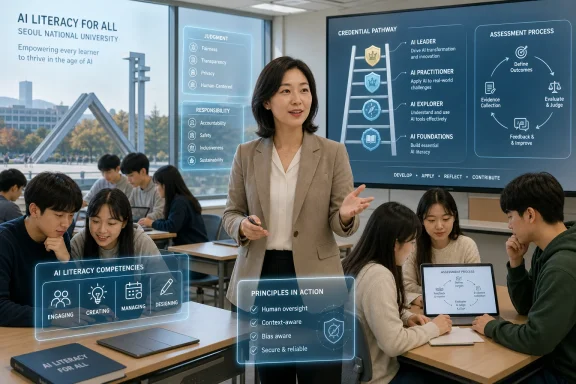
The curriculum is built on AI literacy content jointly developed by Microsoft and ISTE+ASCD and aligned with the OECD AI Literacy Framework. In Korea, the program is organized around four learning goals: engaging with AI, creating with AI, managing with AI, and designing with AI. That sequence is revealing. It moves from use to authorship to governance to intentional system design.
The joint certificate from Seoul National University and Microsoft also gives the program a hybrid identity. It is not simply a Microsoft credential, nor purely an academic course. It sits between platform ecosystem, professional development, and national education strategy. For educators, that may make it more attractive. For skeptics, it will also sharpen the question of how much influence large technology vendors should have over the frameworks by which teachers learn to teach with AI.
That is not inherently bad. Teachers need structured training, and a credential can signal that a professional has done more than attend a one-hour webinar. If designed well, AI literacy credentials can give educators a common vocabulary for risk, bias, attribution, prompting, assessment integrity, and student agency. They can also help school leaders identify staff who can mentor peers.
But credentialing can also become a proxy for readiness rather than proof of it. A teacher who completes an AI pathway may still work in a school with poor devices, overloaded schedules, unclear data governance, anxious parents, and no time to redesign assessments. A school may earn recognition while uneven classroom practice persists. The danger is not that credentials are useless. The danger is that institutions mistake credential accumulation for institutional change.
Microsoft appears aware of this tension, at least in how it describes Elevate. The program combines community, credentials, guided learning, and school recognition pathways. Educators can move from Explorer to Expert and Fellow recognition, while schools can progress from Pathfinder School to Showcase School and Beacon School status. That laddered structure is classic Microsoft ecosystem design: create an entry point, define progression, reward participation, and build a community that keeps people returning.
For WindowsForum readers, the parallel to enterprise IT should be obvious. This resembles the way cloud vendors cultivate administrators, developers, and partners: training paths, badges, reference architectures, communities, and showcase customers. Education is getting its version of the cloud adoption framework, except the workload is not a database migration. It is the cognitive and social development of children.
That does not make the initiative cynical. It does make it strategic. Microsoft has spent the past several years embedding Copilot across Windows, Microsoft 365, GitHub, security operations, developer tools, and business workflows. Education is part of the same platform expansion, but the politics are more delicate. A company can tell a sales team that AI will accelerate work. It cannot credibly tell parents and teachers that faster is always better for a 12-year-old learning to reason.
So the company has adopted a more humanistic vocabulary. It says AI should help educators focus on what matters most: critical thinking, creativity, and other human capabilities. It emphasizes safe integration, educator leadership, and a global peer community. This is not accidental messaging. Microsoft is trying to separate itself from a crude “AI tutor replaces teacher” narrative while still keeping AI at the center of educational modernization.
The practical question is whether the program helps educators challenge Microsoft’s tools as well as use them. Real AI literacy must include the ability to say no, to slow down, to choose non-AI work, to audit outputs, to protect student data, and to preserve spaces where students think without machine assistance. If a credential program only teaches adoption, it is marketing. If it teaches judgment, it may be infrastructure.
LinkedIn’s 2025 Work Change Report projected that 70 percent of the skills required for most jobs would change by 2030. The World Economic Forum’s Future of Jobs Report 2025 estimated a net increase of roughly 78 million jobs by the end of the decade. These numbers are necessarily forecasts, not destiny, but they help explain why governments are treating AI education as workforce policy. Schools are being asked to prepare students for jobs that will be reshaped by tools their teachers are still learning to understand.
That creates an uncomfortable inversion. Students may be early adopters, but they are not automatically wise adopters. Teachers may be slower to adopt, but they are responsible for turning usage into learning. The education system therefore needs teachers who can bridge the gap between student experimentation and institutional purpose.
AI literacy should not become another narrow digital skills module. It should be closer to media literacy, information literacy, and civic reasoning. Students need to understand what AI systems can do, where they fail, how they reflect training data and design choices, how to disclose assistance, how to evaluate generated claims, and how to preserve their own agency when the tool is eager to complete the thought for them.
The program later expanded to Busan, where university student mentors from JUMP and Microsoft employees delivered in-person learning experiences to 2,855 students from 57 elementary, middle, and high schools in May and June 2026. These are modest numbers in national education terms, but they matter because AI access is not just a device issue. It is also a confidence issue, a mentorship issue, and a geography issue.
Former coal-mining communities are a pointed choice. Regions shaped by industrial transition understand that workforce change is not an abstraction. When a dominant economic model fades, education becomes both a promise and a pressure point. AI literacy initiatives in such communities carry symbolic weight: the next transition should not arrive only after the opportunities have already concentrated elsewhere.
Corporate volunteerism will not solve structural inequality. Nor will a few thousand students in workshops close the gap between affluent AI-rich schools and under-resourced classrooms. But these programs show how Microsoft is trying to make AI education legible outside elite urban institutions. If the company wants to argue that AI can broaden opportunity, it has to show up in places where opportunity has historically been uneven.
Korea’s emphasis on performance-based assessment guidelines points in the right direction. The old model assumes that the submitted artifact is a reliable proxy for student understanding. Generative AI weakens that assumption. Schools will need more oral defense, in-class process work, version history, reflection logs, source attribution, teacher observation, and tasks that require local context or personal reasoning.
This does not mean every assignment becomes surveillance. It means assessment design has to become more intentional. If a writing assignment is meant to measure final prose polish, AI assistance may be relevant. If it is meant to measure argument formation, evidence selection, or the student’s ability to revise under feedback, the process matters more than the product. The same applies to code, math explanation, research synthesis, design work, and presentations.
Teachers are the people who translate those distinctions into classroom reality. No central ministry and no vendor dashboard can fully automate the judgment required. That is why Microsoft’s educator-first framing is plausible. It is also why the quality of the training matters so much.
If Korean schools deepen their use of Microsoft education services, IT teams will have to manage the usual Microsoft stack concerns: account provisioning, Microsoft Learn and Elevate identity alignment, student and teacher access policies, data retention, endpoint readiness, and the governance of AI-enabled features across Microsoft 365. Even when the classroom story is about critical thinking, the deployment story is about configuration.
The announcement’s instruction that applicants create both Microsoft Learn and Microsoft Elevate accounts with matching display names is a small but telling detail. Identity consistency, credential tracking, and platform participation are not peripheral; they are the plumbing of the program. At scale, school systems will need to decide how personal professional development accounts intersect with institutional accounts, employment changes, privacy obligations, and recognition records.
This is where many AI education strategies will either mature or stall. Training teachers is necessary, but teachers cannot be expected to troubleshoot fragmented identity systems, unclear data policies, and inconsistent device access while also redesigning pedagogy. If AI literacy becomes another unfunded mandate pushed through under-supported IT environments, the implementation gap will widen.
Microsoft Elevate for Educators in Korea is a governed-partnership model, at least on paper. It links a global vendor program with Seoul National University localization, aligns with international AI literacy frameworks, and sits alongside Korea’s national teacher-capacity strategy. That is stronger than simply dropping chatbots into classrooms and calling it transformation.
Still, public institutions must keep their spine. They need independent evaluation of learning outcomes, transparent procurement rules, data protection requirements, and room for pedagogical approaches that do not map neatly onto a vendor ecosystem. They also need to ensure that AI literacy includes critical understanding of platform power itself.
The best outcome is not a classroom where Microsoft’s tools are everywhere. The best outcome is a classroom where educators understand when a tool helps, when it harms, and when the human work of learning should remain deliberately unaccelerated.
 Microsoft Is Selling Restraint as Much as Adoption
The obvious reading of Microsoft Elevate for Educators is that it is a product-adjacent professional development program. It gives educators a community, credentials, training pathways, and recognition tracks; it also keeps Microsoft’s education brand close to the people deciding how AI appears in classrooms. That is true, but it is also too shallow.The more interesting move is rhetorical. Microsoft is positioning Elevate not as a shortcut to more AI usage, but as a framework for better AI usage. In the company’s Korea announcement, the recurring nouns are not “automation,” “efficiency,” or “disruption.” They are “capacity,” “judgment,” “responsibility,” “critical thinking,” and “care.”
That language reflects a shift across the education technology market. The first wave of generative AI in schools was shaped by panic and novelty: cheating, lesson-plan generation, chatbot bans, plagiarism detectors, productivity hacks, and a thousand improvised classroom policies. The second wave is more institutional. Governments and vendors now understand that the absence of rules does not stop AI adoption; it merely pushes adoption into private accounts, student phones, and teacher-by-teacher improvisation.
Microsoft’s bet in Korea is that the teacher is the only scalable governance layer the classroom actually has. Policies matter, curricula matter, and platform controls matter, but the real-time decision about whether AI is deepening learning or flattening it still happens between a student, a task, and an educator.
The Education System Is Late to a Revolution It Already Entered
The World Economic Forum’s June 2026 report, Shaping the Future of Learning: Education Readiness for the Age of AI, frames the problem bluntly: AI is spreading from the bottom up while the surrounding education system struggles to keep pace. Students and teachers are experimenting faster than policymakers can update curricula, assessment standards, and institutional guidelines. That lag is not a bureaucratic inconvenience. It is the central governance problem of AI-era education.The risks are familiar but still poorly absorbed. If AI is used as a universal answer machine, it can weaken the parts of learning that depend on productive struggle: memory formation, reasoning, revision, argument, and the confidence to sit with uncertainty. If it becomes an invisible co-author, schools may lose trust in student work. If it is banned without credible alternatives, students learn to hide usage rather than interrogate it.
The Microsoft-cited 2025 AI in Education survey conducted by PSB Insights and Microsoft found that 76 percent of school and institutional leaders agreed AI literacy should be fundamental to every student’s learning. UNESCO, meanwhile, has warned that fewer than 10 percent of schools and universities globally have formal policies or guidelines for generative AI. The gap between those two numbers is the whole story: leaders increasingly agree on the destination, but most institutions have not built the road.
That is where Microsoft sees an opening. Elevate for Educators is not merely a training catalog; it is a bid to occupy the messy middle between global AI enthusiasm and local classroom practice. Korea is a particularly useful proving ground because its government has already made AI education a national priority while also emphasizing teacher capacity, curriculum redesign, and ethics.
Korea Is Trying Not to Make the Teacher Disappear
Korea’s recent AI education policy direction matters because it rejects the lazy version of AI transformation. The lazy version imagines that sufficiently good software can personalize instruction, automate feedback, and free teachers from routine burdens, as if schooling were primarily a logistics problem. Korea’s stated approach is more careful: strengthen teachers first, then integrate AI into the system they lead.In August 2025, Korea’s Ministry of Education and the Korea Education and Research Information Service used the AI and Digital Education Innovation Conference to emphasize teacher training and classroom innovation. In November 2025, the government’s AI Talent Development for All strategy extended that theme, calling for stronger AI competencies among pre-service and in-service teachers, revisions to K–12 curricula, and expanded national AI education infrastructure. The through line is not that AI should replace instructional labor. It is that the country needs a teaching workforce capable of shaping AI use rather than reacting to it.
That is a subtle but consequential distinction. When governments frame AI education as infrastructure alone, procurement becomes the main event. When they frame it as teacher capacity, the emphasis shifts to professional judgment, assessment design, ethics, and classroom culture. Korea appears to be moving toward the latter, at least in its public strategy.
The December 2025 creation of an AI Talent Development Task Force and the later introduction of guidelines for AI use in performance-based assessments are also telling. The ministry did not simply reach for blanket prohibition. Its guidelines reportedly emphasize appropriate use, source attribution, pre-assessment instruction, and greater attention to classroom engagement and learning processes. In other words, the assessment target shifts from the final artifact to the learner’s visible thinking.
That move may prove more durable than any individual AI policy. In a world where polished text, images, code, and presentations are cheap, schools have to value process more explicitly. Teachers need to know not only whether a student submitted a plausible answer, but how the student questioned, tested, revised, defended, and understood it.
The Seoul National University Partnership Gives Microsoft Local Legitimacy
The most important Korea-specific part of the announcement is Microsoft’s partnership with the Center for Future Education Innovation at Seoul National University. Together, they are designing and launching a Korean AI Literacy Credential Program for changemakers and K–12 educators. The nonprofit professional pathway is already being offered through Seoul National University’s Institute of Education and Training, while the K–12 educator pathway is scheduled to open in September 2026.This is the kind of partnership Microsoft needs if Elevate is to be more than an imported credential badge. A global curriculum can provide structure, but education systems are deeply local: policy vocabulary, classroom norms, assessment pressures, parental expectations, teacher workload, university entrance dynamics, and national workforce priorities all shape what “AI literacy” actually means. Seoul National University’s role is to localize and enhance the program for Korea’s educational context.
The curriculum is built on AI literacy content jointly developed by Microsoft and ISTE+ASCD and aligned with the OECD AI Literacy Framework. In Korea, the program is organized around four learning goals: engaging with AI, creating with AI, managing with AI, and designing with AI. That sequence is revealing. It moves from use to authorship to governance to intentional system design.
The joint certificate from Seoul National University and Microsoft also gives the program a hybrid identity. It is not simply a Microsoft credential, nor purely an academic course. It sits between platform ecosystem, professional development, and national education strategy. For educators, that may make it more attractive. For skeptics, it will also sharpen the question of how much influence large technology vendors should have over the frameworks by which teachers learn to teach with AI.
The Credential Economy Comes for the Classroom
Microsoft Elevate for Educators arrives inside a broader credential economy that has already reshaped IT and is now moving deeper into education. Microsoft Learn, role-based certifications, cloud credentials, and AI training pathways have long been part of the enterprise workforce pipeline. The new twist is that teachers themselves are becoming credentialed AI intermediaries.That is not inherently bad. Teachers need structured training, and a credential can signal that a professional has done more than attend a one-hour webinar. If designed well, AI literacy credentials can give educators a common vocabulary for risk, bias, attribution, prompting, assessment integrity, and student agency. They can also help school leaders identify staff who can mentor peers.
But credentialing can also become a proxy for readiness rather than proof of it. A teacher who completes an AI pathway may still work in a school with poor devices, overloaded schedules, unclear data governance, anxious parents, and no time to redesign assessments. A school may earn recognition while uneven classroom practice persists. The danger is not that credentials are useless. The danger is that institutions mistake credential accumulation for institutional change.
Microsoft appears aware of this tension, at least in how it describes Elevate. The program combines community, credentials, guided learning, and school recognition pathways. Educators can move from Explorer to Expert and Fellow recognition, while schools can progress from Pathfinder School to Showcase School and Beacon School status. That laddered structure is classic Microsoft ecosystem design: create an entry point, define progression, reward participation, and build a community that keeps people returning.
For WindowsForum readers, the parallel to enterprise IT should be obvious. This resembles the way cloud vendors cultivate administrators, developers, and partners: training paths, badges, reference architectures, communities, and showcase customers. Education is getting its version of the cloud adoption framework, except the workload is not a database migration. It is the cognitive and social development of children.
The Platform Vendor Wants to Be the Governance Partner
Microsoft’s education pitch now lives at the intersection of three powerful incentives. It wants to sell and normalize AI-enabled tools, it wants to be seen as a responsible steward of AI adoption, and it wants institutions to build long-term skills around Microsoft platforms. Elevate for Educators serves all three.That does not make the initiative cynical. It does make it strategic. Microsoft has spent the past several years embedding Copilot across Windows, Microsoft 365, GitHub, security operations, developer tools, and business workflows. Education is part of the same platform expansion, but the politics are more delicate. A company can tell a sales team that AI will accelerate work. It cannot credibly tell parents and teachers that faster is always better for a 12-year-old learning to reason.
So the company has adopted a more humanistic vocabulary. It says AI should help educators focus on what matters most: critical thinking, creativity, and other human capabilities. It emphasizes safe integration, educator leadership, and a global peer community. This is not accidental messaging. Microsoft is trying to separate itself from a crude “AI tutor replaces teacher” narrative while still keeping AI at the center of educational modernization.
The practical question is whether the program helps educators challenge Microsoft’s tools as well as use them. Real AI literacy must include the ability to say no, to slow down, to choose non-AI work, to audit outputs, to protect student data, and to preserve spaces where students think without machine assistance. If a credential program only teaches adoption, it is marketing. If it teaches judgment, it may be infrastructure.
AI Literacy Is Becoming a Civic Skill, Not a Computer Class
The Korea launch also reflects a broader redefinition of AI literacy. In the early phase, AI literacy often meant understanding what generative AI is, how to prompt it, and where it might be useful. That is no longer enough. The stakes now include labor markets, academic integrity, democratic information environments, data rights, and the formation of student habits.LinkedIn’s 2025 Work Change Report projected that 70 percent of the skills required for most jobs would change by 2030. The World Economic Forum’s Future of Jobs Report 2025 estimated a net increase of roughly 78 million jobs by the end of the decade. These numbers are necessarily forecasts, not destiny, but they help explain why governments are treating AI education as workforce policy. Schools are being asked to prepare students for jobs that will be reshaped by tools their teachers are still learning to understand.
That creates an uncomfortable inversion. Students may be early adopters, but they are not automatically wise adopters. Teachers may be slower to adopt, but they are responsible for turning usage into learning. The education system therefore needs teachers who can bridge the gap between student experimentation and institutional purpose.
AI literacy should not become another narrow digital skills module. It should be closer to media literacy, information literacy, and civic reasoning. Students need to understand what AI systems can do, where they fail, how they reflect training data and design choices, how to disclose assistance, how to evaluate generated claims, and how to preserve their own agency when the tool is eager to complete the thought for them.
The Local Outreach Work Is More Than Corporate Philanthropy
Microsoft’s Korea announcement also highlights local partnerships beyond educator credentials. In Gangwon Province’s former coal-mining communities, Microsoft worked with social venture JUMP and the Gangwon Regional Office of Education on “Hour of AI X Empowering Local Futures,” a hands-on AI learning initiative for students and teachers. From December 2025 through January 2026, more than 2,000 students and teachers from 26 schools participated.The program later expanded to Busan, where university student mentors from JUMP and Microsoft employees delivered in-person learning experiences to 2,855 students from 57 elementary, middle, and high schools in May and June 2026. These are modest numbers in national education terms, but they matter because AI access is not just a device issue. It is also a confidence issue, a mentorship issue, and a geography issue.
Former coal-mining communities are a pointed choice. Regions shaped by industrial transition understand that workforce change is not an abstraction. When a dominant economic model fades, education becomes both a promise and a pressure point. AI literacy initiatives in such communities carry symbolic weight: the next transition should not arrive only after the opportunities have already concentrated elsewhere.
Corporate volunteerism will not solve structural inequality. Nor will a few thousand students in workshops close the gap between affluent AI-rich schools and under-resourced classrooms. But these programs show how Microsoft is trying to make AI education legible outside elite urban institutions. If the company wants to argue that AI can broaden opportunity, it has to show up in places where opportunity has historically been uneven.
Assessment Is Where the AI Argument Gets Real
Most AI-in-education debates eventually collapse into assessment because assessment is where institutional trust either holds or breaks. A chatbot can help a student brainstorm, summarize, translate, code, draft, and revise. At some point, the teacher has to decide what the student knows, what the student did, and what kind of assistance is acceptable.Korea’s emphasis on performance-based assessment guidelines points in the right direction. The old model assumes that the submitted artifact is a reliable proxy for student understanding. Generative AI weakens that assumption. Schools will need more oral defense, in-class process work, version history, reflection logs, source attribution, teacher observation, and tasks that require local context or personal reasoning.
This does not mean every assignment becomes surveillance. It means assessment design has to become more intentional. If a writing assignment is meant to measure final prose polish, AI assistance may be relevant. If it is meant to measure argument formation, evidence selection, or the student’s ability to revise under feedback, the process matters more than the product. The same applies to code, math explanation, research synthesis, design work, and presentations.
Teachers are the people who translate those distinctions into classroom reality. No central ministry and no vendor dashboard can fully automate the judgment required. That is why Microsoft’s educator-first framing is plausible. It is also why the quality of the training matters so much.
The Windows Angle Is the Administrative Burden Nobody Should Ignore
For WindowsForum’s core audience, the education AI story is not only pedagogical. It is operational. Every new AI education initiative eventually lands on administrators, identity systems, tenant policies, device management, privacy reviews, content filters, procurement workflows, and support desks.If Korean schools deepen their use of Microsoft education services, IT teams will have to manage the usual Microsoft stack concerns: account provisioning, Microsoft Learn and Elevate identity alignment, student and teacher access policies, data retention, endpoint readiness, and the governance of AI-enabled features across Microsoft 365. Even when the classroom story is about critical thinking, the deployment story is about configuration.
The announcement’s instruction that applicants create both Microsoft Learn and Microsoft Elevate accounts with matching display names is a small but telling detail. Identity consistency, credential tracking, and platform participation are not peripheral; they are the plumbing of the program. At scale, school systems will need to decide how personal professional development accounts intersect with institutional accounts, employment changes, privacy obligations, and recognition records.
This is where many AI education strategies will either mature or stall. Training teachers is necessary, but teachers cannot be expected to troubleshoot fragmented identity systems, unclear data policies, and inconsistent device access while also redesigning pedagogy. If AI literacy becomes another unfunded mandate pushed through under-supported IT environments, the implementation gap will widen.
The Vendor-Led Future Needs Public-Sector Spine
The uncomfortable reality is that technology vendors are moving faster than public institutions because they have the products, money, engineering talent, and global distribution channels. Microsoft, Google, OpenAI, Anthropic, and others can ship education-facing tools and training materials at a pace ministries cannot match. Schools therefore face a choice not between vendor influence and no vendor influence, but between governed partnership and unmanaged dependence.Microsoft Elevate for Educators in Korea is a governed-partnership model, at least on paper. It links a global vendor program with Seoul National University localization, aligns with international AI literacy frameworks, and sits alongside Korea’s national teacher-capacity strategy. That is stronger than simply dropping chatbots into classrooms and calling it transformation.
Still, public institutions must keep their spine. They need independent evaluation of learning outcomes, transparent procurement rules, data protection requirements, and room for pedagogical approaches that do not map neatly onto a vendor ecosystem. They also need to ensure that AI literacy includes critical understanding of platform power itself.
The best outcome is not a classroom where Microsoft’s tools are everywhere. The best outcome is a classroom where educators understand when a tool helps, when it harms, and when the human work of learning should remain deliberately unaccelerated.
Korea’s Elevate Launch Turns AI Education Into a Teacher-Capacity Test
Microsoft’s Korea launch is best read as a test of whether AI education can move from enthusiasm to disciplined practice. The announcement ties together global workforce anxiety, national AI strategy, university localization, community-based outreach, and a credential ladder for teachers and schools.- Microsoft Elevate for Educators is launching in Korea as a global community and credential program focused on helping teachers integrate AI responsibly.
- Seoul National University is localizing Microsoft and ISTE+ASCD’s AI literacy curriculum for Korea, with a K–12 educator pathway scheduled to open in September 2026.
- Korea’s recent AI education policy direction emphasizes teacher training, curriculum reform, AI ethics, and assessment practices rather than replacing teachers with software.
- Microsoft’s local outreach in Gangwon and Busan shows that AI literacy is being framed as a regional access issue, not only an elite-school initiative.
- The program’s success will depend less on credential counts than on whether educators gain real authority to shape, limit, and evaluate AI use in learning.
References
- Primary source: Microsoft Source
Published: Thu, 25 Jun 2026 02:48:40 GMT
- Related coverage: weforum.org
- Official source: microsoft.com
Microsoft Elevate for Educators: Advanced recognition application guide 2026-2027 | Microsoft Education Blog
Lead with AI. Apply for Microsoft Elevate Educators 2026–2027 and shape the future of learning.www.microsoft.com - Official source: learn.microsoft.com
Understand the AI Literacy Framework, in Partnership with ISTE+ASCD - Training | Microsoft Learn
Apply the AILit Framework to school scenarios, identifying decision domains, forming domain-first questions, and using reflection loops to guide safeguards, communication, and responsible AI use.learn.microsoft.com - Official source: elevateforeducators.microsoft.com
Microsoft Elevate for Educators
elevateforeducators.microsoft.com
- Official source: cdn-dynmedia-1.microsoft.com

- Related coverage: educatorstechnology.com
