

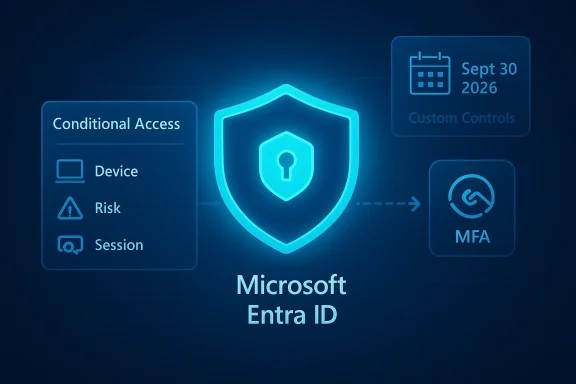
Microsoft has quietly removed one of the biggest identity-management frictions for enterprise customers: the inability to cleanly use third-party MFA providers inside Microsoft Entra ID without sacrificing policy control. The new external MFA capability is now generally available, and Microsoft is positioning it as the successor to Custom Controls, which remains on a retirement path with a cutoff date of September 30, 2026 tnon-Microsoft authentication stacks, the change is more than a feature checkbox; it is a practical reset for how Entra ID can fit into mixed-vendor security architectures. It also reflects Microsoft’s broader shift toward Zero Trust controls that preserve central policy enforcement even when the authentication experience is delegated outward .
Microsoft Entra ID has loncenter of Microsoft’s identity story, and for good reason. In modern enterprises, identity is the control plane through which cloud access, SaaS permissions, device trust, and session risk all intersect. That means any improvement to sign-in flexibility is not just about convenience; it changes how security teams design workflows, enforce compliance, and balance user friction against protection. Microsoft’s own documentation increasingly frames identity governance as a core security control, not a back-office administration layer, because access decisions now have to stay continuously justified rather than merely documented after the fact .
The external MFA announcement lands at exactly the right momdealing with hybrid estates, mergers, outsourced operations, regulated workflows, and a growing reliance on non-Microsoft security tools that may already be embedded in their environments. In the past, those organizations often had to choose between Microsoft-native MFA and awkward custom integrations that were harder to govern and harder to retire. Now Microsoft is offering a standard path built on OpenID Connect, which gives vendors a familiar integration model while preserving Conditional Access and the broader Entra policy engine .
That matters because the identity market has changed. Authentication is no longer, and MFA is no longer a single product category. Microsoft has been expanding Entra into a broader governance layer that covers users, devices, workloads, and even AI agents. In that context, external MFA is not a standalone announcement; it is one more sign that Microsoft wants the platform to be the policy brain while allowing the authentication muscle to come from different places .
There is also a competitive subtext here. Microsoft is not conceding that third-party MFA should sit those providers inside Entra’s control model, which lets Microsoft preserve the value of Conditional Access, session rules, and risk-based policy enforcement. That is a classic Microsoft move: absorb heterogeneity, standardize the control point, and make the ecosystem broader without making governance looser .
That flexibility is not trivial. Authentication migrations are often expensive because they affect employee workflows, help desk volumes, privileged access processes,upporting external MFA through a standard integration path, Microsoft reduces the pressure to rip and replace working tools just to get better integration with Entra. It also gives IT teams a better story when leadership asks why the company needs a migration project at all. The answer can now be integration without disruption rather than wholesale replacement .
The implication is that identity architecture becomes more modular. A company can choose the MFA provider that best fits its business model, while Entra continues to govern session access, reauthentication, an other words, the enterprise can be opinionated about policy and flexible about implementation. That is exactly the kind of middle path security leaders have been asking for.
That said, Microsoft also acknowledges the downside of over-tuning. If reauthentication is too frequent, the result can be fatigue, annoyance, and even prompt habituation, which is a subtle security risk in itself. Users who arompts constantly may become less careful, not more careful. That is why the policy layer matters as much as the MFA method itself.
That standardization has a second-order benefit: it makes the integration more governable. When an external MFA provider is wired in through a predictable protocol, administrators can reason about claims, metadata, trust boundaries, and operational fily than they can with ad hoc custom integrations. Microsoft’s documentation says the metadata must comply with OIDC Discovery 1.0 and include the required metadata fields, which suggests that the implementation is designed to be systematic rather than improvisational .
This matters especially in the Microsoft-heavy but not Microsoft-only enterprise. Many large organizations are using Entra alongside other security and identity platforms. OIDC support signals that Microsoft wants those customers to view Entra as the policy center, not the entire universe.
That distinction is critical. If the external MFA provider were to own the entire authentication decision, Microsoft would lose the ability to enforce consistent access controls. Instead, the company is preserving the centrality of Entra while opening the door to outside methods. That is the’s current platform strategy: keep the control plane centralized, even when the components are distributed.
This is the right architecture for modern enterprise security. Authentication methods come and go, but policy should remain stable. By keeping Conditional Access authoritative, Microsoft ensures that organizations can change MFA providers without rewriting their entire access model. That reduces operational churn and makes security posture more durable over time.
The deeper lesson is that MFA is no longer just about proving identity. It is about sustaining trust throughout the session lifecycle. In that sense, external MFA is less about what prompt appears and more about where the prompt sits inside the broader trust chain.
The practical takeaway is that stronger flexibility does not automatically produce stronger security. It only creates more options. The quality of the outcome still depends on policy design, user education, and disciplined review.
That timeline is important because identity projects often stall until the deadline becomes impossible to ignore. Microsoft seems aware of that pattern, which is why its documentation already describes how external MFA and Custom Controls can operate in parallel during the migration period. The message is clear: use the overlap window to validate the new model rather than waiting for the old one to fail under pressure .
That staged path is the right one. Identity changes are notorious for creating support spikes if rolled out too aggressively. A parallel policy approach reduces risk and gives administrators time to compare user experience, failure rates, and enforcement behavior side by side.
It also signals that Microsoft is serious about reducing the surface area of legacy paths inside Entra. The platform is becoming more opinionated, but also more coherent. That is usually a good thing for enterprises that want fewer exceptions and clearer support boundaries.
The important point is that the new capability is not just about convenience for IT. It directly affects attack resilience. If a company can enforce strong MFA more consistently while preserving centralized policy checks, then compromised credentials become less useful to adversaries. That is particularly valuable in environments where users, contractors, and external collaborators all need access under different trust conditions.
That means the enterprise can apply least privilege, session controls, and risk assessment in a more consistent way. In practice, that consistency is often more valuable than any single authentication factor, because it reduces policy drift over time.
This is why identity security is never just a product question. It is a behavioral system. The organization has to balance prompt frequency, trust signals, and user productivity with a degree of discipline that many teams underestimate.
That is particularly relevant for companies running a mix of cloud services, on-premises directories, line-of-business applications, and third-party security products. In those environments, “clean room” identity redesigns are rarely realistic. Microsoft’s approach is more incremental: keep the control plane consistent and modernize the edges as needed.
This is also where Microsoft’s bigger ecosystem advantage shows up. If Entra can govern users, workloads, and sessions across a mixed estate, then it becomes the place where identity policy is written and enforced. That has enormous value for enterprise security teams that are tired of stitching together separate control systems.
There is also a financial angle. Organizations with existing third-party MFA investments no longer need to treat those tools as orphaned assets when they move deeper into Microsoft’s stack. They can continue using what they already own while gaining the policy benefits of Entra.
This mirrors Microsoft’s larger platform play across security. The company has been increasingly explicit that identity, data, cloud posture, and AI workflows should be governed together. External MFA is one more piece in that puzzle. It broadens the ecosystem without surrendering the center.
That does not eliminate competition, but it changes where the battle happens. The winner may not be the vendor with the best prompt or the fanciest factor. It may be the one that integrates most cleanly with the policy engine enterprises trust.
That makes the announcement less about a universal shift in MFA and more about a strategic refinement in how Microsoft wants its platform to be used.
The broader opportunity is architectural. Microsoft is building an identity model where the platform governs more of the access lifecycle, but not necessarily all of the underlying methods. That creates room for coexistence with existing investments and makes Entra more practical in the kinds of complicated environments real companies actually run.
There is also the migration risk around Custom Controls. Enterprises that delay planning may find themselves racing toward the September 30, 2026 retirement date with too little time to test alternatives. That would be a bad way to handle an identity change, especially in regulated or high-availability environments where authentication outages have outsized consequences .
What makes this worth watching is that it fits a larger pattern inside Entra. Microsoft is steadily turning identity into a platform for policy continuity across users, workloads, and now external authentication providers. That suggests future changes will likely continue moving in the same direction: more openness at the edges, more control at the center, and more pressure on enterprises to modernize without fragmenting their security model.
Source: Petri IT Knowledgebase Microsoft Entra ID External MFA Now Generally Available
 Overview
Microsoft Entra ID has loncenter of Microsoft’s identity story, and for good reason. In modern enterprises, identity is the control plane through which cloud access, SaaS permissions, device trust, and session risk all intersect. That means any improvement to sign-in flexibility is not just about convenience; it changes how security teams design workflows, enforce compliance, and balance user friction against protection. Microsoft’s own documentation increasingly frames identity governance as a core security control, not a back-office administration layer, because access decisions now have to stay continuously justified rather than merely documented after the fact .The external MFA announcement lands at exactly the right momdealing with hybrid estates, mergers, outsourced operations, regulated workflows, and a growing reliance on non-Microsoft security tools that may already be embedded in their environments. In the past, those organizations often had to choose between Microsoft-native MFA and awkward custom integrations that were harder to govern and harder to retire. Now Microsoft is offering a standard path built on OpenID Connect, which gives vendors a familiar integration model while preserving Conditional Access and the broader Entra policy engine .
That matters because the identity market has changed. Authentication is no longer, and MFA is no longer a single product category. Microsoft has been expanding Entra into a broader governance layer that covers users, devices, workloads, and even AI agents. In that context, external MFA is not a standalone announcement; it is one more sign that Microsoft wants the platform to be the policy brain while allowing the authentication muscle to come from different places .
There is also a competitive subtext here. Microsoft is not conceding that third-party MFA should sit those providers inside Entra’s control model, which lets Microsoft preserve the value of Conditional Access, session rules, and risk-based policy enforcement. That is a classic Microsoft move: absorb heterogeneity, standardize the control point, and make the ecosystem broader without making governance looser .
Why External MFA Matters
The biggest practical reason external MFA matters is simple: real enterprises rarely live inside a single-vendozations already have contractual, operational, or regulatory reasons to use third-party MFA systems, whether because they acquired them years ago, inherited them through a merger, or chose them for a specific compliance use case. Microsoft’s new capability lets those organizations keep their authentication investments while still using Entra ID as the policy hub .That flexibility is not trivial. Authentication migrations are often expensive because they affect employee workflows, help desk volumes, privileged access processes,upporting external MFA through a standard integration path, Microsoft reduces the pressure to rip and replace working tools just to get better integration with Entra. It also gives IT teams a better story when leadership asks why the company needs a migration project at all. The answer can now be integration without disruption rather than wholesale replacement .
The enterprise use case
For enterprises, the feature is especially relevant in regulated industries where identity workflows have to satisfy internal audit requirements, external ceronal compliance obligations. External MFA support lets organizations preserve a preferred vendor or specialized authentication method while still enforcing Conditional Access and Microsoft’s real-time policy checks. That combination is powerful because it separates the experience of authenticating from the authority that decides whether access is allowed in the first place .The implication is that identity architecture becomes more modular. A company can choose the MFA provider that best fits its business model, while Entra continues to govern session access, reauthentication, an other words, the enterprise can be opinionated about policy and flexible about implementation. That is exactly the kind of middle path security leaders have been asking for.
The user experience angle
There is also a user productivity angle, and it should not be underestimated. Every identity stack adds friction somewhere, and MFA is one of the most visible touchpoints in the entire sign-in flow. If the authentication path is clumsy, users complain. If it is too easy, security teams worry. Microsoft’s approach here is to let organizations tune those prompts through Conditional Access and sign-in frequency controls, rather than force them into a one-size-fits-all authentication pattern .That said, Microsoft also acknowledges the downside of over-tuning. If reauthentication is too frequent, the result can be fatigue, annoyance, and even prompt habituation, which is a subtle security risk in itself. Users who arompts constantly may become less careful, not more careful. That is why the policy layer matters as much as the MFA method itself.
- Better fit for heterogeneous environments
- Lower migration pressure for existing MFA investments
- More consistent user experience across apps
- Easier policy enforcement through Entra
- Reduced likelihood of fragile custom workarounds
OpenID Connect as the Integration Layer
The fact that Microsoft chose OpenID Connect as the integration standard is one of the most important technical details in the announcement. OIDC is already a familiar protocol in modern identity architecture, so using it lowers the barrier for vendors and administrators alike. It also gives Microsoft a clean way to say that external MFA is not a bolt-on exception but a standards-based part of the Entra ecosystem .That standardization has a second-order benefit: it makes the integration more governable. When an external MFA provider is wired in through a predictable protocol, administrators can reason about claims, metadata, trust boundaries, and operational fily than they can with ad hoc custom integrations. Microsoft’s documentation says the metadata must comply with OIDC Discovery 1.0 and include the required metadata fields, which suggests that the implementation is designed to be systematic rather than improvisational .
Why standards matter
Identity teams are often stuck maintaining fragile authentication bridges that no one wants to touch. Standards-based integration lowers long-term support risk because more of the behavior is documented, inspectable, and predictable. It also giver answer to enterprise buyers who worry that moving deeper into Entra means sacrificing interoperability.This matters especially in the Microsoft-heavy but not Microsoft-only enterprise. Many large organizations are using Entra alongside other security and identity platforms. OIDC support signals that Microsoft wants those customers to view Entra as the policy center, not the entire universe.
Policy continuity remains intact
The most important safeguard is that external MFA does not bypass Microsoft’s policy engine. Microsoft says sign-ins still pass through the full Entra policy stack, including Conditional Access and risk evaluation. That means the external provider is not taking over the decision-making process; it is only handling the MFA challenge itself .That distinction is critical. If the external MFA provider were to own the entire authentication decision, Microsoft would lose the ability to enforce consistent access controls. Instead, the company is preserving the centrality of Entra while opening the door to outside methods. That is the’s current platform strategy: keep the control plane centralized, even when the components are distributed.
- OIDC reduces integration complexity
- Metadata requirements improve trust and consistency
- Microsoft keeps the policy engine in the middle
- External methods become easier to govern at scale
- Vendors can integrate without deep custom engineering
Conditional Access Still Holds the Keys
One of the clearest signs that Microsoft is serious about security continuity is the way it ties external MFA directly to Conditional Access. That matters because Conditional Access is where context-aware policy lives: device state, sign-in risk, user group membership, application sensitivity, session behavior, and reauthentication rules all converge there. External MFA does not replace that layer; it feeds into it .This is the right architecture for modern enterprise security. Authentication methods come and go, but policy should remain stable. By keeping Conditional Access authoritative, Microsoft ensures that organizations can change MFA providers without rewriting their entire access model. That reduces operational churn and makes security posture more durable over time.
Balancing friction and trust
Microsoft explicitly notes that Conditional Access policies can be tuned using sign-in frequency and session controls, and that these settings should be aligned to security and business goals. That is a subtle but important point. Too much friction can drive workarounds, while too little can let risky sessions persist longer than they should .The deeper lesson is that MFA is no longer just about proving identity. It is about sustaining trust throughout the session lifecycle. In that sense, external MFA is less about what prompt appears and more about where the prompt sits inside the broader trust chain.
Security teams still need to tune carefully
There is a real operationazations may assume that because an external MFA product is reputable, policy tuning no longer matters. That would be a mistake. Conditional Access still needs proper thresholds, exception handling, and reauthentication cadence. Microsoft’s own guidance warns that excessive reauthentication can hurt productivity and may even create security blind spots if users learn to click reflexively .The practical takeaway is that stronger flexibility does not automatically produce stronger security. It only creates more options. The quality of the outcome still depends on policy design, user education, and disciplined review.
Custom Controls Are Going Away
The retirement of Custom Controls is the other half of the story, and perhaps the more urgeustomers. Microsoft says external MFA replaces Custom Controls, which are scheduled for deprecation on September 30, 2026. Existing implementations will keep working during the transition, but organizations will need a migration plan well before the retirement date arrives .That timeline is important because identity projects often stall until the deadline becomes impossible to ignore. Microsoft seems aware of that pattern, which is why its documentation already describes how external MFA and Custom Controls can operate in parallel during the migration period. The message is clear: use the overlap window to validate the new model rather than waiting for the old one to fail under pressure .
What migration likely means
For many organizations, the move will not be purely technical. It will involve testing provider compatibility, reviewing Conditional Access policies, validating user flows, and checking whether the new external MFA behavior satisfies internal security standards. Microsoft recommends a staged approach with parallel policies, so teams can test the new MFA path with a subset of users befustom-control version .That staged path is the right one. Identity changes are notorious for creating support spikes if rolled out too aggressively. A parallel policy approach reduces risk and gives administrators time to compare user experience, failure rates, and enforcement behavior side by side.
Why the retirement matters strategically
The deprecation tells us something broader about Microsoft’s direction. Custom Controls were always a more bespoke m mechanisms do not scale as cleanly as productized standards. By moving to external MFA, Microsoft is consolidating the identity story around a more predictable integration model. That should help engineering, support, and governance all at once.It also signals that Microsoft is serious about reducing the surface area of legacy paths inside Entra. The platform is becoming more opinionated, but also more coherent. That is usually a good thing for enterprises that want fewer exceptions and clearer support boundaries.
- Custom Controls are on a defined retirement path
- Parallel migration reduces implementation risk
- Policy testing should happen before the cutoff
- Organizations should inventory all legacy integrations
- Vendor compatibility needs to be validated early
Security and Threat Implications
Identity remains the preferred entry point for attackers because credentials, sessions, and authentication prompts are easier to target than hardened network perimeters. That reality has made MFA one of the most important controls in enterprise defense. Microsoft’s new external MFA support does not change that fact, but it does strengthen the organization’s ability to standardize strong authentication across more complicated environments .The important point is that the new capability is not just about convenience for IT. It directly affects attack resilience. If a company can enforce strong MFA more consistently while preserving centralized policy checks, then compromised credentials become less useful to adversaries. That is particularly valuable in environments where users, contractors, and external collaborators all need access under different trust conditions.
A Zero Trust fit
Thisnto Microsoft’s broader Zero Trust narrative. The company has increasingly positioned identity governance as a security operating layer, not just a compliance function. External MFA extends that idea by letting the platform maintain control even when the authentication factor itself is sourced outside Microsoft’s own stack .That means the enterprise can apply least privilege, session controls, and risk assessment in a more consistent way. In practice, that consistency is often more valuable than any single authentication factor, because it reduces policy drift over time.
Phishing and MFA fatigue still matter
There is also a human element here. Microsoft’s guidance around Conditional Access acknowledges that reauthentication frequency has a direct effect on user behavior. If prompts are too frequent, users may become desensitized. If they are too sparse, risky sessions may linger longer than intended. Either way, the result can be weaker real-world security than the policy intended to create .This is why identity security is never just a product question. It is a behavioral system. The organization has to balance prompt frequency, trust signals, and user productivity with a degree of discipline that many teams underestimate.
Key security takeaways
- External MFA strengthens defense without giving up policy control
- Centralized Conditional Access remains the real enforcement layer
- Poor tuning can undermine both security and usability
- Migration off Custom Controls should be planned, not imp matters as much as the provider you choose
Enterprise Architecture and Hybrid Reality
The most interesting thing about Microsoft’s announcement may be what it implies for architecture, not just MFA. Entra is increasingly being shaped as the policy layer for a world that is hybrid, multi-vendor, and increasingly automated. External MFA fits that model because it allows organizations to preserve specialized tools without fragmenting their access strategy .That is particularly relevant for companies running a mix of cloud services, on-premises directories, line-of-business applications, and third-party security products. In those environments, “clean room” identity redesigns are rarely realistic. Microsoft’s approach is more incremental: keep the control plane consistent and modernize the edges as needed.
Why hybrids need flexibility
Hybrid estates often outlive multiple technology generations. The authentication methods, compliance requirements, and administrative habits builtisappear just because a company adopts a cloud-first strategy. External MFA gives those organizations a way to modernize without forcing every authentication decision into a single Microsoft-native method.This is also where Microsoft’s bigger ecosystem advantage shows up. If Entra can govern users, workloads, and sessions across a mixed estate, then it becomes the place where identity policy is written and enforced. That has enormous value for enterprise security teams that are tired of stitching together separate control systems.
The operational upside
Operationally, the feature can reduce help desk friction and policy fragmentation. Instead of maintaining parallel authentication exceptions or fragile custom bridges, teams can lean on a more standardized integration model. That makes audits easier, migrations less risky, and long-term support simpler.There is also a financial angle. Organizations with existing third-party MFA investments no longer need to treat those tools as orphaned assets when they move deeper into Microsoft’s stack. They can continue using what they already own while gaining the policy benefits of Entra.
- Better support for mixed-vendor environments
- Easier coexistence with legacy systems
- Reduced need for one-off identity exceptions
- Cleaner audit and compliance posture
- More realistic migration paths for large enterprises
Microsoft’s Platform Strategy
This feature is also revealing in a broader strategic sense. Microsoft is not trying to eliminate third-party identity tools; it is trying to make them more useful inside Microsoft’s control fabric. That is a subtle but powerful move. The more Microsoft becomes the policy layer for identity, the more indispensable Entra becomes, even when other vendors still handle pieces of the authentication stack .This mirrors Microsoft’s larger platform play across security. The company has been increasingly explicit that identity, data, cloud posture, and AI workflows should be governed together. External MFA is one more piece in that puzzle. It broadens the ecosystem without surrendering the center.
Competitive implications
For rivals, the challenge is obvious. If Microsoft can support external MFA while keeping the policy logic inside Entra, then third-party vendors may find themselves competing for a narrower part of the stack than before. They can own the factor or the challenge flow, but Microsoft still controls access decisions, risk evaluation, and session enforcement.That does not eliminate competition, but it changes where the battle happens. The winner may not be the vendor with the best prompt or the fanciest factor. It may be the one that integrates most cleanly with the policy engine enterprises trust.
Why this helps Microsoft-heavy shops
For Microsoft-heavy organizations, the benefit is especially strong. Many already rely on Entra for sign-in, Conditional Access, and identity governance. External MFA lets those shops add flexibility without creating a parallel policy universe. In other words, the more Microsoft is already embedded, the more valuable this feature becomes.That makes the announcement less about a universal shift in MFA and more about a strategic refinement in how Microsoft wants its platform to be used.
- Microsoft keeps the policy center
- Third-party MFA becomes easier to absorb
- Entra gets stronger as the control plane
- Competitive differentiation shifts toward integration
- Microsoft-heavy enterprises gain the most
Strengths and Opportunities
The strongest aspect of this update is that it addresses a real enterprise pain point without weakening the security model. Organizations gain interoperability, Microsoft retains policy enforcement, and the transition away from Custom Controls becomes more manageable. That combination is rare in identity security, where flexibility often comes at the cost of control.The broader opportunity is architectural. Microsoft is building an identity model where the platform governs more of the access lifecycle, but not necessarily all of the underlying methods. That creates room for coexistence with existing investments and makes Entra more practical in the kinds of complicated environments real companies actually run.
- Preserves existing third-party MFA investments
- Keeps Conditional Access at the center
- Improves support for mergers and mixed environments
- Reduces the need for brittle custom integrations
- Creates a clearer migration path before 2026
- Supports stronger Zero Trust consistency
- Aligns with Microsoft’s broader governance strategy
Risks and Concerns
The main concern is that flexibility can mask complexity. Just because external MFA is now supported does not mean deployment will be simple. Organizations still have to validate provider behavior, test user flows, adjust policy timing, and ensure their Conditional Access configuration does not introduce gaps or excessive friction. Microsoft’s own guidance about prompt frequency is a reminder that poor tuning can degrade both security and usability .There is also the migration risk around Custom Controls. Enterprises that delay planning may find themselves racing toward the September 30, 2026 retirement date with too little time to test alternatives. That would be a bad way to handle an identity change, especially in regulated or high-availability environments where authentication outages have outsized consequences .
- Migration fatigue could slow adoption
- Poor policy tuning may increase user frustration
- Overreliance on MFA may create false confidence
- Legacy custom-control environments may lag behind
- Multi-vendor intill need testing
- Support teams may face short-term complexity
- Excessive prompt frequency can cause riskier user behavior
Looking Ahead
The next year will show whether organizations treat external MFA as a niche enhancement or as the new default path for heterogeneous identity environments. The technical groundwork is now there, but the real test will be operational: can enterprises migrate cleanly from Custom Controls, keep user friction low, and maintain strong enforcement across a broader range of providers? Microsoft has given customers the tools, but the implementation discipline will still determine the outcome .What makes this worth watching is that it fits a larger pattern inside Entra. Microsoft is steadily turning identity into a platform for policy continuity across users, workloads, and now external authentication providers. That suggests future changes will likely continue moving in the same direction: more openness at the edges, more control at the center, and more pressure on enterprises to modernize without fragmenting their security model.
- Watch for migration guidance from Microsoft
- Expect more vendors to advertise OIDC-based MFA compatibility
- Look for new Conditional Access templates and best practices
- Monitor whether enterprises reduce reliance on legacy custom controls
- Track how partners position themselves inside Entra’s control plane
Source: Petri IT Knowledgebase Microsoft Entra ID External MFA Now Generally Available
