

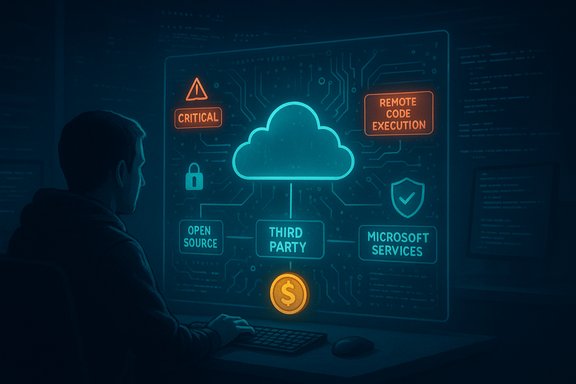
Microsoft has quietly rewritten the rules of engagement for vulnerability research: starting now, any critical flaw that demonstrably impacts Microsoft’s online services is eligible for a bounty — even if the vulnerable code lives in third‑party software or open‑source libraries, and even if no formal bounty program previously covered that component.
Microsoft’s Security Response Center (MSRC) announced the policy change — which it calls “In Scope by Default” — in a post by Tom Gallagher, MSRC’s VP of Engineering delivered at Black Hat Europe and published on the MSRC blog. The new approach treats Microsoft’s cloud and online services as the anchor for eligibility: if a vulnerability has a direct and demonstrable impact on those services, it qualifies for award consideration regardless of authorship or ownership of the underlying code. The shift comes amid an aggressive expansion of Microsoft’s bounty and live‑research programs. Microsoft reported awarding more than $17 million to researchers last year through its bug bounty programs and the Zero Day Quest live‑hacking competition, and the company signalled intentions to increase spending. Zero Day Quest itself has become a major channel for high‑impact cloud and AI research, with Microsoft running qualifying challenges and live events offering multi‑million‑dollar prize pools.
Other cloud providers and large software vendors may feel pressure to follow suit, since the attack surface argument Microsoft makes applies to almost every modern service provider. If several major players adopt similar policies, that could shift the industry toward more consistent recognition for supply‑chain and dependency‑focused research — something many security experts have lobbied for over the past five years. However, industry adoption will also bring the hard work of harmonizing triage standards, disclosure timers, and legal protections. Without coordinated industry norms, researchers may still face fragmentation — an expanded marketplace of eligibility but persistent operational friction.
Microsoft’s new policy reframes a simple truth: attackers exploit weaknesses, not vendor labels. Turning that truth into sustainable incentives and scalable processes is the company’s next, far harder task.
Source: theregister.com Microsoft now buys bugs, with or without a bounty program
 Background
Microsoft’s Security Response Center (MSRC) announced the policy change — which it calls “In Scope by Default” — in a post by Tom Gallagher, MSRC’s VP of Engineering delivered at Black Hat Europe and published on the MSRC blog. The new approach treats Microsoft’s cloud and online services as the anchor for eligibility: if a vulnerability has a direct and demonstrable impact on those services, it qualifies for award consideration regardless of authorship or ownership of the underlying code. The shift comes amid an aggressive expansion of Microsoft’s bounty and live‑research programs. Microsoft reported awarding more than $17 million to researchers last year through its bug bounty programs and the Zero Day Quest live‑hacking competition, and the company signalled intentions to increase spending. Zero Day Quest itself has become a major channel for high‑impact cloud and AI research, with Microsoft running qualifying challenges and live events offering multi‑million‑dollar prize pools. Why this matters now
Microsoft frames the change as a response to two converging realities: (1) cloud and AI services stitch together vast stacks of proprietary, vendor, and open‑source components, so real‑world attacks target seams rather than single packaged products; and (2) threat actors are agnostic about ownership — they exploit whichever weakness is easiest and highest impact. By defaulting services into scope, Microsoft aims to remove guesswork about eligibility and incentivize researchers to look where attackers already are.What “In Scope by Default” actually does
Expanded eligibility
- Any critical vulnerability with a clear impact on Microsoft online services is eligible for a bounty award.
- Eligibility is separated from code ownership: Microsoft, third parties, and open‑source components are all covered if they affect Microsoft’s services.
- Newly launched Microsoft services will be covered immediately on day one under the new default scope.
How awards are positioned
Microsoft says the class and severity of a vulnerability will determine award levels, not the component’s provenance. In practice that means a critical remote‑code‑execution (RCE) that compromises a Microsoft service via a third‑party library could attract a payout comparable to an equal‑severity bug in a Microsoft‑authored product. The MSRC announcement frames this as parity to reduce gaps that might otherwise disincentivize high‑value research.Operational mechanics (what to expect)
MSRC points researchers to its Researcher Portal and established triage and disclosure processes. Historically, MSRC’s public guidance says triage starts quickly and that researchers should provide high‑quality reports to speed assessment; the new policy overlays eligibility changes but keeps the coordinated vulnerability disclosure (CVD) workflow intact.The upside: why this could be a net win for security
1) Incentivizes research on true attack surfaces
Cloud services are complex systems built from many moving parts. Making third‑party and open‑source dependencies explicitly eligible reduces the perverse incentive for researchers to avoid those components because “they’re out of scope.” The result should be more coverage of those seams where real attacks often emerge.2) Aligns incentives with customer‑impact
By tying eligibility to demonstrable impact on Microsoft services, MSRC is steering attention toward vulnerabilities that matter to customers rather than low‑impact bugs in isolated testbeds. That focus on customer risk can increase signal‑to‑noise for both researchers and MSRC triage teams.3) Creates a funding path for third‑party fixes
Open‑source maintainers and vendors that previously had no bounty program available may now be able to route responsible findings through MSRC and obtain recognition or an award where none existed. That can help raise the security bar across the broader ecosystem.4) Scales Microsoft’s public investment in cloud and AI security
Microsoft is already running Zero Day Quest and other programs dedicated to cloud and AI research. Expanding baseline eligibility reflects a strategic investment: more money and clearer signals will likely attract more skilled researchers to study high‑impact scenarios. Microsoft’s own reports show large sums paid in recent cycles and an intention to keep expanding those investments.Risks, tradeoffs, and open questions
A. Legal and ethical risk for researchers
Testing third‑party or open‑source components that feed into Microsoft services may still expose researchers to legal risk depending on how that code is hosted, licensed, or deployed — especially if testing requires interacting with infrastructure owned by other organizations. MSRC’s Rules of Engagement are an important disclaimer, but the announcement does not create automatic legal safe‑harbour for testing third‑party systems. Researchers should still look for explicit permission before intrusive tests.B. Triage and throughput pressures for MSRC
Expanding eligibility to include every service and dependent component will increase the volume and complexity of submissions. MSRC has improved tools and runs large events like Zero Day Quest, but scaling human triage, engineering coordination, and legal review across a vastly larger scope is nontrivial. Historically, researchers have criticized slow response times and disputed triage outcomes; adding more submissions could exacerbate those pain points without commensurate investment in processes and staffing.C. Attribution and duplication issues
When a vulnerability arises in a third‑party component used by many vendors, multiple organizations may receive reports of the same flaw. Microsoft’s policy promises to pay researchers for findings that affect Microsoft services, but it does not abolish the coordination problem: multiple vendors may claim credit or offer awards for overlapping research. Clear, rapid coordination — and transparent rules about duplicate payouts — will be essential.D. Incentive misalignment with some third parties
An award paid by Microsoft does help a maintainer or vendor by drawing attention to the issue, but it does not automatically fund the maintainer’s long‑term work or patching capacity. In some cases, maintainers may not have the resources to implement complex fixes immediately, creating friction in coordinated disclosure that a bounty alone cannot solve.E. Possible friction with other vendors’ programs and platforms
Bounty platforms and vendor programs use differing triage standards, SLAs, and legal terms. Microsoft’s expansion raises questions about how cross‑vendor disputes will be resolved, whether platform mediation services will be used, and how researchers choose where to report. Industry mediation mechanisms have sometimes frustrated researchers in the past and may be tested by the new approach.How MSRC can make this work in practice
The policy’s success will hinge on execution. Below are practical steps MSRC should (and, in some cases, has signalled it will) take to reduce the friction this change can introduce:- Scale triage teams and automation to handle increased submission volumes so that SLAs are preserved and researchers aren’t left waiting unreasonably long.
- Publish clearer guidance on how to demonstrate “direct and demonstrable impact” on Microsoft services so researchers know when a third‑party bug will qualify.
- Offer explicit legal guidance or safe‑harbour language for researchers acting within MSRC’s Rules of Engagement, especially when testing dependencies that touch other vendors. If safe‑harbour can’t be granted, MSRC should at minimum explain the legal boundaries clearly.
- Improve cross‑vendor coordination frameworks and specify how duplicate discoveries will be reconciled and rewarded to avoid unfair outcomes.
- Increase transparency around triage decisions and severity downgrades, including the rationale for changing impact scores so researchers understand the path from submission to payout. That addresses recurring community complaints about opaque triage and reward determinations.
Community response and credibility gap
Microsoft’s announcement was widely covered by tech press and security outlets, which largely framed the move as a meaningful expansion of researcher incentives. Independent outlets reiterated Microsoft’s intent to treat third‑party and open‑source dependencies as potential bounty targets when they affect Microsoft services. At the same time, long‑running frustrations remain. Researchers have historically pointed to two recurring issues with large vendor programs: slow triage and opaque triage/award outcomes, both of which can undermine trust. Those complaints are documented anecdotally across community forums and have been covered in industry reporting; Microsoft’s public guidance on expectations aims to address some of these pain points, but critics argue that clearer operational guarantees are still needed. Katie Moussouris, an industry veteran who helped spin up Microsoft’s early vulnerability programs, famously described Microsoft’s initial adoption of bounties as “like boiling a frog” — a wry observation that large programmatic shifts at major vendors can be slow and incremental. That historical note highlights why many security researchers will watch the rollout of “In Scope by Default” closely to see if practice follows promise.Short‑term practical guidance for researchers
- Read Microsoft’s Rules of Engagement and the MSRC Researcher Portal guidance before testing. That remains MSRC’s baseline to avoid harming customers and to preserve eligibility.
- If testing third‑party components or services that you do not own, seek explicit permission from the service owner when feasible; document the permissions chain to reduce legal exposure. MSRC’s eligibility is not a blanket legal shield.
- Provide complete, high‑quality reports with reproducible proof‑of‑concepts. MSRC’s guidance stresses that better reports speed triage and increase the likelihood of higher awards.
- Track disclosure timelines and be prepared to escalate through MSRC’s official channels if triage becomes stalled, but expect the coordination process to involve engineering teams across multiple organizations in complex dependency cases.
Larger industry implications
Microsoft’s move is potentially a turning point for how major cloud vendors think about vulnerability incentives. By decoupling award eligibility from strict code ownership and tying it to service impact, Microsoft is formalizing a view of security that treats the cloud as a cross‑domain system where upstream and downstream components all matter.Other cloud providers and large software vendors may feel pressure to follow suit, since the attack surface argument Microsoft makes applies to almost every modern service provider. If several major players adopt similar policies, that could shift the industry toward more consistent recognition for supply‑chain and dependency‑focused research — something many security experts have lobbied for over the past five years. However, industry adoption will also bring the hard work of harmonizing triage standards, disclosure timers, and legal protections. Without coordinated industry norms, researchers may still face fragmentation — an expanded marketplace of eligibility but persistent operational friction.
Conclusion
Microsoft’s “In Scope by Default” announcement is a structural shift: it acknowledges that cloud‑era risk does not respect vendor boundaries and attempts to convert that reality into a clearer incentive for security research. The plan has clear upsides — better coverage of critical third‑party and open‑source dependencies, more focused attention on customer impact, and an explicit commitment to expand awards that support cloud and AI security research. But the success of the initiative will be judged in the details: whether MSRC can scale triage and coordination, provide clear legal guidance to researchers, and keep dispute resolution and award processes transparent. Without those operational guarantees, the expanded scope risks amplifying existing frustrations around slow response times and opaque triage outcomes rather than closing security gaps. Researchers and ecosystem stakeholders should therefore welcome Microsoft’s commitment — and watch closely for the operational follow‑through that will determine whether the program truly delivers on its promise.Microsoft’s new policy reframes a simple truth: attackers exploit weaknesses, not vendor labels. Turning that truth into sustainable incentives and scalable processes is the company’s next, far harder task.
Source: theregister.com Microsoft now buys bugs, with or without a bounty program
