

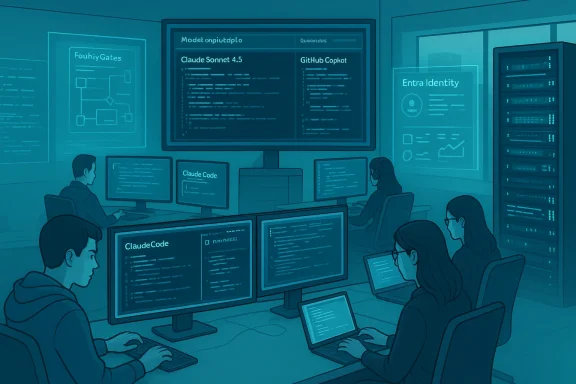
Microsoft’s engineering halls are quietly being retooled: across several of its largest teams, employees are being asked to adopt Anthropic’s Claude Code alongside — and in some cases instead of — Microsoft’s own Copilot tooling, a shift that signals both a practical response to which models perform best for a given task and a strategic widening of Microsoft’s multi‑model AI playbook.
Anthropic and Microsoft announced a far‑reaching commercial and engineering expansion in November 2025 that made Anthropic’s Claude family (notably Claude Sonnet 4.5, Claude Opus 4.1, and Claude Haiku 4.5) available in Microsoft Foundry and selectable inside Microsoft’s Copilot surfaces. The deal included headline compute and investment commitments, with Anthropic committing to purchase a very large tranche of Azure compute capacity. Inside Microsoft, the change is now less theoretical and more operational. Multiple internal pilot programs are encouraging engineers — and even nontechnical staff such as designers and project managers — to try Claude Code for prototyping, automation, and coding tasks, and teams are being asked to compare it directly to GitHub Copilot. The reporting on this shift is based on internal sound product rollouts that place Claude variants across Azure Foundry, Microsoft 365 Copilot, and Copilot Studio.
This is not just a product swap; it is a multilevel move that touches model choice, enterprise procurement, and the operational governance of millions of lines of code inside Microsoft’s repositories. The practical consequences reach from day‑to‑day developer productivity to long‑term strategic alignment between Microsoft, Anthropic, and NVIDIA.
That pattern also transforms procurement: corporations will now factor model performance, compute availability, and hardware co‑design into their sourcing decisions, not just price or API terms. The result is closer commercial ties between model creators, chip vendors, and cloud incumbents — which accelerates capability but raises concentration risk and regulatory scrutiny.
Microsoft’s long‑term bet appears to be on a hybrid strategy: continue deep partnerships with OpenAI while expanding multi‑model options where they add customer value. That approach reflects the reality of contemporary AI engineering — no single model wins every contest — and positions Microsoft to deliver the best tool for the task while retaining enterprise controls.
What’s happening inside Microsoft now will be instructive for any organization planning to adopt agentic coding assistants at scale. The lesson is to treat agents as production systems — instrumented, governed, and integrated into established software engineering and compliance practices — rather than as toys. The stakes are high: the next wave of productivity gains depends on doing this transition deliberately, transparently, and safely.
Source: The Verge Claude Code is suddenly everywhere inside Microsoft
 Background
Anthropic and Microsoft announced a far‑reaching commercial and engineering expansion in November 2025 that made Anthropic’s Claude family (notably Claude Sonnet 4.5, Claude Opus 4.1, and Claude Haiku 4.5) available in Microsoft Foundry and selectable inside Microsoft’s Copilot surfaces. The deal included headline compute and investment commitments, with Anthropic committing to purchase a very large tranche of Azure compute capacity. Inside Microsoft, the change is now less theoretical and more operational. Multiple internal pilot programs are encouraging engineers — and even nontechnical staff such as designers and project managers — to try Claude Code for prototyping, automation, and coding tasks, and teams are being asked to compare it directly to GitHub Copilot. The reporting on this shift is based on internal sound product rollouts that place Claude variants across Azure Foundry, Microsoft 365 Copilot, and Copilot Studio.This is not just a product swap; it is a multilevel move that touches model choice, enterprise procurement, and the operational governance of millions of lines of code inside Microsoft’s repositories. The practical consequences reach from day‑to‑day developer productivity to long‑term strategic alignment between Microsoft, Anthropic, and NVIDIA.
What exactly is changing inside Microsoft?
Claude Code: the tool being piloted
- Claude Code is Anthropic’s coding‑focused agentic product that pairs Claude models with developer tooling to generate, edit, and explain code. Anthropic positions Sonnet variants as especially strong for coding and agentic workflows, and Microsoft’s Foundry and Copilot integrations expose those capabilities to enterprise teams.
- Microsoft engineering teams are being asked to install and use Claude Code alongside GitHub Copilot and to report comparative feedback. That includes teams responsible for flagship products — Windows, Teams, Bing, Edge, Surface — effectively expanding trials from developer crush zones into product groups that also include designers and product managers. This internal push is described by reporting from staff‑level sources and by the fact that Anthropic's models are now selectable inside Microsoft product surfaces.
Where Claude is appearing in Microsoft’s stack
- Microsoft Foundry: Claude Sonnet, Opus and Haiku are listed in the Foundry catalog, offered as serverless endpoints and integrated with Entra identity, SDKs, and enterprise governance hooks. This makes Claude a production‑grade option for agentic applications and coding workflows.
- Microsoft 365 Copilot and Copilot Studio: Anthropic models are already selectable in research‑ and de Copilot, where tenant admins can opt in and set controls. Microsoft’s Copilot surfaces now operate as an orchestration plane that can route tasks to different model backends.
- GitHub Copilot and developer workflows: Although GitHub Copilot remains Microsoft’s marketed coding assistant, internal pilots require engineers to use both Copilot and Claude Code and to compare outcomes, suggesting Microsoft is treating model choice pragmatically — not dogmatically. This internal experimentation could shape which models Microsoft surfaces to customers down the road.
Why Microsoft is doing this now
1) Practical performance: task‑matched models
Different models have different comparative strengths. Anthropic and Microsoft material describe Sonnet as top‑tier for coding and deep multi‑step agent work, Opus for specialized reasoning, and Haiku as a fast, cost‑efficient option for high‑throughput use. Pitting models against each other inside real developer workflows gives teams empirical feedback to route the right workload to the most effective engine.2) Multi‑model resilience and procurement pragmatism
A multis single‑vendor dependence and can mitigate outages, licensing frictions, or sudden capability gaps. Anthropic’s availability across clouds and Microsoft’s Foundry integration lets enterprises centralize governance while preserving choice. The Anthropic–Microsoft–NVIDIA arrangement also ties compute capacity and co‑engineering support to model performance at scale.3) Democratizing creation across roles
Claude Code (and companion agent tools like Claude Cowork) emphasize approachable coding for nondevelopers. Microsoft’s internal push to let designers and managers prototype using Claude tools reflects a broader intent to let AI collapse the barrier between idea and working prototype. That has immediate product advantages but also operational complications, which are discussed below.What Microsoft, Anthropic, and outside reporting actually confirm
- Anthropic made Claude Sonnet 4.5, Opus 4.1, and Haiku 4.5 available in Microsoft Foundry and integrated Claude into Microsoft 365 Copilot features.
- Anthropic publicly announced a large Azure compute commitment and a strategic arrangement involving NVIDIA and Microsoft that includes investment and co‑engineering language; headline figures (Anthropic’s ~$30 billion Azure commitment, NVIDIA’s and Microsoft’s “up to” investment pledges) were widely reported by major outlets and on the companies’ blogs. These numbers are presented as staged, conditional commitments rather than immediate cash transfers.
- Microsoft is running internal pilots that encourage teams to test Claude Code and compare it with GitHub Copilot, and it has surfaced Anthropic models in parts of Copilot where Anthropic’s useful. The reporting on internal adoption is drawn from employee sources and corroborating product integrations. Readers should treat internal usage claims as plausible but partially based on anonymous or internal sourcing.
- Anthropic’s Claude is being positioned into productivity surfaces (Excel, Researcher agent) and developer workflows (Claude Code, Foundry) that previously leaned more heavily on OpenAI‑backed models inside Microsoft. Microsoft continues to emphasize OpenAI as a primary partner for frontier models, but it has embraced Anthropic as part of a pragmatic multi‑vendor strategy.
Strengths: what Claude Code brings to Microsoft’s table
- Ease of use and agentic design: Claude Code is designed to be approachable for nondevelopers — it emphasizes higher‑level prompts, agentic workflows, and prototyping support that shortens the loop from idea to runnable code. That ease of use is precisely why teams outside pure engineering are being encouraged to experiment.
- Task fit and specialization: Anthropic’s Sonnet‑family models are specifically promoted for coding and complex agent orchestration, which can translate to better completions, fewer back‑and‑forth iterations, and more reliable edits in certain coding contexts. Microsoft’s decision to let teams choose the model that performs best for a task is a pragmatic productivity play.
- Multi‑model flexibility in Foundry: Making Claude available in Microsoft Foundry gives enterprises the ability to route workloads to Claude under Azure governance and billing, aiding procurement simplicity and compliance when customers already have Azure relationships. Foundry exposes Claude with SDKs and Entra identity primitives, which supports enterprise integration efforts.
- Commercial leverage and capacity: The compute and investment arrangements with Anthropic and NVIDIA help Microsoft ensure that chosen models can be scaled and co‑optimized for Azure’s data‑center architectures — a practical advantage when large inference volumes are required.
Risks and do manage
Governance and data residency
Routing tenant data to Anthropic‑hosted endpoints (or to other cloud hosts chosen by Anthropic) changes the contractual and data‑processing calculus for regulated customers. Microsoft’s admin gating and tenant opt‑in mitigate some risk, but organizations must still assess contract terms, residency, and legal exposure when enabling third‑party backends. This is a central tension created by multi‑model orchestration.Increased operational complexity
Allowing multiple models inside shared productivity and engineering surfaces raises administrative and monitoring burdens: which model is approved for which classification of data, who can publish agents in Copilot Studio, how changes are audited, and how to correlate telemetry when multiple model providers are in play. Enterprises will need more sophisticated policy tooling and a clear model governance taxonomy.Security, hallucinations, and provenance
All LLMs can hallucinate; Anthropic’s emphasis on citation and tool use helps, but it does not eliminate the need for confirmatory checks. When models are given code repository access or are allowed to commit changes, the risks include introducing subtle logic errors, security regressions, or inadvertent credential exposure. Engineering processes must incorporate verification, code review, and automated testing as mandatory gates.Workforce and role compression
Increasingly powerful coding agents that let nontechnical staff create working prototypes can speed development but also compress early‑career tasks traditionally assigned to junior developers. The industry trend toward agentic auegitimate concerns that entry‑level developer roles will evolve rapidly or decline in number. Microsoft’s broad pilot will surface how costly or beneficial this compression will be in practice.Concentration of compute and systemic risk
The $30 billion headline and “up to one gigawatt” capacity language are powerful indicators of hardware concentration. Tying model scale to a small set of integrated infrastructure providers concentrates systemic risk: power, cooling, and supply‑chain disruptions at large data centers can become chokepoints if many models and vendors depend on the same facilities. These are industry‑level risks beyond Microsoft alone.What’s verifiable — and what remains opaque
- Verifiable: Claude models are available in Microsoft Foundry and as selectable options inside Copilot features; Anthropic and Microsoft publicly documented this. The high‑level compute and investment commitments were publicly announced and widely reported by major outlets.
- Less verifiable: the precise scale of internal adoption (numbers of employees using Claude Code, which specific teams have full rollouts, and the exact outcomes of those internal comparisons) comes from reporting that cites anonymous internal sources. While product integrations corroborate that Microsoft is enabling Anthropic models broadly, the granular internal HR and policy decisions cannot be independently verified from public documents. Those claims should be treated as credible reporting but with caution.
What Microsoft should do next (practical, short‑term recommendations)
- Strengthen tenant‑level policy controls in Copilot Studio and Foundry so admins can:
- Specify allowed models per data classification.
- Enforce mandatory code review and unit test gates for AI‑generated commits.
- Require human signoff on any repository write operations triggered by agents.
- Instrument model usage with richer telemetry and explainability:
- Track which model generated a commit/change and capture the triggering prompt and surrounding context.
- Surface provenance metadata in pull requests so reviewers see “AI‑assisted: Claude Sonnet 4.5” or “AI‑assisted: Copilot” with a confidence score.
- Define a cross‑functional pilot checklist before broad rollout:
- Security review, code‑quality metrics, compliance mapping, retention and deletion policies for model inputs and outputs.
- A rollback plan for agent‑initiated changes to repositories.
- Revisit education and staffing strategies:
- Retask junior developers toward verification, automation engineering, and agent‑orchestration tasks.
- Offer upskilling paths so staff displaced from traditional routinized tasks can proctor, audit, and extend AI systems.
- Maintain procurement and legal clarity:
- Ensure that customers who require strict data residency or contractual non‑training clauses can opt for models hosted under the contractual surface they require (e.g., Anthropic on Azure under a MACC billing arrangement versus Anthropic hosted elsewhere).
Broader industry implications
Microsoft’s embrace of Anthropic models alongside OpenAI models is a crystallization of the multi‑model reality the enterprise market is entering. Foundry’s catalog approach — offering multiple frontier families under a single governance plane — will likely become the standard enterprise pattern: choose the model that fits the job, but manage it centrally.That pattern also transforms procurement: corporations will now factor model performance, compute availability, and hardware co‑design into their sourcing decisions, not just price or API terms. The result is closer commercial ties between model creators, chip vendors, and cloud incumbents — which accelerates capability but raises concentration risk and regulatory scrutiny.
The moral of this moment for Windows and Azure ecosystems
Microsoft’s experiment to have thousands of employees pick up Claude Code: it tests whether Anthropic’s coding and agent advantages translate to faster internal iterations and better product outcomes. If the pilots deliver measurable gains, Microsoft could start offering Anthropic‑driven services more broadly to Azure customers or productize those integrations inside Copilot features. But the decision is not purely technical; it is an operational and ethical one that forces a tech giant to reconcile productivity gains with governance, workforce impacts, and the concentration of physical compute.Microsoft’s long‑term bet appears to be on a hybrid strategy: continue deep partnerships with OpenAI while expanding multi‑model options where they add customer value. That approach reflects the reality of contemporary AI engineering — no single model wins every contest — and positions Microsoft to deliver the best tool for the task while retaining enterprise controls.
Conclusion
The rollout of Claude Code inside Microsoft is more than a technology swap; it is a live experiment in how a major cloud and software company will govern, provision, and sell choice in a world of competing frontier models. The immediate upside is pragmatic: better task‑matching, faster prototyping, and more options for teams. The trade‑offs are policy and operational complexity, legal exposure when third‑party models process tenant data, and economic and workforce shifts as agentic systems change who writes and reviews code.What’s happening inside Microsoft now will be instructive for any organization planning to adopt agentic coding assistants at scale. The lesson is to treat agents as production systems — instrumented, governed, and integrated into established software engineering and compliance practices — rather than as toys. The stakes are high: the next wave of productivity gains depends on doing this transition deliberately, transparently, and safely.
Source: The Verge Claude Code is suddenly everywhere inside Microsoft
