

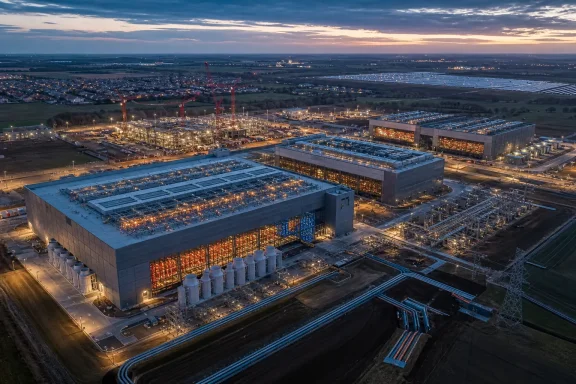
Microsoft announced on June 23, 2026, that its first Fairwater AI datacenter in Mount Pleasant, Wisconsin, had completed construction and become fully operational after startup work began in April, putting a 315-acre, GPU-dense supercomputing campus into service ahead of schedule. This is not merely another Azure building opening in the Midwest: it is Microsoft converting the AI boom from a software narrative into fixed industrial capacity. The company is betting that controlling the chips, storage, cooling, networking, power arrangements, and physical geography of AI will matter as much as controlling the models. Wisconsin now hosts one of the clearest examples of how that wager reshapes both cloud computing and the communities drafted to support it.
Microsoft’s announcement closes the gap between unveiling an enormous AI facility and proving that it can be built, energized, cooled, staffed, and brought online. Equipment startup began in April, according to Microsoft and Wisconsin Public Radio, before the company declared the first Mount Pleasant facility fully operational on June 23.
That distinction matters. The technology industry has produced no shortage of proposed AI campuses, multibillion-dollar investment commitments, and architectural renderings, but a completed facility represents usable computing capacity rather than an option on future capacity. Fairwater is now part of the physical production system behind Azure AI, Microsoft AI, Copilot, OpenAI workloads, and other large-scale customers.
Microsoft says nearly 10,000 construction workers contributed during the two-year development, with more than 3,000 workers active during peak daily construction. Nearly 550 full-time employees were on-site supporting the first facility when Microsoft announced completion, and the company and its contractors were still hiring.
Those numbers also show how quickly the staffing picture changed. Wisconsin Public Radio reported in May that Microsoft had hired around 375 full-time employees in Wisconsin and intended to add another 125 for the first datacenter. Microsoft had previously projected roughly 500 permanent jobs at Fairwater 1, but its completion announcement described nearly 550 people on-site.
The figures are not necessarily contradictory. They were reported at different stages of startup and may use different definitions of employees, contractors, and personnel supporting the facility. The broader point is that Fairwater has moved beyond the temporary construction economy into permanent operations, even as construction continues immediately next door.
The original secondary article carrying the headline “Microsoft Completes Wisconsin Data Center to Accelerate AI Expansion” was unavailable when accessed. Instead of the report, the site displayed a Cloudflare message describing an unknown connection issue between Cloudflare and the origin web server, telling visitors to try again in a few minutes and directing the website owner to retrieve the corresponding server log and include the Ray ID in a support request.
That error page cannot substantiate the headline on its own. The underlying event, however, is confirmed directly by Microsoft’s June 23 announcement and by independent reporting from Wisconsin Public Radio and specialist datacenter publications. In this case, the broken secondary page obscures a real milestone rather than exposing a fabricated one.
Fairwater is designed around the opposite problem. Frontier-model training requires huge numbers of accelerators to cooperate on one computational task, exchanging partial results quickly enough that expensive chips do not sit idle waiting for data. The useful unit is no longer an individual server or even one rack; it is the entire coordinated cluster.
Microsoft says Fairwater contains a single massive cluster of NVIDIA GB200 servers, millions of compute cores, and exabytes of storage. Each rack contains 72 NVIDIA Blackwell GPUs linked within one NVLink domain, with 1.8 terabytes per second of GPU-to-GPU bandwidth and 14 terabytes of pooled memory available across the rack.
Microsoft claims such a rack can process 865,000 tokens per second. More important than the isolated throughput figure is the architecture surrounding it: racks are connected through InfiniBand and Ethernet fabrics delivering 800 gigabits per second, arranged in a non-blocking topology intended to let accelerators communicate at full line rate without network congestion becoming the dominant bottleneck.
Fairwater’s physical construction reflects that requirement. Microsoft arranged the racks in a two-story configuration, allowing equipment to connect not only to neighboring racks on the same floor but also to racks immediately above or below. Shorter physical paths can reduce latency, which becomes increasingly important when thousands of accelerators must repeatedly synchronize during a training run.
The facility covers 315 acres and includes three large buildings with a combined 1.2 million square feet under roof. Microsoft says construction consumed 26.5 million pounds of structural steel, 120 miles of medium-voltage underground cable, 72.6 miles of mechanical piping, and 46.6 miles of deep foundation piles.
Those measurements are more than corporate spectacle. They demonstrate that frontier AI performance is increasingly determined by civil engineering, electrical distribution, thermal design, and network topology—not merely by which company can buy the newest accelerator.
The storage system is similarly specialized. Microsoft says the storage infrastructure stretches the equivalent of five football fields, with Azure Blob Storage accounts designed to sustain more than two million read-and-write transactions per second. The objective is to keep datasets flowing to the accelerators fast enough that the GPU cluster remains productive.
This is why Microsoft describes Fairwater as an “AI factory.” The term can sound like marketing, but it captures a real architectural change: data enters, repeated computation transforms it into a trained model, and that model becomes an input for software products and cloud services. The scarce product is no longer server space; it is synchronized AI computation at industrial scale.
Those claims need context. Microsoft is describing a distributed, commercially operated AI system optimized for training and inference, not simply presenting a traditional supercomputer benchmark result. The company has not framed Fairwater as a conventional entrant in the public rankings used to compare scientific supercomputers under a standardized test.
Its claim rests on scale, accelerator density, networking, pooled memory, storage throughput, and the ability to coordinate large numbers of GPUs. That may make Fairwater extraordinarily capable for the workloads it was designed to run, but readers should not interpret Microsoft’s language as a straightforward, independently verified comparison across every kind of high-performance computing.
The more consequential claim is that Microsoft can treat several facilities as parts of one larger system. Fairwater connects to Microsoft’s AI wide-area network, which the company says can pool compute, storage, and networking across geographically separated Azure locations.
A single training job has traditionally been constrained by the equipment available within one cluster and by the latency between its components. Microsoft’s architecture attempts to expand that boundary, allowing regional facilities to contribute to a distributed supercomputer rather than operating only as isolated islands of capacity.
That creates flexibility. Workloads can potentially be placed according to available accelerators, network capacity, resilience requirements, energy conditions, and customer demand. It also allows Microsoft to expand the system by reproducing the Fairwater design in other locations instead of trying to make one physical campus infinitely large.
Microsoft said in September 2025 that multiple identical Fairwater datacenters were already under construction elsewhere in the United States. The Wisconsin facility is therefore both a production site and a reference architecture—a repeatable template for building the next layer of Microsoft’s AI cloud.
Microsoft’s initial Wisconsin commitment was $3.3 billion, while the second facility added approximately $4 billion, bringing the announced total investment to more than $7 billion. Separately, Microsoft estimates that it will have spent $4.7 billion locally on hyperscale construction in Wisconsin between 2024 and 2028.
Those figures measure different things and should not be treated as interchangeable. The larger number represents Microsoft’s overall investment commitment, while the $4.7 billion estimate concerns local hyperscale construction spending over a specified period. Corporate capital plans may also include equipment, property, networking, and other costs that do not fall into the same local-spending category.
Microsoft says it has made direct purchases from 29 companies across 11 Wisconsin counties. The supplier list extends beyond Racine County to steel fabricators, electrical-equipment manufacturers, contractors, construction suppliers, and machinery producers elsewhere in the state.
The second facility is not necessarily the end of the campus. Wisconsin Public Radio reported that Mount Pleasant approved site plans in January for up to 15 additional Microsoft datacenters that could be developed over the following decade. Approval does not guarantee that every building will be constructed, but it gives the scale of the company’s possible long-term footprint.
That optionality is strategically valuable. Microsoft can expand when demand, hardware availability, power infrastructure, and capital budgets align, without restarting the local approval process for every conceptual phase. For residents and regulators, however, it means the operational impact of Fairwater 1 is only an early sample of what the site could become.
September 18, 2025 — Microsoft publicly detailed the Fairwater architecture and committed approximately $4 billion for a second Mount Pleasant facility, raising its Wisconsin commitment above $7 billion.
April 10, 2026 — Microsoft acknowledged that neighbors had reported noise from the Mount Pleasant facility during equipment startup.
April 15, 2026 — Microsoft said high-speed cooling fans were producing an unexpectedly far-traveling tonal hum and announced operational adjustments and additional sound-reduction work.
June 18, 2026 — Microsoft said testing and mitigation had resolved the reported hum according to independent monitoring and feedback from several neighbors, while promising further acoustic work.
June 23, 2026 — Microsoft announced that construction of Fairwater 1 was complete and that the facility was fully operational, with nearly 550 full-time employees on-site.
July 2, 2026 — Wisconsin Public Radio reported that three Sturtevant residents had filed a proposed class-action lawsuit alleging excessive and persistent noise from the facility.
Microsoft has supplied what the previous megaproject narrative struggled to deliver: visible construction, operational buildings, substantial capital spending, and permanent technical employment. Village President David DeGroot called Fairwater’s completion a historic milestone for Mount Pleasant and Racine County, arguing that the campus could strengthen the regional economy and position Wisconsin as an innovation center.
The construction benefit is already measurable. Almost 10,000 workers participated over the first facility’s development, according to Microsoft and the state, covering trades including electrical work, plumbing, pipefitting, carpentry, structural steel, concrete, and earthmoving.
Permanent employment is smaller than the construction total but still significant for a datacenter. Microsoft expects the combined workforce of the first two facilities to reach roughly 800 when the second is operational. Possible expansion to the north could add hundreds more, although those positions depend on projects that are not yet complete.
The company is also trying to connect the campus to a wider skills strategy. Its Datacenter Academy partnership with Gateway Technical College is intended to train more than 1,000 students over five years for operations and IT roles. Microsoft has separately worked with statewide partners on AI training and backed a manufacturing-focused AI Co-Innovation Lab at the University of Wisconsin-Milwaukee.
That lab is an important part of Microsoft’s argument because a datacenter’s direct benefits can otherwise appear narrow. The company wants the public to see Fairwater not simply as a fenced compound exporting computation to global customers, but as an anchor for regional manufacturers, developers, students, and small businesses adopting AI.
The test will be whether those surrounding programs become durable economic institutions or remain modest attachments to a much larger infrastructure project. A workforce academy can train residents, but it does not guarantee that most of the highest-value AI research and engineering roles will be located in Wisconsin. A local company can use Azure services without receiving privileged access merely because the underlying hardware sits nearby.
Fairwater’s economic bargain is therefore mixed but real. Wisconsin receives construction activity, tax-base growth, skilled operations jobs, supplier spending, and educational partnerships. Microsoft receives a large, expandable industrial campus for a class of infrastructure that is becoming increasingly difficult to place near population centers without political resistance.
Microsoft says the loop was filled during construction and then recirculates the same water. The remaining portion of the facility primarily relies on outside air, using water only on the hottest days. The company has compared Fairwater’s annual water use to that of a typical restaurant, although that remains Microsoft’s own characterization of operating consumption.
This design addresses one of the most immediate objections to AI datacenters: that dense computing facilities can compete with communities for water. Liquid cooling also allows more heat-generating equipment to be packed into each rack than conventional air cooling could comfortably support.
The trade-off is that moving heat away from the chips still requires large mechanical systems. Microsoft describes Fairwater as having the second-largest water-cooled chiller plant in the world, with hot water routed to external cooling fins and 172 fans, each 20 feet in size, used to chill and recirculate it.
That machinery became central to the facility’s first neighborhood dispute. Microsoft said cooling fans were running at high speeds during startup and producing a tonal hum that traveled farther than expected. The water may remain inside a loop, but heat and sound still have to leave the computing environment.
Energy is the larger unresolved question. Microsoft says it is prepaying for the electricity and related infrastructure it will use so that the campus does not shift those costs to ordinary customers. It has also promised to match fossil-fuel electricity consumption with carbon-free energy added to the grid, including power associated with a 250-megawatt solar project in Portage County.
Matching consumption with renewable generation does not mean every Fairwater workload operates on carbon-free electricity at every moment. Grid accounting, generation timing, transmission constraints, and the mix of available power still matter. Microsoft’s commitment is meaningful, but it should not be confused with physically isolating the campus from fossil-fuel generation.
Wisconsin Public Radio has reported substantial public concern over the energy demands of datacenters in Mount Pleasant and Port Washington. Testimony before state regulators indicated that those projects could double demand on the utility system by 2030, while regulators have moved to establish special rate structures for datacenter-scale customers.
This is where the AI infrastructure debate becomes more consequential than arguments over individual software features. A Copilot button can be disabled; a new generation plant, transmission corridor, or industrial electricity tariff can shape a region for decades.
Residents north of the facility reported a tonal humming sound as equipment came online. Microsoft acknowledged the issue on April 10 and said on April 15 that engineers had traced it to cooling fans operating at high speed during startup.
The company said the facility remained within the requirements of the local noise ordinance but admitted that it had not expected the tone to travel as far as it did. Engineers manually adjusted the fans, planned mechanical operating limits, and committed to installing additional sound-reduction components.
On June 18, Microsoft said its monitoring and feedback from several neighbors showed that the mitigations had fully resolved the problem. The company nevertheless said it would continue short-term mitigation, install more acoustic components, and monitor the site.
That account is now contested. Wisconsin Public Radio reported on July 2 that three residents of nearby Sturtevant had filed a proposed class-action lawsuit accusing Microsoft of allowing unreasonable and excessive noise onto surrounding properties.
The complaint reportedly attributes the sound not only to cooling equipment but also to generators and other heating, ventilation, and air-conditioning systems. It further argues that conventional decibel measurements may not capture the low-frequency character of the alleged hum.
These are allegations, not established findings. Microsoft said it was aware of the lawsuit and reiterated that it was committed to being a good neighbor. A Mount Pleasant spokesperson said the village had received no formal complaints since the adjustments announced in April.
The disagreement is still revealing. Microsoft’s instruments and some neighbor feedback indicated that the mitigation worked; the plaintiffs allege that the disturbance remained persistent and damaging. Both statements can exist in the public record without the dispute being settled.
Other reported complaints include construction dust, traffic, intense lighting, and the transformation of a rural landscape. Those effects are harder to neutralize with a software-like patch because they arise from the basic scale and operating schedule of the project.
Fairwater’s engineering success does not cancel its local externalities. In fact, the more thoroughly Microsoft scales this architecture, the more urgently it will need repeatable methods for acoustic modeling, lighting control, road management, utility financing, and transparent complaint handling.
Microsoft says its AI datacenters support OpenAI, Microsoft AI, Copilot, and other large-scale workloads. More training capacity can help the company develop larger or more specialized models, test new architectures, serve inference at greater scale, and reduce dependence on constrained clusters elsewhere.
For Windows users, that may eventually mean more capable Copilot services, faster rollout of cloud-hosted AI functions, or better capacity during periods of demand. None of those outcomes follows automatically from the June 23 completion announcement, however, and Microsoft did not attach a specific Windows feature release to Fairwater’s opening.
The same caution applies to Azure customers. “Fully operational” means the infrastructure is running; it does not necessarily mean every organization can immediately order Fairwater-backed capacity in the Azure portal. Access to advanced accelerators can depend on region, subscription eligibility, quotas, reservations, product availability, customer agreements, and Microsoft’s own allocation priorities.
For enterprise IT, Fairwater is nevertheless strategically important. It signals that Microsoft expects AI workloads to remain large enough and valuable enough to justify purpose-built campuses costing billions of dollars. Organizations planning around Azure AI should assume that Microsoft’s platform strategy is moving toward deeply integrated hardware, networking, storage, and model services rather than commodity cloud servers with accelerators added as an afterthought.
That integration can offer performance and scale, but it may also deepen platform dependence. A workload optimized around Microsoft’s distributed infrastructure, storage services, identity system, security tooling, and model APIs may be difficult to reproduce economically on another cloud.
Capacity planning therefore needs to include architectural portability, data-egress implications, residency requirements, operational concentration, and fallback options. Fairwater strengthens Azure’s AI proposition; it also raises the cost of pretending that AI infrastructure is interchangeable.
That system extends the familiar Azure model. Conventional cloud architecture pools general-purpose resources so customers can obtain virtual infrastructure on demand. Microsoft’s AI network instead tries to pool highly specialized accelerator clusters while preserving enough bandwidth and coordination to perform jobs that once required one physically concentrated supercomputer.
The economics favor replication. A standardized Fairwater design allows Microsoft to reuse engineering work, procurement relationships, cooling systems, server layouts, network architecture, and operational procedures. Each new campus can become another module in the AI wide-area network.
Replication also spreads risk. Power constraints, weather, hardware failures, and regional disruptions become easier to absorb when capacity is distributed. At the same time, a geographically dispersed system introduces dependencies on long-haul networking, workload orchestration, data movement, and consistent security controls.
Microsoft’s competitive bet is that its experience running a global cloud gives it an advantage over companies assembling AI clusters as isolated projects. Azure already has identity, storage, networking, observability, security, billing, and enterprise sales systems. Fairwater adds an infrastructure layer designed specifically for the most demanding model workloads.
This vertical integration is why the campus matters even to organizations that will never know which physical building processed their request. The output is not sold as Wisconsin electricity, cooling, or GPU cycles. It appears as an API response, a Copilot suggestion, a model-training job, or an enterprise service embedded inside software.
The physical infrastructure becomes invisible precisely when it works. The controversy around Fairwater is a reminder that it never disappears for the people living next to it.
Microsoft must now demonstrate sustained reliability, effective noise control, responsible construction management, and credible accounting for water, energy, and grid costs. Its claims will be judged not only through corporate sustainability reports but also through utility proceedings, employment data, neighborhood experience, and the performance of its AI services.
The second facility provides an immediate test. Microsoft can apply the acoustic lessons from Fairwater 1 during construction rather than after residents complain. It can design lighting and road controls for an operating campus that remains an active construction zone. It can also provide clearer distinctions between permanent Microsoft jobs, contractor roles, temporary construction employment, and broader economic estimates.
The company’s broader expansion plans raise the stakes. If additional Mount Pleasant facilities proceed, the cumulative impact will matter more than the performance of any one building. A fan adjustment may solve a particular tone, but it does not answer how a large cluster of datacenters changes electricity demand, land use, traffic, and the character of surrounding communities.
 Fairwater Turns Microsoft’s AI Promises Into Operating Capacity
Microsoft’s announcement closes the gap between unveiling an enormous AI facility and proving that it can be built, energized, cooled, staffed, and brought online. Equipment startup began in April, according to Microsoft and Wisconsin Public Radio, before the company declared the first Mount Pleasant facility fully operational on June 23.That distinction matters. The technology industry has produced no shortage of proposed AI campuses, multibillion-dollar investment commitments, and architectural renderings, but a completed facility represents usable computing capacity rather than an option on future capacity. Fairwater is now part of the physical production system behind Azure AI, Microsoft AI, Copilot, OpenAI workloads, and other large-scale customers.
Microsoft says nearly 10,000 construction workers contributed during the two-year development, with more than 3,000 workers active during peak daily construction. Nearly 550 full-time employees were on-site supporting the first facility when Microsoft announced completion, and the company and its contractors were still hiring.
Those numbers also show how quickly the staffing picture changed. Wisconsin Public Radio reported in May that Microsoft had hired around 375 full-time employees in Wisconsin and intended to add another 125 for the first datacenter. Microsoft had previously projected roughly 500 permanent jobs at Fairwater 1, but its completion announcement described nearly 550 people on-site.
The figures are not necessarily contradictory. They were reported at different stages of startup and may use different definitions of employees, contractors, and personnel supporting the facility. The broader point is that Fairwater has moved beyond the temporary construction economy into permanent operations, even as construction continues immediately next door.
The original secondary article carrying the headline “Microsoft Completes Wisconsin Data Center to Accelerate AI Expansion” was unavailable when accessed. Instead of the report, the site displayed a Cloudflare message describing an unknown connection issue between Cloudflare and the origin web server, telling visitors to try again in a few minutes and directing the website owner to retrieve the corresponding server log and include the Ray ID in a support request.
That error page cannot substantiate the headline on its own. The underlying event, however, is confirmed directly by Microsoft’s June 23 announcement and by independent reporting from Wisconsin Public Radio and specialist datacenter publications. In this case, the broken secondary page obscures a real milestone rather than exposing a fabricated one.
This Datacenter Is Designed as One Machine, Not a Warehouse of Servers
Traditional cloud datacenters are built to divide themselves. One customer may run a database, another a website, another a virtual desktop deployment, and thousands more may consume isolated services sharing the same physical campus without their workloads ever touching.Fairwater is designed around the opposite problem. Frontier-model training requires huge numbers of accelerators to cooperate on one computational task, exchanging partial results quickly enough that expensive chips do not sit idle waiting for data. The useful unit is no longer an individual server or even one rack; it is the entire coordinated cluster.
Microsoft says Fairwater contains a single massive cluster of NVIDIA GB200 servers, millions of compute cores, and exabytes of storage. Each rack contains 72 NVIDIA Blackwell GPUs linked within one NVLink domain, with 1.8 terabytes per second of GPU-to-GPU bandwidth and 14 terabytes of pooled memory available across the rack.
Microsoft claims such a rack can process 865,000 tokens per second. More important than the isolated throughput figure is the architecture surrounding it: racks are connected through InfiniBand and Ethernet fabrics delivering 800 gigabits per second, arranged in a non-blocking topology intended to let accelerators communicate at full line rate without network congestion becoming the dominant bottleneck.
Fairwater’s physical construction reflects that requirement. Microsoft arranged the racks in a two-story configuration, allowing equipment to connect not only to neighboring racks on the same floor but also to racks immediately above or below. Shorter physical paths can reduce latency, which becomes increasingly important when thousands of accelerators must repeatedly synchronize during a training run.
The facility covers 315 acres and includes three large buildings with a combined 1.2 million square feet under roof. Microsoft says construction consumed 26.5 million pounds of structural steel, 120 miles of medium-voltage underground cable, 72.6 miles of mechanical piping, and 46.6 miles of deep foundation piles.
Those measurements are more than corporate spectacle. They demonstrate that frontier AI performance is increasingly determined by civil engineering, electrical distribution, thermal design, and network topology—not merely by which company can buy the newest accelerator.
The storage system is similarly specialized. Microsoft says the storage infrastructure stretches the equivalent of five football fields, with Azure Blob Storage accounts designed to sustain more than two million read-and-write transactions per second. The objective is to keep datasets flowing to the accelerators fast enough that the GPU cluster remains productive.
This is why Microsoft describes Fairwater as an “AI factory.” The term can sound like marketing, but it captures a real architectural change: data enters, repeated computation transforms it into a trained model, and that model becomes an input for software products and cloud services. The scarce product is no longer server space; it is synchronized AI computation at industrial scale.
“World’s Most Powerful” Is a Strategy Claim, Not Just a Benchmark Claim
Microsoft President Brad Smith called Fairwater the world’s most powerful supercomputer when the company announced that the facility was fully operational. Microsoft has also said the Wisconsin installation can deliver ten times the performance of the world’s fastest conventional supercomputer.Those claims need context. Microsoft is describing a distributed, commercially operated AI system optimized for training and inference, not simply presenting a traditional supercomputer benchmark result. The company has not framed Fairwater as a conventional entrant in the public rankings used to compare scientific supercomputers under a standardized test.
Its claim rests on scale, accelerator density, networking, pooled memory, storage throughput, and the ability to coordinate large numbers of GPUs. That may make Fairwater extraordinarily capable for the workloads it was designed to run, but readers should not interpret Microsoft’s language as a straightforward, independently verified comparison across every kind of high-performance computing.
The more consequential claim is that Microsoft can treat several facilities as parts of one larger system. Fairwater connects to Microsoft’s AI wide-area network, which the company says can pool compute, storage, and networking across geographically separated Azure locations.
A single training job has traditionally been constrained by the equipment available within one cluster and by the latency between its components. Microsoft’s architecture attempts to expand that boundary, allowing regional facilities to contribute to a distributed supercomputer rather than operating only as isolated islands of capacity.
That creates flexibility. Workloads can potentially be placed according to available accelerators, network capacity, resilience requirements, energy conditions, and customer demand. It also allows Microsoft to expand the system by reproducing the Fairwater design in other locations instead of trying to make one physical campus infinitely large.
Microsoft said in September 2025 that multiple identical Fairwater datacenters were already under construction elsewhere in the United States. The Wisconsin facility is therefore both a production site and a reference architecture—a repeatable template for building the next layer of Microsoft’s AI cloud.
The First Building Is Only the Opening Phase
Microsoft’s completion announcement can sound final, but construction in Mount Pleasant is far from over. A second facility of similar size and scale is already being built next to Fairwater 1, with foundation work, steel erection, and underground utility installation underway.| Measure | Fairwater 1 | Second Mount Pleasant facility |
|---|---|---|
| Status | Fully operational | Under construction |
| Announced investment | Initial $3.3 billion commitment | Approximately $4 billion |
| Completion | Announced June 23, 2026 | Scheduled for 2028 |
| Employment | Nearly 550 full-time personnel on-site at completion | Around 800 full-time employees across both facilities when operational |
| Strategic role | First operational AI supercomputing facility | Similar-size expansion of the Mount Pleasant campus |
Those figures measure different things and should not be treated as interchangeable. The larger number represents Microsoft’s overall investment commitment, while the $4.7 billion estimate concerns local hyperscale construction spending over a specified period. Corporate capital plans may also include equipment, property, networking, and other costs that do not fall into the same local-spending category.
Microsoft says it has made direct purchases from 29 companies across 11 Wisconsin counties. The supplier list extends beyond Racine County to steel fabricators, electrical-equipment manufacturers, contractors, construction suppliers, and machinery producers elsewhere in the state.
The second facility is not necessarily the end of the campus. Wisconsin Public Radio reported that Mount Pleasant approved site plans in January for up to 15 additional Microsoft datacenters that could be developed over the following decade. Approval does not guarantee that every building will be constructed, but it gives the scale of the company’s possible long-term footprint.
That optionality is strategically valuable. Microsoft can expand when demand, hardware availability, power infrastructure, and capital budgets align, without restarting the local approval process for every conceptual phase. For residents and regulators, however, it means the operational impact of Fairwater 1 is only an early sample of what the site could become.
Timeline
May 8, 2024 — Microsoft announced a $3.3 billion Wisconsin investment centered on cloud and AI infrastructure in Mount Pleasant, along with workforce, business, and community programs.September 18, 2025 — Microsoft publicly detailed the Fairwater architecture and committed approximately $4 billion for a second Mount Pleasant facility, raising its Wisconsin commitment above $7 billion.
April 10, 2026 — Microsoft acknowledged that neighbors had reported noise from the Mount Pleasant facility during equipment startup.
April 15, 2026 — Microsoft said high-speed cooling fans were producing an unexpectedly far-traveling tonal hum and announced operational adjustments and additional sound-reduction work.
June 18, 2026 — Microsoft said testing and mitigation had resolved the reported hum according to independent monitoring and feedback from several neighbors, while promising further acoustic work.
June 23, 2026 — Microsoft announced that construction of Fairwater 1 was complete and that the facility was fully operational, with nearly 550 full-time employees on-site.
July 2, 2026 — Wisconsin Public Radio reported that three Sturtevant residents had filed a proposed class-action lawsuit alleging excessive and persistent noise from the facility.
Wisconsin Gets Jobs—and a Long-Term Infrastructure Bargain
Mount Pleasant’s appeal to Microsoft was not accidental. The area offered developable industrial land, access to regional power and communications infrastructure, proximity to Milwaukee and Chicago, and a political establishment eager to replace the disappointment surrounding the site’s earlier industrial ambitions with a credible long-term investor.Microsoft has supplied what the previous megaproject narrative struggled to deliver: visible construction, operational buildings, substantial capital spending, and permanent technical employment. Village President David DeGroot called Fairwater’s completion a historic milestone for Mount Pleasant and Racine County, arguing that the campus could strengthen the regional economy and position Wisconsin as an innovation center.
The construction benefit is already measurable. Almost 10,000 workers participated over the first facility’s development, according to Microsoft and the state, covering trades including electrical work, plumbing, pipefitting, carpentry, structural steel, concrete, and earthmoving.
Permanent employment is smaller than the construction total but still significant for a datacenter. Microsoft expects the combined workforce of the first two facilities to reach roughly 800 when the second is operational. Possible expansion to the north could add hundreds more, although those positions depend on projects that are not yet complete.
The company is also trying to connect the campus to a wider skills strategy. Its Datacenter Academy partnership with Gateway Technical College is intended to train more than 1,000 students over five years for operations and IT roles. Microsoft has separately worked with statewide partners on AI training and backed a manufacturing-focused AI Co-Innovation Lab at the University of Wisconsin-Milwaukee.
That lab is an important part of Microsoft’s argument because a datacenter’s direct benefits can otherwise appear narrow. The company wants the public to see Fairwater not simply as a fenced compound exporting computation to global customers, but as an anchor for regional manufacturers, developers, students, and small businesses adopting AI.
The test will be whether those surrounding programs become durable economic institutions or remain modest attachments to a much larger infrastructure project. A workforce academy can train residents, but it does not guarantee that most of the highest-value AI research and engineering roles will be located in Wisconsin. A local company can use Azure services without receiving privileged access merely because the underlying hardware sits nearby.
Fairwater’s economic bargain is therefore mixed but real. Wisconsin receives construction activity, tax-base growth, skilled operations jobs, supplier spending, and educational partnerships. Microsoft receives a large, expandable industrial campus for a class of infrastructure that is becoming increasingly difficult to place near population centers without political resistance.
Cooling Innovation Reduces Water Demand but Cannot Erase the Footprint
Fairwater’s technical centerpiece is not only its GPUs. The facility uses closed-loop liquid cooling across more than 90 percent of its capacity, circulating coolant through the system rather than continually consuming fresh water through evaporation.Microsoft says the loop was filled during construction and then recirculates the same water. The remaining portion of the facility primarily relies on outside air, using water only on the hottest days. The company has compared Fairwater’s annual water use to that of a typical restaurant, although that remains Microsoft’s own characterization of operating consumption.
This design addresses one of the most immediate objections to AI datacenters: that dense computing facilities can compete with communities for water. Liquid cooling also allows more heat-generating equipment to be packed into each rack than conventional air cooling could comfortably support.
The trade-off is that moving heat away from the chips still requires large mechanical systems. Microsoft describes Fairwater as having the second-largest water-cooled chiller plant in the world, with hot water routed to external cooling fins and 172 fans, each 20 feet in size, used to chill and recirculate it.
That machinery became central to the facility’s first neighborhood dispute. Microsoft said cooling fans were running at high speeds during startup and producing a tonal hum that traveled farther than expected. The water may remain inside a loop, but heat and sound still have to leave the computing environment.
Energy is the larger unresolved question. Microsoft says it is prepaying for the electricity and related infrastructure it will use so that the campus does not shift those costs to ordinary customers. It has also promised to match fossil-fuel electricity consumption with carbon-free energy added to the grid, including power associated with a 250-megawatt solar project in Portage County.
Matching consumption with renewable generation does not mean every Fairwater workload operates on carbon-free electricity at every moment. Grid accounting, generation timing, transmission constraints, and the mix of available power still matter. Microsoft’s commitment is meaningful, but it should not be confused with physically isolating the campus from fossil-fuel generation.
Wisconsin Public Radio has reported substantial public concern over the energy demands of datacenters in Mount Pleasant and Port Washington. Testimony before state regulators indicated that those projects could double demand on the utility system by 2030, while regulators have moved to establish special rate structures for datacenter-scale customers.
This is where the AI infrastructure debate becomes more consequential than arguments over individual software features. A Copilot button can be disabled; a new generation plant, transmission corridor, or industrial electricity tariff can shape a region for decades.
The Startup Hum Cut Through Microsoft’s Victory Lap
Microsoft’s “good neighbor” language is not ornamental. It responds to the central political risk facing Fairwater and every campus modeled after it: communities may welcome investment in theory while rejecting the lived consequences of round-the-clock industrial computing.Residents north of the facility reported a tonal humming sound as equipment came online. Microsoft acknowledged the issue on April 10 and said on April 15 that engineers had traced it to cooling fans operating at high speed during startup.
The company said the facility remained within the requirements of the local noise ordinance but admitted that it had not expected the tone to travel as far as it did. Engineers manually adjusted the fans, planned mechanical operating limits, and committed to installing additional sound-reduction components.
On June 18, Microsoft said its monitoring and feedback from several neighbors showed that the mitigations had fully resolved the problem. The company nevertheless said it would continue short-term mitigation, install more acoustic components, and monitor the site.
That account is now contested. Wisconsin Public Radio reported on July 2 that three residents of nearby Sturtevant had filed a proposed class-action lawsuit accusing Microsoft of allowing unreasonable and excessive noise onto surrounding properties.
The complaint reportedly attributes the sound not only to cooling equipment but also to generators and other heating, ventilation, and air-conditioning systems. It further argues that conventional decibel measurements may not capture the low-frequency character of the alleged hum.
These are allegations, not established findings. Microsoft said it was aware of the lawsuit and reiterated that it was committed to being a good neighbor. A Mount Pleasant spokesperson said the village had received no formal complaints since the adjustments announced in April.
The disagreement is still revealing. Microsoft’s instruments and some neighbor feedback indicated that the mitigation worked; the plaintiffs allege that the disturbance remained persistent and damaging. Both statements can exist in the public record without the dispute being settled.
Other reported complaints include construction dust, traffic, intense lighting, and the transformation of a rural landscape. Those effects are harder to neutralize with a software-like patch because they arise from the basic scale and operating schedule of the project.
Fairwater’s engineering success does not cancel its local externalities. In fact, the more thoroughly Microsoft scales this architecture, the more urgently it will need repeatable methods for acoustic modeling, lighting control, road management, utility financing, and transparent complaint handling.
Windows Users Will Feel Fairwater Indirectly, Not as a New Feature Switch
Fairwater is not a Windows update, a new PC specification, or an Azure region announcement that immediately exposes a clearly labeled service to every customer. Its effects will arrive through the products and cloud platforms that consume its capacity.Microsoft says its AI datacenters support OpenAI, Microsoft AI, Copilot, and other large-scale workloads. More training capacity can help the company develop larger or more specialized models, test new architectures, serve inference at greater scale, and reduce dependence on constrained clusters elsewhere.
For Windows users, that may eventually mean more capable Copilot services, faster rollout of cloud-hosted AI functions, or better capacity during periods of demand. None of those outcomes follows automatically from the June 23 completion announcement, however, and Microsoft did not attach a specific Windows feature release to Fairwater’s opening.
The same caution applies to Azure customers. “Fully operational” means the infrastructure is running; it does not necessarily mean every organization can immediately order Fairwater-backed capacity in the Azure portal. Access to advanced accelerators can depend on region, subscription eligibility, quotas, reservations, product availability, customer agreements, and Microsoft’s own allocation priorities.
For enterprise IT, Fairwater is nevertheless strategically important. It signals that Microsoft expects AI workloads to remain large enough and valuable enough to justify purpose-built campuses costing billions of dollars. Organizations planning around Azure AI should assume that Microsoft’s platform strategy is moving toward deeply integrated hardware, networking, storage, and model services rather than commodity cloud servers with accelerators added as an afterthought.
That integration can offer performance and scale, but it may also deepen platform dependence. A workload optimized around Microsoft’s distributed infrastructure, storage services, identity system, security tooling, and model APIs may be difficult to reproduce economically on another cloud.
Capacity planning therefore needs to include architectural portability, data-egress implications, residency requirements, operational concentration, and fallback options. Fairwater strengthens Azure’s AI proposition; it also raises the cost of pretending that AI infrastructure is interchangeable.
Action checklist for admins
- Verify which Azure regions and subscriptions actually expose the required accelerator, model, and storage capacity before committing a production design.
- Request quota and capacity guidance early; a completed datacenter does not guarantee immediate availability for every tenant.
- Model training, inference, storage, networking, and data-egress costs together rather than pricing GPU time in isolation.
- Document data-residency, compliance, and retention requirements before moving sensitive datasets into AI pipelines.
- Test failure and throttling scenarios across regions, including what happens if a preferred model or accelerator class becomes unavailable.
- Separate Windows or Microsoft 365 Copilot deployment decisions from assumptions about Fairwater; no specific client feature is unlocked merely because the facility is operational.
- Track Microsoft’s sustainability and regional-infrastructure disclosures when corporate environmental reporting depends on cloud consumption.
The Real Product Is a Network of AI Factories
Fairwater’s importance is easiest to miss when it is treated as a spectacular building. The campus matters because Microsoft intends to connect facilities like it into a wider computational system.That system extends the familiar Azure model. Conventional cloud architecture pools general-purpose resources so customers can obtain virtual infrastructure on demand. Microsoft’s AI network instead tries to pool highly specialized accelerator clusters while preserving enough bandwidth and coordination to perform jobs that once required one physically concentrated supercomputer.
The economics favor replication. A standardized Fairwater design allows Microsoft to reuse engineering work, procurement relationships, cooling systems, server layouts, network architecture, and operational procedures. Each new campus can become another module in the AI wide-area network.
Replication also spreads risk. Power constraints, weather, hardware failures, and regional disruptions become easier to absorb when capacity is distributed. At the same time, a geographically dispersed system introduces dependencies on long-haul networking, workload orchestration, data movement, and consistent security controls.
Microsoft’s competitive bet is that its experience running a global cloud gives it an advantage over companies assembling AI clusters as isolated projects. Azure already has identity, storage, networking, observability, security, billing, and enterprise sales systems. Fairwater adds an infrastructure layer designed specifically for the most demanding model workloads.
This vertical integration is why the campus matters even to organizations that will never know which physical building processed their request. The output is not sold as Wisconsin electricity, cooling, or GPU cycles. It appears as an API response, a Copilot suggestion, a model-training job, or an enterprise service embedded inside software.
The physical infrastructure becomes invisible precisely when it works. The controversy around Fairwater is a reminder that it never disappears for the people living next to it.
Fairwater’s Next Test Begins After Completion
The June announcement settled whether Microsoft could finish its first Mount Pleasant facility. It did not settle whether the company can operate and expand the campus while maintaining public confidence.Microsoft must now demonstrate sustained reliability, effective noise control, responsible construction management, and credible accounting for water, energy, and grid costs. Its claims will be judged not only through corporate sustainability reports but also through utility proceedings, employment data, neighborhood experience, and the performance of its AI services.
The second facility provides an immediate test. Microsoft can apply the acoustic lessons from Fairwater 1 during construction rather than after residents complain. It can design lighting and road controls for an operating campus that remains an active construction zone. It can also provide clearer distinctions between permanent Microsoft jobs, contractor roles, temporary construction employment, and broader economic estimates.
The company’s broader expansion plans raise the stakes. If additional Mount Pleasant facilities proceed, the cumulative impact will matter more than the performance of any one building. A fan adjustment may solve a particular tone, but it does not answer how a large cluster of datacenters changes electricity demand, land use, traffic, and the character of surrounding communities.
What the Wisconsin Milestone Actually Establishes
Fairwater’s opening proves that Microsoft’s AI infrastructure program has crossed from announcement into operation. It does not prove every claim made around the project, but it gives customers, competitors, regulators, and residents something concrete to evaluate.- Fairwater 1 became fully operational on June 23, 2026, after equipment startup began in April.
- The 315-acre facility is engineered as a tightly coupled AI supercomputer rather than a conventional general-purpose cloud campus.
- Microsoft’s “world’s most powerful” description is a company claim based on architecture and AI workload scale, not a simple independent ranking result.
- A second, approximately $4 billion facility is under construction next door and is scheduled for completion in 2028.
- Microsoft expects roughly 800 full-time jobs across the first two facilities once both are operating.
- Closed-loop liquid cooling sharply reduces routine water consumption, but energy, noise, construction, and land-use concerns remain.
- A post-opening lawsuit shows that technical compliance and community acceptance are not the same standard.
References
- Primary source: sekbernews.id
Published: 2026-07-10T21:12:07.202797
Microsoft Completes Wisconsin Data Center to Accelerate AI Expansion
Microsoft finalized its initial data center in Mount Pleasant, Wisconsin ahead of schedule, marking a significant milestone for global AI development.www.sekbernews.id - Related coverage: techradar.com
- Related coverage: windowscentral.com
Microsoft hit with class-action lawsuit over "unreasonable and excessive noise" from datacenter | Windows Central
Fairwater, Wisconsin is home to one of the most powerful datacenters in the world, but many local residents claim the site emits too much noise.www.windowscentral.com - Related coverage: tomshardware.com
Wisconsin residents file class-action lawsuit against Microsoft's 'world's most powerful AI data center' due to data center noise — plaintiffs also mention construction noise and extreme light pollution from $7.3 billion facility | Tom's Hardwa
A data center set right up against homes unavoidably creates a messy situation.www.tomshardware.com - Related coverage: pcgamer.com
Wisconsin residents file class-action lawsuit against Microsoft, alleging 'unreasonable and excessive noise' from data center | PC Gamer
'Microsoft prides itself on being a good neighbor in the communities where we operate.'www.pcgamer.com - Official source: news.microsoft.com

- Official source: blogs.microsoft.com
Made in Wisconsin: The world’s most powerful AI datacenter - Microsoft On the Issues
Today, we announced the newest AI @Microsoft datacenters in Wisconsin—some of the largest and most sophisticated AI training facilities ever built. By early 2026, our first datacenter will be operational, creating hundreds of jobs, with additional AI datacenters already underway to expand the...blogs.microsoft.com - Related coverage: datacenterknowledge.com
Microsoft’s Wisconsin AI Data Center Campus Now Fully Operational
The Mount Pleasant campus offers a glimpse of how hyperscalers are turning multibillion-dollar AI infrastructure plans into operational capacity.www.datacenterknowledge.com - Official source: local.microsoft.com
Mount Pleasant datacenter project update - Microsoft Local
Project overview Microsoft is developing a datacenter campus in Mount Pleasant, Wisconsin. Why datacenters are needed Datacenters provide the physical infrastructure for the technology we depend on at work and in our personal lives. Whenever you open an app on your phone, join a virtual...local.microsoft.com - Related coverage: mtpleasantwi.gov
- Related coverage: techtimes.com
Microsoft Opens Fairwater: Wisconsin AI Campus Runs as One Supercomputer via 800G Ethernet
Microsoft AI data center Fairwater opened June 23 in Mount Pleasant, Wisconsin, linking hundreds of thousands of NVIDIA GB200 GPUs into one cluster via 800G Ethernet and closed-loop cooling.www.techtimes.com - Related coverage: wpr.org
Microsoft says it has hired around 375 people for its Mount Pleasant data center
Microsoft has hired around 375 people for full-time positions in Wisconsin and that number could grow to 800 by the time the company finishes its second data center in Racine County, according to a company spokesperson.www.wpr.org - Related coverage: extension.wisc.edu
- Related coverage: axios.com
Microsoft points to lower water use in AI era
Hyperscalers at the heart of the AI boom are racing to respond to growing concerns about the buildout's environmental footprint.www.axios.com
- Related coverage: constructionreviewonline.com
Fairwater Data Center in Mount Pleasant, Wisconsin Completes Construction, Says Microsoft
Microsoft has completed construction of the first data center facility at its Mount Pleasant campus in Wisconsin, U.S.constructionreviewonline.com - Related coverage: wisn.com
- Related coverage: spectrumnews1.com
- Related coverage: artsboard.wisconsin.gov