

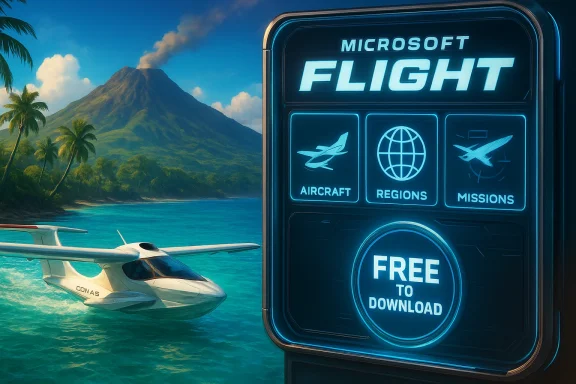
Microsoft’s return to the skies in 2012 took an unexpected route: instead of a full-blown sequel to Flight Simulator, the company launched Microsoft Flight as a free-to-download, freemium entry aimed at broadening the audience for virtual flying — and it arrived with the promise that “it won’t cost you a penny to download.”
Microsoft’s long-running flight franchise dates back to the early 1980s, but by the late 2000s the series had fallen relatively quiet in terms of official follow-ups. In January 2012 Microsoft announced a new direction: a streamlined, accessible product that would give anyone with a PC the chance to “jump into the fun, freedom and adventure of flight” without the friction of expensive hardware or steep learning curves. That product, simply titled Microsoft Flight, was slated to launch as a free-to-play download on February 29, 2012, with optional paid expansions and aircraft sold through Microsoft’s marketplace.
The strategy was bold: instead of selling a single boxed title with maximum content, Microsoft aimed to democratize access, using a freemium storefront model to monetize additional aircraft, regions and mission packs. For players, the baseline experience included a polished single region and a clearly signposted progression path; for Microsoft, the hope was to build a large user base and convert a meaningful slice of that audience into paying customers for DLC.
This approach promised several advantages:
The divide was predictable: newcomers appreciated an easy entry point and lower technical barriers, while longtime simmers lamented the loss of extensibility and depth that had defined the Flight Simulator lineage. That schism proved to be more than academic; it affected conversion rates and long-term engagement.
That choice had downstream effects:
In the end, Microsoft Flight’s brief life underscores a broader industry truth: business model innovation must be matched by community-first design, robust content pipelines, and resilience against platform shifts. The subsequent return of the Flight Simulator franchise in 2020 shows that Microsoft learned from those missteps, refocusing on authenticity, scale, and community engagement. For publishers and developers, Microsoft Flight remains a valuable case study in both the promise and peril of modernizing legacy IP for new audiences.
Source: onmsft.com https://onmsft.com/news/microsoft-flight-now-available-wont-cost-you-penny-download/
 Background and overview
Microsoft’s long-running flight franchise dates back to the early 1980s, but by the late 2000s the series had fallen relatively quiet in terms of official follow-ups. In January 2012 Microsoft announced a new direction: a streamlined, accessible product that would give anyone with a PC the chance to “jump into the fun, freedom and adventure of flight” without the friction of expensive hardware or steep learning curves. That product, simply titled Microsoft Flight, was slated to launch as a free-to-play download on February 29, 2012, with optional paid expansions and aircraft sold through Microsoft’s marketplace.The strategy was bold: instead of selling a single boxed title with maximum content, Microsoft aimed to democratize access, using a freemium storefront model to monetize additional aircraft, regions and mission packs. For players, the baseline experience included a polished single region and a clearly signposted progression path; for Microsoft, the hope was to build a large user base and convert a meaningful slice of that audience into paying customers for DLC.
What shipped at launch — content and technical baseline
Included content
At launch, Microsoft Flight offered the Big Island of Hawaii as the primary play area and the ICON A5 amphibious light-sport aircraft as the free, core flyable aircraft. Players who signed in with Games for Windows – LIVE received additional free perks (for example, the Boeing Stearman in some promotions), and optional premium items — more aircraft and the Hawaiian Adventure Pack — were available for purchase. That mix positioned the base product as an approachable “toybox” and the paid expansions as the path to deeper, more traditional sim experiences.System requirements and delivery format
Microsoft designed Flight to be broadly accessible. Minimum system requirements were modest by 2012 standards — dual-core CPUs, a few gigabytes of RAM, and consumer GPUs — while recommended specs were higher for users aiming to unlock the full graphical fidelity. The game distributed as a digital download and used the Games for Windows – LIVE system for account tie-ins, achievements, and the marketplace that handled add-on purchases. Those platform choices directly influenced the user experience in positive and negative ways, as the marketplace now served both as the source of revenue and as a single point of dependency.The freemium model: how Microsoft planned to make money
Microsoft’s plan was straightforward: give away the core island and a single aircraft for free, then sell optional aircraft and region packs — a model similar to mobile freemium games but applied to a PC flight product. The Hawaiian Adventure Pack, for instance, bundled multiple islands, a new plane and around 20 missions and was priced in the ballpark of $19.99, while individual historic or specialty aircraft were sold at lower price points. The marketplace approach allowed the company to release content iteratively and adjust pricing or offerings over time.This approach promised several advantages:
- Rapid scale: By removing the initial price barrier, Microsoft could attract casual players who would never have purchased a full-priced sim.
- Ongoing revenue: A steady stream of paid expansions and aircraft could, in theory, produce longer revenue tails than one-off boxed sales.
- Iterative product growth: Microsoft could test content and tune offerings based on telemetry and purchase behavior.
Early reactions: accessibility vs. authenticity
Industry and community reaction to Microsoft Flight was mixed. Many outlets and commentators applauded Microsoft’s attempt to make flying accessible to casual gamers and newcomers; the visuals for the Hawaiian scenery and the ICON A5 were frequently praised as polished and inviting. At the same time, seasoned flight-sim veterans and several specialist outlets criticized the title for feeling more like a “game” than a true flight simulator — noting a smaller fleet, limited terrain, and a closed ecosystem that did not accept existing Flight Simulator X add-ons. Those limitations were significant for a community accustomed to a massive third-party add-on market and near-infinite customizability.The divide was predictable: newcomers appreciated an easy entry point and lower technical barriers, while longtime simmers lamented the loss of extensibility and depth that had defined the Flight Simulator lineage. That schism proved to be more than academic; it affected conversion rates and long-term engagement.
The short lifespan: cancellation and marketplace shutdown
Less than five months after launch, Microsoft abruptly announced that it had ceased active development on Microsoft Flight. The July 25–26, 2012 decision officially ended the studio’s ongoing roadmap for the title, leaving the core product available for download but halting future paid expansions and feature development. Industry coverage at the time framed the move as part business-readjustment and part market response: Microsoft said it was aligning long-term goals and development plans, while analysts pointed to weak DLC sales, market fragmentation, and the product’s failure to capture the hardcore sim audience as likely contributors.That choice had downstream effects:
- Microsoft closed the Xbox.com PC Marketplace in August 2013, which removed the primary storefront for Flight add-ons and limited the ability to acquire new DLC through official channels.
- Multiplayer servers and online-only features were later turned off (notably in October 2014), which further reduced the product’s utility even for existing owners and made some content permanently inaccessible. Users who had purchased add-ons retained access in many cases, but the ecosystem’s viability effectively ended.
Strengths: what Microsoft Flight did well
Microsoft Flight had several clear strengths worth highlighting:- Low barrier to entry: The free download model removed the financial friction that keeps many potential players from trying flight software. This broadened the potential audience beyond hobbyist pilots to casual gamers and learners.
- Polished presentation: The island scenery and the core free aircraft received praise for visuals and approachable flight dynamics that balanced realism and playability. The ICON A5, in particular, was a strong marketing hook and an intriguing aircraft choice that emphasized leisure flying.
- Modern distribution: By leveraging digital distribution and a marketplace for add-ons, Microsoft modernized how extra content could be sold and delivered — a forward-looking approach that mirrors later successes in other entertainment categories.
- Potential for iterative growth: The freemium model, if supported by steady content and community engagement, could have enabled Microsoft to build a living platform with recurring revenue rather than a single peak at launch.
Risks and where Microsoft Flight faltered
Despite the promising elements, Microsoft Flight exposed a set of execution risks that undermined its long-term success:- Misaligned audience expectations: The flight-sim community is deeply invested in realism, third-party aircraft, and global scenery — priorities that Microsoft Flight deprioritized. That mismatch meant the product had a hard time converting hardcore simmers to buyers, while casual players often didn’t buy enough DLC to sustain the business model.
- Marketplace dependency: Relying on Games for Windows – LIVE and Microsoft’s marketplace centralized distribution but also placed the product’s destiny in the hands of platform policy decisions. The later closure of the marketplace illustrated how platform-level moves can strand digital ecosystems.
- Limited extensibility: Microsoft Flight was not compatible with Flight Simulator X add-ons, eliminating an entire ecosystem of third-party content that had traditionally kept Microsoft’s flight products alive and vibrant. That decision removed a key lever for community-driven longevity.
- Monetization friction: Early DLC pricing and the paltry amount of free content left many players feeling like the base product was too lean — a perception that dampened goodwill and reduced the lifetime value of free users. Several contemporary reviews and community reactions flagged this as a reason conversion rates underperformed expectations.
- Short runway for growth: The product needed time, steady content drops, and community engagement to mature. Microsoft did not provide that runway, leading to an early shutdown that effectively curtailed the experiment before it could fully mature.
Lessons learned and legacy
The Microsoft Flight episode left a mixed legacy — one of both innovation and caution. Key lessons include:- Know your core market: Radical changes to a legacy franchise require a careful balancing act between attracting new users and retaining the loyalty of established, vocal communities. Alienating the latter can negate any gains from the former.
- Build for ecosystems: For simulation genres, third-party ecosystems are often the lifeblood of long-term engagement. Supporting modding, add-ons and community tools is not optional if the goal is longevity.
- Avoid single-point failure: When a product depends on a single marketplace or platform service, any corporate decision to alter that platform can have outsized downstream consequences. The shutdown of the Xbox PC Marketplace illustrates this fragility.
- Give freemium time and content: Freemium requires both patience and an aggressive content cadence to convert a meaningful share of users into paying customers; that process often takes longer than traditional boxed releases. Microsoft Flight’s short development window did not allow this process to play out.
For players today: what to take away
If the 2012 Microsoft Flight launch teaches one practical thing for players and hobbyists in 2026, it is this: free or heavily discounted entry can be an excellent way to sample a simulator, but long-term enjoyment usually hinges on the depth and ecosystem behind the product.- If you want immediate accessibility and low friction, seek out free or low-cost entry titles or demos — but check whether content you value (aircraft, regions, multiplayer) is gated behind paywalls and whether those gating mechanisms are sustainable.
- If you prioritize authenticity, community add-ons, and long-lasting support, consider established simulator ecosystems that prioritize third-party development and broad compatibility. Modern incarnations of Microsoft Flight Simulator (2020 and beyond) and X-Plane remain the safest bets for simulators that combine realism, community content, and ongoing developer support.
Final analysis: a bold idea that ran out of runway
Microsoft Flight in 2012 was an ambitious experiment: blending approachable design with a modern digital storefront to reimagine how aviation could be packaged and sold on PCs. Its strengths were real — accessibility, thoughtful presentation, and a modern distribution model — but so were its structural weaknesses. The freemium approach clashed with the flight-sim market’s expectations, and a reliance on a proprietary marketplace left the product vulnerable to platform-level changes.In the end, Microsoft Flight’s brief life underscores a broader industry truth: business model innovation must be matched by community-first design, robust content pipelines, and resilience against platform shifts. The subsequent return of the Flight Simulator franchise in 2020 shows that Microsoft learned from those missteps, refocusing on authenticity, scale, and community engagement. For publishers and developers, Microsoft Flight remains a valuable case study in both the promise and peril of modernizing legacy IP for new audiences.
Source: onmsft.com https://onmsft.com/news/microsoft-flight-now-available-wont-cost-you-penny-download/
