

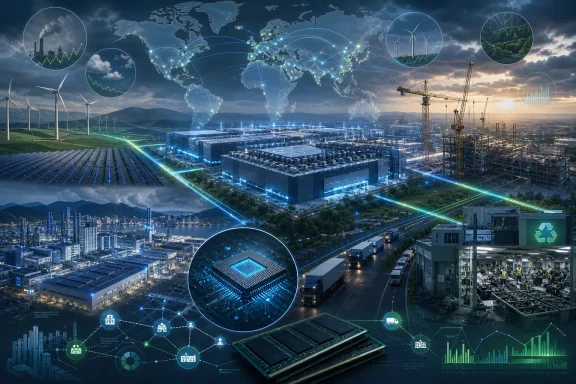
Microsoft’s second annual Global Sustainability Supplier Summit has exposed the defining infrastructure challenge of the AI era: the computing industry cannot keep treating environmental performance as a problem confined to datacenter walls. With Microsoft Cloud spanning more than 500 datacenter campuses and 80 regions, the company’s expansion increasingly depends on electricity grids, semiconductor factories, construction materials, equipment vendors, logistics networks, and local communities that Microsoft does not directly control. The Seoul summit therefore marked an important shift from setting corporate goals to building the industrial system needed to deliver them—even as Microsoft’s own emissions data shows how rapidly AI growth is raising the difficulty level.
Microsoft entered the decade with some of the technology sector’s most ambitious environmental commitments. In January 2020, it pledged to become carbon negative by 2030, remove its historical carbon emissions by 2050, become water positive, reach zero waste across its direct footprint, and protect more land than it uses.
Those targets were established before generative AI radically changed the infrastructure outlook. Cloud growth was already driving datacenter construction, but the emergence of large AI models added extraordinary demand for accelerators, high-bandwidth memory, networking equipment, cooling systems, substations, transmission capacity, and new power generation.
Every new Azure region requires far more than servers. It depends on land, concrete, steel, copper, transformers, backup power, cooling equipment, optical networking, advanced chips, and a reliable stream of replacement components. The environmental footprint begins years before a rack becomes operational and extends across multiple tiers of suppliers.
Azure has expanded, Microsoft has deepened its partnership with OpenAI, Copilot has spread across the company’s software portfolio, and AI infrastructure has become a strategic priority. The result is a tension shared across the hyperscale cloud industry: efficiency may improve at the level of an individual calculation, server, or facility while total resource consumption continues to rise because overall demand grows even faster.
Microsoft characterized its 2025 supplier summit in Singapore as an exercise in alignment. The 2026 gathering in Seoul focused more directly on execution and on the policies required to convert corporate demand into operational projects.
High-bandwidth memory has become especially important to AI accelerators. Its production involves sophisticated fabrication processes, extensive clean-room operations, high-purity materials, significant electricity consumption, and complex upstream supplier networks.
Microsoft cannot decarbonize an Azure AI service merely by improving the power usage effectiveness of the datacenter in which it runs. It must also address the emissions associated with producing the accelerators, memory, server boards, networking hardware, and buildings required to deliver that service.
This is why the summit placed unusual emphasis on policy. Corporate purchasing commitments can create demand, but governments, utilities, grid operators, developers, financiers, and communities must translate that demand into generation and transmission capacity.
Scope 3 has become what Microsoft calls the industry’s “great equalizer.” A hyperscaler may have enormous purchasing power, but it still depends on suppliers whose factories serve multiple customers and whose electricity comes from regional grids.
Accurately measuring those emissions is difficult for several reasons:
Yet mandates alone will not solve the problem. Smaller suppliers may lack the capital, staff, data systems, or market access needed to comply. If Microsoft imposes standards without offering practical assistance, it could concentrate business among the largest vendors rather than decarbonize the wider ecosystem.
A successful supplier program therefore needs financing mechanisms, technical guidance, common measurement tools, longer-term demand signals, and realistic transition plans. The summit’s focus on execution playbooks and targeted pilots suggests Microsoft understands that compliance questionnaires are not a substitute for industrial transformation.
Its Circular Centers have also increased the reuse and recycling of cloud hardware. The company reports a 92% reuse and recycling rate through that program, building on earlier results that allowed it to reach its original 90% hardware target ahead of schedule.
That distinction matters because an AI cluster may consume power continuously, including at night, during low-wind periods, or when the local grid relies heavily on fossil-fuel generation. Long-term power purchase agreements can help finance additional renewable capacity, but annual matching still provides an incomplete picture of the electricity physically serving a facility.
The next stage is more demanding: aligning consumption with carbon-free generation by location and time. That requires a broader mix of resources, potentially including solar, wind, geothermal power, hydropower, nuclear energy, storage, demand flexibility, and transmission.
The increase reflects rapid datacenter expansion, growing electricity consumption, construction activity, hardware procurement, and a change in how Microsoft accounts for certain renewable-energy instruments. Scope 2 emissions became a much larger portion of the reported total, illustrating how difficult it is to add AI capacity faster than clean power and grid infrastructure can be delivered.
This does not erase Microsoft’s renewable-energy or circularity achievements, but it does prevent them from being treated as proof that the overall footprint is shrinking. The company is simultaneously making genuine progress in individual programs and moving farther from the emissions trajectory implied by its 2030 carbon-negative commitment.
Utilities in several markets face long interconnection queues, insufficient transmission, transformer shortages, and rapidly rising demand. A datacenter campus may be designed and permitted before the grid can supply the capacity its operators require.
However, solar output varies with daylight and weather. A large AI installation running around the clock cannot rely on solar alone without storage, complementary generation, grid connections, or workload flexibility.
The practical path will involve portfolios rather than a single preferred technology. Regions will need to combine resources according to local geography, market structure, existing infrastructure, and public acceptance.
The AI industry’s clean-energy challenge therefore unfolds in a sequence:
The reform generally restricts excessive setback requirements while preserving limited exceptions for protected locations, residential areas, and certain sites near major roads. It is expected to broaden the range of viable renewable-energy projects after implementation.
The value of the Korean reform will therefore be measured in megawatts connected, not clauses amended. If hundreds of municipalities interpret and implement the framework consistently, the result could be a meaningful increase in developable solar locations.
If local opposition, grid congestion, or procedural delays persist, the practical effect may be smaller. Microsoft’s phrase “from policy to power” captures the central test: legislation must produce real electrons where semiconductor and advanced-manufacturing facilities can use them.
South Korea’s community-participation models may help address that concern. Shared ownership, local revenue, rooftop installations, and self-consumption projects can make renewable energy part of regional economic development rather than an external industrial demand.
For Microsoft and its suppliers, community trust is not separate from execution. Opposition that delays a transmission line or solar project can become a direct constraint on cloud and semiconductor capacity.
Advanced packaging and high-bandwidth memory add further manufacturing stages. The pressure to increase accelerator output can also drive construction of new fabrication plants, packaging facilities, and supporting infrastructure.
When computing becomes cheaper or more capable, customers often use more of it. Larger models, longer context windows, agentic workflows, video generation, real-time inference, and broader deployment can absorb efficiency gains and increase total demand.
This rebound effect means Microsoft must track both unit efficiency and absolute consumption. Reporting only that a new accelerator performs more operations per joule would miss the environmental effect of deploying hundreds of thousands of those accelerators.
Lower-carbon alternatives are emerging, including supplementary cementitious materials, cleaner steelmaking, material-efficient structural design, recycled metals, and improved lifecycle assessment. The obstacle is moving those solutions from pilots into large, dependable supply contracts.
Hyperscalers can accelerate adoption by guaranteeing demand. They must also preserve engineering standards, cost control, and construction schedules, because an experimental material that cannot be certified or supplied at scale will not support a global datacenter program.
Reuse preserves more of the energy, materials, and manufacturing effort embedded in equipment. Component harvesting can also reduce demand for replacement parts and improve supply resilience during periods of shortage.
Circularity should therefore follow a hierarchy:
Recovering these materials can reduce waste and diversify supply. The quantities reclaimed from retired hardware may not replace primary mining, but they can create strategic inventories, support recycling markets, and reduce exposure to geopolitical disruption.
The program’s recognition in Gartner’s 2026 Social Impact of the Year category gives Microsoft a useful case study. Its larger significance will depend on whether recovery becomes repeatable, economical, and traceable across the global cloud fleet.
These capabilities could make environmental management faster and more precise. They could also help suppliers that lack large sustainability teams automate parts of data collection and reporting.
The most useful systems would connect several data layers:
Companies must clearly separate measured values from modeled values. They also need audit trails that explain how figures were calculated and changed over time.
Without those safeguards, AI could make environmental reporting appear more sophisticated while hiding uncertainty. The objective should be decision-grade transparency, not a dashboard whose confidence exceeds the underlying evidence.
This matters because purchased cloud and AI services may appear in an enterprise’s own Scope 3 inventory. A customer cannot calculate that footprint accurately if the cloud provider supplies only broad corporate averages.
Microsoft could give customers more control by offering:
Enterprise customers should not assume that sustainable infrastructure will always be cheaper. Microsoft may absorb some costs, share them with suppliers, or incorporate them into service pricing.
The strategic question is whether cleaner, more resilient infrastructure reduces long-term exposure to energy volatility, carbon regulation, supply disruptions, and community opposition. If it does, a higher upfront cost may protect customers from larger future risks.
As Copilot and local AI capabilities expand, consumers will hear more claims about performance per watt. Those claims should be evaluated alongside repairability, useful life, software support, battery replacement, and the environmental cost of manufacturing a new machine.
A small, optimized model running occasionally on an NPU may be highly efficient. A large workload that runs slowly on consumer hardware may consume more energy than an optimized cloud service operating on specialized accelerators.
The answer will vary by task. Microsoft and PC manufacturers should provide credible energy and performance data rather than implying that “on-device” and “sustainable” are synonymous.
Repairable designs, replaceable storage, accessible batteries, driver support, firmware updates, and realistic hardware requirements can all extend device life. This is an area where software policy and supply-chain sustainability directly intersect.
Sustainability is therefore becoming both a reputational issue and a capacity strategy. A company that secures dependable carbon-free electricity can expand with less exposure to regulation, fossil-fuel prices, and public resistance.
Collaboration makes sense where no single buyer can change a regional grid. Shared demand can justify larger renewable projects, better transmission, common data standards, and supplier training.
Competition remains intense elsewhere. Each cloud provider will want preferential access to clean capacity, differentiated sustainability claims, and lower-carbon hardware. Common standards must therefore prevent collaboration from becoming a vehicle for vague commitments or selective disclosure.
The provider with the most credible data may gain an advantage over one with the largest headline number. Auditable emissions inventories, hourly energy matching, product-level carbon data, and transparent accounting changes could become meaningful enterprise sales tools.
Important indicators will include the percentage of strategic suppliers using carbon-free electricity, the share reporting factory-level data, reductions in embodied carbon per server, and the number of pilots that progress to commercial deployment.
More granular reporting would allow customers to distinguish contractual progress from physical grid decarbonization. It would also make year-to-year comparisons more useful when accounting methods change.
The company may need to prioritize regions with available low-carbon power, delay projects where grids cannot support them responsibly, or make AI workloads more flexible. Those choices could conflict with commercial pressure to deploy capacity everywhere as quickly as possible.
Microsoft’s central argument is ultimately correct: sustainability in the AI era depends on systems, not isolated corporate actions. Electricity grids, semiconductor factories, construction supply chains, cloud architectures, public policy, and local communities must evolve together. The company has the scale to accelerate that transition, but its rising emissions demonstrate that scale can amplify the problem just as easily as it can finance the solution; the decisive measure will be whether Microsoft and its partners can turn contracts, summits, and targets into cleaner power, lower-carbon hardware, longer-lived equipment, and an absolute reduction in environmental impact before 2030 arrives.
 Background
Microsoft entered the decade with some of the technology sector’s most ambitious environmental commitments. In January 2020, it pledged to become carbon negative by 2030, remove its historical carbon emissions by 2050, become water positive, reach zero waste across its direct footprint, and protect more land than it uses.Those targets were established before generative AI radically changed the infrastructure outlook. Cloud growth was already driving datacenter construction, but the emergence of large AI models added extraordinary demand for accelerators, high-bandwidth memory, networking equipment, cooling systems, substations, transmission capacity, and new power generation.
From software company to industrial-scale infrastructure operator
Microsoft remains best known to many Windows users as the developer of Windows, Microsoft 365, Xbox, and Surface. Its modern business, however, also operates at the scale of a major industrial and energy consumer.Every new Azure region requires far more than servers. It depends on land, concrete, steel, copper, transformers, backup power, cooling equipment, optical networking, advanced chips, and a reliable stream of replacement components. The environmental footprint begins years before a rack becomes operational and extends across multiple tiers of suppliers.
The 2020 baseline meets the AI boom
Microsoft measures progress toward its 2030 targets against a fiscal 2020 baseline. That provides a consistent reference point, but it also highlights how dramatically the company has changed since the goals were announced.Azure has expanded, Microsoft has deepened its partnership with OpenAI, Copilot has spread across the company’s software portfolio, and AI infrastructure has become a strategic priority. The result is a tension shared across the hyperscale cloud industry: efficiency may improve at the level of an individual calculation, server, or facility while total resource consumption continues to rise because overall demand grows even faster.
Why Microsoft Took the Conversation to Seoul
The 2026 Global Sustainability Supplier Summit brought together more than 100 attendees representing dozens of suppliers and organizations. Participants came from semiconductor manufacturing, finance, consulting, startups, advocacy groups, and nonprofit organizations, reflecting the broad coalition now required to decarbonize cloud infrastructure.Microsoft characterized its 2025 supplier summit in Singapore as an exercise in alignment. The 2026 gathering in Seoul focused more directly on execution and on the policies required to convert corporate demand into operational projects.
South Korea sits near the center of the AI supply chain
Seoul was a strategically significant venue rather than a symbolic choice. South Korea is home to Samsung Electronics and SK hynix, two companies deeply embedded in the production of memory, storage, semiconductor components, displays, and other technologies used throughout modern computing.High-bandwidth memory has become especially important to AI accelerators. Its production involves sophisticated fabrication processes, extensive clean-room operations, high-purity materials, significant electricity consumption, and complex upstream supplier networks.
Microsoft cannot decarbonize an Azure AI service merely by improving the power usage effectiveness of the datacenter in which it runs. It must also address the emissions associated with producing the accelerators, memory, server boards, networking hardware, and buildings required to deliver that service.
Manufacturing regions need additional clean electricity
Many technology suppliers operate in regions where access to carbon-free electricity remains limited, expensive, or administratively difficult. A supplier can install more efficient equipment, but it cannot independently build a national transmission network or rewrite local renewable-energy regulations.This is why the summit placed unusual emphasis on policy. Corporate purchasing commitments can create demand, but governments, utilities, grid operators, developers, financiers, and communities must translate that demand into generation and transmission capacity.
Scope 3 Becomes the Central Battlefield
According to Microsoft’s 2026 Environmental Sustainability Report, roughly 70% of its emissions are associated with purchased goods, purchased services, and capital goods. Those sources fall within Scope 3, the category covering indirect value-chain emissions outside a company’s directly controlled operations and purchased electricity.Scope 3 has become what Microsoft calls the industry’s “great equalizer.” A hyperscaler may have enormous purchasing power, but it still depends on suppliers whose factories serve multiple customers and whose electricity comes from regional grids.
Why Scope 3 accounting is difficult
Scope 1 emissions come from sources a company owns or controls, while Scope 2 generally covers emissions associated with purchased energy. Scope 3 stretches across the wider value chain, including manufacturing, construction, transportation, business travel, product use, and waste.Accurately measuring those emissions is difficult for several reasons:
- Many suppliers do not yet provide detailed, product-level environmental data.
- Lower-tier suppliers may be invisible to the customer purchasing the finished component.
- Spend-based estimates can obscure operational improvements or exaggerate changes caused by price inflation.
- Different accounting methods can produce materially different results for the same activity.
- A supplier’s electricity mix may vary by factory, hour, season, and contractual arrangement.
- Lifecycle boundaries may differ between vendors, making direct comparisons unreliable.
Procurement becomes environmental policy
For Microsoft, supplier contracts are becoming one of the strongest tools available. Purchasing requirements can encourage vendors to disclose emissions, improve energy efficiency, source cleaner electricity, reduce waste, and develop lower-carbon materials.Yet mandates alone will not solve the problem. Smaller suppliers may lack the capital, staff, data systems, or market access needed to comply. If Microsoft imposes standards without offering practical assistance, it could concentrate business among the largest vendors rather than decarbonize the wider ecosystem.
A successful supplier program therefore needs financing mechanisms, technical guidance, common measurement tools, longer-term demand signals, and realistic transition plans. The summit’s focus on execution playbooks and targeted pilots suggests Microsoft understands that compliance questionnaires are not a substitute for industrial transformation.
Microsoft’s Progress and Its Uncomfortable Emissions Trend
Microsoft has achieved several important operational milestones. It says it now matches 100% of its annual electricity consumption with renewable energy and has contracted approximately 40 gigawatts of new renewable supply across 26 countries through more than 400 agreements involving over 95 utilities and developers.Its Circular Centers have also increased the reuse and recycling of cloud hardware. The company reports a 92% reuse and recycling rate through that program, building on earlier results that allowed it to reach its original 90% hardware target ahead of schedule.
Annual matching is not round-the-clock clean power
Renewable-energy matching does not necessarily mean every Microsoft datacenter runs directly on carbon-free electricity every hour. Annual accounting can balance electricity consumption against renewable generation purchased or contracted elsewhere or at different times.That distinction matters because an AI cluster may consume power continuously, including at night, during low-wind periods, or when the local grid relies heavily on fossil-fuel generation. Long-term power purchase agreements can help finance additional renewable capacity, but annual matching still provides an incomplete picture of the electricity physically serving a facility.
The next stage is more demanding: aligning consumption with carbon-free generation by location and time. That requires a broader mix of resources, potentially including solar, wind, geothermal power, hydropower, nuclear energy, storage, demand flexibility, and transmission.
Total emissions are moving in the wrong direction
Microsoft’s latest reporting also presents a sobering counterpoint to its supplier-summit message. For fiscal 2025, the company reported total greenhouse-gas emissions of approximately 20.3 million metric tons of carbon-dioxide equivalent, up from about 16.2 million in fiscal 2024—a year-over-year increase of roughly 25%.The increase reflects rapid datacenter expansion, growing electricity consumption, construction activity, hardware procurement, and a change in how Microsoft accounts for certain renewable-energy instruments. Scope 2 emissions became a much larger portion of the reported total, illustrating how difficult it is to add AI capacity faster than clean power and grid infrastructure can be delivered.
This does not erase Microsoft’s renewable-energy or circularity achievements, but it does prevent them from being treated as proof that the overall footprint is shrinking. The company is simultaneously making genuine progress in individual programs and moving farther from the emissions trajectory implied by its 2030 carbon-negative commitment.
Carbon-Free Electricity Becomes a Capacity Requirement
The Seoul summit framed carbon-free electricity not merely as an environmental preference but as an enabler of AI growth. That framing reflects a practical reality: power availability has become one of the largest constraints on datacenter development.Utilities in several markets face long interconnection queues, insufficient transmission, transformer shortages, and rapidly rising demand. A datacenter campus may be designed and permitted before the grid can supply the capacity its operators require.
Solar can move quickly, but it cannot work alone
Microsoft highlighted solar energy as one of the fastest generation technologies to deploy. Solar projects can be modular, construction timelines can be relatively short, and industrial rooftops or parking structures can provide useful sites in densely developed manufacturing regions.However, solar output varies with daylight and weather. A large AI installation running around the clock cannot rely on solar alone without storage, complementary generation, grid connections, or workload flexibility.
The practical path will involve portfolios rather than a single preferred technology. Regions will need to combine resources according to local geography, market structure, existing infrastructure, and public acceptance.
Grid infrastructure is the hidden bottleneck
Building generation does not help if the electricity cannot reach the factories and datacenters that need it. Transmission projects can take far longer to permit and construct than solar or wind farms, while distribution systems may require extensive upgrades to accommodate large industrial loads.The AI industry’s clean-energy challenge therefore unfolds in a sequence:
- Companies provide credible, long-term demand signals.
- Developers secure land, permits, equipment, and financing for new generation.
- Grid operators study and approve interconnection requests.
- Utilities and governments build transmission and distribution capacity.
- Suppliers negotiate access to the resulting electricity.
- Measurement systems verify whether claimed reductions correspond to real-world changes.
South Korea’s Policy Shift Offers a Test Case
South Korea recently amended its renewable-energy framework to rationalize municipal separation-distance restrictions that had constrained solar construction. Local rules had often required solar facilities to remain specified distances from roads, homes, or other features, sharply reducing the amount of usable land.The reform generally restricts excessive setback requirements while preserving limited exceptions for protected locations, residential areas, and certain sites near major roads. It is expected to broaden the range of viable renewable-energy projects after implementation.
From legal reform to physical deployment
Changing the law is only the first step. Developers still need suitable sites, community acceptance, interconnection capacity, project financing, equipment, and customers willing to sign durable contracts.The value of the Korean reform will therefore be measured in megawatts connected, not clauses amended. If hundreds of municipalities interpret and implement the framework consistently, the result could be a meaningful increase in developable solar locations.
If local opposition, grid congestion, or procedural delays persist, the practical effect may be smaller. Microsoft’s phrase “from policy to power” captures the central test: legislation must produce real electrons where semiconductor and advanced-manufacturing facilities can use them.
Community participation remains essential
Relaxing setback rules can create conflict if residents believe projects are being imposed without local benefits. Renewable development succeeds more consistently when communities receive transparent information, meaningful consultation, economic participation, or direct benefits.South Korea’s community-participation models may help address that concern. Shared ownership, local revenue, rooftop installations, and self-consumption projects can make renewable energy part of regional economic development rather than an external industrial demand.
For Microsoft and its suppliers, community trust is not separate from execution. Opposition that delays a transmission line or solar project can become a direct constraint on cloud and semiconductor capacity.
Semiconductors, Materials, and the Embodied Cost of AI
AI infrastructure has a large footprint before it consumes its first kilowatt-hour in a datacenter. Semiconductor fabrication requires ultrapure water, process gases, chemicals, clean rooms, precision equipment, and tightly controlled production environments.Advanced packaging and high-bandwidth memory add further manufacturing stages. The pressure to increase accelerator output can also drive construction of new fabrication plants, packaging facilities, and supporting infrastructure.
Hardware efficiency can create rebound effects
New chips usually deliver more performance per watt than previous generations. That is valuable, but improved efficiency does not guarantee a reduction in total energy consumption.When computing becomes cheaper or more capable, customers often use more of it. Larger models, longer context windows, agentic workflows, video generation, real-time inference, and broader deployment can absorb efficiency gains and increase total demand.
This rebound effect means Microsoft must track both unit efficiency and absolute consumption. Reporting only that a new accelerator performs more operations per joule would miss the environmental effect of deploying hundreds of thousands of those accelerators.
Concrete, steel, and copper matter too
Datacenter sustainability discussions often concentrate on electricity, but construction materials produce substantial embodied emissions. Concrete relies on carbon-intensive cement, steel production remains heavily dependent on fossil fuels in many markets, and electrification is increasing demand for copper.Lower-carbon alternatives are emerging, including supplementary cementitious materials, cleaner steelmaking, material-efficient structural design, recycled metals, and improved lifecycle assessment. The obstacle is moving those solutions from pilots into large, dependable supply contracts.
Hyperscalers can accelerate adoption by guaranteeing demand. They must also preserve engineering standards, cost control, and construction schedules, because an experimental material that cannot be certified or supplied at scale will not support a global datacenter program.
Circularity Must Move Beyond Recycling
Microsoft’s Circular Centers recover servers and components from datacenters, assess their condition, and direct them toward reuse, refurbishment, harvesting, or recycling. This is more valuable than sending decommissioned hardware directly into a conventional waste stream.Reuse preserves more of the energy, materials, and manufacturing effort embedded in equipment. Component harvesting can also reduce demand for replacement parts and improve supply resilience during periods of shortage.
Extending useful life is the highest-value intervention
A high recycling percentage is encouraging, but recycling remains less desirable than avoiding premature replacement. Melting metals and processing electronic waste consume energy and may recover only part of the original material value.Circularity should therefore follow a hierarchy:
- Design hardware for durability, repair, and disassembly.
- Use telemetry to replace components based on condition rather than arbitrary schedules.
- Redeploy functional equipment into less demanding roles.
- Harvest tested parts for maintenance inventories.
- Refurbish or resell equipment when security and reliability requirements permit.
- Recycle remaining materials through verified, responsible channels.
Rare-earth recovery connects sustainability to resilience
Microsoft’s Rare Earth Element Program illustrates how environmental and business priorities can reinforce each other. Rare-earth materials are used in components such as magnets, drives, motors, and power equipment, while their extraction and processing are concentrated in a limited number of regions.Recovering these materials can reduce waste and diversify supply. The quantities reclaimed from retired hardware may not replace primary mining, but they can create strategic inventories, support recycling markets, and reduce exposure to geopolitical disruption.
The program’s recognition in Gartner’s 2026 Social Impact of the Year category gives Microsoft a useful case study. Its larger significance will depend on whether recovery becomes repeatable, economical, and traceable across the global cloud fleet.
AI Can Help Measure the Problem, but It Cannot Erase It
The summit emphasized innovation in lifecycle assessment, financing, materials, and AI-assisted sustainability. AI can process large datasets, identify anomalies, estimate missing information, optimize logistics, forecast renewable generation, and improve datacenter workload scheduling.These capabilities could make environmental management faster and more precise. They could also help suppliers that lack large sustainability teams automate parts of data collection and reporting.
Better measurement can improve purchasing decisions
A mature lifecycle-assessment platform could allow Microsoft to compare functionally equivalent components based on embodied carbon, recycled content, repairability, transportation distance, and expected service life. Procurement teams could then incorporate environmental performance into cost and reliability decisions.The most useful systems would connect several data layers:
- Supplier-specific manufacturing information.
- Factory-level electricity sources.
- Product bills of materials.
- Logistics routes and shipping modes.
- Expected hardware utilization and lifespan.
- Repair, reuse, and end-of-life outcomes.
Automation introduces its own integrity risks
AI-generated estimates can create false precision. A model may fill gaps in supplier data, but its output remains an estimate shaped by assumptions, training data, and system boundaries.Companies must clearly separate measured values from modeled values. They also need audit trails that explain how figures were calculated and changed over time.
Without those safeguards, AI could make environmental reporting appear more sophisticated while hiding uncertainty. The objective should be decision-grade transparency, not a dashboard whose confidence exceeds the underlying evidence.
Implications for Enterprise Customers
Enterprise customers increasingly want to understand the environmental effect of moving workloads to Azure or adopting Microsoft 365 Copilot. Microsoft’s supplier initiative could eventually improve the quality of product-level disclosures available to those customers.This matters because purchased cloud and AI services may appear in an enterprise’s own Scope 3 inventory. A customer cannot calculate that footprint accurately if the cloud provider supplies only broad corporate averages.
Cloud selection may include carbon availability
Traditional cloud architecture weighs price, latency, security, compliance, resilience, and service availability. Carbon intensity is becoming another variable, particularly for organizations with formal emissions targets or regulatory reporting obligations.Microsoft could give customers more control by offering:
- Region-specific emissions information.
- Workload scheduling around cleaner grid periods.
- Carbon-aware recommendations in Azure management tools.
- More granular estimates for AI training and inference.
- Verified allocation methods for shared infrastructure.
- Options to prioritize lower-carbon regions when latency permits.
Supplier standards may affect cloud pricing
Cleaner electricity, low-carbon materials, verified reporting, and circular hardware systems all have costs. Some investments may lower operating expenses over time, but others could increase near-term capital expenditure.Enterprise customers should not assume that sustainable infrastructure will always be cheaper. Microsoft may absorb some costs, share them with suppliers, or incorporate them into service pricing.
The strategic question is whether cleaner, more resilient infrastructure reduces long-term exposure to energy volatility, carbon regulation, supply disruptions, and community opposition. If it does, a higher upfront cost may protect customers from larger future risks.
Implications for Windows Users and Device Buyers
The summit focused on Microsoft Cloud’s supply chain, but its principles extend to Windows PCs and connected devices. AI PCs require processors with neural processing units, additional memory, storage, and increasingly sophisticated power-management features.As Copilot and local AI capabilities expand, consumers will hear more claims about performance per watt. Those claims should be evaluated alongside repairability, useful life, software support, battery replacement, and the environmental cost of manufacturing a new machine.
Local AI is not automatically greener
Running an AI task locally can reduce network traffic and avoid some cloud inference, but it transfers electricity consumption to the user’s device. Whether that is environmentally preferable depends on the hardware, workload, local electricity mix, and efficiency of the cloud alternative.A small, optimized model running occasionally on an NPU may be highly efficient. A large workload that runs slowly on consumer hardware may consume more energy than an optimized cloud service operating on specialized accelerators.
The answer will vary by task. Microsoft and PC manufacturers should provide credible energy and performance data rather than implying that “on-device” and “sustainable” are synonymous.
Longer support can reduce hardware turnover
Windows compatibility policies and security-support periods influence how long devices remain useful. If users replace otherwise functional PCs because they cannot run a supported operating system, the sustainability consequences extend beyond Microsoft’s own facilities.Repairable designs, replaceable storage, accessible batteries, driver support, firmware updates, and realistic hardware requirements can all extend device life. This is an area where software policy and supply-chain sustainability directly intersect.
Competitive Implications for the Cloud Industry
Microsoft is not alone in facing rising AI-related electricity and construction demand. Every major hyperscaler is competing for chips, land, power agreements, transformers, grid connections, and engineering talent.Sustainability is therefore becoming both a reputational issue and a capacity strategy. A company that secures dependable carbon-free electricity can expand with less exposure to regulation, fossil-fuel prices, and public resistance.
Supplier collaboration can coexist with fierce competition
Industry groups such as SEMI’s Global Energy and Sustainability Executive Council allow cloud companies and semiconductor suppliers to address shared barriers. Microsoft leads the council’s carbon-free electricity pillar, giving it an opportunity to shape common approaches.Collaboration makes sense where no single buyer can change a regional grid. Shared demand can justify larger renewable projects, better transmission, common data standards, and supplier training.
Competition remains intense elsewhere. Each cloud provider will want preferential access to clean capacity, differentiated sustainability claims, and lower-carbon hardware. Common standards must therefore prevent collaboration from becoming a vehicle for vague commitments or selective disclosure.
Transparency may become the real differentiator
Renewable contracts measured in gigawatts make impressive announcements, but customers and communities increasingly want evidence of local and temporal impact. They will ask whether projects add new generation, reduce fossil-fuel use, relieve or worsen grid congestion, and protect household electricity customers from cost shifts.The provider with the most credible data may gain an advantage over one with the largest headline number. Auditable emissions inventories, hourly energy matching, product-level carbon data, and transparent accounting changes could become meaningful enterprise sales tools.
Strengths and Opportunities
Microsoft’s supplier strategy has several credible strengths, particularly when viewed as an industrial program rather than a communications exercise.- Microsoft’s purchasing scale can create demand for low-carbon electricity, materials, logistics, and manufacturing.
- Long-term contracts can help developers and suppliers finance projects that would otherwise struggle to reach construction.
- Circular Centers can reduce waste, recover components, and strengthen access to strategically important materials.
- Supplier collaboration can spread tools and practices beyond Microsoft’s directly controlled operations.
- Better lifecycle data can give enterprise customers more accurate estimates for Azure and AI services.
- Policy engagement can address barriers that corporate efficiency programs cannot solve on their own.
- Carbon-aware cloud tools could turn sustainability into a practical workload-management feature.
- Regional clean-energy investment can support both advanced manufacturing and broader economic development.
Risks and Concerns
The summit’s collaborative tone should not obscure the size of the challenge or the gap between Microsoft’s goals and current emissions trajectory.- AI growth may continue to outpace improvements in efficiency and clean-energy deployment.
- Annual renewable matching can conceal periods when datacenters rely on carbon-intensive grid power.
- Supplier disclosures may remain inconsistent, incomplete, or based on rough estimates.
- Smaller vendors could face disproportionate compliance costs and lose business to larger incumbents.
- New renewable generation may be delayed by permitting, transmission shortages, and community opposition.
- Recycling claims can distract from the more important goals of durability, repair, and reuse.
- Carbon-removal contracts may be used to compensate for emissions that should first be reduced.
- AI-based accounting tools could produce confident figures from uncertain source data.
- Datacenter expansion may increase local electricity prices or compete with other industrial and household needs.
- Water, land use, biodiversity, and construction impacts may receive less attention than carbon.
What to Watch Next
The period between 2026 and 2030 will determine whether Microsoft’s sustainability commitments remain credible. The company now has less than five years to reconcile extraordinary AI infrastructure growth with goals designed in a very different technology environment.Supplier roadmaps need measurable outcomes
Microsoft says the next phase will involve shared roadmaps, targeted pilots, execution guidance, and stronger accountability. Observers should look for specific results rather than additional summit declarations.Important indicators will include the percentage of strategic suppliers using carbon-free electricity, the share reporting factory-level data, reductions in embodied carbon per server, and the number of pilots that progress to commercial deployment.
Electricity accounting will face greater scrutiny
Microsoft’s movement away from weaker short-term renewable instruments has made its reported footprint look worse, but it can also improve the integrity of future claims. The company should continue explaining the difference between annual matching, additional renewable generation, local grid supply, and hourly carbon-free energy.More granular reporting would allow customers to distinguish contractual progress from physical grid decarbonization. It would also make year-to-year comparisons more useful when accounting methods change.
The 2030 target may require difficult choices
Microsoft continues to say its sustainability ambitions remain unchanged. Maintaining that position will require rapid deployment of clean energy, deeper supplier reductions, major efficiency improvements, credible carbon removal, and possibly changes to where and when infrastructure is built.The company may need to prioritize regions with available low-carbon power, delay projects where grids cannot support them responsibly, or make AI workloads more flexible. Those choices could conflict with commercial pressure to deploy capacity everywhere as quickly as possible.
Four tests will define success
By the end of the decade, Microsoft’s program should be judged against four practical tests:- Do absolute emissions decline substantially rather than merely growing more slowly than revenue or computing demand?
- Does new electricity procurement add dependable carbon-free capacity where Microsoft and its suppliers operate?
- Do suppliers receive enough technical and financial support to make verifiable reductions?
- Can customers obtain transparent, decision-grade environmental data for the cloud and AI services they purchase?
Microsoft’s central argument is ultimately correct: sustainability in the AI era depends on systems, not isolated corporate actions. Electricity grids, semiconductor factories, construction supply chains, cloud architectures, public policy, and local communities must evolve together. The company has the scale to accelerate that transition, but its rising emissions demonstrate that scale can amplify the problem just as easily as it can finance the solution; the decisive measure will be whether Microsoft and its partners can turn contracts, summits, and targets into cleaner power, lower-carbon hardware, longer-lived equipment, and an absolute reduction in environmental impact before 2030 arrives.
References
- Primary source: Microsoft Source
Published: 2026-07-21T16:10:08.117934
Sustainability for the AI Era - Source Asia
 news.microsoft.com