Microsoft G42 200 MW UAE Data Center Expansion Drives AI Cloud Push

  • Thread Author
Microsoft and Abu Dhabi’s G42 announced a 200‑megawatt expansion of data‑centre capacity in the United Arab Emirates, a move folded into a broader Microsoft commitment of roughly $15.2 billion for UAE AI and cloud infrastructure between 2023 and 2029; the partners say the new capacity will begin coming online before the end of 2026 and will be deployed through Khazna Data Centers as part of an integrated package of compute, governance, skills and product‑residency commitments.

Futuristic data center under a neon holographic UAE map at dusk.Background / Overview​

The announcement is the latest and clearest sign of the Gulf’s acceleration into hyperscale AI infrastructure. The headline package is threefold: a 200 MW increase in data‑centre IT power delivered by Khazna Data Centers (a G42 unit), a wider Microsoft investment program totalling about $15.2 billion across 2023–2029, and authorised U.S. export licenses enabling Microsoft to place very high‑end NVIDIA accelerators in UAE facilities. Microsoft frames the investment as more than raw capacity: it pairs compute with product residency (enabling in‑country processing for qualified Microsoft 365 Copilot customers), workforce skilling goals, and new governance institutions such as a Responsible AI Future Foundation. The stated objective is to supply sovereign, secure, and AI‑ready Azure services to regulated industries and public sector customers in the region.

Why 200 MW matters: a practical translation​

A 200‑megawatt announcement is distance between a press release and an operational reality. In datacenter engineering terms, 200 MW refers to available electrical capacity for IT load — the power envelope that supports racks, accelerators, cooling, and redundancy. It does not directly equate to a GPU count, but it is the principal constraint that governs how many rack‑scale accelerator clusters can be deployed.
  • At modern GPU density for top‑tier accelerators, tens of thousands of GPUs can be supported by 200 MW when paired with high‑density racks and advanced cooling (liquid or immersion).
  • In practice, the usable compute that emerges from this power budget depends on substation build‑outs, transformer sizing, distribution architectures, and the adoption of liquid cooling or other high‑efficiency thermal strategies.

The hardware leap: Blackwell / GB‑class accelerators​

The deal is explicitly tied to shipment approvals for NVIDIA’s latest datacenter accelerators (GB200/GB300 / Blackwell family), which are designed for rack‑scale training and inference workloads. Microsoft says prior export and licensing work allowed it to accumulate the equivalent of roughly 21,500 A100‑class GPUs already in the UAE and that a further authorization covers the equivalent of approximately 60,400 A100‑class units via newer GB300/Blackwell systems. Those numbers are being used by vendors and analysts as capacity proxies, but exact performance and model outcomes depend heavily on architecture and topology.

Technical implications for cloud architects and enterprise IT​

This expansion has multiple, concrete implications for engineering teams planning cloud and hybrid AI deployments.
  • Latency and locality: Local high‑performance inference and model hosting reduces round‑trip times for user‑facing Copilot and conversational workloads and becomes especially material for latency‑sensitive enterprise apps running across the Gulf and neighbouring markets.
  • Product residency: Microsoft’s product‑level residency commitments for Microsoft 365 Copilot (processing within UAE Azure regions for qualified customers) turn infrastructure into a product guarantee that can unblock regulated customers seeking onshore processing.
  • Hybrid patterns: Organizations will likely adopt hybrid topologies where on‑premise systems handle sensitive data ingress and regional sovereign clouds handle large‑model inference bursts, reducing egress exposure and legal friction.

Rack, network and cooling considerations​

  • Rack power density will increase: expect many racks in the 20–40 kW and higher class, which pushes architecture toward liquid cooling and careful PUE (power usage effectiveness) optimization.
  • Network topology must favor low‑latency intra‑rack fabrics (NVLink / NVSwitch) and high‑bandwidth aggregation between clusters for model parallel training.
  • Facility resilience: committing 200 MW requires multi‑feed substations, redundancy, and grid agreements that are multi‑year engineering projects — the announced MW is a target, not an overnight turn‑up.

Geopolitics and export controls: the new diplomacy of compute​

This build is not just an engineering project — it is a geopolitical instrument. The U.S. Commerce Department’s export licenses that permitted Microsoft to move advanced accelerators to the UAE illustrate how trade policy, national security, and industrial strategy intersect in the AI era. Policymakers used export controls to limit certain high‑end technologies to specific countries; special authorizations for allies create precedents about how frontier compute is disseminated.
  • The approvals signal a calibrated U.S. willingness to place frontier GPUs in allied jurisdictions under stringent safeguards intended to control proliferation risks and to enforce operational guardrails.
  • This path could become a model for enabling allied AI capacity while maintaining export‑control objectives, but it also raises concerns about dual‑use risks, oversight sufficiency, and how enforcement will be operationalized across borders.

Accountability mechanics that will matter​

  • Independent third‑party audits and public, redacted compliance summaries.
  • Clear custody, logging and hardware‑chain controls for exported accelerators.
  • Well‑defined legal mechanisms for cross‑jurisdictional enforcement when contractual or export obligations are suspected to be breached.

Economic, workforce and industrial impacts​

Microsoft couples the infrastructure spend with a skilling target — training up to one million people in the UAE by 2027 — and the announcement ties capital formation to local product development, research, and talent pipelines. If realized properly, this can create a sustaining local ecosystem of engineers, researchers and systems integrators. Positive potential:
  • Faster digital transformation for banks, energy companies and public services through local Azure services and Copilot integration.
  • New M&E and sys‑ops jobs around high‑density GPU operations, cooling, and data‑centre networking.
  • A research and governance cluster (Responsible AI Future Foundation, MBZUAI links) that might deliver regional AI policy leadership and publishable research.
Caveats and execution risks:
  • Skilling metrics vary: learning hours, certifications, and job placements are different measures; headline trainee counts can be inflated without corresponding absorption into sustainable employment.
  • Supplier and partner ecosystems must be nurtured; otherwise, the region will become a compute landlord with limited downstream economic diversification.

Energy and sustainability: match demand with supply​

AI compute is electricity‑intensive. Delivering 200 MW of IT power — plus supporting infrastructure — requires reliable grid capacity and often bespoke generation or storage to meet uptime and carbon‑intensity targets. Microsoft and partners have flagged energy partnerships with Masdar and national utilities to supply renewables and firming solutions, but converting project pipeline into physically deliverable, grid‑synced low‑carbon power is complex and multi‑year.
Key technical and procurement points:
  • Long‑term PPAs, behind‑the‑meter microgrids, and hybrid firming (renewables + storage + dispatchable backup) will likely be needed to meet reliability floors for hyperscale AI clusters.
  • Cooling choices (immersion or direct liquid cooling) can materially reduce energy overhead per FLOP and improve PUE, but they require different supply‑chain and maintenance profiles.
Environmental risk remains if energy supply timelines lag compute roll‑out. Robust disclosure — including location‑level carbon intensity metrics and contractually firmed delivery dates for renewable supply — will be essential for credible sustainability claims.

Governance, sovereignty and privacy​

Microsoft and G42 frame the program as a sovereign cloud solution with “trusted infrastructure” and product‑level guarantees for regulated customers. That combination of a hyperscaler platform with a local governance plane (Khazna / G42) is increasingly common in the region, but it raises a set of governance questions that buyers and regulators will need to resolve.
Risks to monitor:
  • Transparency vs. opacity: Binding intergovernmental or corporate assurances are only meaningful with verifiable oversight and third‑party attestations; otherwise, trust is conditional.
  • Vendor concentration: Deep integration between national infrastructure, a single hyperscaler and one large local operator can create lock‑in and resilience concerns for critical infrastructure. Contracts should include explicit portability, audit and contingency clauses.
  • Data access and legal regimes: Data residency reduces some legal friction, but cross‑border law enforcement requests, administrative access powers and interactions with export obligations must be contractually and technically addressed.

What this means for Windows‑centric enterprises and IT leaders​

For organizations that run Windows, Microsoft 365 and Azure‑anchored stacks, the expansion changes procurement calculus in several ways:
  • Sovereign Copilot hosting: Enterprises operating in the UAE or serving customers there can more credibly promise on‑shore Copilot processing for qualified workloads, which reduces legal exposure for regulated datasets.
  • Hybrid AI lifting: Local Azure capacity provides an attractive target for bursty, GPU‑heavy training and large‑context inference while maintaining local control for PII or regulated data. Architects should define SLAs, data flows, and rollout plans now.
  • Procurement checklist: Review contractual audit rights, data portability guarantees, incident response obligations, and energy sourcing commitments before committing to long‑term take‑or‑pay or preferential pricing arrangements.
Suggested immediate actions for IT leaders:
  • Inventory workloads that require on‑shore processing or low latency and map them to product‑residency timelines.
  • Add compliance requirements (audit, portability, breach notification) into RFPs and MOUs with cloud providers and local partners.
  • Engage procurement and legal to secure energy, resilience and exit clauses that avoid long‑term concentration risk.

Timeline, deliverables and what to watch next​

Microsoft and G42 state that the first capacity will begin coming online before the end of 2026, but several factors will determine the actual pace: substation and transmission upgrades, PPA and renewables delivery, physical construction, and the phased arrival and racking of GB‑class accelerators. Treat the timelines as phased and conditional on utility and supply‑chain milestones. Near‑term signals to monitor:
  • Public filings or redacted third‑party audit summaries showing compliance with export‑control conditions.
  • Notices of commercial availability for product‑level Copilot residency and which features are available day‑one for qualified customers.
  • Signed PPAs, grid interconnection approvals and visible construction milestones for high‑voltage infrastructure.

Strengths, risks and final assessment​

Strengths:
  • The package is comprehensive: compute + governance + skilling + product residency. That integrated approach addresses many of the adoption blockers that regulated industries face when considering advanced AI.
  • Approved export pathways for high‑end accelerators unlock frontier compute in a friendly jurisdiction, lowering latency and legal friction for regional customers.
Risks:
  • Execution risk is material: delivering 200 MW of usable, GPU‑dense compute in under two years requires parallel progress on grid works, cooling, supply chain and compliance verification.
  • Oversight and transparency will determine whether the safeguards promised by contractual and intergovernmental frameworks are credible; independent audits and public reporting will be essential to build long‑term trust.
  • Carbon and energy risks: headline renewable commitments must translate into physically delivered, grid‑synchronised low‑carbon supply; otherwise, the environmental footprint will be a legitimate reputational and regulatory risk.
Final assessment: This announcement is a consequential strategic move that advances the UAE’s ambition to be an AI hub and materially expands Azure’s in‑region AI capability. The package is deliberately broader than a pure capacity play — it is a test case for how hyperscalers, national partners and exporting authorities can jointly enable frontier compute outside the United States under enforceable conditions. Success will depend on tight, independently verifiable execution across energy, export‑control compliance and governance transparency.

Practical checklist for enterprise decision‑makers (summary)​

  • Confirm product residency readiness: request a day‑by‑day availability matrix for Microsoft 365 Copilot features that will be processed in UAE regions.
  • Insist on audit rights and periodic, third‑party compliance attestations tied to export‑control and custody obligations.
  • Verify energy sourcing contracts and realistic timelines for renewable delivery if sustainability targets are required by policy or procurement.
  • Prepare hybrid architectures and portability plans to avoid lock‑in and to ensure business continuity if vendor or policy shifts occur.

This expansion marks a milestone in how frontier AI compute is provisioned globally: raw megawatts are necessary but not sufficient. The lasting value of the program will be decided by operational delivery — substations built on time, GB‑class accelerators racked and validated under auditable safeguards, and measurable social and environmental outcomes from the skilling and renewables commitments. If those conditions are met with transparent governance and independent verification, the initiative could become a repeatable model for trusted, sovereign AI capacity; if they are not, the region will still gain capacity but questions about oversight, concentration and environmental cost will persist.
Source: The Hindu Microsoft, G42 announce 200 MW data centre capacity expansion in the UAE
 

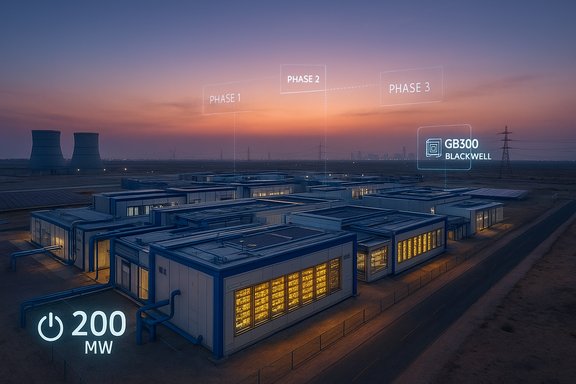
Microsoft and Abu Dhabi’s G42 have announced a coordinated expansion that will add 200 megawatts (MW) of new data‑center capacity in the United Arab Emirates — a move the partners say will be online in phases before the end of 2026 and that sits inside Microsoft’s broader $15.2 billion investment program for the UAE.

Sunset over a modular industrial campus with Phase 1–3 labels and a 200 MW display.Background​

The announcement formalizes a deeper operating relationship between Microsoft and G42 that builds on prior investments and collaboration, including Microsoft’s previously disclosed minority equity stake in G42 and a multi‑party assurance framework designed to govern security, export controls, and responsible‑AI safeguards. The new capacity will be delivered through Khazna Data Centers, a G42 subsidiary that operates and develops hyperscale facilities across the UAE. This move should be read as a strategic package: compute capacity, hardware authorizations, product‑level residency promises for certain Microsoft services, and workforce development commitments are being presented together as a single program to accelerate AI adoption in regulated industries and public services across the Gulf. Reuters, Microsoft’s own statements, and contemporaneous reporting all emphasize the integrated nature of the plan.

Why 200 MW matters: the technical and economic context​

What does “200 MW” actually mean?​

When operators announce a number like 200 MW, they are referring to IT‑load electrical capacity — the power budget available to run servers, accelerators (GPUs), storage, networking and the ancillary plant (power distribution, UPS, and cooling). That number is the single most important engineering constraint for modern AI data centers: it defines how many GPU‑dense racks can be supported, what cooling technology is required, and how the site must connect to the grid.
  • At a conservative assumption of ~10 kW per rack, 200 MW of IT load equates to roughly 20,000 racks; at higher densities used by next‑generation accelerator racks the rack count is smaller but each rack delivers substantially greater compute.
  • High‑density racks commonly push facilities toward liquid cooling, higher voltage distribution and aggressive PUE targets; all of these are capital‑intensive design choices and operational commitments.

Why this is an AI‑first build​

Microsoft says the expansion is explicitly AI‑focused: the partners plan to deploy advanced Nvidia accelerators (GB‑class / Blackwell family) under U.S. export licenses, giving the UAE in‑region access to frontier inference and training hardware. That makes the sites suitable for large‑context models, private model hosting, and low‑latency Copilot‑style productivity services for regulated customers. Multiple outlets reported authorized shipments equivalent to tens of thousands of A100‑class GPUs; Microsoft’s numbers and vendor messaging convert those inventories into performance proxies rather than literal counts.

The policy and geopolitical dimension​

Export licenses and tech diplomacy​

A defining element of the announcement is that U.S. authorities have approved export licenses permitting the shipment of advanced Nvidia accelerators to UAE facilities. That approval is a diplomatic and regulatory milestone: it demonstrates a path for frontier compute to be operated overseas under a set of bilateral and corporate assurances, and it creates a template for how export control regimes can be reconciled with allied commercial deployments. News agencies and Microsoft’s own posts describe these approvals as tightly controlled and contingent on compliance measures. This is not merely commercial logistics. Exporting the latest accelerators involves national‑security tradeoffs, and the licensing regime used in this case will be watched closely by policymakers and competitors. It sets a precedent for how the United States may enable allied and partner nations to host advanced AI infrastructure while seeking to mitigate proliferation risks.

Sovereignty, product residency, and regulated customers​

Microsoft has attached product‑level residency claims to this infrastructure — most notably the ability to offer in‑country processing for selected Microsoft 365 Copilot interactions to “qualified UAE organizations.” For banks, healthcare providers and government agencies that require demonstrable data residency and auditability, this turns an abstract infrastructure pledge into a concrete procurement proposition. However, product residency is a promise with operational caveats: eligibility rules, telemetry and emergency access policies, and contractual terms will determine how broadly the guarantee applies. Independent reporting makes clear that these are phased rollouts, not immediate blanket guarantees.

The local delivery vehicle: Khazna, G42 and the UAE strategy​

Khazna Data Centers — G42’s hyperscale wholesale arm — will lead delivery and operations. Khazna already operates modular and AI‑ready facilities across the UAE, and the fresh 200 MW pledge accelerates that roadmap. G42’s role combines local market knowledge, state connections and the ability to execute large civil and electrical works in the region. Microsoft brings Azure platform services, enterprise go‑to‑market reach, and operational expertise for sovereign cloud offerings. The partnership is a textbook example of a hyperscaler partnering with a national champion to meet the needs of regulated local customers.
The UAE has been explicit in its ambition to become an AI hub. Federal strategy documents and government initiatives aim to increase the digital economy’s contribution to GDP and to attract both talent and capital. Microsoft’s package — compute, governance bodies, and skilling programs — is structured to align with those national targets.

Hardware arithmetic and the limits of public figures​

Several outlets report that Microsoft secured authorizations that are being described as the equivalent of tens of thousands of A100‑class GPUs, and Microsoft itself has framed the recent approvals as enabling the shipment of GB300 / Blackwell‑class systems that translate into very large A100‑equivalent numbers. Those equivalences are useful shorthand for journalists and analysts, but they are performance proxies rather than literal inventories.
  • A single GB300 rack can deliver multiples of the training or inference throughput of older A100 nodes depending on topology, interconnect, and software stack. Treat “A100‑equivalent” figures as coarse scaling metrics, not exact measures of raw capability.
Because vendors sometimes report chip counts as shorthand for scale, readers should be cautious about equating A100‑equivalent counts directly to application performance or economic cost. Cooling, network fabric (NVLink/NVSwitch), rack interconnect topology, and software optimizations are equally determinant of realized model throughput.

Economic, sustainability and grid implications​

Power and grid integration​

Adding 200 MW of IT load is a major grid commitment. Delivering that capacity requires substation upgrades, long‑term power purchase agreements (PPAs), potential on‑site generation or storage, and coordination with utilities. Public announcements to date do not provide a full disclosure of the mix of grid vs. renewable firming or the PPA structure; those omissions are material because they determine both operating cost and sustainability profile. Independent coverage notes the absence of detailed energy sourcing commitments alongside the capacity announcement.

Environmental footprint and efficiency pathways​

Large AI‑dense facilities optimize toward lower PUEs and often deploy liquid cooling to handle concentrated heat loads. The partners have discussed LEED or similar environmental targets on some Khazna projects, but the precise energy mix — how much wind or solar is contracted, whether firming capacity or batteries are used, and what carbon‑accounting rules apply — remains to be disclosed in detail. Any long‑term claim about “green” AI capacity should be assessed against signed PPAs, storage or firming agreements, and independent verification statements.

Talent, governance and research commitments​

Microsoft tied the infrastructure package to ambitious skilling goals and institutional commitments:
  • A public pledge to scale local skills programs — Microsoft has publicly referenced plans to skill up to one million people in the UAE by 2027 as part of broader regional workforce initiatives. Reported numbers also include specific targets for students, teachers and government employees.
  • The creation of governance and research vehicles such as an AI for Good Lab and a Responsible AI Future Foundation in partnership with MBZUAI and regional institutions. These are intended to address responsible‑AI frameworks, safety research, and domain‑specific standards.
These commitments are meaningful if they are backed by verifiable curricula, internships, research grants, and transparent measurement of outcomes. The promise of training one million people is transformative only if it results in tangible employment, accredited certification pathways, and enterprise hiring that leverages those skills.

Implications for enterprises, developers and Windows‑centric customers​

For CIOs and procurement teams​

  • Reassess residency requirements: For regulated workloads (finance, healthcare, government) the availability of local Azure‑grade compute with in‑country processing options reduces legal and latency friction — but buyers should insist on clear contractual language regarding eligibility, telemetry, audit rights and portability.
  • Demand transparency on energy sourcing: Long‑term pricing and ESG commitments will depend on the energy contracts that underpin the sites. Include renewable sourcing and firming criteria in procurement RFPs.
  • Verify SLA specifics for Copilot and product‑level residency promises: Ensure failover, geo‑redundancy, and incident response protocols are codified. Product residency often includes exceptions; be certain about those edge cases.

For developers and data scientists​

  • Expect improved latency and the ability to host private inference near users in the Gulf — this is useful for large interactive agents and real‑time ML services.
  • Plan for hybrid topologies where sensitive data remains in local sovereign clouds while scale training or very large context inference runs on Khazna/Azure capacity. Understand egress costs and data movement patterns up front.

Risks, unknowns and caveats​

Timeline risk​

Public statements place initial capacity coming online before the end of 2026, but that timeline is conditional. Delivering 200 MW of usable IT load requires multi‑year substation upgrades, delivery of third‑party rack systems and accelerators, and the completion of civil works. Treat the 2026 date as a phased target rather than a single day of turn‑up.

Energy and sustainability uncertainty​

Announcements highlight ambitious sustainability goals in some Khazna projects, but detailed PPAs, battery‑storage or firming contracts have not been published alongside the capacity pledge. Without those agreements, long‑term carbon profile claims remain provisional. Procurement teams and regulators should press for disclosure.

Geopolitical and policy sensitivity​

The export licenses used to move GB‑class systems into the UAE are precedent‑setting. While this enables in‑region AI development, it also increases scrutiny: other governments and competitors will examine the safeguards, auditing processes and incident response arrangements that accompany such deployments. Policymakers will watch this as a model that could be replicated — or challenged — elsewhere.

Counting chips vs. measuring performance​

Public reporting frequently cites “A100‑equivalent” numbers to communicate scale. These metrics are rough proxies and conceal differences in architecture, memory topology and interconnect. Organizations should evaluate performance using realistic benchmarks tied to their workloads rather than headline chip counts.

What’s next: operational milestones to watch​

  • Publication of PPA and energy‑firming contracts tied to the 200 MW build — these will indicate actual sustainability and price risk posture.
  • Detailed facility siting and substation agreements — these documents will show how quickly capacity can be turned up and where resiliency investments are concentrated.
  • Product residency operational guidelines — Microsoft should publish the eligibility criteria, telemetry exceptions, and audit processes for in‑country Copilot processing.
  • Third‑party audits or compliance attestations tied to the Intergovernmental Assurance Agreement and the Responsible AI Future Foundation — these add credibility to sovereignty and governance claims.
  • Phased arrival and validation of GB‑class hardware and performance benchmarks demonstrating local model training and inference at scale.

Bottom line: strategic win with measurable caveats​

Microsoft and G42’s 200 MW data‑center expansion is a major, tangible step toward building regionally sovereign, AI‑capable cloud infrastructure in the UAE. It combines raw compute scale, product‑level residency promises, and workforce and governance initiatives into a single, headline‑grabbing package. The announcement changes the procurement calculus for any organization in the Gulf that requires low latency, auditable processing and local AI compute.
At the same time, important details remain to be verified: the exact energy sourcing and firming arrangements, site‑level delivery timelines, the operational scope of product‑residency promises, and the real‑world performance of GB‑class hardware measured against enterprise workloads. Those unknowns will determine how much of the announced promise translates into durable national capacity and local economic benefit.

Practical checklist for IT leaders and procurement teams​

  • Inventory workloads that require on‑shore processing and map them to Microsoft’s product‑residency timelines.
  • Insert auditability, data portability, and vendor‑exit clauses into RFPs tied to local capacity.
  • Require transparent energy and sustainability commitments (signed PPAs, firming arrangements) before committing to capacity‑dependent pricing.
  • Negotiate SLAs and eligibility rules for Copilot‑style on‑country processing — demand clarity on telemetry and emergency access.
  • Plan hybrid topologies and test failover to alternative regions; sovereignty reduces legal friction but does not eliminate operational outage risk.

Conclusion​

This is a momentous infrastructure announcement: adding 200 MW of AI‑ready capacity via Khazna Data Centers and embedding it within a $15.2 billion Microsoft investment plan materially raises the UAE’s compute ceiling and strengthens Azure’s sovereign offering in the Gulf. The package — compute, chips, governance, and skilling — is deliberately constructed to accelerate AI adoption inside regulated markets.
Yet the story is far from complete. The operationalization of that vision requires visible energy contracts, published site engineering milestones, third‑party verification of governance commitments, and transparent product‑residency terms. Until those follow‑on disclosures arrive and are independently audited, the announcement should be celebrated for scale and ambition while being treated with pragmatic scrutiny by enterprises, policymakers, and investors.
Source: Startup Story Microsoft and UAE’s G42 Announce Major Data Center Expansion to Accelerate AI and Cloud Growth | Startup Story
 

Microsoft and Abu Dhabi‑based G42 have announced a coordinated expansion that will add 200 megawatts (MW) of new datacenter capacity to the United Arab Emirates, a move packaged inside Microsoft’s broader $15.2 billion UAE investment and delivered through G42’s Khazna Data Centers — capacity the partners say will begin coming online in phases before the end of 2026.

Desert data center beneath glowing AI cloud icons in the sky.Background​

Microsoft’s recent announcement builds on an already deepening strategic relationship with G42 that includes investments, joint governance initiatives, and local operational infrastructure. The 200 MW commitment is explicitly framed as an AI‑first expansion intended to strengthen Azure‑grade, sovereign cloud services in the UAE, while pairing compute build‑out with governance (the Responsible AI Future Foundation), skills programs, and product‑residency promises for selected Microsoft services.
That framing is significant: rather than a stand‑alone hyperscale build, the project is being marketed as an integrated package combining compute, regulatory assurances, and local capability‑building — a model that aims to appeal to heavily regulated customers in finance, healthcare, energy, and government who require data locality and auditable controls.

Why this announcement matters now​

The headline numbers — 200 MW of IT‑load capacity and a $15.2 billion regional commitment — are consequential for three converging reasons:
  • Power is the principal gating factor for large AI infrastructure: 200 MW of IT load translates into material headroom for GPU‑dense racks and training/inference pods.
  • Microsoft is tying infrastructure to product‑level residency commitments (notably for portions of Microsoft 365 Copilot), making the physical capacity legally and commercially meaningful for regulated customers.
  • The announcements were accompanied by reported U.S. export authorizations that allow shipment of frontier Nvidia accelerators (GB/Blackwell‑class systems) to UAE facilities — a regulatory and diplomatic precedent that shapes how advanced compute can be distributed globally.
Taken together, the expansion materially shifts what in‑region customers can do with Azure in the Gulf: lower latency inference, onshore model hosting, and the possibility of large‑model training within national borders under an assurance framework.

What “200 MW” actually means (a practical translation)​

When vendors announce a 200 MW datacenter commitment they are referring to IT‑load electrical capacity — the maximum electrical envelope available to run servers, accelerators, storage, networking and the cooling systems that sustain them. That is the single most important engineering constraint for modern AI‑first facilities.
To translate it to operational scale:
  • At a conservative estimate of ~10 kW per rack (typical for mixed cloud workloads), 200 MW of IT load could support roughly 20,000 racks.
  • For GPU‑dense, Blackwell/GB‑class racks (which can draw 10–40+ kW per rack), the total rack count will be lower, but each rack delivers far greater training and inference throughput. The result is tens of thousands of high‑end accelerators deployed across the footprint depending on design choices.
Key caveats to keep in mind: these are order‑of‑magnitude calculations. Final usable compute depends on rack densities, cooling approach (air vs direct liquid vs immersion), redundancy architecture (N+1 vs 2N), and the specific accelerator families used. Those engineering choices materially change the delivered performance, energy profile and operational risk.

Technical architecture likely to be used​

The partners describe the build as AI‑optimised, and standard design patterns for such environments point to the following features:
  • High‑density power distribution and prefabricated modular halls that accelerate deployment while enabling repeatable design.
  • Liquid cooling (direct‑to‑chip or immersion) at scale to manage heat from modern accelerator racks and to keep Power Usage Effectiveness (PUE) competitive.
  • Rack and pod topologies that support pooled memory and high‑speed interconnects for large‑model training.
  • Energy management and workload orchestration systems to smooth peak draw and reduce operating cost.
These design features are not optional when deploying GB/Blackwell‑class racks at scale; they change the OPEX profile, maintenance regimes, and even the choice of supply‑chain partners for servers, chillers, and electrical equipment.

Geopolitics, export controls and the diplomacy of compute​

One of the most consequential non‑technical elements of this announcement is the reported regulatory approval route that enabled Microsoft to place frontier Nvidia accelerators in UAE facilities. The approvals are being described by stakeholders as conditional export licenses that required bilateral assurances and operational guardrails.
Why that matters:
  • It sets a precedent for how Western cloud providers can deploy high‑end AI hardware outside U.S. jurisdiction while satisfying national‑security and export‑control concerns.
  • It creates a model for trusted cross‑border compute where hardware transfers are tied to governance, auditability, and partnership frameworks rather than being treated as simple commercial exports.
  • The deal will be watched closely by other governments and vendors: the same mechanism could be used to enable allied partners to host cutting‑edge compute, or conversely could become a point of friction if political conditions change.
At the same time, such arrangements raise hard questions about transparency, operational oversight, and the conditions under which hardware can be used. The licenses’ details — what telemetry, audit, or emergency‑access rules were negotiated — are material to long‑term trust but have not been fully disclosed publicly. Those gaps merit scrutiny.

Economic, workforce and ecosystem impacts​

Microsoft has tied this infrastructure commitment to ambitious local skilling targets and research partnerships. The company has reiterated prior pledges to scale local engineering and skills — including a goal to skill one million people in the UAE by 2027 — and points to institutions such as the Global Engineering Development Center and the AI for Good Lab in Abu Dhabi as anchors.
Potential positive outcomes:
  • Creation of local, high‑value jobs in data‑center operations, cloud engineering, and AI services.
  • Lower barriers for startups and research institutions to access hyperscale compute without moving data offshore.
  • Stimulus for a local SaaS and AI services ecosystem that can capture more value within the UAE economy.
Realistic constraints:
  • Translating capex into broad workforce outcomes requires inclusive training pipelines, credible certifications, and hiring commitments — not just PR targets. The history of large infrastructure programs shows that without measurable, audited outcomes, skills commitments can underdeliver.
  • The economic value captured locally depends on procurement rules, startup incentives, and whether cloud‑native firms are able to build lasting businesses in the region rather than exporting revenue elsewhere.

Strengths of the deal​

  • Integrated model: Combining capacity, governance, and skilling is smarter than a pure capex announcement; it addresses the three major barriers for regulated AI adoption — compute, compliance, and talent.
  • Operational headroom for Azure: For enterprise customers demanding data residency and performance, local, Azure‑grade AI capacity materially reduces latency and legal friction.
  • Diplomatic precedent: Conditional export licenses that enable frontier accelerators to be operated offshore while preserving safeguards create a replicable model for trusted alliances.

Key risks and open questions​

While the announcement advances regional AI capability, several significant risks and unknowns remain:
  • Energy sourcing and sustainability: 200 MW of IT load implies a very large and steady power demand. The public materials released so far do not disclose the detailed energy mix, firming arrangements, or timelines for renewables and storage needed to meet sustainability claims. Delivering on green power at scale is technically and commercially difficult and must be independently verified.
  • Site and grid readiness: The practical delivery of 200 MW requires substation upgrades, transmission work, and multi‑year utility agreements. Exact site locations and grid integration plans were not disclosed alongside the announcement, making the timeline and operational risk hard to assess.
  • Transparency around export‑control conditions: The licenses that enable advanced accelerators to be shipped to the UAE are reported to be conditional. The specifics — telemetry, audit frequency, emergency access, or limitations on certain work — have not been fully publicized. That opacity reduces independent oversight of long‑term compliance.
  • Concentration and vendor lock‑in: Heavy reliance on a single hyperscaler‑local partner model can concentrate control over data and compute. Customers and governments should guard against dependency that limits competition or bargaining power.
  • Operational secrecy and security: Large, sovereign projects can sometimes prioritize speed and control over independent third‑party verification. Ensuring continuous, external auditing (security, energy, environmental) will be critical for credibility.
  • Uncertain GPU inventory metrics: Public reporting and vendor statements have used shorthand like “A100‑equivalent” to describe compute inventories. Those metrics are proxies and can be misleading because newer Blackwell/GB‑class accelerators deliver materially more performance per watt than older generations. Treat GPU counts quoted as “equivalents” with caution.
Where claims are precise (for example, the 200 MW headline and the $15.2 billion investment envelope), the public filings and contemporaneous reporting corroborate them. Where claims are proxies or operational (GPU‑equivalent counts, exact timelines for product residency, or detailed energy contracts), they are either estimates or remain undisclosed and should be flagged as such.

What this means for Windows‑centric enterprises and IT decision makers​

For organizations that run Windows workloads and depend on Azure services, the Khazna‑Microsoft expansion is more than regional news — it affects architectural choices and procurement.
Practical takeaways:
  • Review product‑residency commitments for Microsoft 365 Copilot and ask for day‑by‑day availability matrices that define which features will be processed in‑country and when. Demand contractual clarity on eligibility rules and telemetry access.
  • Insist on audit rights and third‑party attestations for any sovereign hosting or export‑controlled compute you contract; opaque governance is a procurement risk.
  • Prepare hybrid topologies: keep critical ingress and sensitive preprocessing on‑premises or in private clouds and use Khazna/Azure capacity for large‑scale training and inference bursts where product residency rules allow.
  • Ask for energy and sustainability commitments with contractual remedies: if “green” processing matters, procurement should require PPAs, storage firming plans, and reporting on PUE and carbon attribution.
  • Negotiate portability and exit clauses: ensure models and data can be moved or replicated across zones and vendors to reduce lock‑in risk.
Checklist for procurement teams:
  • Confirm which Microsoft/Azure services will support in‑country processing for regulated workloads.
  • Require independent security, export‑control and privacy audits.
  • Demand transparent energy sourcing documentation and timelines.

Longer‑term implications for the region​

If implemented transparently and with robust safeguards, the Khazna‑Microsoft deal could catalyze serious AI industrialization in the Gulf: universities and startups gain access to hyperscale compute, regulated industries can pilot generative AI with onshore guarantees, and the UAE’s digital economy strategy gains a physical backbone.
But the long arc will be defined less by headlines and more by execution: whether substation projects finish on time, whether energy firming arrangements are signed and delivered, whether product‑residency guarantees are upheld under real‑world telemetry, and whether workforce promises convert into meaningful local hiring and entrepreneurship. Each of those implementation steps is susceptible to delay and political friction — and each will determine how much value the UAE captures from this infrastructure investment.

Recommendations for policymakers and civil society​

  • Require public reporting on energy contracts, PUE targets and independent environmental assessments for facilities that add material grid demand.
  • Insist on legal frameworks that guarantee independent audits of export‑control compliance and hardware usage in sovereign cloud contexts.
  • Invest in training pipelines with accredited credentials to ensure skilling commitments lead to durable employment and local enterprise formation.
These steps help align commercial ambition with public accountability and ensure the benefits of large infrastructure investments are broadly shared.

Conclusion​

The Microsoft–G42 200 MW announcement is consequential: it materially increases Gulf‑region AI compute headroom, couples infrastructure to product‑residency and governance promises, and establishes a diplomatic precedent for controlled export of frontier accelerators. The deal’s strengths lie in its integrated approach — compute, governance, and skills — while the most pressing risks are operational transparency, energy sourcing, and the details of export‑control oversight.
For IT leaders, procurement teams, and policymakers, the immediate priority is to convert headline commitments into verifiable deliverables: clarify which services will be handled in‑country and when, secure audit and portability rights, insist on transparent energy and sustainability plans, and monitor export‑control compliance. If the parties deliver on these fronts with independent verification, the expansion could become a model for trusted sovereign‑grade AI infrastructure; if not, it will still add capacity, but questions about oversight, environmental cost, and strategic concentration will linger.

Source: Communications Today Microsoft, G42 announce 200 MW data centre capacity expansion | Communications Today
 

Back
Top