

Microsoft added Microsoft 365 Roadmap ID 567313 on July 7, 2026, promising Microsoft Graph access to primary and auxiliary archive mailboxes for Microsoft Purview Data Lifecycle Management, with worldwide general availability planned for August 2026. The feature sounds narrow, almost plumbing-level, but it lands at a decisive moment for Exchange Online customers. Microsoft is trying to make Graph the only credible path into mailbox data before Exchange Web Services begins its scheduled retirement in October 2026. For administrators, compliance teams, and vendors, this is less a new convenience than a last-mile migration signal: the archive can no longer be treated as a special case.
Microsoft’s roadmap entry describes a single, seamless archive view even when a user’s archive data physically lives across multiple auxiliary mailboxes. That phrase matters because auto-expanding archives have always hidden complexity from end users while exposing it to applications. Outlook could make the experience look unified; EWS-era tooling could often navigate the archive world with Exchange-specific assumptions. Graph, by contrast, has been forced to grow from a modern productivity API into the replacement substrate for decades of Exchange behaviors.
As Microsoft Learn and the Microsoft 365 Developer Blog have made clear in recent EWS retirement guidance, the company’s long-term answer is not to preserve EWS indefinitely but to close enough parity gaps in Graph that customers can move. This roadmap item is one of those parity-gap closures. It is also a test of whether Microsoft can retire legacy interfaces without stranding the compliance and archiving workflows that enterprises actually run.
For ordinary users, an Exchange Online archive is a secondary place where old mail goes when retention policies, mailbox quotas, or organizational governance rules say it should. It appears beside the primary mailbox, and in a well-behaved client it feels like one more tree of folders. The complexity is deliberately hidden because nobody wants a records manager or a finance employee thinking about physical mailbox partitions.
But Exchange Online at scale has never been just one user, one mailbox, one database. Microsoft’s auto-expanding archive architecture can distribute archived content across a main archive mailbox and auxiliary archive mailboxes as storage grows. That design solves a service-scale problem for Microsoft and a capacity problem for customers, but it creates an API problem for software that needs to discover, export, search, migrate, or govern archived items.
The roadmap language is therefore doing more work than it first appears. “Main + Auxiliary” is Microsoft acknowledging that archive access is not merely about exposing a folder called Archive through Graph. It is about letting applications traverse the archive as users and compliance systems understand it, not as the backend happens to store it.
That distinction is essential for Microsoft Purview Data Lifecycle Management. Purview policies care about what should be retained, deleted, labeled, moved, or discoverable. They do not become simpler because the underlying mail has spilled into auxiliary archive mailboxes. If Graph cannot present that sprawl coherently, every downstream compliance workflow inherits the storage topology as a business problem.
That schedule changes the meaning of every Graph roadmap item touching mail. In calmer times, Graph support for auxiliary archive mailboxes would be a nice developer enhancement. In mid-2026, it is part of a forced migration runway.
The EWS retirement is not an abstract developer-platform cleanup. EWS has been the quiet workhorse behind backup tools, migration suites, compliance exports, archiving products, line-of-business integrations, and internal scripts that nobody wants to inventory until they fail. Some of those workloads are already covered by Graph. Others have lived in awkward gaps where Microsoft’s strategic API did not yet behave like Exchange’s historical API.
Archive mailbox access sits squarely in that uncomfortable zone. If an organization has years of regulated email sitting in auto-expanded archives, “just migrate to Graph” is not a plan unless Graph can reach the data. The new roadmap item suggests Microsoft knows the retirement deadline cannot succeed on PowerPoint strategy alone; it has to survive the ugly edge cases in production tenants.
Microsoft’s February 2026 Message Center update, later summarized by several Microsoft 365-focused outlets and community archives, sharpened the EWS schedule into operational deadlines. The first disruption point is not April 2027, when EWS is fully gone. It is October 1, 2026, when disablement begins and administrators need explicit controls to keep some EWS-dependent apps alive temporarily. That makes an August 2026 general availability date for this archive Graph support feel less like comfortable lead time and more like a sprint finish.
Microsoft Graph’s mailbox import and export APIs already moved the story forward. Microsoft announced general availability for those APIs in May 2026, positioning them as a production-ready way to import and export Exchange Online mailbox data through Graph. Microsoft Learn says those APIs can access mailbox contents as folders and items in a consistent format, and the official guidance now includes archive-related redirect handling for auto-expanded archive folders.
That redirect handling reveals the underlying challenge. In some cases, an export request against archive content can return an error indicating that the item physically resides in an auxiliary archive mailbox, requiring the application to reissue the request using the provided target. For imports, the application may similarly have to create a new import session targeting the mailbox indicated by the service. This is sensible engineering, but it also means developers must understand archive indirection unless Microsoft wraps more of it in higher-level behavior.
The roadmap entry appears aimed at that gap. The goal is not simply to tell developers, “Here is where the auxiliary mailbox lives.” It is to give users and applications a coherent archive experience, one that can bridge the main archive and auxiliary mailboxes without making the user experience fracture along storage boundaries.
That matters because compliance systems do not get partial credit for elegant failure. A retention workflow that misses a subsection of archived mail is not “mostly working.” A migration product that exports the visible archive but mishandles auxiliary content is not “Graph-ready.” A records process that forces administrators to reason manually about mailbox fragments is exactly the sort of complexity cloud services are supposed to absorb.
Purview Data Lifecycle Management is one of Microsoft’s answers to the question every regulated tenant eventually asks: how do we keep what we must, delete what we should, and prove that both actions happened according to policy? Email archives are central to that answer because Exchange remains the system of record for huge amounts of business communication. Old mail is not dead mail; it is evidence, institutional memory, liability, and sometimes discoverable material.
Archive mailboxes also sit at the intersection of user convenience and legal defensibility. Organizations use archives to keep primary mailboxes manageable while preserving content under retention schemes. They use auto-expanding archives because data grows faster than policy committees can redesign retention rules. They use Purview because manual lifecycle governance at Microsoft 365 scale is fantasy.
If Graph access to auxiliary archives is incomplete, Purview’s lifecycle story becomes uneven. Microsoft can have elegant retention labels, dashboards, and compliance portals, but the technical control plane still has to reach the items. The new roadmap item acknowledges that the control plane must span the whole archive, not just the easy mailbox.
There is also a vendor ecosystem implication. Backup, migration, archiving, supervision, and compliance vendors have spent years building around Exchange behaviors. Some have publicly warned customers about EWS retirement timelines and Graph migration requirements. A first-party Graph path into distributed archive mailboxes gives those vendors something concrete to build against, but it also raises the bar: once Microsoft ships the API, “waiting for parity” becomes a less persuasive excuse.
A Graph feature becoming generally available does not instantly make every dependent application production-safe. Vendors need to implement it, test it against messy tenant histories, handle throttling, validate permissions, document behavior, and support customers who discover that their archives are stranger than expected. Internal development teams need to update scripts, obtain app consent, revise runbooks, and satisfy auditors who may not care that Microsoft shipped the API only weeks before a deadline.
This is where Microsoft’s cloud cadence collides with enterprise change control. A roadmap GA month is not a deployment plan. It is a signal that the component should exist, not that all dependent workflows will be ready.
Administrators should treat August 2026 as the start of final validation, not the start of analysis. If a tenant still has unknown EWS callers by then, the archive Graph enhancement will not rescue the organization from poor inventory. Microsoft has provided EWS usage reporting and analyzer tooling precisely because the hard part is often finding the dependency before it breaks.
The release scope also matters. The roadmap lists Worldwide standard multi-tenant availability, not sovereign clouds. Microsoft Graph documentation for some mailbox import and export APIs has historically shown limited national cloud availability, with global service support arriving first. Government and specialized cloud customers should be especially cautious about assuming that an August 2026 worldwide commercial rollout solves their timeline.
That is good news in security terms. It is also painful. Archive access is inherently sensitive because it reaches older content that users may no longer see daily but organizations may be legally required to retain. A tool that can export archive items has access to years of communications. A tool that can import or move items can alter the evidentiary shape of a mailbox if misused or misconfigured.
Microsoft’s mailbox import and export APIs use explicit permissions for export and import/export operations. That is the right design direction, but it forces administrators to make hard decisions about which apps should have tenant-wide mailbox capabilities and under what governance. The retirement of EWS should not become a copy-paste migration of excessive privilege into Graph.
Purview-oriented archive access also raises questions about delegated versus application permissions. Compliance and lifecycle tools often run without an interactive user, which means application permissions and administrative consent become central. Security teams should expect to review service principals, conditional access impacts, audit logs, and workload identities as part of the migration.
The best outcome is not merely that old EWS jobs keep running through Graph. The best outcome is that organizations use the migration to reduce standing access, retire obsolete integrations, and make mailbox-data access visible enough to defend. Microsoft can supply the API, but customers still own the permission hygiene.
A fragmented archive view creates support tickets and distrust. Users may believe mail is missing when it is merely located in an auxiliary archive that a tool does not display properly. Help desks may waste time reconciling what Outlook shows against what a third-party tool exports. Compliance teams may be forced to explain why one interface sees content another does not.
A seamless view reduces those discrepancies. It means archive folder discovery, item enumeration, export, and lifecycle operations can align more closely with the mental model that users and administrators already have. If Graph can make auxiliary archives disappear as a separate concern in normal operations, it gives the ecosystem a stable abstraction.
But the abstraction must be honest. Developers still need predictable error handling, clear mailbox identifiers, stable folder IDs, and documentation for redirects and edge cases. Microsoft’s existing redirect guidance for auto-expanded archives is useful because it does not pretend the complexity is gone; it explains how applications should respond when physical placement leaks through.
The challenge for Microsoft is to decide how much of that complexity Graph should hide and how much it should expose. Hide too little, and every vendor must become an Exchange archive topology expert. Hide too much, and troubleshooting becomes opaque when a compliance export fails at scale. The right answer is probably layered: seamless by default, explicit when the application needs to reason about storage boundaries.
The EWS retirement has created a noisy market of migration assurances. Some vendors are genuinely ready or close. Others are using “Graph migration” as a vague comfort phrase while still depending on EWS for awkward corners. Archive mailboxes, public folders, certain calendar behaviors, and deep Exchange-specific operations have been among the places where customers need to ask sharper questions.
With Graph support for main and auxiliary archive mailboxes scheduled before the October disablement phase, customers should demand specific answers. Does the product enumerate auto-expanded archive folders through Graph? Does it handle archive redirects? Does it export full-fidelity items where required? Does it require broad application permissions? Does it support the tenant’s cloud instance? Does it have a tested plan for October 1, 2026, not merely April 1, 2027?
This is not vendor-bashing; it is risk management. EWS retirement is a forcing function across an ecosystem that has enjoyed long compatibility tails. Microsoft’s archive support gives vendors a moving target, but the direction is no longer ambiguous.
Enterprises should also beware of products that turn Graph limitations into silent data gaps. A backup or compliance platform that reports success while skipping auxiliary archive content is worse than one that fails noisily. The test cases need to include large, auto-expanded archives, not just tidy executive mailboxes.
The security argument for EWS retirement is real. Microsoft has cited the broader move to modern authentication and stronger security posture, and its documentation notes that the Midnight Blizzard incident increased urgency around EWS deprecation. Old, broad, and deeply embedded interfaces are attractive targets and difficult to govern cleanly.
Still, security-driven retirement does not eliminate operational responsibility. If Microsoft closes EWS before Graph covers the practical surface area customers need, customers will not experience that as modernization. They will experience it as breakage imposed by the platform owner.
That is why this roadmap item is important despite its narrow wording. It is evidence that Microsoft is still filling Graph gaps close to the deadline. The uncomfortable part is that “in development” on July 7, 2026, for an August 2026 GA, leaves little margin for defects, documentation gaps, throttling surprises, or SDK lag.
Microsoft needs this feature to be boring when it ships. Archive discovery should work. Redirects should be documented. Permissions should be clear. Error messages should be actionable. Throttling behavior should be predictable enough for migration and compliance products to design around. In this corner of Microsoft 365, boring is the premium experience.
Microsoft’s EWS usage reports and analyzer tools should be part of the baseline work. So should vendor attestations that go beyond marketing language. A vendor saying “we support Graph” is not the same as saying “we support Graph-based access to auto-expanded Exchange Online archive mailboxes, including auxiliary archive content, in your cloud instance.”
Administrators should also separate three classes of workload. Some EWS dependencies can be retired because nobody needs them anymore. Some can be migrated to existing Graph APIs today. Some are blocked on features like this one and need a controlled plan as soon as general availability arrives.
The archive-specific test plan should be concrete. Pick mailboxes with auto-expanding archives, long retention histories, unusual folder structures, and real-world volume. Validate discovery, export, import if relevant, lifecycle operations, and reporting. Compare what Graph-based tools see against what Outlook and Purview expose. Do not wait for the first legal hold, audit request, or migration weekend to discover that auxiliary archive content behaves differently.
There is also a communications job. Compliance officers, legal teams, and records managers need to understand that the API migration is not just an IT refactor. It affects the systems they rely on to preserve and produce information. If the organization has regulatory obligations around email retention, the EWS-to-Graph transition belongs in governance forums, not just developer standups.
Microsoft’s roadmap entry describes a single, seamless archive view even when a user’s archive data physically lives across multiple auxiliary mailboxes. That phrase matters because auto-expanding archives have always hidden complexity from end users while exposing it to applications. Outlook could make the experience look unified; EWS-era tooling could often navigate the archive world with Exchange-specific assumptions. Graph, by contrast, has been forced to grow from a modern productivity API into the replacement substrate for decades of Exchange behaviors.
As Microsoft Learn and the Microsoft 365 Developer Blog have made clear in recent EWS retirement guidance, the company’s long-term answer is not to preserve EWS indefinitely but to close enough parity gaps in Graph that customers can move. This roadmap item is one of those parity-gap closures. It is also a test of whether Microsoft can retire legacy interfaces without stranding the compliance and archiving workflows that enterprises actually run.
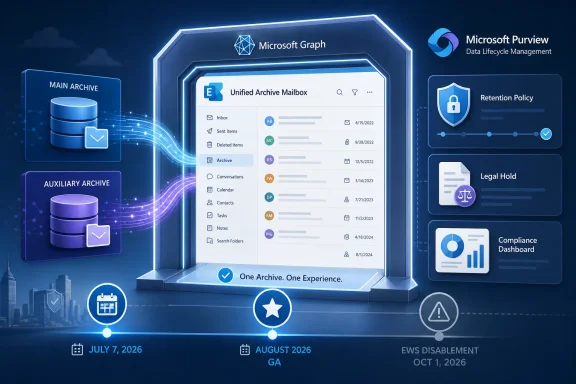 The Archive Mailbox Was Always More Complicated Than It Looked
For ordinary users, an Exchange Online archive is a secondary place where old mail goes when retention policies, mailbox quotas, or organizational governance rules say it should. It appears beside the primary mailbox, and in a well-behaved client it feels like one more tree of folders. The complexity is deliberately hidden because nobody wants a records manager or a finance employee thinking about physical mailbox partitions.But Exchange Online at scale has never been just one user, one mailbox, one database. Microsoft’s auto-expanding archive architecture can distribute archived content across a main archive mailbox and auxiliary archive mailboxes as storage grows. That design solves a service-scale problem for Microsoft and a capacity problem for customers, but it creates an API problem for software that needs to discover, export, search, migrate, or govern archived items.
The roadmap language is therefore doing more work than it first appears. “Main + Auxiliary” is Microsoft acknowledging that archive access is not merely about exposing a folder called Archive through Graph. It is about letting applications traverse the archive as users and compliance systems understand it, not as the backend happens to store it.
That distinction is essential for Microsoft Purview Data Lifecycle Management. Purview policies care about what should be retained, deleted, labeled, moved, or discoverable. They do not become simpler because the underlying mail has spilled into auxiliary archive mailboxes. If Graph cannot present that sprawl coherently, every downstream compliance workflow inherits the storage topology as a business problem.
Graph Becomes the Front Door Because EWS Is Closing
The timing is impossible to ignore. Microsoft has said for years that Exchange Web Services would stop receiving new functionality, then later set an Exchange Online disablement path beginning in October 2026 and culminating in full retirement in April 2027. Microsoft’s own documentation now frames migration to Graph as the route forward, citing security, modernization, and the need to retire legacy dependencies.That schedule changes the meaning of every Graph roadmap item touching mail. In calmer times, Graph support for auxiliary archive mailboxes would be a nice developer enhancement. In mid-2026, it is part of a forced migration runway.
The EWS retirement is not an abstract developer-platform cleanup. EWS has been the quiet workhorse behind backup tools, migration suites, compliance exports, archiving products, line-of-business integrations, and internal scripts that nobody wants to inventory until they fail. Some of those workloads are already covered by Graph. Others have lived in awkward gaps where Microsoft’s strategic API did not yet behave like Exchange’s historical API.
Archive mailbox access sits squarely in that uncomfortable zone. If an organization has years of regulated email sitting in auto-expanded archives, “just migrate to Graph” is not a plan unless Graph can reach the data. The new roadmap item suggests Microsoft knows the retirement deadline cannot succeed on PowerPoint strategy alone; it has to survive the ugly edge cases in production tenants.
Microsoft’s February 2026 Message Center update, later summarized by several Microsoft 365-focused outlets and community archives, sharpened the EWS schedule into operational deadlines. The first disruption point is not April 2027, when EWS is fully gone. It is October 1, 2026, when disablement begins and administrators need explicit controls to keep some EWS-dependent apps alive temporarily. That makes an August 2026 general availability date for this archive Graph support feel less like comfortable lead time and more like a sprint finish.
Microsoft Is Trying to Turn Archive Topology Into an Implementation Detail
The most important promise in Roadmap ID 567313 is not “Graph API support.” It is the promise of a single archive view despite physically distributed storage. That is the architectural principle Microsoft needs to defend if Graph is to replace EWS in real-world Exchange Online estates.Microsoft Graph’s mailbox import and export APIs already moved the story forward. Microsoft announced general availability for those APIs in May 2026, positioning them as a production-ready way to import and export Exchange Online mailbox data through Graph. Microsoft Learn says those APIs can access mailbox contents as folders and items in a consistent format, and the official guidance now includes archive-related redirect handling for auto-expanded archive folders.
That redirect handling reveals the underlying challenge. In some cases, an export request against archive content can return an error indicating that the item physically resides in an auxiliary archive mailbox, requiring the application to reissue the request using the provided target. For imports, the application may similarly have to create a new import session targeting the mailbox indicated by the service. This is sensible engineering, but it also means developers must understand archive indirection unless Microsoft wraps more of it in higher-level behavior.
The roadmap entry appears aimed at that gap. The goal is not simply to tell developers, “Here is where the auxiliary mailbox lives.” It is to give users and applications a coherent archive experience, one that can bridge the main archive and auxiliary mailboxes without making the user experience fracture along storage boundaries.
That matters because compliance systems do not get partial credit for elegant failure. A retention workflow that misses a subsection of archived mail is not “mostly working.” A migration product that exports the visible archive but mishandles auxiliary content is not “Graph-ready.” A records process that forces administrators to reason manually about mailbox fragments is exactly the sort of complexity cloud services are supposed to absorb.
Purview’s Role Makes This a Governance Story, Not Just a Developer Story
It is tempting to file this roadmap item under developer platform news, but the product listed is Microsoft Purview, not just Exchange Online or Microsoft Graph. That placement is a clue. Microsoft is tying API access to archive mailboxes directly to data lifecycle management, which is where retention, deletion, and governance meet business risk.Purview Data Lifecycle Management is one of Microsoft’s answers to the question every regulated tenant eventually asks: how do we keep what we must, delete what we should, and prove that both actions happened according to policy? Email archives are central to that answer because Exchange remains the system of record for huge amounts of business communication. Old mail is not dead mail; it is evidence, institutional memory, liability, and sometimes discoverable material.
Archive mailboxes also sit at the intersection of user convenience and legal defensibility. Organizations use archives to keep primary mailboxes manageable while preserving content under retention schemes. They use auto-expanding archives because data grows faster than policy committees can redesign retention rules. They use Purview because manual lifecycle governance at Microsoft 365 scale is fantasy.
If Graph access to auxiliary archives is incomplete, Purview’s lifecycle story becomes uneven. Microsoft can have elegant retention labels, dashboards, and compliance portals, but the technical control plane still has to reach the items. The new roadmap item acknowledges that the control plane must span the whole archive, not just the easy mailbox.
There is also a vendor ecosystem implication. Backup, migration, archiving, supervision, and compliance vendors have spent years building around Exchange behaviors. Some have publicly warned customers about EWS retirement timelines and Graph migration requirements. A first-party Graph path into distributed archive mailboxes gives those vendors something concrete to build against, but it also raises the bar: once Microsoft ships the API, “waiting for parity” becomes a less persuasive excuse.
The August 2026 Date Is Useful, but It Is Not Comfortable
The roadmap says general availability is planned for August 2026 in Worldwide standard multi-tenant clouds. That is encouraging because it comes before the October EWS disablement wave. It is also uncomfortably late for enterprises that validate compliance tooling slowly.A Graph feature becoming generally available does not instantly make every dependent application production-safe. Vendors need to implement it, test it against messy tenant histories, handle throttling, validate permissions, document behavior, and support customers who discover that their archives are stranger than expected. Internal development teams need to update scripts, obtain app consent, revise runbooks, and satisfy auditors who may not care that Microsoft shipped the API only weeks before a deadline.
This is where Microsoft’s cloud cadence collides with enterprise change control. A roadmap GA month is not a deployment plan. It is a signal that the component should exist, not that all dependent workflows will be ready.
Administrators should treat August 2026 as the start of final validation, not the start of analysis. If a tenant still has unknown EWS callers by then, the archive Graph enhancement will not rescue the organization from poor inventory. Microsoft has provided EWS usage reporting and analyzer tooling precisely because the hard part is often finding the dependency before it breaks.
The release scope also matters. The roadmap lists Worldwide standard multi-tenant availability, not sovereign clouds. Microsoft Graph documentation for some mailbox import and export APIs has historically shown limited national cloud availability, with global service support arriving first. Government and specialized cloud customers should be especially cautious about assuming that an August 2026 worldwide commercial rollout solves their timeline.
The New API Path Will Still Force a Permissions Reckoning
Graph does not merely replace endpoints; it changes the security model around them. EWS-era applications often accumulated broad access over time, and many tenants tolerated that sprawl because the integrations were old, business-critical, and poorly documented. Graph migration creates a moment to reauthorize the same business process under modern permissions, application consent, and audit expectations.That is good news in security terms. It is also painful. Archive access is inherently sensitive because it reaches older content that users may no longer see daily but organizations may be legally required to retain. A tool that can export archive items has access to years of communications. A tool that can import or move items can alter the evidentiary shape of a mailbox if misused or misconfigured.
Microsoft’s mailbox import and export APIs use explicit permissions for export and import/export operations. That is the right design direction, but it forces administrators to make hard decisions about which apps should have tenant-wide mailbox capabilities and under what governance. The retirement of EWS should not become a copy-paste migration of excessive privilege into Graph.
Purview-oriented archive access also raises questions about delegated versus application permissions. Compliance and lifecycle tools often run without an interactive user, which means application permissions and administrative consent become central. Security teams should expect to review service principals, conditional access impacts, audit logs, and workload identities as part of the migration.
The best outcome is not merely that old EWS jobs keep running through Graph. The best outcome is that organizations use the migration to reduce standing access, retire obsolete integrations, and make mailbox-data access visible enough to defend. Microsoft can supply the API, but customers still own the permission hygiene.
The Seamless View Is a User-Experience Promise With Compliance Consequences
Microsoft’s roadmap wording emphasizes the user outcome: a single, seamless Archive view. That sounds like a client nicety, but in enterprise software, user experience is often a proxy for operational correctness.A fragmented archive view creates support tickets and distrust. Users may believe mail is missing when it is merely located in an auxiliary archive that a tool does not display properly. Help desks may waste time reconciling what Outlook shows against what a third-party tool exports. Compliance teams may be forced to explain why one interface sees content another does not.
A seamless view reduces those discrepancies. It means archive folder discovery, item enumeration, export, and lifecycle operations can align more closely with the mental model that users and administrators already have. If Graph can make auxiliary archives disappear as a separate concern in normal operations, it gives the ecosystem a stable abstraction.
But the abstraction must be honest. Developers still need predictable error handling, clear mailbox identifiers, stable folder IDs, and documentation for redirects and edge cases. Microsoft’s existing redirect guidance for auto-expanded archives is useful because it does not pretend the complexity is gone; it explains how applications should respond when physical placement leaks through.
The challenge for Microsoft is to decide how much of that complexity Graph should hide and how much it should expose. Hide too little, and every vendor must become an Exchange archive topology expert. Hide too much, and troubleshooting becomes opaque when a compliance export fails at scale. The right answer is probably layered: seamless by default, explicit when the application needs to reason about storage boundaries.
Vendors Now Have Fewer Places to Hide
For third-party vendors, Roadmap ID 567313 is both relief and pressure. It gives them a plausible path away from EWS for archive-heavy scenarios. It also removes one of the more defensible explanations for delay.The EWS retirement has created a noisy market of migration assurances. Some vendors are genuinely ready or close. Others are using “Graph migration” as a vague comfort phrase while still depending on EWS for awkward corners. Archive mailboxes, public folders, certain calendar behaviors, and deep Exchange-specific operations have been among the places where customers need to ask sharper questions.
With Graph support for main and auxiliary archive mailboxes scheduled before the October disablement phase, customers should demand specific answers. Does the product enumerate auto-expanded archive folders through Graph? Does it handle archive redirects? Does it export full-fidelity items where required? Does it require broad application permissions? Does it support the tenant’s cloud instance? Does it have a tested plan for October 1, 2026, not merely April 1, 2027?
This is not vendor-bashing; it is risk management. EWS retirement is a forcing function across an ecosystem that has enjoyed long compatibility tails. Microsoft’s archive support gives vendors a moving target, but the direction is no longer ambiguous.
Enterprises should also beware of products that turn Graph limitations into silent data gaps. A backup or compliance platform that reports success while skipping auxiliary archive content is worse than one that fails noisily. The test cases need to include large, auto-expanded archives, not just tidy executive mailboxes.
Microsoft’s Own Deadline Makes Quality More Important Than Speed
Microsoft is often criticized for announcing deprecations before replacements feel complete. Sometimes that criticism is unfair; legacy APIs cannot live forever, and security realities force modernization. But Exchange is not a peripheral workload, and archived mail is not disposable data. The company has to land this transition carefully.The security argument for EWS retirement is real. Microsoft has cited the broader move to modern authentication and stronger security posture, and its documentation notes that the Midnight Blizzard incident increased urgency around EWS deprecation. Old, broad, and deeply embedded interfaces are attractive targets and difficult to govern cleanly.
Still, security-driven retirement does not eliminate operational responsibility. If Microsoft closes EWS before Graph covers the practical surface area customers need, customers will not experience that as modernization. They will experience it as breakage imposed by the platform owner.
That is why this roadmap item is important despite its narrow wording. It is evidence that Microsoft is still filling Graph gaps close to the deadline. The uncomfortable part is that “in development” on July 7, 2026, for an August 2026 GA, leaves little margin for defects, documentation gaps, throttling surprises, or SDK lag.
Microsoft needs this feature to be boring when it ships. Archive discovery should work. Redirects should be documented. Permissions should be clear. Error messages should be actionable. Throttling behavior should be predictable enough for migration and compliance products to design around. In this corner of Microsoft 365, boring is the premium experience.
Administrators Should Start With Inventory, Not Optimism
The practical response for IT teams is to stop treating EWS retirement as a future project. October 2026 is close enough that tenants should already know which applications still call EWS, which ones touch archive mailboxes, and which vendors have shipped Graph-based replacements. If that inventory does not exist, the archive roadmap item is not the first task; discovery is.Microsoft’s EWS usage reports and analyzer tools should be part of the baseline work. So should vendor attestations that go beyond marketing language. A vendor saying “we support Graph” is not the same as saying “we support Graph-based access to auto-expanded Exchange Online archive mailboxes, including auxiliary archive content, in your cloud instance.”
Administrators should also separate three classes of workload. Some EWS dependencies can be retired because nobody needs them anymore. Some can be migrated to existing Graph APIs today. Some are blocked on features like this one and need a controlled plan as soon as general availability arrives.
The archive-specific test plan should be concrete. Pick mailboxes with auto-expanding archives, long retention histories, unusual folder structures, and real-world volume. Validate discovery, export, import if relevant, lifecycle operations, and reporting. Compare what Graph-based tools see against what Outlook and Purview expose. Do not wait for the first legal hold, audit request, or migration weekend to discover that auxiliary archive content behaves differently.
There is also a communications job. Compliance officers, legal teams, and records managers need to understand that the API migration is not just an IT refactor. It affects the systems they rely on to preserve and produce information. If the organization has regulatory obligations around email retention, the EWS-to-Graph transition belongs in governance forums, not just developer standups.
The Archive Deadline Has Finally Become Concrete
Microsoft’s roadmap entry is small enough to miss and consequential enough to deserve a place on every Exchange Online migration checklist. The shape of the next few months is now clearer: Graph becomes the path, archive mailboxes lose their exception status, and EWS-era assumptions have to be tested before Microsoft starts turning the lights off.- Microsoft created Roadmap ID 567313 on July 7, 2026, with general availability planned for August 2026 in worldwide standard multi-tenant Microsoft 365 environments.
- The feature targets Microsoft Purview Data Lifecycle Management and promises Graph access across both main archive mailboxes and auxiliary archive mailboxes.
- The timing aligns with Microsoft’s scheduled Exchange Online EWS disablement beginning October 1, 2026, and full retirement in April 2027.
- Organizations with auto-expanding archives should validate Graph-based discovery and export against real large mailboxes, not only simple test accounts.
- Vendors should be pressed for specific support statements around auxiliary archive access, redirect handling, permissions, and cloud availability.
- Administrators should use the EWS migration window to reduce excessive mailbox permissions rather than simply recreating legacy access through Graph.
References
- Primary source: Microsoft 365 Roadmap
Published: 2026-07-07T23:01:01.6729014Z
Loading…
www.microsoft.com - Official source: devblogs.microsoft.com
Loading…
devblogs.microsoft.com - Official source: learn.microsoft.com
Deprecation of Exchange Web Services in Exchange Online | Microsoft Learn
Learn about deprecation of Exchange Web Services (EWS) in Exchange Onlinelearn.microsoft.com - Related coverage: windowscentral.com
EWS is shutting down in Microsoft 365 and Exchange Online | Windows Central
It's a drawn-out affair, but that gives users plenty of time to take the necessary migration steps.www.windowscentral.com - Related coverage: techradar.com
Microsoft starts the countdown for the end of Exchange Web Services | TechRadar
Exchange Web Services will be shut down from April 2027www.techradar.com - Related coverage: afi.ai
Loading…
www.afi.ai
- Related coverage: help.signinsolutions.com
Loading…
help.signinsolutions.com - Official source: techcommunity.microsoft.com
- Official source: download.microsoft.com
- Official source: cdn-dynmedia-1.microsoft.com
- Related coverage: techriver.com
- Related coverage: sharepointeurope.com
Loading…
www.sharepointeurope.com