

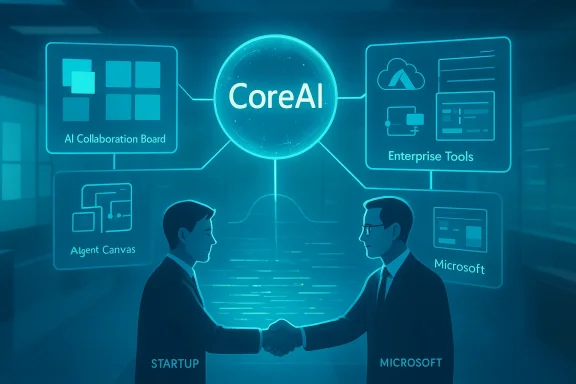
Microsoft’s reported hiring of the team behind Cove, a Sequoia-backed AI startup, fits neatly into the company’s broader 2025-2026 playbook: buy talent, absorb product instincts, and accelerate the CoreAI stack rather than wait for incremental internal development. The move matters less as a standalone startup event and more as another signal that Microsoft is using selective team hires to fortify its AI platform ambitions, especially as it pushes harder into agents, app building, and enterprise-grade tooling. That strategy has become more visible since Microsoft created CoreAI – Platform and Tools and framed AI infrastructure as the foundation of its next software era.
Microsoft has spent the last few years reshaping itself around AI, but the pace accelerated sharply once Copilot became the company’s public face for the AI transition. The shift was not just about adding a chatbot layer to Windows, Office, or GitHub; it was about turning Microsoft into the supplier of the full AI stack, from infrastructure to developer tooling to user-facing experiences. That ambition was made explicit when Satya Nadella announced CoreAI – Platform and Tools in January 2025, describing an internal organization meant to build the end-to-end Copilot and AI stack for both first-party and third-party customers.
That context is essential for understanding why a startup team like Cove’s would be attractive. In the AI era, Microsoft has shown a preference for acqui-hire-like talent absorption when the people matter more than the corporate shell. The company has done this before in different forms, and the logic is simple: if a team has already proven it can identify a useful user problem, move quickly, and think in product terms, then folding that team into Microsoft can shorten the time between idea and shipped capability. This is especially useful in AI, where model capabilities, product expectations, and user habits are changing fast.
Cove itself arrived in the market as part of the wave of AI-native collaboration tools trying to reimagine whiteboarding and shared workspaces. TechCrunch reported in October 2024 that the company had raised a seed round backed by Sequoia Capital and other investors, and that its product focused on an AI-powered collaboration board. That positioning placed Cove in a crowded but strategically important category: the layer where teams brainstorm, organize, and turn messy intent into structured work.
The broader competitive backdrop is obvious. Microsoft is not only defending its Windows and Office franchises; it is also trying to define the next generation of work software, where agents, interactive canvases, and workflow orchestration become core primitives. If that future materializes, then the software that captures the earliest phase of team ideation becomes disproportionately valuable. Startup teams that have worked on collaboration, copilots, and AI interfaces bring exactly the kind of product intuition Microsoft wants to internalize.
This kind of move also helps Microsoft avoid the drag of integrating a full acquisition. Instead of managing a large transaction, the company can selectively bring in people who already understand the problem space. The result is usually faster and less disruptive, though not necessarily less risky.
The company’s logic seems to be that the next durable AI advantage will come from blending platform depth with product speed. That is a hard combination for smaller startups to match, even when they have excellent ideas. Microsoft can, in effect, take the startup’s best instincts and deploy them across a much larger base.
Cove likely appealed to Microsoft because this category maps well onto the company’s evolving vision for Copilot and agents. Microsoft has been talking for more than a year about new UI patterns, agent orchestration, and a reimagined management layer for AI-driven work. A collaborative canvas is a plausible interface for that future.
There is also a strong fit with Microsoft’s existing foothold in workplace software. If Microsoft can make collaborative AI experiences feel native inside its ecosystem, it gains an advantage over point solutions that must fight for adoption from scratch. In that sense, the Cove team could help Microsoft reduce the gap between experimentation and daily use.
This is where AI startups differ from earlier software waves. A team can build meaningful technology quickly, but the long-term winner is often the one that gets embedded into the larger platform ecosystem. That means a startup’s team can be monetized indirectly through hiring, partnership, or product absorption rather than a classic acquisition.
That has implications for how investors price risk in AI collaboration, productivity, and agent software. If Microsoft can hire the people and adopt the ideas without buying the entire company, the standalone startup moat becomes narrower. That reality may push venture firms to favor teams with truly differentiated data, distribution, or workflow control.
This matters for agents in particular. Agents are only useful when users trust them, understand them, and can see where they fit inside a workflow. Teams like Cove’s are likely to have thought deeply about surfacing AI at just the right moment in a collaboration flow.
That could mean better interaction models, more intuitive surfaces, or new ways to let users move from unstructured thinking to executable work. It may also mean Microsoft becoming more aggressive about building native AI canvases rather than relying on AI as a supplemental feature.
For startups, that changes the calculus. A product that once looked like an independent venture may now be seen as a candidate for strategic talent absorption. That can dampen enthusiasm for building in categories where platform incumbents can move quickly.
In practical terms, that could lead to:
That is also why such hires can pay off disproportionately. An enterprise feature that reduces meeting friction or project chaos at scale can be worth far more than a flashy consumer app with limited retention. Microsoft knows this better than most.
The key difference is intent. Enterprise wants predictable utility; consumer wants immediate simplicity. The best Microsoft AI products tend to bridge both, and startup teams can help sharpen that bridge.
That does not mean every lesson from Cove will show up directly in the OS. It does mean Microsoft is assembling a portfolio of product instincts that may eventually influence how Windows users create, organize, and act on information.
The company’s challenge is making those synergies feel authentic rather than bolted on. Users have become skeptical of AI features that look impressive in demos but do not survive real work. Startup teams can help because they are often more ruthless about what actually gets used.
The other question is whether this becomes a template. Microsoft has clearly shown a willingness to bring in startup teams that complement its AI strategy, and that may become more common if the company keeps prioritizing speed. In a market where AI interfaces are still being invented, the companies that combine distribution, talent, and iteration will likely set the pace.
Source: Windows Report https://windowsreport.com/microsoft-hires-team-behind-sequoia-backed-ai-startup-cove/
 Background
Microsoft has spent the last few years reshaping itself around AI, but the pace accelerated sharply once Copilot became the company’s public face for the AI transition. The shift was not just about adding a chatbot layer to Windows, Office, or GitHub; it was about turning Microsoft into the supplier of the full AI stack, from infrastructure to developer tooling to user-facing experiences. That ambition was made explicit when Satya Nadella announced CoreAI – Platform and Tools in January 2025, describing an internal organization meant to build the end-to-end Copilot and AI stack for both first-party and third-party customers.That context is essential for understanding why a startup team like Cove’s would be attractive. In the AI era, Microsoft has shown a preference for acqui-hire-like talent absorption when the people matter more than the corporate shell. The company has done this before in different forms, and the logic is simple: if a team has already proven it can identify a useful user problem, move quickly, and think in product terms, then folding that team into Microsoft can shorten the time between idea and shipped capability. This is especially useful in AI, where model capabilities, product expectations, and user habits are changing fast.
Cove itself arrived in the market as part of the wave of AI-native collaboration tools trying to reimagine whiteboarding and shared workspaces. TechCrunch reported in October 2024 that the company had raised a seed round backed by Sequoia Capital and other investors, and that its product focused on an AI-powered collaboration board. That positioning placed Cove in a crowded but strategically important category: the layer where teams brainstorm, organize, and turn messy intent into structured work.
The broader competitive backdrop is obvious. Microsoft is not only defending its Windows and Office franchises; it is also trying to define the next generation of work software, where agents, interactive canvases, and workflow orchestration become core primitives. If that future materializes, then the software that captures the earliest phase of team ideation becomes disproportionately valuable. Startup teams that have worked on collaboration, copilots, and AI interfaces bring exactly the kind of product intuition Microsoft wants to internalize.
What This Hire Suggests About Microsoft’s Strategy
The most important takeaway is that Microsoft appears to be treating AI as an organization design problem as much as a technology problem. Building better models matters, but so does assembling teams that know how to shape those models into useful products. By pulling in a startup team, Microsoft can import not just code or architecture, but the decision-making culture of a small, fast-moving company.Talent is now the product
In the AI market, the best teams are often more valuable than the standalone startup entity. A startup may have a beautiful product story, but if the underlying category is still emerging, the talent can be more strategically useful inside a company with Microsoft’s distribution, cloud, and enterprise channels. That is especially true for a company like Cove, where the product itself sits close to Microsoft’s own roadmap for collaborative AI surfaces.This kind of move also helps Microsoft avoid the drag of integrating a full acquisition. Instead of managing a large transaction, the company can selectively bring in people who already understand the problem space. The result is usually faster and less disruptive, though not necessarily less risky.
- Microsoft can accelerate product development without buying a whole company.
- The team’s domain expertise becomes immediately reusable inside CoreAI.
- The company can reduce overlap with internal experimental efforts.
- Startups get a more certain path to scale than trying to win a market from scratch.
- Investors may still see value if the team’s move validates the category.
Why this matters in the AI race
Microsoft’s AI competition is no longer just with OpenAI’s alternative ecosystem, Google, or Anthropic. It is also with dozens of specialized startups that can move faster on narrow use cases. Hiring the Cove team is a way to neutralize one of those small but potentially influential threats before it becomes a bigger strategic problem.The company’s logic seems to be that the next durable AI advantage will come from blending platform depth with product speed. That is a hard combination for smaller startups to match, even when they have excellent ideas. Microsoft can, in effect, take the startup’s best instincts and deploy them across a much larger base.
Cove’s Product Category Is More Important Than the Brand
Cove’s significance lies in what it was trying to build rather than how famous the brand became. AI collaboration boards sit at a crossroads between brainstorming software, project planning tools, and agentic interfaces. That intersection is attractive because it combines human creativity with machine assistance in a way that enterprise users can understand.Collaboration is becoming an AI interface
The old metaphor for productivity software was the document, spreadsheet, or presentation. The new metaphor may be a living workspace where users can ask questions, generate structure, and move between ideas and execution without leaving the surface. That is why collaboration boards matter: they are a natural place for AI to help people organize thinking before work becomes formalized.Cove likely appealed to Microsoft because this category maps well onto the company’s evolving vision for Copilot and agents. Microsoft has been talking for more than a year about new UI patterns, agent orchestration, and a reimagined management layer for AI-driven work. A collaborative canvas is a plausible interface for that future.
The enterprise use case is especially strong
Enterprise customers rarely want “AI” in the abstract. They want help with concrete tasks: summarizing meetings, structuring projects, assigning next steps, and making large-scale collaboration less chaotic. A team like Cove’s likely built products around those needs, which makes its talent especially relevant to Microsoft’s enterprise business.There is also a strong fit with Microsoft’s existing foothold in workplace software. If Microsoft can make collaborative AI experiences feel native inside its ecosystem, it gains an advantage over point solutions that must fight for adoption from scratch. In that sense, the Cove team could help Microsoft reduce the gap between experimentation and daily use.
- Collaboration boards can become AI-native workspaces.
- Enterprises want structure, not gimmicks.
- The category aligns with Microsoft 365 and Copilot.
- Product design in this space can influence user behavior at scale.
- The distinction between “brainstorming” and “execution” is getting thinner.
Sequoia’s Backing and What It Signals
The fact that Cove was Sequoia-backed matters because it tells us the startup was not just an idea in search of validation. Sequoia tends to back companies it believes can define a category or become an important platform player. When Microsoft steps in to hire the team, it suggests the startup’s intellectual capital was valuable even if the company itself was not headed toward a standalone blockbuster exit.Venture validation still has strategic value
A Sequoia-backed startup often arrives with stronger product discipline, better market positioning, and a more credible founding team than the average early-stage company. Those qualities make the people behind it attractive to larger incumbents. Microsoft does not need the startup to have conquered the market; it only needs confidence that the team knows how to recognize a promising workflow and turn it into a polished product.This is where AI startups differ from earlier software waves. A team can build meaningful technology quickly, but the long-term winner is often the one that gets embedded into the larger platform ecosystem. That means a startup’s team can be monetized indirectly through hiring, partnership, or product absorption rather than a classic acquisition.
Investors should read this carefully
For venture capital, this kind of outcome cuts both ways. On one hand, it shows that high-quality teams can still attract attention from major platforms. On the other hand, it can also signal that some AI categories are becoming difficult for independent startups to defend if a large incumbent can replicate the product faster than expected.That has implications for how investors price risk in AI collaboration, productivity, and agent software. If Microsoft can hire the people and adopt the ideas without buying the entire company, the standalone startup moat becomes narrower. That reality may push venture firms to favor teams with truly differentiated data, distribution, or workflow control.
- Sequoia backing suggests the startup had credible market promise.
- Microsoft may value the team more than the company structure.
- The exit path for AI startups is becoming more diverse.
- Some categories are easier for incumbents to absorb than to acquire.
- Venture firms will likely keep favoring product and technical excellence over mere speed.
What It Means for CoreAI and Microsoft’s Internal AI Roadmap
Microsoft’s January 2025 CoreAI announcement made clear that the company wants a unified AI platform organization spanning model-adjacent infrastructure, developer tools, and product integration. Bringing in startup talent fits that structure because it gives CoreAI a stronger link to real-world product sensibilities. A team that has lived in the startup pressure cooker can help prevent Microsoft from becoming too abstract or too internal-facing.The platform stack needs more than infrastructure
Microsoft already has scale in Azure, developer tools, and workplace software. The harder challenge is making these parts behave like a coherent AI platform rather than disconnected offerings. That is where smaller startup teams can help, because they often know how to turn one clear use case into a repeatable user experience.This matters for agents in particular. Agents are only useful when users trust them, understand them, and can see where they fit inside a workflow. Teams like Cove’s are likely to have thought deeply about surfacing AI at just the right moment in a collaboration flow.
This could shape how Microsoft builds future products
Microsoft has increasingly emphasized the idea of an AI-first app stack, with agents orchestrating complex workflows across applications and services. A collaboration-oriented startup team may influence how those experiences are visualized, navigated, and controlled. The best startup hires often do not merely add headcount; they change the product’s instincts.That could mean better interaction models, more intuitive surfaces, or new ways to let users move from unstructured thinking to executable work. It may also mean Microsoft becoming more aggressive about building native AI canvases rather than relying on AI as a supplemental feature.
- CoreAI needs product-oriented builders, not only researchers.
- Startup teams can bring user empathy to platform work.
- Agents require clean interaction patterns.
- Collaboration surfaces are likely to become more central.
- Microsoft wants tighter feedback loops between platform and product.
Competitive Implications for Rivals
Microsoft’s move sends a message to competitors: even small, specialized startup ideas may not remain independent for long if they overlap with Microsoft’s strategic roadmap. That is not necessarily an anti-competitive problem, but it does show how seriously Microsoft is treating the AI platform war. Rivals now have to assume that any promising collaboration, productivity, or interface layer may be quickly mapped into Microsoft’s ecosystem.Google, Atlassian, and the startup ecosystem all feel it
Google has its own AI workspace ambitions, while Atlassian has long owned much of the team collaboration and knowledge work stack. But Microsoft’s advantage is distribution. If Microsoft folds startup talent into Copilot, Teams, or adjacent surfaces, it can reach users where they already work instead of asking them to adopt a new product category.For startups, that changes the calculus. A product that once looked like an independent venture may now be seen as a candidate for strategic talent absorption. That can dampen enthusiasm for building in categories where platform incumbents can move quickly.
The broader market may consolidate faster
There is a growing pattern in AI: the most visible exits are not always giant acquisitions but strategic team moves, research partnerships, and product integrations. That creates a market where some of the value gets captured earlier and more quietly. It also means the startup ecosystem may see faster consolidation around platform owners with the strongest distribution channels.In practical terms, that could lead to:
- fewer durable standalone companies in collaborative AI,
- more M&A pressure on startups with thin defensibility,
- stronger incentives to build around proprietary data,
- and a premium on teams that can ship polished user experiences quickly.
Enterprise Versus Consumer Impact
The enterprise impact is likely much larger than the consumer impact, at least initially. Microsoft’s greatest leverage comes from workplace software, cloud infrastructure, and organizational deployments. A team like Cove’s can help refine AI interfaces that make sense for companies, not just individual users.Enterprise users want reliability and control
Businesses care about auditability, permissions, governance, and workflow consistency. That means the AI collaboration experiences Microsoft builds from this kind of talent will likely emphasize structured assistance rather than freeform novelty. The result should be better alignment with Microsoft 365, Teams, and enterprise security requirements.That is also why such hires can pay off disproportionately. An enterprise feature that reduces meeting friction or project chaos at scale can be worth far more than a flashy consumer app with limited retention. Microsoft knows this better than most.
Consumer adoption follows when the experience feels natural
Consumer users may not notice the pedigree of the team, but they will notice if the experience feels smoother. If Microsoft uses startup talent to make AI canvases more intuitive, then consumer spillover becomes possible through Windows, Copilot, and cross-device experiences. That is especially true if Microsoft turns collaboration into a lightweight, everyday behavior rather than a formal enterprise ritual.The key difference is intent. Enterprise wants predictable utility; consumer wants immediate simplicity. The best Microsoft AI products tend to bridge both, and startup teams can help sharpen that bridge.
- Enterprise value usually comes from workflow efficiency.
- Consumer value usually comes from ease of use.
- Microsoft can serve both if the interface is disciplined.
- Security and governance are non-negotiable in business deployments.
- Consumer delight often depends on enterprise-grade reliability underneath.
Why This Matters for Windows and the Microsoft Ecosystem
Even though Cove is not a Windows product story on the surface, the hire is relevant to the future of Windows as an AI platform. Microsoft has been steadily repositioning Windows not just as an operating system, but as an entry point into AI-powered tasks, search, and productivity. Startup talent that improves collaboration interfaces can eventually inform how AI behaves across the desktop.Windows is becoming more agent-friendly
Microsoft’s recent AI strategy suggests a future where the operating system is less about launching apps and more about orchestrating intent. In that world, collaboration surfaces, task canvases, and agent controls all matter. A team experienced in AI collaboration tools could help Microsoft make those interactions more coherent on Windows.That does not mean every lesson from Cove will show up directly in the OS. It does mean Microsoft is assembling a portfolio of product instincts that may eventually influence how Windows users create, organize, and act on information.
The ecosystem effect is larger than one startup
Microsoft’s strength has always been the ecosystem effect: improvements in one part of the stack tend to ripple outward. If CoreAI becomes more capable at turning ideas into products, then GitHub, Azure, Copilot, and Windows can all benefit. That kind of internal synergy is precisely why talent hires can matter more than headlines suggest.The company’s challenge is making those synergies feel authentic rather than bolted on. Users have become skeptical of AI features that look impressive in demos but do not survive real work. Startup teams can help because they are often more ruthless about what actually gets used.
Strengths and Opportunities
Microsoft’s hiring of the Cove team has several obvious strengths, and the opportunity set is broader than a single product line. The move strengthens the company’s AI bench while also reinforcing the idea that Microsoft wants to own the interface layer where humans and agents collaborate. It is a classic platform strategy, but with a faster, more opportunistic edge.- Faster product iteration inside CoreAI.
- Sharper collaboration UX for enterprise AI tools.
- Better alignment between startup-style experimentation and Microsoft scale.
- Potential spillover into Copilot and Windows experiences.
- Stronger defensive posture against specialist AI startups.
- Improved recruiting signal for other top-tier AI builders.
- More coherent end-to-end strategy across infrastructure and app layers.
Risks and Concerns
The biggest risk is that Microsoft absorbs the talent but fails to convert it into a distinct product advantage. Hiring smart people is not the same as creating a breakthrough experience. There is also the possibility that startup culture gets diluted once it enters a large organization, especially one as process-heavy as Microsoft.- The team could be lost in organizational complexity.
- Microsoft may overestimate how transferable the startup’s product instincts are.
- The company could create internal overlap with existing AI efforts.
- Startups in adjacent spaces may be discouraged from competing.
- A talent hire may not produce a visible user-facing win.
- Integration risks can slow the pace the acquisition was meant to accelerate.
- If the category is too crowded, the move may look symbolic rather than transformative.
Looking Ahead
What happens next will depend on whether Microsoft gives the Cove team enough room to influence real product surfaces. If the team is used only as an idea source, the impact may be modest. If it becomes embedded in CoreAI’s product loop, however, it could shape how Microsoft thinks about collaborative AI for years.The other question is whether this becomes a template. Microsoft has clearly shown a willingness to bring in startup teams that complement its AI strategy, and that may become more common if the company keeps prioritizing speed. In a market where AI interfaces are still being invented, the companies that combine distribution, talent, and iteration will likely set the pace.
- Watch for changes to Copilot and agent surfaces.
- Watch for any new Microsoft collaboration or canvas-style tools.
- Watch for additional startup-team hires into CoreAI.
- Watch for rival responses in enterprise productivity software.
- Watch for venture capital to shift toward more defensible AI workflows.
Source: Windows Report https://windowsreport.com/microsoft-hires-team-behind-sequoia-backed-ai-startup-cove/
Last edited:
