

Microsoft's pitch at Ignite was blunt and unapologetic: build your own AI agents — and use Microsoft's stack to do it at scale, with new layers for intelligence, governance, and cost control. What was presented in San Francisco is not a handful of features; it's a full enterprise play for an agent-first future: Work IQ as the contextual intelligence layer, Agent 365 as the control plane for fleets of agents, expanded Copilot and Copilot Studio features to let non-developers and pros build agents, and a broadened Foundry model lineup (including Anthropic) so organizations can pick the models they trust. Taken together these announcements signal Microsoft moving from "Copilot as helper" to "Copilot as orchestrator" — but the strategic gap between Microsoft's roadmap and real-world readiness is large, and adoption will depend on trust, governance, and measurable ROI.
Microsoft used Ignite to sketch a future where agents — autonomous, task-focused AI programs — become as commonplace as business apps. The company framed this as the rise of the "Frontier Firm": organizations that embed AI across workflows, empower employees to create with AI, and maintain observability and governance across the stack. The keynote and accompanying product briefings emphasized three core ideas: AI in the flow of work, ubiquitous innovation (citizen maker + pro dev), and observability/trust at every layer. These themes drove the major product rollouts: Work IQ, expanded Copilot modes, Copilot Studio enhancements, Agent 365, and Foundry model updates. Microsoft also leaned on a startling statistic — an IDC estimate that more than 1.3 billion agents could be deployed by 2028 — to justify Agent 365 and the urgency of governance, identity, and lifecycle management for agents. Whether that figure is a reasonable projection or a marketing accelerant, it helped frame Agent 365 as a necessary management control plane, not an optional add-on.
In short, Microsoft has supplied the scaffolding for an agent-driven future; it's now on customers and partners to build the houses, enforce the building codes, measure the value, and decide whether they want thousands of agents humming in their fleets — or a few tightly governed, high-impact agents that actually move the business needle. The product pieces are falling into place, but widespread adoption will be pragmatic, measured, and conditional on trust and repeatable ROI.
Bold takeaways:
Source: PCMag Microsoft Wants Us Creating Our Own AI Agents. Is Anyone Actually Interested?
 Background
Microsoft used Ignite to sketch a future where agents — autonomous, task-focused AI programs — become as commonplace as business apps. The company framed this as the rise of the "Frontier Firm": organizations that embed AI across workflows, empower employees to create with AI, and maintain observability and governance across the stack. The keynote and accompanying product briefings emphasized three core ideas: AI in the flow of work, ubiquitous innovation (citizen maker + pro dev), and observability/trust at every layer. These themes drove the major product rollouts: Work IQ, expanded Copilot modes, Copilot Studio enhancements, Agent 365, and Foundry model updates. Microsoft also leaned on a startling statistic — an IDC estimate that more than 1.3 billion agents could be deployed by 2028 — to justify Agent 365 and the urgency of governance, identity, and lifecycle management for agents. Whether that figure is a reasonable projection or a marketing accelerant, it helped frame Agent 365 as a necessary management control plane, not an optional add-on. What Microsoft announced (the essentials)
Work IQ: an intelligence layer for context and memory
Work IQ is positioned as a persistent intelligence layer that aggregates organizational signals (files, email, calendar, tenant data) and personal signals (preferences, behaviour, saved instructions) to give Copilot and agents memory and contextual inference. Microsoft says Work IQ enables Copilot to retain cross-session context, anticipate next actions, and personalize responses — essentially layering a runtime memory and inference capability on top of Microsoft Graph-style data. This is the engine Microsoft expects agents and Copilots to use for meaningful, role-aware automation.Agent 365: control, telemetry, and governance
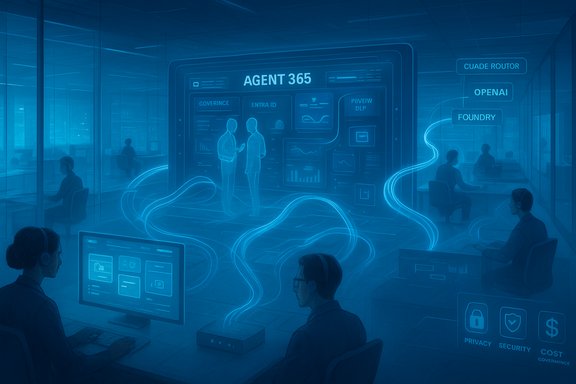
Agent 365 is the control plane Microsoft described as the admin-level interface for registering, monitoring, and governing agents across an enterprise — including third-party and open-source agents. It offers a registry, access control, visualization/dashboards, and security signals so IT can treat agents like identities and workloads that must be managed. Microsoft tied Agent 365 to Entra Agent ID (an identity type for agents) and Purview DLP enhancements so actions by agents can be constrained and audited. Early access is via Microsoft's Frontier program.Copilot Chat / Copilot evolution and pricing model
Microsoft repositioned its free Copilot Chat offering as a low-barrier entry into agent capabilities, while preserving a premium Copilot experience (integrated directly into Word, Excel, Outlook, etc. that still carries the licensed enterprise price point. Critically, Microsoft added a pay-as-you-go consumption model for agent interactions in Copilot Chat: messages and actions are metered so organizations incur costs only for actual usage. Microsoft and press reporting laid out sample consumption tiers and example pricing units for simple responses, generative responses, and Graph-grounded responses, giving IT finance teams ways to forecast spending.Copilot Studio, GitHub Agent HQ, and Foundry expansions
Copilot Studio is the no-code/low-code environment for building agents; Microsoft stressed "the maker inside all of us" and demonstrated drag-and-drop/ declarative agent creation for business users. For professional dev teams, Microsoft introduced Agent HQ within GitHub (a place to pick agents and agent components) and expanded Foundry with additional model choices and a model router (automatic selection of best model by accuracy/cost/latency). Anthropic's Claude family is now part of Foundry's model catalog, giving customers model choice beyond OpenAI models. Microsoft also described an "Agent Factory" metered plan to simplify development and rollout costs.Why Microsoft thinks this matters
- Microsoft argues agents are the next app category: lightweight, composable, and specialized for business tasks. Agents can be shared, observed, and governed; Agent 365 treats them as first-class citizens.
- Work IQ promises to make AI more useful by placing memory and inference close to the user: instead of copying and pasting into a chat, Copilot would know your role, meetings, and documents to give targeted assistance.
- Democratizing agent creation lowers the barrier to experimentation and scale: Copilot Studio plus consumption pricing is explicitly designed to get more teams building without committing to heavy license bills upfront.
Critical analysis — strengths, weaknesses, and the adoption gap
Strengths: the building blocks are comprehensive
Microsoft showed a holistic platform approach rather than a single flashy feature. The combination of:- Context and memory (Work IQ) to make agents actually useful,
- Governance and identity (Agent 365, Entra Agent ID) to manage risk,
- Developer and citizen tools (Copilot Studio, Foundry, GitHub integration) to scale creation,
- Consumption-based economics to reduce procurement friction,
Weaknesses: trust, ROI, and complexity remain real barriers
For many IT leaders and line-of-business owners the announcements answer "how" more than "why." The product pitch presumes (a) ready, clean data; (b) strong business-IT alignment; (c) regulatory comfort; and (d) operational discipline to monitor and tune agents. Microsoft itself acknowledged that many AI projects fail for reasons like misalignment, data quality, compliance constraints, and unfocused experimentation — precisely the gaps that will slow agent rollouts. Until organizations have clearer playbooks and demonstrated cost/benefit results, adoption will be cautious.- Data quality: Agents are only as good as the data and context they can rely on. If Work IQ is fed poor or siloed data, agents will make mistakes that harm trust and adoption.
- Governance complexity: Agent 365 is necessary, but treating an army of autonomous agents as identities multiplies the identity surface area by orders of magnitude. Managing lifecycle, secrets, and permission scopes at scale will be non-trivial.
- Cost predictability: Consumption pricing lowers entry cost but shifts risk to operational cost management. Without tooling and maturity, organizations may face surprise Azure bills from agent testing or runaway loops.
- Human factors: Will individual contributors actually create agents? Early feedback and forum discussions suggest many attendees are intrigued, but formalized internal processes for citizen development, review, and QA are required to prevent "random acts of innovation."
Security and privacy — improvements but still a primary adoption blocker
Microsoft's Entra Agent ID and Purview DLP integrations are the correct architectural moves: give each agent an identity, apply least-privilege, and log everything. Yet identity is just one piece. Attacks could exploit agent privileges or social engineering of agent prompts. Observability must include behavior analytics and anomaly detection specific to agent workflows. The product announcements add controls, but security teams will demand strong SLAs, auditability, and proof that agents cannot be coerced into leaking sensitive material or taking unauthorized actions. The rhetoric around governance is mature; the operational tooling and third-party validation will determine trust.The economics: pay-as-you-go vs. licensed Copilot
Microsoft’s two-tiered approach is notable:- Free/low-friction Copilot Chat with metered agent capabilities (pay-as-you-go).
- Full Microsoft 365 Copilot licensed at enterprise price (still widely reported as $30/user/month for full integrated Copilot capabilities).
Who will adopt first — and where agents are likely to deliver ROI early
Not all organizations will rush to deploy hundreds of agents. The earliest adopters will likely be:- Process-heavy enterprises with measurable transactional workloads (logistics, claims processing, HR operations) where automating repetitive, rule-based tasks yields quick ROI.
- Teams with clean, centralized data estates (e.g., customer support with consolidated ticketing systems, finance teams with integrated ERPs) where Graph-grounded agents can operate with predictable inputs.
- Technology-forward "frontier firms" with internal AI competency and available FDE (forward-deployed engineers) or partner ecosystems that can accelerate safe rollout.
Practical checklist for IT leaders considering agents now
- Start with a business-led use case, not a technology-first experiment. Identify a high-frequency, measurable process with clear owners.
- Audit data hygiene and identify necessary Graph connectors and tenants that agents will use. Invest in Fabric/Foundry RAG pipelines only after data mapping.
- Run pilot agents in a limited environment with Agent 365 / Entra Agent ID enabled and strict least-privilege policies.
- Meter costs and set consumption alerts. Use model router and cheaper models for background tasks; reserve high-cost models for high-value reasoning.
- Build a governance board (security, legal, finance, and business owners) to approve agent designs and monitor behavior logs.
- Invest in training for citizen creators and establish QA gates within Copilot Studio pipelines.
Open questions and risks Microsoft and customers must address
- Will the IDC 1.3 billion estimate drive responsible policy or create fear-driven regulation? The scale projection is useful to justify controls, but it may also prompt knee-jerk restrictions that stifle experimentation. Organizations should plan for scale while enforcing incremental rollout guardrails.
- How well will model choice and the model router work in practice? Mixing Anthropic, OpenAI, Microsoft, and third-party models gives flexibility, but it also adds complexity in governance and explainability. Organizations will want provenance and model-forensics capabilities for regulated use cases.
- Can Microsoft demonstrate clear ROI cases beyond pilot anecdotes? Broad adoption depends on measurable outcomes: time saved, error reduction, revenue impact, or cost avoidance. Anecdotes help sell the promise; published case studies built on production rollouts will drive the next wave of adoption.
- How will regulatory frameworks (the EU AI Act, industry-specific rules) affect agent behavior and design? Enterprises operating across jurisdictions must build compliance into agent lifecycles from the start.
Conclusion
Microsoft's Ignite message is ambitious and coherent: make agents easy, make them useful with a strong contextual layer (Work IQ), make them selectable and optimizable with model choice and routing, and make them manageable with an enterprise-grade control plane (Agent 365 + Entra Agent ID). Those are the right strategic moves to turn agents into enterprise-grade automation — if organizations solve alignment, data quality, governance, and cost management.In short, Microsoft has supplied the scaffolding for an agent-driven future; it's now on customers and partners to build the houses, enforce the building codes, measure the value, and decide whether they want thousands of agents humming in their fleets — or a few tightly governed, high-impact agents that actually move the business needle. The product pieces are falling into place, but widespread adoption will be pragmatic, measured, and conditional on trust and repeatable ROI.
Bold takeaways:
- Work IQ aims to turn Copilot from reactive tool into a role-aware assistant.
- Agent 365 is Microsoft’s answer to agent governance — treat agents like identities and workloads.
- Consumption pricing lowers entry friction but requires operational cost controls to avoid surprises.
- Model choice (Anthropic in Foundry, OpenAI, others) is now a mainstream platform expectation — but it increases governance needs.
Source: PCMag Microsoft Wants Us Creating Our Own AI Agents. Is Anyone Actually Interested?
