

Microsoft marked the first anniversary of its Indonesia Central cloud region on May 29, 2026, framing the in-country Azure infrastructure as both a working datacenter platform and a strategic bet on Indonesia’s AI economy. The anniversary is more than a corporate victory lap. It is a reminder that the AI boom is being built not in abstractions, but in substations, cooling loops, security perimeters, workforce pipelines, and local regulatory compromises. For Indonesia, the question is no longer whether global cloud infrastructure will arrive; it is whether the country can turn that infrastructure into durable national capability rather than rented capacity.
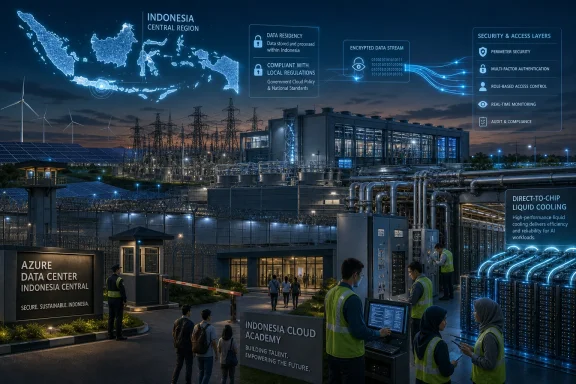
For most users, cloud computing is still experienced as latency disappearing. A payment clears, a Teams call connects, a file syncs, a model responds, and the machinery behind those events remains deliberately unseen. Microsoft’s anniversary note pulls that machinery into view, if only briefly, by describing Indonesia Central as a highly restricted industrial facility rather than a magical layer of software.
That matters because the AI era has made the physicality of computing impossible to ignore. The old sales pitch for cloud was elasticity: buy what you need, scale when demand arrives, and stop worrying about the server room. The new sales pitch is proximity: run data, applications, and AI workloads closer to users, regulators, and institutions that increasingly care where the computation happens.
Indonesia Central sits at the intersection of those two arguments. It gives Microsoft a local platform for Azure services in one of Southeast Asia’s most important digital markets, while giving Indonesian customers a way to argue that they are not simply exporting their digital future to Singapore, Japan, or the United States. That is powerful positioning, especially for banks, public-sector agencies, universities, telcos, and healthcare organizations whose cloud decisions are now tangled with sovereignty, compliance, and trust.
But the phrase cloud region can flatten what is actually being built. A region is not one room full of servers. It is a networked, redundant, heavily guarded cluster of facilities and systems designed to keep running through component failures, power instability, thermal stress, cyber risk, and human error. In Microsoft’s telling, Indonesia Central is meant to be invisible to end users precisely because it is engineered not to draw attention to itself.
That invisibility is the product. If the facility becomes visible to ordinary users, something has probably gone wrong.
Microsoft says Indonesia Central uses advanced cooling methods, including direct-to-chip liquid cooling, to manage those loads more efficiently. That detail is important because it signals where hyperscale datacenter design is heading. The AI boom is pushing operators beyond the assumptions of conventional enterprise datacenters, where air cooling and room-level thermal management were often sufficient.
Direct-to-chip cooling changes the architectural conversation. Instead of treating heat as a room problem, it treats heat as a silicon-adjacent problem. Coolant is brought closer to the components producing the heat, making it possible to support denser compute racks and higher-power AI systems without relying exclusively on large volumes of chilled air.
Microsoft’s Alistair Speirs also pushes back against a common assumption: that liquid cooling is necessarily more water-intensive than air cooling. The company argues that closed-loop liquid cooling can circulate the same water for years without evaporation, while evaporative air-cooling systems consume water continuously. That framing is not just a technical correction; it is reputational defense in a market where datacenter water use is increasingly controversial.
The sustainability claim should still be read carefully. A closed cooling loop may reduce operational water loss, but datacenters remain large consumers of electricity, land, materials, and supply-chain inputs. Microsoft’s message is that the company can scale AI infrastructure without simply scaling waste in parallel. The harder test will be whether those efficiency gains hold as demand for AI workloads grows faster than nearly every earlier generation of enterprise software.
This is where Indonesia Central becomes a useful case study. Microsoft is not merely installing cloud capacity for yesterday’s workloads. It is preparing for a future in which universities run tutoring systems, banks migrate critical data, developers call foundation models through Azure OpenAI Service, and enterprises expect AI inference to feel local and responsive. Cooling is not a basement-level detail in that world. It is one of the constraints that decides how much AI a country can practically host.
Microsoft says Indonesia Central is supported by its own high-voltage substation, a phrase that should stop readers from thinking about datacenters as merely larger server closets. This is industrial infrastructure. It belongs in the same mental category as ports, rail corridors, semiconductor fabs, and telecom backbones: facilities whose value depends on both capacity and continuity.
The company also highlights a 10-year partnership with Perusahaan Listrik Negara to support 200 MW of renewable energy into the grid. That agreement gives Microsoft a sustainability narrative, but it also exposes the central tension of modern cloud expansion. Hyperscalers want to tell governments they are accelerating clean energy transitions, while critics can fairly ask whether giant AI facilities increase demand faster than renewable supply can catch up.
Both things can be true. A large corporate buyer can help finance renewable energy projects and make cleaner generation more bankable. The same buyer can also add enormous load to a grid already serving households, factories, hospitals, and transport systems. The net effect depends on execution, additionality, grid planning, and whether clean-energy claims translate into actual system-level decarbonization rather than accounting comfort.
Microsoft’s use of lower-carbon alternatives such as biofuel for backup systems points to another shift. The backup generator is no longer invisible in sustainability reporting. As customers scrutinize their own emissions, the carbon profile of the cloud supply chain becomes part of procurement, compliance, and brand risk.
For Indonesian organizations adopting AI, this is not abstract. A bank that moves critical applications to Azure inherits some of Microsoft’s resilience and sustainability posture. A university using AI tutors does the same. The cloud customer may not operate the substation, but it is increasingly dependent on the substation’s performance, politics, and environmental credibility.
That is especially relevant in finance. Microsoft says BNI Finance migrated more than 200 terabytes of mission-critical data and over 100 application services to Azure and the Indonesia Central region within two months. The speed of that migration is notable, but the more important phrase is mission-critical. This is not a marketing website or a side project. It is the kind of workload that forces boards, auditors, regulators, security teams, and application owners into the same room.
Local cloud regions do not magically solve compliance. They do, however, reduce the number of objections. Data residency requirements become easier to satisfy. Latency-sensitive applications get a better architectural option. Disaster recovery planning can be designed around in-country infrastructure. Security controls can be mapped more directly to local operating assumptions.
For years, global cloud adoption in many markets followed a familiar path: developer enthusiasm first, enterprise caution second, regulated-sector acceptance last. A local region compresses that timeline. It tells cautious organizations that the platform has moved closer to them — geographically, commercially, and politically.
That proximity is part of Microsoft’s competitive play. AWS, Google Cloud, Alibaba Cloud, and regional providers all understand that Southeast Asia is not one market but a patchwork of regulatory environments, languages, infrastructure constraints, and national development agendas. A cloud region is a stake in that ground. It says: we are not just selling into this country; we are building inside it.
For WindowsForum readers, the connection to the Microsoft ecosystem is obvious. Azure is no longer just a backend for cloud-native apps. It is increasingly where Microsoft wants identity, security, productivity, analytics, developer tooling, AI services, and Windows-adjacent management to converge. A local Azure region makes that convergence easier to sell to customers who might otherwise keep sensitive workloads on-premises or split them across providers.
But the more interesting security claim is procedural. Microsoft emphasizes not only gates and cameras, but rules governing how people interact with systems and data. This is where hyperscale security differs from the popular imagination. The danger is not only a dramatic physical breach; it is also misconfiguration, insider access, sloppy maintenance practice, weak identity controls, and poorly governed operational exceptions.
Modern cloud security is therefore both stronger and more complicated than the traditional enterprise model. A customer moving into Azure gains access to Microsoft’s global security engineering, encryption, monitoring, and compliance investments. The same customer also accepts the shared-responsibility model, where a badly configured identity policy, exposed storage account, or vulnerable application can still cause serious damage.
That distinction matters in Indonesia as much as anywhere else. A local region may help with residency and latency, but it does not absolve customers from governance. If anything, it may increase the number of organizations ready to move sensitive workloads before their internal security maturity has fully caught up.
Microsoft’s broader trust message is designed to soothe that concern. The company wants governments and regulated industries to see Azure as a safer place to modernize than their own fragmented infrastructure estates. Often, that argument has merit. Many enterprises are worse at patching, monitoring, and identity discipline than the hyperscalers they distrust.
Yet the tradeoff is concentration. As more services, data, identity systems, and AI capabilities cluster around a small number of cloud providers, outages and security incidents become more systemically important. Indonesia Central may reduce dependence on foreign geography, but it also deepens dependence on Microsoft’s platform.
This is the correct pressure point. A country does not become an AI economy simply because cloud capacity exists inside its borders. It becomes one when engineers, technicians, developers, security analysts, policymakers, educators, and entrepreneurs can build useful things on top of that capacity.
Datacenters create direct jobs, but not usually in numbers that match the scale of the investment headline. Ninety-nine on-site professionals is meaningful for a highly specialized facility, not a mass-employment engine. The larger workforce opportunity sits around the facility: cloud migration teams, AI application developers, cybersecurity professionals, data engineers, compliance specialists, power engineers, cooling experts, and local suppliers.
That is why Microsoft’s skilling narrative is not decorative. It is central to whether Indonesia captures more than a hosting fee from the AI boom. If Indonesian organizations use Azure mainly to consume imported AI services, the country gains capability but remains downstream. If Indonesian developers, universities, banks, hospitals, and public agencies build locally relevant systems on the platform, the value equation changes.
Universitas Terbuka’s AI Tutor project is a useful example. Microsoft says the university is using Azure OpenAI Service to support more than 100,000 students across 500 classes. Education at that scale is exactly where AI can look less like a toy and more like infrastructure, particularly in a geographically dispersed country where access and consistency matter.
But education is also where the limitations of AI become socially visible. A tutor system must be accurate, culturally appropriate, linguistically capable, transparent about uncertainty, and integrated into human teaching rather than treated as a cheap replacement for it. Local infrastructure may improve performance and data handling, but pedagogy remains the hard part.
This is the new geography of cloud competition. The first phase of hyperscale expansion concentrated capacity in a smaller number of global hubs. The next phase pushes infrastructure closer to large populations, regulated industries, and governments that want digital sovereignty without fully rejecting foreign platforms.
Indonesia is a natural target. It has a large population, a growing digital economy, an active developer base, major banks and telcos, and national ambitions around AI adoption. It also has infrastructure challenges that make the arrival of hyperscale facilities both attractive and contentious.
For Microsoft, being early enough matters. A cloud region is sticky infrastructure. Once enterprises migrate workloads, train staff, rework compliance processes, and build application architectures around a platform, switching becomes expensive. The first anniversary of Indonesia Central is therefore not just a celebration of what has run for a year. It is a checkpoint in a long customer lock-in strategy.
That phrase sounds harsher than Microsoft’s preferred language, but it is not inherently sinister. All major enterprise platforms create switching costs. The question is whether customers receive enough reliability, capability, security, and local economic benefit to justify those costs.
Indonesia’s policy challenge is to welcome infrastructure without surrendering leverage. That means pushing for transparent sustainability practices, meaningful skilling outcomes, competitive cloud markets, strong data governance, and procurement strategies that avoid accidental dependency. Hyperscalers are useful national partners, but they are not charities. Their incentives overlap with national goals only where contracts, regulation, and market pressure make them overlap.
They also reveal how hard the story is to tell convincingly. Small circular-economy practices matter, especially for local communities. But they sit beside much larger questions about power demand, water use, construction emissions, hardware supply chains, and the rapid refresh cycles associated with AI accelerators.
The AI industry has a measurement problem as much as a sustainability problem. Customers and citizens need to know not only whether a facility has efficient cooling, but how much energy it uses, what portion is matched by genuinely additional clean power, how water is accounted for, what happens during drought or grid stress, and how hardware disposal is managed. Corporate summaries rarely provide enough detail to answer all of that.
Microsoft has set aggressive global sustainability goals, including its commitment to become carbon negative by 2030. The difficulty is that the AI boom arrived like a stress test for those commitments. Training and inference demand, datacenter construction, and specialized hardware procurement have all accelerated. The company now has to prove that its sustainability promises can survive the very AI growth it is helping create.
Indonesia Central’s closed-loop cooling and renewable energy partnership are therefore important, but not final answers. They are design choices in a system that will keep changing as demand grows. The stronger Microsoft’s local business becomes, the more scrutiny those choices deserve.
That scrutiny should not be treated as anti-technology. It is the price of becoming infrastructure. Roads, power plants, ports, and telecom networks are all judged by public consequences as well as private efficiency. Cloud regions now belong in that category.
A local cloud region strengthens that entire chain. It makes it easier for Indonesian organizations to adopt Microsoft services as a package rather than as disconnected products. The cloud region becomes the foundation under collaboration, security, application modernization, analytics, and AI.
For IT administrators, this integration is both attractive and worrying. On the attractive side, Microsoft can offer a coherent management and security model across endpoints, identities, workloads, and data. For organizations struggling with legacy infrastructure and fragmented tooling, that coherence is valuable.
On the worrying side, integration can become dependency by another name. If an organization standardizes on Microsoft for identity, productivity, endpoint security, cloud hosting, AI services, and developer tooling, it may gain operational simplicity while losing negotiating flexibility. The more seamless the platform feels, the harder it can be to leave.
This is why local infrastructure should not end the architectural debate. Indonesian enterprises still need multi-cloud strategies where appropriate, exit planning for critical systems, portable data practices, and internal skills that are not limited to one vendor’s vocabulary. The goal should be to use Microsoft’s investment, not be used by it.
The more complicated question is distribution. Who captures the value created by Indonesia Central? Microsoft certainly does, through Azure consumption, enterprise contracts, AI services, and deeper market position. Large Indonesian institutions also gain, especially those that can modernize faster because local infrastructure removes old barriers.
The harder cases are smaller companies, regional governments, local software firms, vocational students, and communities near the infrastructure. They need more than marketing proximity to benefit. They need affordable access, practical training, procurement pathways, local-language AI tooling, reliable connectivity, and a policy environment that turns hyperscale investment into domestic capability.
This is where Microsoft’s “Frontier Firms” framing deserves a raised eyebrow. It is useful to spotlight early adopters, but early adopters are often the organizations already best positioned to benefit. The national story becomes more persuasive when the second and third waves arrive: mid-sized manufacturers, local hospitals, municipal agencies, rural education providers, and small developer shops building for Indonesian needs.
If Indonesia Central remains primarily a platform for large enterprises to modernize existing systems, it will still be commercially successful. If it helps broaden who can build, deploy, and govern AI in Indonesia, it becomes more consequential.
 Microsoft’s Invisible Cloud Has Become Very Physical
For most users, cloud computing is still experienced as latency disappearing. A payment clears, a Teams call connects, a file syncs, a model responds, and the machinery behind those events remains deliberately unseen. Microsoft’s anniversary note pulls that machinery into view, if only briefly, by describing Indonesia Central as a highly restricted industrial facility rather than a magical layer of software.That matters because the AI era has made the physicality of computing impossible to ignore. The old sales pitch for cloud was elasticity: buy what you need, scale when demand arrives, and stop worrying about the server room. The new sales pitch is proximity: run data, applications, and AI workloads closer to users, regulators, and institutions that increasingly care where the computation happens.
Indonesia Central sits at the intersection of those two arguments. It gives Microsoft a local platform for Azure services in one of Southeast Asia’s most important digital markets, while giving Indonesian customers a way to argue that they are not simply exporting their digital future to Singapore, Japan, or the United States. That is powerful positioning, especially for banks, public-sector agencies, universities, telcos, and healthcare organizations whose cloud decisions are now tangled with sovereignty, compliance, and trust.
But the phrase cloud region can flatten what is actually being built. A region is not one room full of servers. It is a networked, redundant, heavily guarded cluster of facilities and systems designed to keep running through component failures, power instability, thermal stress, cyber risk, and human error. In Microsoft’s telling, Indonesia Central is meant to be invisible to end users precisely because it is engineered not to draw attention to itself.
That invisibility is the product. If the facility becomes visible to ordinary users, something has probably gone wrong.
AI Turns Cooling From Facilities Plumbing Into Strategic Infrastructure
The most revealing part of Microsoft’s anniversary account is not the usual language about innovation. It is the emphasis on heat. AI infrastructure is, at one level, a story about expensive processors converting electricity into computation and heat at industrial scale. The more powerful the GPUs and CPUs, the more serious the thermal problem becomes.Microsoft says Indonesia Central uses advanced cooling methods, including direct-to-chip liquid cooling, to manage those loads more efficiently. That detail is important because it signals where hyperscale datacenter design is heading. The AI boom is pushing operators beyond the assumptions of conventional enterprise datacenters, where air cooling and room-level thermal management were often sufficient.
Direct-to-chip cooling changes the architectural conversation. Instead of treating heat as a room problem, it treats heat as a silicon-adjacent problem. Coolant is brought closer to the components producing the heat, making it possible to support denser compute racks and higher-power AI systems without relying exclusively on large volumes of chilled air.
Microsoft’s Alistair Speirs also pushes back against a common assumption: that liquid cooling is necessarily more water-intensive than air cooling. The company argues that closed-loop liquid cooling can circulate the same water for years without evaporation, while evaporative air-cooling systems consume water continuously. That framing is not just a technical correction; it is reputational defense in a market where datacenter water use is increasingly controversial.
The sustainability claim should still be read carefully. A closed cooling loop may reduce operational water loss, but datacenters remain large consumers of electricity, land, materials, and supply-chain inputs. Microsoft’s message is that the company can scale AI infrastructure without simply scaling waste in parallel. The harder test will be whether those efficiency gains hold as demand for AI workloads grows faster than nearly every earlier generation of enterprise software.
This is where Indonesia Central becomes a useful case study. Microsoft is not merely installing cloud capacity for yesterday’s workloads. It is preparing for a future in which universities run tutoring systems, banks migrate critical data, developers call foundation models through Azure OpenAI Service, and enterprises expect AI inference to feel local and responsive. Cooling is not a basement-level detail in that world. It is one of the constraints that decides how much AI a country can practically host.
Power Reliability Is the Other Half of the AI Bargain
If cooling is the thermal side of the AI bargain, power is the political and economic side. A hyperscale datacenter region cannot behave like an ordinary office campus. It needs layered power systems, backup generation, switching infrastructure, and enough redundancy to survive failures without customers noticing.Microsoft says Indonesia Central is supported by its own high-voltage substation, a phrase that should stop readers from thinking about datacenters as merely larger server closets. This is industrial infrastructure. It belongs in the same mental category as ports, rail corridors, semiconductor fabs, and telecom backbones: facilities whose value depends on both capacity and continuity.
The company also highlights a 10-year partnership with Perusahaan Listrik Negara to support 200 MW of renewable energy into the grid. That agreement gives Microsoft a sustainability narrative, but it also exposes the central tension of modern cloud expansion. Hyperscalers want to tell governments they are accelerating clean energy transitions, while critics can fairly ask whether giant AI facilities increase demand faster than renewable supply can catch up.
Both things can be true. A large corporate buyer can help finance renewable energy projects and make cleaner generation more bankable. The same buyer can also add enormous load to a grid already serving households, factories, hospitals, and transport systems. The net effect depends on execution, additionality, grid planning, and whether clean-energy claims translate into actual system-level decarbonization rather than accounting comfort.
Microsoft’s use of lower-carbon alternatives such as biofuel for backup systems points to another shift. The backup generator is no longer invisible in sustainability reporting. As customers scrutinize their own emissions, the carbon profile of the cloud supply chain becomes part of procurement, compliance, and brand risk.
For Indonesian organizations adopting AI, this is not abstract. A bank that moves critical applications to Azure inherits some of Microsoft’s resilience and sustainability posture. A university using AI tutors does the same. The cloud customer may not operate the substation, but it is increasingly dependent on the substation’s performance, politics, and environmental credibility.
Data Residency Is the Quiet Feature Enterprises Actually Buy
Microsoft naturally emphasizes innovation, AI, and national empowerment. Enterprise buyers often begin somewhere more practical: where is the data, who can access it, what law applies, and how fast can the system respond? Indonesia Central gives Microsoft a stronger answer to those questions than a distant regional hub could.That is especially relevant in finance. Microsoft says BNI Finance migrated more than 200 terabytes of mission-critical data and over 100 application services to Azure and the Indonesia Central region within two months. The speed of that migration is notable, but the more important phrase is mission-critical. This is not a marketing website or a side project. It is the kind of workload that forces boards, auditors, regulators, security teams, and application owners into the same room.
Local cloud regions do not magically solve compliance. They do, however, reduce the number of objections. Data residency requirements become easier to satisfy. Latency-sensitive applications get a better architectural option. Disaster recovery planning can be designed around in-country infrastructure. Security controls can be mapped more directly to local operating assumptions.
For years, global cloud adoption in many markets followed a familiar path: developer enthusiasm first, enterprise caution second, regulated-sector acceptance last. A local region compresses that timeline. It tells cautious organizations that the platform has moved closer to them — geographically, commercially, and politically.
That proximity is part of Microsoft’s competitive play. AWS, Google Cloud, Alibaba Cloud, and regional providers all understand that Southeast Asia is not one market but a patchwork of regulatory environments, languages, infrastructure constraints, and national development agendas. A cloud region is a stake in that ground. It says: we are not just selling into this country; we are building inside it.
For WindowsForum readers, the connection to the Microsoft ecosystem is obvious. Azure is no longer just a backend for cloud-native apps. It is increasingly where Microsoft wants identity, security, productivity, analytics, developer tooling, AI services, and Windows-adjacent management to converge. A local Azure region makes that convergence easier to sell to customers who might otherwise keep sensitive workloads on-premises or split them across providers.
The Security Story Is About Process, Not Just Perimeters
Microsoft’s description of Indonesia Central leans heavily on physical security: restricted buildings, controlled access, monitored spaces, and limited authorization. That is expected. Datacenters are built around layers of exclusion, and hyperscalers generally reveal only enough to reassure customers without helping attackers.But the more interesting security claim is procedural. Microsoft emphasizes not only gates and cameras, but rules governing how people interact with systems and data. This is where hyperscale security differs from the popular imagination. The danger is not only a dramatic physical breach; it is also misconfiguration, insider access, sloppy maintenance practice, weak identity controls, and poorly governed operational exceptions.
Modern cloud security is therefore both stronger and more complicated than the traditional enterprise model. A customer moving into Azure gains access to Microsoft’s global security engineering, encryption, monitoring, and compliance investments. The same customer also accepts the shared-responsibility model, where a badly configured identity policy, exposed storage account, or vulnerable application can still cause serious damage.
That distinction matters in Indonesia as much as anywhere else. A local region may help with residency and latency, but it does not absolve customers from governance. If anything, it may increase the number of organizations ready to move sensitive workloads before their internal security maturity has fully caught up.
Microsoft’s broader trust message is designed to soothe that concern. The company wants governments and regulated industries to see Azure as a safer place to modernize than their own fragmented infrastructure estates. Often, that argument has merit. Many enterprises are worse at patching, monitoring, and identity discipline than the hyperscalers they distrust.
Yet the tradeoff is concentration. As more services, data, identity systems, and AI capabilities cluster around a small number of cloud providers, outages and security incidents become more systemically important. Indonesia Central may reduce dependence on foreign geography, but it also deepens dependence on Microsoft’s platform.
Workforce Development Is the Difference Between Hosting AI and Owning It
The most politically important section of Microsoft’s anniversary message may be the one about people. The company says Indonesia Central has 99 specialized professionals on site, including technicians, electrical engineers, and operations experts. It also points to the Nusantara Datacenter Academy and Microsoft Elevate as pathways for local technical training.This is the correct pressure point. A country does not become an AI economy simply because cloud capacity exists inside its borders. It becomes one when engineers, technicians, developers, security analysts, policymakers, educators, and entrepreneurs can build useful things on top of that capacity.
Datacenters create direct jobs, but not usually in numbers that match the scale of the investment headline. Ninety-nine on-site professionals is meaningful for a highly specialized facility, not a mass-employment engine. The larger workforce opportunity sits around the facility: cloud migration teams, AI application developers, cybersecurity professionals, data engineers, compliance specialists, power engineers, cooling experts, and local suppliers.
That is why Microsoft’s skilling narrative is not decorative. It is central to whether Indonesia captures more than a hosting fee from the AI boom. If Indonesian organizations use Azure mainly to consume imported AI services, the country gains capability but remains downstream. If Indonesian developers, universities, banks, hospitals, and public agencies build locally relevant systems on the platform, the value equation changes.
Universitas Terbuka’s AI Tutor project is a useful example. Microsoft says the university is using Azure OpenAI Service to support more than 100,000 students across 500 classes. Education at that scale is exactly where AI can look less like a toy and more like infrastructure, particularly in a geographically dispersed country where access and consistency matter.
But education is also where the limitations of AI become socially visible. A tutor system must be accurate, culturally appropriate, linguistically capable, transparent about uncertainty, and integrated into human teaching rather than treated as a cheap replacement for it. Local infrastructure may improve performance and data handling, but pedagogy remains the hard part.
Southeast Asia Is Becoming a Datacenter Chessboard
Indonesia Central is not an isolated move. Microsoft has been expanding across Asia, with investments and regions tied to Malaysia, Thailand, Japan, India, and other markets. The company’s 2024 pledge of US$1.7 billion for Indonesia fits into a larger regional contest among hyperscalers to secure land, energy, regulatory trust, enterprise customers, and AI demand.This is the new geography of cloud competition. The first phase of hyperscale expansion concentrated capacity in a smaller number of global hubs. The next phase pushes infrastructure closer to large populations, regulated industries, and governments that want digital sovereignty without fully rejecting foreign platforms.
Indonesia is a natural target. It has a large population, a growing digital economy, an active developer base, major banks and telcos, and national ambitions around AI adoption. It also has infrastructure challenges that make the arrival of hyperscale facilities both attractive and contentious.
For Microsoft, being early enough matters. A cloud region is sticky infrastructure. Once enterprises migrate workloads, train staff, rework compliance processes, and build application architectures around a platform, switching becomes expensive. The first anniversary of Indonesia Central is therefore not just a celebration of what has run for a year. It is a checkpoint in a long customer lock-in strategy.
That phrase sounds harsher than Microsoft’s preferred language, but it is not inherently sinister. All major enterprise platforms create switching costs. The question is whether customers receive enough reliability, capability, security, and local economic benefit to justify those costs.
Indonesia’s policy challenge is to welcome infrastructure without surrendering leverage. That means pushing for transparent sustainability practices, meaningful skilling outcomes, competitive cloud markets, strong data governance, and procurement strategies that avoid accidental dependency. Hyperscalers are useful national partners, but they are not charities. Their incentives overlap with national goals only where contracts, regulation, and market pressure make them overlap.
The Sustainability Claims Will Have to Survive Scale
Microsoft’s anniversary piece includes several granular sustainability examples: recycling wood packaging into furniture, repurposing concrete waste for village roads and housing foundations, redirecting food waste to community farming, sourcing local rebar and concrete to reduce transport-related emissions, and supporting rainwater harvesting with Yayasan Rumah Energi. These details are meant to show that sustainability is operational, not just aspirational.They also reveal how hard the story is to tell convincingly. Small circular-economy practices matter, especially for local communities. But they sit beside much larger questions about power demand, water use, construction emissions, hardware supply chains, and the rapid refresh cycles associated with AI accelerators.
The AI industry has a measurement problem as much as a sustainability problem. Customers and citizens need to know not only whether a facility has efficient cooling, but how much energy it uses, what portion is matched by genuinely additional clean power, how water is accounted for, what happens during drought or grid stress, and how hardware disposal is managed. Corporate summaries rarely provide enough detail to answer all of that.
Microsoft has set aggressive global sustainability goals, including its commitment to become carbon negative by 2030. The difficulty is that the AI boom arrived like a stress test for those commitments. Training and inference demand, datacenter construction, and specialized hardware procurement have all accelerated. The company now has to prove that its sustainability promises can survive the very AI growth it is helping create.
Indonesia Central’s closed-loop cooling and renewable energy partnership are therefore important, but not final answers. They are design choices in a system that will keep changing as demand grows. The stronger Microsoft’s local business becomes, the more scrutiny those choices deserve.
That scrutiny should not be treated as anti-technology. It is the price of becoming infrastructure. Roads, power plants, ports, and telecom networks are all judged by public consequences as well as private efficiency. Cloud regions now belong in that category.
Microsoft’s Indonesia Bet Is Also a Windows Ecosystem Bet
Although Indonesia Central is an Azure story on the surface, it has implications across Microsoft’s broader stack. The company’s modern enterprise pitch is increasingly integrated: Windows endpoints managed through cloud services, identities anchored in Entra ID, security telemetry flowing into Microsoft Defender, productivity work happening inside Microsoft 365, and AI assistance arriving through Copilot and Azure OpenAI.A local cloud region strengthens that entire chain. It makes it easier for Indonesian organizations to adopt Microsoft services as a package rather than as disconnected products. The cloud region becomes the foundation under collaboration, security, application modernization, analytics, and AI.
For IT administrators, this integration is both attractive and worrying. On the attractive side, Microsoft can offer a coherent management and security model across endpoints, identities, workloads, and data. For organizations struggling with legacy infrastructure and fragmented tooling, that coherence is valuable.
On the worrying side, integration can become dependency by another name. If an organization standardizes on Microsoft for identity, productivity, endpoint security, cloud hosting, AI services, and developer tooling, it may gain operational simplicity while losing negotiating flexibility. The more seamless the platform feels, the harder it can be to leave.
This is why local infrastructure should not end the architectural debate. Indonesian enterprises still need multi-cloud strategies where appropriate, exit planning for critical systems, portable data practices, and internal skills that are not limited to one vendor’s vocabulary. The goal should be to use Microsoft’s investment, not be used by it.
The First Year Proves the Region Works; the Next Years Will Test Who Benefits
The concrete evidence from year one is straightforward. Microsoft has a functioning in-country cloud region. Customers in finance and education are already using it for major workloads. The facility is being positioned as secure, resilient, energy-conscious, and AI-ready. Training programs are being attached to the infrastructure narrative.The more complicated question is distribution. Who captures the value created by Indonesia Central? Microsoft certainly does, through Azure consumption, enterprise contracts, AI services, and deeper market position. Large Indonesian institutions also gain, especially those that can modernize faster because local infrastructure removes old barriers.
The harder cases are smaller companies, regional governments, local software firms, vocational students, and communities near the infrastructure. They need more than marketing proximity to benefit. They need affordable access, practical training, procurement pathways, local-language AI tooling, reliable connectivity, and a policy environment that turns hyperscale investment into domestic capability.
This is where Microsoft’s “Frontier Firms” framing deserves a raised eyebrow. It is useful to spotlight early adopters, but early adopters are often the organizations already best positioned to benefit. The national story becomes more persuasive when the second and third waves arrive: mid-sized manufacturers, local hospitals, municipal agencies, rural education providers, and small developer shops building for Indonesian needs.
If Indonesia Central remains primarily a platform for large enterprises to modernize existing systems, it will still be commercially successful. If it helps broaden who can build, deploy, and govern AI in Indonesia, it becomes more consequential.
The Anniversary Message Hides a Harder National Test
Microsoft’s first-year update is optimistic, but the real test of Indonesia Central will be measured in operating discipline, customer outcomes, and local capability rather than ribbon-cutting language. The practical lessons are already visible.- Indonesia Central gives Microsoft a stronger local answer for data residency, latency, and regulated-sector cloud adoption in Indonesia.
- The region’s emphasis on direct-to-chip liquid cooling shows how AI workloads are reshaping datacenter design from the rack outward.
- Microsoft’s renewable energy partnership with PLN is strategically important, but its climate value depends on how clean power supply scales against rising AI demand.
- Workforce programs such as the Nusantara Datacenter Academy and Microsoft Elevate will matter most if they create durable local careers beyond Microsoft’s own facilities.
- Indonesian customers should treat local Azure capacity as an opportunity to modernize, while still preserving governance, portability, and vendor-negotiation leverage.
- The region’s long-term significance will depend less on whether Microsoft can run infrastructure and more on whether Indonesian institutions can build independent value on top of it.
References
- Primary source: Microsoft Source
Published: Fri, 29 May 2026 12:56:20 GMT
- Related coverage: datacenters.com
- Related coverage: techrepublic.com
Microsoft's $3.9B Southeast Asia Cloud Expansion Targets Indonesia, Malaysia AI Markets
Microsoft launched the first cloud regions in Indonesia and Malaysia, boosting AI innovation, local data security, and digital economy growth in Southeast Asia.www.techrepublic.com
- Related coverage: kvia.com
Microsoft will invest $1.7 billion in AI and cloud infrastructure in Indonesia - KVIA
By EDNA TARIGAN Associated Press JAKARTA, Indonesia (AP) — Microsoft will invest $1.7 billion over the next four years in new cloud and artificial intelligence infrastructure in Indonesia — the single largest investment in Microsoft’s 29-year history in the country. That’s according to...kvia.com
- Related coverage: indonesiabusinesspost.com
Microsoft launches first data center region in Indonesia
Microsoft launched on Tuesday, May 27, 2025 the Indonesia Central Cloud Region, marking its first data center cluster in the country expected to significantly aindonesiabusinesspost.com - Related coverage: investing.com
Microsoft to invest $1.7 billion in cloud, AI in Indonesia, CEO says By Reuters
Microsoft to invest $1.7 billion in cloud, AI in Indonesia, CEO sayswww.investing.com

- Related coverage: technode.global
Microsoft opens first cloud region in Indonesia - TNGlobal
American technology conglomerate Microsoft announced Tuesday the opening of its first cloud region in Indonesia, called Indonesia Central.technode.global - Related coverage: medcom.id
Microsoft Resmikan Cloud Region Indonesia Central
Microsoft luncurkan cloud region Indonesia Central untuk dorong transformasi digital, ciptakan 106.000 lapangan kerja, dan tingkatkan ekonomi nasional.www.medcom.id
- Related coverage: rcrwireless.com
Microsoft opens cloud region in Indonesia to support AI infra
Analyst firm IDC projects that Microsoft and its ecosystem could contribute $15.2 billion to Indonesia’s economy from 2025 to 2028.www.rcrwireless.com - Related coverage: jagatreview.com

Microsoft Resmikan “Indonesia Central”, Data Center Pertamanya di Tanah Air • Jagat Review
Jakarta, 27 Mei 2025 – Microsoft hari ini secara resmi meluncurkan data center pertama mereka di Indonesia yang diberi nama “Indonesia Central”. Data center
www.jagatreview.com
- Related coverage: techxplore.com
- Related coverage: assets.kpmg.com
beyond capacity building indonesia intelligence sustainable data centers.pdf.coredownload.inline
PDF documentassets.kpmg.com
- Related coverage: miti.gov.my
- Official source: cdn-dynmedia-1.microsoft.com
