

Microsoft Digital has introduced an AI-powered Intelligent Risk Engine inside its expense approval workflow to score expense reports by risk before managers review them. For managers, finance teams, and admins, the practical implication is clear: approval work can move from uniform manual checking toward prioritized review, but only if scoring, explanations, audit records, and compliance ownership are treated as core controls rather than convenience features.
The broader strategy is not that AI replaces finance governance. It is that AI can triage repetitive, rules-heavy work before human attention is spent on the wrong items. Expense approvals are a useful proving ground because they are frequent, auditable, policy-bound, and sensitive when something goes wrong. If a system can reduce routine review without weakening controls, the same pattern may eventually influence other internal workflows. If it cannot explain its recommendations or preserve accountability, it simply moves risk from the approval screen to the audit trail.
The old approval model had a familiar enterprise defect: it treated too many submissions as if they deserved the same level of attention. A routine low-value receipt and a more complicated expense could both land in a manager’s queue with similar urgency, even though the practical compliance risk might differ substantially.
That is the kind of workflow failure that grows quietly inside large organizations. Nobody designs a system to waste manager time. The waste accumulates because compliance obligations, local policy nuance, audit concerns, and legacy user experience all get layered onto the same approval surface. Managers respond rationally by reviewing everything because accountability still sits with them.
Microsoft’s stated problem was not simply that expense reports took too long to approve. The deeper problem was signal quality. Managers needed a way to identify which reports deserved closer review and which appeared to be routine. Without that signal, every approval could feel like a potential compliance trap.
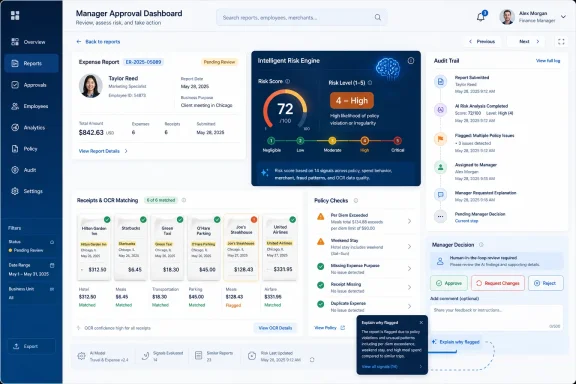
Microsoft says the Intelligent Risk Engine addresses that problem by evaluating expense reports with a mix of AI-based checks and policy-driven checks. The system assigns a numerical risk score from 1 to 100, maps that score to a risk level from 1 to 5, and presents an explanation of what triggered the flag. The workflow is therefore not just “approve faster.” It is “review according to risk.”
That distinction matters. A faster bad process is still a bad process. The useful change is that risk becomes visible at the point of approval, where the manager can act on it.
This is where many automation projects make the wrong move. They chase speed while preserving the same mental model. If a system merely makes every expense easier to open, route, or click through, it still asks the manager to carry the full cognitive burden. The Intelligent Risk Engine is more consequential because it changes the decision surface itself.
The practical problem can be summarized in four linked points:
Microsoft’s approach is to break that loop by giving the approver a quantified starting point. The key word is starting point. The score should not be treated as the final decision. It is a baseline for human judgment.
That is the first governance lesson for readers. A risk engine that silently approves or rejects without review, explanation, or oversight becomes a liability. A risk engine that standardizes what gets attention, shows why, and preserves human accountability can become useful operational infrastructure.
The output is a score from 1 to 100 and a risk level from 1 to 5. The score appears in the approval workflow so that the manager sees the risk signal where the decision is already being made. That design choice is important. AI that requires a second dashboard often becomes another place to forget. AI embedded in the actual approval surface has a better chance of changing behavior.
Microsoft’s risk model can be summarized this way, using only the grounded mechanics Microsoft has described and separating the writer’s interpretation from the stated facts:
The first four columns reflect Microsoft’s described scoring structure. The final column is analysis, not a Microsoft directive. It translates the scoring concept into likely operational behavior, but every organization would need to define its own manager instructions, escalation paths, and approval thresholds.
This distinction is essential. A high-risk score does not automatically prove misconduct. A low-risk score does not prove perfection. The score is a routing and prioritization signal. It tells the manager where to look first and why.
The value of the system depends on the quality of those explanations. If the tool says only “high risk,” it creates anxiety without clarity. If it identifies the specific concern, such as a receipt mismatch or policy issue, the manager can confirm, challenge, or resolve the matter. Explanation is not a decorative feature. It is what makes the risk score usable.
Traditional expense governance often relies on a mix of employee accuracy, manager diligence, and downstream audit review. That model can be costly because late findings create rework. The employee may need to correct the report. The manager may need to revisit a prior decision. Finance or audit may need to intervene. The organization pays for the original process and then pays again for cleanup.
The Intelligent Risk Engine attempts to move part of that control earlier. If a submission appears routine, the manager can spend less time on it. If a submission includes a policy concern, mismatch, or unusual pattern, the manager sees that before approval.
That is the concrete takeaway for admins and finance leaders: the value is not only in reducing clicks. The value is in moving useful signal closer to the transaction.
Still, this is where the boundary between fact and analysis matters. Microsoft has described the system as a way to score and flag expense reports. It is reasonable to infer that earlier signal may reduce rework if the scoring is accurate and if managers act on the explanations. But that outcome depends on implementation quality, policy design, user training, and audit feedback. It should not be assumed automatically.
For WindowsForum readers who manage Microsoft 365, identity, endpoint compliance, governance, or business applications, the pattern should feel familiar. Modern enterprise systems increasingly push controls into the daily workflow rather than leaving them only in separate review processes. The useful question is not whether that pattern is fashionable. The useful question is whether the embedded signal is reliable enough to influence action.
Scoring and prioritization help managers decide where to focus. Auto-approval changes the control environment because some items may move forward without routine human approval. That can save time, but it also requires stronger evidence, clearer ownership, and better monitoring.
The phrase “subject to compliance approval” is important. It means the organization should not treat AI scoring as sufficient on its own. Compliance, finance, audit, and IT must agree on which transactions are eligible, what thresholds apply, how exceptions are handled, and how the system will be tested over time.
The hard question is not simply whether the model can classify expenses. The hard question is who accepts accountability when a low-risk classification is wrong.
That is why any organization considering similar automation should avoid beginning with a target percentage. The right opening question is not, “How much can we auto-approve?” It is, “Which narrow category of expenses has enough historical evidence, policy clarity, and audit confidence to justify automation?”
A responsible rollout would begin with classification only. Managers would continue to approve, but the organization would compare the AI score against actual review outcomes. Over time, finance and compliance could identify categories where the score is consistently reliable. Only then should the organization consider limited automatic approval, and only for well-defined cases.
Auto-approval is not a switch. It is a control decision.
Expense workflows contain many small manual decisions. Which category applies? Does the receipt match the claimed amount? Is the date correct? Is the merchant visible? Does the item align with policy? Is the expense associated with the right project, trip, event, or business purpose?
Each decision is small in isolation. Together, they create friction for employees and ambiguity for managers.
OCR-assisted receipt matching can reduce manual validation work. Automatic categorization can reduce employee entry errors. Risk scoring can then use cleaner inputs to decide which reports deserve more attention.
The operational takeaway is simple: scoring should not be evaluated separately from data capture. If the receipt extraction is unreliable, the risk score may look precise while resting on weak evidence. If categorization is inconsistent, policy checks may misfire. If employee or manager metadata is stale, routing and accountability may be wrong.
In other words, the risk engine is only as strong as the expense data pipeline behind it.
This is also why finance leaders should not view AI approval as an isolated feature purchase. Before adopting similar automation, they should review the full chain: employee submission, receipt capture, category assignment, policy mapping, manager hierarchy, approval routing, audit logging, and exception handling.
The first skepticism should be about data quality. Risk scoring depends on accurate receipt extraction, consistent policy mapping, meaningful spending history, correct employee metadata, reliable manager hierarchies, and region-aware rules. If the underlying data is inconsistent, the score may appear precise while hiding ambiguity.
The second skepticism should be about policy drift. Expense policies are not static. Thresholds change. Regional rules change. Travel norms change. Reimbursement categories change. If policy-driven checks are not governed with the same seriousness as financial controls, the engine may slowly encode yesterday’s rules.
The third skepticism should be about automation bias. Once a report is labeled negligible or low risk, managers may stop looking even when something seems off. Conversely, a high-risk score may make a legitimate employee submission feel suspect before a human has reviewed the facts. Training and interface design matter because the score shapes perception.
The fourth skepticism should be about auditability. “The system scored it low risk” is not, by itself, an audit defense. The organization needs to preserve the score, the reason codes, the policy version, the extracted receipt data, the approver action, and the escalation path. If those records cannot be reconstructed later, automation may reduce front-end friction while increasing back-end exposure.
The fifth skepticism should be about employee trust. Expense systems touch money, travel, meals, local customs, and manager judgment. If employees believe an opaque model is flagging them unfairly, the workflow may become faster but less trusted. Explanations are therefore part of operational legitimacy.
The sixth skepticism should be about exception handling. Any useful scoring model will encounter cases that do not fit the standard pattern. A system that cannot handle exceptions gracefully will push ambiguous work back to managers, finance teams, or support queues. The organization must decide who owns those exceptions before automation scales.
The deeper work is governance. Who owns the policy logic? Who reviews false positives and false negatives? Who decides when a category can move from “score only” to “auto approve”? Who signs off on regional exceptions? Who monitors score distribution over time? Who can override the recommendation? Who investigates when a high-risk report is approved anyway?
No serious AI approval system belongs exclusively to IT, finance, or audit. It cuts across all three. IT manages the workflow, integrations, identity, permissions, logging, and platform reliability. Finance owns the policy and business process. Compliance or audit validates whether the control environment remains acceptable. Managers are the daily users who must understand what the score means and what it does not mean.
That cross-functional ownership should be established before rollout. If it is deferred until after the system is live, every disputed score becomes a governance problem.
The win is in the middle: enough transparency to preserve accountability, enough automation to remove waste.
Microsoft’s stated facts include the existence of the Intelligent Risk Engine, its use inside the expense approval workflow, the combination of AI-based and policy-driven checks, the use of receipt matching and spending-pattern analysis, the 1-to-100 score, the five-level risk model, and the presence of explanations for flagged items. Microsoft has also indicated that low-risk auto-approval is a planned direction subject to compliance approval.
The analysis is that this model represents a shift from uniform manual review toward risk-based decisioning. That conclusion follows from the scoring design, but it is still an interpretation. The analysis is also that similar systems could reduce manager burden, surface issues earlier, and improve audit readiness if implemented carefully. Those outcomes depend on data quality, policy governance, manager training, and monitoring.
That separation matters because enterprise AI projects often fail when a stated capability is mistaken for a guaranteed business result. A system can score expenses. That does not automatically mean it improves governance. A system can explain flags. That does not automatically mean managers understand them. A system can identify low-risk submissions. That does not automatically mean they should be auto-approved.
Readers should treat the Intelligent Risk Engine as a concrete internal workflow example, not as proof that every organization should immediately automate expense approvals. The design is useful. The governance work is mandatory.
Expense reports are only one example. The same operating question can apply to procurement requests, access reviews, vendor onboarding, device exceptions, security exemptions, contract approvals, and service management changes. In each case, the organization should ask:
The strongest use case is not where AI can make a decision in isolation. It is where AI can reduce noise, surface reasons, and let accountable humans focus on the cases that need judgment.
That is the practical significance of Microsoft’s Intelligent Risk Engine. It is not glamorous AI. It is not a chatbot. It is a risk signal inserted into a business process that managers already use. That is exactly why it matters.
The Intelligent Risk Engine shows one way to balance those demands. Score the transaction. Explain the reason. Keep the human accountable. Preserve the record. Learn from the outcomes. Expand automation only after compliance is satisfied.
That sequence is slower than the hype cycle wants, but it is the only sequence that makes sense for financial workflows. Expense approval may look mundane, but mundane workflows are where enterprise AI will either prove itself or lose trust. The real test is not whether AI can produce an impressive recommendation. The real test is whether the organization can rely on that recommendation when money, policy, audit, and employee trust are all involved.
For admins and finance leaders, the next step is not to copy Microsoft’s internal model blindly. It is to inventory approval queues, identify where risk signals are missing, and decide which controls must exist before any scoring automation goes live.
AI can help managers stop reviewing everything as if everything carries the same risk. But the organization still has to define what risk means, who owns the decision, and how the evidence will stand up later. That is where the real work begins.
The broader strategy is not that AI replaces finance governance. It is that AI can triage repetitive, rules-heavy work before human attention is spent on the wrong items. Expense approvals are a useful proving ground because they are frequent, auditable, policy-bound, and sensitive when something goes wrong. If a system can reduce routine review without weakening controls, the same pattern may eventually influence other internal workflows. If it cannot explain its recommendations or preserve accountability, it simply moves risk from the approval screen to the audit trail.
 Microsoft Turns Expense Approval Into a Risk-Based Workflow
The old approval model had a familiar enterprise defect: it treated too many submissions as if they deserved the same level of attention. A routine low-value receipt and a more complicated expense could both land in a manager’s queue with similar urgency, even though the practical compliance risk might differ substantially.That is the kind of workflow failure that grows quietly inside large organizations. Nobody designs a system to waste manager time. The waste accumulates because compliance obligations, local policy nuance, audit concerns, and legacy user experience all get layered onto the same approval surface. Managers respond rationally by reviewing everything because accountability still sits with them.
Microsoft’s stated problem was not simply that expense reports took too long to approve. The deeper problem was signal quality. Managers needed a way to identify which reports deserved closer review and which appeared to be routine. Without that signal, every approval could feel like a potential compliance trap.
Microsoft says the Intelligent Risk Engine addresses that problem by evaluating expense reports with a mix of AI-based checks and policy-driven checks. The system assigns a numerical risk score from 1 to 100, maps that score to a risk level from 1 to 5, and presents an explanation of what triggered the flag. The workflow is therefore not just “approve faster.” It is “review according to risk.”
That distinction matters. A faster bad process is still a bad process. The useful change is that risk becomes visible at the point of approval, where the manager can act on it.
The Old Expense Stack Had a Signal Problem, Not Just a Speed Problem
Microsoft describes the prior approach as heavily dependent on manual validation. That meant managers could spend time checking routine submissions while still lacking a consistent way to identify items with higher policy or compliance concern.This is where many automation projects make the wrong move. They chase speed while preserving the same mental model. If a system merely makes every expense easier to open, route, or click through, it still asks the manager to carry the full cognitive burden. The Intelligent Risk Engine is more consequential because it changes the decision surface itself.
The practical problem can be summarized in four linked points:
- Managers lacked an early signal showing where risk was concentrated.
- Approvals consumed too much time because low- and high-risk submissions were often handled through the same review motion.
- Routine items absorbed attention that could have been used on exceptions.
- Issues discovered late could create rework for employees, managers, finance, or audit teams.
Microsoft’s approach is to break that loop by giving the approver a quantified starting point. The key word is starting point. The score should not be treated as the final decision. It is a baseline for human judgment.
That is the first governance lesson for readers. A risk engine that silently approves or rejects without review, explanation, or oversight becomes a liability. A risk engine that standardizes what gets attention, shows why, and preserves human accountability can become useful operational infrastructure.
The Risk Score Is the Product
The mechanics are straightforward, but the implications are significant. Microsoft says the Intelligent Risk Engine evaluates each report against criteria such as receipt matching, spending patterns, and policy alignment. Receipt matching uses AI and optical character recognition, while policy-driven checks help compare the report against established rules.The output is a score from 1 to 100 and a risk level from 1 to 5. The score appears in the approval workflow so that the manager sees the risk signal where the decision is already being made. That design choice is important. AI that requires a second dashboard often becomes another place to forget. AI embedded in the actual approval surface has a better chance of changing behavior.
Microsoft’s risk model can be summarized this way, using only the grounded mechanics Microsoft has described and separating the writer’s interpretation from the stated facts:
| Risk score | Risk label | Risk level | Microsoft-stated function | Editorial implication for review |
|---|---|---|---|---|
| 0–25 | Negligible | Level 1 | Lowest risk band in the scoring model | Likely candidate for a lighter review process, if policy allows |
| 25–50 | Low | Level 2 | Low risk band in the scoring model | May warrant a quick reasonableness check rather than deep inspection |
| 50–75 | Medium | Level 3 | Midrange band where attention may be needed | Review the stated flags and request clarification if needed |
| 75–90 | High | Level 4 | Higher risk band in the scoring model | Treat as a priority for careful manager review |
| 90–100 | Critical | Level 5 | Highest risk band in the scoring model | Escalation or compliance review may be appropriate depending on policy |
This distinction is essential. A high-risk score does not automatically prove misconduct. A low-risk score does not prove perfection. The score is a routing and prioritization signal. It tells the manager where to look first and why.
The value of the system depends on the quality of those explanations. If the tool says only “high risk,” it creates anxiety without clarity. If it identifies the specific concern, such as a receipt mismatch or policy issue, the manager can confirm, challenge, or resolve the matter. Explanation is not a decorative feature. It is what makes the risk score usable.
The Governance Shift Is From Late Review to Earlier Intervention
The most important operational change is not simply that a manager sees a number. It is that compliance concerns can be surfaced earlier in the workflow.Traditional expense governance often relies on a mix of employee accuracy, manager diligence, and downstream audit review. That model can be costly because late findings create rework. The employee may need to correct the report. The manager may need to revisit a prior decision. Finance or audit may need to intervene. The organization pays for the original process and then pays again for cleanup.
The Intelligent Risk Engine attempts to move part of that control earlier. If a submission appears routine, the manager can spend less time on it. If a submission includes a policy concern, mismatch, or unusual pattern, the manager sees that before approval.
That is the concrete takeaway for admins and finance leaders: the value is not only in reducing clicks. The value is in moving useful signal closer to the transaction.
Still, this is where the boundary between fact and analysis matters. Microsoft has described the system as a way to score and flag expense reports. It is reasonable to infer that earlier signal may reduce rework if the scoring is accurate and if managers act on the explanations. But that outcome depends on implementation quality, policy design, user training, and audit feedback. It should not be assumed automatically.
For WindowsForum readers who manage Microsoft 365, identity, endpoint compliance, governance, or business applications, the pattern should feel familiar. Modern enterprise systems increasingly push controls into the daily workflow rather than leaving them only in separate review processes. The useful question is not whether that pattern is fashionable. The useful question is whether the embedded signal is reliable enough to influence action.
Auto-Approval Is Where Risk and ROI Both Get Real
Microsoft has indicated that low-risk automatic approval is a future direction, subject to compliance approval. That is where the operational stakes rise sharply.Scoring and prioritization help managers decide where to focus. Auto-approval changes the control environment because some items may move forward without routine human approval. That can save time, but it also requires stronger evidence, clearer ownership, and better monitoring.
The phrase “subject to compliance approval” is important. It means the organization should not treat AI scoring as sufficient on its own. Compliance, finance, audit, and IT must agree on which transactions are eligible, what thresholds apply, how exceptions are handled, and how the system will be tested over time.
The hard question is not simply whether the model can classify expenses. The hard question is who accepts accountability when a low-risk classification is wrong.
That is why any organization considering similar automation should avoid beginning with a target percentage. The right opening question is not, “How much can we auto-approve?” It is, “Which narrow category of expenses has enough historical evidence, policy clarity, and audit confidence to justify automation?”
A responsible rollout would begin with classification only. Managers would continue to approve, but the organization would compare the AI score against actual review outcomes. Over time, finance and compliance could identify categories where the score is consistently reliable. Only then should the organization consider limited automatic approval, and only for well-defined cases.
Auto-approval is not a switch. It is a control decision.
OCR and Categorization Matter Because They Improve the Input Layer
Microsoft also describes optical character recognition and automatic categorization as part of the expense experience. These capabilities may sound less dramatic than risk scoring, but they are important because the quality of a risk score depends heavily on the quality of the input data.Expense workflows contain many small manual decisions. Which category applies? Does the receipt match the claimed amount? Is the date correct? Is the merchant visible? Does the item align with policy? Is the expense associated with the right project, trip, event, or business purpose?
Each decision is small in isolation. Together, they create friction for employees and ambiguity for managers.
OCR-assisted receipt matching can reduce manual validation work. Automatic categorization can reduce employee entry errors. Risk scoring can then use cleaner inputs to decide which reports deserve more attention.
The operational takeaway is simple: scoring should not be evaluated separately from data capture. If the receipt extraction is unreliable, the risk score may look precise while resting on weak evidence. If categorization is inconsistent, policy checks may misfire. If employee or manager metadata is stale, routing and accountability may be wrong.
In other words, the risk engine is only as strong as the expense data pipeline behind it.
This is also why finance leaders should not view AI approval as an isolated feature purchase. Before adopting similar automation, they should review the full chain: employee submission, receipt capture, category assignment, policy mapping, manager hierarchy, approval routing, audit logging, and exception handling.
Where Enterprise IT Should Be Skeptical
Microsoft’s case is compelling because it is concrete: expense reports are high-volume, repetitive, and governed by policy. But specificity is not the same as universality. Microsoft has unusual advantages, including internal technical capacity, mature enterprise systems, and large transaction volume. A smaller organization or a company with fragmented expense data may not see the same results from the same design pattern.The first skepticism should be about data quality. Risk scoring depends on accurate receipt extraction, consistent policy mapping, meaningful spending history, correct employee metadata, reliable manager hierarchies, and region-aware rules. If the underlying data is inconsistent, the score may appear precise while hiding ambiguity.
The second skepticism should be about policy drift. Expense policies are not static. Thresholds change. Regional rules change. Travel norms change. Reimbursement categories change. If policy-driven checks are not governed with the same seriousness as financial controls, the engine may slowly encode yesterday’s rules.
The third skepticism should be about automation bias. Once a report is labeled negligible or low risk, managers may stop looking even when something seems off. Conversely, a high-risk score may make a legitimate employee submission feel suspect before a human has reviewed the facts. Training and interface design matter because the score shapes perception.
The fourth skepticism should be about auditability. “The system scored it low risk” is not, by itself, an audit defense. The organization needs to preserve the score, the reason codes, the policy version, the extracted receipt data, the approver action, and the escalation path. If those records cannot be reconstructed later, automation may reduce front-end friction while increasing back-end exposure.
The fifth skepticism should be about employee trust. Expense systems touch money, travel, meals, local customs, and manager judgment. If employees believe an opaque model is flagging them unfairly, the workflow may become faster but less trusted. Explanations are therefore part of operational legitimacy.
The sixth skepticism should be about exception handling. Any useful scoring model will encounter cases that do not fit the standard pattern. A system that cannot handle exceptions gracefully will push ambiguous work back to managers, finance teams, or support queues. The organization must decide who owns those exceptions before automation scales.
The Admin Work Is Governance, Not Just Integration
For IT departments, the Intelligent Risk Engine story is tempting to reduce to integration: connect the expense system, feed policy rules, enable OCR, expose scores in approvals, and measure cycle time. That is the easy part to describe and the hard part to operationalize.The deeper work is governance. Who owns the policy logic? Who reviews false positives and false negatives? Who decides when a category can move from “score only” to “auto approve”? Who signs off on regional exceptions? Who monitors score distribution over time? Who can override the recommendation? Who investigates when a high-risk report is approved anyway?
No serious AI approval system belongs exclusively to IT, finance, or audit. It cuts across all three. IT manages the workflow, integrations, identity, permissions, logging, and platform reliability. Finance owns the policy and business process. Compliance or audit validates whether the control environment remains acceptable. Managers are the daily users who must understand what the score means and what it does not mean.
That cross-functional ownership should be established before rollout. If it is deferred until after the system is live, every disputed score becomes a governance problem.
Action checklist for admins and finance leaders
- Identify which approval workflows currently apply similar manual scrutiny to low- and high-risk items.
- Confirm that policies are documented clearly enough to be translated into checks.
- Validate receipt extraction accuracy across regions, languages, currencies, merchants, and receipt formats.
- Confirm that employee records, manager hierarchies, cost centers, and approval routing data are current.
- Define risk bands in business language before setting automation thresholds.
- Require reason codes for every flagged transaction.
- Store the score, reason codes, policy version, receipt data, approver action, override, and escalation history.
- Begin with scoring and prioritization before enabling automatic approval.
- Measure false positives, false negatives, manager overrides, audit findings, and employee disputes.
- Assign a compliance or finance owner for threshold changes and policy drift.
- Train managers that a risk score is a review signal, not a misconduct finding.
- Define which transaction types are never eligible for auto-approval.
- Review score distributions regularly to detect model drift or policy mismatch.
- Create an escalation path for employees who believe a report was flagged incorrectly.
The win is in the middle: enough transparency to preserve accountability, enough automation to remove waste.
What Readers Should Separate as Fact and Analysis
It is useful to draw a bright line between Microsoft’s stated facts and the interpretation that follows from them.Microsoft’s stated facts include the existence of the Intelligent Risk Engine, its use inside the expense approval workflow, the combination of AI-based and policy-driven checks, the use of receipt matching and spending-pattern analysis, the 1-to-100 score, the five-level risk model, and the presence of explanations for flagged items. Microsoft has also indicated that low-risk auto-approval is a planned direction subject to compliance approval.
The analysis is that this model represents a shift from uniform manual review toward risk-based decisioning. That conclusion follows from the scoring design, but it is still an interpretation. The analysis is also that similar systems could reduce manager burden, surface issues earlier, and improve audit readiness if implemented carefully. Those outcomes depend on data quality, policy governance, manager training, and monitoring.
That separation matters because enterprise AI projects often fail when a stated capability is mistaken for a guaranteed business result. A system can score expenses. That does not automatically mean it improves governance. A system can explain flags. That does not automatically mean managers understand them. A system can identify low-risk submissions. That does not automatically mean they should be auto-approved.
Readers should treat the Intelligent Risk Engine as a concrete internal workflow example, not as proof that every organization should immediately automate expense approvals. The design is useful. The governance work is mandatory.
What This Means for Microsoft-Centric IT Teams
For Microsoft-focused admins, the immediate lesson is not to hunt for a single switch that recreates Microsoft’s internal implementation. The better lesson is to examine where approval workflows already exist and where risk is unevenly distributed.Expense reports are only one example. The same operating question can apply to procurement requests, access reviews, vendor onboarding, device exceptions, security exemptions, contract approvals, and service management changes. In each case, the organization should ask:
- Are reviewers treating routine and risky items the same way?
- Is there enough structured data to score risk reliably?
- Can the system explain why something is flagged?
- Is the approval history defensible later?
- Who owns policy changes?
- What happens when the score is wrong?
The strongest use case is not where AI can make a decision in isolation. It is where AI can reduce noise, surface reasons, and let accountable humans focus on the cases that need judgment.
That is the practical significance of Microsoft’s Intelligent Risk Engine. It is not glamorous AI. It is not a chatbot. It is a risk signal inserted into a business process that managers already use. That is exactly why it matters.
The Forward View: From Review Everything to Review What Matters
The direction of travel is clear: more enterprise workflows will move from blanket human review toward risk-based review. The pressure is obvious. Managers have too many approvals. Finance teams need stronger controls. Employees want less administrative friction. Audit teams need better evidence. IT teams need systems that are both efficient and defensible.The Intelligent Risk Engine shows one way to balance those demands. Score the transaction. Explain the reason. Keep the human accountable. Preserve the record. Learn from the outcomes. Expand automation only after compliance is satisfied.
That sequence is slower than the hype cycle wants, but it is the only sequence that makes sense for financial workflows. Expense approval may look mundane, but mundane workflows are where enterprise AI will either prove itself or lose trust. The real test is not whether AI can produce an impressive recommendation. The real test is whether the organization can rely on that recommendation when money, policy, audit, and employee trust are all involved.
For admins and finance leaders, the next step is not to copy Microsoft’s internal model blindly. It is to inventory approval queues, identify where risk signals are missing, and decide which controls must exist before any scoring automation goes live.
AI can help managers stop reviewing everything as if everything carries the same risk. But the organization still has to define what risk means, who owns the decision, and how the evidence will stand up later. That is where the real work begins.