

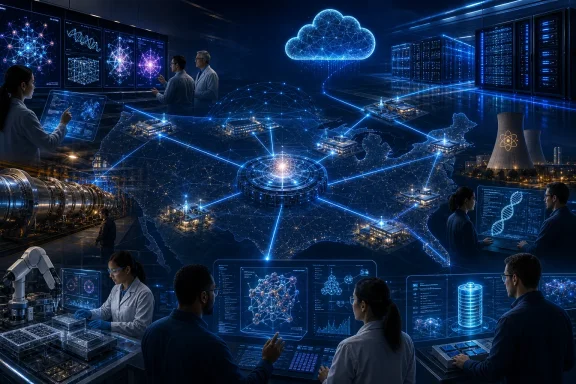
Microsoft is committing $60 million in cloud capacity, artificial intelligence services, and engineering support to the U.S. Department of Energy’s Genesis Mission, an ambitious federal effort intended to connect the country’s national laboratories, supercomputers, experimental facilities, and scientific datasets into an AI-powered research platform. The investment is significant less for its headline value than for the operating model behind it: Microsoft is creating a dedicated coordination office called SPARK, providing access to its Microsoft Discovery platform, and embedding technical teams alongside researchers to turn experimental AI systems into secure, repeatable scientific workflows.
The Department of Energy occupies a distinctive position in the American research system. Its 17 national laboratories operate advanced supercomputers, particle accelerators, neutron sources, materials laboratories, biological research facilities, and national security infrastructure that would be difficult for universities or private companies to reproduce independently.
Genesis Mission seeks to connect more of those resources rather than treating them as isolated islands of expertise. The Department describes the initiative as a national effort to build an integrated scientific platform spanning AI systems, experimental facilities, unique datasets, and some of the world’s most capable computing infrastructure.
AI changes that process in several ways. Machine-learning models can identify patterns in experimental data, approximate computationally expensive simulations, recommend promising experiments, extract knowledge from scientific literature, and help coordinate instruments and laboratory equipment.
The goal is not simply to place a chatbot beside a scientist. The larger objective is to create a continuous scientific loop in which models, simulations, instruments, data systems, and human researchers inform one another.
Nevertheless, the direction is clear. DOE wants researchers to spend less time preparing data, navigating fragmented systems, repeating routine analyses, and waiting for computational resources, while spending more time evaluating hypotheses and designing meaningful experiments.
The federal government has also identified an initial set of national science and technology challenges spanning energy, biotechnology, advanced manufacturing, critical minerals, materials, nuclear technology, quantum computing, national security, and the electric grid. Microsoft’s contribution will have to demonstrate value across this broad and technically diverse portfolio.
Cloud credits can disappear quickly when researchers train large models, run parameter sweeps, process instrument data, or maintain poorly optimized development environments. Engineering services may therefore be as important as the raw computing allocation.
Researchers may also use cloud resources as an elastic extension of laboratory supercomputers. A project could perform tightly coupled numerical simulation on a DOE system while using Azure for data preparation, model serving, workflow orchestration, or collaboration with external institutions.
This hybrid approach is more plausible than replacing national laboratory computing with a commercial cloud. DOE’s machines are designed for specialized, large-scale scientific workloads, while Azure offers on-demand capacity, managed services, global connectivity, and a broad software ecosystem.
That work can include:
Large partnerships frequently lose momentum because responsibilities are distributed across too many stakeholders. A laboratory may identify a valuable use case but struggle to find the appropriate product team, obtain credits, negotiate data controls, or secure engineering assistance before the research opportunity passes.
A central office should make it easier to compare projects and direct limited resources toward work with the greatest scientific potential. It may also expose uncomfortable trade-offs when laboratories compete for the same engineers, accelerators, or specialized AI models.
The five operating commitments behind SPARK are:
The risk is that excessive standardization could slow exploratory research. Breakthroughs rarely emerge from perfectly predictable project plans, so SPARK will need to distinguish between disciplined delivery and bureaucratic gatekeeping.
Microsoft Discovery is now generally available, while a companion desktop application gives researchers and students a local entry point to some of its capabilities. For DOE, the important question is not whether the platform can generate plausible scientific suggestions, but whether it can support evidence-based, traceable, and repeatable research.
A general-purpose model might summarize papers or produce code, but it could still propose a material that violates basic chemistry or overlook a critical boundary condition in a simulation. Discovery therefore emphasizes models and workflows grounded in scientific data and methods rather than treating every task as a conversational prompt.
Microsoft says the platform supports teams of AI agents that can perform tasks such as literature review, data analysis, simulation planning, and hypothesis generation under human direction. The agents may also preserve context through an agentic memory system, allowing a project to maintain continuity across an extended research process.
This distinction matters because national laboratories already possess enormous investments in computing and data systems. The challenge is interoperability: connecting those assets without weakening security, creating unmanageable data transfers, or forcing every laboratory into an identical architecture.
A hybrid design can place each component where it is most effective. DOE supercomputers may run the largest simulations, Azure may host AI agents and shared services, and laboratory systems may retain direct control over instruments.
The architecture will also need to minimize unnecessary data movement. Experimental facilities can generate enormous datasets, and transferring everything into the cloud may be expensive, slow, or prohibited. In many cases, it will be more efficient to move models to the data or extract compact representations before transferring results.
Visual Studio Code, GitHub, Azure development tools, PowerShell, and Microsoft’s identity stack can also form part of the operational layer surrounding scientific workloads. For WindowsForum readers, the broader trend is familiar: Windows is increasingly one endpoint in a distributed environment rather than the operating system beneath every calculation.
Security requirements will vary by project. Open energy research has a different threat model from biotechnology, nuclear operations, critical infrastructure, export-controlled technology, or work associated with national security.
A Zero Trust model instead verifies each identity, device, workload, and request. Entra can manage authentication and authorization, Defender can detect threats across endpoints and cloud resources, and Sentinel can aggregate security events for investigation.
The principle is straightforward: no user or service should receive broad access merely because it is connected to a trusted network. Permissions should be narrowly scoped, continuously evaluated, and revoked when no longer needed.
Such interference could remain invisible until scientists fail to reproduce the results or, worse, make physical decisions based on corrupted evidence. Genesis Mission security must therefore protect provenance and integrity as carefully as confidentiality.
Important controls will include:
These projects are also useful tests of whether a common platform can serve disciplines with radically different data, safety, and validation requirements.
Microsoft says the approach can shrink parts of the analysis process from years to weeks. That claim will ultimately need to be judged against complete development timelines, because discovering a candidate is only one step toward producing a stable, affordable, manufacturable, and safe battery material.
PNNL is also connecting Microsoft Discovery with laboratory automation for biosystems design. In a self-driving workflow, AI proposes experiments, automation executes them, instruments record the results, and the system adjusts subsequent experiments in response.
Biosecurity AI is inherently dual-use. The same capabilities that improve detection and defense can potentially reveal information useful for harmful biological design, making access controls, evaluation, and human oversight essential.
AI output in this field must also be treated as probabilistic evidence rather than an authoritative warning. False negatives could miss a dangerous signal, while false positives could divert scarce public-health and national-security resources.
MatterGen is designed to generate candidate materials with specified properties, while MatterSim predicts how materials may behave. Pairing generation and simulation allows the system to propose candidates and computationally filter them before physical experimentation.
The decisive test will be experimental success. A model can generate mathematically valid structures that remain difficult to synthesize, unstable under real conditions, dependent on scarce inputs, or unsuitable for manufacturing.
However, faster documentation must not become weaker scrutiny. AI may help locate evidence, draft sections, compare requirements, and identify contradictions, but qualified engineers and regulators must retain responsibility for safety conclusions.
INL has also demonstrated secure cloud support for distributed autonomous operations involving nuclear power generation. This could improve efficiency and remote management, but it expands the cyber-physical attack surface and makes resilient communications, manual fallback procedures, and segmented control networks indispensable.
Its Majorana program has advanced from the Majorana 1 processor announced in February 2025 to the Majorana 2 chip disclosed in June 2026. Microsoft says the newer design uses an improved materials stack and delivers a thousandfold increase in qubit reliability compared with its earlier generation.
Topological qubits are intended to encode information in a way that provides intrinsic resistance to some forms of error. If Microsoft’s approach scales as planned, it could reduce the overhead required for quantum error correction and enable more compact quantum systems.
The engineering path still includes multi-qubit operation, high-fidelity control, error correction, system integration, cryogenic operation, and proof that quantum hardware can outperform classical alternatives on valuable problems. Genesis Mission participants should treat quantum access as a research opportunity, not as a guaranteed near-term replacement for supercomputers.
That creates a potential feedback loop. AI assists researchers in improving quantum hardware, while increasingly capable quantum systems eventually expand the scientific problems researchers can investigate.
DOE laboratories are well positioned to test this relationship because they combine quantum expertise, advanced materials characterization, supercomputing, and demanding mission problems. They can also provide independent validation that separates engineering progress from marketing optimism.
Microsoft is using the partnership to demonstrate that its cloud can support more than office productivity and general-purpose generative AI. Scientific research is among the most demanding tests of data governance, computational scale, provenance, and technical accuracy.
Enterprises should pay particular attention to the investment split. Microsoft is devoting one-third of the package to engineering services because sophisticated platforms still require integration, operational discipline, and workforce development.
The lesson is clear: buying AI capacity without funding data preparation and deployment expertise is unlikely to create durable value.
The competition will revolve around more than accelerator counts. Providers must demonstrate secure hybrid operations, scientific model quality, efficient data movement, specialized engineering talent, and compatibility with existing laboratory systems.
DOE should preserve architectural flexibility and avoid dependence on any single commercial stack. A national scientific platform will be more resilient if workloads, models, and data can move between environments through documented standards.
The more visible near-term change may occur in the scientific workforce. Researchers will need to combine domain expertise with data engineering, model evaluation, cybersecurity, automation, and software operations.
Training programs should therefore avoid portraying AI as an oracle. Researchers need practical skills in uncertainty, bias detection, provenance, prompt and workflow design, code review, and experimental validation.
Automation may eliminate some repetitive analytical work, but it may also increase demand for people who can design higher-value experiments and interpret ambiguous results. The transition could be disruptive for institutions that treat software support as a secondary service rather than a core scientific capability.
A materials project might measure the number of experimentally validated candidates per dollar, while a permitting project might track review time, document defects, and unresolved safety questions. A biosecurity project may need separate metrics for detection sensitivity, false alarms, response time, and analyst workload.
Clear reporting can also prevent exaggerated expectations. Scientific progress is uneven, and some of the most informative projects will fail. A credible program should treat well-documented failure as knowledge rather than conceal it behind broad claims of transformation.
The second test will be whether the four highlighted projects produce independently validated scientific or operational gains. Demonstrations are encouraging, but Genesis Mission’s credibility will depend on repeatable results under real laboratory and regulatory conditions.
Microsoft’s contribution can be substantial without becoming exclusive. The healthiest outcome would allow Azure, Microsoft Discovery, and SPARK to contribute specialized value while remaining interoperable with DOE systems, academic tools, open-source software, and competing commercial platforms.
Microsoft’s $60 million commitment gives the Genesis Mission more than temporary cloud capacity: it introduces a structured attempt to combine AI agents, scientific models, hybrid infrastructure, cybersecurity, laboratory automation, and human expertise around some of the country’s most difficult research challenges. The opportunity is enormous, but so is the obligation to validate every important result, preserve scientific independence, protect sensitive systems, and prevent convenience from hardening into technological dependence. If SPARK can turn Microsoft’s sprawling portfolio into transparent, reproducible, and secure scientific practice, the partnership may offer a credible blueprint for AI-assisted research at national scale—and help determine whether the next generation of American breakthroughs emerges from faster computing alone or from a fundamentally better way of doing science.
 Background
The Department of Energy occupies a distinctive position in the American research system. Its 17 national laboratories operate advanced supercomputers, particle accelerators, neutron sources, materials laboratories, biological research facilities, and national security infrastructure that would be difficult for universities or private companies to reproduce independently.Genesis Mission seeks to connect more of those resources rather than treating them as isolated islands of expertise. The Department describes the initiative as a national effort to build an integrated scientific platform spanning AI systems, experimental facilities, unique datasets, and some of the world’s most capable computing infrastructure.
From supercomputing to AI-assisted science
DOE laboratories have long used high-performance computing to model nuclear reactions, climate systems, combustion, materials, proteins, and other physical processes. Traditional simulation usually begins with mathematical models created by scientists and engineers, followed by large numerical calculations that approximate how a system behaves.AI changes that process in several ways. Machine-learning models can identify patterns in experimental data, approximate computationally expensive simulations, recommend promising experiments, extract knowledge from scientific literature, and help coordinate instruments and laboratory equipment.
The goal is not simply to place a chatbot beside a scientist. The larger objective is to create a continuous scientific loop in which models, simulations, instruments, data systems, and human researchers inform one another.
A ten-year productivity target
Genesis Mission has set the expansive goal of doubling the productivity and impact of American research and innovation within a decade. That target is difficult to measure because scientific productivity cannot be reduced to a single metric such as publications, patents, or completed experiments.Nevertheless, the direction is clear. DOE wants researchers to spend less time preparing data, navigating fragmented systems, repeating routine analyses, and waiting for computational resources, while spending more time evaluating hypotheses and designing meaningful experiments.
The federal government has also identified an initial set of national science and technology challenges spanning energy, biotechnology, advanced manufacturing, critical minerals, materials, nuclear technology, quantum computing, national security, and the electric grid. Microsoft’s contribution will have to demonstrate value across this broad and technically diverse portfolio.
Microsoft’s $60 Million Commitment
Microsoft’s package consists of $40 million in Azure compute and AI credits distributed over three years and $20 million in solution engineering enablement services. The two-part structure acknowledges a lesson repeatedly learned in public-sector technology programs: access to infrastructure does not automatically produce operational results.Cloud credits can disappear quickly when researchers train large models, run parameter sweeps, process instrument data, or maintain poorly optimized development environments. Engineering services may therefore be as important as the raw computing allocation.
What the Azure credits provide
The $40 million portion will give approved Genesis Mission projects access to Azure infrastructure for model training, scientific simulation, data processing, inference, application hosting, and collaboration. Workloads could range from relatively modest document-analysis systems to GPU-intensive foundation models trained on scientific data.Researchers may also use cloud resources as an elastic extension of laboratory supercomputers. A project could perform tightly coupled numerical simulation on a DOE system while using Azure for data preparation, model serving, workflow orchestration, or collaboration with external institutions.
This hybrid approach is more plausible than replacing national laboratory computing with a commercial cloud. DOE’s machines are designed for specialized, large-scale scientific workloads, while Azure offers on-demand capacity, managed services, global connectivity, and a broad software ecosystem.
Why services account for one-third of the package
Microsoft has allocated $20 million to architecture, engineering, deployment, adoption, and acceleration services. These teams are expected to help researchers move from promising prototypes to systems that can operate under government security, compliance, and reproducibility requirements.That work can include:
- Engineers can redesign experiments so that expensive accelerators are used efficiently rather than consumed by avoidable data movement or idle resources.
- Architects can determine which components should run in a national laboratory, a government cloud region, a conventional Azure environment, or an isolated facility.
- Security specialists can define identities, privileges, network boundaries, logging policies, and controls for sensitive scientific data.
- Adoption teams can train researchers to operate the systems instead of leaving laboratories dependent on outside consultants.
- Software specialists can convert notebook-based demonstrations into maintained services with testing, monitoring, documentation, and recovery procedures.
SPARK Becomes Microsoft’s Front Door
The Scientific Partnership Advancing Research & Knowledge office, or SPARK, will act as Microsoft’s coordination hub for Genesis Mission activities. Its purpose is to provide DOE with a consistent path into a company whose cloud, security, research, quantum, engineering, partner, and public-sector organizations otherwise operate through different structures.Large partnerships frequently lose momentum because responsibilities are distributed across too many stakeholders. A laboratory may identify a valuable use case but struggle to find the appropriate product team, obtain credits, negotiate data controls, or secure engineering assistance before the research opportunity passes.
A program office built around scientific delivery
SPARK will include a dedicated program management office responsible for intake, prioritization, reporting, and coordination with DOE. Microsoft says projects will follow a sprint-and-checkpoint cadence, introducing a software-style delivery model into scientific collaborations that may traditionally operate around proposals, annual funding cycles, and publication milestones.A central office should make it easier to compare projects and direct limited resources toward work with the greatest scientific potential. It may also expose uncomfortable trade-offs when laboratories compete for the same engineers, accelerators, or specialized AI models.
The five operating commitments behind SPARK are:
- A Genesis Mission program management office will receive proposals, coordinate priorities, and maintain the working relationship with DOE.
- An AI for Science Center of Excellence will help transform ideas into secure and scalable implementations.
- A credit-optimization function will direct Azure capacity toward projects where cloud resources can have the greatest effect.
- Technical services will help laboratories adopt and operate AI capabilities with assistance from Microsoft and selected partners.
- Joint research and development will address challenge problems selected with DOE scientific leadership under agreed publication and intellectual-property terms.
The importance of portfolio discipline
A centralized intake process can prevent cloud credits from being fragmented across dozens of experiments that never advance beyond demonstration stage. It can also create a common set of expectations for data readiness, scientific validation, security review, and long-term ownership.The risk is that excessive standardization could slow exploratory research. Breakthroughs rarely emerge from perfectly predictable project plans, so SPARK will need to distinguish between disciplined delivery and bureaucratic gatekeeping.
Microsoft Discovery as the Research Layer
Microsoft plans to make Microsoft Discovery a central part of its Genesis Mission contribution. The platform combines scientific models, simulation, data, agentic AI, and experimental workflows inside a governed environment intended for research and development.Microsoft Discovery is now generally available, while a companion desktop application gives researchers and students a local entry point to some of its capabilities. For DOE, the important question is not whether the platform can generate plausible scientific suggestions, but whether it can support evidence-based, traceable, and repeatable research.
Beyond a general-purpose AI assistant
Scientific AI systems must understand more than ordinary language. They need access to units, molecular structures, physical constraints, uncertainty estimates, experimental conditions, instrument metadata, and domain-specific terminology.A general-purpose model might summarize papers or produce code, but it could still propose a material that violates basic chemistry or overlook a critical boundary condition in a simulation. Discovery therefore emphasizes models and workflows grounded in scientific data and methods rather than treating every task as a conversational prompt.
Microsoft says the platform supports teams of AI agents that can perform tasks such as literature review, data analysis, simulation planning, and hypothesis generation under human direction. The agents may also preserve context through an agentic memory system, allowing a project to maintain continuity across an extended research process.
Creating a governed scientific loop
A productive AI-assisted experiment could proceed through the following sequence:- Researchers define the scientific objective, constraints, and accepted validation criteria.
- AI systems review relevant data, publications, simulation results, and previous experiments.
- Scientific models rank candidate materials, molecules, processes, or configurations.
- Simulation tools reject candidates that fail computational tests.
- Laboratory automation performs selected physical experiments.
- Instrument results return to the data environment with complete metadata and provenance.
- Models update their recommendations based on the new evidence.
- Human experts review the results, investigate anomalies, and decide whether the loop should continue.
Extending the American Science and Security Platform
DOE’s planned American Science and Security Platform is intended to connect laboratory infrastructure, scientific data, advanced computing, and AI capabilities. Azure will complement that environment rather than operate as its sole foundation.This distinction matters because national laboratories already possess enormous investments in computing and data systems. The challenge is interoperability: connecting those assets without weakening security, creating unmanageable data transfers, or forcing every laboratory into an identical architecture.
Hybrid computing becomes the practical model
Scientific workloads vary widely. Some require thousands of processors communicating with extremely low latency, while others consist of independent jobs that can run efficiently across cloud instances. Data-sensitive work may need to remain inside a laboratory boundary, whereas public scientific datasets can be processed more flexibly.A hybrid design can place each component where it is most effective. DOE supercomputers may run the largest simulations, Azure may host AI agents and shared services, and laboratory systems may retain direct control over instruments.
The architecture will also need to minimize unnecessary data movement. Experimental facilities can generate enormous datasets, and transferring everything into the cloud may be expensive, slow, or prohibited. In many cases, it will be more efficient to move models to the data or extract compact representations before transferring results.
Windows and developer tooling in the research environment
Although the heaviest computation will often run on Linux-based clusters, Windows remains relevant to scientific teams through desktop applications, administration, identity, collaboration, visualization, and development tools. The Microsoft Discovery app could give researchers a more approachable local workspace before workloads move into larger governed environments.Visual Studio Code, GitHub, Azure development tools, PowerShell, and Microsoft’s identity stack can also form part of the operational layer surrounding scientific workloads. For WindowsForum readers, the broader trend is familiar: Windows is increasingly one endpoint in a distributed environment rather than the operating system beneath every calculation.
Security for High-Consequence Research
Microsoft is positioning its FedRAMP-authorized cloud portfolio and Zero Trust products as the security foundation for its Genesis Mission participation. The company specifically highlights Microsoft Defender, Microsoft Sentinel, and Microsoft Entra alongside Azure and Microsoft Foundry.Security requirements will vary by project. Open energy research has a different threat model from biotechnology, nuclear operations, critical infrastructure, export-controlled technology, or work associated with national security.
Identity becomes the new laboratory perimeter
Traditional security often depended on a clearly defined institutional network. Genesis Mission projects will connect federal employees, laboratory contractors, universities, private companies, cloud services, supercomputers, and experimental facilities, making a single perimeter unrealistic.A Zero Trust model instead verifies each identity, device, workload, and request. Entra can manage authentication and authorization, Defender can detect threats across endpoints and cloud resources, and Sentinel can aggregate security events for investigation.
The principle is straightforward: no user or service should receive broad access merely because it is connected to a trusted network. Permissions should be narrowly scoped, continuously evaluated, and revoked when no longer needed.
Scientific integrity is also a security issue
Research systems face threats beyond conventional data theft. An attacker might poison a training dataset, modify experimental metadata, tamper with a model, alter a simulation configuration, or manipulate the software supply chain.Such interference could remain invisible until scientists fail to reproduce the results or, worse, make physical decisions based on corrupted evidence. Genesis Mission security must therefore protect provenance and integrity as carefully as confidentiality.
Important controls will include:
- Every dataset should carry records describing its origin, processing history, access restrictions, and quality checks.
- Models should be versioned alongside training data, configuration files, evaluation results, and approved use cases.
- Automated laboratory actions should require explicit permission boundaries and emergency shutdown mechanisms.
- Software dependencies should be scanned, signed, and traceable through the build and deployment process.
- High-impact conclusions should remain subject to independent scientific review rather than being accepted from model output alone.
Four Early Projects Show the Strategy
Microsoft has identified initial collaborations involving Pacific Northwest National Laboratory, Lawrence Livermore National Laboratory, Johns Hopkins University Applied Physics Laboratory, and Idaho National Laboratory. Together, they illustrate the breadth of the program, from batteries and biological systems to nuclear regulation.These projects are also useful tests of whether a common platform can serve disciplines with radically different data, safety, and validation requirements.
Energy storage and automated biology
At Pacific Northwest National Laboratory, Microsoft is supporting work intended to accelerate the discovery of energy-storage materials. AI can reduce a large candidate space by identifying compounds or structures most likely to possess desirable properties before researchers invest in expensive synthesis and testing.Microsoft says the approach can shrink parts of the analysis process from years to weeks. That claim will ultimately need to be judged against complete development timelines, because discovering a candidate is only one step toward producing a stable, affordable, manufacturable, and safe battery material.
PNNL is also connecting Microsoft Discovery with laboratory automation for biosystems design. In a self-driving workflow, AI proposes experiments, automation executes them, instruments record the results, and the system adjusts subsequent experiments in response.
Biosecurity at Lawrence Livermore
The Lawrence Livermore project combines AI and bioinformatics to identify emerging biological threats and accelerate response development. Potential applications include analyzing genomic data, detecting unusual patterns, modeling pathogen evolution, and prioritizing countermeasure research.Biosecurity AI is inherently dual-use. The same capabilities that improve detection and defense can potentially reveal information useful for harmful biological design, making access controls, evaluation, and human oversight essential.
AI output in this field must also be treated as probabilistic evidence rather than an authoritative warning. False negatives could miss a dangerous signal, while false positives could divert scarce public-health and national-security resources.
Autonomous materials laboratories
Johns Hopkins University Applied Physics Laboratory is integrating foundation models and simulation tools, including Microsoft’s MatterGen and MatterSim technologies, into autonomous laboratory workflows. The work focuses on structural materials and superconductors, areas where the number of possible compositions and processing conditions far exceeds what researchers can test manually.MatterGen is designed to generate candidate materials with specified properties, while MatterSim predicts how materials may behave. Pairing generation and simulation allows the system to propose candidates and computationally filter them before physical experimentation.
The decisive test will be experimental success. A model can generate mathematically valid structures that remain difficult to synthesize, unstable under real conditions, dependent on scarce inputs, or unsuitable for manufacturing.
Nuclear permitting and remote operations
Idaho National Laboratory is applying AI to the documentation associated with nuclear licensing, permitting, engineering, and safety review. Nuclear projects generate vast quantities of interconnected technical material, and automating document preparation or consistency checking could reduce repetitive work.However, faster documentation must not become weaker scrutiny. AI may help locate evidence, draft sections, compare requirements, and identify contradictions, but qualified engineers and regulators must retain responsibility for safety conclusions.
INL has also demonstrated secure cloud support for distributed autonomous operations involving nuclear power generation. This could improve efficiency and remote management, but it expands the cyber-physical attack surface and makes resilient communications, manual fallback procedures, and segmented control networks indispensable.
The Quantum Dimension
Microsoft is linking its Genesis Mission commitment to its continued development of topological quantum computing. The company argues that AI can accelerate quantum research today, while future quantum systems may eventually tackle chemistry and materials problems that remain impractical for classical machines.Its Majorana program has advanced from the Majorana 1 processor announced in February 2025 to the Majorana 2 chip disclosed in June 2026. Microsoft says the newer design uses an improved materials stack and delivers a thousandfold increase in qubit reliability compared with its earlier generation.
Promise must be separated from present capability
Microsoft now projects that it can reach a scalable quantum computer by 2029, but this remains a roadmap rather than an available production system. Quantum hardware claims require careful scrutiny because laboratory demonstrations do not automatically translate into fault-tolerant, commercially useful computation.Topological qubits are intended to encode information in a way that provides intrinsic resistance to some forms of error. If Microsoft’s approach scales as planned, it could reduce the overhead required for quantum error correction and enable more compact quantum systems.
The engineering path still includes multi-qubit operation, high-fidelity control, error correction, system integration, cryogenic operation, and proof that quantum hardware can outperform classical alternatives on valuable problems. Genesis Mission participants should treat quantum access as a research opportunity, not as a guaranteed near-term replacement for supercomputers.
AI and quantum as a reinforcing cycle
The more immediate contribution may flow in the opposite direction: AI helping to build better quantum devices. Microsoft says Discovery agents supported the materials and process research behind Majorana 2 by analyzing evidence and guiding experimental work.That creates a potential feedback loop. AI assists researchers in improving quantum hardware, while increasingly capable quantum systems eventually expand the scientific problems researchers can investigate.
DOE laboratories are well positioned to test this relationship because they combine quantum expertise, advanced materials characterization, supercomputing, and demanding mission problems. They can also provide independent validation that separates engineering progress from marketing optimism.
Enterprise and Government Implications
Genesis Mission is a federal science initiative, but its operating model has broader implications for enterprises deploying AI in regulated environments. The same problems appear in pharmaceuticals, manufacturing, aerospace, energy, finance, and healthcare: fragmented data, sensitive intellectual property, expensive experiments, and strict validation requirements.Microsoft is using the partnership to demonstrate that its cloud can support more than office productivity and general-purpose generative AI. Scientific research is among the most demanding tests of data governance, computational scale, provenance, and technical accuracy.
A reference architecture for regulated AI
If SPARK succeeds, Microsoft could adapt its methods into repeatable patterns for commercial customers. Those patterns might cover hybrid computation, agent permissions, model validation, laboratory integration, auditable workflows, and secure collaboration across organizational boundaries.Enterprises should pay particular attention to the investment split. Microsoft is devoting one-third of the package to engineering services because sophisticated platforms still require integration, operational discipline, and workforce development.
The lesson is clear: buying AI capacity without funding data preparation and deployment expertise is unlikely to create durable value.
Competitive pressure on the cloud market
The partnership strengthens Azure’s position in government science, but Microsoft is not operating in an uncontested field. Other cloud providers, semiconductor companies, AI laboratories, and high-performance computing vendors are pursuing federal research workloads.The competition will revolve around more than accelerator counts. Providers must demonstrate secure hybrid operations, scientific model quality, efficient data movement, specialized engineering talent, and compatibility with existing laboratory systems.
DOE should preserve architectural flexibility and avoid dependence on any single commercial stack. A national scientific platform will be more resilient if workloads, models, and data can move between environments through documented standards.
Consumer and Workforce Impact
Consumers are unlikely to interact directly with SPARK, but successful projects could eventually influence batteries, electricity generation, medicines, materials, public-health systems, and infrastructure costs. Scientific advances often take years to reach commercial products, so immediate claims about household benefits would be premature.The more visible near-term change may occur in the scientific workforce. Researchers will need to combine domain expertise with data engineering, model evaluation, cybersecurity, automation, and software operations.
Scientists remain accountable
Agentic AI can perform extensive exploratory work, but it cannot assume legal or ethical responsibility for a safety decision. Scientists must understand how a recommendation was produced, what data informed it, and where the model is likely to fail.Training programs should therefore avoid portraying AI as an oracle. Researchers need practical skills in uncertainty, bias detection, provenance, prompt and workflow design, code review, and experimental validation.
New roles around automated discovery
The research organization of the future may include AI workflow engineers, scientific data stewards, laboratory automation specialists, model evaluators, research security analysts, and reproducibility leads. These roles will bridge the gap between software teams and subject-matter experts.Automation may eliminate some repetitive analytical work, but it may also increase demand for people who can design higher-value experiments and interpret ambiguous results. The transition could be disruptive for institutions that treat software support as a secondary service rather than a core scientific capability.
Strengths and Opportunities
Microsoft’s commitment gives Genesis Mission a combination of infrastructure, software, security tooling, and engineering support. The program’s most promising feature is its attempt to connect those elements around real scientific problems rather than offering technology in isolation.- The hybrid model respects existing DOE investments. Azure can extend laboratory systems without pretending that a public cloud should replace specialized supercomputers and secure facilities.
- The services allocation addresses the implementation gap. Dedicated engineers can help transform research prototypes into maintained, documented, and secure systems.
- SPARK creates organizational accountability. A single coordination office should reduce confusion over project ownership, technical support, credits, and escalation.
- Microsoft Discovery targets complete workflows. Connecting literature, models, simulation, data, and experiments could deliver more value than deploying separate AI assistants.
- Initial projects focus on consequential problems. Batteries, biosecurity, structural materials, superconductors, and nuclear energy offer clear tests of scientific and national value.
- The partnership could improve reproducibility. Governed workflows can record the data, software, model versions, and decisions behind each result.
- National laboratories provide rigorous validation. DOE scientists can test commercial AI claims against physical experiments and demanding mission requirements.
- The program can strengthen American scientific infrastructure. Shared tools and methods may help laboratories collaborate more effectively while maintaining institutional expertise.
Risks and Concerns
The promise of AI-accelerated science is accompanied by technical, political, financial, and governance risks. Success should be measured through validated discoveries and sustainable capabilities, not simply cloud consumption or the number of pilots launched.- Vendor lock-in could constrain future research. Proprietary agents, data formats, and orchestration systems may make projects difficult to migrate to other platforms.
- Credit-driven experimentation can become wasteful. Researchers may optimize for using available capacity rather than selecting the most scientifically appropriate method.
- AI-generated errors can appear convincing. A fluent explanation or plausible molecular structure does not constitute scientific evidence.
- Autonomous laboratories can amplify mistakes. A poorly defined objective may cause a system to perform many irrelevant or unsafe experiments at machine speed.
- Sensitive data may cross institutional boundaries. Misconfigured identities, storage systems, or collaboration tools could expose national-security or proprietary information.
- Dual-use biological capabilities require special controls. Defensive models and datasets may also have offensive applications.
- Quantum expectations could outrun engineering reality. Microsoft’s roadmap is ambitious, but practical fault-tolerant systems still require major technical milestones.
- Intellectual-property disputes could slow collaboration. Joint research must define ownership, publication rights, licensing, and access to trained models before discoveries occur.
- A three-year credit package may not guarantee long-term sustainability. Laboratories need funding and operating plans for successful systems after promotional resources expire.
- Political changes could alter priorities. A decade-long scientific mission requires continuity across administrations, budgets, and shifting national strategies.
Measuring Whether the Mission Works
Genesis Mission’s goal of doubling research productivity will require more sophisticated evaluation than counting publications or GPU hours. Each project should establish scientific, operational, and economic baselines before AI tools are introduced.A materials project might measure the number of experimentally validated candidates per dollar, while a permitting project might track review time, document defects, and unresolved safety questions. A biosecurity project may need separate metrics for detection sensitivity, false alarms, response time, and analyst workload.
Evidence should outrank activity
Useful performance indicators include:- Projects should report the time from hypothesis formation to validated experimental result.
- Teams should measure the cost of producing each reproducible finding, not merely the cost of an individual model run.
- Evaluations should compare AI-assisted methods with strong conventional baselines.
- Researchers should disclose failed experiments and negative results when security and publication rules permit.
- Independent teams should attempt to reproduce high-impact findings.
- Operational systems should track security incidents, model drift, outages, and human overrides.
- Programs should document whether laboratory personnel can maintain the system without permanent vendor intervention.
Public value must remain visible
Because Genesis Mission uses federal assets and addresses national priorities, DOE should communicate results in language that connects scientific milestones to public outcomes. That does not require exposing classified or proprietary details, but it does require transparency about spending, performance, and lessons learned.Clear reporting can also prevent exaggerated expectations. Scientific progress is uneven, and some of the most informative projects will fail. A credible program should treat well-documented failure as knowledge rather than conceal it behind broad claims of transformation.
What to Watch Next
The first test will be how quickly SPARK moves from announcement to an operating portfolio with transparent selection criteria and measurable milestones. Microsoft and DOE will need to show that researchers can enter the program without navigating a maze of product organizations and contracting processes.The second test will be whether the four highlighted projects produce independently validated scientific or operational gains. Demonstrations are encouraging, but Genesis Mission’s credibility will depend on repeatable results under real laboratory and regulatory conditions.
Key milestones for the coming years
Several developments deserve close attention:- DOE and Microsoft should define how Azure credits are allocated, monitored, and renewed.
- SPARK should publish or communicate consistent technical and scientific readiness criteria for participating projects.
- Laboratories should establish common standards for data provenance, model evaluation, and reproducible AI-assisted experiments.
- Hybrid architectures should demonstrate secure interoperability between Azure, laboratory systems, and DOE supercomputers.
- Microsoft Discovery should prove that agent teams can produce better scientific outcomes than conventional tools, not merely more automated output.
- Nuclear and biological projects should establish especially strict human-approval and containment mechanisms.
- Joint research agreements should clarify intellectual property, publication, and long-term access to models and data.
- DOE should demonstrate that successful projects remain sustainable after the initial three-year Microsoft credit period.
- Microsoft’s Majorana roadmap should be evaluated against independently verifiable hardware milestones on the path toward its stated 2029 target.
- Genesis Mission should report whether its methods are spreading across all 17 national laboratories rather than remaining concentrated in a few showcase projects.
The larger strategic question
The long-term issue is whether Genesis Mission becomes durable national infrastructure or a collection of loosely connected vendor partnerships. A unified scientific platform requires standards, shared governance, sustained federal investment, and the ability to incorporate technologies that do not yet exist.Microsoft’s contribution can be substantial without becoming exclusive. The healthiest outcome would allow Azure, Microsoft Discovery, and SPARK to contribute specialized value while remaining interoperable with DOE systems, academic tools, open-source software, and competing commercial platforms.
Microsoft’s $60 million commitment gives the Genesis Mission more than temporary cloud capacity: it introduces a structured attempt to combine AI agents, scientific models, hybrid infrastructure, cybersecurity, laboratory automation, and human expertise around some of the country’s most difficult research challenges. The opportunity is enormous, but so is the obligation to validate every important result, preserve scientific independence, protect sensitive systems, and prevent convenience from hardening into technological dependence. If SPARK can turn Microsoft’s sprawling portfolio into transparent, reproducible, and secure scientific practice, the partnership may offer a credible blueprint for AI-assisted research at national scale—and help determine whether the next generation of American breakthroughs emerges from faster computing alone or from a fundamentally better way of doing science.
References
- Primary source: The Official Microsoft Blog
Published: 2026-07-22T12:00:06+00:00
Powering America's Genesis Mission: Microsoft's commitment to scientific discovery - The Official Microsoft Blog
Today, we’re excited to share a long-term commitment to the Department of Energy’s (DOE) Genesis Mission, backed by a $60 million investment designed to accelerate AI for science and the breakthroughs it can deliver for the country. This deepened commitment includes Microsoft’s new Scientific...blogs.microsoft.com - Related coverage: energy.gov
The Genesis Mission
A national initiative to build the world's most powerful scientific platform.www.energy.gov - Official source: news.microsoft.com
Majorana 2, made more reliable with Microsoft Discovery agentic AI
How Microsoft’s new quantum chip was made 1,000x more reliable with the help of Microsoft Discovery's agentic AI.news.microsoft.com - Official source: azure.microsoft.com