

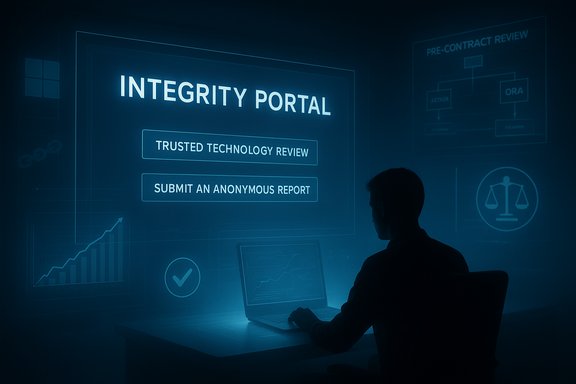
Microsoft has added a new channel inside its internal Integrity Portal that lets employees confidentially flag ethical, legal, or human‑rights concerns about how the company’s technology is developed, deployed, or used.
The new option — presented to staff as Trusted Technology Review — was announced in an internal memo from Microsoft President Brad Smith on November 5, 2025. It expands the existing Microsoft Integrity Portal, giving more than 200,000 employees a designated and anonymous pathway to raise questions about potentially problematic uses of Microsoft products, services, partnerships, or contracts. The company also said it is strengthening pre‑contract review and human‑rights due diligence processes to ensure escalations reach the right legal, technical, and human‑rights teams earlier in a contract lifecycle.
This update arrives against a backdrop of intense internal and external scrutiny over high‑risk deployments of cloud and AI services, and months of employee activism urging stronger guardrails. The Trusted Technology Review is a procedural fix intended to convert episodic workplace protests, petitions, and ad‑hoc escalations into a routinized governance pathway — one that theoretically channels concerns into formal review, investigation, and, where necessary, corrective action.
This change follows intense internal pressure and public controversy centered on allegations that certain defense and surveillance customers used Microsoft cloud services in ways that may have harmed civilians. Microsoft previously launched internal reviews, made operational changes to some subscriptions, and publicly committed to stronger human‑rights due diligence. The Trusted Technology Review is the next step: a formal channel for employees who see questionable designs, deployments, or partner behaviors to put those concerns on the company’s compliance radar.
The intended effect is to close gaps where sensitive work — especially for defense, law‑enforcement, or surveillance customers — could proceed without adequate human‑rights or ethical review.
However, institutions must be careful not to conflate process with impact. A well‑designed portal is necessary but insufficient. Operational rigor — rapid, credible investigations, willingness to change or terminate contracts, and external validation — is what turns reports into responsible outcomes.
Key tests lie ahead: Microsoft must detail how anonymity works in practice, how reports are triaged and resolved, whether high‑risk activities can be paused, and whether outcomes will be summarized in ways that rebuild trust with employees and the public. Without those operational guarantees and independent oversight, the Trusted Technology Review risks being read as a defensive measure rather than a generative governance mechanism.
For Microsoft and the broader industry, the imperative is clear: procedural outlets must be matched by demonstrable, timely action. Only then will employees believe that the mechanisms they use to raise ethical alarms actually prevent harm.
Source: BW People https://www.bwpeople.in/article/microsoft-launches-tool-for-staff-to-report-ethical-concerns-578767/
 Overview
The new option — presented to staff as Trusted Technology Review — was announced in an internal memo from Microsoft President Brad Smith on November 5, 2025. It expands the existing Microsoft Integrity Portal, giving more than 200,000 employees a designated and anonymous pathway to raise questions about potentially problematic uses of Microsoft products, services, partnerships, or contracts. The company also said it is strengthening pre‑contract review and human‑rights due diligence processes to ensure escalations reach the right legal, technical, and human‑rights teams earlier in a contract lifecycle.This update arrives against a backdrop of intense internal and external scrutiny over high‑risk deployments of cloud and AI services, and months of employee activism urging stronger guardrails. The Trusted Technology Review is a procedural fix intended to convert episodic workplace protests, petitions, and ad‑hoc escalations into a routinized governance pathway — one that theoretically channels concerns into formal review, investigation, and, where necessary, corrective action.
Background: why Microsoft built a new internal reporting path
From workplace reports to technology governance
Microsoft’s Integrity Portal has long been the company’s standard platform for reporting workplace misconduct, security incidents, legal issues, and privacy events. The addition of Trusted Technology Review deliberately frames technology‑use concerns in the same operational terms as those other categories — making them reportable items rather than matters that must be escalated informally.This change follows intense internal pressure and public controversy centered on allegations that certain defense and surveillance customers used Microsoft cloud services in ways that may have harmed civilians. Microsoft previously launched internal reviews, made operational changes to some subscriptions, and publicly committed to stronger human‑rights due diligence. The Trusted Technology Review is the next step: a formal channel for employees who see questionable designs, deployments, or partner behaviors to put those concerns on the company’s compliance radar.
Aether, ORA and the governance ecosystem
Microsoft’s responsible‑AI and ethics governance infrastructure — including the Aether Committee (AI, Ethics, and Effects in Engineering and Research), the Office of Responsible AI (ORA), and Responsible AI Strategy groups — provides the institutional scaffolding that will receive, review, and advise on escalations. Embedding a reporting option into the Integrity Portal enables concerns to flow into those governance bodies and, crucially, into legal and procurement workflows earlier than ad‑hoc processes allowed.The intended effect is to close gaps where sensitive work — especially for defense, law‑enforcement, or surveillance customers — could proceed without adequate human‑rights or ethical review.
What Microsoft has promised — the mechanics announced
- A selectable reporting type called Trusted Technology Review inside the Microsoft Integrity Portal.
- Anonymity options and application of Microsoft’s standard non‑retaliation policy for reporters.
- Integration of reported items with strengthened pre‑contract review processes and escalation to teams responsible for legal, technical, human‑rights, and policy evaluation.
- Explicit direction that employees who have information about possible policy violations in the development or deployment of technology should use the portal and select Trusted Technology Review as the report type.
What is clear — and what remains opaque
Confirmed, high‑confidence facts
- Microsoft added Trusted Technology Review to the Integrity Portal and communicated the change to employees on November 5, 2025.
- The feature is meant to allow employees to report concerns about how Microsoft technology is developed or deployed, and the company says employees may report anonymously.
- Microsoft stated it is strengthening its pre‑contract review process and human‑rights due diligence as part of a broader governance response.
- The announcement follows months of employee activism and external reporting about sensitive uses of cloud and AI services that prompted internal reviews.
Unverified or internally controlled details
Several operational details are not publicly disclosed and remain unverifiable outside Microsoft’s governance teams:- The precise triage and investigation workflow for Trusted Technology Review submissions (who reviews first, exact escalation thresholds, and decision‑makers).
- Technical measures used to guarantee and preserve reporter anonymity (e.g., whether metadata is scrubbed, which systems have access, retention windows).
- Concrete Service Level Agreements (SLAs) — expected timelines for acknowledgement, investigation, and remediation.
- Whether certain report categories can automatically pause procurement or deployment activities while the review is ongoing.
- How evidence collected through the portal might be preserved for possible regulatory, legal, or criminal proceedings.
Why this matters: strengths and immediate benefits
1) Lowering the activation energy for reporting
By putting a specific option into the Integrity Portal, Microsoft reduces the friction for employees who previously had to decide whether to escalate a technology‑specific concern through irregular channels — emails, managers, internal forums, or public activism. This lowers the cost of surfacing potential harms and should increase the volume of actionable intelligence available to governance teams.2) Formalizing human‑rights due diligence
Trusted Technology Review signals a structural shift: human‑rights and ethics concerns are being treated as first‑class outcomes in governance, not as PR problems after the fact. Combining reporting with pre‑contract review changes means content from the portal can potentially influence whether Microsoft signs, continues, or terminates a given engagement.3) Using existing compliance infrastructure
Placing the new option in an existing, enterprise‑grade system leverages established investigation processes, legal protections, and case‑management tooling. That avoids ad‑hoc, paper‑trail‑free whistleblowing that frequently fails to trigger formal review.4) Potential to standardize and surface systemic risk
If Microsoft aggregates and anonymizes reports into trend data, it can spot systemic issues — repeat partner behavior, recurring technical designs that raise risks, or procurement patterns that correlate with harm. That intelligence is far more valuable than one‑off fixes.Key risks and limits — where the system may fail employees
Trust vs. optics
Anonymity and non‑retaliation policies are necessary but not sufficient. Employees will only use the portal if they trust the follow‑through and if prior cases demonstrate meaningful remedial action. Without transparent outcomes or published metrics, the Trusted Technology Review could be perceived as a safety valve for internal dissent rather than a mechanism for accountability.The anonymity paradox
Anonymity reduces fear of retaliation, but truly anonymous systems are hard to build. Metadata, IP logs, or case‑management notes can inadvertently identify reporters. Legal obligations or internal investigations may require preserving data that weakens anonymity guarantees. Microsoft must be explicit about what anonymity means in practice, how it is implemented, and what limits apply.Potential for overclassification and non‑action
Reports about potential wrongdoing can be routed into legal or security classifications that limit transparency and, intentionally or not, reduce the public accountability of outcomes. Without independent oversight, reports may be closed with limited disclosure to the wider workforce, undermining trust.Scope creep and misuse
Employees might use the Trusted Technology Review for matters outside its intended remit (grievances, personnel disputes, or commercial complaints). Good triage helps, but misclassification wastes investigator time and delays response to genuine high‑risk technology issues.Legal and regulatory exposure
A robust reporting mechanism increases the likelihood that Microsoft’s internal processes will generate evidence that regulators or litigants could later seek. That can have legal consequences for the company and may create tension between transparent remediation and litigation risk management.Practical questions employees and managers will ask
- How do I file a Trusted Technology Review report in a way that protects anonymity and preserves necessary technical evidence?
- Which Microsoft teams will receive my report, and at what stage will they be involved (legal, Aether, ORA, procurement)?
- Will filing a report pause or block ongoing work or contractual activity while investigations proceed?
- How will investigators balance privacy and whistleblower protections with legal obligations or national security constraints?
- Will Microsoft publish aggregate metrics showing report volumes, categories, remediation rates, and timelines?
Technical and procedural design considerations Microsoft should make public
- Anonymity architecture: Explain how the portal isolates reporter identifiers, strips metadata, and prevents access to raw logs by case reviewers.
- Chain of custody: Describe how evidence in a report is preserved intact for internal review and, where necessary, regulatory use.
- Triage matrix: Publish the criteria that route reports to specific teams (technical, legal, human‑rights, procurement) and timelines for escalation.
- SLA and transparency commitments: Commit to acknowledgement times, investigation windows, and when reporters (anonymous or identified) will receive updates.
- Independent oversight: Consider an internal audit or external independent ombudsperson to review a random sample of cases and validate that policies were followed.
- Aggregate transparency: Publish anonymized dashboards or periodic reports on report volumes, categories, and outcomes to build trust.
Comparisons: how other organizations handle ethics reporting
Enterprise governance is evolving. A growing market of vendors and academic centers builds tools that mirror Microsoft’s approach: embedding ethics guidance and reporting into collaboration platforms, offering AI‑assisted triage, and integrating reporting with case management.- Some vendors offer AI‑enabled “ethics chat” and in‑workflow reporting inside Slack and Teams to guide employees on whether an incident rises to a reportable level.
- Hotline providers focus on truly independent channels, ensuring anonymity by routing reports through third‑party call centers or encrypted portals to reduce employer access to metadata.
- Enterprises with proactive programs often publish regular “speak up” metrics and maintain independent investigation teams to reinforce credibility.
Legal and regulatory implications
Introducing a formal technology‑ethics reporting channel has implications across legal, compliance, and procurement domains:- Whistleblower protection law: In some jurisdictions, internal reporting channels are a precondition for whistleblower protections; Microsoft’s portal must meet regulatory standards where applicable.
- Data protection and privacy law: Handling personal data (including data about employees or customers) in reports implicates GDPR and other national privacy regimes; Microsoft must ensure lawful bases for processing and robust safeguards.
- Contract and export controls: Reporting information about international contracts or defense customers could raise export control and national‑security obligations; Microsoft’s reviewers must be prepared to reconcile compliance with disclosure and remediation goals.
- Human‑rights due diligence: The portal can support compliance with evolving corporate human‑rights due‑diligence requirements, especially in regions moving toward mandatory due‑diligence regimes for supply chains and technology.
What success looks like — measurable outcomes to watch
- Increased number of actionable reports on high‑risk technical engagements, filtered through effective triage.
- Evidence that reported concerns change outcomes: contract renegotiation, suspension of services, or termination where policies were violated.
- Regular public summaries (anonymized) that show categories, response times, and remediations to build trust.
- Demonstrable protections for reporters: low incidence of reported retaliation and visible protections where incidents occurred.
- External audits or independent oversight reports verifying the portal’s integrity, anonymity guarantees, and adherence to policies.
Recommendations and best practices for Microsoft
- Publish a clear transparency roadmap: Commit to a public timeline for disclosing anonymized metrics and the broad outcomes of investigations originating from the portal.
- Define and publicize anonymity guarantees: Explain what metadata is captured, who can access logs, and how long data is retained.
- Establish independent review: Invite external human‑rights experts or a neutral ombudsperson to review a sample of cases and policy compliance.
- Create explicit pausing rules: For high‑risk reports, define when deployments or contracting steps are paused pending review.
- Educate employees: Provide training so staff understand what to report, how the process works, and what to expect at each stage.
- Integrate with procurement gating: Ensure that information flowing from the portal can meaningfully affect approval gates in procurement workflows.
- Protect reporters beyond policy: Offer legal counsel access and clear escalation rights in the event of retaliation, with external routes for whistleblowers when internal processes fail.
What employees should consider when using the portal
- Use the Trusted Technology Review for concerns about technology design, deployment, or partner behavior that may raise ethics or human‑rights issues.
- Preserve evidence securely: if documents or logs are relevant, ask how to upload them via the portal so chain of custody is maintained.
- If anonymity is essential, follow Microsoft’s guidance carefully and understand the limits described in any published anonymity policy.
- Keep expectations realistic: not all reports will lead to public disclosure, but internal corrective actions can still be meaningful.
- If internal avenues feel inadequate, consider legal advice or external whistleblower protections in the relevant jurisdiction.
Broader lessons for the tech industry
Microsoft’s step is symptomatic of a larger shift: employees expect not only safety and workplace fairness but also the ability to influence how the technologies they build are used in the world. Large technology companies are increasingly treating ethical red flags like compliance incidents rather than public relations problems. Companies that do this well will combine fast, confidential reporting with transparent outcomes and independent validation.However, institutions must be careful not to conflate process with impact. A well‑designed portal is necessary but insufficient. Operational rigor — rapid, credible investigations, willingness to change or terminate contracts, and external validation — is what turns reports into responsible outcomes.
Conclusion
The Trusted Technology Review is a meaningful procedural advance: it lowers the activation cost of reporting ethical and human‑rights concerns, embeds those concerns into the company’s formal compliance structure, and signals an intent to strengthen pre‑contract and procurement reviews. Yet implementation will determine whether the portal is effective.Key tests lie ahead: Microsoft must detail how anonymity works in practice, how reports are triaged and resolved, whether high‑risk activities can be paused, and whether outcomes will be summarized in ways that rebuild trust with employees and the public. Without those operational guarantees and independent oversight, the Trusted Technology Review risks being read as a defensive measure rather than a generative governance mechanism.
For Microsoft and the broader industry, the imperative is clear: procedural outlets must be matched by demonstrable, timely action. Only then will employees believe that the mechanisms they use to raise ethical alarms actually prevent harm.
Source: BW People https://www.bwpeople.in/article/microsoft-launches-tool-for-staff-to-report-ethical-concerns-578767/
