

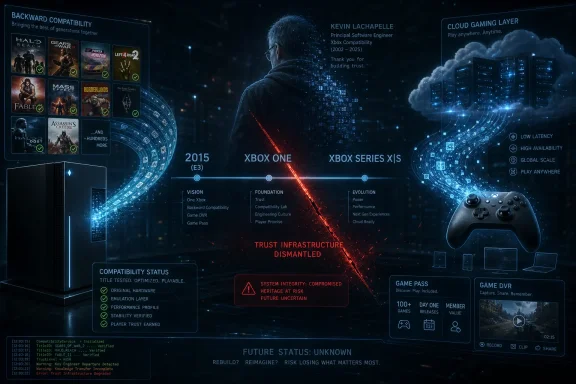
Microsoft laid off Kevin LaChapelle, a 37-year company veteran who helped build Xbox backward compatibility and later led Xbox Cloud Gaming, during a July 2026 restructuring that includes thousands of Microsoft job cuts and a deep reset of the Xbox business. The news, reported by Windows Central from LaChapelle’s own LinkedIn post and echoed by GameSpot and others, is not just another name in a brutal layoff cycle. It is a signal that Microsoft is willing to cut into the institutional memory behind the very platform features that once made Xbox feel different. The company is not merely trimming fat; it is rewriting what it thinks Xbox is for.
LaChapelle’s exit lands differently from a studio closure or a canceled game because backward compatibility was one of the rare Xbox initiatives that rebuilt trust after the Xbox One’s disastrous opening act. When Phil Spencer announced Xbox One backward compatibility at E3 2015, Microsoft was not just adding a feature. It was telling players that the money, time, and identity they had invested in the Xbox 360 era still mattered.
That mattered because Xbox One launched into a credibility crisis. Its original positioning around TV, Kinect, and online restrictions made the console feel like a corporate strategy deck wearing a gamepad costume. Backward compatibility was one of the clearest reversals of that era: a technically difficult, player-friendly feature that Sony did not match on PlayStation 4 in the same native fashion.
Microsoft’s own Xbox Wire coverage at the time emphasized that the program was free for supported games and brought Xbox One system features such as screenshots, broadcasting, and Game DVR to older Xbox 360 titles. That was the trick. It did not merely preserve old games; it pulled them forward into the modern platform layer.
LaChapelle, by his own account, led the team of engineers that built that program. In his LinkedIn post, quoted by Windows Central, he described sitting in the auditorium when Spencer announced it at E3 2015 and hearing the crowd reaction. That moment has become part of Xbox lore because it was one of the few times in the Xbox One era when Microsoft looked not like a company chasing a market thesis, but like a company listening.
The layoff of that kind of platform veteran does not prove Microsoft is abandoning backward compatibility or cloud gaming. Large organizations are more complicated than one person, and successful platform features survive through teams, codebases, roadmaps, and executives who keep funding them. But it does show that the new Xbox reset is not being limited to underperforming games, duplicated functions, or obvious post-acquisition overlap. It is reaching into the people who carried Xbox’s best technical arguments.
That was more than nostalgia. It was a statement about platform stewardship. Console ecosystems ask users to buy into closed hardware, storefronts, subscriptions, achievements, friends lists, controllers, and proprietary services. When a platform holder makes old purchases work on new machines, it reduces the sense that each generation is a controlled demolition of the last one.
The engineering challenge was also nontrivial. Xbox backward compatibility on Xbox One and Series X|S has depended on emulation, game-by-game validation, licensing work, and platform integration that had to make old software behave in a new environment without violating the expectations of players or rights holders. That is why the program’s final supported list became finite rather than universal.
Windows Central notes that hundreds of Xbox 360 and original Xbox titles are playable across Xbox One and Xbox Series X|S through the program. Microsoft’s current backward compatibility materials still frame the feature as a way to play select original Xbox, Xbox 360, and Xbox One games on newer Xbox consoles. The important word is select, because this was never magic. It was sustained, expensive platform work.
That is why LaChapelle’s layoff stings even if the system itself remains intact. The people who understand why a feature succeeded are not always the same people who can maintain its code. Sometimes the most valuable knowledge is cultural: why the feature mattered, which tradeoffs were acceptable, and how much goodwill it generated when Xbox badly needed goodwill.
That strategy made sense on paper. Microsoft had cloud infrastructure, first-party studios, Windows, Xbox consoles, and a subscription service with enough momentum to define the company’s gaming pitch. If any company could make high-end game streaming feel ordinary, Microsoft had the ingredients.
But cloud gaming has remained a more ambiguous success than backward compatibility. It is useful, impressive in the right conditions, and strategically important for reaching phones, tablets, handheld PCs, smart TVs, and low-power devices. It is also constrained by latency, network quality, licensing, input expectations, business models, and the stubborn fact that many players still prefer local hardware when they have the choice.
That makes cloud gaming vulnerable in a reset. Backward compatibility produced immediate goodwill among core Xbox users. Cloud gaming produces optionality, and optionality is harder to defend when finance teams demand margin improvement. The same executive can describe streaming as the future of entertainment, as LaChapelle did in his post, while another spreadsheet marks the present-day business as insufficiently healthy.
The danger for Microsoft is that cloud gaming’s strategic value is long-term, while layoffs are immediate. Xbox Cloud Gaming may yet become more important as handheld PCs, low-cost devices, and hybrid console-PC hardware evolve. But the people best equipped to connect the current service to that future are precisely the kind of platform builders who become easy to overlook when a company reorganizes around nearer-term returns.
The numbers vary slightly by outlet depending on timing and whether they count immediate layoffs, future fiscal-year reductions, and studio divestitures in the same bucket. But the direction is not in dispute. Microsoft is shrinking Xbox’s headcount, narrowing its studio exposure, and presenting the move as a reset of a gaming business that expanded aggressively after years of acquisitions.
That last point is crucial. This is not a company that lacked scale. Microsoft bought ZeniMax, then Activision Blizzard, and spent years telling investors and players that Xbox would be everywhere: console, PC, cloud, subscription, mobile, and competing storefronts. Now the company is discovering that owning more of the gaming map does not automatically make the territory profitable.
Axios reported that Microsoft’s internal rationale included the view that it was not the best home for every type of studio, with smaller and midsize studio investment producing poor returns in a typical year. GeekWire similarly described Xbox leadership framing the restructuring as the most significant in Xbox history and pointing toward a return to growth in 2027. Those are the kinds of phrases companies use when they want to turn layoffs into strategy.
The problem is that Xbox’s most beloved achievements were often not the cleanest spreadsheet items. Backward compatibility was a platform investment in trust. Cloud gaming was a platform investment in reach. Game Pass itself was a platform investment in habit formation. If Microsoft now judges Xbox mostly through near-term margin comparison against other platform and publishing businesses, it risks undercounting the parts of Xbox that made the platform worth choosing.
But platform layoffs may tell us more about the direction of Xbox than studio moves do. Microsoft can argue that divesting a studio preserves a team outside its corporate structure, or that a particular game category no longer fits its portfolio. It is harder to wave away the loss of senior platform leadership as merely a portfolio optimization story.
Xbox’s central challenge is that its platform identity has become increasingly diffuse. It wants to sell consoles, but also publish on rival consoles. It wants Game Pass to be central, but also needs premium game sales. It wants cloud gaming to widen access, but also must justify infrastructure costs. It wants Windows handhelds and future hybrid hardware to matter, but has to make the Xbox layer feel coherent on devices that are not traditional Xbox consoles.
In that environment, backward compatibility and cloud gaming are not side features. They are connective tissue. One says your past Xbox purchases follow you forward. The other says your Xbox library can follow you beyond the box. Together, they make Xbox less dependent on a single console generation and more like a durable account-based entertainment platform.
That is why the personnel story matters. A company can keep the slogans while losing the people who know how to make them real. Microsoft is large enough to retain immense technical capability after any one layoff, but repeated cuts create a different risk: erosion by subtraction, where no single departure kills a strategy, yet the cumulative effect makes the strategy less believable.
That sprawl was exhilarating when capital was cheap and growth narratives were rewarded. It now looks harder to defend under pressure from declining console hardware sales, uneven first-party output, Game Pass maturation, and the cost of absorbing enormous acquisitions. Microsoft does not need a new slogan; it needs a hierarchy of commitments.
Backward compatibility once supplied such a hierarchy in miniature. It told players that Xbox would compete not merely by buying studios or promising future ecosystems, but by respecting the library they already had. That is an old-fashioned platform promise, and it remains powerful precisely because so many digital storefronts treat continuity as negotiable.
Cloud gaming supplied a different hierarchy. It argued that the device should matter less than access. That remains a plausible future, especially as handheld Windows gaming devices improve and consumers become accustomed to streaming everything else. But gaming is less forgiving than video or music; a bad stream does not merely look worse, it plays worse.
The uncomfortable truth is that both of LaChapelle’s signature domains require patience. Backward compatibility required tedious title-by-title work, licensing navigation, and technical validation. Cloud gaming requires infrastructure, iterative quality improvements, and years of consumer behavior change. Neither is the kind of initiative that thrives when corporate strategy is dominated by a one-year reset narrative.
Microsoft never solved the entire preservation problem. The supported catalog is limited, and rights issues kept many games stranded. Some online features died regardless of compatibility. Physical discs often act as entitlement keys rather than fully self-contained preservation media on modern systems.
Still, Xbox did more than most console platforms to make older games playable on newer hardware. That gave Microsoft a moral and practical argument at the same time. It could say, with some credibility, that investing in Xbox meant investing in a library with a future.
Windows Central recently reported renewed signs of interest around backward compatibility, including fan requests for classic games and speculation that the program could matter to future Xbox hardware plans. If Microsoft is indeed preparing a PC-console hybrid strategy, backward compatibility becomes more important, not less. A hybrid Xbox that plays modern Windows games but fumbles the emotional inheritance of Xbox, Xbox 360, and Xbox One would be technically interesting and culturally weaker.
That is the tension. The very moment when backward compatibility may need fresh ambition is the moment Microsoft has laid off one of the people most associated with making the original revival work. That does not doom the effort. It does make the company’s reassurances harder to take on faith.
A 37-year tenure at Microsoft is almost unimaginable in today’s technology labor market. LaChapelle’s career spans eras when Microsoft was the Windows monopoly, the antitrust defendant, the Xbox insurgent, the cloud giant, and the AI platform company. Losing someone with that range may be rational from a cost-center perspective, but it is still a loss of organizational memory.
That matters especially because Xbox is not just a set of assets. It is a relationship with players who remember promises. They remember “all in one entertainment” overreach. They remember the Xbox 360 red ring era. They remember the Xbox One reversal. They remember Game Pass’s rise. They remember Microsoft buying publishers and insisting that the ecosystem would become richer as a result.
When those players see the architect of backward compatibility and cloud gaming cut loose, they do not parse it as an isolated HR event. They read it as another clue about whether Microsoft still values the player-first platform work that helped Xbox regain credibility. Fair or not, layoffs are interpreted symbolically because companies train customers to interpret everything symbolically.
Microsoft may argue, accurately, that teams remain in place and roadmaps continue. But trust is not maintained by org charts alone. It is maintained by visible continuity between past promises and future investment. LaChapelle’s exit weakens that visible continuity at a sensitive moment.
If that is the future, backward compatibility becomes conceptually central. Windows survives in part because compatibility is its superpower. Enterprises tolerate its messiness because old software usually keeps working. Gamers tolerate its quirks because the PC library is vast, messy, moddable, and persistent.
Xbox has historically been the cleaner, more controlled alternative. It sacrificed openness for ease, certification, living-room reliability, and a strong first-party identity. A hybrid Xbox future would need to borrow from Windows without becoming merely a branded Windows box under the TV.
That is difficult. It requires people who understand the console contract and the PC contract. It requires a platform layer that can make old Xbox titles, current console games, PC games, cloud entitlements, Game Pass, saves, achievements, controllers, and storefront policies feel like parts of one system rather than a pile of compromises.
LaChapelle’s resume sat almost exactly at that intersection. Backward compatibility is about old software surviving new hardware. Cloud gaming is about software escaping hardware altogether. If Xbox is moving toward a post-console platform model, the loss of leaders from those domains is not reassuring.
But discipline can become self-harm when it confuses what is expensive with what is expendable. Platform goodwill is expensive. Compatibility is expensive. Cloud experimentation is expensive. Maintaining creative variety across studios is expensive. The question is not whether these investments cost money, but which of them create the conditions for Xbox to matter.
If Microsoft narrows Xbox too far around predictable returns, megafranchises, platform fees, and cross-platform publishing, it may improve margins while reducing differentiation. That is the danger of a reset framed primarily through business health. A healthier Xbox on paper could be a less compelling Xbox in the hands of players.
The irony is that backward compatibility was a business feature disguised as a fan service. It helped persuade people to stay in the ecosystem. It made digital libraries feel safer. It gave Xbox a concrete answer to PlayStation’s dominance during a difficult generation. It was not charity; it was enlightened platform self-interest.
Cloud gaming may yet play a similar role if Microsoft can make it reliable, affordable, and meaningfully integrated across devices. But that will require patience and a willingness to keep investing before the market is fully proven. The cut that removed LaChapelle therefore reads less like a single personnel decision and more like a test of whether Microsoft still believes in platform patience.
The harder conclusion is that Xbox’s most durable advantages have not come only from owning content. They have come from platform commitments that told players their libraries, devices, and habits would carry forward. Backward compatibility was the clearest example. Cloud gaming was the most ambitious extension of the same idea.
That is why this layoff deserves attention beyond sympathy for a veteran employee. It is a reminder that platform strategy is built by people, not just declared by executives. When those people are removed, the strategy may continue, but the burden of proof shifts back to the company.
 Microsoft Cuts Into the Machinery That Made Xbox Trustworthy
LaChapelle’s exit lands differently from a studio closure or a canceled game because backward compatibility was one of the rare Xbox initiatives that rebuilt trust after the Xbox One’s disastrous opening act. When Phil Spencer announced Xbox One backward compatibility at E3 2015, Microsoft was not just adding a feature. It was telling players that the money, time, and identity they had invested in the Xbox 360 era still mattered.That mattered because Xbox One launched into a credibility crisis. Its original positioning around TV, Kinect, and online restrictions made the console feel like a corporate strategy deck wearing a gamepad costume. Backward compatibility was one of the clearest reversals of that era: a technically difficult, player-friendly feature that Sony did not match on PlayStation 4 in the same native fashion.
Microsoft’s own Xbox Wire coverage at the time emphasized that the program was free for supported games and brought Xbox One system features such as screenshots, broadcasting, and Game DVR to older Xbox 360 titles. That was the trick. It did not merely preserve old games; it pulled them forward into the modern platform layer.
LaChapelle, by his own account, led the team of engineers that built that program. In his LinkedIn post, quoted by Windows Central, he described sitting in the auditorium when Spencer announced it at E3 2015 and hearing the crowd reaction. That moment has become part of Xbox lore because it was one of the few times in the Xbox One era when Microsoft looked not like a company chasing a market thesis, but like a company listening.
The layoff of that kind of platform veteran does not prove Microsoft is abandoning backward compatibility or cloud gaming. Large organizations are more complicated than one person, and successful platform features survive through teams, codebases, roadmaps, and executives who keep funding them. But it does show that the new Xbox reset is not being limited to underperforming games, duplicated functions, or obvious post-acquisition overlap. It is reaching into the people who carried Xbox’s best technical arguments.
Backward Compatibility Was Xbox’s Apology in Software Form
Backward compatibility is often treated as a convenience feature, but for Xbox it became something closer to a brand correction. It made the Xbox One less isolated from the Xbox 360’s enormous library and softened the generational cliff that console makers had long accepted as normal. For players, it meant that discs on a shelf and digital purchases in an account had a chance of continuing to matter.That was more than nostalgia. It was a statement about platform stewardship. Console ecosystems ask users to buy into closed hardware, storefronts, subscriptions, achievements, friends lists, controllers, and proprietary services. When a platform holder makes old purchases work on new machines, it reduces the sense that each generation is a controlled demolition of the last one.
The engineering challenge was also nontrivial. Xbox backward compatibility on Xbox One and Series X|S has depended on emulation, game-by-game validation, licensing work, and platform integration that had to make old software behave in a new environment without violating the expectations of players or rights holders. That is why the program’s final supported list became finite rather than universal.
Windows Central notes that hundreds of Xbox 360 and original Xbox titles are playable across Xbox One and Xbox Series X|S through the program. Microsoft’s current backward compatibility materials still frame the feature as a way to play select original Xbox, Xbox 360, and Xbox One games on newer Xbox consoles. The important word is select, because this was never magic. It was sustained, expensive platform work.
That is why LaChapelle’s layoff stings even if the system itself remains intact. The people who understand why a feature succeeded are not always the same people who can maintain its code. Sometimes the most valuable knowledge is cultural: why the feature mattered, which tradeoffs were acceptable, and how much goodwill it generated when Xbox badly needed goodwill.
Cloud Gaming Was the Bigger Bet, and the Harder One to Defend
LaChapelle’s later work on Xbox Cloud Gaming places him at the center of Microsoft’s other great Xbox thesis: that the console would become only one endpoint in a wider gaming service. Project xCloud entered public testing before Xbox Cloud Gaming launched more broadly through Game Pass Ultimate in 2020. It was Microsoft’s attempt to make its Azure footprint, subscription ambitions, and Xbox content library reinforce one another.That strategy made sense on paper. Microsoft had cloud infrastructure, first-party studios, Windows, Xbox consoles, and a subscription service with enough momentum to define the company’s gaming pitch. If any company could make high-end game streaming feel ordinary, Microsoft had the ingredients.
But cloud gaming has remained a more ambiguous success than backward compatibility. It is useful, impressive in the right conditions, and strategically important for reaching phones, tablets, handheld PCs, smart TVs, and low-power devices. It is also constrained by latency, network quality, licensing, input expectations, business models, and the stubborn fact that many players still prefer local hardware when they have the choice.
That makes cloud gaming vulnerable in a reset. Backward compatibility produced immediate goodwill among core Xbox users. Cloud gaming produces optionality, and optionality is harder to defend when finance teams demand margin improvement. The same executive can describe streaming as the future of entertainment, as LaChapelle did in his post, while another spreadsheet marks the present-day business as insufficiently healthy.
The danger for Microsoft is that cloud gaming’s strategic value is long-term, while layoffs are immediate. Xbox Cloud Gaming may yet become more important as handheld PCs, low-cost devices, and hybrid console-PC hardware evolve. But the people best equipped to connect the current service to that future are precisely the kind of platform builders who become easy to overlook when a company reorganizes around nearer-term returns.
The Xbox Reset Is Bigger Than One Executive, Which Is Exactly the Problem
The broader layoff wave gives LaChapelle’s departure its real context. GeekWire reported that Microsoft is cutting about 4,800 jobs overall, roughly 2 percent of its workforce, with Xbox absorbing a major share of the pain. Axios, Windows Central, PC Gamer, and other outlets described a sweeping restructuring in which thousands of Xbox roles are being removed and multiple studios are being divested or moved toward new ownership.The numbers vary slightly by outlet depending on timing and whether they count immediate layoffs, future fiscal-year reductions, and studio divestitures in the same bucket. But the direction is not in dispute. Microsoft is shrinking Xbox’s headcount, narrowing its studio exposure, and presenting the move as a reset of a gaming business that expanded aggressively after years of acquisitions.
That last point is crucial. This is not a company that lacked scale. Microsoft bought ZeniMax, then Activision Blizzard, and spent years telling investors and players that Xbox would be everywhere: console, PC, cloud, subscription, mobile, and competing storefronts. Now the company is discovering that owning more of the gaming map does not automatically make the territory profitable.
Axios reported that Microsoft’s internal rationale included the view that it was not the best home for every type of studio, with smaller and midsize studio investment producing poor returns in a typical year. GeekWire similarly described Xbox leadership framing the restructuring as the most significant in Xbox history and pointing toward a return to growth in 2027. Those are the kinds of phrases companies use when they want to turn layoffs into strategy.
The problem is that Xbox’s most beloved achievements were often not the cleanest spreadsheet items. Backward compatibility was a platform investment in trust. Cloud gaming was a platform investment in reach. Game Pass itself was a platform investment in habit formation. If Microsoft now judges Xbox mostly through near-term margin comparison against other platform and publishing businesses, it risks undercounting the parts of Xbox that made the platform worth choosing.
Studio Divestitures Explain the Mood, but Platform Layoffs Explain the Direction
Most public attention has understandably gone to the studios. When developers lose jobs, projects are disrupted, or beloved teams are spun away from Microsoft, the consequences are visible and emotional. Games are tangible artifacts; a platform vice president’s layoff is more abstract.But platform layoffs may tell us more about the direction of Xbox than studio moves do. Microsoft can argue that divesting a studio preserves a team outside its corporate structure, or that a particular game category no longer fits its portfolio. It is harder to wave away the loss of senior platform leadership as merely a portfolio optimization story.
Xbox’s central challenge is that its platform identity has become increasingly diffuse. It wants to sell consoles, but also publish on rival consoles. It wants Game Pass to be central, but also needs premium game sales. It wants cloud gaming to widen access, but also must justify infrastructure costs. It wants Windows handhelds and future hybrid hardware to matter, but has to make the Xbox layer feel coherent on devices that are not traditional Xbox consoles.
In that environment, backward compatibility and cloud gaming are not side features. They are connective tissue. One says your past Xbox purchases follow you forward. The other says your Xbox library can follow you beyond the box. Together, they make Xbox less dependent on a single console generation and more like a durable account-based entertainment platform.
That is why the personnel story matters. A company can keep the slogans while losing the people who know how to make them real. Microsoft is large enough to retain immense technical capability after any one layoff, but repeated cuts create a different risk: erosion by subtraction, where no single departure kills a strategy, yet the cumulative effect makes the strategy less believable.
Microsoft’s Gaming Problem Is Not a Lack of Vision
It would be too simple to say Microsoft has no vision for Xbox. If anything, Xbox has had too many visions at once. It has been the living-room console, the Game Pass machine, the PC publisher, the cloud service, the Activision Blizzard owner, the mobile aspirant, the preservation-friendly platform, and the future hybrid device company.That sprawl was exhilarating when capital was cheap and growth narratives were rewarded. It now looks harder to defend under pressure from declining console hardware sales, uneven first-party output, Game Pass maturation, and the cost of absorbing enormous acquisitions. Microsoft does not need a new slogan; it needs a hierarchy of commitments.
Backward compatibility once supplied such a hierarchy in miniature. It told players that Xbox would compete not merely by buying studios or promising future ecosystems, but by respecting the library they already had. That is an old-fashioned platform promise, and it remains powerful precisely because so many digital storefronts treat continuity as negotiable.
Cloud gaming supplied a different hierarchy. It argued that the device should matter less than access. That remains a plausible future, especially as handheld Windows gaming devices improve and consumers become accustomed to streaming everything else. But gaming is less forgiving than video or music; a bad stream does not merely look worse, it plays worse.
The uncomfortable truth is that both of LaChapelle’s signature domains require patience. Backward compatibility required tedious title-by-title work, licensing navigation, and technical validation. Cloud gaming requires infrastructure, iterative quality improvements, and years of consumer behavior change. Neither is the kind of initiative that thrives when corporate strategy is dominated by a one-year reset narrative.
The Preservation Signal Could Not Come at a Worse Time
LaChapelle’s departure also lands during a broader industry argument over game preservation. Digital storefront closures, licensing expirations, delisted games, server shutdowns, and remasters replacing originals have made players more aware that access is fragile. Xbox’s backward compatibility program became one of the few large-platform examples of preservation that also worked as a commercial feature.Microsoft never solved the entire preservation problem. The supported catalog is limited, and rights issues kept many games stranded. Some online features died regardless of compatibility. Physical discs often act as entitlement keys rather than fully self-contained preservation media on modern systems.
Still, Xbox did more than most console platforms to make older games playable on newer hardware. That gave Microsoft a moral and practical argument at the same time. It could say, with some credibility, that investing in Xbox meant investing in a library with a future.
Windows Central recently reported renewed signs of interest around backward compatibility, including fan requests for classic games and speculation that the program could matter to future Xbox hardware plans. If Microsoft is indeed preparing a PC-console hybrid strategy, backward compatibility becomes more important, not less. A hybrid Xbox that plays modern Windows games but fumbles the emotional inheritance of Xbox, Xbox 360, and Xbox One would be technically interesting and culturally weaker.
That is the tension. The very moment when backward compatibility may need fresh ambition is the moment Microsoft has laid off one of the people most associated with making the original revival work. That does not doom the effort. It does make the company’s reassurances harder to take on faith.
The Human Cost Is the Strategy Story
Layoff coverage often splits into two tracks: the human story and the business story. In this case, they are the same story. Microsoft’s choices about who stays, who goes, and which teams remain intact reveal what kind of Xbox the company is trying to build.A 37-year tenure at Microsoft is almost unimaginable in today’s technology labor market. LaChapelle’s career spans eras when Microsoft was the Windows monopoly, the antitrust defendant, the Xbox insurgent, the cloud giant, and the AI platform company. Losing someone with that range may be rational from a cost-center perspective, but it is still a loss of organizational memory.
That matters especially because Xbox is not just a set of assets. It is a relationship with players who remember promises. They remember “all in one entertainment” overreach. They remember the Xbox 360 red ring era. They remember the Xbox One reversal. They remember Game Pass’s rise. They remember Microsoft buying publishers and insisting that the ecosystem would become richer as a result.
When those players see the architect of backward compatibility and cloud gaming cut loose, they do not parse it as an isolated HR event. They read it as another clue about whether Microsoft still values the player-first platform work that helped Xbox regain credibility. Fair or not, layoffs are interpreted symbolically because companies train customers to interpret everything symbolically.
Microsoft may argue, accurately, that teams remain in place and roadmaps continue. But trust is not maintained by org charts alone. It is maintained by visible continuity between past promises and future investment. LaChapelle’s exit weakens that visible continuity at a sensitive moment.
Xbox’s Future Is Starting to Look More Like Windows
There is another way to read this reset: Xbox is being pulled closer to the logic of Windows. Not Windows as a desktop operating system alone, but Windows as a broad compatibility layer, developer surface, device ecosystem, store battle, subscription host, and enterprise-scale platform. Project Helix rumors and Microsoft’s public flirtation with hybrid console-PC ideas point in that direction.If that is the future, backward compatibility becomes conceptually central. Windows survives in part because compatibility is its superpower. Enterprises tolerate its messiness because old software usually keeps working. Gamers tolerate its quirks because the PC library is vast, messy, moddable, and persistent.
Xbox has historically been the cleaner, more controlled alternative. It sacrificed openness for ease, certification, living-room reliability, and a strong first-party identity. A hybrid Xbox future would need to borrow from Windows without becoming merely a branded Windows box under the TV.
That is difficult. It requires people who understand the console contract and the PC contract. It requires a platform layer that can make old Xbox titles, current console games, PC games, cloud entitlements, Game Pass, saves, achievements, controllers, and storefront policies feel like parts of one system rather than a pile of compromises.
LaChapelle’s resume sat almost exactly at that intersection. Backward compatibility is about old software surviving new hardware. Cloud gaming is about software escaping hardware altogether. If Xbox is moving toward a post-console platform model, the loss of leaders from those domains is not reassuring.
The Xbox Brand Cannot Survive on Content Accounting Alone
Microsoft’s gaming business plainly needs discipline. No serious reading of the last decade suggests every bet paid off. The company bought studios, funded projects, expanded Game Pass, entered cloud gaming, pushed PC, and tried to maintain console relevance while Sony and Nintendo kept strong hardware identities. Some rationalization was inevitable.But discipline can become self-harm when it confuses what is expensive with what is expendable. Platform goodwill is expensive. Compatibility is expensive. Cloud experimentation is expensive. Maintaining creative variety across studios is expensive. The question is not whether these investments cost money, but which of them create the conditions for Xbox to matter.
If Microsoft narrows Xbox too far around predictable returns, megafranchises, platform fees, and cross-platform publishing, it may improve margins while reducing differentiation. That is the danger of a reset framed primarily through business health. A healthier Xbox on paper could be a less compelling Xbox in the hands of players.
The irony is that backward compatibility was a business feature disguised as a fan service. It helped persuade people to stay in the ecosystem. It made digital libraries feel safer. It gave Xbox a concrete answer to PlayStation’s dominance during a difficult generation. It was not charity; it was enlightened platform self-interest.
Cloud gaming may yet play a similar role if Microsoft can make it reliable, affordable, and meaningfully integrated across devices. But that will require patience and a willingness to keep investing before the market is fully proven. The cut that removed LaChapelle therefore reads less like a single personnel decision and more like a test of whether Microsoft still believes in platform patience.
The LaChapelle Layoff Is a Warning Label on the Reset
The concrete facts are simple, but their implications are messy. Windows Central reported LaChapelle’s LinkedIn post on July 7, after Microsoft’s July 6 restructuring news. GeekWire, Axios, PC Gamer, GameSpot, and others have described a broader Xbox overhaul involving thousands of job cuts and studio divestitures. Microsoft is trying to reset a gaming business that expanded rapidly and is now being forced to justify itself more harshly.The harder conclusion is that Xbox’s most durable advantages have not come only from owning content. They have come from platform commitments that told players their libraries, devices, and habits would carry forward. Backward compatibility was the clearest example. Cloud gaming was the most ambitious extension of the same idea.
That is why this layoff deserves attention beyond sympathy for a veteran employee. It is a reminder that platform strategy is built by people, not just declared by executives. When those people are removed, the strategy may continue, but the burden of proof shifts back to the company.
The Bill Comes Due for an Xbox Built on Every Future at Once
The immediate lesson for WindowsForum readers is not that Xbox backward compatibility is dead, or that Xbox Cloud Gaming is doomed. The lesson is that Microsoft’s gaming reset is now touching the technical and cultural infrastructure behind Xbox’s best arguments. That should make enthusiasts and IT-minded observers watch the next moves closely.- Microsoft’s July 2026 cuts are not limited to game studios; they also affect senior Xbox platform talent associated with core ecosystem features.
- Kevin LaChapelle’s departure matters because backward compatibility and cloud gaming are both long-horizon platform bets, not disposable side projects.
- Xbox backward compatibility helped repair Microsoft’s relationship with players after the Xbox One launch and remains one of the brand’s strongest trust signals.
- Xbox Cloud Gaming still has strategic value, but its business case is harder to defend during a margin-focused restructuring.
- Microsoft’s rumored or expected hybrid Xbox future will need more compatibility expertise, not less, if it wants to bridge console, PC, and cloud convincingly.
- The next test is whether Microsoft keeps investing in library continuity and device flexibility after removing some of the people most associated with those ideas.
References
- Primary source: Windows Central
Published: 2026-07-07T16:52:08.078942
Xbox's Backwards Compatibility Program and Cloud Gaming lead has been laid off from Microsoft after 37 years — "I wish the team nothing but success" | Windows Central
Microsoft has laid off the architect of Xbox Backwards Compatibility and Xbox Cloud Gaming.www.windowscentral.com - Related coverage: axios.com
Microsoft dashes game developer dreams
Microsoft's M&A ambitions might be changes, as it revamps Xbox.www.axios.com
- Related coverage: tomshardware.com
Microsoft 'resets' Xbox by cutting 3,200 jobs this year, divesting five game studios — firm cites 'margins that are 3-10x lower than comparable platform and publishing businesses' | Tom's Hardware
1,600 jobs will be eliminated today, the rest throughout FY27www.tomshardware.com - Related coverage: pcgamer.com
Xbox is laying off 3,200 people and dumping 4 studios in 'the most significant restructure in Xbox history' | PC Gamer
Compulsion, Double Fine, Ninja Theory, and Undead Labs are out, and the future doesn't sound very good for Arkane either.www.pcgamer.com - Related coverage: gematsu.com
Xbox to lay off 3,200 employees, divest five studios - Gematsu
Xbox has announced a major restructuring, reducing its headcount by 3,200 employees throughout fiscal year 2027, with 1,600 roles eliminated today.www.gematsu.com - Related coverage: techspot.com
Microsoft is cutting 3,200 Xbox jobs and spinning off four game studios | TechSpot
In a public memo to Xbox employees, CEO Asha Sharma confirmed that Microsoft will eliminate approximately 3,200 positions across the gaming division between now and July 2027,...www.techspot.com
- Related coverage: gamespot.com
Xbox Layoffs Included 37-Year Veteran Who Designed One Of Xbox's Best Features Ever - GameSpot
The Xbox cuts will affect more than 3,000 people.www.gamespot.com - Official source: 9to5windows.com
Xbox VP Kevin LaChapelle laid off after 37 years; he led Backwards Compatibility and Cloud Gaming - 9to5Windows
Kevin LaChapelle, the executive behind Xbox's Backwards Compatibility program and Cloud Gaming service, has been laid off after a 37-year tenure at Microsoft. His departure marks a significant loss for the gaming division amid broader restructuring.9to5windows.com - Related coverage: dexerto.com
Xbox sells off four studios as company confirms 3,200 job cuts - Dexerto
Xbox began cutting 3,200 jobs and confirmed four studios were leaving as Sharma called the business “not healthy”www.dexerto.com - Related coverage: geekwire.com
Microsoft cuts 4,800 jobs, about 2% globally, revamps salesforce and launches massive Xbox overhaul – GeekWire
Microsoft is cutting 4,800 jobs and overhauling its Xbox gaming business in what its new gaming CEO calls the biggest restructuring in Xbox history, while reshaping its sales and consulting division amid record AI spending and a 30% stock slide.www.geekwire.com - Related coverage: techcrunch.com
Microsoft lays off nearly 5,000 employees across Xbox, commercial sales | TechCrunch
Microsoft cut around 4,800 roles, or 2.1% of its global workforce, on Monday — the latest in a series of layoffs that’s stoking fears of AI replacing jobs. The layoffs will hit Xbox and commercial sales the hardest.techcrunch.com - Related coverage: elpais.com
- Related coverage: as.com
- Related coverage: news.xbox.com
E3 2019: What’s Next for Xbox Backward Compatibility - XBOX Wire
Since the Xbox One Backward Compatibility program was announced at E3 2015, over half of all Xbox gamers have enjoyed Original Xbox or Xbox 360 games on Xbox One. During that time, the Backward Compatibility catalog we built directly from fan feedback has grown to over 600 titles including...news.xbox.com - Related coverage: xbox.com
XBOX Backward Compatible Games | XBOX
Discover the library of XBOX backward compatible games. Experience game franchises from past generations and enjoy the games you love at no additional cost.www.xbox.com - Related coverage: shacknews.com
E3 2015: Microsoft Announces Xbox One Backwards Compatibility | Shacknews
Phil Spencer took to the stage at the Xbox E3 Press Conference to announce Xbox One backwards compatibility.www.shacknews.com - Official source: support.microsoft.com
Xbox Support
 support.microsoft.com
- Official source: blogs.microsoft.com
E3: Hot lineup of Xbox One exclusive titles, backward compatibility for Xbox 360 announced - The Official Microsoft Blog
It was hard to catch a breath during the Xbox E3 briefing Monday: The news included the reveal of “Halo 5: Guardians” Warzone, an all-new, massive scale multiplayer mode where up to 24 players battle with AI characters joining in the fight; a fully featured version of “Minecraft” for Microsoft...blogs.microsoft.com - Related coverage: gameinformer.com
Microsoft Announces Xbox 360 Backwards Compatibility For Xbox One
One of the most wanted features is coming to Xbox One.gameinformer.com - Related coverage: operationrainfall.com
E3 2015: Xbox One Backward Compatibility with Xbox 360 - opr
At Microsoft's E3 conference, it was announced that the Xbox One will finally be backward compatible with certain Xbox 360 titles.operationrainfall.com - Related coverage: time.com
E3 2015: Microsoft Announces Backward Compatibility for Xbox One
Microsoft is adding backward compatibility to its Xbox One console, the company announced at its E3 2015 event Monday.time.com - Related coverage: techradar.com
Microsoft has recommitted to its Xbox Backwards Compatibility Program going forward and will be 'rolling out new ways to play some of the most iconic games from our past' | TechRadar
Microsoft has recommitted to its Xbox Backwards Compatibility Program for its future consoles and confirmed it will return in some form later this year.www.techradar.com