

Microsoft’s sudden lockout of two prominent open source developers has become more than an isolated support failure: it has exposed a brittle corner of the company’s Windows hardware ecosystem, where account verification, driver signing, and support automation can collide with real-world engineering deadlines. In the case of VeraCrypt maintainer Mounir Idrassi and WireGuard creator Jason Donenfeld, the immediate result was the same: they were unable to sign updates, could not get a timely human explanation, and were left navigating opaque appeal paths that allegedly depended on AI support tooling and long review windows. Microsoft now says the accounts should be restored soon and that it is reviewing how it communicates policy changes, but the episode has already become a cautionary tale for anyone shipping security-critical code on Windows.
The basic facts are now fairly clear. According to the reporting that sparked the discussion, both Idrassi and Donenfeld were unexpectedly deactivated from Microsoft’s developer systems, which prevented them from completing essential submission and signing workflows for VeraCrypt and WireGuard. Microsoft says the actions were tied to Windows Hardware Program account verification procedures, not a targeted enforcement against the projects themselves, and it has promised to improve how it communicates such requirements. That distinction matters, but it does not erase the operational damage caused by a silent suspension at the exact moment a maintainer needs to publish a fix.
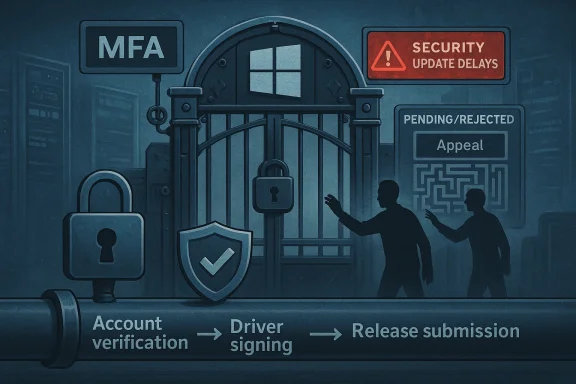
This is also not happening in a vacuum. Microsoft has spent the last year tightening the security and identity requirements around Partner Center and hardware-related programs, including mandatory MFA and account verification updates across partner workflows. Microsoft’s own documentation says verification can block hardware submissions, driver code signing, and other critical partner actions if the account is pending, rejected, or otherwise not in good standing. In other words, the policy has a legitimate security rationale; the failure here is how it appears to have been executed and communicated.
The episode touches a nerve because both named projects sit in the narrow category of software users notice only when something goes wrong. VeraCrypt is widely relied on for disk encryption, while WireGuard is a modern VPN protocol and implementation that has become part of both consumer and enterprise networking stacks. If maintainers cannot rapidly ship driver updates or bootloader signatures, the downstream effect is not just inconvenience. It is a potential delay in patching security vulnerabilities, and security delays tend to magnify trust problems rather than reduce them.
There is also an uncomfortable symbolism in the fact that these developers are not fringe operators. They are exactly the kind of technically sophisticated, security-conscious maintainers Microsoft should want inside its ecosystem, not bouncing off a wall of automated enforcement. When a platform vendor treats a serious maintainer like a disposable support ticket, the message reaches far beyond the individuals involved. It tells the rest of the ecosystem that process can outrank context, and that is never a comfortable message for an infrastructure provider.
Microsoft’s official guidance reflects that balance. The company states that Partner Center verification can govern access to activities such as hardware submissions and driver code signing, and it warns that functionality can be blocked if verification is pending or rejected. It also documents identity and business verification flows for hardware developers, including the use of trusted ID vendors and the need for monitored work email addresses. The process is designed to protect the platform, but the paperwork becomes consequential when the maintainer is standing between users and a needed security update.
The register of complaints around Microsoft account and Partner Center friction is hardly new, either. Over the last year, Microsoft Q&A threads have repeatedly surfaced around “account verification,” access issues, and hardware-program onboarding, which suggests that the underlying support experience is already a pain point. That does not prove a systemic defect in every case, but it does show that the ecosystem is familiar with slow, ambiguous verification loops. When those loops hit a maintainer with a live release emergency, the problem feels less like compliance and more like a trap.
What made this case different was the caliber of the affected projects and the speed with which the story spread. WireGuard and VeraCrypt occupy a special place in the open source world because they are both technical and security-sensitive, and because they are used in environments where trust is not a slogan. A lockout in that context does not simply inconvenience a hobbyist; it interrupts the public’s expectation that critical infrastructure maintainers can maintain critical infrastructure.
Microsoft’s October 2025 Partner Center updates help explain the backdrop. The company said it was rolling out mandatory MFA and related security changes across partner workflows, with enforcement timelines that would not be optional. It also emphasized that the changes were meant to protect the platform and that partners should have received communications through email, banners, and reminders. That may be true in aggregate, but the existence of the rule is not the same as the success of the notification, and the gap between the two is what produced this controversy.
Both men also said they received no meaningful prior warning. Idrassi reported no email, no explanation, and no clear appeal path. Donenfeld said he searched through every inbox and log he could find and still found nothing, while the appeal process appeared to route him into a support maze that was effectively unusable with a deactivated account. This is the part that makes the story sting: even if Microsoft had a legitimate verification reason, the enforcement sequence appears to have been designed for an idealized workflow, not a real person under deadline.
Donenfeld’s comments also illustrate a second point: modern open source maintainers increasingly manage both software and infrastructure. They are not just publishing code to GitHub and walking away. They are coordinating certificates, WHLK/WHLK-style validation, package submission, and platform-specific signing requirements, all while trying to keep release processes auditable and repeatable. A lockout that interrupts that work is not bureaucratic trivia. It is a production event.
Microsoft’s response, according to the reporting, was to attribute the lockouts to Windows Hardware Program verification procedures and to say the accounts should be restored soon. That may well be the technically correct explanation, but correctness is not the same as usability. A process can be legitimate and still be badly timed, badly surfaced, and badly supported.
The company also published October 2025 announcements indicating that mandatory MFA was being enforced across Partner Center portal pages and APIs, with partner communications sent in advance. Microsoft framed those changes as a way to improve security and protect against unauthorized access. In the abstract, that is hard to argue with. In practice, however, each new gate increases the number of ways a legitimate developer can be locked out by a mismatch, a stale record, or a missing notification.
The deeper lesson is that identity policy is no longer an administrative afterthought. For driver authors, package maintainers, and hardware partners, verification is now part of the release architecture. If a company changes that architecture without reliable, personalized notification, the result is a silent outage disguised as routine compliance.
In both reported cases, the affected developers are not casual users of Microsoft’s ecosystem. They are experts who understand code signing, driver packaging, and the requirements imposed by Windows. That makes the lockout especially galling because it removes the very people most likely to follow the rules. If experienced maintainers can be shut out without warning, less sophisticated developers will assume the process is arbitrary, and that assumption alone corrodes confidence.
There is also a feedback loop here. The harder it becomes to release on a platform, the more maintainers will consider whether that platform deserves first-class support. That does not mean they will abandon Windows overnight, but it does mean they will design around its friction, which can eventually reduce the platform’s relevance. In that sense, support quality becomes an ecosystem retention strategy.
Microsoft’s suggestion, via a support page and related guidance, points affected users toward formal pathways for reinstatement. That is reasonable on paper. But a formal pathway is only useful when it can be reached, populated, and processed in a human time frame. If the underlying tools assume a normal login state, then suspension of the login state can cut off the only channel that matters. The result is a process that looks rigorous but behaves like a dead end.
The better model would include more context at the moment of suspension, not less. Even if a company cannot disclose every detail, it should be able to tell a developer whether the problem is identity, documentation, inactivity, policy change, or some other category. That would not eliminate disputes, but it would at least make remediation possible.
The company also leaned on the idea that it had already warned partners in advance through emails, banners, and reminders. That may be entirely accurate from Microsoft’s point of view, yet the affected developers say they never received the notices. When a major platform vendor asserts that communication happened and the recipient insists it did not, the true lesson may be about distribution failure rather than malice. In complex partner ecosystems, sent and seen are not the same thing.
Microsoft is also trying to shift affected users toward support documentation and automated guidance. That may help with scale, but it does not solve the special case of high-value maintainers whose accounts are integral to ecosystem security. In those cases, the company needs a premium path, not a generic one.
For enterprise customers, the stakes are more tangible. Organizations rely on predictable patch cadence, especially for software involved in confidentiality and remote access. A delay in code signing can ripple into change-management calendars, compliance commitments, and incident-response timelines. When a driver update is blocked, the problem is no longer just developer inconvenience; it is a business continuity concern.
Consumer users, meanwhile, have a different but equally real vulnerability: they tend to assume that security software is maintained continuously. When a developer lockout creates a patch delay, users are the ones who ultimately inherit the risk. That is why this story matters outside the Windows developer community. It is a reminder that invisible platform bureaucracy can have very visible downstream consequences.
There is also a subtle market implication. Security-conscious open source projects need platform trust to remain committed to Windows. If the cost of staying on Windows includes unpredictable access to the signing pipeline, some maintainers will gradually optimize for other environments or reduce the depth of their Windows support. That would not make Windows unusable, but it would weaken its position in certain security-sensitive niches. Over time, friction becomes strategy.
This is also a reminder that platform trust is cumulative. Developers remember not just whether a company supports them, but whether it supports them at the worst possible moment. A policy that looks tidy in a governance deck can look reckless when it blocks a patch for an encrypted storage tool or a VPN driver. That discrepancy is where reputations are made or damaged.
The most important question is not whether these two accounts were eventually unlocked. It is whether Microsoft can create a system that does not make a maintainer helpless at the exact moment they need to fix a problem. A mature platform should be able to verify identities without strangling legitimate work, especially when that work protects the very users the platform wants to keep safe.
The real story here is not that Microsoft has rules. It is that rules without resilient communication and humane escalation can become their own kind of outage. In a world where security updates are part of the defense perimeter, that is a lesson no platform vendor can afford to ignore.
Source: theregister.com Microsoft locks out top open source devs, blames process
 Overview
The basic facts are now fairly clear. According to the reporting that sparked the discussion, both Idrassi and Donenfeld were unexpectedly deactivated from Microsoft’s developer systems, which prevented them from completing essential submission and signing workflows for VeraCrypt and WireGuard. Microsoft says the actions were tied to Windows Hardware Program account verification procedures, not a targeted enforcement against the projects themselves, and it has promised to improve how it communicates such requirements. That distinction matters, but it does not erase the operational damage caused by a silent suspension at the exact moment a maintainer needs to publish a fix.This is also not happening in a vacuum. Microsoft has spent the last year tightening the security and identity requirements around Partner Center and hardware-related programs, including mandatory MFA and account verification updates across partner workflows. Microsoft’s own documentation says verification can block hardware submissions, driver code signing, and other critical partner actions if the account is pending, rejected, or otherwise not in good standing. In other words, the policy has a legitimate security rationale; the failure here is how it appears to have been executed and communicated.
The episode touches a nerve because both named projects sit in the narrow category of software users notice only when something goes wrong. VeraCrypt is widely relied on for disk encryption, while WireGuard is a modern VPN protocol and implementation that has become part of both consumer and enterprise networking stacks. If maintainers cannot rapidly ship driver updates or bootloader signatures, the downstream effect is not just inconvenience. It is a potential delay in patching security vulnerabilities, and security delays tend to magnify trust problems rather than reduce them.
There is also an uncomfortable symbolism in the fact that these developers are not fringe operators. They are exactly the kind of technically sophisticated, security-conscious maintainers Microsoft should want inside its ecosystem, not bouncing off a wall of automated enforcement. When a platform vendor treats a serious maintainer like a disposable support ticket, the message reaches far beyond the individuals involved. It tells the rest of the ecosystem that process can outrank context, and that is never a comfortable message for an infrastructure provider.
Background
The Windows hardware signing world has always been more bureaucratic than most developers would like. Kernel drivers, bootloaders, and other privileged components cannot simply be uploaded and shipped like ordinary apps; they pass through a controlled pipeline that depends on certificates, account authorization, and Microsoft’s review systems. That control exists for good reason, because kernel-mode code can compromise the entire machine if it is abused, but it also means a single account problem can stall an entire release train.Microsoft’s official guidance reflects that balance. The company states that Partner Center verification can govern access to activities such as hardware submissions and driver code signing, and it warns that functionality can be blocked if verification is pending or rejected. It also documents identity and business verification flows for hardware developers, including the use of trusted ID vendors and the need for monitored work email addresses. The process is designed to protect the platform, but the paperwork becomes consequential when the maintainer is standing between users and a needed security update.
The register of complaints around Microsoft account and Partner Center friction is hardly new, either. Over the last year, Microsoft Q&A threads have repeatedly surfaced around “account verification,” access issues, and hardware-program onboarding, which suggests that the underlying support experience is already a pain point. That does not prove a systemic defect in every case, but it does show that the ecosystem is familiar with slow, ambiguous verification loops. When those loops hit a maintainer with a live release emergency, the problem feels less like compliance and more like a trap.
What made this case different was the caliber of the affected projects and the speed with which the story spread. WireGuard and VeraCrypt occupy a special place in the open source world because they are both technical and security-sensitive, and because they are used in environments where trust is not a slogan. A lockout in that context does not simply inconvenience a hobbyist; it interrupts the public’s expectation that critical infrastructure maintainers can maintain critical infrastructure.
Microsoft’s October 2025 Partner Center updates help explain the backdrop. The company said it was rolling out mandatory MFA and related security changes across partner workflows, with enforcement timelines that would not be optional. It also emphasized that the changes were meant to protect the platform and that partners should have received communications through email, banners, and reminders. That may be true in aggregate, but the existence of the rule is not the same as the success of the notification, and the gap between the two is what produced this controversy.
Why this matters beyond one account
The broader issue is that software distribution is increasingly mediated by identity systems that can fail in ways invisible to outsiders. A developer might have code ready, a certificate in hand, and a valid business relationship with Microsoft, yet still be blocked by an automated policy decision. In a modern platform ecosystem, that is as important as a compiler error, because it stops the release at the gate.- Driver signing is not a cosmetic approval step.
- Account verification can become a release-blocking dependency.
- Opaque enforcement creates security risk, not just annoyance.
- Automation without clear escalation paths can damage trust.
- Trusted maintainers need predictable support channels.
What Happened to VeraCrypt and WireGuard
The accounts at the center of the story belonged to maintainers whose day jobs depend on reliable access to Microsoft’s hardware submission systems. Idrassi said he was unable to sign the VeraCrypt driver and bootloader through the hardware dashboard, which also affected other projects he supports through IDRIX. Donenfeld described a similar experience with WireGuard, where he had already spent weeks rebuilding the Windows driver workflow and was ready to submit a signed package when he discovered his access had been cut off. That is the kind of timing that turns a policy change into a crisis.Both men also said they received no meaningful prior warning. Idrassi reported no email, no explanation, and no clear appeal path. Donenfeld said he searched through every inbox and log he could find and still found nothing, while the appeal process appeared to route him into a support maze that was effectively unusable with a deactivated account. This is the part that makes the story sting: even if Microsoft had a legitimate verification reason, the enforcement sequence appears to have been designed for an idealized workflow, not a real person under deadline.
The security implications
For WireGuard in particular, the implications are obvious. If a vulnerability were discovered in the Windows driver path, an inability to sign and ship a fix would create a painful lag in remediation. That does not mean WireGuard itself is insecure; rather, it means the release machinery around secure software can become the weak link. In cybersecurity, the delivery chain is part of the defense chain.Donenfeld’s comments also illustrate a second point: modern open source maintainers increasingly manage both software and infrastructure. They are not just publishing code to GitHub and walking away. They are coordinating certificates, WHLK/WHLK-style validation, package submission, and platform-specific signing requirements, all while trying to keep release processes auditable and repeatable. A lockout that interrupts that work is not bureaucratic trivia. It is a production event.
Microsoft’s response, according to the reporting, was to attribute the lockouts to Windows Hardware Program verification procedures and to say the accounts should be restored soon. That may well be the technically correct explanation, but correctness is not the same as usability. A process can be legitimate and still be badly timed, badly surfaced, and badly supported.
- No warning means no chance to preempt the outage.
- No human escalation means no practical continuity plan.
- No clear documentation means the appeal process becomes guesswork.
- No account access means the appeal path can become self-defeating.
- No rapid exception process means security fixes can wait.
Microsoft’s Verification Push
Microsoft’s documentation shows that the company has been formalizing identity and business verification across Partner Center for some time. For hardware developers, the account owner or primary contact may need to provide identity and business documentation, and the company explains that verification can be Passed, Rejected, Challenged, or Pending depending on the stage of the process. It also says some workflows can be blocked if the account is not authorized. That is all consistent with a company trying to harden the supply chain.The company also published October 2025 announcements indicating that mandatory MFA was being enforced across Partner Center portal pages and APIs, with partner communications sent in advance. Microsoft framed those changes as a way to improve security and protect against unauthorized access. In the abstract, that is hard to argue with. In practice, however, each new gate increases the number of ways a legitimate developer can be locked out by a mismatch, a stale record, or a missing notification.
Security versus usability
This is where platform vendors frequently misread the room. Security controls are often judged by their stated intention, while developers judge them by their worst failure mode. Microsoft can say, plausibly, that extra verification protects the hardware ecosystem. Developers can reply, also plausibly, that a secure ecosystem is one they can still access when they need to ship emergency fixes. Both statements can be true at once.The deeper lesson is that identity policy is no longer an administrative afterthought. For driver authors, package maintainers, and hardware partners, verification is now part of the release architecture. If a company changes that architecture without reliable, personalized notification, the result is a silent outage disguised as routine compliance.
- More verification can improve trust.
- More verification can also increase fragility.
- Better notice reduces friction.
- Better escalation reduces operational risk.
- Better documentation reduces support load.
Why Open Source Maintainers Felt the Pain First
Open source maintainers often sit at the sharp end of platform policy because they have less organizational insulation than large commercial vendors. A corporate product team may have account managers, support contracts, and escalation paths. An individual maintainer or small project team often has none of that, even when the software they steward is widely used. That makes a lockout more than an inconvenience; it can become a governance failure.In both reported cases, the affected developers are not casual users of Microsoft’s ecosystem. They are experts who understand code signing, driver packaging, and the requirements imposed by Windows. That makes the lockout especially galling because it removes the very people most likely to follow the rules. If experienced maintainers can be shut out without warning, less sophisticated developers will assume the process is arbitrary, and that assumption alone corrodes confidence.
The maintainer burden
The burden is compounded by the fact that open source projects increasingly need production-grade release hygiene. Security-sensitive projects cannot simply release whatever they want whenever they want; they need signed binaries, repeatable builds, and trusted distribution pathways. If Microsoft wants these projects to remain healthy on Windows, it must treat their maintainers as operational partners, not as anonymous applicants in a queue.There is also a feedback loop here. The harder it becomes to release on a platform, the more maintainers will consider whether that platform deserves first-class support. That does not mean they will abandon Windows overnight, but it does mean they will design around its friction, which can eventually reduce the platform’s relevance. In that sense, support quality becomes an ecosystem retention strategy.
- Open source maintainers are often under-resourced.
- Security updates need predictable signing access.
- Support queues are not a substitute for continuity.
- Trusted developers deserve deterministic appeal paths.
- Platform friction can reshape project priorities.
The Support Experience Problem
Donenfeld’s account of the appeal process is particularly revealing because it highlights a common modern support anti-pattern: automation without ownership. He described being pushed toward an AI support ticket tool that could not handle the account state he was in, creating a catch-22 where he needed access to appeal access. That is not just annoying; it is structurally broken. When the support system cannot accept the problem because the problem is the support system, the user is effectively trapped.Microsoft’s suggestion, via a support page and related guidance, points affected users toward formal pathways for reinstatement. That is reasonable on paper. But a formal pathway is only useful when it can be reached, populated, and processed in a human time frame. If the underlying tools assume a normal login state, then suspension of the login state can cut off the only channel that matters. The result is a process that looks rigorous but behaves like a dead end.
Why opacity is dangerous
Opacity in support is more than a customer-service sin. It is a risk multiplier because it prevents users from correcting the underlying trigger. Idrassi and Donenfeld both said they lacked any clear explanation for what caused the lockouts. Without that information, the best they could do was guess at compliance gaps, chase different Microsoft contacts, and wait. That is a poor way to run a security program.The better model would include more context at the moment of suspension, not less. Even if a company cannot disclose every detail, it should be able to tell a developer whether the problem is identity, documentation, inactivity, policy change, or some other category. That would not eliminate disputes, but it would at least make remediation possible.
- Explain the category of issue.
- Provide a working appeal path outside the suspended account.
- Offer a human escalation lane for security-critical projects.
- Give realistic timelines and status updates.
- Make the remedy discoverable before the deadline expires.
Microsoft’s Public Response
Microsoft’s public reaction was prompt once the story became visible. Pavan Davuluri said the company was actively working to resolve the issue and that VeraCrypt and WireGuard should be back up and running soon. He also said the deactivations were part of account verification procedures and that Microsoft would review how it communicates changes like this. That is the right tone, but tone is not the same as operational safety. The best apology in the world does not prevent the next lockout if the underlying design remains unchanged.The company also leaned on the idea that it had already warned partners in advance through emails, banners, and reminders. That may be entirely accurate from Microsoft’s point of view, yet the affected developers say they never received the notices. When a major platform vendor asserts that communication happened and the recipient insists it did not, the true lesson may be about distribution failure rather than malice. In complex partner ecosystems, sent and seen are not the same thing.
The restoration timeline
According to the report, Donenfeld’s account was ultimately reinstated and he was able to push a kernel driver update. That is good news, but it also reveals how expensive the delay was. Even a same-week recovery is slow when the release in question may affect security posture. A sixty-day appeal window, if that was indeed the formal expectation, is wildly out of proportion for a critical maintainer whose work can have immediate impact on users and enterprise customers.Microsoft is also trying to shift affected users toward support documentation and automated guidance. That may help with scale, but it does not solve the special case of high-value maintainers whose accounts are integral to ecosystem security. In those cases, the company needs a premium path, not a generic one.
- Quick restoration helps, but only after damage is done.
- Public statements matter less than communication reliability.
- One-size-fits-all support is a poor fit for critical maintainers.
- Appeal timelines must match operational urgency.
- Verification policy should not disable emergency continuity.
Enterprise and Consumer Impact
For consumers, the immediate impact is mostly indirect. If VeraCrypt or WireGuard drivers cannot be updated on time, users may be exposed to known bugs or delayed fixes, but they are unlikely to notice the root cause. The average home user sees only that a software update is late or that a trust chain is temporarily broken. In the background, though, the integrity of a widely used encryption or VPN tool depends on a release process that has become unusually brittle.For enterprise customers, the stakes are more tangible. Organizations rely on predictable patch cadence, especially for software involved in confidentiality and remote access. A delay in code signing can ripple into change-management calendars, compliance commitments, and incident-response timelines. When a driver update is blocked, the problem is no longer just developer inconvenience; it is a business continuity concern.
Different stakes, same dependency
The enterprise angle also underscores how centralized release channels have become. When Microsoft controls the final signature path, it effectively becomes part of the product’s supply chain. That means its verification and support errors can affect regulated environments, internal VPN rollouts, or encryption standards in ways that external observers may not immediately appreciate.Consumer users, meanwhile, have a different but equally real vulnerability: they tend to assume that security software is maintained continuously. When a developer lockout creates a patch delay, users are the ones who ultimately inherit the risk. That is why this story matters outside the Windows developer community. It is a reminder that invisible platform bureaucracy can have very visible downstream consequences.
- Consumers depend on timely fixes they never see.
- Enterprises depend on predictable signing and release windows.
- Compliance teams depend on auditability and continuity.
- Security tools depend on uninterrupted maintainer access.
- Platform policy failures can become end-user exposure.
Competitive and Industry Implications
The episode arrives at a moment when Microsoft is trying to present Windows as a modern, secure, developer-friendly platform. That message is harder to sustain when the company is simultaneously described as locking out respected maintainers without clear warning. Competitors will not miss the contrast. Linux and macOS communities routinely criticize Apple and Microsoft for gatekeeping, but events like this make those criticisms feel practical rather than ideological.There is also a subtle market implication. Security-conscious open source projects need platform trust to remain committed to Windows. If the cost of staying on Windows includes unpredictable access to the signing pipeline, some maintainers will gradually optimize for other environments or reduce the depth of their Windows support. That would not make Windows unusable, but it would weaken its position in certain security-sensitive niches. Over time, friction becomes strategy.
The message to the ecosystem
The message Microsoft sends in moments like this matters more than the single incident. If the company can show that it will rapidly correct mistakes, improve communications, and provide real escalation for critical projects, the damage may be contained. If not, developers will interpret the event as a warning that their release destiny sits inside a black box. Once that perception takes hold, it is difficult to reverse.This is also a reminder that platform trust is cumulative. Developers remember not just whether a company supports them, but whether it supports them at the worst possible moment. A policy that looks tidy in a governance deck can look reckless when it blocks a patch for an encrypted storage tool or a VPN driver. That discrepancy is where reputations are made or damaged.
- Platform trust is an ecosystem asset.
- Security policy needs graceful failure modes.
- Maintainership continuity is a competitive differentiator.
- Windows cannot afford avoidable friction in high-trust tooling.
- Reputation is shaped by crisis handling, not policy wording.
Strengths and Opportunities
Microsoft still has a chance to turn this into a useful correction rather than a lingering embarrassment. The company has already acknowledged the issue publicly, and it has the engineering depth to redesign notification and escalation flows if it chooses to do so. The opportunity is not only to fix the current accounts, but to build a process that treats security-critical maintainers as priority cases when verification or policy changes disrupt access.- Rapid acknowledgment limits speculation and shows ownership.
- Clearer notifications could reduce future surprise lockouts.
- Special handling for critical projects would align support with real-world risk.
- Better appeal access would eliminate the account-access catch-22.
- More transparent status messaging would help developers self-diagnose issues.
- Improved documentation could reduce reliance on support tickets.
- A formal critical-maintainer path could strengthen trust in Windows tooling.
Risks and Concerns
The danger is that Microsoft treats this as a communications bug when it may also be a design problem. If verification flows can silently disable access for security-critical maintainers, then the system is too coarse for the jobs it is handling. The company also risks normalizing the idea that AI-driven or heavily automated support can stand in for human escalation, which would be a mistake in cases where timing and context matter.- Opaque suspension reasons leave developers unable to remediate quickly.
- Long appeals can be incompatible with urgent security releases.
- Automation-heavy support can fail when the account itself is disabled.
- Notification gaps undermine the legitimacy of enforcement.
- One-size-fits-all policy can hurt trusted maintainers more than bad actors.
- Reputational damage may outlast the actual account restoration.
- Ecosystem drift could push projects to deprioritize Windows.
Looking Ahead
What happens next will tell us whether this was merely an unfortunate incident or a sign of a larger support culture problem. Microsoft has said the accounts should be restored and that it will review its communication practices, which is encouraging, but the company will need to go further if it wants to reassure developers who build security-sensitive Windows software. The next few weeks should reveal whether it implements a more deliberate escalation path or simply lets the controversy fade.The most important question is not whether these two accounts were eventually unlocked. It is whether Microsoft can create a system that does not make a maintainer helpless at the exact moment they need to fix a problem. A mature platform should be able to verify identities without strangling legitimate work, especially when that work protects the very users the platform wants to keep safe.
- Confirm a dedicated escalation path for critical maintainers.
- Publish clearer guidance on account verification triggers.
- Separate suspension notice from account-access dependency.
- Reduce reliance on one login state to file an appeal.
- Offer time-sensitive review for security release emergencies.
The real story here is not that Microsoft has rules. It is that rules without resilient communication and humane escalation can become their own kind of outage. In a world where security updates are part of the defense perimeter, that is a lesson no platform vendor can afford to ignore.
Source: theregister.com Microsoft locks out top open source devs, blames process
Last edited:
