

The UK Court of Appeal has unanimously upheld Competition Appeal Tribunal decisions allowing ValueLicensing’s abuse-of-dominance claim against Microsoft to resume, keeping alive a case over whether business customers can resell qualifying pre-owned Windows and Office licences in the UK. The judgment is not a final finding that Microsoft broke competition law. It is narrower but still commercially important: Microsoft failed to knock out the legal foundations of the second-hand licence market before the main liability fight begins. For Windows estates, procurement teams, and software asset managers, the ruling turns an old licensing headache into a live governance issue again.
The direct answer is this: the Court of Appeal upheld the CAT rulings, Microsoft’s appeals were dismissed, and the case can now proceed toward the liability trial. That means ValueLicensing still has to prove its abuse-of-dominance case, but Microsoft has lost a major attempt to stop or narrow the claim at the preliminary stage.
This is not a ruling that every Microsoft licence can be resold. It is not a ruling that subscription licensing is unlawful. It is not a damages award. It is a ruling that preserves the path for a competition claim about the secondary market for qualifying pre-owned Microsoft software licences, and it does so after the court upheld the CAT’s application of UsedSoft v Oracle and rejected Microsoft’s copyright arguments.
ValueLicensing began proceedings against Microsoft in April 2021, alleging anti-competitive conduct affecting the secondary market for pre-owned Microsoft software licences. The reseller’s complaint is that Microsoft imposed anti-competitive conditions on business customers that restricted them from reselling Microsoft perpetual licences in return for discounts on Microsoft software subscriptions. In ValueLicensing’s words, Microsoft’s conduct was aimed at limiting the size of the market for second-hand software, allegedly leading to higher prices and less choice for customers.
The Court of Appeal has not decided whether that abuse-of-dominance allegation is ultimately proved. That distinction matters. What the court has done is unanimously uphold the Competition Appeal Tribunal’s decisions on jurisdiction and preliminary copyright issues, removing a significant procedural obstacle that had stalled the case while Microsoft pursued appeals.
That makes the ruling a green light, not a finish line. The proceedings had been stayed pending the appeals; ValueLicensing says they can now resume. Jonathan Horley, ValueLicensing’s founder and managing director, framed the decision as a vindication of the reseller’s model, saying the judgment agreed with the main conclusions of the CAT on the rulings under appeal and clarified the legality of ValueLicensing’s business model.
Microsoft’s immediate problem is that several defensive routes closed at once. The Court of Appeal confirmed that the CAT can decide copyright issues where they arise as necessary questions in competition law claims. It also upheld the Tribunal’s application of the UsedSoft v Oracle precedent, rejecting Microsoft’s copyright arguments against lawful resale of qualifying pre-owned Microsoft software licences.
That is why the ruling matters beyond one reseller’s damages claim. The second-hand software market sits at the intersection of copyright, contract, competition law, and vendor sales strategy. This judgment says Microsoft cannot make the resale question disappear at the preliminary stage by reframing the dispute as a copyright problem.
Microsoft’s alleged conduct, according to ValueLicensing, interfered with that market. The accusation is not merely that Microsoft preferred subscription revenue. It is that Microsoft allegedly used discounts on software subscriptions as leverage to secure customer commitments that restricted resale of perpetual licences.
That distinction is central. A vendor may prefer its current commercial model. It may promote cloud subscriptions, package discounts, and encourage customers to modernise. The competition law question is different: whether a dominant vendor can lawfully use commercial terms in a way that restricts the supply of lawful pre-owned licences and weakens a secondary market that competes with its own new sales.
For Windows users, the practical stakes are not abstract. The pre-owned market can offer a route to obtain software rights at lower cost, especially for organisations with legacy systems, offline environments, long-lived regulated deployments, or budget constraints that do not map neatly onto a cloud-first roadmap. ValueLicensing’s theory is that if the supply of those licences is restricted, customers face higher prices and less choice.
The Court of Appeal ruling does not decide whether that theory succeeds. It does, however, ensure that ValueLicensing gets to test it in the main competition claim.
That principle has always been difficult for software vendors because enterprise software is not a simple physical product. It can be copied, bundled, updated, licensed through volume schemes, wrapped in online portals, and mixed with documentation, user interfaces, fonts, graphical material, and other protected material. Vendors therefore have room to argue that particular licensing arrangements sit outside the cleanest version of the UsedSoft rule.
Microsoft tried to use that complexity. The preliminary dispute included whether qualifying pre-owned Windows and Office licences could be resold consistently with the UsedSoft framework, and whether Microsoft’s copyright arguments prevented that resale. Microsoft also challenged the treatment of volume licensing arrangements.
The Court of Appeal sided with the CAT. It upheld the Tribunal’s application of UsedSoft v Oracle and rejected Microsoft’s copyright arguments. It also rejected Microsoft’s argument against resale of volume licences, with the CAT’s approach treating Microsoft’s licensing arrangements as giving rise to multiple software licences rather than a single indivisible block licence.
That point matters for enterprise customers. Volume licensing is how large organisations actually buy. If a large arrangement were treated as one indivisible block, the practical resale market would be far less useful. ValueLicensing says the judgment confirms that qualifying volume licences may be subdivided and resold.
The table tells the commercial story plainly. Microsoft did not lose the final competition trial. But it did lose the jurisdiction point, the UsedSoft point, the volume-licence point, and its attempt to overturn the CAT’s preliminary rulings.
The Court of Appeal rejected that route. It confirmed that the CAT has jurisdiction to determine copyright issues where they arise as necessary questions in competition law claims. That is not just procedural housekeeping. It matters for how modern technology disputes are litigated.
Competition cases against platform and software companies often arrive with several bodies of law tangled together. They may involve contracts, intellectual property, interoperability rules, licensing terms, support policies, cloud incentives, and migration programmes. If every non-competition issue had to be carved out into another forum before the CAT could proceed, large technology defendants would have a strong procedural argument for slowing or fragmenting competition claims.
The Court of Appeal’s ruling narrows that route. The CAT does not become a general copyright court, and Microsoft is not being sued there for copyright infringement as the main claim. But where copyright questions are necessary to decide whether a competition claim can proceed, the Tribunal can resolve them.
That is a meaningful point for IT markets because intellectual property is often the terrain on which market power is defended. Software vendors can argue that licensing restrictions are lawful exercises of copyright. Resellers and customers can argue that those restrictions may become market-closing devices once exhaustion has done its work. The Court of Appeal has effectively said the competition forum is competent to address that collision when it is part of the competition case itself.
The Court of Appeal did not accept Microsoft’s arguments. The narrow point to take from the ruling is that the court upheld the CAT’s application of UsedSoft v Oracle and rejected Microsoft’s copyright objections to lawful resale of qualifying pre-owned Microsoft software licences. It also upheld the approach that treated volume licensing arrangements as capable of giving rise to multiple licences rather than a single indivisible block.
That matters beyond this individual dispute because modern enterprise software is normally sold through complex licensing structures. If a vendor could defeat resale rights simply by relying on the complexity of its licensing architecture, the practical effect of UsedSoft would be limited. The Court of Appeal’s ruling does not erase all licensing complexity, but it prevents Microsoft from using the preliminary copyright arguments raised in this appeal to stop ValueLicensing’s claim before the liability stage.
For WindowsForum readers, this is where the case connects with the larger question of digital ownership. Customers are often told that perpetual licences are not ownership in the ordinary consumer sense. Yet enterprise customers may still treat perpetual software rights as valuable assets in procurement, merger planning, divestitures, retirement projects, and cloud migration negotiations. The Court of Appeal’s ruling reinforces that qualifying software rights can have a transferable economic life, subject to the applicable legal and factual conditions.
Microsoft argued against the resale of volume licences on the basis that they should be treated as an indivisible block. The Court of Appeal rejected that argument by upholding the CAT’s approach. ValueLicensing says the ruling confirms that qualifying volume licences may be subdivided and resold.
That conclusion maps onto how IT departments understand their own estates. A customer may buy rights for hundreds or thousands of seats, but those rights correspond to deployable software use across users, devices, or environments. Treating the entire arrangement as one fused object would make resale far less practical, particularly where the original customer needs to keep some licences while disposing of others.
The word “qualifying” does real work here. This is not a blanket permission slip to sell any Microsoft licence, any subscription entitlement, any cloud service right, or any activation key bought from a dubious marketplace. The case concerns qualifying pre-owned Microsoft software licences, particularly Windows and Office rights considered through the UsedSoft framework and the arrangements examined by the Tribunal.
That nuance is important because the grey market for software keys is full of risk. A court ruling supporting lawful resale of qualifying pre-owned licences does not legitimise counterfeit keys, stolen keys, MSDN keys, regionally restricted keys, education licences sold to consumers, or activation credentials stripped from their contractual context. The ruling strengthens the legal basis for a properly documented secondary market; it does not bless every “cheap Windows key” ad on the internet.
For corporate buyers, the lesson is not “buy anything cheap.” It is “treat pre-owned licensing as a serious procurement category.” That means chain of title, evidence of first acquisition, confirmation that the original acquirer has stopped using the resold rights, contractual review, and software asset management records that can survive audit scrutiny.
CAT preliminary rulings — The Competition Appeal Tribunal made rulings on jurisdiction and copyright issues that were favourable to ValueLicensing and were later appealed by Microsoft.
Court of Appeal judgment — The Court of Appeal unanimously dismissed Microsoft’s appeals and upheld the CAT decisions.
Next stage — With the appeals dismissed, the stayed proceedings can resume and the case can proceed toward the main liability trial.
This sequence explains why the ruling feels both procedural and significant. The competition claim began years ago, but the parties first had to fight over whether the resale market could be treated as lawful in principle for the relevant qualifying licences and whether the CAT could decide the necessary copyright questions. Now the case returns to the harder factual and economic contest: whether Microsoft’s alleged conduct abused dominance and caused loss.
That does not make subscription licensing unlawful. In many cases, subscriptions are easier to manage, easier to secure, and better aligned with current software delivery. Microsoft can fairly argue that cloud migration improves productivity and security, and many IT departments would agree in principle.
The competition question is more specific: whether Microsoft allegedly crossed a line by using discounts on subscriptions to restrict resale of perpetual licences. If a customer accepts terms that limit resale of old licences as part of a migration deal, ValueLicensing’s theory is that supply to the secondary market is reduced. The alleged result is higher prices and less choice for customers that would otherwise buy pre-owned licences.
That theory still has to be proved. The Court of Appeal ruling does not decide dominance, abuse, causation, or loss. Microsoft can still argue that its conduct was legal, pro-customer, commercially justified, or not abusive. What has changed is that Microsoft can no longer rely on the same preliminary copyright and jurisdiction arguments to stop the case before the main competition issues are tried.
The Court of Appeal ruling means the case proceeds, not that ValueLicensing has won on liability. Still, the ruling supports a more careful approach to Microsoft estates. Organisations should identify perpetual Windows and Office licences separately from subscription entitlements, preserve documentation, and review whether migration or discount arrangements included restrictions on resale.
Procurement teams should ask a simple question before signing a cloud or subscription renewal: what are we giving up if surplus perpetual licences cannot be resold? That does not mean every organisation should sell licences. It means the resale value, legal status, and operational need should be assessed before old entitlements are surrendered, retired, or bundled into a new commercial arrangement.
Software asset managers should also tighten evidence. A resale position is only as strong as the records behind it. Purchase history, volume licensing documents, proof that licences are perpetual, deployment records, and evidence that the original user has stopped using the relevant rights all matter. The ruling improves the legal backdrop for a documented secondary market, but it does not remove the need for disciplined SAM controls.
The ruling should also make procurement teams revisit the language of migration deals. If a discount requires commitments that limit resale of perpetual licences, the commercial value of that restriction should be explicit. Too often, licensing negotiations treat old perpetual estates as paperwork rather than assets with potential secondary-market value.
Software asset managers should be particularly attentive. The value of a pre-owned licence depends on documentation. A customer that cannot prove what it bought, when it bought it, under what programme, whether the licence is perpetual, whether it has been fully paid for, and whether it has ceased using the copy being resold will struggle to realise value safely.
This ruling does not eliminate audit risk. Microsoft audits, reseller warranties, contractual obligations, and internal deployment evidence still matter. What changes is the legal backdrop: the Court of Appeal has rejected Microsoft’s copyright objections to lawful resale of qualifying pre-owned Microsoft software licences and has upheld the CAT’s approach to qualifying volume licences.
But it would also be wrong to understate the ruling as a minor procedural waypoint. Microsoft’s appeals were unanimously dismissed. Its jurisdiction argument failed. Its copyright arguments against the lawful resale of qualifying pre-owned Microsoft software licences failed. Its argument against the CAT’s treatment of volume licences failed. The result is that the claim can move forward.
Horley was blunt about that point, saying it was notable that Microsoft’s arguments did not succeed. That is advocacy from a party to the case, not neutral analysis, but the procedural result gives the comment weight. Microsoft went to the Court of Appeal to stop or narrow the path forward and came away with the path reopened.
The strategic issue is larger because Microsoft’s licensing model depends not just on legal enforceability but on customer perception. Enterprise customers often comply with vendor licensing positions because the cost of disagreement is high. The vendor controls portals, audit processes, account teams, support relationships, renewal negotiations, and migration incentives. A Court of Appeal judgment that supports the lawfulness of qualifying resale activity gives customers and resellers more confidence to question overly broad claims about what cannot be transferred.
That does not mean customers should become casual about licensing. The opposite is true. The ruling makes serious licence governance more valuable. If qualifying pre-owned licences can be lawfully resold, then they must be managed like assets, not leftovers. If subscription deals restrict resale, those restrictions must be priced and reviewed. If a reseller offers pre-owned Microsoft rights, the buyer should demand evidence rather than marketing claims.
That is why the Court of Appeal result should be read carefully. It is important because it preserves the claim and upholds the CAT’s preliminary approach. It is not a final merits judgment on abuse of dominance.
The liability trial will need to examine the real-world commercial effects of Microsoft’s conduct. Did the challenged arrangements restrict supply to the secondary market? Did that matter to pricing and customer choice? Were customers prevented or discouraged from selling surplus perpetual licences? Were Microsoft’s subscription discounts ordinary commercial competition, or were they tied to restrictions that had anti-competitive effects? Those are the questions that now move back to the centre of the case.
Microsoft can still win those arguments. ValueLicensing can still lose on liability or causation. The Court of Appeal judgment simply means Microsoft has not succeeded in preventing the case from getting there.
Pre-owned licensing is one pressure valve in that system. It can give buyers a lower-cost route to lawful software rights. It can let sellers recover value from licences they no longer need. It can create competition against new licence sales and subscription migration offers. That is exactly why the legal boundary matters.
The Court of Appeal has not rewritten Microsoft licensing. It has not made procurement simple. It has not removed the need for legal review. But it has strengthened the position that qualifying pre-owned Microsoft software licences can sit within a lawful resale market, and it has allowed ValueLicensing’s competition claim to proceed.
For administrators, the ruling should prompt a cleanup exercise. Know what perpetual licences you have. Know which rights are subscription-only. Know which licences are tied to migration deals. Know what documents you would need to prove entitlement. Know whether retired software rights still have potential value. That is not just a legal exercise; it is asset management.
For procurement leaders, the ruling should prompt a negotiation exercise. When Microsoft or any major vendor offers a subscription discount in exchange for changes to old licence rights, the customer should understand the trade. A discount is not automatically bad. A migration deal is not automatically anti-competitive. But the value of what is being surrendered should be measured.
For resellers, the ruling is encouraging but also raises the standard. A more credible secondary market will depend on clean records, careful qualification, and transparent warranties. The judgment helps the lawful pre-owned market; it does not help sellers who cannot prove where keys came from or whether the original user stopped using the software.
This case is a reminder that old perpetual estates may still matter. They may matter in audits. They may matter in divestitures. They may matter in public-sector budgeting. They may matter in business continuity planning. And, where they qualify for lawful resale, they may matter as recoverable assets.
The Court of Appeal’s judgment does not turn back the cloud era. Microsoft 365, Azure, and subscription licensing remain central to Microsoft’s business and to many customers’ IT strategies. But the ruling does prevent Microsoft from closing down this particular dispute through the preliminary copyright and jurisdiction arguments it advanced.
The forward-looking point is practical. The liability trial will decide whether ValueLicensing can prove its abuse-of-dominance claim. Until then, customers should not treat the ruling as a licence to ignore Microsoft terms, nor should they treat Microsoft’s preferred commercial model as the only possible route. Qualifying pre-owned licences remain part of the conversation, and after the Court of Appeal’s decision, that conversation has more legal weight.
For now, Microsoft has lost the gatekeeping fight. ValueLicensing still has to win the main fight. Windows and Office customers should use the interval wisely: document the estate, value the rights, scrutinise migration terms, and keep perpetual licences visible in procurement strategy rather than letting them disappear into the subscription transition.
The direct answer is this: the Court of Appeal upheld the CAT rulings, Microsoft’s appeals were dismissed, and the case can now proceed toward the liability trial. That means ValueLicensing still has to prove its abuse-of-dominance case, but Microsoft has lost a major attempt to stop or narrow the claim at the preliminary stage.
This is not a ruling that every Microsoft licence can be resold. It is not a ruling that subscription licensing is unlawful. It is not a damages award. It is a ruling that preserves the path for a competition claim about the secondary market for qualifying pre-owned Microsoft software licences, and it does so after the court upheld the CAT’s application of UsedSoft v Oracle and rejected Microsoft’s copyright arguments.
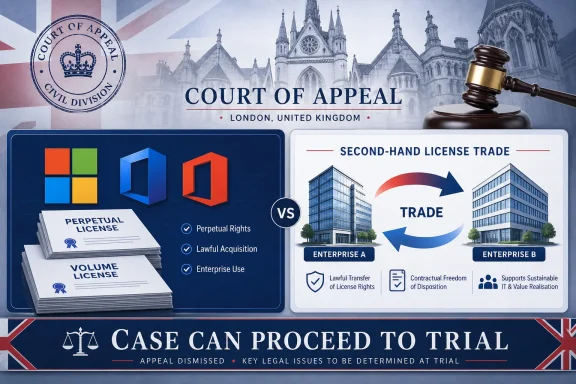 Microsoft Lost the Gatekeeping Fight Before the Main Fight Even Begins
ValueLicensing began proceedings against Microsoft in April 2021, alleging anti-competitive conduct affecting the secondary market for pre-owned Microsoft software licences. The reseller’s complaint is that Microsoft imposed anti-competitive conditions on business customers that restricted them from reselling Microsoft perpetual licences in return for discounts on Microsoft software subscriptions. In ValueLicensing’s words, Microsoft’s conduct was aimed at limiting the size of the market for second-hand software, allegedly leading to higher prices and less choice for customers.The Court of Appeal has not decided whether that abuse-of-dominance allegation is ultimately proved. That distinction matters. What the court has done is unanimously uphold the Competition Appeal Tribunal’s decisions on jurisdiction and preliminary copyright issues, removing a significant procedural obstacle that had stalled the case while Microsoft pursued appeals.
That makes the ruling a green light, not a finish line. The proceedings had been stayed pending the appeals; ValueLicensing says they can now resume. Jonathan Horley, ValueLicensing’s founder and managing director, framed the decision as a vindication of the reseller’s model, saying the judgment agreed with the main conclusions of the CAT on the rulings under appeal and clarified the legality of ValueLicensing’s business model.
Microsoft’s immediate problem is that several defensive routes closed at once. The Court of Appeal confirmed that the CAT can decide copyright issues where they arise as necessary questions in competition law claims. It also upheld the Tribunal’s application of the UsedSoft v Oracle precedent, rejecting Microsoft’s copyright arguments against lawful resale of qualifying pre-owned Microsoft software licences.
That is why the ruling matters beyond one reseller’s damages claim. The second-hand software market sits at the intersection of copyright, contract, competition law, and vendor sales strategy. This judgment says Microsoft cannot make the resale question disappear at the preliminary stage by reframing the dispute as a copyright problem.
The Case Turns on a Simple Commercial Question
The commercial story is familiar to many enterprise IT departments. A business buys perpetual Windows or Office licences. Later, that business migrates, downsizes, consolidates, moves to subscriptions, or changes platforms. A reseller such as ValueLicensing wants to buy surplus rights and sell them to another customer that would rather buy pre-owned perpetual licences than new licences or subscriptions.Microsoft’s alleged conduct, according to ValueLicensing, interfered with that market. The accusation is not merely that Microsoft preferred subscription revenue. It is that Microsoft allegedly used discounts on software subscriptions as leverage to secure customer commitments that restricted resale of perpetual licences.
That distinction is central. A vendor may prefer its current commercial model. It may promote cloud subscriptions, package discounts, and encourage customers to modernise. The competition law question is different: whether a dominant vendor can lawfully use commercial terms in a way that restricts the supply of lawful pre-owned licences and weakens a secondary market that competes with its own new sales.
For Windows users, the practical stakes are not abstract. The pre-owned market can offer a route to obtain software rights at lower cost, especially for organisations with legacy systems, offline environments, long-lived regulated deployments, or budget constraints that do not map neatly onto a cloud-first roadmap. ValueLicensing’s theory is that if the supply of those licences is restricted, customers face higher prices and less choice.
The Court of Appeal ruling does not decide whether that theory succeeds. It does, however, ensure that ValueLicensing gets to test it in the main competition claim.
UsedSoft Is Still Central to the Resale Question
The legal hinge is the 2012 European Union Court of Justice ruling in UsedSoft v Oracle. In that case, the court established that resale of pre-owned software licences can be lawful in certain circumstances. The key idea is exhaustion: once a software company has sold a copy of its computer program, its exclusive right to control distribution of that copy may be exhausted.That principle has always been difficult for software vendors because enterprise software is not a simple physical product. It can be copied, bundled, updated, licensed through volume schemes, wrapped in online portals, and mixed with documentation, user interfaces, fonts, graphical material, and other protected material. Vendors therefore have room to argue that particular licensing arrangements sit outside the cleanest version of the UsedSoft rule.
Microsoft tried to use that complexity. The preliminary dispute included whether qualifying pre-owned Windows and Office licences could be resold consistently with the UsedSoft framework, and whether Microsoft’s copyright arguments prevented that resale. Microsoft also challenged the treatment of volume licensing arrangements.
The Court of Appeal sided with the CAT. It upheld the Tribunal’s application of UsedSoft v Oracle and rejected Microsoft’s copyright arguments. It also rejected Microsoft’s argument against resale of volume licences, with the CAT’s approach treating Microsoft’s licensing arrangements as giving rise to multiple software licences rather than a single indivisible block licence.
That point matters for enterprise customers. Volume licensing is how large organisations actually buy. If a large arrangement were treated as one indivisible block, the practical resale market would be far less useful. ValueLicensing says the judgment confirms that qualifying volume licences may be subdivided and resold.
| Issue Microsoft appealed | Microsoft’s position | Court of Appeal outcome | Practical consequence |
|---|---|---|---|
| CAT jurisdiction | Copyright issues should not be determined by the CAT as part of the competition claim | Rejected; CAT can determine copyright issues where necessary to decide competition law claims | Microsoft cannot divert the preliminary copyright dispute away from the competition forum |
| UsedSoft and copyright exhaustion | Microsoft’s copyright arguments prevented lawful resale of qualifying pre-owned licences | Rejected; CAT’s application of UsedSoft v Oracle upheld | Qualifying pre-owned Microsoft software licences remain capable of lawful resale |
| Volume licence subdivision | Volume licences should be treated as an indivisible block | Rejected; CAT’s approach was upheld | ValueLicensing says qualifying volume licences may be subdivided and resold |
| Remaining appeal grounds | Microsoft advanced further challenges to the CAT decisions | Rejected; Microsoft’s appeals were unanimously dismissed | The stayed proceedings can resume toward the main liability claim |
The Tribunal’s Role Is Now Bigger Than Microsoft Wanted
One of Microsoft’s most important arguments was institutional rather than purely substantive. It contended that the CAT should not determine disputed copyright issues embedded in the competition claim. If that argument had succeeded, the case could have been delayed, fragmented, or substantially weakened.The Court of Appeal rejected that route. It confirmed that the CAT has jurisdiction to determine copyright issues where they arise as necessary questions in competition law claims. That is not just procedural housekeeping. It matters for how modern technology disputes are litigated.
Competition cases against platform and software companies often arrive with several bodies of law tangled together. They may involve contracts, intellectual property, interoperability rules, licensing terms, support policies, cloud incentives, and migration programmes. If every non-competition issue had to be carved out into another forum before the CAT could proceed, large technology defendants would have a strong procedural argument for slowing or fragmenting competition claims.
The Court of Appeal’s ruling narrows that route. The CAT does not become a general copyright court, and Microsoft is not being sued there for copyright infringement as the main claim. But where copyright questions are necessary to decide whether a competition claim can proceed, the Tribunal can resolve them.
That is a meaningful point for IT markets because intellectual property is often the terrain on which market power is defended. Software vendors can argue that licensing restrictions are lawful exercises of copyright. Resellers and customers can argue that those restrictions may become market-closing devices once exhaustion has done its work. The Court of Appeal has effectively said the competition forum is competent to address that collision when it is part of the competition case itself.
The Copyright Arguments Did Not Stop the Resale Claim
Microsoft’s copyright position mattered because Windows and Office are not just abstract licence entries in a spreadsheet. They are complex software products, and Microsoft argued that copyright considerations prevented the resale claim from proceeding in the way ValueLicensing advanced it.The Court of Appeal did not accept Microsoft’s arguments. The narrow point to take from the ruling is that the court upheld the CAT’s application of UsedSoft v Oracle and rejected Microsoft’s copyright objections to lawful resale of qualifying pre-owned Microsoft software licences. It also upheld the approach that treated volume licensing arrangements as capable of giving rise to multiple licences rather than a single indivisible block.
That matters beyond this individual dispute because modern enterprise software is normally sold through complex licensing structures. If a vendor could defeat resale rights simply by relying on the complexity of its licensing architecture, the practical effect of UsedSoft would be limited. The Court of Appeal’s ruling does not erase all licensing complexity, but it prevents Microsoft from using the preliminary copyright arguments raised in this appeal to stop ValueLicensing’s claim before the liability stage.
For WindowsForum readers, this is where the case connects with the larger question of digital ownership. Customers are often told that perpetual licences are not ownership in the ordinary consumer sense. Yet enterprise customers may still treat perpetual software rights as valuable assets in procurement, merger planning, divestitures, retirement projects, and cloud migration negotiations. The Court of Appeal’s ruling reinforces that qualifying software rights can have a transferable economic life, subject to the applicable legal and factual conditions.
The Volume Licence Ruling Hits Enterprise Procurement Where It Lives
The resale of individual boxed software licences is not where the enterprise money is. The real market is in volume licensing: estates of Windows and Office rights accumulated through corporate agreements, government procurements, mergers, divestitures, infrastructure refreshes, and migration projects. If those licences cannot be subdivided, the secondary market becomes clumsy and commercially limited.Microsoft argued against the resale of volume licences on the basis that they should be treated as an indivisible block. The Court of Appeal rejected that argument by upholding the CAT’s approach. ValueLicensing says the ruling confirms that qualifying volume licences may be subdivided and resold.
That conclusion maps onto how IT departments understand their own estates. A customer may buy rights for hundreds or thousands of seats, but those rights correspond to deployable software use across users, devices, or environments. Treating the entire arrangement as one fused object would make resale far less practical, particularly where the original customer needs to keep some licences while disposing of others.
The word “qualifying” does real work here. This is not a blanket permission slip to sell any Microsoft licence, any subscription entitlement, any cloud service right, or any activation key bought from a dubious marketplace. The case concerns qualifying pre-owned Microsoft software licences, particularly Windows and Office rights considered through the UsedSoft framework and the arrangements examined by the Tribunal.
That nuance is important because the grey market for software keys is full of risk. A court ruling supporting lawful resale of qualifying pre-owned licences does not legitimise counterfeit keys, stolen keys, MSDN keys, regionally restricted keys, education licences sold to consumers, or activation credentials stripped from their contractual context. The ruling strengthens the legal basis for a properly documented secondary market; it does not bless every “cheap Windows key” ad on the internet.
For corporate buyers, the lesson is not “buy anything cheap.” It is “treat pre-owned licensing as a serious procurement category.” That means chain of title, evidence of first acquisition, confirmation that the original acquirer has stopped using the resold rights, contractual review, and software asset management records that can survive audit scrutiny.
Timeline
April 2021 — ValueLicensing began proceedings against Microsoft, alleging anti-competitive conduct affecting the secondary market for pre-owned Microsoft software licences.CAT preliminary rulings — The Competition Appeal Tribunal made rulings on jurisdiction and copyright issues that were favourable to ValueLicensing and were later appealed by Microsoft.
Court of Appeal judgment — The Court of Appeal unanimously dismissed Microsoft’s appeals and upheld the CAT decisions.
Next stage — With the appeals dismissed, the stayed proceedings can resume and the case can proceed toward the main liability trial.
This sequence explains why the ruling feels both procedural and significant. The competition claim began years ago, but the parties first had to fight over whether the resale market could be treated as lawful in principle for the relevant qualifying licences and whether the CAT could decide the necessary copyright questions. Now the case returns to the harder factual and economic contest: whether Microsoft’s alleged conduct abused dominance and caused loss.
The Subscription Shift Is the Commercial Backdrop
The allegation at the centre of ValueLicensing’s claim is tied to one of the biggest changes in enterprise IT: the move from perpetual licences to subscriptions. Microsoft’s modern business model is built around recurring revenue, cloud services, Microsoft 365, Azure, security bundles, management tools, and continuous account relationships. Perpetual licences are less central in that model because they leave more long-term control in the customer’s hands.That does not make subscription licensing unlawful. In many cases, subscriptions are easier to manage, easier to secure, and better aligned with current software delivery. Microsoft can fairly argue that cloud migration improves productivity and security, and many IT departments would agree in principle.
The competition question is more specific: whether Microsoft allegedly crossed a line by using discounts on subscriptions to restrict resale of perpetual licences. If a customer accepts terms that limit resale of old licences as part of a migration deal, ValueLicensing’s theory is that supply to the secondary market is reduced. The alleged result is higher prices and less choice for customers that would otherwise buy pre-owned licences.
That theory still has to be proved. The Court of Appeal ruling does not decide dominance, abuse, causation, or loss. Microsoft can still argue that its conduct was legal, pro-customer, commercially justified, or not abusive. What has changed is that Microsoft can no longer rely on the same preliminary copyright and jurisdiction arguments to stop the case before the main competition issues are tried.
What This Means Now
For procurement, software asset management, and IT finance teams, the immediate message is practical rather than dramatic: do not assume old perpetual Windows and Office licences have no recoverable value, and do not assume every migration offer should treat them as administrative clutter.The Court of Appeal ruling means the case proceeds, not that ValueLicensing has won on liability. Still, the ruling supports a more careful approach to Microsoft estates. Organisations should identify perpetual Windows and Office licences separately from subscription entitlements, preserve documentation, and review whether migration or discount arrangements included restrictions on resale.
Procurement teams should ask a simple question before signing a cloud or subscription renewal: what are we giving up if surplus perpetual licences cannot be resold? That does not mean every organisation should sell licences. It means the resale value, legal status, and operational need should be assessed before old entitlements are surrendered, retired, or bundled into a new commercial arrangement.
Software asset managers should also tighten evidence. A resale position is only as strong as the records behind it. Purchase history, volume licensing documents, proof that licences are perpetual, deployment records, and evidence that the original user has stopped using the relevant rights all matter. The ruling improves the legal backdrop for a documented secondary market, but it does not remove the need for disciplined SAM controls.
Windows and Office Buyers Now Have More Leverage, but Not a Free Pass
For Windows and Office customers, the ruling creates leverage in procurement conversations. It strengthens the argument that qualifying perpetual licences may retain resale value and that customers should not casually surrender that value in subscription negotiations. That matters especially for organisations with large legacy estates, public-sector budgets, or regulated environments where cloud migration is slower than vendor sales cycles.The ruling should also make procurement teams revisit the language of migration deals. If a discount requires commitments that limit resale of perpetual licences, the commercial value of that restriction should be explicit. Too often, licensing negotiations treat old perpetual estates as paperwork rather than assets with potential secondary-market value.
Software asset managers should be particularly attentive. The value of a pre-owned licence depends on documentation. A customer that cannot prove what it bought, when it bought it, under what programme, whether the licence is perpetual, whether it has been fully paid for, and whether it has ceased using the copy being resold will struggle to realise value safely.
This ruling does not eliminate audit risk. Microsoft audits, reseller warranties, contractual obligations, and internal deployment evidence still matter. What changes is the legal backdrop: the Court of Appeal has rejected Microsoft’s copyright objections to lawful resale of qualifying pre-owned Microsoft software licences and has upheld the CAT’s approach to qualifying volume licences.
Action checklist for admins
- Inventory perpetual Windows and Office licences separately from subscription entitlements.
- Preserve purchase records, volume licence documentation, assignment records, and evidence of first acquisition.
- Identify licences tied to migrations where resale restrictions or trade-in terms were accepted in exchange for subscription discounts.
- Do not treat the ruling as approval for grey-market keys; require chain-of-title evidence from any reseller.
- Ask procurement and legal teams to value surplus perpetual licences before agreeing to cloud migration concessions.
- Update software asset management processes so retired licences are tracked as potential assets, not merely decommissioned records.
- Review renewal playbooks so perpetual licence value is considered before subscription commitments are finalised.
- Keep legal, procurement, SAM, and infrastructure teams aligned before disposing of or relying on pre-owned licences.
Microsoft’s Defeat Is Narrow in Law but Broad in Strategy
It would be easy to overstate the ruling as a total loss for Microsoft. It is not. The Court of Appeal did not find Microsoft liable for abuse of dominance. It did not award damages to ValueLicensing. It did not declare every Microsoft licence resalable or every contractual restriction unlawful. It did not decide the entire economics of the secondary market.But it would also be wrong to understate the ruling as a minor procedural waypoint. Microsoft’s appeals were unanimously dismissed. Its jurisdiction argument failed. Its copyright arguments against the lawful resale of qualifying pre-owned Microsoft software licences failed. Its argument against the CAT’s treatment of volume licences failed. The result is that the claim can move forward.
Horley was blunt about that point, saying it was notable that Microsoft’s arguments did not succeed. That is advocacy from a party to the case, not neutral analysis, but the procedural result gives the comment weight. Microsoft went to the Court of Appeal to stop or narrow the path forward and came away with the path reopened.
The strategic issue is larger because Microsoft’s licensing model depends not just on legal enforceability but on customer perception. Enterprise customers often comply with vendor licensing positions because the cost of disagreement is high. The vendor controls portals, audit processes, account teams, support relationships, renewal negotiations, and migration incentives. A Court of Appeal judgment that supports the lawfulness of qualifying resale activity gives customers and resellers more confidence to question overly broad claims about what cannot be transferred.
That does not mean customers should become casual about licensing. The opposite is true. The ruling makes serious licence governance more valuable. If qualifying pre-owned licences can be lawfully resold, then they must be managed like assets, not leftovers. If subscription deals restrict resale, those restrictions must be priced and reviewed. If a reseller offers pre-owned Microsoft rights, the buyer should demand evidence rather than marketing claims.
What the Liability Trial Will Still Have to Decide
The next phase is where the competition claim becomes harder. ValueLicensing still has to prove the substance of its case. That means establishing the relevant market, Microsoft’s position in that market, the conduct complained of, whether the conduct was abusive, and whether it caused loss. Microsoft will have the opportunity to defend its commercial practices and argue that its conduct was lawful.That is why the Court of Appeal result should be read carefully. It is important because it preserves the claim and upholds the CAT’s preliminary approach. It is not a final merits judgment on abuse of dominance.
The liability trial will need to examine the real-world commercial effects of Microsoft’s conduct. Did the challenged arrangements restrict supply to the secondary market? Did that matter to pricing and customer choice? Were customers prevented or discouraged from selling surplus perpetual licences? Were Microsoft’s subscription discounts ordinary commercial competition, or were they tied to restrictions that had anti-competitive effects? Those are the questions that now move back to the centre of the case.
Microsoft can still win those arguments. ValueLicensing can still lose on liability or causation. The Court of Appeal judgment simply means Microsoft has not succeeded in preventing the case from getting there.
Why WindowsForum Readers Should Care
This case matters because Windows and Office licensing still sits inside many real-world IT decisions. Even as Microsoft pushes cloud subscriptions, organisations continue to run legacy applications, long-term desktop estates, offline environments, regulated workloads, virtual desktop deployments, and systems that depend on stable perpetual rights. The assumption that every organisation can or should move everything into subscriptions on the vendor’s preferred timetable is not how enterprise IT actually works.Pre-owned licensing is one pressure valve in that system. It can give buyers a lower-cost route to lawful software rights. It can let sellers recover value from licences they no longer need. It can create competition against new licence sales and subscription migration offers. That is exactly why the legal boundary matters.
The Court of Appeal has not rewritten Microsoft licensing. It has not made procurement simple. It has not removed the need for legal review. But it has strengthened the position that qualifying pre-owned Microsoft software licences can sit within a lawful resale market, and it has allowed ValueLicensing’s competition claim to proceed.
For administrators, the ruling should prompt a cleanup exercise. Know what perpetual licences you have. Know which rights are subscription-only. Know which licences are tied to migration deals. Know what documents you would need to prove entitlement. Know whether retired software rights still have potential value. That is not just a legal exercise; it is asset management.
For procurement leaders, the ruling should prompt a negotiation exercise. When Microsoft or any major vendor offers a subscription discount in exchange for changes to old licence rights, the customer should understand the trade. A discount is not automatically bad. A migration deal is not automatically anti-competitive. But the value of what is being surrendered should be measured.
For resellers, the ruling is encouraging but also raises the standard. A more credible secondary market will depend on clean records, careful qualification, and transparent warranties. The judgment helps the lawful pre-owned market; it does not help sellers who cannot prove where keys came from or whether the original user stopped using the software.
The Bigger Lesson: Perpetual Rights Still Matter
The software industry has spent years nudging customers from ownership-like perpetual models toward recurring subscriptions. There are good reasons for that shift: security updates, cloud integration, predictable budgeting, and simpler provisioning. But there is also a transfer of control. Subscriptions generally reduce the customer’s ability to hold, redeploy, or resell long-term rights outside the vendor’s current commercial framework.This case is a reminder that old perpetual estates may still matter. They may matter in audits. They may matter in divestitures. They may matter in public-sector budgeting. They may matter in business continuity planning. And, where they qualify for lawful resale, they may matter as recoverable assets.
The Court of Appeal’s judgment does not turn back the cloud era. Microsoft 365, Azure, and subscription licensing remain central to Microsoft’s business and to many customers’ IT strategies. But the ruling does prevent Microsoft from closing down this particular dispute through the preliminary copyright and jurisdiction arguments it advanced.
The forward-looking point is practical. The liability trial will decide whether ValueLicensing can prove its abuse-of-dominance claim. Until then, customers should not treat the ruling as a licence to ignore Microsoft terms, nor should they treat Microsoft’s preferred commercial model as the only possible route. Qualifying pre-owned licences remain part of the conversation, and after the Court of Appeal’s decision, that conversation has more legal weight.
For now, Microsoft has lost the gatekeeping fight. ValueLicensing still has to win the main fight. Windows and Office customers should use the interval wisely: document the estate, value the rights, scrutinise migration terms, and keep perpetual licences visible in procurement strategy rather than letting them disappear into the subscription transition.
References
- Primary source: Computer Weekly
Published: 2026-07-09T13:49:11.861041
Loading…
www.computerweekly.com - Related coverage: valuelicensing.com
Loading…
www.valuelicensing.com - Related coverage: catribunal.org.uk
Loading…
www.catribunal.org.uk - Related coverage: judiciary.uk
Loading…
www.judiciary.uk - Related coverage: solicitorsjournal.com
Loading…
www.solicitorsjournal.com - Related coverage: theregister.com
Loading…
www.theregister.com
- Related coverage: justice.gov
Loading…
www.justice.gov - Related coverage: tomshardware.com
Microsoft to appeal ruling in favor of reselling perpetual Windows licenses — UK Competition Court says fineprint holds no ground as judges throw out company's 'creative work' argument | Tom's Hardware
Microsoft Office products are not copyright protected.www.tomshardware.com - Related coverage: techradar.com
Loading…
www.techradar.com - Related coverage: itpro.com
Loading…
www.itpro.com - Related coverage: pcgamer.com
If Microsoft wins this UK court case it might spell the end of second-hand Windows licenses | PC Gamer
Microsoft's defence is to do with "non-program" parts of the OS.www.pcgamer.com