

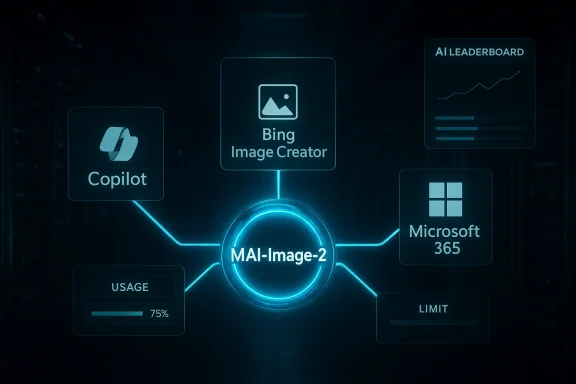
Microsoft’s latest push into in-house generative AI marks a sharper turn in its platform strategy. The company is reportedly advancing MAI-Image-2, a text-to-image model that aims to compete at the top of public leaderboards while giving Microsoft more control over how image generation works across Copilot, Bing Image Creator, and other products. That matters because the move is not just about prettier pictures; it is about reducing dependence on external model suppliers, tightening product integration, and owning more of the economics and roadmap of AI creation.
The timing is equally important. Microsoft is coming off a strong earnings report, continues paying a $0.91 quarterly dividend, and is still navigating the evolving contours of its partnership with OpenAI. At the same time, OpenAI has been accelerating its own product expansion in coding and infrastructure, while broader AI competition is intensifying around images, agents, and developer tooling. In other words, MAI-Image-2 is best understood as part of a larger industry shift: the biggest technology companies are no longer content to merely consume frontier models; they want to build them, tune them, and control the customer relationship end to end.
Microsoft’s image-model strategy has been moving in this direction for months. Earlier in the year, the company introduced MAI-Image-1, its first in-house image generator, signaling that Microsoft intended to create a proprietary visual-AI stack rather than rely forever on outside providers. That earlier model was positioned as a serious step toward tighter integration with Microsoft’s consumer and enterprise surfaces, especially Bing and Copilot. The new MAI-Image-2 appears to extend that logic with better realism, stronger scene composition, and improved text rendering, which are exactly the areas that matter when users want more than generic AI art.
The reported standing of MAI-Image-2 on the Arena.ai image leaderboard is also notable because it suggests Microsoft is no longer playing catch-up in public benchmarks. The latest Arena updates emphasize category-based performance and quality filtering, which makes leaderboard movement more meaningful than simple vanity rankings. If Microsoft’s model is genuinely near the top tier, then the company can credibly argue that in-house development is not merely a branding exercise but a strategic substitute for imported capability.
Yet the release also shows the familiar tradeoff that comes with aggressive AI productization. Microsoft has historically been careful about safety, policy enforcement, and content credentials in its image tools, and those controls can make a product feel restrictive to power users. The Bitget report says MAI-Image-2 is constrained by strong filters and usage limits, which would fit Microsoft’s broader corporate posture: ship useful AI, but avoid the reputational and legal risk of completely open-ended generation. That caution may frustrate enthusiasts, but for enterprise buyers it is often a feature rather than a bug. Risk-managed AI tends to travel farther inside large organizations than unconstrained novelty.
This story also sits inside a more complicated Microsoft-OpenAI relationship than many readers still assume. Microsoft and OpenAI recently reaffirmed that their partnership remains intact even as OpenAI expands its capital and cloud relationships elsewhere. OpenAI, meanwhile, has been rolling out more own-brand products and acquisitions, including moves that strengthen its coding and developer ecosystem. The result is not a breakup, but a gradual normalization of competition inside a long-running alliance.
The company also benefits from reducing platform risk. Dependency on external suppliers creates leverage for the supplier, especially when that supplier is also a competitor in adjacent markets. Microsoft has spent years building a cloud and software ecosystem that favors predictable economics and deep integration; in-house image generation is a natural extension of that philosophy. It may not eliminate outside model partnerships, but it gives Microsoft bargaining power and optionality.
Scene construction matters for similar reasons. A coherent image with consistent spatial logic saves time during editing and reduces the need for iterative prompt gymnastics. In practice, users care whether the model can place objects correctly, honor camera perspective, and maintain relationships between foreground and background elements. A model that gets those fundamentals right can become the first draft for a much larger creative workflow.
Usage restrictions create a second layer of tension. Rate limits and access caps may be understandable while Microsoft tests load, abuse patterns, and model behavior, but they also suggest the company is not yet ready to open the floodgates. That could be deliberate, especially if Microsoft wants to stage rollout through Copilot tiers or enterprise channels first. Still, it means the product’s benchmark status may overstate its immediate real-world impact.
If Astral’s tools are widely used in the Python community, OpenAI would gain more than just features. It would gain credibility with a major segment of developers who want practical utilities, not just chat interfaces. That matters because Python remains a default language for AI, data science, automation, and backend glue code. In a market like that, tool fidelity can shape user habit formation faster than model naming or branding.
The reported stock purchase by Rep. Cleo Fields adds a political-news layer that can shape market perception, though congressional transactions should never be over-read as a forecast. Such purchases are often interpreted as a sign of confidence, but they may simply reflect portfolio decisions subject to disclosure rules. Still, when a major company is winning on earnings and expanding in AI, any public buy signal tends to reinforce the sense that institutional and political sentiment is not turning bearish. Sentiment is not fundamentals, but it can amplify them.
Microsoft’s incentive here is obvious: it wants to preserve the economics of a relationship that has helped make Azure central to the AI conversation. OpenAI’s incentive is equally obvious: it wants optionality, bargaining power, and enough infrastructure diversity to support faster growth. The consequence is a partnership that is still intact but clearly maturing into something less dependent and more transactional. That is not a breakup; it is what scale tends to do to alliances.
Source: Bitget Microsoft Launches MAI-Image-2 Text-to-Image Model-And It's Better Than Expected | Bitget News
The timing is equally important. Microsoft is coming off a strong earnings report, continues paying a $0.91 quarterly dividend, and is still navigating the evolving contours of its partnership with OpenAI. At the same time, OpenAI has been accelerating its own product expansion in coding and infrastructure, while broader AI competition is intensifying around images, agents, and developer tooling. In other words, MAI-Image-2 is best understood as part of a larger industry shift: the biggest technology companies are no longer content to merely consume frontier models; they want to build them, tune them, and control the customer relationship end to end.
 Overview
Microsoft’s image-model strategy has been moving in this direction for months. Earlier in the year, the company introduced MAI-Image-1, its first in-house image generator, signaling that Microsoft intended to create a proprietary visual-AI stack rather than rely forever on outside providers. That earlier model was positioned as a serious step toward tighter integration with Microsoft’s consumer and enterprise surfaces, especially Bing and Copilot. The new MAI-Image-2 appears to extend that logic with better realism, stronger scene composition, and improved text rendering, which are exactly the areas that matter when users want more than generic AI art.The reported standing of MAI-Image-2 on the Arena.ai image leaderboard is also notable because it suggests Microsoft is no longer playing catch-up in public benchmarks. The latest Arena updates emphasize category-based performance and quality filtering, which makes leaderboard movement more meaningful than simple vanity rankings. If Microsoft’s model is genuinely near the top tier, then the company can credibly argue that in-house development is not merely a branding exercise but a strategic substitute for imported capability.
Yet the release also shows the familiar tradeoff that comes with aggressive AI productization. Microsoft has historically been careful about safety, policy enforcement, and content credentials in its image tools, and those controls can make a product feel restrictive to power users. The Bitget report says MAI-Image-2 is constrained by strong filters and usage limits, which would fit Microsoft’s broader corporate posture: ship useful AI, but avoid the reputational and legal risk of completely open-ended generation. That caution may frustrate enthusiasts, but for enterprise buyers it is often a feature rather than a bug. Risk-managed AI tends to travel farther inside large organizations than unconstrained novelty.
This story also sits inside a more complicated Microsoft-OpenAI relationship than many readers still assume. Microsoft and OpenAI recently reaffirmed that their partnership remains intact even as OpenAI expands its capital and cloud relationships elsewhere. OpenAI, meanwhile, has been rolling out more own-brand products and acquisitions, including moves that strengthen its coding and developer ecosystem. The result is not a breakup, but a gradual normalization of competition inside a long-running alliance.
Microsoft’s In-House AI Turn
The strategic logic behind MAI-Image-2 is straightforward: vertical integration. Microsoft wants the same kind of control over image generation that it already seeks in operating systems, productivity software, cloud services, and enterprise security. In-house models let the company optimize for latency, pricing, safety policy, region-specific compliance, and product design in ways a third-party API can’t always match. That is a big deal when the model is not a side feature but a core capability embedded in a flagship consumer and business platform.Why control matters
A text-to-image model is not just a creative toy. It can become a productivity primitive for marketing teams, sales organizations, design departments, educators, and software builders who need visual content at scale. If Microsoft can tune MAI-Image-2 specifically for Copilot, Office workflows, and Bing-facing consumer experiences, it can shape both the product behavior and the user journey more tightly than if it were simply renting someone else’s model. That is especially valuable when Microsoft wants to bundle AI into broader subscriptions and not merely sell API calls.The company also benefits from reducing platform risk. Dependency on external suppliers creates leverage for the supplier, especially when that supplier is also a competitor in adjacent markets. Microsoft has spent years building a cloud and software ecosystem that favors predictable economics and deep integration; in-house image generation is a natural extension of that philosophy. It may not eliminate outside model partnerships, but it gives Microsoft bargaining power and optionality.
- Less reliance on external model providers
- More product-specific tuning for Copilot and Bing
- Better control over pricing and packaging
- Tighter governance for enterprise customers
- More room to iterate without waiting on partner roadmaps
The enterprise angle
For enterprise users, the most important question is not whether the model can make flashy pictures. It is whether Microsoft can make AI generation reliable enough for business use and predictable enough for compliance teams. A model with strong text rendering and scene construction can be far more useful in corporate workflows than one that simply produces visually impressive images with low practical value. That is why the claim that MAI-Image-2 is “better than expected” matters: it suggests Microsoft may be building for workflow utility, not just benchmark theater.What the Model’s Reported Strengths Mean
The most interesting part of the MAI-Image-2 story is not that Microsoft has an image model, but that it is reportedly good at the things users complain about most. Photorealism, text rendering, and coherent scene construction are difficult problems because they require more than stylistic output; they require semantic consistency, object placement, and an understanding of typography in context. Many models can create pretty images, but far fewer can produce a sign, poster, or interface mockup where the text is actually legible and the layout makes sense.Why text rendering is a big deal
Text rendering is a practical discriminator in the AI image market. It determines whether a model is useful for marketing comps, presentation slides, signage, thumbnails, and localized content. If MAI-Image-2 genuinely improves here, Microsoft could position it not merely as an art generator but as a visual drafting assistant for business users who need fast prototypes. That could be more commercially valuable than novelty-driven output, even if it draws less attention on social media. Useful beats dazzling when the buyer is a company.Scene construction matters for similar reasons. A coherent image with consistent spatial logic saves time during editing and reduces the need for iterative prompt gymnastics. In practice, users care whether the model can place objects correctly, honor camera perspective, and maintain relationships between foreground and background elements. A model that gets those fundamentals right can become the first draft for a much larger creative workflow.
- Better photorealism improves business and consumer appeal
- Stronger text rendering broadens use cases beyond “art”
- Scene consistency reduces editing time
- More usable for thumbnails, posters, mockups, and marketing assets
- Higher practical value than pure stylistic novelty
Filters, Guardrails, and the Cost of Safety
The reported “aggressive content filters” around MAI-Image-2 are consistent with Microsoft’s longstanding public stance on responsible AI. The company has repeatedly emphasized safety tooling, content credentials, and enterprise-grade trust as core differentiators. That approach makes sense for a company that sells to governments, regulated industries, and Fortune 500 buyers, but it can create friction in creative workflows where users want fewer guardrails and more latitude.The tradeoff Microsoft is making
A tightly filtered model lowers certain legal and reputational risks. It can also help Microsoft avoid the kind of public backlash that comes with controversial image outputs, unsafe content, or policy confusion. But too much control can undercut the very flexibility that made generative AI exciting in the first place. If the filters are overly broad, the system may become hesitant, generic, or frustrating, especially for users experimenting with edge-case prompts or niche visual styles. Safety is indispensable; overblocking is expensive.Usage restrictions create a second layer of tension. Rate limits and access caps may be understandable while Microsoft tests load, abuse patterns, and model behavior, but they also suggest the company is not yet ready to open the floodgates. That could be deliberate, especially if Microsoft wants to stage rollout through Copilot tiers or enterprise channels first. Still, it means the product’s benchmark status may overstate its immediate real-world impact.
- Safety filters can improve trust
- Excessive blocking can reduce usefulness
- Usage caps may protect infrastructure but slow adoption
- Enterprise buyers may tolerate controls more than consumers
- Microsoft must balance innovation with compliance and brand risk
OpenAI, Astral, and the Coding Race
The second headline in the source material — OpenAI’s reported acquisition of Astral, a Microsoft-backed Python toolmaker — underscores how intensely the AI coding market is now consolidating around developer workflow control. OpenAI has been steadily expanding Codex, and its own public updates show rapidly growing usage across developers and businesses. In that context, acquiring tooling that matters to Python users makes strategic sense because it strengthens the chain from model to editor to deployment.Why developer tools are strategic
The coding layer is where AI moves from novelty to recurring revenue. Once a model becomes embedded in IDEs, terminals, cloud agents, and workplace workflows, switching costs rise quickly. OpenAI has already framed Codex as central to how software is built, and recent product launches show the company pushing farther into task delegation, security research, and agentic workflows. That means every acquisition or integration in the coding space is less about one tool and more about control of the ecosystem.If Astral’s tools are widely used in the Python community, OpenAI would gain more than just features. It would gain credibility with a major segment of developers who want practical utilities, not just chat interfaces. That matters because Python remains a default language for AI, data science, automation, and backend glue code. In a market like that, tool fidelity can shape user habit formation faster than model naming or branding.
- More developer lock-in through workflow integration
- Stronger Codex differentiation versus rivals
- Better alignment with Python-heavy AI workloads
- Potential leverage in enterprise software-building pipelines
- Increased pressure on competing coding assistants
Market Response and Investor Signaling
Microsoft’s recent quarterly results reinforce why the stock still attracts confidence even amid strategic uncertainty. The company reported $81.3 billion in revenue, up 17%, along with stronger operating income and EPS in its fiscal second quarter. Those numbers matter because they suggest Microsoft is not buying AI time on credit alone; it is converting AI demand into actual top-line and bottom-line momentum.Why the dividend still matters
The board’s declaration of a $0.91 per share dividend is a reminder that Microsoft remains a cash-rich, mature software giant even while it behaves like an AI platform company. Dividend consistency matters to income investors and signals financial resilience during expensive infrastructure cycles. In practice, this can help support the stock when AI valuation narratives become volatile or when the market begins to question how quickly AI spending translates into durable returns.The reported stock purchase by Rep. Cleo Fields adds a political-news layer that can shape market perception, though congressional transactions should never be over-read as a forecast. Such purchases are often interpreted as a sign of confidence, but they may simply reflect portfolio decisions subject to disclosure rules. Still, when a major company is winning on earnings and expanding in AI, any public buy signal tends to reinforce the sense that institutional and political sentiment is not turning bearish. Sentiment is not fundamentals, but it can amplify them.
- Strong earnings support the AI investment thesis
- Dividend stability appeals to long-term holders
- Political purchases can influence narrative momentum
- Market confidence is being sustained by execution, not just hype
- AI expansion is increasingly linked to earnings quality
Legal and Strategic Tensions in the AI Cloud Stack
One of the most consequential parts of the broader narrative is the ongoing tension around Microsoft, OpenAI, and cloud exclusivity. Microsoft and OpenAI recently said their partnership remains intact, while acknowledging that OpenAI can pursue additional compute elsewhere within the existing framework. That statement is a useful reminder that these deals are not static; they evolve as each company seeks more leverage, more scale, and more flexibility.Why exclusivity matters
In the AI era, cloud contracts are not just infrastructure agreements. They are strategic moats that determine who gets to host models, serve APIs, and capture margin from usage growth. If a major customer or partner arrangement shifts, the impact can ripple through revenue forecasts, negotiation posture, and competitive positioning. That is why any rumored legal dispute over AI infrastructure commitments would be closely watched by investors and enterprise buyers alike.Microsoft’s incentive here is obvious: it wants to preserve the economics of a relationship that has helped make Azure central to the AI conversation. OpenAI’s incentive is equally obvious: it wants optionality, bargaining power, and enough infrastructure diversity to support faster growth. The consequence is a partnership that is still intact but clearly maturing into something less dependent and more transactional. That is not a breakup; it is what scale tends to do to alliances.
- Cloud exclusivity influences bargaining power
- Infrastructure deals shape AI economics
- Legal uncertainty can delay product and corporate plans
- Rival cloud providers watch these terms closely
- Enterprise customers may seek more multi-cloud flexibility
Strengths and Opportunities
Microsoft’s AI push is compelling because it combines technical progress, distribution, and balance-sheet strength in one package. The company is not trying to win on one flashy feature; it is trying to make AI generation and AI coding feel native to its ecosystem, which is a much more durable strategy. It also has the benefit of enterprise trust, consumer reach, and a product portfolio broad enough to absorb missteps without derailing the overall business.- In-house control over model behavior, pricing, and rollout
- Stronger Copilot integration potential across consumer and enterprise products
- Better text rendering could unlock practical business uses
- Photorealism and scene quality help broaden creative applications
- Financial strength supports long-term AI investment
- Existing distribution through Bing, Copilot, and Microsoft 365 lowers adoption friction
- A visible dividend and strong earnings support investor confidence
Risks and Concerns
The biggest concern is that Microsoft may build excellent models that still feel constrained by policy, access limits, or product fragmentation. In generative AI, user experience matters as much as benchmark ranking, and a model that is hard to use can lose mindshare quickly. There is also the risk that Microsoft’s strategic diversification creates confusion if customers are unsure whether they are using OpenAI models, Microsoft models, or a hybrid of both.- Aggressive filters may frustrate users and reduce utility
- Usage caps can slow adoption and create negative sentiment
- Benchmark rank may not translate into real-world engagement
- Ongoing OpenAI dependency still creates strategic exposure
- Legal or contractual disputes could distract management and unsettle markets
- Competitive pressure from Google, OpenAI, Anthropic, and others remains intense
- Enterprise buyers may demand stronger guarantees around provenance and compliance
Looking Ahead
The next phase of this story will be about rollout, not announcement. If Microsoft broadens access to MAI-Image-2 inside Copilot and Bing Image Creator, the market will get a much clearer picture of whether the model is truly competitive or simply impressive in controlled testing. The same is true for OpenAI’s coding acquisitions and Codex expansion: the real question is whether those gains convert into durable developer habit and enterprise spending.Key things to watch
- Whether Microsoft loosens filters and usage limits
- How quickly MAI-Image-2 reaches Copilot and Bing Image Creator
- Whether OpenAI’s coding acquisitions improve Codex stickiness
- Any further changes to the Microsoft-OpenAI partnership
- Whether Azure, Copilot, and AI tool usage continue to show up in earnings strength
Source: Bitget Microsoft Launches MAI-Image-2 Text-to-Image Model-And It's Better Than Expected | Bitget News
Last edited:
