

Paul Thurrott’s July 10, 2026 “Ask Paul” argues that Microsoft’s years-long effort to build competitive in-house AI models is necessary but may mature only after AI assistants have displaced the Microsoft 365 applications, Windows workflows, and ecosystem lock-in those models are supposed to protect. That makes Microsoft’s AI push less a conventional product race than a fight to control the interface that comes after applications. The same column’s defenses of Windows, enthusiasm for Snapdragon X, and concern over the Microsoft Global Device ID reveal the other half of the problem: Microsoft must preserve trust and platform relevance while rebuilding its business around technology designed to make platforms less visible. The company is not merely trying to improve Copilot; it is trying to survive the end state Copilot implies.
NickTech’s question begins with what sounds like a straightforward competitive concern: can Microsoft develop large language models that are as capable as those already available, and could weaker in-house models drive customers away from Copilot? Thurrott’s answer is more consequential. Microsoft, he notes, “has been working on its own LLMs for years,” so the existence of an internal model program is not the revelation.
What changed was the strategic urgency. Microsoft and OpenAI reconfigured their partnership earlier in 2026, giving Microsoft the ability to pursue super-intelligence without OpenAI’s help or involvement. Microsoft’s own description of the amended partnership emphasized greater flexibility for both companies, while coverage from the Associated Press characterized the change as another step toward loosening an alliance that had defined the opening phase of the generative-AI boom.
This matters because Microsoft originally used OpenAI as both an accelerator and a bridge. OpenAI supplied frontier capabilities while Microsoft supplied cloud infrastructure, enterprise distribution, developer tooling, and the applications through which those capabilities could reach paying customers. That arrangement allowed Microsoft to move faster than it could have by building every important model internally.
But a bridge is not the same thing as a permanent foundation. If Copilot remains strategically dependent on a partner that is also building a competing destination for users, Microsoft does not fully control its costs, product roadmap, differentiation, or ultimate relationship with the customer. The partnership can continue to produce value while still becoming insufficient as Microsoft’s long-term operating model.
At Build 2026 in May, Microsoft publicly demonstrated that this transition was already underway by announcing several new top-tier Microsoft AI, or MAI, models. Microsoft AI CEO Mustafa Suleyman framed the work around a more human-centered form of super-intelligence rather than a race toward an abstract, all-purpose AGI milestone. Official Build materials likewise presented Microsoft’s models and Scout personal agent as parts of a broader system, not isolated research demonstrations.
Thurrott believes Microsoft will eventually become competitive because it possesses the essential ingredients: technical expertise, access to massive infrastructure, years of experience using and enhancing OpenAI’s models, and an enterprise customer base large enough to generate demand. The harder question is whether eventually is soon enough.
Model development is not a feature that can be completed in one product cycle. Microsoft AI shipped its first models less than a year before the July 10 column, and getting those models out required a year and a half. Even a company with Microsoft’s capital and datacenter footprint cannot instantly produce a frontier model, validate it, optimize its operating costs, integrate it across products, and convince customers that it is reliable enough for important work.
That delay would be manageable if the target were stationary. It is not. Model rankings change rapidly across coding, reasoning, generation, tool use, latency, and cost, often producing a new market narrative every time a major laboratory ships an update. A model can look competitive in one workload and pedestrian in another, while a highly ranked release can lose its apparent lead before an enterprise has finished evaluating it.
This is why the fixation on a single “best” model can obscure Microsoft’s real objective. It does not need every MAI model to dominate every benchmark every week. It needs a model portfolio that is capable enough, economical enough, and deeply enough integrated that Microsoft customers do not feel compelled to leave the ecosystem to complete ordinary work.
Earlier in 2026 — Microsoft and OpenAI reconfigured their partnership, giving Microsoft room to pursue super-intelligence without OpenAI’s help or involvement.
May 2026 — Microsoft used Build 2026 to announce several top-tier MAI models and introduce Scout, its personal AI agent.
July 9, 2026 — OpenAI combined ChatGPT, Codex, Work, browser capabilities, and its other functions into a broader ChatGPT experience while moving to kill its standalone browser.
July 10, 2026 — Thurrott argued that Microsoft’s ability to build competitive models was likely, but that the company could arrive after the traditional application ecosystem had already begun losing its strategic importance.
Microsoft has the same advantage on a larger enterprise canvas. Its products already sit inside identity systems, document repositories, email workflows, meetings, security policies, compliance regimes, and purchasing agreements. An organization that has standardized on Microsoft 365 will not casually replace that environment because another model scores better on a reasoning test.
This is the unglamorous power of inertia. If Copilot can summarize the right internal documents, work within organizational permissions, manipulate familiar business data, and satisfy administrative requirements, it may be more useful to a company than a technically superior model that requires another contract, another management layer, and another set of data-governance decisions.
Thurrott is careful not to confuse that advantage with current success. The percentage of Microsoft’s installed base paying for Copilot has reportedly remained small. Microsoft has distribution, but distribution does not guarantee that customers will see enough value to accept an additional charge or redesign established workflows.
The economics may nevertheless improve. Smaller cloud models and on-device models are becoming more capable, reducing the need to send every request through the most expensive frontier system. Microsoft can route work to different models according to complexity, latency, privacy, and cost, reserving its most powerful systems for the tasks that justify them.
That creates room for free or bundled AI that is merely sufficient for routine use. Customers may not actively choose Microsoft’s model over every competitor; they may simply stop shopping because the integrated option works. In enterprise software, the system that clears the reliability threshold and requires the least organizational friction often wins more business than the system with the most impressive demonstration.
Owning more of the model layer also gives Microsoft greater control over margins. If the company can use its own models for a meaningful portion of Copilot activity, it can reduce its reliance on external economics while tuning those models for its applications, cloud, and customer workloads. Cost savings are not incidental when AI usage is continuous and usage-based pricing is becoming more common.
But “good enough” is a floor, not a strategy by itself. If Microsoft’s models are consistently slower, less capable, or less trustworthy, integration becomes a trap rather than an advantage. Customers will tolerate a narrow gap for convenience; they will not tolerate an assistant that routinely fails at the work it was purchased to perform.
Today, users translate intentions into applications. A person decides that a task requires a spreadsheet, a presentation, a document, an email, or several browser tabs, and then manually operates the corresponding tools. Even when Copilot assists, the application generally remains the visible container for the work.
The agentic model reverses that relationship. The user describes the desired result in natural language, and the AI selects tools, gathers data, invokes services, edits files, checks its work, and returns an outcome. The user does not need to know which application produced which intermediate step, just as a cloud customer does not normally care which physical server processed a request.
Word and Excel do not necessarily disappear as technologies in that world. Their formatting engines, calculation systems, file compatibility, automation interfaces, and business rules can survive as services invoked by an agent. What disappears is their privileged position as destinations where users spend the working day.
This distinction is existential for Microsoft. The company’s lock-in has historically been reinforced by documents, workflows, skills, file formats, management tools, and organizational habits tied to its visible applications. If an AI can orchestrate those capabilities without requiring the user to open the applications, then Microsoft 365 becomes infrastructure: valuable, perhaps indispensable, but increasingly hidden and easier to substitute.
OpenAI’s July 9 move makes that future tangible. It was described as combining ChatGPT, Codex, Work, web-browser capabilities, and everything else OpenAI does into one ChatGPT super-app while killing its standalone browser. The packaging may evolve, but the direction is clear: ChatGPT is being positioned as the place where users begin tasks, supervise execution, and receive results.
That is more threatening to Microsoft than another chatbot benchmark. OpenAI does not need to reproduce every Microsoft 365 interface if it can become the interface above Microsoft 365. It can let Microsoft’s services perform parts of the work while capturing the customer’s attention, intent, history, and subscription relationship at the agent layer.
Nadella’s old description of Copilot as the new Start menu looks more prescient in this context. A Start menu is not merely an application; it is a launch point through which users reach the rest of the system. Nearly three years after that comparison, the market is converging on the idea that an AI assistant could become the launch point for nearly every meaningful computing task.
Scout, introduced during the Build 2026 keynote, suggests that Microsoft is pursuing its own version of this model. A personal agent capable of acting across work resources can evolve into Microsoft’s super-app even if the final product carries a different name. Outlook or Teams might initially serve as its visible home, but the long-term ambition is larger than adding a chat pane to existing software.
The strategic conflict is brutal. Microsoft must accelerate the transition because a competitor controlling the AI interface could reduce Microsoft to a collection of back-end services. Yet every successful step toward agentic computing also weakens the traditional applications that generate Microsoft’s most important commercial advantage.
This explains the apparent excess of Microsoft’s AI push over the past three years. The company has inserted Copilot into products where customers did not always ask for it, used Windows as a distribution surface, invested heavily in OpenAI, built its own models, and begun developing a personal agent. Those choices can be criticized individually while still following a coherent corporate diagnosis: AI is a do-or-die platform transition for Microsoft.
The AI transition is less forgiving. If AI assistants abstract away applications and cloud services simultaneously, Microsoft cannot count on shifting revenue from one familiar product category to another. It must establish an agent business capable of producing economics commensurate with Microsoft 365 while paying the enormous infrastructure costs associated with model training and inference.
One possibility is that Microsoft 365 evolves rather than vanishes. The brand could become the commercial wrapper for Copilot, Scout, enterprise data access, governance, and the services agents use behind the scenes. Legacy applications could remain available for specialists and traditional workflows while a growing majority of users interact primarily with an agent.
That would resemble Microsoft’s treatment of older technologies during earlier platform shifts. A mature product rarely disappears on the day its successor arrives. It persists inside compatibility layers, administrative tools, regulated environments, and organizations that have good reasons not to change.
Yet a gradual decline does not remove the revenue problem. If fewer users actively value Word or Excel as products, Microsoft must justify subscriptions through agent capabilities. It must also prevent customers from deciding that their preferred independent AI can call Microsoft’s back-end services only when necessary.
The winning model may therefore be less about possessing the smartest standalone LLM and more about controlling orchestration. Microsoft needs an agent that understands organizational context, respects permissions, chooses models intelligently, invokes Microsoft and third-party tools, and can be managed at enterprise scale. Its in-house models are essential components of that system, but they are not the system by themselves.
This is why Thurrott’s timing concern lands harder than the original reader question. Microsoft can probably produce competitive frontier models. The danger is that it spends years winning model independence only to discover that the decisive contest moved upward—from who supplies the model to who owns the agent, the interface, and the customer.
The obvious explanation would be familiarity after more than 30 years of Windows use, or professional dependence from writing about Microsoft. Thurrott rejects both as the decisive factor. He says he remains on Windows because repeated testing of competing platforms continues to reveal workflow blockers that he does not encounter on Windows.
This is not a claim that Windows is elegant or free from abuse. Thurrott has extensively criticized Microsoft’s degradation of the experience and has documented ways to “de-enshittify” Windows 11. His case is that Windows’ flaws can generally be fixed or worked around without surrendering the platform’s breadth, while rival operating systems impose smaller but irreducible limitations that accumulate during daily use.
That distinction matters more than a conventional feature comparison. Most professional workflows are not defeated by the absence of one spectacular capability. They are degraded by dozens of interruptions: a missing shortcut, an inconsistent windowing behavior, a peripheral that lacks full support, an application that works differently, or a task that suddenly requires the mouse.
Affinity provides Thurrott’s concrete example. On Windows, he can configure Ctrl + E to export an edited image, matching the endpoint of his photo workflow. On the Mac, he cannot configure the equivalent within the application, turning a familiar keyboard-driven operation into a recurring interruption.
Any single example can be dismissed with a utility, script, alternate application, or different habit. Thurrott anticipates that response from a highly technical audience. His argument is not that no workaround exists for anything on the Mac; it is that researching, installing, configuring, and remembering workarounds for a long list of small limitations becomes its own productivity tax—and some limitations cannot be removed.
Window and keyboard behavior reinforce the point. He cites incomplete keyboard navigation, inconsistent third-party applications, Cmd + Tab not exposing every open window in the expected way, varying methods for moving among an application’s windows, inconsistent display modes, full-screen applications becoming separate virtual desktops, and Stage Manager as examples of friction.
Apple’s hardware presents a related constraint: quality within a narrow range rather than breadth across a market. A user seeking the largest Mac laptop display is pushed toward a thick, heavy, expensive 16-inch MacBook Pro or a smaller 15-inch MacBook Air. The PC ecosystem offers more manufacturers, form factors, configurations, and price points.
The absence of Face ID on Macs is another example of Apple’s peculiar product boundaries. Thurrott notes that the only iPad supporting Face ID is the most expensive model. These omissions do not make Apple hardware bad; they illustrate how a tightly controlled product line can leave needs unaddressed even while its individual devices are exceptionally refined.
Windows’ continuing value is therefore breadth under pressure. It can serve ordinary office users, developers, gamers, engineers, creative professionals, enterprises, hobbyists, and specialized hardware customers without forcing all of them into one machine philosophy. That range remains an asset while AI agents are still uneven, applications still matter, and users still need conventional computers to recover when automation fails.
Apple Silicon demonstrated the benefits of tightly integrated Arm-based computing: strong everyday performance, efficiency, battery life, and reliability. Apple’s unified-memory design contributes to that system, but it also introduces trade-offs. Memory cannot be upgraded after purchase, and the architecture does not offer dedicated graphics in the conventional PC sense.
Snapdragon X narrows the gap by bringing many of the same experiential gains to the broader PC ecosystem. It offers better efficiency, battery life, reliability, and strong day-to-day performance while preserving the Windows environment and greater choice among hardware manufacturers. Snapdragon X2 systems extend that direction rather than reversing it.
Thurrott does not claim Snapdragon X is superior to Apple Silicon in most individual technical categories. His more defensible claim is that it is close enough to change the experience of using a Windows laptop. It reaches the “good enough” threshold while preserving the platform and workflows he considers better.
That phrase connects the hardware argument to the AI argument. Microsoft’s models need not beat every rival everywhere if their integration makes them preferable for Microsoft customers. Snapdragon X need not defeat Apple Silicon in every benchmark if it delivers the efficiency improvements Windows users need without introducing unacceptable workflow compromises.
The caveats remain important. Neither Apple Silicon nor Snapdragon X is the universal choice for gaming, high-end scientific computing, engineering, or every workstation workload. Arm support continues to depend on applications, drivers, peripherals, anti-cheat systems, virtualization requirements, and specialized enterprise software.
For IT departments, the lesson is not to replace every x86 device immediately. It is to stop treating x86 as the automatic default. Snapdragon X and Snapdragon X2 systems should be evaluated against real organizational workloads, especially for employees whose work centers on browsers, Microsoft 365, communication, remote services, and native Arm applications.
Windows on Arm also gives Microsoft an endpoint better suited to its AI strategy. Efficient on-device models can reduce cloud costs, improve responsiveness, and keep some processing local. A platform transition away from power-hungry assumptions could make the PC a more capable participant in agentic computing rather than a passive terminal for cloud services.
Thurrott’s first reaction is that GDID is not new. His second is that it resembles fingerprinting, the widespread practice of combining device and software characteristics to recognize users or systems even when conventional tracking controls have been limited.
The distinction between telemetry and GDID is critical. Windows 10 and Windows 11 do not allow users to turn off telemetry entirely, according to Thurrott, and third-party tools such as Win11Debloat can reduce or disable more of it. But he cautions that the Microsoft Global Device ID is not simply another telemetry option that such a utility already blocks.
Several details remain unclear in the source discussion. It is unknown whether the relevant Windows installation had previously been associated with a Microsoft account, whether that account permanently tied the hardware and software combination to a person, or whether the GDID was transmitted whenever the device accessed particular online services. Thurrott suspects the account question may not matter, but he does not present that suspicion as established fact.
The law-enforcement context makes the debate easy to polarize. Few people will object to catching someone who deliberately participated in cyberattacks, but the legitimacy of one outcome does not settle whether a persistent device identifier has appropriate safeguards, disclosures, retention policies, and limits on secondary use.
The core concern is not that Microsoft necessarily created GDID as a secret surveillance backdoor. A stable device identity can support reliability analysis, cloud infrastructure, licensing, fraud prevention, feature continuity, and troubleshooting. The problem is that information gathered for ordinary operational reasons can become surveillance-capable when combined with account records, browsing activity, service logs, or legal demands.
That is the broader lesson of fingerprinting. Intent does not determine capability. A company can build an identifier for product reliability and later discover that the same identifier can connect actions across contexts, while an attacker who compromises the relevant systems may seek the same correlation for malicious purposes.
Microsoft’s historic burden makes transparency especially important. Windows has long attracted suspicions about government access and hidden backdoors, even when those claims are contradicted by evidence and source-code access programs. Ambiguity around GDID gives old fears new material because users cannot assess a system they were never clearly taught to recognize.
The answer is not to pretend that devices can operate without identities or logs. Modern cloud-connected systems require some method of recognizing installations, enforcing entitlements, synchronizing state, diagnosing failures, and combating abuse. The answer is to disclose those mechanisms plainly and give administrators meaningful documentation about what is created, when it is transmitted, what it can be linked to, how long it is retained, and which controls actually affect it.
That loyalty is rooted in physical workflow rather than ecosystem branding. A good keyboard disappears during use, just as a good operating system and a good AI assistant should. Microsoft’s strategic challenge is that invisible products can be indispensable without remaining visible enough to defend a premium commercial relationship.
OldITPro2000’s question about Thurrott.com’s Premium paywall brings the economics into the publishing world. The reader reports being able to read at least 90 percent of an article before the fade-out began and nearly 99 percent before seeing the Premium notice, a much more generous preview than before.
The change was intentional. A year or two earlier, Thurrott and Robert increased the amount of Premium text visible outside the paywall after a change in Google’s ranking behavior made heavily restricted posts a visibility problem. The site needed to preserve value for paying readers while exposing enough material for search engines and other indexing systems.
That is a miniature version of Microsoft’s dilemma. Thurrott.com needs a paywall to monetize its most committed audience, but a wall that hides too much reduces discovery and weakens the funnel that creates future subscribers. Microsoft needs proprietary models, applications, and cloud services to monetize its ecosystem, but an ecosystem that is too closed may lose users to agents that promise to work across everything.
Search engines and chatbots complicate the bargain further. Publishers need their work to be visible to systems that can also reduce the need to visit the original site. Software companies need their services to be callable by agents that can also reduce the need to open the original application. In both cases, distribution can become disintermediation.
The column’s running headline jokes—about Ubisoft layoffs after an Assassin’s Creed launch, rumored larger batteries for the iPhone 18 Pro and iPhone 18 Pro Max, scientists rejecting the simulation hypothesis, Cracker Barrel saving itself, and Microsoft fixing an annoying Copilot issue in Outlook—provide the conversational scaffolding. Yet beneath the humor is a consistent theme: mature institutions keep trying to preserve familiar products while the economic and technological context around them changes.
The immediate implications are concrete:
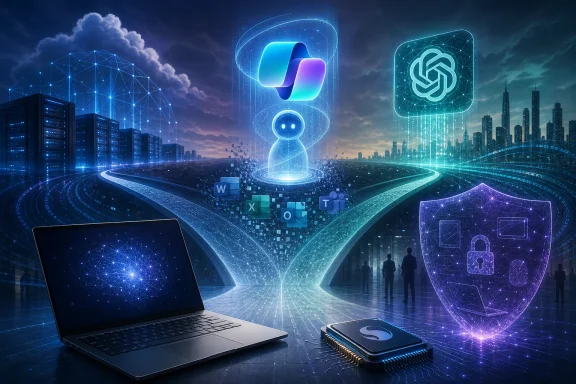 Microsoft’s Model Race Is Really a Timing Crisis
NickTech’s question begins with what sounds like a straightforward competitive concern: can Microsoft develop large language models that are as capable as those already available, and could weaker in-house models drive customers away from Copilot? Thurrott’s answer is more consequential. Microsoft, he notes, “has been working on its own LLMs for years,” so the existence of an internal model program is not the revelation.What changed was the strategic urgency. Microsoft and OpenAI reconfigured their partnership earlier in 2026, giving Microsoft the ability to pursue super-intelligence without OpenAI’s help or involvement. Microsoft’s own description of the amended partnership emphasized greater flexibility for both companies, while coverage from the Associated Press characterized the change as another step toward loosening an alliance that had defined the opening phase of the generative-AI boom.
This matters because Microsoft originally used OpenAI as both an accelerator and a bridge. OpenAI supplied frontier capabilities while Microsoft supplied cloud infrastructure, enterprise distribution, developer tooling, and the applications through which those capabilities could reach paying customers. That arrangement allowed Microsoft to move faster than it could have by building every important model internally.
But a bridge is not the same thing as a permanent foundation. If Copilot remains strategically dependent on a partner that is also building a competing destination for users, Microsoft does not fully control its costs, product roadmap, differentiation, or ultimate relationship with the customer. The partnership can continue to produce value while still becoming insufficient as Microsoft’s long-term operating model.
At Build 2026 in May, Microsoft publicly demonstrated that this transition was already underway by announcing several new top-tier Microsoft AI, or MAI, models. Microsoft AI CEO Mustafa Suleyman framed the work around a more human-centered form of super-intelligence rather than a race toward an abstract, all-purpose AGI milestone. Official Build materials likewise presented Microsoft’s models and Scout personal agent as parts of a broader system, not isolated research demonstrations.
Thurrott believes Microsoft will eventually become competitive because it possesses the essential ingredients: technical expertise, access to massive infrastructure, years of experience using and enhancing OpenAI’s models, and an enterprise customer base large enough to generate demand. The harder question is whether eventually is soon enough.
Model development is not a feature that can be completed in one product cycle. Microsoft AI shipped its first models less than a year before the July 10 column, and getting those models out required a year and a half. Even a company with Microsoft’s capital and datacenter footprint cannot instantly produce a frontier model, validate it, optimize its operating costs, integrate it across products, and convince customers that it is reliable enough for important work.
That delay would be manageable if the target were stationary. It is not. Model rankings change rapidly across coding, reasoning, generation, tool use, latency, and cost, often producing a new market narrative every time a major laboratory ships an update. A model can look competitive in one workload and pedestrian in another, while a highly ranked release can lose its apparent lead before an enterprise has finished evaluating it.
This is why the fixation on a single “best” model can obscure Microsoft’s real objective. It does not need every MAI model to dominate every benchmark every week. It needs a model portfolio that is capable enough, economical enough, and deeply enough integrated that Microsoft customers do not feel compelled to leave the ecosystem to complete ordinary work.
Timeline
Almost three years before July 10, 2026 — Microsoft CEO Satya Nadella described Copilot as “the new Start menu,” signaling that Microsoft already saw AI as a new interaction layer rather than another application.Earlier in 2026 — Microsoft and OpenAI reconfigured their partnership, giving Microsoft room to pursue super-intelligence without OpenAI’s help or involvement.
May 2026 — Microsoft used Build 2026 to announce several top-tier MAI models and introduce Scout, its personal AI agent.
July 9, 2026 — OpenAI combined ChatGPT, Codex, Work, browser capabilities, and its other functions into a broader ChatGPT experience while moving to kill its standalone browser.
July 10, 2026 — Thurrott argued that Microsoft’s ability to build competitive models was likely, but that the company could arrive after the traditional application ecosystem had already begun losing its strategic importance.
“Good Enough” AI Could Be Microsoft’s Most Valuable Model
Microsoft does not necessarily need an undisputed benchmark champion to protect Copilot. Google illustrates why: many Google Workspace customers will use Gemini because it is available where they already work, interoperates with the services they already understand, and appears on an existing bill. Convenience, organizational approval, data access, and procurement simplicity can outweigh marginal differences in benchmark performance.Microsoft has the same advantage on a larger enterprise canvas. Its products already sit inside identity systems, document repositories, email workflows, meetings, security policies, compliance regimes, and purchasing agreements. An organization that has standardized on Microsoft 365 will not casually replace that environment because another model scores better on a reasoning test.
This is the unglamorous power of inertia. If Copilot can summarize the right internal documents, work within organizational permissions, manipulate familiar business data, and satisfy administrative requirements, it may be more useful to a company than a technically superior model that requires another contract, another management layer, and another set of data-governance decisions.
Thurrott is careful not to confuse that advantage with current success. The percentage of Microsoft’s installed base paying for Copilot has reportedly remained small. Microsoft has distribution, but distribution does not guarantee that customers will see enough value to accept an additional charge or redesign established workflows.
The economics may nevertheless improve. Smaller cloud models and on-device models are becoming more capable, reducing the need to send every request through the most expensive frontier system. Microsoft can route work to different models according to complexity, latency, privacy, and cost, reserving its most powerful systems for the tasks that justify them.
That creates room for free or bundled AI that is merely sufficient for routine use. Customers may not actively choose Microsoft’s model over every competitor; they may simply stop shopping because the integrated option works. In enterprise software, the system that clears the reliability threshold and requires the least organizational friction often wins more business than the system with the most impressive demonstration.
Owning more of the model layer also gives Microsoft greater control over margins. If the company can use its own models for a meaningful portion of Copilot activity, it can reduce its reliance on external economics while tuning those models for its applications, cloud, and customer workloads. Cost savings are not incidental when AI usage is continuous and usage-based pricing is becoming more common.
But “good enough” is a floor, not a strategy by itself. If Microsoft’s models are consistently slower, less capable, or less trustworthy, integration becomes a trap rather than an advantage. Customers will tolerate a narrow gap for convenience; they will not tolerate an assistant that routinely fails at the work it was purchased to perform.
The Super-App Turns Microsoft 365 Into Back-End Plumbing
The most important argument in Thurrott’s answer is that Microsoft may be building models to defend a business that AI will fundamentally dismantle. Microsoft 365 is described in the column as Microsoft’s “single biggest business,” yet the logic of agentic AI points away from the familiar Word, Excel, Outlook, and Teams model of computing.Today, users translate intentions into applications. A person decides that a task requires a spreadsheet, a presentation, a document, an email, or several browser tabs, and then manually operates the corresponding tools. Even when Copilot assists, the application generally remains the visible container for the work.
The agentic model reverses that relationship. The user describes the desired result in natural language, and the AI selects tools, gathers data, invokes services, edits files, checks its work, and returns an outcome. The user does not need to know which application produced which intermediate step, just as a cloud customer does not normally care which physical server processed a request.
Word and Excel do not necessarily disappear as technologies in that world. Their formatting engines, calculation systems, file compatibility, automation interfaces, and business rules can survive as services invoked by an agent. What disappears is their privileged position as destinations where users spend the working day.
This distinction is existential for Microsoft. The company’s lock-in has historically been reinforced by documents, workflows, skills, file formats, management tools, and organizational habits tied to its visible applications. If an AI can orchestrate those capabilities without requiring the user to open the applications, then Microsoft 365 becomes infrastructure: valuable, perhaps indispensable, but increasingly hidden and easier to substitute.
OpenAI’s July 9 move makes that future tangible. It was described as combining ChatGPT, Codex, Work, web-browser capabilities, and everything else OpenAI does into one ChatGPT super-app while killing its standalone browser. The packaging may evolve, but the direction is clear: ChatGPT is being positioned as the place where users begin tasks, supervise execution, and receive results.
That is more threatening to Microsoft than another chatbot benchmark. OpenAI does not need to reproduce every Microsoft 365 interface if it can become the interface above Microsoft 365. It can let Microsoft’s services perform parts of the work while capturing the customer’s attention, intent, history, and subscription relationship at the agent layer.
Nadella’s old description of Copilot as the new Start menu looks more prescient in this context. A Start menu is not merely an application; it is a launch point through which users reach the rest of the system. Nearly three years after that comparison, the market is converging on the idea that an AI assistant could become the launch point for nearly every meaningful computing task.
Scout, introduced during the Build 2026 keynote, suggests that Microsoft is pursuing its own version of this model. A personal agent capable of acting across work resources can evolve into Microsoft’s super-app even if the final product carries a different name. Outlook or Teams might initially serve as its visible home, but the long-term ambition is larger than adding a chat pane to existing software.
| Strategic layer | Microsoft’s established position | Microsoft’s emerging position | OpenAI’s direction | Central risk |
|---|---|---|---|---|
| User interface | Windows and Microsoft 365 applications | Copilot and Scout | ChatGPT super-app | Another company controls where work begins |
| Model layer | Heavy use of OpenAI models | Top-tier MAI models developed in-house | OpenAI’s own frontier systems | Microsoft remains dependent or falls behind |
| Work execution | Users operate Word, Excel, Outlook, and other apps | Agents orchestrate tools and services | ChatGPT, Codex, Work, and browser capabilities converge | Applications lose their lock-in value |
| Distribution | Enterprise dominance and existing Microsoft 365 customers | Bundled, on-device, and cloud AI | Direct relationship through ChatGPT | Enterprise inertia weakens as interfaces change |
| Revenue | Microsoft 365 licensing and cloud services | AI consumption, agent access, and evolving subscriptions | Super-app subscriptions and usage | New AI revenue fails to replace Microsoft 365 economics |
This explains the apparent excess of Microsoft’s AI push over the past three years. The company has inserted Copilot into products where customers did not always ask for it, used Windows as a distribution surface, invested heavily in OpenAI, built its own models, and begun developing a personal agent. Those choices can be criticized individually while still following a coherent corporate diagnosis: AI is a do-or-die platform transition for Microsoft.
Microsoft Must Replace More Than an Application Suite
The cloud era diminished Windows without destroying Microsoft because Microsoft 365 benefited from the transition. Desktop software became subscription software; local servers became cloud services; identity, collaboration, storage, and management shifted toward recurring revenue. Microsoft lost some control at the endpoint but gained a larger and more durable commercial relationship in the cloud.The AI transition is less forgiving. If AI assistants abstract away applications and cloud services simultaneously, Microsoft cannot count on shifting revenue from one familiar product category to another. It must establish an agent business capable of producing economics commensurate with Microsoft 365 while paying the enormous infrastructure costs associated with model training and inference.
One possibility is that Microsoft 365 evolves rather than vanishes. The brand could become the commercial wrapper for Copilot, Scout, enterprise data access, governance, and the services agents use behind the scenes. Legacy applications could remain available for specialists and traditional workflows while a growing majority of users interact primarily with an agent.
That would resemble Microsoft’s treatment of older technologies during earlier platform shifts. A mature product rarely disappears on the day its successor arrives. It persists inside compatibility layers, administrative tools, regulated environments, and organizations that have good reasons not to change.
Yet a gradual decline does not remove the revenue problem. If fewer users actively value Word or Excel as products, Microsoft must justify subscriptions through agent capabilities. It must also prevent customers from deciding that their preferred independent AI can call Microsoft’s back-end services only when necessary.
The winning model may therefore be less about possessing the smartest standalone LLM and more about controlling orchestration. Microsoft needs an agent that understands organizational context, respects permissions, chooses models intelligently, invokes Microsoft and third-party tools, and can be managed at enterprise scale. Its in-house models are essential components of that system, but they are not the system by themselves.
This is why Thurrott’s timing concern lands harder than the original reader question. Microsoft can probably produce competitive frontier models. The danger is that it spends years winning model independence only to discover that the decisive contest moved upward—from who supplies the model to who owns the agent, the interface, and the customer.
Windows Still Matters Because the Future Has Not Arrived Evenly
The second major reader exchange appears to change the subject, but it actually describes the bridge Microsoft needs while the AI transition unfolds. Jrzoomer asks why Thurrott continues to use a PC as his primary platform when so much work happens on the web and many important applications run on both Windows and macOS.The obvious explanation would be familiarity after more than 30 years of Windows use, or professional dependence from writing about Microsoft. Thurrott rejects both as the decisive factor. He says he remains on Windows because repeated testing of competing platforms continues to reveal workflow blockers that he does not encounter on Windows.
This is not a claim that Windows is elegant or free from abuse. Thurrott has extensively criticized Microsoft’s degradation of the experience and has documented ways to “de-enshittify” Windows 11. His case is that Windows’ flaws can generally be fixed or worked around without surrendering the platform’s breadth, while rival operating systems impose smaller but irreducible limitations that accumulate during daily use.
That distinction matters more than a conventional feature comparison. Most professional workflows are not defeated by the absence of one spectacular capability. They are degraded by dozens of interruptions: a missing shortcut, an inconsistent windowing behavior, a peripheral that lacks full support, an application that works differently, or a task that suddenly requires the mouse.
Affinity provides Thurrott’s concrete example. On Windows, he can configure Ctrl + E to export an edited image, matching the endpoint of his photo workflow. On the Mac, he cannot configure the equivalent within the application, turning a familiar keyboard-driven operation into a recurring interruption.
Any single example can be dismissed with a utility, script, alternate application, or different habit. Thurrott anticipates that response from a highly technical audience. His argument is not that no workaround exists for anything on the Mac; it is that researching, installing, configuring, and remembering workarounds for a long list of small limitations becomes its own productivity tax—and some limitations cannot be removed.
Window and keyboard behavior reinforce the point. He cites incomplete keyboard navigation, inconsistent third-party applications, Cmd + Tab not exposing every open window in the expected way, varying methods for moving among an application’s windows, inconsistent display modes, full-screen applications becoming separate virtual desktops, and Stage Manager as examples of friction.
Apple’s hardware presents a related constraint: quality within a narrow range rather than breadth across a market. A user seeking the largest Mac laptop display is pushed toward a thick, heavy, expensive 16-inch MacBook Pro or a smaller 15-inch MacBook Air. The PC ecosystem offers more manufacturers, form factors, configurations, and price points.
The absence of Face ID on Macs is another example of Apple’s peculiar product boundaries. Thurrott notes that the only iPad supporting Face ID is the most expensive model. These omissions do not make Apple hardware bad; they illustrate how a tightly controlled product line can leave needs unaddressed even while its individual devices are exceptionally refined.
Windows’ continuing value is therefore breadth under pressure. It can serve ordinary office users, developers, gamers, engineers, creative professionals, enterprises, hobbyists, and specialized hardware customers without forcing all of them into one machine philosophy. That range remains an asset while AI agents are still uneven, applications still matter, and users still need conventional computers to recover when automation fails.
Snapdragon X Gives Windows a Credible Post-x86 Path
Thurrott’s strongest platform preference is not Windows on any hardware. It is Windows 11 on Arm running on Snapdragon X, which he says he prefers above all other operating-system and processor combinations. That judgment separates loyalty to Windows from loyalty to the x86 architecture that historically defined the PC.Apple Silicon demonstrated the benefits of tightly integrated Arm-based computing: strong everyday performance, efficiency, battery life, and reliability. Apple’s unified-memory design contributes to that system, but it also introduces trade-offs. Memory cannot be upgraded after purchase, and the architecture does not offer dedicated graphics in the conventional PC sense.
Snapdragon X narrows the gap by bringing many of the same experiential gains to the broader PC ecosystem. It offers better efficiency, battery life, reliability, and strong day-to-day performance while preserving the Windows environment and greater choice among hardware manufacturers. Snapdragon X2 systems extend that direction rather than reversing it.
Thurrott does not claim Snapdragon X is superior to Apple Silicon in most individual technical categories. His more defensible claim is that it is close enough to change the experience of using a Windows laptop. It reaches the “good enough” threshold while preserving the platform and workflows he considers better.
That phrase connects the hardware argument to the AI argument. Microsoft’s models need not beat every rival everywhere if their integration makes them preferable for Microsoft customers. Snapdragon X need not defeat Apple Silicon in every benchmark if it delivers the efficiency improvements Windows users need without introducing unacceptable workflow compromises.
The caveats remain important. Neither Apple Silicon nor Snapdragon X is the universal choice for gaming, high-end scientific computing, engineering, or every workstation workload. Arm support continues to depend on applications, drivers, peripherals, anti-cheat systems, virtualization requirements, and specialized enterprise software.
For IT departments, the lesson is not to replace every x86 device immediately. It is to stop treating x86 as the automatic default. Snapdragon X and Snapdragon X2 systems should be evaluated against real organizational workloads, especially for employees whose work centers on browsers, Microsoft 365, communication, remote services, and native Arm applications.
Windows on Arm also gives Microsoft an endpoint better suited to its AI strategy. Efficient on-device models can reduce cloud costs, improve responsiveness, and keep some processing local. A platform transition away from power-hungry assumptions could make the PC a more capable participant in agentic computing rather than a passive terminal for cloud services.
GDID Shows the Price of an Invisible Platform
Helix2301’s question about the Microsoft Global Device ID brings the argument back to trust. Reporting around the identifier intensified after court records showed that Microsoft-provided information helped law enforcement connect a Windows device to a hacker accused of attacks involving airlines. Tom’s Hardware and other outlets focused on how a device-level identifier could link activity that users might otherwise assume was difficult to correlate.Thurrott’s first reaction is that GDID is not new. His second is that it resembles fingerprinting, the widespread practice of combining device and software characteristics to recognize users or systems even when conventional tracking controls have been limited.
The distinction between telemetry and GDID is critical. Windows 10 and Windows 11 do not allow users to turn off telemetry entirely, according to Thurrott, and third-party tools such as Win11Debloat can reduce or disable more of it. But he cautions that the Microsoft Global Device ID is not simply another telemetry option that such a utility already blocks.
Several details remain unclear in the source discussion. It is unknown whether the relevant Windows installation had previously been associated with a Microsoft account, whether that account permanently tied the hardware and software combination to a person, or whether the GDID was transmitted whenever the device accessed particular online services. Thurrott suspects the account question may not matter, but he does not present that suspicion as established fact.
The law-enforcement context makes the debate easy to polarize. Few people will object to catching someone who deliberately participated in cyberattacks, but the legitimacy of one outcome does not settle whether a persistent device identifier has appropriate safeguards, disclosures, retention policies, and limits on secondary use.
The core concern is not that Microsoft necessarily created GDID as a secret surveillance backdoor. A stable device identity can support reliability analysis, cloud infrastructure, licensing, fraud prevention, feature continuity, and troubleshooting. The problem is that information gathered for ordinary operational reasons can become surveillance-capable when combined with account records, browsing activity, service logs, or legal demands.
That is the broader lesson of fingerprinting. Intent does not determine capability. A company can build an identifier for product reliability and later discover that the same identifier can connect actions across contexts, while an attacker who compromises the relevant systems may seek the same correlation for malicious purposes.
Microsoft’s historic burden makes transparency especially important. Windows has long attracted suspicions about government access and hidden backdoors, even when those claims are contradicted by evidence and source-code access programs. Ambiguity around GDID gives old fears new material because users cannot assess a system they were never clearly taught to recognize.
The answer is not to pretend that devices can operate without identities or logs. Modern cloud-connected systems require some method of recognizing installations, enforcing entitlements, synchronizing state, diagnosing failures, and combating abuse. The answer is to disclose those mechanisms plainly and give administrators meaningful documentation about what is created, when it is transmitted, what it can be linked to, how long it is retained, and which controls actually affect it.
Action checklist for admins
- Inventory Windows 10 and Windows 11 diagnostic-data policies and confirm that deployed settings match the organization’s documented privacy baseline.
- Treat GDID and ordinary Windows telemetry as separate issues; do not assume a telemetry-reduction tool also blocks or changes the Global Device ID.
- Review where Microsoft accounts and cloud-connected Windows features are permitted, particularly on privileged, investigative, or privacy-sensitive systems.
- Test utilities such as Win11Debloat in a controlled environment before deployment, and document exactly which settings and services they alter.
- Monitor Microsoft’s official documentation and credible security research for clarification on GDID generation, transmission, account linkage, retention, and administrative controls.
- Ensure legal, security, and privacy teams understand that operational device identifiers can become evidence or surveillance mechanisms when correlated with service logs.
The Smaller Answers Expose the Same Economics
The remaining exchanges in the July 10 column look lighter, but they reinforce the tension between user loyalty, product continuity, and commercial survival. Thurrott confirms that the Microsoft Sculpt Ergonomic keyboard and mouse remain his preferred combination, with sets in Pennsylvania and Mexico City. The enduring affection for a discontinued or aging peripheral illustrates how Microsoft can build hardware people genuinely want to keep even as its broader product strategy moves elsewhere.That loyalty is rooted in physical workflow rather than ecosystem branding. A good keyboard disappears during use, just as a good operating system and a good AI assistant should. Microsoft’s strategic challenge is that invisible products can be indispensable without remaining visible enough to defend a premium commercial relationship.
OldITPro2000’s question about Thurrott.com’s Premium paywall brings the economics into the publishing world. The reader reports being able to read at least 90 percent of an article before the fade-out began and nearly 99 percent before seeing the Premium notice, a much more generous preview than before.
The change was intentional. A year or two earlier, Thurrott and Robert increased the amount of Premium text visible outside the paywall after a change in Google’s ranking behavior made heavily restricted posts a visibility problem. The site needed to preserve value for paying readers while exposing enough material for search engines and other indexing systems.
That is a miniature version of Microsoft’s dilemma. Thurrott.com needs a paywall to monetize its most committed audience, but a wall that hides too much reduces discovery and weakens the funnel that creates future subscribers. Microsoft needs proprietary models, applications, and cloud services to monetize its ecosystem, but an ecosystem that is too closed may lose users to agents that promise to work across everything.
Search engines and chatbots complicate the bargain further. Publishers need their work to be visible to systems that can also reduce the need to visit the original site. Software companies need their services to be callable by agents that can also reduce the need to open the original application. In both cases, distribution can become disintermediation.
The column’s running headline jokes—about Ubisoft layoffs after an Assassin’s Creed launch, rumored larger batteries for the iPhone 18 Pro and iPhone 18 Pro Max, scientists rejecting the simulation hypothesis, Cracker Barrel saving itself, and Microsoft fixing an annoying Copilot issue in Outlook—provide the conversational scaffolding. Yet beneath the humor is a consistent theme: mature institutions keep trying to preserve familiar products while the economic and technological context around them changes.
What Microsoft Must Get Right Before Applications Fade
The July 10 answers do not amount to a conventional product forecast. They describe a narrow period in which Windows remains the most flexible desktop platform, Snapdragon X offers it a credible modern hardware foundation, Microsoft 365 still supplies enormous commercial inertia, and AI agents are beginning to make all three advantages less permanent.The immediate implications are concrete:
- Microsoft’s years of internal LLM work are strategically necessary, but model competitiveness alone will not secure the customer relationship.
- The Microsoft–OpenAI partnership can remain valuable even as both companies compete to own the primary AI interface.
- Scout and Copilot must evolve beyond add-ons inside legacy applications if Microsoft intends to counter ChatGPT’s super-app direction.
- Microsoft 365 may survive as agent-accessible infrastructure, but its current application-driven lock-in cannot be assumed to survive with it.
- Windows 11 on Arm and Snapdragon X/X2 provide Microsoft with a stronger endpoint for efficient, on-device, AI-assisted computing.
- GDID demonstrates why Microsoft must pair deeper cloud integration with clearer disclosure and more credible privacy controls.
References
- Primary source: thurrott.com
Published: 2026-07-10T16:20:24.605969
Loading…
www.thurrott.com