

Microsoft's new MAI Superintelligence Team marks a decisive pivot toward building domain-focused, human-centered AI that aims to outperform humans in narrowly defined, high-impact fields while explicitly embedding safety, interpretability, and human oversight into every layer of the stack.
Microsoft announced the formation of the MAI Superintelligence Team as part of its Microsoft AI organization, with Mustafa Suleyman — a co‑founder of DeepMind and former CEO of Inflection AI — at the helm. The stated mission is to pursue what Microsoft calls Humanist Superintelligence (HSI): systems that deliver superhuman capability in specific domains like medical diagnosis, molecular discovery, and energy systems, but always in service of people and constrained by design. Microsoft framed the effort as a long‑term research and engineering investment rather than an open‑ended race for general artificial intelligence. This move follows months of strategic repositioning inside Microsoft AI: the company is simultaneously deepening partnerships with external models while expanding in‑house capacity, hiring aggressively, and scaling GPU clusters large enough to train frontier models. Microsoft leadership positions MAI as the vehicle to combine scale, domain expertise, and safety research in one focused program.
For enterprises, regulators, and technologists, MAI’s emergence signals that the next phase of AI will be less about generalized chatbots and more about domain superpowers — powerful, specialized systems that will demand rigorous oversight, careful integration, and ongoing public scrutiny. The promise is vast; the duty to get it right has never been clearer.
Source: TechJuice Microsoft Forms MAI Superintelligence Team to Build Human-Focused AI Models
 Background
Microsoft announced the formation of the MAI Superintelligence Team as part of its Microsoft AI organization, with Mustafa Suleyman — a co‑founder of DeepMind and former CEO of Inflection AI — at the helm. The stated mission is to pursue what Microsoft calls Humanist Superintelligence (HSI): systems that deliver superhuman capability in specific domains like medical diagnosis, molecular discovery, and energy systems, but always in service of people and constrained by design. Microsoft framed the effort as a long‑term research and engineering investment rather than an open‑ended race for general artificial intelligence. This move follows months of strategic repositioning inside Microsoft AI: the company is simultaneously deepening partnerships with external models while expanding in‑house capacity, hiring aggressively, and scaling GPU clusters large enough to train frontier models. Microsoft leadership positions MAI as the vehicle to combine scale, domain expertise, and safety research in one focused program. What Microsoft Means by “Humanist Superintelligence”
A definition that prioritizes people over capability
Microsoft’s “humanist” label isn’t marketing alone — it reflects a philosophical stance. HSI, as described by Mustafa Suleyman, aims to produce incredibly advanced capabilities that are still problem‑oriented and domain specific, not an unbounded, general intelligence operating with high degrees of autonomy. The team emphasizes:- Human-centered outcomes: AI that augments human decision‑making and expands human capacity.
- Constrained autonomy: Systems designed to operate within explicit limits and oversight.
- Problem-first engineering: Build capabilities targeted at measurable, societally valuable problems (e.g., earlier disease detection, novel molecules, energy optimization).
Why the distinction matters
The distinction between HSI and AGI is consequential for regulators, enterprises, and researchers. HSI lets Microsoft argue that it is not engaged in an open‑ended race to create unconstrained superintelligence; instead, it’s pursuing high‑impact capabilities that can be validated, audited, and governed. That positioning can reduce regulatory friction and appeals to enterprise customers who need tight control, traceability, and risk management.Strategy and Structure: How MAI Is Organized
Leadership and talent plan
Mustafa Suleyman leads the MAI Superintelligence Team, supported by senior scientists and Microsoft AI leadership. The team will combine expertise from Microsoft Research, Azure AI, and global labs, and plans to recruit across disciplines — including computer science, biology, cognitive science, and energy systems. Microsoft has signaled aggressive hiring and collaboration plans with academic institutions, hospitals, and international labs to accelerate prototype validation.Organizational approach
MAI is being built as a concentrated research program nested within Microsoft AI that connects to product groups across Azure, Microsoft 365, and Copilot. The organization structure aims to:- Centralize frontier research and domain specialization.
- Provide a pathway to productize validated models into Azure services and Copilot experiences.
- Maintain strict governance for proprietary model artifacts while publishing key safety research.
Technical Roadmap: What Microsoft Is Investing In
Compute and model scale
Microsoft is scaling its compute footprint aggressively to support in‑house training. Public reporting indicates early experimental clusters and previews (e.g., MAI‑1 preview) trained on very large H100 GPU counts — one report referenced an early cluster size of roughly 15,000 H100 GPUs as a benchmark example of the magnitude Microsoft is already operating at and intends to expand from. Microsoft executives have discussed plans for clusters six to ten times larger than current previews to match or exceed other major lab capacities.Domain specialization and hybrid models
Rather than a single monolithic AGI model, the MAI strategy favors specialized supermodels that combine:- Foundation model backbones tuned for reasoning and long‑context understanding.
- Domain‑specific fine‑tuning (healthcare, molecular simulation, energy systems).
- Interpretability layers and embedded safety checks to produce auditable outputs.
- Human‑in‑the‑loop flows that keep experts in control of final decisions.
Integration stack
Microsoft plans to fold MAI outputs into existing product lines:- Azure for compute, model hosting, and secure enterprise deployments.
- Copilot experiences for knowledge workers and domain specialists.
- Specialized tools for diagnostic assistance, molecular modeling, and grid optimization. Early pilots are expected once validation and compliance frameworks are in place.
Early Use Cases and Timelines
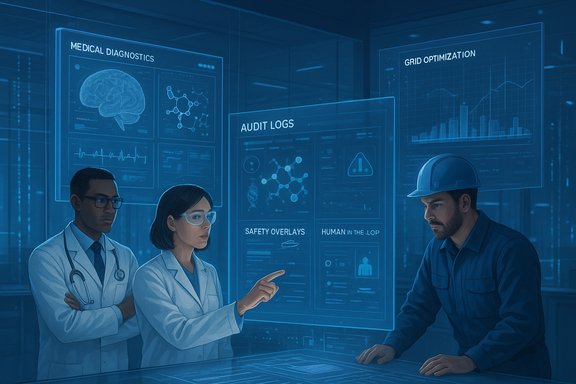
Microsoft highlighted three priority domains for MAI that combine high societal impact and tractable evaluation metrics:- Medical superintelligence: Tools to detect disease earlier and suggest interventions, with a stated belief that the company has a “line of sight” to medical superintelligence in the near term (reports cite timelines such as two to three years for consequential breakthroughs). These efforts aim to extend diagnostic reach and improve early detection across populations.
- Molecular discovery: Accelerating drug discovery and materials science by simulating complex molecular interactions and proposing candidate molecules with improved efficiency over traditional lab cycles. Microsoft positions this work as a sequel to landmark structural biology advances that previously transformed the field.
- Clean energy optimization: Middleware and research models designed to optimize grid behavior, design better batteries, or accelerate materials discovery for renewable generation — areas where highly capable domain models could materially reduce emissions and costs.
Integration with Microsoft’s AI Ecosystem
Dual strategy: build and partner
Microsoft is explicit about pursuing a “best‑of‑both” approach: build proprietary frontier models while maintaining and extending partnerships with external model providers where appropriate. That duality allows Microsoft to:- Productize in‑house models when they deliver unique value.
- Integrate third‑party models into Microsoft 365 and Azure where they outperform internal alternatives.
- Preserve access to OpenAI models while developing independent capabilities.
Product pathways
The MAI program’s outputs are planned to be embedded across:- Azure AI services: As managed, auditable model endpoints for regulated industries.
- Copilot: Specialist copilots for clinicians, researchers, and energy operators that combine domain reasoning with human oversight.
- Enterprise tools: Workflow integrations in Microsoft 365 to improve productivity in highly regulated contexts.
Competitive and Regulatory Context
How MAI compares with peers
Major AI competitors — Meta, Google DeepMind, Anthropic and others — are also advancing projects under the “superintelligence” banner. Microsoft’s distinguishing claim is explicit controllability and domain restriction rather than open‑ended capability growth. That framing is likely strategic: it addresses both enterprise adoption barriers and regulatory scrutiny by foregrounding alignment and safety.Regulatory advantages and risks
Microsoft’s emphasis on alignment, human‑in‑the‑loop design, and transparency is calculated to be attractive to policymakers. Governments tightening AI safety and audit requirements may prefer models that:- Are constrained by design.
- Offer interpretable outputs.
- Can be validated and re‑trained under regulated conditions.
Strengths: Where MAI’s Approach Makes Sense
- Practicality over novelty: Focusing on specific, measurable problems (healthcare, energy, molecules) improves the odds of producing demonstrable benefits and clearer validation metrics.
- Enterprise readiness: Embedding safety, interpretability, and governance into model design aligns with enterprise procurement priorities and regulatory compliance needs.
- Scale and resources: Microsoft’s ability to provision massive GPU clusters, integrate with Azure, and mobilize cross‑disciplinary talent provides a credible platform for ambitious model training and deployment. Reports of thousands of H100 GPUs in early clusters underscore the scale being pursued.
- Collaborative posture: Public commitments to publish safety findings and work with academic and clinical partners strengthen the credibility of the program — provided the commitments are fulfilled in practice.
Risks, Open Questions, and Technical Challenges
Technical uncertainty
Building models that reliably deliver superhuman reasoning in narrow domains is nontrivial. Key technical challenges include:- Robust reasoning: Ensuring models maintain accuracy and calibrated uncertainty across edge cases and distribution shifts.
- Bias mitigation: Producing unbiased datasets and debiasing model behavior in domains where historical data reflects systemic inequities.
- Interpretability: Constructing interpretability layers that provide actionable, auditable explanations for domain experts without oversimplifying model reasoning.
Safety tradeoffs and capability leakage
Suleyman has acknowledged the tension between capability and control: giving up some capability may be necessary to maintain human understanding and control of model behavior. That tradeoff is a design challenge — if too much capability is curtailed, models may fail to achieve transformative results; if too little curtailment is used, oversight may be inadequate. Finding the operational sweet spot is hard, and the path to it is an open research problem.Concentration of power and governance
Concentrating frontier systems in large, well‑resourced firms raises geopolitical and economic questions:- Who decides which problems receive priority and which populations benefit?
- How will Microsoft enforce export controls, model use restrictions, and guard against dual‑use risks?
- What mechanisms will ensure independent verification of safety claims?
Timelines: aspirational vs. verifiable claims
Some statements — such as having a “line of sight” to medical superintelligence within two to three years — are aspirational and hinge on optimistic assumptions about dataset quality, regulatory approvals, and translational challenges. These claims should be treated as tentative until peer‑reviewed results, clinical trials, and independent audits are available. Early timelines must be cross‑checked with domain partners and regulatory milestones.What the Industry and Regulators Should Watch For
- Transparency in safety research: Publishing safety and alignment research, including negative results, will be critical to maintaining trust. Open, third‑party evaluations will help validate Microsoft’s humanist claims.
- Independent audits and red‑teaming: Third‑party stress tests, adversarial evaluations, and red‑teaming of MAI models should be mandated for high‑impact deployments (especially in medicine and critical infrastructure).
- Clear governance frameworks: Microsoft’s internal governance must include external oversight mechanisms to reduce conflicts between proprietary IP protection and public welfare. Regulatory frameworks should specify audit requirements, data provenance standards, and deployment thresholds for high‑risk domains.
- Equitable access: Policymakers should consider mechanisms to ensure that breakthroughs — particularly in healthcare and energy — are accessible beyond the largest health systems and corporations. Global equity must be part of any “humanist” mandate.
Practical Implications for Windows and Enterprise IT Teams
- Prepare for specialist Copilots: Over the next several years, expect domain‑specific copilots (clinical, research, energy operations) to appear in enterprise portfolios. IT teams should plan governance, logging, and integration strategies now.
- Audit and compliance readiness: Enterprises in regulated sectors should update compliance playbooks to include AI audit trails, model change control, and human review checkpoints.
- Invest in data hygiene: The success of domain supermodels depends on high‑quality, well‑curated data. IT organizations must prioritize data lineage, consent management, and bias audits.
- Edge and hybrid deployments: Expect a mix of cloud and hybrid model deployment options. Architectures that enable secure inference at the edge, with robust telemetry back to Azure, will be increasingly important.
Conclusion: Ambition with Accountability — The Only Viable Path
Microsoft’s MAI Superintelligence Team is a significant bet: channeling vast compute, cross‑disciplinary talent, and product integration to achieve specialized superhuman performance while attempting to preserve human judgment, societal benefit, and regulatory compliance. The humanist framing is strategically astute — it addresses market desire for practical, controllable AI and acknowledges the moral stakes of building systems with unprecedented capability. Yet ambition alone is insufficient. The program’s credibility will ultimately be judged by measurable deliverables: peer‑reviewed research, independent audits, clinical validations, and transparent governance mechanisms that demonstrate real benefits without disproportionate concentration of power or unchecked risk. If Microsoft follows through on publishing safety findings, engaging external validators, and designing for equitable access, MAI could become a template for responsible frontier AI. If not, the project risks repeating familiar industry mistakes: exceptional capabilities wrapped in insufficient accountability.For enterprises, regulators, and technologists, MAI’s emergence signals that the next phase of AI will be less about generalized chatbots and more about domain superpowers — powerful, specialized systems that will demand rigorous oversight, careful integration, and ongoing public scrutiny. The promise is vast; the duty to get it right has never been clearer.
Source: TechJuice Microsoft Forms MAI Superintelligence Team to Build Human-Focused AI Models
