

Microsoft is reportedly preparing to wind down most Claude Code licenses inside its Experiences + Devices organization by June 30, 2026, moving developers working on Windows, Microsoft 365, Outlook, Teams, and Surface toward GitHub Copilot CLI instead. The decision looks, on paper, like ordinary platform consolidation. In practice, it exposes the awkward middle phase of Microsoft’s AI strategy: the company wants developers to trust AI coding agents, but not necessarily the ones its own engineers appear to prefer. That tension matters because Microsoft is not merely another customer of these tools; it is trying to sell the future of software development while still negotiating that future internally.
For the last two years, Microsoft’s pitch has been simple enough to fit on a keynote slide: AI will become a native layer of work, and GitHub Copilot will be one of the clearest proofs. Developers were supposed to be the early adopters, the rational technical audience that could validate the product category before it spread to lawyers, accountants, analysts, and everyone else with a keyboard.
That story became more powerful when Satya Nadella said in 2025 that roughly 20 to 30 percent of code in Microsoft repositories was being written by software. Whether that number was a carefully measured productivity statistic or a broader executive signal, it framed Microsoft as a company already living in the future it was selling. The implication was not just that AI could write code, but that Microsoft had operationalized it at scale.
The Claude Code report complicates that narrative. If Microsoft’s own engineering orgs embraced Anthropic’s coding tool so enthusiastically that it began to undercut GitHub Copilot CLI, the story shifts from “Microsoft has cracked AI-assisted development” to “Microsoft is still deciding which AI developer experience actually works.” That is a much less tidy message, but probably a more honest one.
It also shows how quickly developer tooling loyalty can form. Six months is not a long time in enterprise software procurement, but it is an eternity in daily engineering workflow. Once a tool becomes part of how people read repositories, debug failures, draft tests, and move through terminal sessions, taking it away stops looking like license cleanup and starts feeling like a productivity tax.
The problem is that real working conditions have a way of embarrassing strategy decks. Claude Code reportedly became popular among Microsoft employees, including developers, project managers, and designers. That popularity appears to have been especially sensitive because GitHub Copilot CLI was trying to occupy a similar command-line workflow.
This is where the distinction between AI model and AI product becomes important. Developers do not merely choose the model with the best benchmark number. They choose the tool that fits their habits, recovers gracefully from mistakes, understands repository context, runs commands without theatrics, and does not make them feel like unpaid QA for a corporate roadmap.
Microsoft’s public explanation, through Rajesh Jha, is that Claude Code helped the company learn quickly and benchmark real workflows, while Copilot CLI gives Microsoft and GitHub something they can shape directly around internal repositories, workflows, security expectations, and engineering needs. That is a reasonable enterprise argument. It is also the kind of argument executives make when the tool developers like best is not the tool procurement wants standardized.
The revealing phrase is “shape directly.” Microsoft can influence GitHub Copilot CLI in a way it cannot influence Claude Code. It can align features with internal compliance requirements, tune integration with GitHub, manage identity, telemetry, and policy, and build a product story that can be sold back to enterprises. That is strategically coherent. It just does not answer the engineer’s more immediate question: will it help me ship faster tomorrow morning?
That does not make the move cynical. It makes it normal. The uncomfortable part is that AI coding tools are being treated simultaneously as strategic accelerators and ordinary SaaS line items. Microsoft wants the market to believe these systems are transformative, yet internally they are still subject to the same renewal-cycle logic as project management apps and design tools.
There is a lesson here for every CIO being pitched an AI coding assistant this year. The actual cost of these tools is not only the subscription price. It is the cost of retraining habits, rewriting policy, auditing generated code, managing secrets exposure, securing terminal access, and supporting developers when the tool that impressed them in a pilot is not the tool the company ultimately standardizes.
The fiscal-year angle also highlights a subtle conflict in Microsoft’s incentives. If Claude Code makes Microsoft developers more productive but weakens GitHub Copilot CLI’s internal adoption story, Microsoft has to decide which productivity matters more: the immediate output of its engineers or the long-term credibility of its own product platform. In a pure engineering culture, the better tool wins. In a platform company, the tool that advances the platform often gets the second chance.
That is why Microsoft cannot afford for Copilot CLI to be perceived as an also-ran inside its own walls. GitHub is one of Microsoft’s most important developer assets, and Copilot is one of the clearest monetization paths for generative AI beyond consumer chat. If the company’s Windows and Microsoft 365 engineers are widely seen preferring Claude Code, customers will ask the obvious question: why should we standardize on Copilot if Microsoft’s own builders chose something else when given the chance?
The answer Microsoft wants to give is integration. Copilot CLI can be tied to GitHub identity, repositories, enterprise policy, audit controls, and a broader Copilot ecosystem. It can become part of a managed developer platform rather than a standalone coding assistant. For large enterprises, that pitch has real weight.
But integration is not a substitute for trust. Developers forgive rough edges in a tool that saves them time. They resent polish in a tool that slows them down. If Copilot CLI is behind Claude Code in the workflows that matter most, internal migration will not be solved by a memo; it will require Microsoft to close product gaps quickly enough that developers do not mentally classify the change as corporate self-dealing.
This is the difficult part of selling AI to technical workers. They are not impressed by a brand halo for long. They test the tool against the repo, the build system, the bug, and the deadline. The product either earns its slot in the workflow or becomes another background tax of working at a large company.
That matters because the AI coding market has shifted from novelty to agency. Early Copilot-style autocomplete was impressive because it filled in code. The newer race is about systems that can inspect a project, edit multiple files, run tests, interpret failures, and iterate toward a goal. The product frontier has moved from “suggest the next line” to “take a bounded engineering task and make visible progress.”
Microsoft knows this better than most. GitHub Copilot has already expanded far beyond inline suggestions, and Copilot CLI is part of that same evolution. The issue is not whether Microsoft understands the direction of travel. The issue is whether it can move quickly enough when competitors specialize in one sharply defined developer experience.
Anthropic’s advantage, at least in perception, is focus. Claude Code is not carrying the burden of making every Microsoft product feel AI-native. It does not need to reinforce Windows, Office, Teams, Azure, GitHub, and the Copilot brand architecture all at once. It can be judged more narrowly: does it help developers work?
That narrowness can be powerful. Developers often prefer tools that do one thing well over platforms that promise to do everything eventually. Microsoft’s challenge is to make Copilot CLI feel like the former while still serving the latter.
The especially sensitive point is feature disparity. If staffers preferred Claude Code because it was better at the practical work of coding, Microsoft has to treat that as competitive intelligence, not cultural disobedience. Internal adoption is one of the few places where Microsoft can get brutally honest feedback without a customer success layer smoothing the edges.
There is an old pattern in enterprise IT where standardization is presented as simplification but experienced as downgrading. Workers are told that one platform will reduce complexity, improve governance, and centralize support. Those benefits are real. But if the standardized tool is weaker than the tool it replaces, the organization quietly pays the difference in time, morale, and workaround culture.
AI coding tools amplify that effect because they are intimate tools. They sit between the developer and the codebase. They can shape how someone investigates unfamiliar code, how they recover from errors, and how much mental energy they spend on boilerplate. Replacing one is not like changing a video conferencing vendor.
Microsoft has a defensible reason to prefer its own stack. But the company should be careful about the message it sends internally. If developers believe AI adoption means losing the best available tools in favor of strategic alignment, they may become less willing to participate in future pilots. That would be a self-inflicted wound for a company that needs its engineering workforce to be both customer and co-inventor.
The Experiences + Devices group is not a side lab. It includes teams tied to Windows, Microsoft 365, Outlook, Teams, and Surface. These are products with enormous install bases, long compatibility tails, and little room for careless automation. If Microsoft changes the coding assistant used by thousands of people in that organization, the consequences may be invisible when things go well and painfully visible when they do not.
That does not mean Copilot CLI will make Windows worse. It may ultimately improve Microsoft’s internal engineering because it can be tailored to Microsoft’s repositories and security requirements. A deeply integrated, policy-aware coding agent could be safer and more useful inside a company of Microsoft’s scale than a popular external tool.
But the transition period matters. Large codebases are full of local knowledge, legacy assumptions, internal tools, build quirks, and undocumented traps. AI coding agents can help navigate that complexity, but only if developers trust them enough to use them actively and skeptically. A mandated migration that reduces trust can lower the value of the whole AI layer.
For Windows enthusiasts, the broader question is whether Microsoft’s AI-first engineering culture produces better software or simply faster churn. The company has been criticized for pushing AI features into consumer products before their value is obvious. The same concern applies upstream: faster code generation is not the same thing as better product judgment.
From that perspective, Copilot CLI offers Microsoft a cleaner control plane. The company can align it with GitHub, internal policies, security expectations, repository permissions, and auditing. It can decide how data flows, where prompts are processed, what logs are retained, and how agentic actions are constrained. Those details matter more in a company maintaining Windows and Microsoft 365 than they do in a weekend side project.
This is where Microsoft’s internal move may preview broader enterprise behavior. Many companies will experiment with a variety of AI coding tools in 2026, find that developers strongly prefer one or two, and then standardize on another because the security, compliance, procurement, and platform story is easier. The best tool in the hands of an individual developer may not be the tool a regulated enterprise is willing to bless.
Still, governance cannot be used as a magic word. If Microsoft is serious that Copilot CLI better fits its security and engineering needs, it must make that advantage tangible to developers. Policy compliance should feel like guardrails that help teams move faster, not paperwork disguised as product strategy.
The ideal outcome for Microsoft is not merely that Claude Code seats disappear from an expense report. It is that Copilot CLI becomes good enough that developers stop wanting them back. That is a much higher bar.
That makes the Claude Code pullback more interesting. Microsoft is not rejecting Anthropic everywhere. It is deciding that, for a particular internal developer workflow, its own GitHub-branded tool should become the standard. The distinction matters because the future of enterprise AI will not be one model vendor ruling everything; it will be a constant negotiation between capability, cost, control, and distribution.
The reported interest in AI startup acquisitions, including speculation around Cursor, belongs in the same context. Microsoft knows the developer market is moving quickly, and it knows that GitHub Copilot’s early lead is not permanent by divine right. Cursor, Claude Code, OpenAI’s coding tools, Google’s developer products, and smaller agentic platforms are all competing for the same daily habit.
This is why the internal Claude Code episode feels less like a minor licensing decision and more like a live-fire test of Microsoft’s moat. GitHub gives Microsoft distribution. Azure gives it infrastructure. Windows and Microsoft 365 give it scale. But developer affection is earned at the level of latency, context windows, diff quality, test loops, and whether the agent does something dumb with your working tree.
The company can buy, partner, or integrate its way around many gaps. It cannot indefinitely message its way around a product developers do not prefer.
AI coding assistants sit directly at the collision point. They are personal enough for developers to care deeply and powerful enough for companies to regulate heavily. The more capable they become, the less plausible it is to treat them as harmless optional add-ons.
Microsoft’s reported move suggests that the age of casual AI tooling pilots is ending. In 2024 and 2025, many organizations let teams experiment because the category was new and executives wanted learning. In 2026, the question is shifting to which tools become approved, budgeted, monitored, and embedded in official workflows.
That shift will disappoint developers who want the best tool available at any given moment. It will also disappoint vendors hoping that viral adoption alone can overcome enterprise platform gravity. A tool can win hearts and still lose the standardization fight if the buyer decides the platform alternative is safer, cheaper, or strategically cleaner.
The danger for Microsoft is that it trains the market to see Copilot not as the best answer but as the Microsoft answer. That is a subtle but serious distinction. Enterprises buy Microsoft answers all the time, but developers advocate for tools they believe in. Copilot needs both constituencies.
That is exactly what will happen across banks, manufacturers, software vendors, universities, government agencies, and healthcare systems as AI coding agents move from experiments to procurement decisions. The names will change, but the pattern will not. Developers will ask for the tool that works best. Leadership will ask which one is secure, supportable, and aligned with the company’s stack.
Microsoft’s advantage is that it can turn this discomfort into product improvement. If the Copilot CLI team gets direct, unfiltered feedback from Windows and Microsoft 365 engineers who have spent months using Claude Code, it has a rare opportunity. It can identify the missing features, the workflow annoyances, the places where agent behavior falls short, and the exact reasons developers resisted the migration.
The company’s disadvantage is that the market can see the tension. A platform company can survive internal grumbling. It has a harder time if that grumbling confirms what customers already suspect: that the AI branding is ahead of the product experience.
This is why the next few months matter more than the license cancellation itself. If Copilot CLI visibly improves and Microsoft engineers adapt, the June 30 deadline will look like a painful but rational consolidation. If frustration lingers, Claude Code will become the ghost tool in the room, the benchmark everyone remembers when Copilot stumbles.
Source: Windows Central Microsoft is ditching Claude Code for Copilot CLI — but its own devs aren’t happy
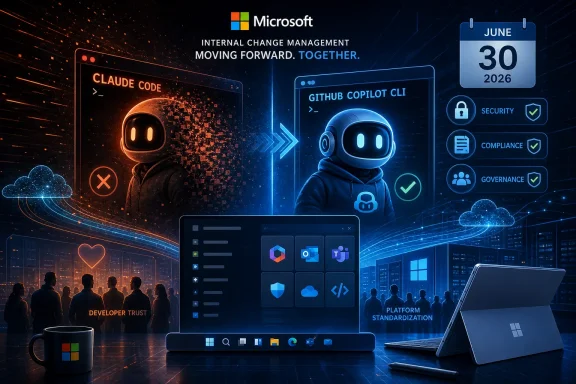 Microsoft’s AI Coding Story Just Hit Its Own Supply Chain Problem
For the last two years, Microsoft’s pitch has been simple enough to fit on a keynote slide: AI will become a native layer of work, and GitHub Copilot will be one of the clearest proofs. Developers were supposed to be the early adopters, the rational technical audience that could validate the product category before it spread to lawyers, accountants, analysts, and everyone else with a keyboard.That story became more powerful when Satya Nadella said in 2025 that roughly 20 to 30 percent of code in Microsoft repositories was being written by software. Whether that number was a carefully measured productivity statistic or a broader executive signal, it framed Microsoft as a company already living in the future it was selling. The implication was not just that AI could write code, but that Microsoft had operationalized it at scale.
The Claude Code report complicates that narrative. If Microsoft’s own engineering orgs embraced Anthropic’s coding tool so enthusiastically that it began to undercut GitHub Copilot CLI, the story shifts from “Microsoft has cracked AI-assisted development” to “Microsoft is still deciding which AI developer experience actually works.” That is a much less tidy message, but probably a more honest one.
It also shows how quickly developer tooling loyalty can form. Six months is not a long time in enterprise software procurement, but it is an eternity in daily engineering workflow. Once a tool becomes part of how people read repositories, debug failures, draft tests, and move through terminal sessions, taking it away stops looking like license cleanup and starts feeling like a productivity tax.
Claude Code Won the Battle Microsoft Thought It Was Hosting
According to the reporting, Microsoft began opening Claude Code access to employees in December, not as a replacement for Copilot but as a benchmark and learning exercise. That was a sensible move. If a company wants to build a serious coding agent, it should compare its own product against the strongest outside tools under real working conditions, not just synthetic demos.The problem is that real working conditions have a way of embarrassing strategy decks. Claude Code reportedly became popular among Microsoft employees, including developers, project managers, and designers. That popularity appears to have been especially sensitive because GitHub Copilot CLI was trying to occupy a similar command-line workflow.
This is where the distinction between AI model and AI product becomes important. Developers do not merely choose the model with the best benchmark number. They choose the tool that fits their habits, recovers gracefully from mistakes, understands repository context, runs commands without theatrics, and does not make them feel like unpaid QA for a corporate roadmap.
Microsoft’s public explanation, through Rajesh Jha, is that Claude Code helped the company learn quickly and benchmark real workflows, while Copilot CLI gives Microsoft and GitHub something they can shape directly around internal repositories, workflows, security expectations, and engineering needs. That is a reasonable enterprise argument. It is also the kind of argument executives make when the tool developers like best is not the tool procurement wants standardized.
The revealing phrase is “shape directly.” Microsoft can influence GitHub Copilot CLI in a way it cannot influence Claude Code. It can align features with internal compliance requirements, tune integration with GitHub, manage identity, telemetry, and policy, and build a product story that can be sold back to enterprises. That is strategically coherent. It just does not answer the engineer’s more immediate question: will it help me ship faster tomorrow morning?
The End of June Is Doing More Work Than Microsoft Wants to Admit
The reported deadline of June 30 is not an incidental calendar detail. Microsoft’s fiscal year ends that day, and large organizations often use fiscal boundaries to clean up software spend, rationalize seat counts, and convert experimental access into official platforms. If Claude Code licenses were expensive, duplicative, or hard to justify at scale, June 30 gives finance and engineering leadership a natural line to draw.That does not make the move cynical. It makes it normal. The uncomfortable part is that AI coding tools are being treated simultaneously as strategic accelerators and ordinary SaaS line items. Microsoft wants the market to believe these systems are transformative, yet internally they are still subject to the same renewal-cycle logic as project management apps and design tools.
There is a lesson here for every CIO being pitched an AI coding assistant this year. The actual cost of these tools is not only the subscription price. It is the cost of retraining habits, rewriting policy, auditing generated code, managing secrets exposure, securing terminal access, and supporting developers when the tool that impressed them in a pilot is not the tool the company ultimately standardizes.
The fiscal-year angle also highlights a subtle conflict in Microsoft’s incentives. If Claude Code makes Microsoft developers more productive but weakens GitHub Copilot CLI’s internal adoption story, Microsoft has to decide which productivity matters more: the immediate output of its engineers or the long-term credibility of its own product platform. In a pure engineering culture, the better tool wins. In a platform company, the tool that advances the platform often gets the second chance.
Copilot CLI Is Not Just a Tool, It Is a Distribution Strategy
GitHub Copilot CLI is important because the terminal is where many serious developers still live. IDE plugins are useful, chat windows are convenient, but the command line remains the control surface for builds, tests, package managers, deployments, scripts, containers, and the low-level reality of software work. A coding agent that works well there has a chance to become more than an autocomplete feature.That is why Microsoft cannot afford for Copilot CLI to be perceived as an also-ran inside its own walls. GitHub is one of Microsoft’s most important developer assets, and Copilot is one of the clearest monetization paths for generative AI beyond consumer chat. If the company’s Windows and Microsoft 365 engineers are widely seen preferring Claude Code, customers will ask the obvious question: why should we standardize on Copilot if Microsoft’s own builders chose something else when given the chance?
The answer Microsoft wants to give is integration. Copilot CLI can be tied to GitHub identity, repositories, enterprise policy, audit controls, and a broader Copilot ecosystem. It can become part of a managed developer platform rather than a standalone coding assistant. For large enterprises, that pitch has real weight.
But integration is not a substitute for trust. Developers forgive rough edges in a tool that saves them time. They resent polish in a tool that slows them down. If Copilot CLI is behind Claude Code in the workflows that matter most, internal migration will not be solved by a memo; it will require Microsoft to close product gaps quickly enough that developers do not mentally classify the change as corporate self-dealing.
This is the difficult part of selling AI to technical workers. They are not impressed by a brand halo for long. They test the tool against the repo, the build system, the bug, and the deadline. The product either earns its slot in the workflow or becomes another background tax of working at a large company.
Anthropic Became the Uncomfortable Benchmark
Claude Code’s rise inside Microsoft also says something about Anthropic’s position in the AI coding market. The tool did not win attention merely because Claude models are good at code. It won because Anthropic packaged those capabilities into a workflow that felt native to how developers already operate: terminal first, repository aware, and willing to act rather than simply suggest.That matters because the AI coding market has shifted from novelty to agency. Early Copilot-style autocomplete was impressive because it filled in code. The newer race is about systems that can inspect a project, edit multiple files, run tests, interpret failures, and iterate toward a goal. The product frontier has moved from “suggest the next line” to “take a bounded engineering task and make visible progress.”
Microsoft knows this better than most. GitHub Copilot has already expanded far beyond inline suggestions, and Copilot CLI is part of that same evolution. The issue is not whether Microsoft understands the direction of travel. The issue is whether it can move quickly enough when competitors specialize in one sharply defined developer experience.
Anthropic’s advantage, at least in perception, is focus. Claude Code is not carrying the burden of making every Microsoft product feel AI-native. It does not need to reinforce Windows, Office, Teams, Azure, GitHub, and the Copilot brand architecture all at once. It can be judged more narrowly: does it help developers work?
That narrowness can be powerful. Developers often prefer tools that do one thing well over platforms that promise to do everything eventually. Microsoft’s challenge is to make Copilot CLI feel like the former while still serving the latter.
The Internal Backlash Is the Product Feedback
Reports that Microsoft developers are unhappy should not be dismissed as ordinary resistance to change. Developer frustration is often the earliest reliable signal that a platform mandate is outrunning the product. When engineers complain about losing a tool, they are usually complaining about lost capability, lost speed, or lost autonomy.The especially sensitive point is feature disparity. If staffers preferred Claude Code because it was better at the practical work of coding, Microsoft has to treat that as competitive intelligence, not cultural disobedience. Internal adoption is one of the few places where Microsoft can get brutally honest feedback without a customer success layer smoothing the edges.
There is an old pattern in enterprise IT where standardization is presented as simplification but experienced as downgrading. Workers are told that one platform will reduce complexity, improve governance, and centralize support. Those benefits are real. But if the standardized tool is weaker than the tool it replaces, the organization quietly pays the difference in time, morale, and workaround culture.
AI coding tools amplify that effect because they are intimate tools. They sit between the developer and the codebase. They can shape how someone investigates unfamiliar code, how they recover from errors, and how much mental energy they spend on boilerplate. Replacing one is not like changing a video conferencing vendor.
Microsoft has a defensible reason to prefer its own stack. But the company should be careful about the message it sends internally. If developers believe AI adoption means losing the best available tools in favor of strategic alignment, they may become less willing to participate in future pilots. That would be a self-inflicted wound for a company that needs its engineering workforce to be both customer and co-inventor.
Windows Users Should Care Because This Is Where Product Quality Begins
At first glance, the dispute sounds remote from ordinary Windows users. Whether a Microsoft engineer writes code with Claude Code or Copilot CLI seems like an internal tooling detail, far removed from Start menu bugs, update reliability, driver regressions, or Microsoft 365 performance. But tooling decisions shape the quality and velocity of the products users eventually receive.The Experiences + Devices group is not a side lab. It includes teams tied to Windows, Microsoft 365, Outlook, Teams, and Surface. These are products with enormous install bases, long compatibility tails, and little room for careless automation. If Microsoft changes the coding assistant used by thousands of people in that organization, the consequences may be invisible when things go well and painfully visible when they do not.
That does not mean Copilot CLI will make Windows worse. It may ultimately improve Microsoft’s internal engineering because it can be tailored to Microsoft’s repositories and security requirements. A deeply integrated, policy-aware coding agent could be safer and more useful inside a company of Microsoft’s scale than a popular external tool.
But the transition period matters. Large codebases are full of local knowledge, legacy assumptions, internal tools, build quirks, and undocumented traps. AI coding agents can help navigate that complexity, but only if developers trust them enough to use them actively and skeptically. A mandated migration that reduces trust can lower the value of the whole AI layer.
For Windows enthusiasts, the broader question is whether Microsoft’s AI-first engineering culture produces better software or simply faster churn. The company has been criticized for pushing AI features into consumer products before their value is obvious. The same concern applies upstream: faster code generation is not the same thing as better product judgment.
Security and Governance Are the Strongest Arguments Microsoft Has
The best version of Microsoft’s case is not brand loyalty. It is governance. AI coding agents touch source code, terminals, local files, dependencies, tests, logs, secrets-adjacent workflows, and sometimes production-adjacent automation. Any large enterprise should be careful about which systems get that level of access.From that perspective, Copilot CLI offers Microsoft a cleaner control plane. The company can align it with GitHub, internal policies, security expectations, repository permissions, and auditing. It can decide how data flows, where prompts are processed, what logs are retained, and how agentic actions are constrained. Those details matter more in a company maintaining Windows and Microsoft 365 than they do in a weekend side project.
This is where Microsoft’s internal move may preview broader enterprise behavior. Many companies will experiment with a variety of AI coding tools in 2026, find that developers strongly prefer one or two, and then standardize on another because the security, compliance, procurement, and platform story is easier. The best tool in the hands of an individual developer may not be the tool a regulated enterprise is willing to bless.
Still, governance cannot be used as a magic word. If Microsoft is serious that Copilot CLI better fits its security and engineering needs, it must make that advantage tangible to developers. Policy compliance should feel like guardrails that help teams move faster, not paperwork disguised as product strategy.
The ideal outcome for Microsoft is not merely that Claude Code seats disappear from an expense report. It is that Copilot CLI becomes good enough that developers stop wanting them back. That is a much higher bar.
The OpenAI Relationship Is No Longer the Whole AI Story
This episode also lands in a market where Microsoft’s AI alliances are more complicated than they used to be. The company remains deeply tied to OpenAI, but it has also shown more interest in multiple models, multiple providers, and more flexible AI infrastructure. Copilot itself has increasingly been framed less as a single-model wrapper and more as a product layer that can route, govern, and integrate AI capabilities.That makes the Claude Code pullback more interesting. Microsoft is not rejecting Anthropic everywhere. It is deciding that, for a particular internal developer workflow, its own GitHub-branded tool should become the standard. The distinction matters because the future of enterprise AI will not be one model vendor ruling everything; it will be a constant negotiation between capability, cost, control, and distribution.
The reported interest in AI startup acquisitions, including speculation around Cursor, belongs in the same context. Microsoft knows the developer market is moving quickly, and it knows that GitHub Copilot’s early lead is not permanent by divine right. Cursor, Claude Code, OpenAI’s coding tools, Google’s developer products, and smaller agentic platforms are all competing for the same daily habit.
This is why the internal Claude Code episode feels less like a minor licensing decision and more like a live-fire test of Microsoft’s moat. GitHub gives Microsoft distribution. Azure gives it infrastructure. Windows and Microsoft 365 give it scale. But developer affection is earned at the level of latency, context windows, diff quality, test loops, and whether the agent does something dumb with your working tree.
The company can buy, partner, or integrate its way around many gaps. It cannot indefinitely message its way around a product developers do not prefer.
The Real Contest Is Between Choice and Standardization
Developer culture has always had a strong bias toward choice. Editors, shells, terminals, package managers, languages, and frameworks are all bound up with identity and productivity. Corporate IT has an equally strong bias toward standardization, especially when tools touch sensitive data or meaningful spend.AI coding assistants sit directly at the collision point. They are personal enough for developers to care deeply and powerful enough for companies to regulate heavily. The more capable they become, the less plausible it is to treat them as harmless optional add-ons.
Microsoft’s reported move suggests that the age of casual AI tooling pilots is ending. In 2024 and 2025, many organizations let teams experiment because the category was new and executives wanted learning. In 2026, the question is shifting to which tools become approved, budgeted, monitored, and embedded in official workflows.
That shift will disappoint developers who want the best tool available at any given moment. It will also disappoint vendors hoping that viral adoption alone can overcome enterprise platform gravity. A tool can win hearts and still lose the standardization fight if the buyer decides the platform alternative is safer, cheaper, or strategically cleaner.
The danger for Microsoft is that it trains the market to see Copilot not as the best answer but as the Microsoft answer. That is a subtle but serious distinction. Enterprises buy Microsoft answers all the time, but developers advocate for tools they believe in. Copilot needs both constituencies.
Microsoft’s Own Engineers Are Now the Customer Case Study
The most useful way to read this story is not as hypocrisy, but as a case study. Microsoft is experiencing the same messy AI adoption cycle it is selling to everyone else. The pilot found enthusiasm. The competitor performed well. Costs became visible. Governance concerns mattered. The platform owner wanted consolidation. Users pushed back.That is exactly what will happen across banks, manufacturers, software vendors, universities, government agencies, and healthcare systems as AI coding agents move from experiments to procurement decisions. The names will change, but the pattern will not. Developers will ask for the tool that works best. Leadership will ask which one is secure, supportable, and aligned with the company’s stack.
Microsoft’s advantage is that it can turn this discomfort into product improvement. If the Copilot CLI team gets direct, unfiltered feedback from Windows and Microsoft 365 engineers who have spent months using Claude Code, it has a rare opportunity. It can identify the missing features, the workflow annoyances, the places where agent behavior falls short, and the exact reasons developers resisted the migration.
The company’s disadvantage is that the market can see the tension. A platform company can survive internal grumbling. It has a harder time if that grumbling confirms what customers already suspect: that the AI branding is ahead of the product experience.
This is why the next few months matter more than the license cancellation itself. If Copilot CLI visibly improves and Microsoft engineers adapt, the June 30 deadline will look like a painful but rational consolidation. If frustration lingers, Claude Code will become the ghost tool in the room, the benchmark everyone remembers when Copilot stumbles.
The June 30 Deadline Turns a Tool Choice Into a Test of Trust
The concrete takeaways are less about one vendor beating another and more about how AI development work is being absorbed into enterprise machinery. Microsoft is trying to convert experimentation into standardization, and that conversion is always where slogans meet cost centers.- Microsoft is reportedly targeting June 30, 2026, to wind down most Claude Code usage in its Experiences + Devices group.
- The affected organization includes teams tied to Windows, Microsoft 365, Outlook, Teams, and Surface.
- Claude Code appears to have gained meaningful internal popularity during a roughly six-month window of access.
- Microsoft’s strongest argument for Copilot CLI is control over integration, security expectations, repository workflows, and product direction.
- The biggest risk is that developers experience the shift as a downgrade rather than a consolidation.
- The outcome will influence how credible GitHub Copilot CLI looks to enterprises making their own AI tooling decisions.
Source: Windows Central Microsoft is ditching Claude Code for Copilot CLI — but its own devs aren’t happy
