

Microsoft’s latest recognition in The Forrester Wave™ for sovereign cloud platforms is more than a bragging right for the Azure team; it is a signal that digital sovereignty has become a first-class cloud requirement, not a niche add-on. For organizations juggling regulation, geopolitics, AI adoption, and operational resilience, the report’s message is clear: the winners will be vendors that can deliver consistent sovereign controls across public cloud, private cloud, and disconnected environments. Microsoft’s own sovereign-cloud messaging now emphasizes exactly that platform-wide approach, spanning Azure, Microsoft 365, security, and AI services.
Sovereign cloud used to be framed as a compliance problem: keep data in-country, satisfy a regulator, and move on. That view is too narrow for 2026. The modern version of sovereignty is about where data lives, who can operate the infrastructure, how keys are controlled, and whether an organization can keep running if legal, political, or connectivity assumptions change. Microsoft has spent the last several years turning that broader definition into a product strategy, not just a policy statement.
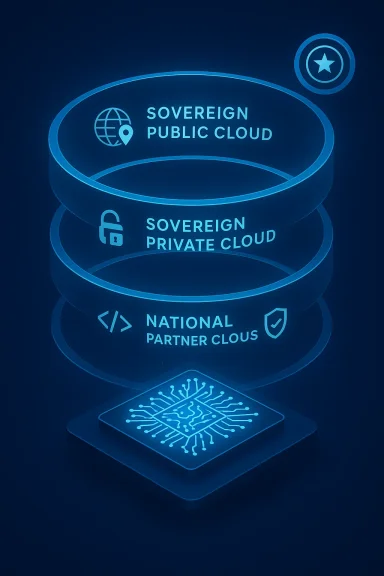
The company’s sovereign cloud story is built on layers. On one end is the Sovereign Public Cloud, which adds controls such as residency, access governance, customer-controlled encryption, and policy-as-code on top of Microsoft’s hyperscale cloud. On another is the Sovereign Private Cloud, built around Azure Local and Microsoft 365 Local for customer-operated or disconnected environments. And in between sits a partner model, including national cloud partnerships such as Bleu and Delos Cloud, where local operators run the infrastructure under sovereign requirements.
That strategy did not appear overnight. Microsoft has repeatedly expanded its European data-residency commitments, completing the EU Data Boundary and positioning it as a foundational sovereignty layer for core cloud services. The company has also stressed that sovereignty is not just for governments; regulated industries, critical infrastructure operators, and multinationals with cross-border legal exposure increasingly want the same controls. The Forrester recognition lands squarely in that context.
What makes this moment noteworthy is timing. In early 2026, Microsoft announced that Azure Local disconnected operations, Microsoft 365 Local disconnected mode, and Foundry Local were being extended to make full-stack cloud and AI workloads possible even in air-gapped environments. That move sharpened the company’s pitch: sovereignty is not only about locking data down, but about preserving modern application and AI capabilities without forcing customers into a false choice between control and innovation.
Forrester’s praise therefore lands in a market that is changing rapidly. Competitors are racing to build sovereign variants, regulators are demanding more local control, and customers are increasingly asking for something more practical than a branding exercise. They want a cloud platform that can scale with policy changes, support AI, and still survive in the real world when networks, borders, and legal regimes get complicated.
Microsoft’s own framing emphasizes a platform approach rather than a single sovereign SKU. The company argues that sovereignty is achieved through a mix of technical controls, operational practices, and contractual commitments applied consistently across deployment models. In other words, the platform has to support the same governance logic whether the workload sits in Azure, in a customer datacenter, or in a nationally operated partner cloud.
That said, leadership in this market is not the same as universality. Sovereign requirements differ wildly across countries and sectors. Some buyers need residency and operator controls; others need disconnected operation; still others need local legal ownership and national partner clouds. Microsoft’s advantage is not that it solves every version of sovereignty perfectly, but that it can offer a menu of sovereignty patterns under one brand and one management model.
Key takeaways from the recognition include:
Microsoft’s own materials acknowledge that most customers do not buy sovereignty as a standalone product. They architect for it over time by combining controls, operational separation, residency guarantees, and local governance. That is a useful admission because it reflects how real-world IT works: organizations do not rip out everything and start over; they layer sovereignty where risk demands it.
That is why the market keeps converging on hybrid and disconnected designs. When Microsoft says sovereignty can be achieved across public and private cloud, and even in partner-operated national clouds, it is responding to a basic reality: one deployment model will not fit every law, regulator, or operational boundary.
The practical consequence is that sovereignty is increasingly judged by whether a vendor can support:
That layered model is clever because it gives customers a migration path. An organization can start with residency controls, then move to private or disconnected options if regulations tighten, or partner with a national cloud operator if sovereignty has to be formally separated from a global hyperscaler’s operating model. Microsoft is effectively telling customers that sovereignty does not have to be a one-way exit from the cloud.
In the private cloud tier, Azure Local and Microsoft 365 Local are the centerpiece. Microsoft says Azure Local provides compute, storage, and networking in customer premises or edge environments, while Microsoft 365 Local can run core productivity workloads within the sovereign boundary, including disconnected scenarios. That is a much stronger sovereignty story than residency alone, because it keeps the operational plane inside the customer’s control.
In national partner clouds, Microsoft points to offerings such as Bleu in France and Delos Cloud in Germany, where infrastructure is independently owned and operated under local requirements. These arrangements matter because some sovereignty buyers are not merely worried about where data sits; they care about who legally and operationally runs the stack.
This is important because fragmentation is the hidden tax of sovereign cloud. If every environment uses different tooling, teams lose speed, security becomes inconsistent, and compliance reporting turns into manual labor. Microsoft’s pitch is that one control plane can cover connected, hybrid, and disconnected environments, which is exactly what sovereignty-conscious customers want to hear.
That consistency also affects developer experience. Teams prefer to build once and deploy across multiple environments with minimal rewrites. If sovereign cloud turns into a separate stack with separate pipelines, adoption will stall. Microsoft’s model lowers that barrier by keeping infrastructure-as-code, GitOps, and policy management in the story from the start.
The operational benefits are straightforward:
That matters because many customers are no longer asking whether they can host data locally. They are asking whether they can run modern AI on sensitive data without pushing it into a generic public model boundary. The answer increasingly has to include local inference, private model hosting, and disconnected AI workflows.
This raises the stakes for competitors. A vendor that can only offer residency or operator separation is fine for legacy sovereignty concerns. But a vendor that can also run AI close to the data, inside the same governance boundary, is positioned for the next generation of regulated workloads. That is where Microsoft’s claim becomes strategically powerful.
At the same time, AI heightens the trust burden. Models can leak data, workloads can be hard to inspect, and the difference between a compliant deployment and a risky one may come down to subtle configuration choices. Sovereign cloud therefore has to become more than a location policy; it has to be a control framework for the AI lifecycle itself.
For enterprises, the calculus is more nuanced. Many large companies are not trying to satisfy a sovereignty doctrine so much as a collection of regulatory and operational constraints across regions. For them, Microsoft’s value is that it offers sovereign controls without forcing a wholesale departure from the broader Microsoft ecosystem.
That dual appeal is a major advantage over point solutions. A sovereign cloud that only works for a small subset of government workloads may be politically useful but commercially limited. A sovereign cloud that extends into collaboration, security, application hosting, and AI becomes part of the enterprise operating system. That is the real prize Microsoft is chasing.
It also explains why Microsoft keeps emphasizing that sovereignty is not isolation. Customers still want global innovation, security updates, and modern application services. The challenge is to keep those benefits while binding them with stronger local control. In that sense, Microsoft’s argument is not anti-cloud at all; it is a new cloud contract for constrained environments.
That creates a difficult benchmark for rivals. If a competitor offers a sovereign region but cannot provide the same developer tooling, productivity integration, and AI runtime support across connected and disconnected modes, it may lose deals to Microsoft even in cases where Microsoft is not the most local or politically convenient provider. The bar is no longer residency alone; it is the whole platform experience.
That does not mean Microsoft is invulnerable. Regulators and customers are still wary of concentration risk, and the same vendor that offers sovereign controls can also become the point of dependency buyers were hoping to avoid. But in practical procurement terms, Microsoft is currently making the strongest case that sovereignty and scale can coexist inside one ecosystem.
Rivals will likely need to answer with:
But Europe is not merely a compliance market. It is a strategic proving ground. If Microsoft can satisfy Europe’s strictest sovereignty expectations while keeping customers on its cloud platform, it gains a template it can export to other regions with their own sovereignty regimes. That is why Europe matters so much to the company’s broader cloud narrative.
This is where the market gets interesting. Europe’s demands often become the baseline for future cloud products elsewhere, because vendors would rather engineer for the toughest market once than build region-specific products forever. Microsoft’s Forrester recognition should therefore be read not just as a current accolade, but as evidence that sovereign cloud is now being industrialized.
And yet the European story also illustrates the tension at the heart of sovereignty. Customers want control, but they do not want to lose access to leading AI, security, and productivity capabilities. Microsoft’s challenge is to keep those capabilities available while ensuring that European regulators and enterprises believe the control boundary is real. That balance will remain fragile.
Microsoft also benefits from a rare combination of hyperscale reach and edge/private-cloud options. Few vendors can plausibly offer residency controls, customer-operated infrastructure, national partner clouds, and AI runtime support inside a single ecosystem. That breadth matters because sovereignty requirements evolve, and buyers want a path that does not force a complete platform reset.
Additional strengths and opportunities include:
A second risk is complexity. Microsoft’s model is attractive because it spans multiple environments, but that breadth can also make procurement, architecture, and compliance harder to reason about. Sovereign cloud only works if the controls are understandable, auditable, and consistently enforced; otherwise, it becomes a layered promise that is difficult to verify in practice.
Other concerns remain significant:
Expect the conversation to sharpen around deployment friction, certification, and real-world workload support. Customers will want to know not just whether a workload can be sovereign, but how much extra work it takes to make it so. The more Microsoft can minimize that overhead, the more defensible its position becomes.
Things worth watching:
Source: Microsoft Azure Microsoft named a Leader in The Forrester Wave™ | Microsoft Azure Blog
 Background
Sovereign cloud used to be framed as a compliance problem: keep data in-country, satisfy a regulator, and move on. That view is too narrow for 2026. The modern version of sovereignty is about where data lives, who can operate the infrastructure, how keys are controlled, and whether an organization can keep running if legal, political, or connectivity assumptions change. Microsoft has spent the last several years turning that broader definition into a product strategy, not just a policy statement.The company’s sovereign cloud story is built on layers. On one end is the Sovereign Public Cloud, which adds controls such as residency, access governance, customer-controlled encryption, and policy-as-code on top of Microsoft’s hyperscale cloud. On another is the Sovereign Private Cloud, built around Azure Local and Microsoft 365 Local for customer-operated or disconnected environments. And in between sits a partner model, including national cloud partnerships such as Bleu and Delos Cloud, where local operators run the infrastructure under sovereign requirements.
That strategy did not appear overnight. Microsoft has repeatedly expanded its European data-residency commitments, completing the EU Data Boundary and positioning it as a foundational sovereignty layer for core cloud services. The company has also stressed that sovereignty is not just for governments; regulated industries, critical infrastructure operators, and multinationals with cross-border legal exposure increasingly want the same controls. The Forrester recognition lands squarely in that context.
What makes this moment noteworthy is timing. In early 2026, Microsoft announced that Azure Local disconnected operations, Microsoft 365 Local disconnected mode, and Foundry Local were being extended to make full-stack cloud and AI workloads possible even in air-gapped environments. That move sharpened the company’s pitch: sovereignty is not only about locking data down, but about preserving modern application and AI capabilities without forcing customers into a false choice between control and innovation.
Forrester’s praise therefore lands in a market that is changing rapidly. Competitors are racing to build sovereign variants, regulators are demanding more local control, and customers are increasingly asking for something more practical than a branding exercise. They want a cloud platform that can scale with policy changes, support AI, and still survive in the real world when networks, borders, and legal regimes get complicated.
What Microsoft Actually Won
The headline says Microsoft was named a Leader, but the more important detail is why. The company’s score, according to Microsoft’s summary of the evaluation, was driven by current offering and strategy. That matters because sovereign-cloud buyers are not shopping for marketing language; they are evaluating whether the vendor has real controls today and a credible roadmap for tomorrow.Microsoft’s own framing emphasizes a platform approach rather than a single sovereign SKU. The company argues that sovereignty is achieved through a mix of technical controls, operational practices, and contractual commitments applied consistently across deployment models. In other words, the platform has to support the same governance logic whether the workload sits in Azure, in a customer datacenter, or in a nationally operated partner cloud.
Why “Leader” Matters More Than It Sounds
Forrester’s terminology can sound ceremonial, but in procurement circles it can shape shortlists. A Leader designation tells CIOs and CISOs that Microsoft is not an outsider trying to bolt sovereignty onto a mainstream cloud stack after the fact. It suggests the company is now considered one of the defining vendors in the category.That said, leadership in this market is not the same as universality. Sovereign requirements differ wildly across countries and sectors. Some buyers need residency and operator controls; others need disconnected operation; still others need local legal ownership and national partner clouds. Microsoft’s advantage is not that it solves every version of sovereignty perfectly, but that it can offer a menu of sovereignty patterns under one brand and one management model.
Key takeaways from the recognition include:
- Microsoft Sovereign Cloud now spans public, private, and partner-operated models.
- The company is positioning sovereignty as a platform capability, not a separate product silo.
- The strategy extends beyond infrastructure into AI, productivity, and security.
- Customers can adopt sovereignty incrementally rather than redesigning everything at once.
Why Sovereignty Has Become Table Stakes
Sovereignty used to be a special-case conversation for defense agencies and a few regulated banks. That has changed because cloud risk itself has changed. Today, an enterprise can face legal exposure from data residency rules, resilience demands from critical operations, and geopolitical sensitivity from cross-border data access all at the same time. The result is that sovereignty has become a strategic cloud planning issue, not a side compliance checklist.Microsoft’s own materials acknowledge that most customers do not buy sovereignty as a standalone product. They architect for it over time by combining controls, operational separation, residency guarantees, and local governance. That is a useful admission because it reflects how real-world IT works: organizations do not rip out everything and start over; they layer sovereignty where risk demands it.
The Real Buyers Are Often Not Who You Think
Public-sector teams are obvious customers, but the bigger commercial story may be regulated private-sector industries. Healthcare providers, energy operators, financial institutions, telecoms, and large multinationals are all coping with overlapping sovereignty demands. They do not necessarily want to abandon hyperscale cloud; they want to make it legally and operationally defensible.That is why the market keeps converging on hybrid and disconnected designs. When Microsoft says sovereignty can be achieved across public and private cloud, and even in partner-operated national clouds, it is responding to a basic reality: one deployment model will not fit every law, regulator, or operational boundary.
The practical consequence is that sovereignty is increasingly judged by whether a vendor can support:
- Data residency without sacrificing service depth.
- Operational autonomy without losing governance.
- AI workloads without breaking local control.
- Disconnected operation when connectivity cannot be assumed.
- Consistent tooling across all those environments.
The Microsoft Sovereign Cloud Stack
Microsoft’s sovereign stack is easier to understand if you view it as three concentric rings. The outer ring is Sovereign Public Cloud, which keeps customers inside Microsoft-operated hyperscale regions while adding local-residency and access controls. The middle ring is Sovereign Private Cloud, anchored by Azure Local and Microsoft 365 Local for customer-controlled or disconnected deployments. The inner ring is National Partner Clouds, where local partners operate sovereign instances on behalf of national markets.That layered model is clever because it gives customers a migration path. An organization can start with residency controls, then move to private or disconnected options if regulations tighten, or partner with a national cloud operator if sovereignty has to be formally separated from a global hyperscaler’s operating model. Microsoft is effectively telling customers that sovereignty does not have to be a one-way exit from the cloud.
Public Cloud, Private Cloud, and National Clouds
In the public cloud tier, Microsoft leans on features such as the EU Data Boundary, customer-managed keys, confidential computing, policy-as-code, and regional residency commitments. The promise is that customers can keep using Azure’s scale and service catalog while reducing who can access what, and from where.In the private cloud tier, Azure Local and Microsoft 365 Local are the centerpiece. Microsoft says Azure Local provides compute, storage, and networking in customer premises or edge environments, while Microsoft 365 Local can run core productivity workloads within the sovereign boundary, including disconnected scenarios. That is a much stronger sovereignty story than residency alone, because it keeps the operational plane inside the customer’s control.
In national partner clouds, Microsoft points to offerings such as Bleu in France and Delos Cloud in Germany, where infrastructure is independently owned and operated under local requirements. These arrangements matter because some sovereignty buyers are not merely worried about where data sits; they care about who legally and operationally runs the stack.
Why Azure Arc and Azure Local Matter
The most interesting part of Microsoft’s sovereign pitch may not be the obvious data-residency language. It is the management consistency story, especially around Azure Arc and Azure Local. These tools let Microsoft extend policy, governance, and deployment patterns into environments that are not classic public cloud. That reduces the operational penalty of sovereignty.This is important because fragmentation is the hidden tax of sovereign cloud. If every environment uses different tooling, teams lose speed, security becomes inconsistent, and compliance reporting turns into manual labor. Microsoft’s pitch is that one control plane can cover connected, hybrid, and disconnected environments, which is exactly what sovereignty-conscious customers want to hear.
Consistency as the Real Product
Forrester specifically called out Microsoft’s container and Kubernetes capabilities, and that is no accident. Kubernetes has become the common abstraction layer for modern applications, so any sovereign cloud platform that cannot support it cleanly risks becoming a niche island rather than a strategic platform. Azure Arc and Azure Local let Microsoft argue that sovereignty does not have to mean giving up cloud-native operations.That consistency also affects developer experience. Teams prefer to build once and deploy across multiple environments with minimal rewrites. If sovereign cloud turns into a separate stack with separate pipelines, adoption will stall. Microsoft’s model lowers that barrier by keeping infrastructure-as-code, GitOps, and policy management in the story from the start.
The operational benefits are straightforward:
- Fewer tooling silos across environments.
- Easier policy enforcement and auditability.
- Better portability between connected and disconnected sites.
- A more familiar developer workflow.
- Less retraining for platform and security teams.
AI Changes the Sovereignty Equation
Sovereignty used to be about storage and access. Now it has to include AI inference, model governance, and the location of computational work itself. Microsoft clearly understands this, which is why its sovereign-cloud messaging now includes AI development and runtime capabilities as part of the platform story.That matters because many customers are no longer asking whether they can host data locally. They are asking whether they can run modern AI on sensitive data without pushing it into a generic public model boundary. The answer increasingly has to include local inference, private model hosting, and disconnected AI workflows.
Sovereign AI Is the Next Procurement Frontier
The February 2026 Microsoft announcement about disconnected operations made this shift explicit. Microsoft said Azure Local disconnected operations, Microsoft 365 Local disconnected mode, and Foundry Local would enable large multimodal models to run inside sovereign, air-gapped environments. That is a major market signal: sovereign cloud is no longer just a governance layer; it is becoming an AI execution environment.This raises the stakes for competitors. A vendor that can only offer residency or operator separation is fine for legacy sovereignty concerns. But a vendor that can also run AI close to the data, inside the same governance boundary, is positioned for the next generation of regulated workloads. That is where Microsoft’s claim becomes strategically powerful.
At the same time, AI heightens the trust burden. Models can leak data, workloads can be hard to inspect, and the difference between a compliant deployment and a risky one may come down to subtle configuration choices. Sovereign cloud therefore has to become more than a location policy; it has to be a control framework for the AI lifecycle itself.
Enterprise Impact Versus Public Sector Impact
For public-sector buyers, sovereign cloud is often about legal certainty and national control. Governments want to know where data resides, who can administer the platform, and whether the cloud can survive policy changes or disconnection. Microsoft’s partner-cloud model and disconnected private-cloud stack are designed to answer exactly those questions.For enterprises, the calculus is more nuanced. Many large companies are not trying to satisfy a sovereignty doctrine so much as a collection of regulatory and operational constraints across regions. For them, Microsoft’s value is that it offers sovereign controls without forcing a wholesale departure from the broader Microsoft ecosystem.
Different Buyers, Different Pain Points
Public-sector organizations tend to prioritize jurisdiction, operator separation, and national resilience. Enterprise buyers are more likely to prioritize business continuity, cloud standardization, and AI-enabled productivity. Microsoft’s platform approach is interesting because it can speak credibly to both groups without changing the basic management model every time.That dual appeal is a major advantage over point solutions. A sovereign cloud that only works for a small subset of government workloads may be politically useful but commercially limited. A sovereign cloud that extends into collaboration, security, application hosting, and AI becomes part of the enterprise operating system. That is the real prize Microsoft is chasing.
It also explains why Microsoft keeps emphasizing that sovereignty is not isolation. Customers still want global innovation, security updates, and modern application services. The challenge is to keep those benefits while binding them with stronger local control. In that sense, Microsoft’s argument is not anti-cloud at all; it is a new cloud contract for constrained environments.
Competitive Implications
Microsoft’s Leader placement puts pressure on every major cloud provider to prove it can do more than localize datacenters. The market is shifting toward sovereign operating models, not just sovereign geography. Vendors will increasingly be judged on how well they can deliver portability, policy, and AI under local governance.That creates a difficult benchmark for rivals. If a competitor offers a sovereign region but cannot provide the same developer tooling, productivity integration, and AI runtime support across connected and disconnected modes, it may lose deals to Microsoft even in cases where Microsoft is not the most local or politically convenient provider. The bar is no longer residency alone; it is the whole platform experience.
The Platform Versus the Patchwork
Some vendors will try to respond with partner alliances, isolated sovereign regions, or sovereign wrappers around existing cloud services. Those approaches can work, but they often feel fragmented. Microsoft’s advantage is that it can present sovereign cloud as a unified extension of Azure, Microsoft 365, security, and AI rather than a separate, awkwardly assembled product family.That does not mean Microsoft is invulnerable. Regulators and customers are still wary of concentration risk, and the same vendor that offers sovereign controls can also become the point of dependency buyers were hoping to avoid. But in practical procurement terms, Microsoft is currently making the strongest case that sovereignty and scale can coexist inside one ecosystem.
Rivals will likely need to answer with:
- Stronger AI support inside sovereign boundaries.
- Better disconnected and edge capabilities.
- Clearer operator-independence guarantees.
- More transparent contractual controls.
- Easier migration between sovereign and non-sovereign environments.
The Role of Europe
Europe is the epicenter of the sovereign-cloud conversation, and Microsoft knows it. The EU Data Boundary, the Microsoft Cloud for Sovereignty program, and the company’s sovereign cloud partnerships all reflect the continent’s intense regulatory and political pressure around data control. Microsoft has also said it completed the EU Data Boundary in February 2025, which gives European customers more precise residency and transparency guarantees across major cloud services.But Europe is not merely a compliance market. It is a strategic proving ground. If Microsoft can satisfy Europe’s strictest sovereignty expectations while keeping customers on its cloud platform, it gains a template it can export to other regions with their own sovereignty regimes. That is why Europe matters so much to the company’s broader cloud narrative.
Why Europe Shapes the Product Roadmap
European policy pressure has already pushed Microsoft to expand residency, transparency, and local control features faster than many expected. It has also forced the company to articulate what sovereignty means in practical terms, from operator access to data handling to regional legal controls. Those definitions now show up across Microsoft’s sovereign cloud docs and marketing.This is where the market gets interesting. Europe’s demands often become the baseline for future cloud products elsewhere, because vendors would rather engineer for the toughest market once than build region-specific products forever. Microsoft’s Forrester recognition should therefore be read not just as a current accolade, but as evidence that sovereign cloud is now being industrialized.
And yet the European story also illustrates the tension at the heart of sovereignty. Customers want control, but they do not want to lose access to leading AI, security, and productivity capabilities. Microsoft’s challenge is to keep those capabilities available while ensuring that European regulators and enterprises believe the control boundary is real. That balance will remain fragile.
Strengths and Opportunities
Microsoft’s sovereign-cloud strategy has several obvious strengths, and the Forrester recognition validates many of them. The most important is that the company is not selling sovereignty as an isolated niche feature; it is embedding it into a broader cloud, productivity, security, and AI platform. That creates room for both immediate compliance wins and longer-term platform expansion.Microsoft also benefits from a rare combination of hyperscale reach and edge/private-cloud options. Few vendors can plausibly offer residency controls, customer-operated infrastructure, national partner clouds, and AI runtime support inside a single ecosystem. That breadth matters because sovereignty requirements evolve, and buyers want a path that does not force a complete platform reset.
Additional strengths and opportunities include:
- Unified control planes that reduce operational fragmentation.
- Azure Arc and Azure Local for hybrid and disconnected operations.
- EU Data Boundary and other residency commitments that build trust.
- AI at the sovereign edge, which expands the category beyond compliance.
- Productivity workloads in sovereign environments, which broaden the addressable market.
- A credible migration path from public cloud to private or partner-operated models.
Risks and Concerns
The biggest risk is that sovereign cloud could become a new name for old vendor lock-in. If customers move deeper into Microsoft’s sovereignty stack, they may gain control over residency and operations but lose flexibility elsewhere. That concern is not theoretical; it is one reason sovereignty-minded buyers scrutinize every proprietary dependency and contractual nuance.A second risk is complexity. Microsoft’s model is attractive because it spans multiple environments, but that breadth can also make procurement, architecture, and compliance harder to reason about. Sovereign cloud only works if the controls are understandable, auditable, and consistently enforced; otherwise, it becomes a layered promise that is difficult to verify in practice.
Other concerns remain significant:
- Regulatory variation can make one-size-fits-most sovereignty claims brittle.
- AI workloads can introduce new governance and leakage risks.
- Disconnected operations raise support and update-management challenges.
- National partner clouds can complicate accountability across jurisdictions.
- Concentration risk remains a live concern for large buyers and regulators.
- The term sovereignty itself can be oversold if buyers assume it means absolute isolation.
What to Watch Next
The next phase of this market will be defined less by announcements and more by execution. The question is whether Microsoft can keep making sovereignty feel like a practical operating model for cloud and AI, rather than a compliance detour. The Forrester recognition gives the company momentum, but customers will judge it by how cleanly the platform handles local control, disconnected use, and AI at scale.Expect the conversation to sharpen around deployment friction, certification, and real-world workload support. Customers will want to know not just whether a workload can be sovereign, but how much extra work it takes to make it so. The more Microsoft can minimize that overhead, the more defensible its position becomes.
Things worth watching:
- New AI-native sovereign services and how quickly they reach production.
- Expansion of disconnected operations beyond early adopters.
- Whether partner-operated national clouds scale outside Europe.
- How competitors respond with their own sovereign control planes.
- Whether enterprises standardize on one sovereignty pattern or keep mixing models.
Source: Microsoft Azure Microsoft named a Leader in The Forrester Wave™ | Microsoft Azure Blog
