

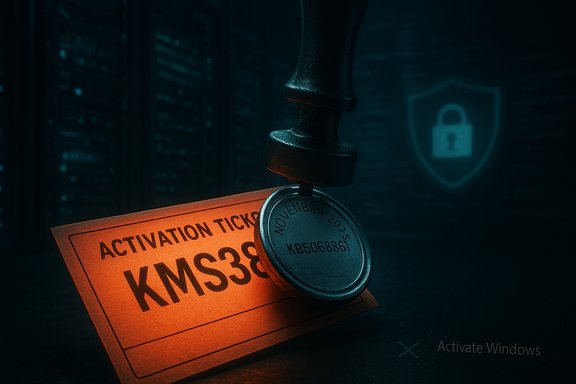
Microsoft’s November cumulative updates closed a long‑standing activation shortcut that many hobbyists and small businesses used to keep Windows and Office running without a legitimate license, and the change — centered on KB5068861 and companion updates — has already forced users in Spain and elsewhere to confront unactivated systems, altered deployment pipelines, and renewed licensing decisions.
Windows activation has always split into two legitimate threads and a persistent gray market. On the enterprise side, KMS (Key Management Service) and volume licensing provide lease‑style activations intended for managed fleets. On the consumer side, retail and OEM keys tie a device to a license. Separately, community projects and gray‑market sellers supplied techniques and low‑cost keys that let many users run fully patched Windows without paying full retail prices.
One such technique, widely known as KMS38, exploited upgrade and migration tooling to create or carry a crafted “GenuineTicket” that made Windows treat a machine as if it had an extended KMS lease — effectively pushing activation out to the Unix 2038 timestamp boundary. Community activator projects such as MAS (Microsoft Activation Scripts / Massgrave) packaged KMS38 in an easy‑to‑use script, making it accessible to a broad audience. MAS’s own documentation describes KMS38 as an offline method that does not leave obvious long‑running services on the system. In November 2025 Microsoft shipped a cumulative set of changes (packaged under KB5068861 for Windows 11 and accompanied by matching rollups for Windows 10) that folded in prior preview fixes and servicing‑stack adjustments. Those changes altered the upgrade helpers and servicing flows that KMS38 depended on, and the practical effect was immediate: KMS38‑activated systems updated with the November rollups began to lose activation, and MAS maintainers removed the KMS38 option from active releases.
Put simply: removing a widely abused upgrade‑time shortcut reduces an attack surface and the risk of trojanized activators — a benefit to the broader user base and corporate customers. Independent commentators who examined the change framed it as a defensible hardening step that nevertheless imposes short‑term pain on users who relied on illicit workarounds.
For defenders and administrators, the right operational posture is to assume that any dependency on an undocumented internal detail is temporary — plan, test, and move to supported licensing models. Security teams should monitor distribution channels for repackaged activators immediately after servicing changes; such mirrors are prime vectors for trojanized packages.
Conclusion
Microsoft’s November servicing changes closed a major activation loophole and provoked an immediate ripple through the activation‑circumvention community and corporate procurement practices, especially in markets like Spain where enforcement and previous legal cases underscore the risks of unlicensed software. The fix strengthens platform integrity, but it also highlights an enduring truth for IT professionals and end users alike: shortcuts that rely on undocumented internals are ephemeral, and the operational, security, and legal costs of depending on them can be severe. Audit your estate, reclaim control of your images, and move licensing into documented, supported channels.
Source: russpain.com Microsoft closes loophole: Spanish users face new restrictions on license bypass
 Background / Overview
Windows activation has always split into two legitimate threads and a persistent gray market. On the enterprise side, KMS (Key Management Service) and volume licensing provide lease‑style activations intended for managed fleets. On the consumer side, retail and OEM keys tie a device to a license. Separately, community projects and gray‑market sellers supplied techniques and low‑cost keys that let many users run fully patched Windows without paying full retail prices.One such technique, widely known as KMS38, exploited upgrade and migration tooling to create or carry a crafted “GenuineTicket” that made Windows treat a machine as if it had an extended KMS lease — effectively pushing activation out to the Unix 2038 timestamp boundary. Community activator projects such as MAS (Microsoft Activation Scripts / Massgrave) packaged KMS38 in an easy‑to‑use script, making it accessible to a broad audience. MAS’s own documentation describes KMS38 as an offline method that does not leave obvious long‑running services on the system. In November 2025 Microsoft shipped a cumulative set of changes (packaged under KB5068861 for Windows 11 and accompanied by matching rollups for Windows 10) that folded in prior preview fixes and servicing‑stack adjustments. Those changes altered the upgrade helpers and servicing flows that KMS38 depended on, and the practical effect was immediate: KMS38‑activated systems updated with the November rollups began to lose activation, and MAS maintainers removed the KMS38 option from active releases.
What KMS38 actually did — a short technical primer
The pieces KMS38 relied on
- gatherosstate.exe and upgrade helpers — historically used by Windows setup to collect activation and eligibility state during an upgrade or repair. KMS38 manipulated the way these helpers produced or accepted a GenuineTicket.
- SPP (Software Protection Platform) — the OS component that consumes activation state and enforces license rules. KMS38 relied on upgrade flows to hand a crafted artifact to SPP in a way that SPP accepted as a long‑lasting activation lease.
Why it worked — and why it was brittle
KMS38 worked because it abused an internal migration pathway that was meant for legitimate upgrade scenarios. It was inherently brittle because it depended on implementation details of the servicing stack and setup helpers — the very details Microsoft can and does change during routine servicing. That brittleness is exactly why the November 2025 cumulative changes rendered the trick ineffective: when upgrade helpers stop performing the same operations or file manifests change inside install images, the crafted tickets are no longer processed the same way.The November 2025 rollups: what Microsoft changed
Microsoft’s official KB for the November 11, 2025 cumulative rollup documents a broad set of fixes and non‑security changes folded into KB5068861 (and parallel KBs for other SKUs). Among typical servicing‑stack and setup improvements were adjustments to components used in upgrade and imaging flows — the same surface KMS38 manipulated. Microsoft’s KBs list file manifests and explain that the November packages include prior preview content; the community analysis shows that those accumulated changes are what prevented KMS38 from functioning on updated systems. Independent coverage and community research confirm the practical outcome: after the November updates, KMS38 no longer behaves as it did, and Massgrave/MAS maintainers removed the KMS38 option from the mainstream script, directing users toward alternative — and riskier — methods.Immediate effects on users and organizations
Home users and hobbyists
- Many casual users who relied on KMS38 saw their PCs revert to an unactivated state after applying the November cumulative updates. That manifests as personalization restrictions, “Activate Windows” watermarks, and reduced ability to change some system settings. Reports across community forums and tech press show that reinstalling or re‑running the now‑retired KMS38 routine no longer restores activation on fully updated systems.
- Some in the community quickly migrated to other methods still circulating — notably HWID (a hardware‑bound digital license technique) and TSforge/TSforge‑style hacks — but those carry equal or greater security and legal risk, and history shows they are themselves temporary. The maintainers of MAS explicitly adjusted the project to remove KMS38 support.
IT teams and imaging/deployment pipelines
- Imaging pipelines and offline deploys that relied on carry‑over behavior must be audited. An image or install media that predates the servicing change may behave differently from an updated image, and remedial in‑place repairs or feature updates can reset any engineered grace period.
- Security teams should treat endpoints that ran activators with suspicion. Activators require elevated privileges and often pull code or binaries from untrusted mirrors — a classic vector for trojanization. Many security advisories and community threads recommend reimaging endpoints that had third‑party activation scripts run against them.
Spanish businesses — compliance, audits, and potential penalties
The russpain coverage highlighting the Spanish market impact is consistent with what compliance officers already know: businesses that rely on unlicensed software expose themselves to audits, civil and (in some cases) criminal liability, and substantial fines. Spain’s legal framework includes criminal offences and civil remedies for intellectual property violations; recent cases show Spanish courts imposing significant penalties on firms that used pirated software, and legal practitioners have documented multimillion‑euro civil claims and large fines in prominent cases. For Spanish organizations, an audit by a rights holder or authorities that finds unlicensed software could trigger financial and reputational consequences. It’s important to be precise: the exact fine or sanction depends on the facts — scale, intention, commercial benefit, and whether the infringement is prosecuted civilly or criminally. Nonetheless, the risk profile is real and meaningful for companies operating inside Spain.Why Microsoft acted — and the security argument
Vendor control over activation is not just an income stream; it’s a surface Microsoft can harden to reduce abuse and supply‑chain risk. Activation helpers used in upgrade scenarios are attractive to attackers because they run with high privileges and touch protected stores. Closing an unintended path that allowed forged activation artifacts to be accepted reduces opportunities for persistent, stealthy modifications that attackers might repurpose.Put simply: removing a widely abused upgrade‑time shortcut reduces an attack surface and the risk of trojanized activators — a benefit to the broader user base and corporate customers. Independent commentators who examined the change framed it as a defensible hardening step that nevertheless imposes short‑term pain on users who relied on illicit workarounds.
Strengths and risks of Microsoft’s approach — balanced analysis
Strengths
- Security hardening: Closing the upgrade‑time ticket carryover removes a class of abuse that could hide crafted artifacts inside legitimate flows.
- Operational predictability: Enterprises and imaging teams benefit when servicing and activation behave predictably across updates.
- Reduced supply‑chain exposure: Community activators are frequently repackaged with malware; removing the easy activation route reduces that incentive.
Risks and downsides
- Collateral pain for home users: Hobbyists and cash‑strapped users who used the shortcut now face a choice: buy a legitimate key, accept reduced functionality, or seek other risky alternatives.
- Drive to riskier alternatives: As one easy trick closes, some users will chase new hacks (HWID, TSforge or repackaged scripts) that may be even more dangerous.
- Perception and migration pressure: Heavier enforcement may accelerate migration to alternative OSes for certain user segments who view licensing enforcement as punitive.
The market for cheap licenses — context and cautions
The russpain piece argues that official OEM and retail license prices have become more accessible, reducing incentives to pirate. That is partially true in the sense that a variety of legitimate, lower‑price licensing avenues exist (education discounts, refurbished device bundles, authorized reseller promotions), and third‑party marketplaces sell budget‑priced keys (often OEM or gray‑market). However, major vendor guidance and community experts repeatedly warn against buying suspiciously cheap keys from unauthorized marketplaces: such keys may be region‑locked, recycled volume keys, or outright stolen, and Microsoft can and does revoke keys that were obtained improperly. Microsoft’s own community pages and Q&A caution users that OEM keys are intended for system builders and that very low prices are a red flag. Practical reality: low prices are available, but they come with tradeoffs. For organizations, procurement from authorized channels and volume licensing remains the only robust, audit‑safe strategy. For individuals, reputable stores, student offers, or device bundles are safer than anonymous discount key marketplaces.Practical remediation and recommended actions
For administrators, IT pros, and conscientious home users, the path forward is pragmatic and short‑term focused.- Audit activation and update status now.
- Check Settings > System > Activation or run slmgr /xpr to confirm legal activation state. If KB5068861 or the November cumulative is installed and activation has changed, treat that as a signal to investigate. Community guidance highlights these exact checks as first steps.
- Inventory devices that have had third‑party activators run.
- If a device had an activator executed with elevated privileges, assume possible compromise: scheduled tasks, installed services, or altered system files may persist. Many security professionals advise reimaging such systems from a known good image rather than trying to “undo” activator changes.
- Stop relying on fragile workarounds in production images.
- Rebuild offline images from official Microsoft ISOs, test feature updates in a lab, and apply the servicing‑stack and cumulative updates in the documented order. Microsoft’s client image releases and file manifests are the authoritative artifacts when validating what an image contains.
- Acquire legitimate licenses for production fleets.
- For businesses, engage volume licensing or authorized Microsoft partners; for small offices, consider OEM or retail purchases through trusted vendors. While gray‑market keys can look inexpensive, they expose organizations to audit risk and potential deactivation.
- If you’re constrained by budget, evaluate alternatives legitimately.
- Options include Windows 10 with supported ESU paths (where available), Chromebooks/ChromeOS Flex for constrained web‑centric deployments, or modern Linux distributions for desktop workflows where compatibility permits. Each choice has tradeoffs; document them and align with security policy.
Spain: special considerations for audits and legal exposure
Spanish law provides both civil and criminal remedies for intellectual property violations, and Spanish courts have previously imposed substantial fines and, in some cases, custodial sentences for IP infringement involving software. Corporate penalties and remedial damages can be significant, and Spanish enforcement bodies — in cooperation with rights‑holder organizations — have pursued large cases in the past. The practical takeaway for Spanish organizations is straightforward: the November updates make continuing to depend on an activation shortcut an operational liability in the event of any future audit. Companies should document remediation steps, present procurement records, and treat any endpoint that had activator tools executed as a potential compromise requiring forensic attention or reimaging. Doing so preserves defensibility during audits and reduces regulatory and contractual risk.What to expect next — the cat‑and‑mouse reality
The activation ecosystem has historically been a back‑and‑forth between vendor hardening and community research. Closing KMS38 is not a final victory; maintainers and forks will seek new edges (and some will find them). Microsoft will continue hardening the servicing and activation surfaces and may use telemetry‑driven staged rollouts and server‑side validation to reduce further abuse.For defenders and administrators, the right operational posture is to assume that any dependency on an undocumented internal detail is temporary — plan, test, and move to supported licensing models. Security teams should monitor distribution channels for repackaged activators immediately after servicing changes; such mirrors are prime vectors for trojanized packages.
Final assessment and practical verdict
Microsoft’s November 2025 cumulative updates (including KB5068861 and related rollups) delivered a measurable and intentional hardening that closed a widely abused offline activation shortcut. That outcome improves the security posture of the platform and reduces an easily‑exploitable supply‑chain vector. It also imposes real short‑term costs on users and organizations that previously relied on the trick. Businesses in Spain face a practical imperative: audit, remediate, and align licensing with procurement records to limit exposure during audits and to avoid the legal and financial consequences documented in recent Spanish enforcement actions. For individuals, the sensible path is to choose legitimate channels for licenses or to migrate to an alternative OS if licensing costs are prohibitive. For administrators, treat devices that ran activators as potential security incidents and rebuild them from known‑good images. The cat‑and‑mouse will continue, but the durable strategy — compliant licensing, good procurement practices, and robust update testing — is the only sustainable defense against future shocks.Conclusion
Microsoft’s November servicing changes closed a major activation loophole and provoked an immediate ripple through the activation‑circumvention community and corporate procurement practices, especially in markets like Spain where enforcement and previous legal cases underscore the risks of unlicensed software. The fix strengthens platform integrity, but it also highlights an enduring truth for IT professionals and end users alike: shortcuts that rely on undocumented internals are ephemeral, and the operational, security, and legal costs of depending on them can be severe. Audit your estate, reclaim control of your images, and move licensing into documented, supported channels.
Source: russpain.com Microsoft closes loophole: Spanish users face new restrictions on license bypass
