

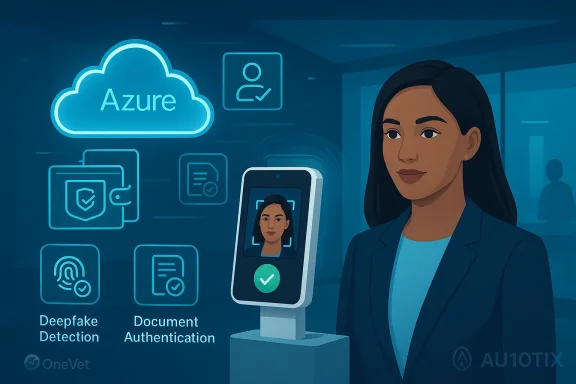
Microsoft’s internal partner-vetting platform OneVet has cut fake account openings by an astonishing figure that — while company-reported and requiring independent audit — signals a notable advance in how large cloud platforms combine biometric identity verification, deepfake detection, and verifiable credentials to harden onboarding and partner access. The result of a strategic integration between Microsoft and identity verification specialist Au10tix, the deployment replaces many manual and document-only flows with an automated, cryptographically-backed verification path running on Azure and tied into Microsoft Entra Verified ID.
Microsoft has been moving decisively toward reusable digital identity and Verifiable Credentials (VCs) as the backbone for secure, privacy-forward authentication and onboarding. Entra Verified ID added standard support for Decentralized Identifiers (DIDs) and VCs to the Microsoft ecosystem, enabling issuers to create credentials that relying parties can verify without having to re-run heavy identity proofing each time.
Au10tix — a veteran identity verification (IDV) vendor with biometric and document verification capabilities — was added to Microsoft’s identity partner portfolio and is now listed among the IDV partners available through Microsoft’s Security Store. That positioning allows Microsoft services to consume Au10tix verification as an issuer of reusable credentials, and to bind verification outcomes into cryptographically-signed VCs that live in users’ wallets (for example, Microsoft Authenticator) for later reuse.
The immediate, pragmatic application highlighted by the vendors is partner account validation inside OneVet — Microsoft’s internal platform for vetting ISVs, connectors, agents, and other third-party partners that seek access to sensitive programs, data or distribution channels within Partner Center and other Microsoft ecosystems. OneVet sits in the partner onboarding and certification path to reduce fraud, manual reviews and stalled certifications.
A few important caveats for technical readers and risk teams:
For IT architects, security leaders, and platform owners, the lesson is clear: reusable, standards-based credentials combined with advanced synthetic-media defenses materially strengthen onboarding and partner-vetting programs. The practical challenge ahead is to integrate these capabilities responsibly — balancing automation with fairness, privacy with operational needs, and innovation with verifiable evidence. As verification technology and adversary techniques both evolve, the organizations that pair strong technical controls with rigorous governance will be best positioned to keep trust intact across partner ecosystems.
Source: Biometric Update Au10tix IDV, deepfake detection helps Microsoft improve internal partner validation | Biometric Update
 Background
Microsoft has been moving decisively toward reusable digital identity and Verifiable Credentials (VCs) as the backbone for secure, privacy-forward authentication and onboarding. Entra Verified ID added standard support for Decentralized Identifiers (DIDs) and VCs to the Microsoft ecosystem, enabling issuers to create credentials that relying parties can verify without having to re-run heavy identity proofing each time.Au10tix — a veteran identity verification (IDV) vendor with biometric and document verification capabilities — was added to Microsoft’s identity partner portfolio and is now listed among the IDV partners available through Microsoft’s Security Store. That positioning allows Microsoft services to consume Au10tix verification as an issuer of reusable credentials, and to bind verification outcomes into cryptographically-signed VCs that live in users’ wallets (for example, Microsoft Authenticator) for later reuse.
The immediate, pragmatic application highlighted by the vendors is partner account validation inside OneVet — Microsoft’s internal platform for vetting ISVs, connectors, agents, and other third-party partners that seek access to sensitive programs, data or distribution channels within Partner Center and other Microsoft ecosystems. OneVet sits in the partner onboarding and certification path to reduce fraud, manual reviews and stalled certifications.
What changed: Au10tix + Entra Verified ID + OneVet
The integration is built from three stacked components:- Automated identity proofing and biometric checks: Au10tix performs document authentication, face biometric matching, and deepfake and synthetic-media detection as part of a single verification transaction. These services distinguish genuine selfie biometrics from manipulated or AI-synthesized images and video.
- Reusable Verifiable Credentials (VCs): Once identity proofing succeeds, the verification results are issued as cryptographic VCs using Microsoft Entra Verified ID standards. These credentials are signed by the issuer and stored in the user’s credential wallet for future re-use.
- Platform orchestration and policy enforcement: OneVet consumes the VCs and ties them into business workflow rules for partner onboarding, gating actions, and automated certification steps. The verification processes run on Microsoft Azure infrastructure to keep latency low and integration friction minimal.
The headline result — and how to read it
Au10tix and Microsoft report a major drop in fake account creation after the integration: a reduction figure widely quoted in vendor and trade reporting. This claimed reduction was achieved by replacing legacy manual or document-only checks with Au10tix’s combination of biometric checks, deepfake detection, and global document coverage, then issuing reusable VCs for future checks.A few important caveats for technical readers and risk teams:
- The reduction figure is described in vendor communications; it is company-reported and has not been accompanied by a detailed third-party audit in the public domain. Treat the percentage as a strong operational indicator rather than an independently verified fact until external metrics are published.
- Even with significant reductions, no verification system is flawless: deployment context (volume, attacker sophistication, regional document variations) influences outcomes. Organizations must evaluate performance against their own threat models and sample populations.
Technical anatomy: what’s doing the heavy lifting
Deepfake and synthetic fraud detection
Deepfake detection is now a required component where biometric checks are used for account creation or recovery. In practice, this means:- Detection engines analyze facial motion, texture consistency, lighting, and biological micro-metrics across frames to flag synthetic content.
- Multi-modal checks combine static document inspection with live selfie capture and liveness (challenge-response or passive) to detect mismatches.
- Specialized models for voice and video are increasingly paired with image checks for call-center or voice-onboarding scenarios.
Biometric binding and liveness
A critical step for reusable credentials is binding the credential to the individual, typically by linking biometric confirmation (selfie + liveness) to the VC at issuance. This prevents credential replay by an attacker who later replays a screenshot or a stored token. The binding can be implemented in ways that limit biometric data exposure:- Storing only biometric templates or hashes rather than raw images.
- Using biometric matching on the verifier side with privacy-preserving measures, or on-device checks where the biometric material never leaves the client device.
- Verifier policies that require periodic reproofing for high-risk operations.
Verifiable Credentials and cryptography
VCs issued by Au10tix within Microsoft’s Entra framework carry cryptographic signatures proving that the issuer attested to the underlying claims. Key technical benefits:- Non-repudiation: The issuer’s signature proves who performed the verification and when.
- Selective disclosure: VC architectures enable sharing of specific attributes (e.g., “business verified”) without revealing full identity details.
- Replay resistance: Credential schemas and proof mechanisms can be configured to prevent simple replay attacks.
Cloud-native orchestration on Azure
Running identity-proofing workloads on Azure brings advantages such as low-latency integration to Microsoft services, scalable document processing, and easier compliance alignment for Microsoft internal platforms. It also raises operational considerations around data residency, encryption-at-rest, and managed key lifecycles.Why this matters for enterprise security and partner onboarding
- Faster, lower-cost vetting: Automated proofing removes large portions of manual review and support queries, shrinking certification cycles and operational overhead.
- Stronger fraud resilience: Combining multi-factor evidence — document authenticity, liveness, deepfake detection and cryptographic VCs — raises the bar for attackers seeking to create fraudulent partner accounts or enroll malicious connectors.
- Better user experience for legitimate partners: Reusable VCs mean partners do not have to resubmit documents repeatedly, shortening repetitive workflows and reducing drop-off.
- Auditability and compliance: Cryptographically-signed credentials and standardized VC formats simplify audit trails and can help meet regulatory KYC or supply-chain verification requirements.
Privacy, data protection, and compliance considerations
Adopting biometric-backed verification and reusable credentials brings specific privacy obligations and design choices. Thoughtful implementation can mitigate many concerns:- Data minimization: Issue credentials that carry only the necessary claims. Where possible, rely on attribute attestations (“entity verified”) instead of storing full identity documents.
- Biometric handling: Avoid storing raw biometric images in centralized services. Prefer templates, on-device storage, or privacy-preserving cryptographic bindings.
- Credential revocation and expiry: VCs must have clear revocation semantics; revoked or expired credentials should be reliably rejected by verifiers to prevent stale attestations being reused.
- Consent and transparency: Partners and users must be clearly informed how verification data is used, stored, and shared. Retention policies should be explicit and enforced.
- Regulatory alignment: Different geographies impose varying requirements (GDPR, CCPA, sectoral KYC/AML rules). Vendors and deployers must confirm residency, processing agreements, and international data transfer mechanisms.
Risks, blind spots, and operational trade-offs
While integrated IDV + VC systems greatly reduce some fraud vectors, they introduce new risk trade-offs:- False positives and accessibility: Aggressive anti-spoofing can reject legitimate applicants (e.g., due to poor-quality cameras, assistive devices, or atypical biometric features). This can disproportionately affect smaller partners or applicants in low-bandwidth regions.
- Model bias and fairness: Biometric matchers and deepfake detectors must be validated across demographics. Unaddressed bias can lead to systematic denials or privacy harms.
- Vendor lock-in and interoperability: Using vendor-specific credential schemas or verification flows can make migration difficult. Rely on standard VC/DID formats and open protocols to maintain portability.
- Over-reliance on automation: Automation should not fully replace human oversight for borderline or high-risk cases. Hybrid workflows preserve both security and fairness.
- Evolving synthetic threats: Agentic AI and more advanced synthetic-media tools continue to evolve. Detection models must be continuously retrained and threat-hunting processes maintained.
- Supply-chain trust: When verification is outsourced to a third-party issuer, the verifier inherits that issuer’s security posture and legal exposure. Contractual SLAs, security attestations, and periodic audits are essential.
What the future may hold
Microsoft and Au10tix signal broader ambitions beyond internal partner vetting:- Broader reusable ID adoption: Expanding reusable VCs across workforce onboarding, B2C scenarios, and cross-organization trust frameworks to reduce repeated KYC friction.
- Stronger synthetic-media defenses: Adding layered detection for increasingly subtle deepfakes and generative-forgery techniques, potentially including multi-signal fusion across video, audio, and behavioral biometrics.
- Privacy-enhancing tech: Greater use of on-device verification, secure enclaves, and selective disclosure to minimize exposure of sensitive data.
- Policy and standards alignment: Emergence of trust frameworks and certification programs for credential issuers and verifiers that standardize security baselines for developers and enterprises.
- Agentic AI integration: As AI agents interact with partner onboarding workflows, detection and verification will need to account for autonomous flows and guardrails.
Practical guidance for IT teams and decision makers
If you are evaluating similar identity-proofing and VC architectures for your organization, consider the following action plan:- Define your threat model and high-risk operations. Identify where identity fraud causes the most damage (partner onboarding, admin access, payments).
- Choose vendors that support standards (W3C VCs, DIDs) and provide clear cryptographic models for issuance, revocation, and selective disclosure.
- Insist on privacy-preserving design: minimize document storage, prefer template or hash storage for biometrics, and adopt short retention windows for raw data.
- Validate anti-spoofing models across your user populations. Ask for demographic performance metrics and independent testing results.
- Design hybrid workflows: automation for clear passes, human review for edge cases, and escalation for high-risk flags.
- Plan for credential lifecycle: define issuer responsibilities, revocation processes, and reproofing intervals for sensitive access.
- Ensure procurement and legal teams include contractual safeguards: SLAs, security attestations, audit rights, data processing clauses, and breach notification timelines.
- Pilot with a narrow population before broad rollout. Monitor false acceptance/false rejection trends and user friction metrics.
- Train support and partner success teams to handle verification rejections gracefully to avoid unnecessary churn.
- Maintain a technical roadmap for retraining anti-fraud models and updating detection signatures as adversary capabilities evolve.
What WindowsForum readers should watch for next
- Independent audits and transparency reports: Look for third-party performance evaluations that validate vendor claims about fraud reduction and detection efficacy.
- Credential interoperability tests: Inter-vendor VC portability and revocation checking will be a crucial indicator of long-term usability.
- Regulatory clarifications: Watch for guidance or regulation addressing biometric verification, especially in cross-border commercial vetting.
- Real-world incidents and red-team findings: Published breakdowns of attacks that bypassed detection will shape vendor roadmaps and customer expectations.
- Evolving partner workflows in Partner Center and Power Platform: Changes in Partner Center certification and OneVet automation will affect ISV onboarding and time-to-market.
Critical analysis — strengths and potential risks
Strengths:- Holistic approach: Combining document authentication, liveness biometrics, and deepfake detection with VCs addresses multiple fraud vectors together rather than in isolation.
- Operational efficiency: Reusable credentials materially reduce repetitive proofing and support tickets, providing both cost and UX benefits.
- Standards-aligned: Use of Entra Verified ID and VC standards helps avoid proprietary lock-in and supports future interoperability.
- Claim verification gap: Performance figures cited by vendors are compelling but require independent validation to become actionable procurement evidence.
- Bias and accessibility: Biometric and liveness systems remain sensitive to camera quality, environmental lighting, and demographic variance — each of which must be tested and mitigated.
- Evolving adversaries: Synthetic media and agentic automation continue to advance; detection is an arms race requiring continuous investment.
Conclusion
Microsoft’s integration of Au10tix identity verification and deepfake detection into OneVet, underpinned by Microsoft Entra Verified ID VCs, epitomizes the direction enterprise identity is now taking: prevent fraud at the edge, make verification reusable, and cryptographically prove trust without re-exposing sensitive data. The reported reduction in fake account openings underscores the operational promise of this approach, even as independent audits and ongoing transparency remain necessary to fully validate vendor claims.For IT architects, security leaders, and platform owners, the lesson is clear: reusable, standards-based credentials combined with advanced synthetic-media defenses materially strengthen onboarding and partner-vetting programs. The practical challenge ahead is to integrate these capabilities responsibly — balancing automation with fairness, privacy with operational needs, and innovation with verifiable evidence. As verification technology and adversary techniques both evolve, the organizations that pair strong technical controls with rigorous governance will be best positioned to keep trust intact across partner ecosystems.
Source: Biometric Update Au10tix IDV, deepfake detection helps Microsoft improve internal partner validation | Biometric Update
