

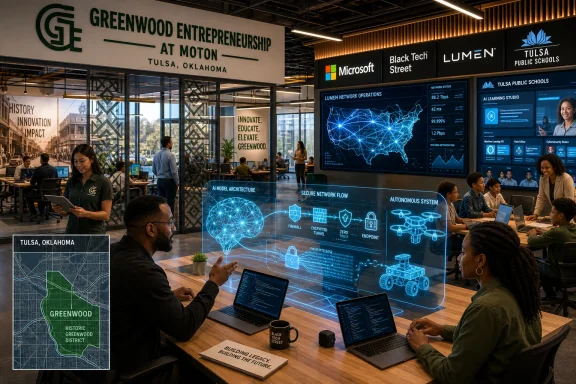
Microsoft and Black Tech Street opened the Greenwood Cyber + AI Lab on May 21, 2026, inside the Greenwood Entrepreneurship at Moton building in Tulsa, Oklahoma, as a collaborative hub for artificial intelligence, cybersecurity, and autonomous systems work. The announcement is not merely another ribbon-cutting in the AI gold rush. It is a bet that place, history, workforce development, and enterprise engineering can be made to reinforce one another. If it works, Tulsa gets something more durable than a branded innovation room; it gets a test case for whether the AI economy can be built somewhere other than the usual coastal corridors.
The first thing to understand about the Greenwood Cyber + AI Lab is that its address is doing part of the work. The lab sits in Tulsa’s historic Greenwood district, the community once known as Black Wall Street and still central to any serious discussion of American entrepreneurship, racial violence, economic rebuilding, and civic memory. Locating a Microsoft-backed AI and cybersecurity lab there is not a neutral real estate decision.
That symbolism can easily become marketing wallpaper, and the tech industry has given communities plenty of reasons to be skeptical of language about empowerment. But Greenwood is not being used here merely as a backdrop. Black Tech Street, founded by Tyrance Billingsley II, has spent years trying to frame Greenwood not as a museum of lost prosperity but as a platform for modern Black technology leadership.
The lab’s opening inside the Greenwood Entrepreneurship at Moton building gives that thesis a physical home. It places AI fluency, cybersecurity practice, startup support, and enterprise collaboration in a district whose story has often been told in the past tense. The argument behind the project is that Greenwood’s next chapter should not be limited to commemoration; it should include ownership of the technologies shaping the next economy.
Microsoft’s role makes the move more consequential. The company is not simply donating software licenses or lending its logo to a local initiative. The announcement says Microsoft engineers and researchers will work through the lab, giving participants access to advanced Microsoft AI and cybersecurity technologies. That turns the facility into a potential bridge between community-rooted ambition and the very real technical stack that enterprises are using to deploy generative AI, secure infrastructure, and automate operations.
That federal money matters because regional innovation strategies often fail at the translation layer. A city can have universities, employers, public agencies, startup programs, and good press, but still lack a place where those pieces meet around actual products and deployable systems. The Greenwood Cyber + AI Lab is being positioned as one of those translation points.
The broader Greenwood AI Center of Excellence received $10.6 million within the Tulsa Tech Hub plan. Its job is to serve as the artificial intelligence component of Tulsa’s autonomy push, with Black Tech Street operating it in partnership with Microsoft and SeedAI. That structure matters because autonomy is not only a hardware story. Drones, robots, logistics systems, and mobility platforms depend on secure data flows, machine perception, model governance, cloud infrastructure, and increasingly sophisticated AI decision-making.
Tulsa’s pitch is therefore not that it can become a mini-Silicon Valley by imitation. Its pitch is that it can specialize. The region already has ties to aerospace, energy, manufacturing, logistics, cyber, and public-sector coordination. If the Greenwood lab becomes useful, it will be because it connects those local advantages to the AI and security tooling that modern autonomous systems require.
That is a more plausible strategy than pretending every city can become the next general-purpose startup capital. The winning regional tech plays of the next decade are likely to be vertical, not generic. Tulsa is trying to own a lane.
That split is important. One half of the effort asks whether residents, students, educators, and workers can understand and use AI tools. The other half asks whether startups, enterprises, researchers, and government partners can build commercially and operationally useful systems. The first is civic infrastructure; the second is industrial infrastructure.
Most AI initiatives overemphasize one side. Corporate programs tend to chase prototypes, pilots, and press releases, while workforce programs often focus on broad awareness without a clear path to deployment. Tulsa’s model is trying to make fluency and application mutually reinforcing. The idea is that a community should not merely be trained to consume AI tools; it should participate in shaping how those tools are tested, governed, secured, and commercialized.
That is especially relevant in cybersecurity. AI has already changed the defensive and offensive tempo of security work, from phishing and social engineering to code analysis, threat hunting, identity compromise, and incident response. A lab that treats AI and cyber as separate domains would already be behind. Pairing them from the start is the right architectural choice.
It also gives the project a more practical edge than the usual “AI for good” framing. Critical infrastructure security, autonomous systems, responsible AI, and startup commercialization are not abstract aspirations. They are areas where organizations already face budget decisions, risk decisions, procurement decisions, and liability concerns. If the lab can help participants move from demos to governed deployments, it will have earned its keep.
For Microsoft, the Greenwood lab can serve several purposes at once. It extends the reach of Azure, Copilot, Microsoft security products, and Microsoft’s AI engineering practices into a region trying to define itself around trustworthy autonomy. It gives the company a community-centered counterpoint to the perception that AI is being built only for hyperscalers and Fortune 500 incumbents. It also creates a channel for Microsoft to understand how smaller organizations, schools, municipalities, and regional employers actually confront AI adoption.
That last point may be the most valuable. Enterprise AI is not failing because executives lack enthusiasm. It is stalling in many places because organizations are unsure how to govern data access, measure productivity gains, prevent leakage, align models to workflows, and train employees without creating chaos. Labs that sit closer to real operational constraints can surface problems that do not show up in keynote demos.
The Greenwood Cyber + AI Lab is therefore not just a local gift. It is part of Microsoft’s broader need to make AI feel deployable, securable, and socially legitimate. The company has the cloud infrastructure and product portfolio; what it needs are credible pathways into communities and sectors where trust cannot be assumed.
That is also why the lab’s focus on responsible AI is more than a reputational flourish. As AI systems move into education, public services, infrastructure, and security operations, questions about bias, accountability, explainability, privacy, and human oversight become procurement blockers. A community-rooted lab in Greenwood can put those questions closer to the engineering process rather than treating them as after-the-fact policy panels.
AI discourse often gets stuck at the model layer. The public sees chatbots, image generators, copilots, and agent demos. Enterprises see something messier: connectivity, identity, latency, observability, data classification, compliance, endpoint exposure, and disaster recovery. Lumen’s role, at least as described initially, is to support applied AI, cybersecurity, infrastructure resilience, and community engagement through the lab.
That makes sense for Tulsa’s autonomy ambitions. Autonomous systems are not just robots with clever algorithms. They are distributed systems that require secure communications, reliable connectivity, edge processing, and defensive planning against disruption. A drone corridor, a robotic inspection platform, or an intelligent mobility network all become security and networking problems the moment they leave the lab.
If Lumen’s involvement becomes substantive, the Greenwood lab could help participants confront the plumbing of AI rather than just its interface. That would be a useful corrective. Many AI pilots die when they collide with real infrastructure. A lab that teaches organizations how to architect for resilience, not merely how to prompt a model, would stand out.
The regional employer angle also matters. Workforce development is more credible when nearby companies can articulate what skills they need and where trained people might go. A lab connected to employers, universities, startups, and public agencies has a better chance of creating career pathways than a program that teaches tools in isolation.
The Tulsa effort includes educator training, AI-powered career pathways, operational productivity improvements, and exploration of Microsoft Copilot tools for administrative workflows. That combination is revealing. It treats AI readiness not as a single classroom module but as a district-wide operational shift.
That is the correct framing. AI in schools is not only a student-use issue. It affects procurement, staff training, data governance, special education support, curriculum planning, career counseling, and administrative workload. If a district adopts AI tools without policy and training, it risks chaos. If it bans or ignores them, it risks leaving students unprepared for a labor market that is already changing.
The challenge will be keeping education from becoming product onboarding by another name. Microsoft has obvious incentives to familiarize educators and administrators with Copilot and related tools. Tulsa Public Schools has a different responsibility: to ensure that AI adoption serves learning, equity, privacy, and workforce readiness rather than simply normalizing one vendor’s ecosystem.
That tension is not disqualifying. It is the reality of modern public technology projects. The best outcome is not vendor purity; it is competent governance. If Tulsa can give educators practical AI training while maintaining clear rules on student data, transparency, and classroom use, the district could become one of the more interesting early examples of municipal AI readiness.
That question should follow the Greenwood Cyber + AI Lab from the ribbon cutting into its operating model. How many local founders gain access to Microsoft engineers? How many students enter meaningful AI and cyber pathways? How many residents secure jobs, credentials, internships, contracts, or startup support? How many community organizations become more capable because of the lab’s work? How many companies simply borrow Greenwood’s aura?
Those metrics will matter more than launch-day quotes. Tyrance Billingsley II described the opening as the culmination of years of collaboration and emphasized the emotional significance of housing Black Tech Street headquarters and the Microsoft lab in GEM. His remarks are powerful because they connect the project to lived geography: a lab across from the middle school he attended, in a building precious to the Greenwood community, focused on one of the defining technologies of the century.
That kind of rootedness is not something a multinational can manufacture. It has to be carried by local leadership. Microsoft can bring engineers, platforms, and enterprise reach. Black Tech Street brings the legitimacy of a mission that predates this announcement and is accountable to a place.
The danger is that the project becomes symbolic capital for everyone and economic capital for too few. The opportunity is that it becomes a model for community technology infrastructure: a place where the benefits of AI are not merely promised downstream but negotiated at the point of creation.
A compromised chatbot is embarrassing. A compromised autonomous system can be dangerous. The more drones, robots, sensors, industrial platforms, and mobility systems depend on AI, the more cybersecurity becomes the foundation under the entire autonomy stack. Authentication, secure software supply chains, model integrity, adversarial testing, encrypted communications, and resilient operations become part of the product, not after-sales features.
The Greenwood Cyber + AI Lab’s initial focus areas reflect this reality. Startups and enterprise innovation give the lab a commercialization path. Critical infrastructure security gives it a public-interest spine. Autonomous systems tie it to Tulsa’s federal Tech Hub mandate. Responsible AI gives the whole effort a governance vocabulary.
That combination is ambitious, and ambition creates execution risk. Each of those domains could occupy a standalone institute. The lab will need to avoid becoming a room where every stakeholder projects a different dream. Its success will depend on disciplined programs, visible outputs, and the ability to say no to vague innovation theater.
The most promising interpretation is that the lab becomes a convening and prototyping layer rather than trying to be everything itself. It can connect Microsoft technical expertise, local founders, Lumen infrastructure knowledge, university research, public-sector needs, and workforce programs around specific challenges. The narrower and more concrete those challenges are, the more credible the lab becomes.
Tulsa is interesting because it sits closer to that adoption frontier than to the model-training frontier. The Greenwood lab is unlikely to produce a frontier model that competes with OpenAI, Anthropic, Google, or Meta. That is not the point. Its more realistic contribution is to show how communities can develop applied AI capacity around local industries and public needs.
That distinction matters for WindowsForum readers because most IT professionals live in the world of implementation, not hype. They are the people asked to deploy Copilot, govern identity, secure endpoints, classify data, reduce ticket volume, evaluate AI features in business software, and explain why a chatbot should not have access to every SharePoint folder. The Greenwood lab’s relevance lies in whether it can produce practices and talent for that world.
A regional AI strategy that takes cybersecurity seriously from day one is also a welcome contrast to the “move fast and patch later” reflex. The AI stack is already complicated enough: cloud services, APIs, plugins, agents, vector databases, permissions, logging, prompt injection, sensitive data exposure, and vendor dependencies. If the Tulsa model teaches builders to treat security and governance as design constraints rather than compliance paperwork, it will have value beyond Oklahoma.
The broader implication is that the AI economy needs more middle layers. Not every community needs a hyperscale lab. Many need trusted spaces where workers, founders, educators, and public agencies can learn how to use powerful tools without surrendering control to them. Greenwood is now making that argument in brick, fiber, and code.
Several practical questions will determine whether the lab becomes durable. Will local startups get structured technical support or occasional office hours? Will enterprise partners bring real problems and budgets, or only sponsorship language? Will Tulsa Public Schools receive usable governance frameworks, or merely tool demonstrations? Will workforce programs connect to jobs with wages and advancement? Will responsible AI be embedded in projects, or separated into panels and principles?
The federal funding also raises the stakes. Tech Hubs money was meant to create regional capacity, not subsidize press releases. Tulsa’s coalition has to prove that the award can produce measurable progress in autonomy, AI, cybersecurity, commercialization, and inclusive workforce development. Greenwood’s lab is now one of the places where that proof will be visible.
There is a governance challenge here as well. Public money, corporate platforms, community institutions, and workforce promises do not automatically align. Transparency about participation, outcomes, access, and ownership will matter. If the lab produces tools, pilots, datasets, training pathways, or startup opportunities, the community will need to understand who controls them and who benefits from them.
That is not cynicism. It is the necessary discipline for a project that has chosen to speak in the language of historic repair and future opportunity. The more meaningful the promise, the more concrete the accountability must be.
 Microsoft Plants an AI Flag Where the Symbolism Is Impossible to Ignore
The first thing to understand about the Greenwood Cyber + AI Lab is that its address is doing part of the work. The lab sits in Tulsa’s historic Greenwood district, the community once known as Black Wall Street and still central to any serious discussion of American entrepreneurship, racial violence, economic rebuilding, and civic memory. Locating a Microsoft-backed AI and cybersecurity lab there is not a neutral real estate decision.That symbolism can easily become marketing wallpaper, and the tech industry has given communities plenty of reasons to be skeptical of language about empowerment. But Greenwood is not being used here merely as a backdrop. Black Tech Street, founded by Tyrance Billingsley II, has spent years trying to frame Greenwood not as a museum of lost prosperity but as a platform for modern Black technology leadership.
The lab’s opening inside the Greenwood Entrepreneurship at Moton building gives that thesis a physical home. It places AI fluency, cybersecurity practice, startup support, and enterprise collaboration in a district whose story has often been told in the past tense. The argument behind the project is that Greenwood’s next chapter should not be limited to commemoration; it should include ownership of the technologies shaping the next economy.
Microsoft’s role makes the move more consequential. The company is not simply donating software licenses or lending its logo to a local initiative. The announcement says Microsoft engineers and researchers will work through the lab, giving participants access to advanced Microsoft AI and cybersecurity technologies. That turns the facility into a potential bridge between community-rooted ambition and the very real technical stack that enterprises are using to deploy generative AI, secure infrastructure, and automate operations.
Tulsa’s Tech Hub Strategy Finally Gets a Front Door
The lab is also the most publicly legible expression yet of Tulsa’s federal Tech Hubs strategy. In 2024, the Tulsa Hub for Equitable and Trustworthy Autonomy won roughly $51 million through the U.S. Economic Development Administration’s Tech Hubs program. The award was designed to help the region build national strength in autonomous systems, including drones, robotics, intelligent mobility, cybersecurity, and related infrastructure.That federal money matters because regional innovation strategies often fail at the translation layer. A city can have universities, employers, public agencies, startup programs, and good press, but still lack a place where those pieces meet around actual products and deployable systems. The Greenwood Cyber + AI Lab is being positioned as one of those translation points.
The broader Greenwood AI Center of Excellence received $10.6 million within the Tulsa Tech Hub plan. Its job is to serve as the artificial intelligence component of Tulsa’s autonomy push, with Black Tech Street operating it in partnership with Microsoft and SeedAI. That structure matters because autonomy is not only a hardware story. Drones, robots, logistics systems, and mobility platforms depend on secure data flows, machine perception, model governance, cloud infrastructure, and increasingly sophisticated AI decision-making.
Tulsa’s pitch is therefore not that it can become a mini-Silicon Valley by imitation. Its pitch is that it can specialize. The region already has ties to aerospace, energy, manufacturing, logistics, cyber, and public-sector coordination. If the Greenwood lab becomes useful, it will be because it connects those local advantages to the AI and security tooling that modern autonomous systems require.
That is a more plausible strategy than pretending every city can become the next general-purpose startup capital. The winning regional tech plays of the next decade are likely to be vertical, not generic. Tulsa is trying to own a lane.
The Lab Is Really Two Projects Wearing One Badge
The Greenwood AI Center of Excellence is built around two related but distinct components. The first is ASPIRE, the AI Societal Program for Innovation, Research, and Education. Its mission is AI fluency, workforce development, and education. The second is the Greenwood Cyber + AI Lab, where organizations can work with Microsoft engineers and technology leaders on applied AI solutions.That split is important. One half of the effort asks whether residents, students, educators, and workers can understand and use AI tools. The other half asks whether startups, enterprises, researchers, and government partners can build commercially and operationally useful systems. The first is civic infrastructure; the second is industrial infrastructure.
Most AI initiatives overemphasize one side. Corporate programs tend to chase prototypes, pilots, and press releases, while workforce programs often focus on broad awareness without a clear path to deployment. Tulsa’s model is trying to make fluency and application mutually reinforcing. The idea is that a community should not merely be trained to consume AI tools; it should participate in shaping how those tools are tested, governed, secured, and commercialized.
That is especially relevant in cybersecurity. AI has already changed the defensive and offensive tempo of security work, from phishing and social engineering to code analysis, threat hunting, identity compromise, and incident response. A lab that treats AI and cyber as separate domains would already be behind. Pairing them from the start is the right architectural choice.
It also gives the project a more practical edge than the usual “AI for good” framing. Critical infrastructure security, autonomous systems, responsible AI, and startup commercialization are not abstract aspirations. They are areas where organizations already face budget decisions, risk decisions, procurement decisions, and liability concerns. If the lab can help participants move from demos to governed deployments, it will have earned its keep.
The Microsoft Angle Is Less Philanthropy Than Ecosystem Strategy
Microsoft’s public language around the lab leans heavily on opportunity, trust, and responsible innovation. That is expected. But the company’s deeper interest is not hard to read: AI adoption depends on ecosystems, and ecosystems need places where customers, developers, educators, and public agencies can learn by building.For Microsoft, the Greenwood lab can serve several purposes at once. It extends the reach of Azure, Copilot, Microsoft security products, and Microsoft’s AI engineering practices into a region trying to define itself around trustworthy autonomy. It gives the company a community-centered counterpoint to the perception that AI is being built only for hyperscalers and Fortune 500 incumbents. It also creates a channel for Microsoft to understand how smaller organizations, schools, municipalities, and regional employers actually confront AI adoption.
That last point may be the most valuable. Enterprise AI is not failing because executives lack enthusiasm. It is stalling in many places because organizations are unsure how to govern data access, measure productivity gains, prevent leakage, align models to workflows, and train employees without creating chaos. Labs that sit closer to real operational constraints can surface problems that do not show up in keynote demos.
The Greenwood Cyber + AI Lab is therefore not just a local gift. It is part of Microsoft’s broader need to make AI feel deployable, securable, and socially legitimate. The company has the cloud infrastructure and product portfolio; what it needs are credible pathways into communities and sectors where trust cannot be assumed.
That is also why the lab’s focus on responsible AI is more than a reputational flourish. As AI systems move into education, public services, infrastructure, and security operations, questions about bias, accountability, explainability, privacy, and human oversight become procurement blockers. A community-rooted lab in Greenwood can put those questions closer to the engineering process rather than treating them as after-the-fact policy panels.
Lumen Brings the Network Layer Into the Story
The announced collaboration with Lumen Technologies gives the project an infrastructure dimension that should not be overlooked. Lumen is a major technology employer in the Tulsa region and a longstanding Microsoft partner. Its participation points to one of the least glamorous but most important realities of AI: none of this works without networks, data movement, resilience, and operational security.AI discourse often gets stuck at the model layer. The public sees chatbots, image generators, copilots, and agent demos. Enterprises see something messier: connectivity, identity, latency, observability, data classification, compliance, endpoint exposure, and disaster recovery. Lumen’s role, at least as described initially, is to support applied AI, cybersecurity, infrastructure resilience, and community engagement through the lab.
That makes sense for Tulsa’s autonomy ambitions. Autonomous systems are not just robots with clever algorithms. They are distributed systems that require secure communications, reliable connectivity, edge processing, and defensive planning against disruption. A drone corridor, a robotic inspection platform, or an intelligent mobility network all become security and networking problems the moment they leave the lab.
If Lumen’s involvement becomes substantive, the Greenwood lab could help participants confront the plumbing of AI rather than just its interface. That would be a useful corrective. Many AI pilots die when they collide with real infrastructure. A lab that teaches organizations how to architect for resilience, not merely how to prompt a model, would stand out.
The regional employer angle also matters. Workforce development is more credible when nearby companies can articulate what skills they need and where trained people might go. A lab connected to employers, universities, startups, and public agencies has a better chance of creating career pathways than a program that teaches tools in isolation.
Tulsa Public Schools Turns AI Readiness Into a District Problem
Microsoft’s partnership with Tulsa Public Schools through its Elevate program extends the initiative into K–12 education, where the stakes are immediate and awkward. School districts are already dealing with AI whether they asked for it or not. Students use generative tools, teachers experiment with lesson planning and feedback, administrators eye productivity gains, and everyone worries about cheating, privacy, bias, and uneven access.The Tulsa effort includes educator training, AI-powered career pathways, operational productivity improvements, and exploration of Microsoft Copilot tools for administrative workflows. That combination is revealing. It treats AI readiness not as a single classroom module but as a district-wide operational shift.
That is the correct framing. AI in schools is not only a student-use issue. It affects procurement, staff training, data governance, special education support, curriculum planning, career counseling, and administrative workload. If a district adopts AI tools without policy and training, it risks chaos. If it bans or ignores them, it risks leaving students unprepared for a labor market that is already changing.
The challenge will be keeping education from becoming product onboarding by another name. Microsoft has obvious incentives to familiarize educators and administrators with Copilot and related tools. Tulsa Public Schools has a different responsibility: to ensure that AI adoption serves learning, equity, privacy, and workforce readiness rather than simply normalizing one vendor’s ecosystem.
That tension is not disqualifying. It is the reality of modern public technology projects. The best outcome is not vendor purity; it is competent governance. If Tulsa can give educators practical AI training while maintaining clear rules on student data, transparency, and classroom use, the district could become one of the more interesting early examples of municipal AI readiness.
Greenwood’s History Raises the Bar for Corporate Promises
The reason this project will be judged more harshly than a lab in a suburban office park is also the reason it matters. Greenwood carries a historical burden and a civic expectation. Any institution that invokes its legacy must be prepared to answer a simple question: who benefits?That question should follow the Greenwood Cyber + AI Lab from the ribbon cutting into its operating model. How many local founders gain access to Microsoft engineers? How many students enter meaningful AI and cyber pathways? How many residents secure jobs, credentials, internships, contracts, or startup support? How many community organizations become more capable because of the lab’s work? How many companies simply borrow Greenwood’s aura?
Those metrics will matter more than launch-day quotes. Tyrance Billingsley II described the opening as the culmination of years of collaboration and emphasized the emotional significance of housing Black Tech Street headquarters and the Microsoft lab in GEM. His remarks are powerful because they connect the project to lived geography: a lab across from the middle school he attended, in a building precious to the Greenwood community, focused on one of the defining technologies of the century.
That kind of rootedness is not something a multinational can manufacture. It has to be carried by local leadership. Microsoft can bring engineers, platforms, and enterprise reach. Black Tech Street brings the legitimacy of a mission that predates this announcement and is accountable to a place.
The danger is that the project becomes symbolic capital for everyone and economic capital for too few. The opportunity is that it becomes a model for community technology infrastructure: a place where the benefits of AI are not merely promised downstream but negotiated at the point of creation.
The Autonomy Bet Makes Cybersecurity the Real Foundation
Tulsa’s Tech Hub designation centers on equitable and trustworthy autonomy, a phrase that sounds bureaucratic until one considers what autonomy actually requires. Autonomous systems are machines that sense, decide, move, and interact with the physical world. That makes trust and security existential rather than optional.A compromised chatbot is embarrassing. A compromised autonomous system can be dangerous. The more drones, robots, sensors, industrial platforms, and mobility systems depend on AI, the more cybersecurity becomes the foundation under the entire autonomy stack. Authentication, secure software supply chains, model integrity, adversarial testing, encrypted communications, and resilient operations become part of the product, not after-sales features.
The Greenwood Cyber + AI Lab’s initial focus areas reflect this reality. Startups and enterprise innovation give the lab a commercialization path. Critical infrastructure security gives it a public-interest spine. Autonomous systems tie it to Tulsa’s federal Tech Hub mandate. Responsible AI gives the whole effort a governance vocabulary.
That combination is ambitious, and ambition creates execution risk. Each of those domains could occupy a standalone institute. The lab will need to avoid becoming a room where every stakeholder projects a different dream. Its success will depend on disciplined programs, visible outputs, and the ability to say no to vague innovation theater.
The most promising interpretation is that the lab becomes a convening and prototyping layer rather than trying to be everything itself. It can connect Microsoft technical expertise, local founders, Lumen infrastructure knowledge, university research, public-sector needs, and workforce programs around specific challenges. The narrower and more concrete those challenges are, the more credible the lab becomes.
The AI Boom Needs More Places Like Tulsa, but Not for the Usual Reasons
The national AI conversation is still too concentrated around model companies, chip supply, data centers, and the platform strategies of a handful of giants. Those are real issues. But AI adoption will ultimately be judged in thousands of less glamorous settings: school districts, city departments, hospitals, utilities, small manufacturers, logistics firms, regional banks, tribal governments, nonprofits, and local startups.Tulsa is interesting because it sits closer to that adoption frontier than to the model-training frontier. The Greenwood lab is unlikely to produce a frontier model that competes with OpenAI, Anthropic, Google, or Meta. That is not the point. Its more realistic contribution is to show how communities can develop applied AI capacity around local industries and public needs.
That distinction matters for WindowsForum readers because most IT professionals live in the world of implementation, not hype. They are the people asked to deploy Copilot, govern identity, secure endpoints, classify data, reduce ticket volume, evaluate AI features in business software, and explain why a chatbot should not have access to every SharePoint folder. The Greenwood lab’s relevance lies in whether it can produce practices and talent for that world.
A regional AI strategy that takes cybersecurity seriously from day one is also a welcome contrast to the “move fast and patch later” reflex. The AI stack is already complicated enough: cloud services, APIs, plugins, agents, vector databases, permissions, logging, prompt injection, sensitive data exposure, and vendor dependencies. If the Tulsa model teaches builders to treat security and governance as design constraints rather than compliance paperwork, it will have value beyond Oklahoma.
The broader implication is that the AI economy needs more middle layers. Not every community needs a hyperscale lab. Many need trusted spaces where workers, founders, educators, and public agencies can learn how to use powerful tools without surrendering control to them. Greenwood is now making that argument in brick, fiber, and code.
The Hard Part Begins After the Ribbon Is Cut
The danger for every innovation hub is that the launch is the most successful thing it ever does. Ribbon cuttings are easy compared with curriculum design, founder support, enterprise procurement, student retention, security testing, grant compliance, and the slow work of building trust. The Greenwood Cyber + AI Lab will be judged by what repeats after the cameras leave.Several practical questions will determine whether the lab becomes durable. Will local startups get structured technical support or occasional office hours? Will enterprise partners bring real problems and budgets, or only sponsorship language? Will Tulsa Public Schools receive usable governance frameworks, or merely tool demonstrations? Will workforce programs connect to jobs with wages and advancement? Will responsible AI be embedded in projects, or separated into panels and principles?
The federal funding also raises the stakes. Tech Hubs money was meant to create regional capacity, not subsidize press releases. Tulsa’s coalition has to prove that the award can produce measurable progress in autonomy, AI, cybersecurity, commercialization, and inclusive workforce development. Greenwood’s lab is now one of the places where that proof will be visible.
There is a governance challenge here as well. Public money, corporate platforms, community institutions, and workforce promises do not automatically align. Transparency about participation, outcomes, access, and ownership will matter. If the lab produces tools, pilots, datasets, training pathways, or startup opportunities, the community will need to understand who controls them and who benefits from them.
That is not cynicism. It is the necessary discipline for a project that has chosen to speak in the language of historic repair and future opportunity. The more meaningful the promise, the more concrete the accountability must be.
The Greenwood Model Will Be Measured in People, Products, and Power
The opening of the Greenwood Cyber + AI Lab gives Tulsa a compelling story, but the story will only hold if it turns into operating reality. The most concrete signs of success will not be slogans about innovation; they will be people trained, products built, systems secured, and local organizations made stronger.- The lab opened on May 21, 2026, in the Greenwood Entrepreneurship at Moton building as part of the broader Greenwood AI Center of Excellence.
- Tulsa’s Tech Hubs strategy is backed by roughly $51 million in federal funding, with $10.6 million allocated to the Greenwood AI Center of Excellence.
- The project links Microsoft, Black Tech Street, SeedAI, Tulsa Innovation Labs, Lumen Technologies, and Tulsa Public Schools around AI, cybersecurity, autonomy, and workforce readiness.
- The lab’s most important technical bet is that AI and cybersecurity must be developed together, especially for autonomous systems and critical infrastructure.
- The project’s most important civic test is whether Greenwood residents, students, founders, and institutions gain durable access to skills, jobs, contracts, and technical power.
- The initiative will be credible only if it produces repeatable programs and measurable outcomes after the opening-week attention fades.
References
- Primary source: Pulse 2.0
Published: 2026-05-25T03:50:08.514553
Microsoft And Black Tech Street Announce Greenwood Cyber + AI Lab Opens In Tulsa
Microsoft and Black Tech Street announced the launch of the Greenwood Cyber + AI Lab in Tulsa, Oklahoma, a new collaborative technology hub focused on advancing artificial intelligence, cybersecurity, and autonomous systems innovation. pulse2.com
- Related coverage: prnewswire.com
Microsoft and Black Tech Street Launch Greenwood Cyber + AI Lab in Tulsa
/PRNewswire/ -- Microsoft and Black Tech Street today announce the opening of the Greenwood Cyber + AI Lab, a collaborative technology hub focused on advancing... www.prnewswire.com
- Related coverage: techinsyte.com
Greenwood Cyber + AI Lab Opens in Tulsa to Boost Enterprise AI and Security Workflows
Microsoft and Black Tech Street announced the opening of the Greenwood Cyber + AI Lab in Tulsa’s historic Greenwood district. The collaborative hub, housed in the Greenwood Entrepreneurship at Moton (GEM) building, brings together startups, enterprises, researchers and public‑sector partners to... techinsyte.com
- Related coverage: eda.gov
Tulsa Tech Hub | U.S. Economic Development Administration
The Tech Hubs Program invests in regions across the U.S. with the potential to become globally competitive in the technologies and industries of the future. A Tech Hubs Designation is a strong endorsement of a region’s plans to supercharge their respective technological industry to create jobs...www.eda.gov
- Related coverage: blacktechstreet.com
Black Tech Street | Rebirthing Black Wall Street as an AI Innovation Economy
Black Tech Street is rebirthing Historic Black Wall Street as an AI innovation economy in Tulsa, Oklahoma. Join our ASPIRE workshops, community events, and tech initiatives.www.blacktechstreet.com
- Related coverage: tulsainnovationlabs.com
Microsoft Co-Innovation Lab | TIL Initiatives
 www.tulsainnovationlabs.com
- Related coverage: oklahoma.gov
- Related coverage: businesswire.com
- Related coverage: landing.tulsaremote.com
- Related coverage: tulsasfuture.com
