

Microsoft has quietly placed the original source code for Zork I, Zork II and Zork III under the MIT License — making the foundational Infocom text adventures available for study, teaching and play — and has done so by submitting clear licensing pull requests to the historical repositories rather than creating new forks.
Zork began as a PDP-10 mainframe project in the late 1970s and became one of the defining works of interactive fiction. The original implementation used MDL on DEC PDP-10 systems; when the game was commercialized through Infocom it was reworked into ZIL (the Zork Implementation Language) and compiled to run on the Z‑machine virtual machine so the same story files could be executed across dozens of microcomputers. That design is widely credited with enabling Infocom’s cross‑platform success in the 1980s. Infocom’s assets changed hands over the decades — Infocom itself was bought by Activision in the 1980s, and Activision later became part of Microsoft’s gaming portfolio following Microsoft’s acquisition of Activision Blizzard — a chain of custody that explains why Microsoft now controls the IP and can grant a license for the historical source materials.
However, there are important limitations and caveats:
There’s a broader preservation benefit too: enabling historians, researchers and students to inspect original source encourages reproducible scholarship. It also helps the interactive fiction community maintain compatibility, repair historical tools, and keep heritage titles playable on modern platforms.
Conclusion
The release is both symbolic and practical: a canonical example of how corporate custodianship can be deployed to preserve and democratize historically important software while retaining necessary commercial and trademark safeguards. It opens doors for better teaching of early parser design and for new generations to examine the architecture that shaped cross‑platform game design long before modern virtualization. If nothing else, Zork’s source — now clearly licensed — gives students the chance to learn from code that helped define an entire genre.
Source: theregister.com Microsoft unleashes Zork I-III source code
 Background
Zork began as a PDP-10 mainframe project in the late 1970s and became one of the defining works of interactive fiction. The original implementation used MDL on DEC PDP-10 systems; when the game was commercialized through Infocom it was reworked into ZIL (the Zork Implementation Language) and compiled to run on the Z‑machine virtual machine so the same story files could be executed across dozens of microcomputers. That design is widely credited with enabling Infocom’s cross‑platform success in the 1980s. Infocom’s assets changed hands over the decades — Infocom itself was bought by Activision in the 1980s, and Activision later became part of Microsoft’s gaming portfolio following Microsoft’s acquisition of Activision Blizzard — a chain of custody that explains why Microsoft now controls the IP and can grant a license for the historical source materials. What Microsoft released and how
Microsoft’s Open Source Programs Office (OSPO), working with Xbox and Activision colleagues and in collaboration with archivists, has submitted upstream pull requests to the established historical repositories for Zork I, Zork II and Zork III that add an explicit MIT LICENSE and repository metadata. The company states that this release includes the original source files, relevant historical documentation and build notes, but excludes packaging artwork, marketing materials and trademark rights. Key points about the release:- The release covers the canonical ZIL/ZAP source for Zork I, II and III — the program code that compiles into Z‑machine story files.
- Microsoft deliberately chose the MIT License for its simplicity and permissiveness, to lower friction for educators and hobbyists who want to read, teach or reuse the code.
- The company coordinated with known archivists (notably the Internet Archive’s community) rather than creating parallel repositories, positioning the existing historical repos as the canonical home for the source.
Technical primer: ZIL, Z‑machine, ZAP, Z3 and ZILF
To understand what the release actually enables, it helps to recap the toolchain and formats involved.- ZIL (Zork Implementation Language): a derivative of MDL used by Infocom to author adventures. ZIL code encodes the game’s object model, grammar, parser and routines. The original ZIL tooling required a mainframe environment to produce story files.
- ZIP / ZILCH / ZAP: historically, ZIL compilation involved a multi‑stage pipeline — ZILCH and related tools produced ZAP assembly blobs which were then assembled into a Z‑machine story file. These names show up frequently in historical notes and modern reconstructions.
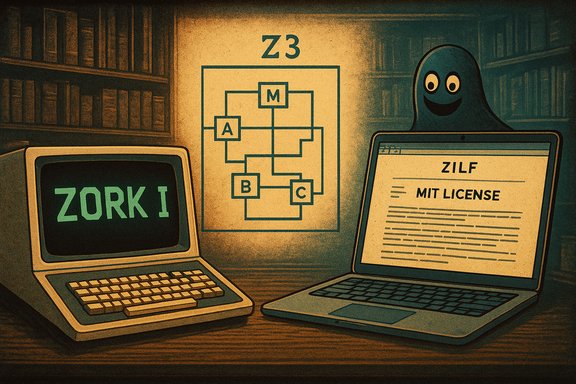
- Z‑machine / Z3: the Z‑machine is the virtual machine developed by Infocom. "Z3" refers to the story file format used by many Infocom-era games (Zork II and others used different Z‑machine versions, but Z3 is a common target). Modern interpreters — often called runners or interpreters — read Z‑machine story files and present the text interface.
- ZILF (ZIL Forever): a modern, community‑maintained toolchain that can compile ZIL sources into Z‑machine story files; contemporary ZILF implementations and their assemblers (often named zilf/zapf in instructions) let hobbyists build playable Z3 files from the historical source. Microsoft’s OSPO recommended ZILF for local compilation and referenced it in their guide.
- Interpreters (Frotz and equivalents): once you have a story file (Z3), you can run it in dozens of Z‑machine runners. Windows Frotz is a mature Windows build based on the Frotz core; there are cross‑platform alternatives (Gargoyle, Glulxe interpreters, CLI runners) that make the games easy to run today.
Preservation, education and research value
This release is notable for three linked reasons:- Source‑level preservation — reading the original ZIL files is a rare opportunity to see how early interactive fiction solved natural‑language parsing, state modeling and content compression for constrained hardware. Those architectural decisions were pioneering at the time and remain instructive for students of software design and language processing.
- Pedagogical utility — because the code is now explicitly MIT‑licensed, instructors can include the files in syllabi, lab exercises and assignments without complicated licensing caveats. Microsoft framed the move explicitly in those terms: giving historically important code to students, teachers and developers to study and play.
- Community and archival continuity — by contributing licensing metadata to the historical repositories (instead of creating company‑branded forks), Microsoft preserved the provenance trail and invited the longstanding IF community and archivists to continue stewardship. That approach reduces fragmentation and helps historians and maintainers work in one canonical place.
What the MIT license actually permits — and what it doesn’t
The practical effect of placing the Zork I–III source under the MIT License is broad: the MIT License is permissive and allows use, modification, distribution and commercial exploitation of the licensed code provided the original copyright and license notice are preserved.However, there are important limitations and caveats:
- Trademark and branding: the MIT license applied to the source code does not grant rights to the Zork trademark(s), box art, or other marketing content. Using the name or packaging commercially can still infringe trademark law. Microsoft explicitly excluded packaging and marketing assets from the release.
- Ancillary assets: music, sound effects, images or other non‑source artifacts that were not included remain governed by their original rights. The release is source‑centric.
- Third‑party content: if any third‑party code or libraries were entwined in the historical files, contributors should carefully check whether all embedded content is actually covered by Microsoft’s grant. Microsoft’s public statement frames this as a preservation grant for the company‑controlled code; anyone planning a derivative commercial product should perform due diligence. If a file contains third‑party assets not owned by Microsoft/Activision, their upstream rights may still apply. This is an area that should be audited before broad reuse.
- Moral and practical restrictions: although the MIT License is permissive, community norms and archive ethics often encourage preserving authorship and historical context; heavy modernization or monetization that erases provenance will frustrate archivists and some original contributors.
How to run the code (short practical walkthrough)
- Clone or access the historical repository with the ZIL source for Zork I, II or III (the canonical historical repos now contain MIT LICENSE files).
- Install a modern ZIL toolchain (ZILF) and the assembler utilities (often zilf/zapf) to compile ZIL to ZAP and assemble into a Z3 story file. ZILF is the recommended community tool; it supports modern platforms.
- Build example (Windows-style commands Microsoft documented as an example):
- "%ZILF_PATH%\zilf.exe" zork1.zil
- "%ZILF_PATH%\zapf.exe" zork1.zap zork1-ignite.z3
- Open zork1-ignite.z3 in a Z‑machine runner such as Windows Frotz.
Community, archival context and provenance
Microsoft’s OSPO credited collaboration with Jason Scott and Internet Archive stewardship in the announcement. That connection is significant: the IF community and archivists have for years maintained and curated Infocom historical repositories, and Microsoft’s approach was to add an explicit license and recognition to that existing archival work rather than supplant it. That cooperative model strengthens provenance and reduces fork‑driven confusion for historians and developers alike. The historical ZIL sources have long circulated in enthusiast circles and occasionally appeared on public code hosting prior to this explicit licensing clarification. Microsoft’s license addition resolves lingering legal ambiguity and — depending on how the canonical repositories are maintained — could simplify future research and classroom use.Strengths of Microsoft’s decision
- Preserves and democratizes history: giving instructors and students explicit permission to study and reuse the source removes a practical barrier that previously forced educators to either rely on questionable copies or avoid direct study.
- Minimal friction license: MIT is one of the easiest licenses to work with in academic and hobby contexts. That lowers the threshold for experimentation, derivative projects and classroom assignments.
- Respects archival continuity: contributing licensing metadata to established historical repositories preserves provenance and honors decades of community stewardship.
- Practical tooling is available: community projects such as ZILF and robust interpreters like Frotz make it straightforward to compile and run the materials across platforms.
Risks, limits and things to watch
- Trademark and brand confusion: permissive code licensing does not hand over trademarks or commercial packaging — projects that use the code must avoid implying endorsement or infringing marks. Microsoft explicitly excluded packaging and trademark rights, but not all users will read the fine print. That creates legal exposure for derivative commercial products that reuse the name or art.
- Residual third‑party rights: if any historical files incorporate code or assets that were never owned by Activision/Microsoft, those elements may still carry third‑party restrictions. A quick source audit is advised for anyone planning redistribution.
- Security and supply‑chain hygiene: the release is historical code written for mainframes and early microcomputers. It is not designed to current security practices and may contain unsafe assumptions if executed in unusual runtime environments. Running source in containers or sandboxes when experimenting is prudent. This is mainly a theoretical risk for research rather than a practical threat to modern systems, but sandboxing mitigates surprises.
- Preservation vs. modernization tension: Microsoft stated the goal is preservation and education, not modernization. The community will almost certainly want to modernize interfaces or tooling; maintainers will need to balance restoration authenticity with practical improve‑and‑interpret contributions. That debate is a normal part of digital preservation efforts.
- Editorialization and hype: some press coverage framed the announcement in highly enthusiastic or jokey terms (for example, suggesting a single demo “saved Ignite” or that the event risked being “eaten by a grue”). Those are colorful media takes rather than factual claims; readers should distinguish promotional color from the core technical and legal facts.
Broader implications: corporate stewardship and the preservation playbook
This move signals a pragmatic approach to corporate code stewardship: Microsoft has legal title to legacy assets via acquisitions and can choose to make historical code both accessible and easy to reuse without ceding brand or commercial control. By adding clean licensing metadata to archival repositories, Microsoft set a template that other companies could adopt when they control historically significant code.There’s a broader preservation benefit too: enabling historians, researchers and students to inspect original source encourages reproducible scholarship. It also helps the interactive fiction community maintain compatibility, repair historical tools, and keep heritage titles playable on modern platforms.
Final assessment
Microsoft’s decision to add a clear MIT license to the canonical Zork I–III historical sources is a concrete win for software preservation, education and the interactive‑fiction community. The release lowers legal friction for classroom use, preserves provenance by working through existing historical repositories, and leverages established community tooling (ZILF, Frotz and others) to make the code playable again. Caveats remain: trademark and asset rights continue to be retained by their owners; any derivative work that uses the Zork name, box art or commercial assets will have to negotiate those rights separately. Users and educators should also verify any third‑party content in the historical files before redistributing compiled artifacts. From a preservation ethics standpoint, the collaborative approach that preserved provenance and acknowledged archival partners is a best practice worth emulation. For developers, teachers and historians, the bottom line is straightforward: the original Zork I–III source has been granted an explicit MIT license and made available in the historical repositories; the code can now be read, taught and compiled with community toolchains such as ZILF and run with modern Z‑machine interpreters — a practical and historically meaningful gift to the software preservation community.Conclusion
The release is both symbolic and practical: a canonical example of how corporate custodianship can be deployed to preserve and democratize historically important software while retaining necessary commercial and trademark safeguards. It opens doors for better teaching of early parser design and for new generations to examine the architecture that shaped cross‑platform game design long before modern virtualization. If nothing else, Zork’s source — now clearly licensed — gives students the chance to learn from code that helped define an entire genre.
Source: theregister.com Microsoft unleashes Zork I-III source code
