

Microsoft’s latest Power Platform update, unveiled at Ignite, accelerates the company’s shift from assistant-style AI to agentic systems while baking in a new layer of admin controls and governance designed to make those agents manageable for large organizations.
Microsoft has been steadily rearchitecting its AI story for enterprises: move beyond single-turn chat assistants and toward autonomous, goal-driven agents that can plan, call tools, and act across business systems. The Power Platform announcements presented at Ignite — spanning Power Apps, Copilot Studio, Dataverse, and admin surfaces in the Power Platform admin center — formalize this strategy by exposing agent-building tooling to citizen makers and pro developers while introducing identity, telemetry, and policy controls intended to reduce operational risk. Microsoft’s broader agent ecosystem (Azure AI Foundry, Copilot Studio, Model Context Protocol support, and Agent Service) supplies the plumbing for multi-agent orchestration, model routing, and observability — the pieces enterprises need to treat agents like production services rather than experimental chatbots. These platform investments are paired with governance capabilities that register agents as directory principals, integrate agent telemetry with Purview and Sentinel, and provide admin kill-switches to quarantine misbehaving agents.
However, the operational burden is real. Successful adoption requires cross-functional governance, investment in telemetry and FinOps, and careful pilot discipline. Security teams must assume agents will be targeted and put runtime protections and incident playbooks in place. Compliance teams will need to incorporate agent logs into existing audit regimes, and procurement must be ready for new licensing and chargeback models.
In short: the technology is moving from experimentation to productization, and Microsoft’s announcements provide many of the scaffolding pieces enterprise IT needs. The remaining hard work is organizational: build the governance processes, fund observability, and execute conservative pilots that validate both value and safety before scaling.
Source: SiliconANGLE Microsoft Power Platform get new agentic and governance capabilities - SiliconANGLE
 Background
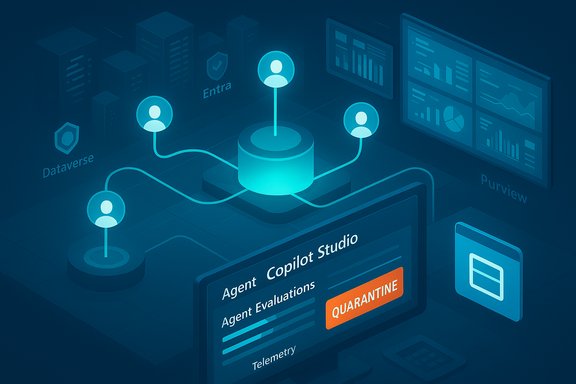
Microsoft has been steadily rearchitecting its AI story for enterprises: move beyond single-turn chat assistants and toward autonomous, goal-driven agents that can plan, call tools, and act across business systems. The Power Platform announcements presented at Ignite — spanning Power Apps, Copilot Studio, Dataverse, and admin surfaces in the Power Platform admin center — formalize this strategy by exposing agent-building tooling to citizen makers and pro developers while introducing identity, telemetry, and policy controls intended to reduce operational risk. Microsoft’s broader agent ecosystem (Azure AI Foundry, Copilot Studio, Model Context Protocol support, and Agent Service) supplies the plumbing for multi-agent orchestration, model routing, and observability — the pieces enterprises need to treat agents like production services rather than experimental chatbots. These platform investments are paired with governance capabilities that register agents as directory principals, integrate agent telemetry with Purview and Sentinel, and provide admin kill-switches to quarantine misbehaving agents. What changed in Power Platform (what was announced)
Copilot Studio and agent lifecycle improvements
- Agent authoring and evaluation: Copilot Studio gains built-in agent evaluations that run agents through predefined scenarios to uncover regressions and compare versions — a step toward CI-style validation for agents.
- Computer-use / hosted browser capability: Agents can operate within a hosted Windows 365 virtual browser or cloud VM to interact with web pages and legacy UI where no API exists. This effectively extends automation into “screen-scrape” or UI-driven domains in a controlled, sandboxed environment.
- Quarantine and admin control: Admins can programmatically quarantine or block agents via APIs and the Power Platform admin center, giving security teams a “big red button” to isolate suspect agents quickly.
Identity, discovery and lifecycle: Entra Agent ID and Agent cataloging
- Entra Agent ID: Agents created in Copilot Studio or Azure AI Foundry are assigned first-class identities in Microsoft Entra (Azure AD). That identity makes agents discoverable, auditable, and controllable with conditional access and lifecycle policies similar to human users or service principals.
- Agent discovery/Agent Store concepts: Microsoft’s commercial roadmap includes in-product agent catalogs and store-like discovery experiences (Agent Store / Agent 365 control concepts) to make agents re-usable, reviewable, and potentially billable items in IT catalogs; early-access programs are already being deployed.
Data integration and grounding
- Dataverse MCP Server (GA) and Dataverse–Fabric integration: Dataverse now offers a Model Context Protocol server to standardize agent access to application logic and data; Dataverse integration with Microsoft Fabric and improved Dataverse tooling for Python lets agents query and update enterprise data with tenant-aware grounding.
- Expanded knowledge sources: Copilot and agents are gaining broader Microsoft 365 grounding (SharePoint, Teams meetings, mailboxes, org directory) so reasoning is tied to internal context rather than purely external models.
Governance, telemetry, and compliance tooling
- Copilot hub and admin telemetry: The Power Platform admin center introduces a Copilot hub that surfaces Copilot and agent usage, per-feature controls, and advisor recommendations for scaling governance. Admins can apply environment-level policies, DLP rules, and monitor usage patterns.
- Purview and Sentinel integration: Agent interactions are auditable via Microsoft Purview and Sentinel, enabling compliance teams to capture prompts, responses, and action logs for retention and forensic review. This ties agent activity into existing compliance and SIEM workflows.
Why this matters — practical implications for IT and business
Productivity: agents as digital labor
Agents can orchestrate multi-step workflows — collecting data, calling APIs, updating records, and communicating results — without repeated human handoffs. For common business operations (invoice intake, customer routing, meeting facilitation, status reporting) agentic automation reduces context switching and can cut cycle times dramatically when properly designed. The low-code Copilot Studio patterns make it feasible for business teams to prototype and iterate quickly.Scale and reuse
An in-product catalog and Copilot Studio templates mean organizations can publish vetted agent templates into a tenant catalog for reuse. This moves agents from one-off scripts into governed catalog items that can be versioned and labeled with owners, cost centers, and lifecycle policies. That’s a major operational shift: agents become manageable assets rather than shadow automations.Security and compliance alignment
By assigning agents Entra identities, integrating telemetry into Purview/Sentinel, and enabling quarantine APIs, Microsoft gives security teams familiar control surfaces to manage the new threat class. Those controls are critical because agents operate across systems and may require persistent permissions (e.g., mailbox read, SharePoint access), which increases the stakes for fine-grained access reviews and conditional access policies.Strengths: where Microsoft’s approach earns credibility
- Platform breadth and integration: Microsoft’s biggest advantage is the tight integration across Power Platform, Microsoft 365, Entra, Purview and Azure — the same fabric enterprises already use for identity, DLP and auditing. That reduces friction when grounding agents to internal data and applying centralized controls.
- Operational tooling for production: Built-in evaluation, observability, tracing, and agent lifecycle APIs take agent development beyond demos. The addition of quarantine APIs and admin surfaces acknowledges practical incident-response needs.
- Standards and extensibility: Support for Model Context Protocol (MCP) and multi-agent orchestration in Azure AI Foundry encourages interoperability and reduces bespoke integration work when connecting tools and data to agents. That makes agents more composable and portable across runtimes.
- Low-code democratization with governance patterns: Copilot Studio and Power Platform let citizen makers build agents while admin controls (environment groups, sharing limits, DLP, approval gates) help IT prevent unrestricted sprawl. This combination enables rapid value while preserving central oversight.
Risks and open issues — what keeps CISOs and compliance leads up at night
Expanded attack surface and novel threat vectors
Agents that act autonomously and can simulate UI interactions create new opportunities for abuse. Recent security research has demonstrated token-theft techniques and social-engineering-based attacks that exploit agent workflows and consent flows; these show attackers targeting the same automation primitives that make agents powerful. Examples such as the CoPhish pattern (exploiting Copilot Studio agent flows to capture OAuth tokens) illustrate real-world risks that require immediate mitigation.Complexity of governance at scale
Treating agents as first-class workforce members (registering them in HR systems, assigning cost centers, licensing them separately) introduces cross-functional complexity. IT, finance, HR and procurement must coordinate to track spend, ownership, and lifecycle; early Microsoft internal notes and partner reporting suggest new licensing concepts and Agent 365-style control planes that organizations must plan for. These commercial and organizational challenges are non-trivial.Risk of hallucinations and incorrect automated actions
Grounding agents to tenant data (Dataverse, SharePoint) reduces but does not eliminate model error. Agents making write-back actions in ERP or CRM systems amplify the impact of a single incorrect inference. For transactional operations, human-in-the-loop gates and deterministic validation checks are required to prevent costly mistakes.Observability and forensic burden
Capturing meaningful traces for agent runs is necessary but expensive: logging prompts, model outputs, tool calls, and downstream side effects at enterprise scale will increase storage and analysis demands. Organizations must plan log retention, indexability, and incident playbooks for agent-driven incidents.Potential vendor lock-in and portability concerns
The combination of Copilot Studio, Dataverse, and Agent stores creates a high value proposition — but also potential lock-in. Agents that depend on Microsoft-specific connectors, Entra identities, and Dataverse indexes will be harder to migrate to other platforms. Use of open standards like MCP mitigates this, but only when vendors fully support interoperable tooling stacks.Concrete steps and governance playbook for IT leaders
Below is a practical, prioritized checklist for IT, security, and platform teams to adopt agentic capabilities with a defensible posture.- Establish an Agent Governance Board
- Include security, legal, compliance, finance, platform engineering, and business owners.
- Define approval criteria for agent types (informational vs. transactional vs. financial).
- Begin with a narrow pilot (3–6 months)
- Pick 2–3 low-risk high-value scenarios (e.g., meeting summarization, ticket triage, basic report generation).
- Run agents in shadow mode first — collect telemetry and validate outputs before granting write privileges.
- Apply least-privilege identity and conditional access
- Register agents with Entra Agent ID and place them in a restricted OU/tenant policy.
- Use access reviews and short-lived credentials for high-risk connectors.
- Instrument comprehensive observability and retention
- Capture agent prompts, plans, tool inputs/outputs, and decision traces.
- Align retention windows with compliance needs and incident response SLAs.
- Enable runtime protections and quarantine APIs
- Wire Copilot Studio’s analyze-tool-execution webhooks and quarantine APIs to security platforms and response playbooks so suspicious runs can be blocked immediately.
- Build deterministic validation and rollback flows
- For any transactional agent, require pre-commit checks or human approval for actions that alter financial, legal, or customer records. Implement idempotency and reconciliation processes.
- Track costs and apply FinOps practices
- Tag agent runs, model selections, and environments for chargeback. Use model-routing policies to reserve large models for high-trust tasks only.
- Harden developer and maker platforms
- Restrict who can publish agents to the tenant catalog; require templated inputs and code-review style signoffs for complex agents.
- Train humans and create a “validation station”
- Teach business owners how to design safe prompts and how to vet agent outputs; institute human-in-the-loop checkpoints for high-risk actions.
- Negotiate vendor responsibilities
- In contracts with third-party agent vendors, require auditability, observability SLAs, and the ability to revoke or quarantines agents quickly.
Technical verification: what’s proven and what remains provisional
- Proven:
- Entra Agent ID exists and is presented as Microsoft’s identity model for agents, enabling lifecycle and conditional access controls.
- Copilot Studio admin features (quarantine API, telemetry integration, agent evaluations) and Dataverse MCP Server are documented in Microsoft blogs and Learn pages.
- Azure AI Foundry Agent Service GA and MCP support are announced in the Foundry blog and Learn docs, confirming production-grade agent runtimes and multi-agent orchestration.
- Corroborated by independent reporting:
- Major outlets (The Verge, Reuters, Wired) have covered the agent direction, computer-use feature, and the emergence of Agent 365-style control planes, offering independent confirmation of Microsoft’s strategy and some early availability details.
- Provisional or requiring caution:
- Licensing and SKU details for agent-specific licenses (A365 / Agent 365) are described in roadmap and partner reporting but remain subject to Microsoft’s formal commercial documentation. Treat projected licensing models as likely but unconfirmed until official SKU and pricing pages are published.
- Third-party integrations and market availability (for example, certain channel GA claims) may vary by tenant and region; validate availability in your tenant before committing to production rollouts.
Risk scenarios and mitigation recipes
- Scenario: an agent is tricked into divulging tenant OAuth tokens via a malicious consent screen.
- Mitigation: restrict third-party app consent, enforce MFA/Conditional Access, monitor for anomalous sign-ins, use Copilot Studio webhooks to block suspicious plan payloads, and have a quarantine playbook to immediately isolate the agent.
- Scenario: an agent writes incorrect financial entries to ERP.
- Mitigation: require transaction-level human approval for any write-backs to finance systems; implement automated reconciliation and a rollback script; keep immutable action logs for forensic review.
- Scenario: proliferation of “shadow agents” across business units.
- Mitigation: centralize agent publishing into a tenant catalog with approval gates, require owner metadata and cost-center tags, and run periodic access reviews.
The ecosystem and vendor landscape — partners, standards and checks
Microsoft is not building this alone. Workday, ServiceNow and partner ecosystems are already positioning to manage agent metadata (Agent System of Record) and to offer runtime checks. Open standards such as the Model Context Protocol (MCP) and the Agent-to-Agent (A2A) protocols aim to make agent tooling composable across vendors, but practical portability depends on broad vendor uptake and disciplined engineering to keep API contracts clean. At the same time, independent security vendors are introducing runtime enforcement layers for agent behavior (real-time allow/block webhooks, behavioral baselining) — an industry response to the fact that build-time scanning alone won’t stop runtime abuse. Organizations should plan for layered defenses: identity + DLP + runtime policy enforcement + observability.Final analysis — balancing the upside and the real costs
Microsoft’s Power Platform agentic and governance enhancements are a critical and pragmatic step toward making agentic AI usable in regulated enterprises. The company has correctly focused on identity, auditability, and admin controls; those design choices materially lower the barrier to enterprise adoption compared with naive, unmanaged agents.However, the operational burden is real. Successful adoption requires cross-functional governance, investment in telemetry and FinOps, and careful pilot discipline. Security teams must assume agents will be targeted and put runtime protections and incident playbooks in place. Compliance teams will need to incorporate agent logs into existing audit regimes, and procurement must be ready for new licensing and chargeback models.
In short: the technology is moving from experimentation to productization, and Microsoft’s announcements provide many of the scaffolding pieces enterprise IT needs. The remaining hard work is organizational: build the governance processes, fund observability, and execute conservative pilots that validate both value and safety before scaling.
Conclusion
The Ignite updates make Power Platform an explicit center of gravity for Microsoft’s agent strategy — low-code agent creation, Dataverse grounding, Entra identity, and admin kill-switches together create a pragmatic enterprise path for agentic automation. The potential productivity gains are substantial, but so are the governance and security responsibilities. Organizations that treat agents as digital labor from day one — with identity, cost ownership, human-in-the-loop checks, and runtime enforcement — will capture the upside while controlling the real-world risks.Source: SiliconANGLE Microsoft Power Platform get new agentic and governance capabilities - SiliconANGLE
