

Microsoft Project Silica is not a reason to delay today’s backup, disaster-recovery, or ransomware-resilience investments. It is a significant archival-storage breakthrough, but IT leaders should treat it as a signal to identify data that may justify a future immutable archive tier—not as a purchasable replacement for OneDrive, Azure Backup, LTO tape, or ordinary Windows recovery systems.
Microsoft Research published its latest Project Silica advances on February 18, 2026, alongside a paper in Nature describing laser-written archival storage in borosilicate glass. Microsoft says the research phase is complete, but it has announced no commercial product, Azure service, pricing, deployment schedule, or consumer device.
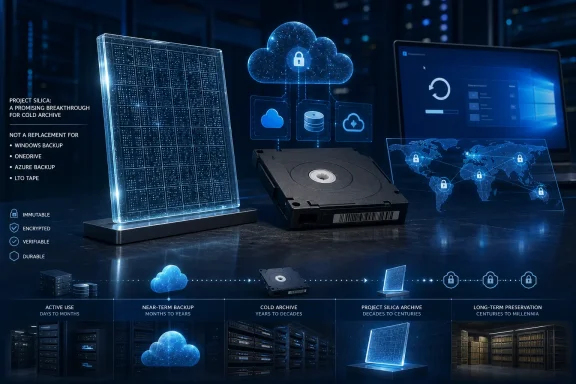
Project Silica writes data into glass using lasers, creating a write-once medium intended for information that must remain unchanged for extremely long periods. The February research moved the system beyond expensive fused silica to more widely available borosilicate glass, addressing media supply and cost obstacles that would matter in any eventual commercialization.
The headline figure is a projected retention period of at least 10,000 years. That makes the research potentially relevant to records whose useful lives could outlast several generations of storage hardware.
It does not make Silica a general-purpose backup medium. Endpoint backups change as users create files, install applications, modify settings, and receive Windows updates. Microsoft 365 protection must account for changing mailboxes, OneDrive files, SharePoint sites, permissions, and retention policies. Silica instead targets cold archival data: information written once, retained for a long time, and retrieved infrequently. When the underlying record changes, the write-once model requires a new archival object rather than an in-place update.
WindowsForum’s coverage shows why that boundary matters. Its reports on Microsoft 365 prompts encouraging OneDrive backup, the newer Windows Backup migration experience, and Quick Machine Recovery all concern continuity, transfer, or restoration of active Windows environments. WindowsForum has also examined Druva’s Microsoft 365 resiliency services and Azure Native Qumulo’s hybrid file-storage and smart-tiering capabilities. Those systems address changing operational data and recoverability. Project Silica is research into preserving a selected final record over a much longer horizon.
Microsoft’s earlier Silica system research cites approximate media lifetimes of five years for hard disk drives and 10 years for tape. Archives that must outlive those periods may require migration, integrity checks, replacement hardware, and continuing preservation of catalogs and access procedures.
Consider a finalized CAD release package that must remain available throughout the service life of an industrial system. The organization may rarely retrieve it, yet could move it through several generations of media, software, and hardware. The same issue can apply to regulated case evidence exports, completed research datasets, and finalized media masters.
Those are stronger candidates than active OneDrive libraries, live Microsoft 365 content, virtual-machine backups, or frequently revised engineering work. The deciding issue is not file size alone. It is whether the object can be finalized, retained without alteration, described independently, and retrieved under a defined process.
Passive storage could also provide an architectural energy benefit because the medium would not need power simply to preserve encoded data. That is a potential design advantage, not a demonstrated outcome of a commercial Project Silica deployment. The energy consumed by writing, cataloging, moving, reading, cooling associated equipment, and maintaining geographic copies would have to be measured in any real implementation.
The current comparison should remain narrow. Existing tape archives have known refresh, integrity-checking, hardware, software, and migration requirements within each organization. Silica research proposes write-once glass with much longer projected media retention. Its commercial production cost, ingest performance, retrieval behavior, supported management model, and integration requirements remain unknown.
Microsoft has described parallel writing and other research advances, but a research demonstration is not a production ingest guarantee. A future customer would need to know how quickly objects can be written, verified, indexed, retrieved, and exported, including performance during peak intake periods.
Capacity claims would also be insufficient by themselves. An archive requires catalogs, metadata, integrity verification, custody controls, retrieval workflows, geographic protection, and a supported exit path. Any future Silica offering would have to be assessed as a complete archival system, not merely as a durable glass platter.
It is important to separate verified Project Silica facts from requirements IT should impose on any future implementation. Microsoft has demonstrated laser-written data in glass and reported its projected retention characteristics. That does not establish the procurement terms, reader strategy, documentation rights, or long-term support model of a forthcoming product.
If Microsoft or another vendor commercializes this approach, customers should treat the following as procurement requirements:
Physical durability also does not eliminate site risk. A glass object can still be lost, stolen, mishandled, or made inaccessible by a facility-level disaster. Geographic redundancy and independent metadata remain necessary when the record cannot be reconstructed.
Use the following checklist on each candidate dataset. Score each row from 0 to 2, then document any legal requirement that overrides the numerical result.
A high score does not mean “buy Silica.” No such product is available. It means the dataset warrants a technology-neutral immutable archive design and a formal comparison of current options with future ones.
Before approving the tier, answer four operational questions:
It should then establish technology-neutral requirements for immutability, documented formats, independent verification, geographic copies, retrieval objectives, metadata preservation, custody, export, and decoder reconstruction. That work improves current tape or cloud archives even if Project Silica never becomes commercially available.
Organizations should not reserve a Project Silica budget until Microsoft announces a product, pricing, support terms, operational performance, and an exit model. They should, however, begin designing the tier when qualifying records must cross multiple planned media migrations and the organization can state exactly what will be preserved, how it will be found, how quickly it must be retrieved, and how it can be moved elsewhere.
Project Silica’s immediate value is evidence that repeated media migration may not always be the only model for long-term preservation. Enterprises should keep funding current Windows, Microsoft 365, backup, recovery, and resiliency systems while identifying the smaller class of finalized records that may justify a future immutable archive tier.
Microsoft Research published its latest Project Silica advances on February 18, 2026, alongside a paper in Nature describing laser-written archival storage in borosilicate glass. Microsoft says the research phase is complete, but it has announced no commercial product, Azure service, pricing, deployment schedule, or consumer device.
 The Breakthrough Changes the Medium, Not the Backup Model
Project Silica writes data into glass using lasers, creating a write-once medium intended for information that must remain unchanged for extremely long periods. The February research moved the system beyond expensive fused silica to more widely available borosilicate glass, addressing media supply and cost obstacles that would matter in any eventual commercialization.The headline figure is a projected retention period of at least 10,000 years. That makes the research potentially relevant to records whose useful lives could outlast several generations of storage hardware.
It does not make Silica a general-purpose backup medium. Endpoint backups change as users create files, install applications, modify settings, and receive Windows updates. Microsoft 365 protection must account for changing mailboxes, OneDrive files, SharePoint sites, permissions, and retention policies. Silica instead targets cold archival data: information written once, retained for a long time, and retrieved infrequently. When the underlying record changes, the write-once model requires a new archival object rather than an in-place update.
WindowsForum’s coverage shows why that boundary matters. Its reports on Microsoft 365 prompts encouraging OneDrive backup, the newer Windows Backup migration experience, and Quick Machine Recovery all concern continuity, transfer, or restoration of active Windows environments. WindowsForum has also examined Druva’s Microsoft 365 resiliency services and Azure Native Qumulo’s hybrid file-storage and smart-tiering capabilities. Those systems address changing operational data and recoverability. Project Silica is research into preserving a selected final record over a much longer horizon.
The Real Cost Target Is Repeated Migration
The strongest potential business case for Project Silica is not merely that glass may remain stable longer than current media. It is the possibility of reducing repeated media-refresh work for rarely accessed records.Microsoft’s earlier Silica system research cites approximate media lifetimes of five years for hard disk drives and 10 years for tape. Archives that must outlive those periods may require migration, integrity checks, replacement hardware, and continuing preservation of catalogs and access procedures.
Consider a finalized CAD release package that must remain available throughout the service life of an industrial system. The organization may rarely retrieve it, yet could move it through several generations of media, software, and hardware. The same issue can apply to regulated case evidence exports, completed research datasets, and finalized media masters.
Those are stronger candidates than active OneDrive libraries, live Microsoft 365 content, virtual-machine backups, or frequently revised engineering work. The deciding issue is not file size alone. It is whether the object can be finalized, retained without alteration, described independently, and retrieved under a defined process.
Passive storage could also provide an architectural energy benefit because the medium would not need power simply to preserve encoded data. That is a potential design advantage, not a demonstrated outcome of a commercial Project Silica deployment. The energy consumed by writing, cataloging, moving, reading, cooling associated equipment, and maintaining geographic copies would have to be measured in any real implementation.
Glass Cannot Yet Beat LTO on a Purchase Order
LTO can be procured today through established enterprise products and operating practices. Project Silica cannot. Microsoft has not published a product price, Azure consumption model, supported capacity tier, contractual durability terms, or retrieval service-level objectives. Meaningful comparisons of cost per terabyte, ingest throughput, retrieval time, staffing, and support are therefore impossible.The current comparison should remain narrow. Existing tape archives have known refresh, integrity-checking, hardware, software, and migration requirements within each organization. Silica research proposes write-once glass with much longer projected media retention. Its commercial production cost, ingest performance, retrieval behavior, supported management model, and integration requirements remain unknown.
Microsoft has described parallel writing and other research advances, but a research demonstration is not a production ingest guarantee. A future customer would need to know how quickly objects can be written, verified, indexed, retrieved, and exported, including performance during peak intake periods.
Capacity claims would also be insufficient by themselves. An archive requires catalogs, metadata, integrity verification, custody controls, retrieval workflows, geographic protection, and a supported exit path. Any future Silica offering would have to be assessed as a complete archival system, not merely as a durable glass platter.
A 10,000-Year Claim Still Needs a 10-Year Plan
Microsoft’s retention estimate is based on accelerated-aging methods, not direct observation across 10,000 years. Such testing can support longevity estimates, but media survival is not the same as continued information accessibility.It is important to separate verified Project Silica facts from requirements IT should impose on any future implementation. Microsoft has demonstrated laser-written data in glass and reported its projected retention characteristics. That does not establish the procurement terms, reader strategy, documentation rights, or long-term support model of a forthcoming product.
If Microsoft or another vendor commercializes this approach, customers should treat the following as procurement requirements:
- Document the encoding format, error-correction method, integrity checks, and version history.
- Define how reader hardware can be replaced, reproduced, or obtained after the original generation is retired.
- Preserve decoding software, dependencies, test vectors, and operating instructions outside the archive platform.
- Maintain searchable metadata and object indexes independently of the glass media.
- Specify chain-of-custody controls for transportation, access, loss, and physical damage.
- Require an export process that does not depend indefinitely on one vendor or service.
- Test retrieval and decoder reconstruction on a scheduled basis.
- Keep the required number of geographically separated copies.
Physical durability also does not eliminate site risk. A glass object can still be lost, stolen, mishandled, or made inaccessible by a facility-level disaster. Geographic redundancy and independent metadata remain necessary when the record cannot be reconstructed.
Qualify a Dataset Before Designing the Tier
An organization should design a long-retention tier now when records must survive multiple planned media migrations and it can define immutable objects, independent metadata, retrieval objectives, and exit requirements. A retention period measured in decades does not automatically justify Silica planning. The dataset must also be stable enough to archive and valuable enough to warrant the additional controls.Use the following checklist on each candidate dataset. Score each row from 0 to 2, then document any legal requirement that overrides the numerical result.
| Qualification factor | 0 points | 1 point | 2 points |
|---|---|---|---|
| Retention period | Fits within the current platform cycle | Likely spans one migration | Must survive multiple planned migrations |
| Change rate | Frequently modified | Periodic new versions | Finalized, immutable object |
| Retrieval frequency | Frequent or operational | Occasional | Rare and request-driven |
| Legal hold or immutability | No fixed-record need | Policy preference | Legal, regulatory, evidentiary, or contractual need |
| Reconstruction cost | Easy to regenerate | Expensive to regenerate | Impossible or unacceptable to recreate |
| Current refresh-cycle cost | Minor and automated | Material but manageable | Repeated migration is a major cost or risk |
| Metadata requirements | Depends on live application state | Some exportable metadata | Complete independent catalog, provenance, and format data |
| Geographic copies | One recoverable copy is sufficient | Second-site copy preferred | Multiple controlled geographic copies required |
Before approving the tier, answer four operational questions:
- What is the archival object? Define the exact final package, its checksums, formats, metadata, ownership, and permitted successors.
- What is the retrieval objective? Specify how quickly authorized users must locate, verify, and receive the object.
- What ends retention? Identify the legal, policy, or business event that permits deletion—or state why retention is permanent.
- How does the organization exit? Define bulk export, verification after migration, reader or decoder transition, and deletion evidence.
IT Should Design the Archive Boundary Now
The useful preparation is to separate permanent records from active data and recovery copies in policy, cataloging, and architecture. IT should calculate the current archive’s full refresh burden, including migration labor, integrity verification, replacement hardware, software support, facilities, failed-media handling, and post-migration validation.It should then establish technology-neutral requirements for immutability, documented formats, independent verification, geographic copies, retrieval objectives, metadata preservation, custody, export, and decoder reconstruction. That work improves current tape or cloud archives even if Project Silica never becomes commercially available.
Organizations should not reserve a Project Silica budget until Microsoft announces a product, pricing, support terms, operational performance, and an exit model. They should, however, begin designing the tier when qualifying records must cross multiple planned media migrations and the organization can state exactly what will be preserved, how it will be found, how quickly it must be retrieved, and how it can be moved elsewhere.
Frequently Asked Questions
Can Project Silica replace Windows Backup or OneDrive?
No. Windows Backup and OneDrive protect changing user data and support device or file recovery. Project Silica is intended for write-once archival information that changes rarely or never.Is Project Silica available through Azure?
No Project Silica Azure SKU or purchasable service has been announced. Microsoft says the research phase is complete, but it has not provided commercial pricing, availability, support terms, or a deployment schedule.Does the 10,000-year estimate prove that every archive will last that long?
No. The estimate relies on accelerated-aging work rather than direct observation over thousands of years. Accessibility would also depend on preserving metadata, formats, readers, decoding methods, custody controls, and geographic copies.Should organizations stop investing in LTO tape?
No. Tape can be procured and operated now. Project Silica cannot enter a defensible purchasing comparison until commercial cost, capacity, ingest performance, retrieval behavior, support, integration, and migration options are known.Project Silica’s immediate value is evidence that repeated media migration may not always be the only model for long-term preservation. Enterprises should keep funding current Windows, Microsoft 365, backup, recovery, and resiliency systems while identifying the smaller class of finalized records that may justify a future immutable archive tier.
References
- Primary source: microsoft.com
Project Silica’s advances in glass storage technology - Microsoft Research
Project Silica introduces new techniques for encoding data in borosilicate glass, as described in the journal Nature. These advances lower media cost and simplify writing and reading systems while supporting 10,000-year data preservation.www.microsoft.com - Independent coverage: news.microsoft.com
- Independent coverage: nature.com
Microsoft team creates ‘revolutionary’ data-storage system that lasts for millennia
Researchers use mini plasma explosions to encode the equivalent of two million books into a coaster-sized device. The method could preserve research data for millennia with minimal storage costs.www.nature.com - Independent coverage: pcworld.com
Is Pyrex glass the answer to long-term data storage? | PCWorld
Microsoft has advanced its Project Silica to the point where it can store data for up to 10,000 years on the type of commercial borosilicate glass used in cookware and in oven doors.www.pcworld.com - Independent coverage: arstechnica.com
Microsoft's new 10,000-year data storage medium: glass - Ars Technica
Femtosecond lasers etch data into a very stable medium.arstechnica.com - Independent coverage: tomshardware.com
Microsoft's Project Silica write-once storage could store terabytes of data for over 10,000 years — company explores two physical glass storage methods, so the glass-clad future of storage isn't coming anytime soon | Tom's Hardware
Microsoft is working on two radically different mechanisms.www.tomshardware.com
