

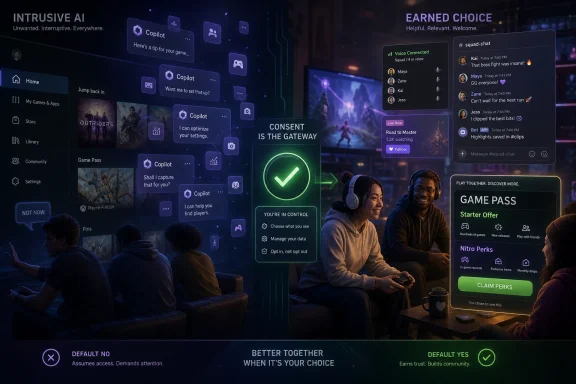
Microsoft is backing away from bringing its Copilot gaming assistant to Xbox consoles and broader PC game environments after months of user resistance, while still expanding its gaming reach through a May 2026 Discord partnership that bundles a starter version of Xbox Game Pass with Discord Nitro. That is the plain news, but the sharper story is about consent. Microsoft has spent the last three years treating AI as an inevitable layer across Windows, Office, Edge, search, and now entertainment. Xbox is the place where that inevitability finally met a user base willing to say: not here, not like this.
For Microsoft, Copilot has never been just a chatbot. It is the branding glue for an entire corporate strategy: AI in the operating system, AI in productivity apps, AI in developer tools, AI in customer service, AI in search, AI in security, and AI in the hardware pitch for new PCs. The company has been remarkably consistent in its message that Copilot is not a side product but the next interface layer for computing.
That strategy makes sense from Redmond’s perspective. Microsoft has the cloud infrastructure, the enterprise relationships, the Office installed base, the Windows footprint, and the OpenAI partnership to push AI at a scale few companies can match. If AI really is the next platform shift, Microsoft does not want to repeat its mobile-era mistake by watching someone else own the interface.
The trouble is that users do not experience platform strategy as strategy. They experience it as another icon on the taskbar, another prompt in Word, another button on the keyboard, another feature they did not ask for, and another administrative setting that must be audited before deployment. The difference between “integrated” and “intrusive” is not a product roadmap distinction; it is a trust distinction.
Xbox sharpened that tension because gaming is not spreadsheets. Players are not logging into a console hoping to have their attention optimized for workflow. They are entering a space where immersion, performance, modding, social identity, ownership, and low-friction play matter more than Microsoft’s desire to make Copilot feel universal.
But gaming is also a domain where users have been trained to distrust anything that looks like telemetry, automation, platform meddling, or monetized recommendation engines. Console dashboards have already become crowded with ads, subscription prompts, store tiles, rewards hooks, and engagement nudges. A Copilot pane arriving in that context was never going to be judged as a neutral helper.
The backlash was therefore not simply anti-AI sentiment. It was anti-platform creep. Players saw a company that had already embedded Copilot across Windows and Microsoft 365 preparing to extend the same logic into a leisure device. They did not hear “assistant”; they heard “the office is following you into the living room.”
That is why Microsoft’s retreat matters. A company that has spent the AI boom telling users that Copilot belongs everywhere has now conceded, at least in this case, that “everywhere” has limits. The Xbox audience forced Microsoft to acknowledge that the right interface for work may be the wrong interface for play.
Windows users have seen this pattern before. Edge prompts, Microsoft account nudges, OneDrive setup flows, Teams integrations, Start menu recommendations, and shifting defaults have all contributed to a broader fatigue with Microsoft’s habit of turning the operating system into a distribution channel. Copilot enters that history carrying baggage.
For enterprises, the concern is more concrete. Every AI surface raises questions about data boundaries, licensing, retention, prompt logging, compliance, user training, and support burden. Even when Microsoft provides controls, administrators still have to understand them, document them, test them, communicate them, and monitor whether future updates change the behavior.
For consumers, the irritation is more emotional but no less real. A feature can be technically optional and still feel forced if it is visually persistent, preinstalled, mapped to a hardware key, promoted during setup, or woven into apps people already pay for. Microsoft often points to settings and policies; users notice the default.
Discord Nitro users are getting access to a starter Game Pass offer with a smaller catalogue and a limited cloud gaming allowance. Existing Game Pass users are also expected to receive Discord-related perks. The exchange is obvious: Discord makes Nitro feel more valuable, Microsoft gets a low-friction discovery funnel for Game Pass, and both companies deepen a partnership that already includes voice and streaming integrations.
This is the kind of platform move gamers are more likely to tolerate because it preserves agency. A Discord Nitro subscriber can see the perk, try it, ignore it, or convert into a fuller Game Pass customer. It does not interrupt a boss fight, annotate a dashboard, or imply that every part of gaming needs an AI concierge.
There is still plenty of commercial calculation here. Microsoft wants Game Pass to remain a habit even as the economics of subscription gaming become more complicated. Discord wants Nitro to feel less like a cosmetic upgrade and more like a bundle of recurring benefits. But the route matters: the partnership meets players in a social gaming environment instead of forcing a Microsoft assistant into the console experience.
Windows is more ambiguous. An operating system assistant could be genuinely useful for settings, troubleshooting, accessibility, file management, and local search. Yet Windows is also the place where Microsoft’s bundling instincts are most visible, and that makes users suspicious even when the feature has merit.
Gaming is different again. The best gaming experiences are often defined by friction that is meaningful rather than accidental. Getting lost, learning systems, experimenting with builds, discovering secrets, and asking friends for help are part of the culture. An omnipresent AI helper risks flattening those experiences into searchable tasks.
That does not mean AI has no place in games. Developers will use AI in testing, localization, animation tooling, moderation, accessibility, upscaling, and content pipelines. Players may welcome optional tools that explain mechanics or help with accessibility barriers. But platform-level Copilot is a harder sell because it arrives as Microsoft’s layer, not the game’s layer.
That semantic drift is dangerous. Once a brand becomes associated with unwanted insertion, even useful features inherit the backlash. Microsoft learned this with earlier attempts to push browsers, assistants, and communication apps into Windows’ center of gravity. The product may improve, but the posture lingers.
The company’s challenge is not merely to make Copilot more capable. It must make Copilot feel reversible. Users and administrators need confidence that they can decline it without losing functionality, hide it without fighting the OS, uninstall it where appropriate, and deploy it only where the benefits justify the governance work.
This is especially important because AI tools create a different kind of anxiety from ordinary software features. A bad toolbar is annoying. A bad AI assistant can produce wrong answers, expose sensitive context, blur authorship, alter workflows, or encourage users to trust output they do not understand. The margin for “just try it” is smaller.
The Windows audience is broad, but it contains a large cohort that values local control. These are the people who know what Group Policy is, who notice when a default changes, who maintain images, who strip consumer features from enterprise builds, who remember when an OS felt less like a services portal. They are not automatically hostile to AI; they are hostile to losing the machine.
Microsoft’s best path is not to pretend that resistance is ignorance. It is to design Copilot as a capability that earns placement through use. That means clean disablement, transparent data handling, honest licensing, minimal nags, and a user interface that does not behave as though every blank space is an upsell opportunity.
There is a version of Copilot that Windows users could accept. It would troubleshoot driver problems without hallucinating, explain settings without changing them unexpectedly, respect local privacy boundaries, and disappear when dismissed. It would be a tool, not a campaign.
That matters at a time when Xbox’s identity is in flux. Microsoft is simultaneously a console maker, a PC gaming platform holder, a publisher, a cloud gaming provider, and the owner of Activision Blizzard. Its games increasingly appear beyond Xbox hardware, while its subscription strategy keeps shifting to match costs, licensing realities, and user growth limits.
In that environment, Copilot risked becoming another symbol of strategic confusion. Is Xbox a console? A Windows gaming shell? A subscription? A cloud service? A social layer? A hardware ecosystem? Adding a broad AI assistant before answering those questions would have made the platform feel less focused, not more futuristic.
Game Pass through Discord is at least coherent. It says Microsoft wants to turn social proximity into game discovery. That may not solve every problem in Xbox’s business, but it aligns with how people actually find games in 2026: through friends, streams, servers, clips, and communities rather than through a corporate assistant waiting on the dashboard.
This is where Microsoft’s enterprise instincts can be both an advantage and a liability. The company knows how to sell managed technology into organizations with compliance needs, procurement cycles, and administrative controls. But consumer platforms do not grant the same patience. If a feature feels imposed, the reaction is immediate and public.
Xbox users gave Microsoft a fast version of the verdict that Windows users often deliver more slowly. They did not want an AI assistant simply because Microsoft had one to offer. They wanted the gaming environment to remain theirs.
For IT pros, that should sound familiar. The healthiest deployments of AI will be the ones where organizations define use cases first and enable tools second. The weakest deployments will be the ones where licensing and vendor enthusiasm outrun policy, training, and user trust.
The concrete lessons are narrower, and more useful:
Source: Texas Standard Microsoft struggles with user backlash over AI
 Microsoft Finds the Edge of the Copilot Map
For Microsoft, Copilot has never been just a chatbot. It is the branding glue for an entire corporate strategy: AI in the operating system, AI in productivity apps, AI in developer tools, AI in customer service, AI in search, AI in security, and AI in the hardware pitch for new PCs. The company has been remarkably consistent in its message that Copilot is not a side product but the next interface layer for computing.That strategy makes sense from Redmond’s perspective. Microsoft has the cloud infrastructure, the enterprise relationships, the Office installed base, the Windows footprint, and the OpenAI partnership to push AI at a scale few companies can match. If AI really is the next platform shift, Microsoft does not want to repeat its mobile-era mistake by watching someone else own the interface.
The trouble is that users do not experience platform strategy as strategy. They experience it as another icon on the taskbar, another prompt in Word, another button on the keyboard, another feature they did not ask for, and another administrative setting that must be audited before deployment. The difference between “integrated” and “intrusive” is not a product roadmap distinction; it is a trust distinction.
Xbox sharpened that tension because gaming is not spreadsheets. Players are not logging into a console hoping to have their attention optimized for workflow. They are entering a space where immersion, performance, modding, social identity, ownership, and low-friction play matter more than Microsoft’s desire to make Copilot feel universal.
Xbox Was Always the Hardest Room for an AI Sales Pitch
The basic idea behind a gaming-focused Copilot was not absurd. An assistant that can explain a confusing quest, summarize patch notes, recommend games, surface accessibility settings, or help a parent configure family controls could be useful. In theory, an AI layer could make a sprawling subscription catalogue less overwhelming and make modern games less hostile to new players.But gaming is also a domain where users have been trained to distrust anything that looks like telemetry, automation, platform meddling, or monetized recommendation engines. Console dashboards have already become crowded with ads, subscription prompts, store tiles, rewards hooks, and engagement nudges. A Copilot pane arriving in that context was never going to be judged as a neutral helper.
The backlash was therefore not simply anti-AI sentiment. It was anti-platform creep. Players saw a company that had already embedded Copilot across Windows and Microsoft 365 preparing to extend the same logic into a leisure device. They did not hear “assistant”; they heard “the office is following you into the living room.”
That is why Microsoft’s retreat matters. A company that has spent the AI boom telling users that Copilot belongs everywhere has now conceded, at least in this case, that “everywhere” has limits. The Xbox audience forced Microsoft to acknowledge that the right interface for work may be the wrong interface for play.
The Backlash Is About Control, Not Just AI
It is tempting to frame this as a simple culture-war skirmish over artificial intelligence. That misses the point. The complaint many users have with Copilot is not that AI exists, or even that Microsoft is investing heavily in it. The complaint is that Microsoft keeps treating adoption as something to be engineered into the environment rather than earned through repeated usefulness.Windows users have seen this pattern before. Edge prompts, Microsoft account nudges, OneDrive setup flows, Teams integrations, Start menu recommendations, and shifting defaults have all contributed to a broader fatigue with Microsoft’s habit of turning the operating system into a distribution channel. Copilot enters that history carrying baggage.
For enterprises, the concern is more concrete. Every AI surface raises questions about data boundaries, licensing, retention, prompt logging, compliance, user training, and support burden. Even when Microsoft provides controls, administrators still have to understand them, document them, test them, communicate them, and monitor whether future updates change the behavior.
For consumers, the irritation is more emotional but no less real. A feature can be technically optional and still feel forced if it is visually persistent, preinstalled, mapped to a hardware key, promoted during setup, or woven into apps people already pay for. Microsoft often points to settings and policies; users notice the default.
Discord Shows Microsoft Choosing Distribution Over Invasion
The Discord partnership is the more interesting half of the story because it shows Microsoft pursuing gamers through a less confrontational channel. Rather than planting Copilot inside Xbox and asking players to accept an AI layer, Microsoft is putting a starter version of Xbox Game Pass where millions of players already gather. That is not subtle, but it is smarter.Discord Nitro users are getting access to a starter Game Pass offer with a smaller catalogue and a limited cloud gaming allowance. Existing Game Pass users are also expected to receive Discord-related perks. The exchange is obvious: Discord makes Nitro feel more valuable, Microsoft gets a low-friction discovery funnel for Game Pass, and both companies deepen a partnership that already includes voice and streaming integrations.
This is the kind of platform move gamers are more likely to tolerate because it preserves agency. A Discord Nitro subscriber can see the perk, try it, ignore it, or convert into a fuller Game Pass customer. It does not interrupt a boss fight, annotate a dashboard, or imply that every part of gaming needs an AI concierge.
There is still plenty of commercial calculation here. Microsoft wants Game Pass to remain a habit even as the economics of subscription gaming become more complicated. Discord wants Nitro to feel less like a cosmetic upgrade and more like a bundle of recurring benefits. But the route matters: the partnership meets players in a social gaming environment instead of forcing a Microsoft assistant into the console experience.
The Office Strategy Does Not Translate Cleanly to the Couch
Copilot’s strongest pitch remains in Microsoft 365, where the product can claim a direct relationship to productivity. Summarizing a Teams meeting, drafting an email, generating a PowerPoint outline, or querying a spreadsheet are use cases that map naturally onto work people already do. Whether Copilot performs those tasks well enough to justify its cost is a separate question, but the conceptual fit is clear.Windows is more ambiguous. An operating system assistant could be genuinely useful for settings, troubleshooting, accessibility, file management, and local search. Yet Windows is also the place where Microsoft’s bundling instincts are most visible, and that makes users suspicious even when the feature has merit.
Gaming is different again. The best gaming experiences are often defined by friction that is meaningful rather than accidental. Getting lost, learning systems, experimenting with builds, discovering secrets, and asking friends for help are part of the culture. An omnipresent AI helper risks flattening those experiences into searchable tasks.
That does not mean AI has no place in games. Developers will use AI in testing, localization, animation tooling, moderation, accessibility, upscaling, and content pipelines. Players may welcome optional tools that explain mechanics or help with accessibility barriers. But platform-level Copilot is a harder sell because it arrives as Microsoft’s layer, not the game’s layer.
Microsoft’s AI Problem Is a Trust Deficit Wearing a Product Name
Copilot now carries two meanings. To Microsoft, it is the friendly name for a family of AI assistants. To many users, it has become shorthand for a corporate mandate that keeps surfacing in places where they did not invite it.That semantic drift is dangerous. Once a brand becomes associated with unwanted insertion, even useful features inherit the backlash. Microsoft learned this with earlier attempts to push browsers, assistants, and communication apps into Windows’ center of gravity. The product may improve, but the posture lingers.
The company’s challenge is not merely to make Copilot more capable. It must make Copilot feel reversible. Users and administrators need confidence that they can decline it without losing functionality, hide it without fighting the OS, uninstall it where appropriate, and deploy it only where the benefits justify the governance work.
This is especially important because AI tools create a different kind of anxiety from ordinary software features. A bad toolbar is annoying. A bad AI assistant can produce wrong answers, expose sensitive context, blur authorship, alter workflows, or encourage users to trust output they do not understand. The margin for “just try it” is smaller.
The Xbox Retreat Is Also a Warning to Windows
Windows enthusiasts should not treat the Xbox decision as a quirky gaming story. It is a preview of the pressure Microsoft will face as Copilot becomes more deeply attached to Windows 11, Copilot+ PCs, Microsoft 365, and future hardware cycles. The same backlash dynamics apply whenever Microsoft confuses availability with acceptance.The Windows audience is broad, but it contains a large cohort that values local control. These are the people who know what Group Policy is, who notice when a default changes, who maintain images, who strip consumer features from enterprise builds, who remember when an OS felt less like a services portal. They are not automatically hostile to AI; they are hostile to losing the machine.
Microsoft’s best path is not to pretend that resistance is ignorance. It is to design Copilot as a capability that earns placement through use. That means clean disablement, transparent data handling, honest licensing, minimal nags, and a user interface that does not behave as though every blank space is an upsell opportunity.
There is a version of Copilot that Windows users could accept. It would troubleshoot driver problems without hallucinating, explain settings without changing them unexpectedly, respect local privacy boundaries, and disappear when dismissed. It would be a tool, not a campaign.
Game Pass, Not Copilot, Is the Better Xbox Ambassador
The Discord deal also reveals where Microsoft’s gaming leverage still lies. Game Pass remains a clearer proposition than Copilot because it offers something players immediately understand: games. The catalogue may be smaller in the starter version, and cloud access may be limited, but the value exchange is legible.That matters at a time when Xbox’s identity is in flux. Microsoft is simultaneously a console maker, a PC gaming platform holder, a publisher, a cloud gaming provider, and the owner of Activision Blizzard. Its games increasingly appear beyond Xbox hardware, while its subscription strategy keeps shifting to match costs, licensing realities, and user growth limits.
In that environment, Copilot risked becoming another symbol of strategic confusion. Is Xbox a console? A Windows gaming shell? A subscription? A cloud service? A social layer? A hardware ecosystem? Adding a broad AI assistant before answering those questions would have made the platform feel less focused, not more futuristic.
Game Pass through Discord is at least coherent. It says Microsoft wants to turn social proximity into game discovery. That may not solve every problem in Xbox’s business, but it aligns with how people actually find games in 2026: through friends, streams, servers, clips, and communities rather than through a corporate assistant waiting on the dashboard.
The AI Boom Is Running Into the Permission Economy
The larger lesson is that AI adoption is entering a permission economy. The first phase of the boom rewarded companies for announcing integrations. The next phase will reward companies for proving that those integrations respect context.This is where Microsoft’s enterprise instincts can be both an advantage and a liability. The company knows how to sell managed technology into organizations with compliance needs, procurement cycles, and administrative controls. But consumer platforms do not grant the same patience. If a feature feels imposed, the reaction is immediate and public.
Xbox users gave Microsoft a fast version of the verdict that Windows users often deliver more slowly. They did not want an AI assistant simply because Microsoft had one to offer. They wanted the gaming environment to remain theirs.
For IT pros, that should sound familiar. The healthiest deployments of AI will be the ones where organizations define use cases first and enable tools second. The weakest deployments will be the ones where licensing and vendor enthusiasm outrun policy, training, and user trust.
Redmond’s Retreat Leaves a Cleaner Set of Lessons
Microsoft’s decision does not mean Copilot is failing. It means the company has discovered that saturation is not the same as success. A product can be strategically central and still be wrong for a specific surface.The concrete lessons are narrower, and more useful:
- Microsoft has backed away from bringing Gaming Copilot to Xbox consoles and broader game environments after visible resistance from players.
- The company is still courting gamers through Discord, where Nitro subscribers receive a starter Game Pass benefit rather than an imposed AI layer.
- Copilot’s acceptance depends heavily on context, because productivity, operating systems, and entertainment environments create very different expectations.
- Windows administrators should expect AI features to remain a moving target and should continue watching defaults, deployment policies, licensing, and uninstall controls.
- Microsoft’s long-term AI credibility will depend less on how many places Copilot appears and more on whether users believe they can meaningfully say no.
Source: Texas Standard Microsoft struggles with user backlash over AI
