

Microsoft has pushed back the general-availability release of Microsoft Purview Data Loss Prevention integration with Microsoft Entra Global Secure Access Internet Access, a feature intended to block sensitive file transfers to unmanaged cloud services and generative AI platforms at the network layer. The Microsoft 365 roadmap now lists Roadmap ID 522096 as still “In development,” with general availability targeted for September 2026; Microsoft’s July 17 update says the GA release “has moved” without giving a reason or a more precise date.
The delay matters because the integration is designed to close a familiar DLP gap: employees do not only move files through Microsoft 365. They upload them through browsers, desktop apps, APIs, add-ins, consumer storage services, collaboration tools, and AI services. Purview policies can already govern data in Microsoft’s productivity estate, but Entra Internet Access is the component that can place inspection and enforcement in the path of wider internet traffic from managed endpoints.
Microsoft’s roadmap describes the eventual feature as an extension of Purview DLP policies that can “intercept and inspect files at the network layer” and apply restrictive actions when policy conditions match. Alerts and incidents are expected to remain visible through Purview and Microsoft Defender, preserving a single investigation path rather than creating a separate secure web gateway console for data-protection events.
The practical promise is straightforward: a user attempting to send a labeled or sensitive document to an untrusted destination can be stopped even when the transfer does not go through Exchange Online, SharePoint Online, OneDrive, or Teams. Microsoft positions the capability for generative AI, cloud storage, and content-sharing services, where users increasingly paste sensitive text or upload documents outside formally sanctioned workflows.
According to Microsoft Learn documentation for Global Secure Access, the service uses content policies to identify selected traffic and either block it by file type or send it to Purview for inspection. Purview then evaluates the content against DLP conditions such as sensitivity labels, sensitive information types, and—in supported scenarios—user risk level. Global Secure Access enforces the resulting audit or block decision.
That division of labor is significant for administrators. Entra Internet Access is not simply becoming another Purview portal setting: it supplies the identity-aware secure web gateway and traffic forwarding layer, while Purview continues to supply the classifiers, DLP rules, alerting, Activity Explorer records, and incident workflow. Organizations that have invested in custom sensitive information types and sensitivity labels should therefore be able to reuse much of that policy work rather than start with a separate data-classification engine.
Microsoft’s own configuration example illustrates the security goal: a PDF containing test credit-card or Social Security numbers can be blocked when a user tries to upload it to ChatGPT. The example also exposes the operational reality. Administrators must identify the actual upload endpoints used by a web service, not merely add a broad domain name and assume every transfer will be inspected.
That means Roadmap ID 522096 should not be read as a blanket statement that all network content filtering capabilities are delayed until September. The basic Entra Internet Access file-type control is already available. What has moved is the broader roadmap item covering Purview DLP integration for sensitive-file filtering at the network layer.
The distinction is more than branding. MIME-type policy answers, “Should a PDF, ZIP archive, or Word document be allowed to move to this destination?” Purview-backed inspection answers, “Does this particular document contain protected financial data, health information, source code, a regulated identifier, or a label that should prevent it from leaving?”
For security teams, the latter is the meaningful control. A blanket PDF block may work for a narrowly defined destination, but it is disruptive for ordinary business activity. Content-aware filtering offers a route to policies that are restrictive where needed without making every external cloud workflow unusable.
Microsoft’s network data security documentation also says that the Entra Global Secure Access integration requires either Microsoft 365 E7 licensing or a combination of Purview E5-equivalent and Entra Internet Access-equivalent licenses. During the public preview, Microsoft says policies enforced through Entra Global Secure Access do not incur additional charges, but the billing configuration requirement remains.
Endpoint routing is another constraint. The Global Secure Access client is required for the documented managed-device scenario and must run on Microsoft Entra joined or hybrid-joined devices. This is not, at least initially, a universal inspection system for every unmanaged personal device, contractor endpoint, or arbitrary network path.
Protocol support is equally relevant. Microsoft documents network content filtering support for HTTP/1.1 traffic and notes that UDP traffic, including QUIC, is not supported. Since modern browsers often favor QUIC for HTTP/3, network teams will need to validate exactly how targeted destinations behave when traffic must be available for inspection. It is also worth noting that compressed content is detected as ZIP but is not decompressed, and Microsoft cautions that true file-type detection is not perfect.
These limitations do not make the control unhelpful; they make testing mandatory. A policy that blocks a test PDF upload through one browser and one service endpoint is not proof that the same protection covers every application version, transport path, or upload mechanism in the estate.
A sensible rollout sequence is likely to be narrower than the marketing description:
Still, the delayed GA date and preview status are reminders that this is an evolving capability, not a finished answer to every cloud-data exposure problem. Network DLP can inspect the traffic it sees and supports; it cannot by itself solve shadow IT discovery, unmanaged endpoints, encrypted channels outside its inspection path, or data that users manually retype into a website.
For Windows administrators and security teams, the September 2026 target is best treated as a planning milestone rather than a deployment deadline. The immediate work is to inventory the endpoints, applications, sensitive-data classifiers, licensed users, and cloud destinations that would be involved—because when Purview-backed network filtering does reach general availability, the hard part will not be enabling it. It will be deciding precisely what the organization can afford to let leave.
The delay matters because the integration is designed to close a familiar DLP gap: employees do not only move files through Microsoft 365. They upload them through browsers, desktop apps, APIs, add-ins, consumer storage services, collaboration tools, and AI services. Purview policies can already govern data in Microsoft’s productivity estate, but Entra Internet Access is the component that can place inspection and enforcement in the path of wider internet traffic from managed endpoints.
Microsoft’s roadmap describes the eventual feature as an extension of Purview DLP policies that can “intercept and inspect files at the network layer” and apply restrictive actions when policy conditions match. Alerts and incidents are expected to remain visible through Purview and Microsoft Defender, preserving a single investigation path rather than creating a separate secure web gateway console for data-protection events.
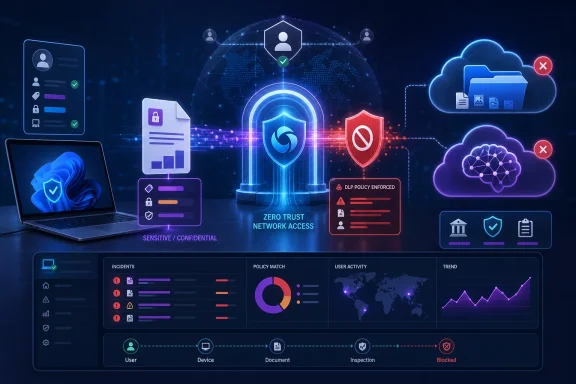 A DLP decision point between the endpoint and the cloud
The practical promise is straightforward: a user attempting to send a labeled or sensitive document to an untrusted destination can be stopped even when the transfer does not go through Exchange Online, SharePoint Online, OneDrive, or Teams. Microsoft positions the capability for generative AI, cloud storage, and content-sharing services, where users increasingly paste sensitive text or upload documents outside formally sanctioned workflows.According to Microsoft Learn documentation for Global Secure Access, the service uses content policies to identify selected traffic and either block it by file type or send it to Purview for inspection. Purview then evaluates the content against DLP conditions such as sensitivity labels, sensitive information types, and—in supported scenarios—user risk level. Global Secure Access enforces the resulting audit or block decision.
That division of labor is significant for administrators. Entra Internet Access is not simply becoming another Purview portal setting: it supplies the identity-aware secure web gateway and traffic forwarding layer, while Purview continues to supply the classifiers, DLP rules, alerting, Activity Explorer records, and incident workflow. Organizations that have invested in custom sensitive information types and sensitivity labels should therefore be able to reuse much of that policy work rather than start with a separate data-classification engine.
Microsoft’s own configuration example illustrates the security goal: a PDF containing test credit-card or Social Security numbers can be blocked when a user tries to upload it to ChatGPT. The example also exposes the operational reality. Administrators must identify the actual upload endpoints used by a web service, not merely add a broad domain name and assume every transfer will be inspected.
The September roadmap date does not make the preview production-ready
There is an important nuance in Microsoft’s current documentation. Basic network content policies—allowing or blocking transfers based on supported file MIME types—are generally available. The richer Scan with Purview action, which is the part that uses Purview DLP to inspect selected file and text content, remains documented by Microsoft as preview.That means Roadmap ID 522096 should not be read as a blanket statement that all network content filtering capabilities are delayed until September. The basic Entra Internet Access file-type control is already available. What has moved is the broader roadmap item covering Purview DLP integration for sensitive-file filtering at the network layer.
The distinction is more than branding. MIME-type policy answers, “Should a PDF, ZIP archive, or Word document be allowed to move to this destination?” Purview-backed inspection answers, “Does this particular document contain protected financial data, health information, source code, a regulated identifier, or a label that should prevent it from leaving?”
For security teams, the latter is the meaningful control. A blanket PDF block may work for a narrowly defined destination, but it is disruptive for ordinary business activity. Content-aware filtering offers a route to policies that are restrictive where needed without making every external cloud workflow unusable.
Licensing, traffic coverage, and protocol limits will shape deployments
Microsoft Learn lists several prerequisites that should keep organizations from treating the feature as a quick toggle. The Purview-integrated path requires Entra Internet Access licensing, eligible Purview DLP licensing, the appropriate administrative roles, and Microsoft Purview pay-as-you-go billing configured before network data-security policies can be created.Microsoft’s network data security documentation also says that the Entra Global Secure Access integration requires either Microsoft 365 E7 licensing or a combination of Purview E5-equivalent and Entra Internet Access-equivalent licenses. During the public preview, Microsoft says policies enforced through Entra Global Secure Access do not incur additional charges, but the billing configuration requirement remains.
Endpoint routing is another constraint. The Global Secure Access client is required for the documented managed-device scenario and must run on Microsoft Entra joined or hybrid-joined devices. This is not, at least initially, a universal inspection system for every unmanaged personal device, contractor endpoint, or arbitrary network path.
Protocol support is equally relevant. Microsoft documents network content filtering support for HTTP/1.1 traffic and notes that UDP traffic, including QUIC, is not supported. Since modern browsers often favor QUIC for HTTP/3, network teams will need to validate exactly how targeted destinations behave when traffic must be available for inspection. It is also worth noting that compressed content is detected as ZIP but is not decompressed, and Microsoft cautions that true file-type detection is not perfect.
These limitations do not make the control unhelpful; they make testing mandatory. A policy that blocks a test PDF upload through one browser and one service endpoint is not proof that the same protection covers every application version, transport path, or upload mechanism in the estate.
The rollout should begin in simulation, not block mode
Microsoft’s Purview guidance supports a staged deployment model, including simulation before enforcement. That should be the default posture for most enterprises, particularly those applying policies to broad categories such as unmanaged AI apps or cloud storage.A sensible rollout sequence is likely to be narrower than the marketing description:
- Start with a small user group and a defined set of high-risk destinations, such as consumer AI tools not approved for corporate data.
- Match Entra content-policy selections to the Purview DLP actions so that the service actually inspects the file or text transfer administrators intend to govern.
- Test uploads, downloads, browser transfers, desktop-app transfers, and API-driven workflows separately rather than assuming they use the same destinations and methods.
- Review both Entra traffic logs and Purview DLP alerts or Activity Explorer events to confirm that a block has a usable investigation trail.
- Expand only after the security team has tuned false positives and the help desk has a clear explanation for affected users.
A meaningful addition to Microsoft’s SASE strategy, but not an instant CASB replacement
Microsoft Entra Internet Access is part of the company’s broader Global Secure Access and secure service edge strategy, where identity, device context, Conditional Access, and network controls increasingly converge. Adding Purview classification to that traffic path makes the platform more credible for organizations that want data protection to follow users beyond Microsoft 365’s own application boundaries.Still, the delayed GA date and preview status are reminders that this is an evolving capability, not a finished answer to every cloud-data exposure problem. Network DLP can inspect the traffic it sees and supports; it cannot by itself solve shadow IT discovery, unmanaged endpoints, encrypted channels outside its inspection path, or data that users manually retype into a website.
For Windows administrators and security teams, the September 2026 target is best treated as a planning milestone rather than a deployment deadline. The immediate work is to inventory the endpoints, applications, sensitive-data classifiers, licensed users, and cloud destinations that would be involved—because when Purview-backed network filtering does reach general availability, the hard part will not be enabling it. It will be deciding precisely what the organization can afford to let leave.
References
- Primary source: Microsoft 365 Roadmap
Published: 2026-07-17T22:12:56.6746119Z
Loading…
www.microsoft.com - Official source: learn.microsoft.com
Create content policies for network content filtering - Global Secure Access | Microsoft Learn
Discover how to configure network content filtering with Global Secure Access to enforce data protection policies for files and text content in real time.learn.microsoft.com