

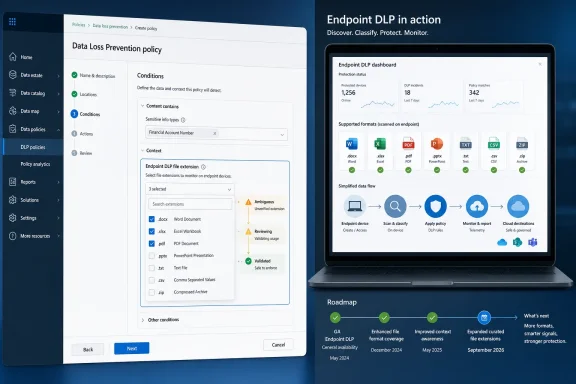
Microsoft has put Microsoft Purview Endpoint Data Loss Prevention Roadmap ID 562993 into development for worldwide commercial tenants, promising by September 2026 a pre-curated file-extension picker for Endpoint DLP’s “file extension” condition instead of today’s free-form text entry. The change sounds microscopic, but it lands in exactly the part of security administration where small ambiguities become large operational failures. Microsoft is not announcing a new DLP engine here; it is admitting, quietly and usefully, that policy authoring is part of the control plane.
As detailed in the Microsoft 365 Roadmap and mirrored by the Microsoft 365 Message Center archive maintained by Merill Fernando, Endpoint DLP will restrict administrators to a supported list of file extensions when building rules around the file-extension condition. Microsoft says the old free-text model could allow unsupported or non-scannable extensions, creating protection gaps and extra endpoint processing. That is an unusually plain description of a familiar enterprise problem: when a security console lets admins type anything, the organization eventually depends on something the product never really understood.
Endpoint DLP is sold as a policy system, but in practice it behaves like a translation layer between human intent and file activity on a device. An administrator says, “Watch these files,” “block this upload,” or “warn before this content leaves the organization.” The endpoint agent, browser integration, Purview service, and audit pipeline then have to turn that intent into concrete checks against files, applications, domains, removable storage, printers, clipboards, and cloud destinations.
The problem with free-form file extensions is that they pretend this translation step is obvious. It is not. A file extension is a naming convention, not a guarantee of file structure, sensitivity, or scanability. It can be missing, misleading, uncommon, misspelled, or simply outside the set of formats the DLP engine can inspect meaningfully.
Microsoft’s roadmap language is careful, but the implication is sharp. If admins could previously enter unsupported or non-scannable extensions, then some policies may have looked complete in the portal while creating weaker coverage on the endpoint. That is not necessarily a product defect in the dramatic sense; it is worse in the bureaucratic sense. It is a configuration that can pass review, satisfy an audit screenshot, and still fail the operational test.
The new pre-curated list is therefore not just a usability improvement. It is a guardrail against false confidence. In security administration, false confidence is often more dangerous than a visible error, because visible errors get ticketed and fixed while silent mismatches become institutional assumptions.
That bluntness does not make it useless. File extensions are still one of the quickest ways to express practical business rules. A legal department may care about Word documents and PDFs; engineering may worry about CAD files, source archives, or spreadsheets; finance may want special handling for exports that routinely leave ERP systems. In the real world, DLP policy design often starts with messy business categories before it matures into elegant classification.
But file extensions also encourage magical thinking. A
Microsoft’s shift to a curated list does not eliminate those limitations. It instead removes one avoidable source of error: asking each tenant administrator to know, remember, and correctly type the universe of extensions Endpoint DLP can actually process. That is not security engineering; that is trivia dressed up as governance.
The first administrator who writes a DLP policy may know exactly why a particular extension was entered. Six months later, the person reviewing the policy may not. Two years later, after acquisitions, licensing changes, endpoint migrations, and staff turnover, the policy may be copied into another rule set with no one remembering whether the extension was supported, deprecated, misspelled, or included as a placeholder.
This is how configuration debt accumulates. It is not always created by incompetence. It is created by interfaces that allow ambiguous intent and provide too little feedback when that intent cannot be enforced.
A curated list changes the administrative contract. The portal is no longer just a form; it becomes a statement of supported behavior. If an extension appears in the picker, admins can reasonably infer Microsoft expects Endpoint DLP to handle it. If it does not appear, the absence forces a conversation before the policy becomes production theater.
But in DLP, unrestricted flexibility often becomes a liability. A policy condition that accepts unsupported values is not truly flexible; it is permissive in the console and ambiguous on the device. That ambiguity matters because Endpoint DLP is not merely reporting inventory. It can warn users, block actions, generate alerts, and become part of an organization’s compliance posture.
Microsoft’s rationale mentions two concrete benefits: improved policy reliability and reduced unnecessary endpoint processing. Those are not cosmetic. Reliability means administrators can expect a policy to match the product’s actual scanning capabilities. Reduced processing means endpoints are not asked to spend time evaluating conditions that cannot produce meaningful results.
The endpoint-performance angle should not be overlooked. Security agents already compete with browsers, collaboration apps, EDR tools, backup clients, VPN software, and line-of-business applications. Every unnecessary scan or evaluation adds friction, especially on older hardware or heavily managed devices. A DLP system that burns cycles on extensions it cannot scan is doing the worst kind of work: expensive work that produces no protection.
That is why Endpoint DLP has become more important as the perimeter has dissolved. Sensitive data no longer leaves only through email. It leaves through browser uploads, personal cloud accounts, unmanaged applications, screenshots, removable media, and increasingly through AI tools that invite users to paste or upload context. Microsoft Learn’s Endpoint DLP documentation describes controls across activities such as uploads, copying, printing, clipboard use, and removable storage, with browser coverage depending on Edge and Purview extensions for other major browsers.
That breadth makes policy precision more important, not less. The more places a DLP rule can fire, the more damaging a vague rule becomes. A noisy policy trains users to click through warnings and trains security teams to ignore alerts. A silent policy, meanwhile, creates a governance gap that may not be discovered until after data has already moved.
The curated extension list sits at the unglamorous base of that stack. Before an organization debates sophisticated user coaching or incident workflow, it has to know that the file categories it selected are real categories the endpoint can evaluate.
Admins will notice in policy authoring. Instead of typing extensions into a field, they should expect to select from a Microsoft-maintained list of supported extensions. Existing policies may need review, especially if organizations have historically used broad or unusual extension entries to approximate business categories.
The important question is not merely whether new policies become cleaner. It is what Microsoft does with existing free-form values. The roadmap item, as of its July 7, 2026 update, does not spell out migration behavior. It does not say whether unsupported existing values will be flagged, preserved, ignored, converted, or blocked during edit.
That migration detail will matter. If Microsoft simply changes the picker for new rules, tenants may carry old ambiguity indefinitely. If it flags existing unsupported extensions, administrators get a useful cleanup project. If it refuses to save edited policies until unsupported values are removed, help desks may get sudden change-management tickets. The feature’s practical impact depends less on the picker itself than on how Microsoft handles the long tail of policies already in production.
A policy that includes unsupported file extensions is weak evidence. It may show intent, but it does not show effective control. Microsoft’s roadmap language essentially acknowledges that the old authoring model could allow a mismatch between what a policy appeared to cover and what Endpoint DLP could actually scan.
For compliance teams, the curated list creates a better evidentiary story. A policy built from supported options is easier to defend than a policy built from hand-entered strings. It narrows the gap between administrative configuration and vendor-supported enforcement.
That does not make DLP a silver bullet. No serious auditor should accept “we configured DLP” as proof that data cannot leave. But reliable conditions make every downstream discussion more grounded. If a DLP alert did not fire, teams can investigate behavior, scope, content, and exclusions rather than first wondering whether the extension value was nonsense.
The file-extension picker is a small example of Microsoft choosing product constraint over theoretical flexibility. That is good. Enterprise security tools too often confuse configurability with maturity. A mature tool does not merely let administrators express any idea; it helps them express enforceable ideas.
This matters especially in Microsoft 365, where many customers inherit security responsibilities because they already standardized on the platform. Not every Purview administrator is a dedicated DLP architect. Some are Microsoft 365 admins who also manage Teams, Exchange, SharePoint, Intune, Defender alerts, and Entra access policies. They need interfaces that prevent foot-guns, not interfaces that reward memorizing product-specific scanning matrices.
Microsoft has been moving more of its security and compliance stack toward guided configuration, policy simulation, templates, and contextual recommendations. The curated extension list belongs to that same product philosophy. It is not glamorous, but it is consistent with a world where the average tenant has too much to configure and too little time to verify every assumption manually.
Teams should inventory existing Endpoint DLP rules that use the file-extension condition. They should identify unusual extensions, duplicate conditions, overly broad policy structures, and rules that were created for one department but later generalized across the tenant. This is exactly the kind of cleanup work that is easy to postpone because nothing is visibly broken.
It would also be wise to compare extension-based rules against sensitivity-label and sensitive-information-type coverage. If a policy exists only because files of a certain extension might contain sensitive data, the organization should ask whether content inspection or labeling would be a more durable control. Extension rules are useful, but they should not become a substitute for classification.
Finally, admins should test the user experience around any policies that become more precise after the change. DLP enforcement is partly psychology. A well-targeted warning can educate; a poorly targeted block can trigger workarounds. The curated list may reduce technical ambiguity, but organizations still have to tune the human side of enforcement.
For WindowsForum readers, the date matters less than the direction. Microsoft is not removing Endpoint DLP; it is refining the administrative surface around it. The company is narrowing policy inputs so they better match supported endpoint behavior.
Still, administrators should watch Message Center posts and Purview documentation as the feature approaches rollout. The roadmap summary gives the “what,” but not enough of the “how.” Tenants will need to know whether existing values are audited, whether PowerShell or Graph-based policy management is affected, whether unsupported values appear in reports, and whether the curated list differs by platform or workload.
That last point deserves attention. Endpoint DLP behavior can vary by operating system, browser, application path, and file inspection capability. If Microsoft presents a single extension list without enough context, admins may still need documentation to understand where each extension is supported and under what conditions. A picker can prevent invalid entries, but it cannot replace transparent product documentation.
Microsoft is making it harder to create a policy that looks legitimate while relying on unsupported extension values. That reduces the distance between policy design and enforcement reality. It also moves responsibility for the supported-extension universe back to Microsoft, where it belongs.
The practical wins are modest but concrete:
As detailed in the Microsoft 365 Roadmap and mirrored by the Microsoft 365 Message Center archive maintained by Merill Fernando, Endpoint DLP will restrict administrators to a supported list of file extensions when building rules around the file-extension condition. Microsoft says the old free-text model could allow unsupported or non-scannable extensions, creating protection gaps and extra endpoint processing. That is an unusually plain description of a familiar enterprise problem: when a security console lets admins type anything, the organization eventually depends on something the product never really understood.
 Microsoft Fixes the Kind of DLP Bug That Never Looks Like a Bug
Endpoint DLP is sold as a policy system, but in practice it behaves like a translation layer between human intent and file activity on a device. An administrator says, “Watch these files,” “block this upload,” or “warn before this content leaves the organization.” The endpoint agent, browser integration, Purview service, and audit pipeline then have to turn that intent into concrete checks against files, applications, domains, removable storage, printers, clipboards, and cloud destinations.The problem with free-form file extensions is that they pretend this translation step is obvious. It is not. A file extension is a naming convention, not a guarantee of file structure, sensitivity, or scanability. It can be missing, misleading, uncommon, misspelled, or simply outside the set of formats the DLP engine can inspect meaningfully.
Microsoft’s roadmap language is careful, but the implication is sharp. If admins could previously enter unsupported or non-scannable extensions, then some policies may have looked complete in the portal while creating weaker coverage on the endpoint. That is not necessarily a product defect in the dramatic sense; it is worse in the bureaucratic sense. It is a configuration that can pass review, satisfy an audit screenshot, and still fail the operational test.
The new pre-curated list is therefore not just a usability improvement. It is a guardrail against false confidence. In security administration, false confidence is often more dangerous than a visible error, because visible errors get ticketed and fixed while silent mismatches become institutional assumptions.
The File Extension Was Always a Blunt Instrument
To understand why this matters, it helps to separate file extension filtering from content-aware DLP. Microsoft Purview DLP can evaluate sensitive information types, sensitivity labels, trainable classifiers, endpoint activities, and other signals. A file-extension condition is a coarser instrument: it narrows or directs attention based on how a file is named.That bluntness does not make it useless. File extensions are still one of the quickest ways to express practical business rules. A legal department may care about Word documents and PDFs; engineering may worry about CAD files, source archives, or spreadsheets; finance may want special handling for exports that routinely leave ERP systems. In the real world, DLP policy design often starts with messy business categories before it matures into elegant classification.
But file extensions also encourage magical thinking. A
.csv file can contain payroll data, telemetry, harmless test output, or a customer dump. A .txt file can be empty or catastrophic. A renamed file can evade simplistic assumptions while still being detectable through deeper inspection, depending on what the platform supports.Microsoft’s shift to a curated list does not eliminate those limitations. It instead removes one avoidable source of error: asking each tenant administrator to know, remember, and correctly type the universe of extensions Endpoint DLP can actually process. That is not security engineering; that is trivia dressed up as governance.
Free-Form Policy Authoring Is a Tax on Every Admin Who Comes Later
Free-form fields are attractive to product teams because they are flexible and cheap to explain. They let the product say, “Enter the values you need,” and move complexity onto the customer. That can be defensible in a developer platform, but it is a poor fit for security policy authoring at enterprise scale.The first administrator who writes a DLP policy may know exactly why a particular extension was entered. Six months later, the person reviewing the policy may not. Two years later, after acquisitions, licensing changes, endpoint migrations, and staff turnover, the policy may be copied into another rule set with no one remembering whether the extension was supported, deprecated, misspelled, or included as a placeholder.
This is how configuration debt accumulates. It is not always created by incompetence. It is created by interfaces that allow ambiguous intent and provide too little feedback when that intent cannot be enforced.
A curated list changes the administrative contract. The portal is no longer just a form; it becomes a statement of supported behavior. If an extension appears in the picker, admins can reasonably infer Microsoft expects Endpoint DLP to handle it. If it does not appear, the absence forces a conversation before the policy becomes production theater.
Microsoft Is Trading Flexibility for Reliability, and That Is the Right Trade
There will be administrators who dislike this change on principle. Free-form input feels powerful. It accommodates edge cases, internal formats, legacy applications, and business-specific file naming practices. A curated list can feel like Microsoft closing a door.But in DLP, unrestricted flexibility often becomes a liability. A policy condition that accepts unsupported values is not truly flexible; it is permissive in the console and ambiguous on the device. That ambiguity matters because Endpoint DLP is not merely reporting inventory. It can warn users, block actions, generate alerts, and become part of an organization’s compliance posture.
Microsoft’s rationale mentions two concrete benefits: improved policy reliability and reduced unnecessary endpoint processing. Those are not cosmetic. Reliability means administrators can expect a policy to match the product’s actual scanning capabilities. Reduced processing means endpoints are not asked to spend time evaluating conditions that cannot produce meaningful results.
The endpoint-performance angle should not be overlooked. Security agents already compete with browsers, collaboration apps, EDR tools, backup clients, VPN software, and line-of-business applications. Every unnecessary scan or evaluation adds friction, especially on older hardware or heavily managed devices. A DLP system that burns cycles on extensions it cannot scan is doing the worst kind of work: expensive work that produces no protection.
The Endpoint Is Where Purview’s Elegant Diagrams Meet User Behavior
Microsoft Purview’s marketing architecture looks orderly because cloud services are easier to draw than people. Exchange, SharePoint, OneDrive, Teams, Defender, Entra, and Purview can be represented as layers in a compliance stack. The endpoint is messier because it is where users drag files, rename attachments, copy data, paste into browsers, sync folders, plug in removable drives, print documents, compress archives, and experiment with whatever new AI client procurement has not yet approved.That is why Endpoint DLP has become more important as the perimeter has dissolved. Sensitive data no longer leaves only through email. It leaves through browser uploads, personal cloud accounts, unmanaged applications, screenshots, removable media, and increasingly through AI tools that invite users to paste or upload context. Microsoft Learn’s Endpoint DLP documentation describes controls across activities such as uploads, copying, printing, clipboard use, and removable storage, with browser coverage depending on Edge and Purview extensions for other major browsers.
That breadth makes policy precision more important, not less. The more places a DLP rule can fire, the more damaging a vague rule becomes. A noisy policy trains users to click through warnings and trains security teams to ignore alerts. A silent policy, meanwhile, creates a governance gap that may not be discovered until after data has already moved.
The curated extension list sits at the unglamorous base of that stack. Before an organization debates sophisticated user coaching or incident workflow, it has to know that the file categories it selected are real categories the endpoint can evaluate.
This Is a Portal Change With Endpoint Consequences
The roadmap lists the platform as Web, which means the visible change is likely to arrive in the Purview admin experience rather than as a user-facing Windows feature. That makes it easy to underestimate. There may be no splashy Windows notification, no new taskbar icon, no headline-grabbing AI assistant, and no obvious moment when end users notice the difference.Admins will notice in policy authoring. Instead of typing extensions into a field, they should expect to select from a Microsoft-maintained list of supported extensions. Existing policies may need review, especially if organizations have historically used broad or unusual extension entries to approximate business categories.
The important question is not merely whether new policies become cleaner. It is what Microsoft does with existing free-form values. The roadmap item, as of its July 7, 2026 update, does not spell out migration behavior. It does not say whether unsupported existing values will be flagged, preserved, ignored, converted, or blocked during edit.
That migration detail will matter. If Microsoft simply changes the picker for new rules, tenants may carry old ambiguity indefinitely. If it flags existing unsupported extensions, administrators get a useful cleanup project. If it refuses to save edited policies until unsupported values are removed, help desks may get sudden change-management tickets. The feature’s practical impact depends less on the picker itself than on how Microsoft handles the long tail of policies already in production.
Compliance Teams Should Read This as a Control-Quality Signal
DLP is often discussed as a technology, but it is also evidence. Organizations use DLP policies to demonstrate that they attempted to protect regulated, confidential, or contractual data. That evidence becomes part of audits, risk assessments, customer questionnaires, cyber-insurance reviews, and board reporting.A policy that includes unsupported file extensions is weak evidence. It may show intent, but it does not show effective control. Microsoft’s roadmap language essentially acknowledges that the old authoring model could allow a mismatch between what a policy appeared to cover and what Endpoint DLP could actually scan.
For compliance teams, the curated list creates a better evidentiary story. A policy built from supported options is easier to defend than a policy built from hand-entered strings. It narrows the gap between administrative configuration and vendor-supported enforcement.
That does not make DLP a silver bullet. No serious auditor should accept “we configured DLP” as proof that data cannot leave. But reliable conditions make every downstream discussion more grounded. If a DLP alert did not fire, teams can investigate behavior, scope, content, and exclusions rather than first wondering whether the extension value was nonsense.
The Change Also Exposes a Larger Microsoft Purview Tension
Microsoft Purview is trying to be both a comprehensive governance platform and an approachable administrative product. Those goals are in tension. Governance platforms must model complex realities; approachable products must prevent users from drowning in them.The file-extension picker is a small example of Microsoft choosing product constraint over theoretical flexibility. That is good. Enterprise security tools too often confuse configurability with maturity. A mature tool does not merely let administrators express any idea; it helps them express enforceable ideas.
This matters especially in Microsoft 365, where many customers inherit security responsibilities because they already standardized on the platform. Not every Purview administrator is a dedicated DLP architect. Some are Microsoft 365 admins who also manage Teams, Exchange, SharePoint, Intune, Defender alerts, and Entra access policies. They need interfaces that prevent foot-guns, not interfaces that reward memorizing product-specific scanning matrices.
Microsoft has been moving more of its security and compliance stack toward guided configuration, policy simulation, templates, and contextual recommendations. The curated extension list belongs to that same product philosophy. It is not glamorous, but it is consistent with a world where the average tenant has too much to configure and too little time to verify every assumption manually.
Security Teams Should Use the Rollout as a Policy Hygiene Event
The feature is listed for General Availability in September 2026 for Worldwide Standard Multi-Tenant cloud customers, according to the current Microsoft 365 Roadmap entry supplied by Microsoft. That gives administrators a window to prepare rather than react. The right move is not to wait for the picker and then click through whatever the portal presents.Teams should inventory existing Endpoint DLP rules that use the file-extension condition. They should identify unusual extensions, duplicate conditions, overly broad policy structures, and rules that were created for one department but later generalized across the tenant. This is exactly the kind of cleanup work that is easy to postpone because nothing is visibly broken.
It would also be wise to compare extension-based rules against sensitivity-label and sensitive-information-type coverage. If a policy exists only because files of a certain extension might contain sensitive data, the organization should ask whether content inspection or labeling would be a more durable control. Extension rules are useful, but they should not become a substitute for classification.
Finally, admins should test the user experience around any policies that become more precise after the change. DLP enforcement is partly psychology. A well-targeted warning can educate; a poorly targeted block can trigger workarounds. The curated list may reduce technical ambiguity, but organizations still have to tune the human side of enforcement.
The Roadmap Date Is a Promise Written in Pencil
Microsoft 365 Roadmap dates are useful, but they are not contracts. The feature is marked as in development, with General Availability currently listed for September 2026 in the information provided, while third-party roadmap mirrors have previously shown July 2026. That discrepancy is not unusual in Microsoft’s service roadmap world, where rollout dates move as engineering, telemetry, and deployment rings change.For WindowsForum readers, the date matters less than the direction. Microsoft is not removing Endpoint DLP; it is refining the administrative surface around it. The company is narrowing policy inputs so they better match supported endpoint behavior.
Still, administrators should watch Message Center posts and Purview documentation as the feature approaches rollout. The roadmap summary gives the “what,” but not enough of the “how.” Tenants will need to know whether existing values are audited, whether PowerShell or Graph-based policy management is affected, whether unsupported values appear in reports, and whether the curated list differs by platform or workload.
That last point deserves attention. Endpoint DLP behavior can vary by operating system, browser, application path, and file inspection capability. If Microsoft presents a single extension list without enough context, admins may still need documentation to understand where each extension is supported and under what conditions. A picker can prevent invalid entries, but it cannot replace transparent product documentation.
Admins Get a Smaller Box, and That Is the Win
The instinctive reaction to a smaller configuration box is often frustration. Security administrators are used to vendors saying “supported” when customers hear “limited.” But this is one case where limitation is the feature.Microsoft is making it harder to create a policy that looks legitimate while relying on unsupported extension values. That reduces the distance between policy design and enforcement reality. It also moves responsibility for the supported-extension universe back to Microsoft, where it belongs.
The practical wins are modest but concrete:
- Administrators will be able to select file extensions from a Microsoft-curated list instead of relying on manually typed values.
- Endpoint DLP policies should become less likely to include unsupported or non-scannable extensions that create silent coverage gaps.
- Endpoint processing should improve when devices are no longer asked to evaluate irrelevant or unsupported extension conditions.
- Existing policies that use unusual or legacy extension entries should be reviewed before the September 2026 General Availability target.
- The change should be treated as a policy-quality improvement, not as a replacement for sensitivity labels, sensitive information types, or broader data classification work.
References
- Primary source: Microsoft 365 Roadmap
Published: 2026-07-07T23:01:01.6729014Z
Microsoft 365 Roadmap | Microsoft 365
The Microsoft 365 Roadmap lists updates that are currently planned for applicable subscribers. Check here for more information on the status of new features and updates.www.microsoft.com
- Official source: learn.microsoft.com
Data Loss Prevention policy reference | Microsoft Learn
DLP policy component and configuration reference. This article provides a detailed anatomy of a DLP policy.learn.microsoft.com - Related coverage: sharepointstuff.com
Microsoft roadmap roundup – 01 June 2026 - SharePoint Stuff
This week's edition of the Microsoft 365 roadmap roundup, has new releases across SharePoint, Teams, Purview, and Copilot... sharepointstuff.com
- Official source: techcommunity.microsoft.com
- Official source: cdn-dynmedia-1.microsoft.com
</rdf:Alt> </dc:title> <dc:creator><rdf:Seq><rdf:li>Microsoft Office User
PDF documentcdn-dynmedia-1.microsoft.com